
Introduction
Higher education is set for a significant transformation with the impending integration of generative artificial intelligence (AI) models as routine valuable educational tools among university students and educators (Fütterer et al., 2023; Grassini, 2023; Kamalov et al., 2023; Southworth et al., 2023). This technological revolution represents a paradigm shifting concept regarding knowledge acquisition and dissemination, especially in the domain of higher education (Alam & Mohanty, 2023; Sallam et al., 2023a).
Generative AI as exemplified by the widely used model, namely ChatGPT (OpenAI, San Francisco, CA, U.S.), can revolutionize teaching and learning methodologies in addition to its potential utility in expediting academic research (Aksoy & Kursun, 2024; Lin, 2023; Sallam, 2023). Nevertheless, it is important to fully understand the implications of integrating ChatGPT among other generative AI models in higher education from the perspective of educational institutions, university educators, and students (Dempere et al., 2023; Maphoto et al., 2024; Michel-Villarreal et al., 2023). This comes in light of the well-recognized limitations and failures of such AI models. These limitations include concerns regarding generation of biased content, inaccuracies, cybersecurity risk as well as the threats of declining critical thinking and analytical skills among students (Ahmad et al., 2023; George & Wooden, 2023; Harrer, 2023; Kooli, 2023; Lo, 2023; Ray, 2023; Sallam, 2023; Sallam et al., 2023c; Tlili et al., 2023).
On the other hand, generative AI models including ChatGPT can offer several benefits in higher education (Arif et al., 2023; Chiu, 2024; Crompton & Burke, 2023). For example, ChatGPT can help to engage students and educators in interactive, intelligent conversations while adapting to individual needs; thus, offering personalized learning experiences (Kamalov et al., 2023; Leng, 2024; M. Sallam et al., 2024; Sallam et al., 2023c). This experience allows for the generation of educational content customized to the variable students’ learning speeds, styles, and interests, making education an efficient and interesting experience (Huber et al., 2024; Javaid et al., 2023; Rahman & Watanobe, 2023).
For educators, ChatGPT can be a powerful tool to organize study materials and to rapidly generate a variety of examples and explanations across different subjects (Crompton & Burke, 2024; DeCook et al., 2024; Javaid et al., 2023; Younis et al., 2024). Additionally, ChatGPT can aid educators in simplifying complex concepts for students (Javaid et al., 2023). Moreover, generative AI models including ChatGPT hold promising potential for automating and standardizing the scoring of essays, potentially enhancing the efficiency and consistency of evaluations in various educational settings (Huang et al., 2024; Mizumoto & Eguchi, 2023; Morjaria et al., 2024). Furthermore, generative AI models can facilitate the digitalization of education and enhance the pedagogical methods’ efficiency and quality (García-Méndez et al., 2024; Ilieva et al., 2023; Montenegro-Rueda et al., 2023; Yu, 2024).
Literature
SWOT (Strengths, Weaknesses, Opportunities, Threats) analyses and recent reviews of ChatGPT in education revealed the future trajectory of the needed research regarding ChatGPT utility in education (Faisal, 2024; Farrokhnia et al., 2023; M. Sallam et al., 2024; Zarei et al., 2024). As stated earlier, the strengths of ChatGPT can be related to enhanced learning outcomes and improved resource efficiency (Bozkurt, 2023; Farrokhnia et al., 2023). On the other hand, ChatGPT challenges include deepening the digital divide, overreliance on technology, and concerns about the quality of generated content (Farrokhnia et al., 2023; Gill et al., 2024). Opportunities provided by ChatGPT arise through innovative pedagogies, while threats include ethical issues and data privacy issues (Farrokhnia et al., 2023; Franco D’Souza et al., 2024; M. Sallam et al., 2024). Thus, the successful integration of ChatGPT in higher education mandates balancing ChatGPT benefits against its challenges (Bahar & Nadeem, 2024; Xu et al., 2024).
The integration of a novel technology in higher education necessitates understanding the perspectives of stakeholders, namely university students and educators (Gkrimpizi et al., 2023; Mishra & Koehler, 2006; Strzelecki, 2023; Veras et al., 2023; Weidener & Fischer, 2024). In particular, the educators’ attitudes, concerns, and readiness to embrace novel AI technologies can influence the adoption and effective use of generative AI tools in teaching and learning environments (Luckin et al., 2022). Therefore, it is essential to assess the university educators’ perspectives on novel AI tools such as ChatGPT, which would be important for the successful implementation of these novel technologies in higher education (Adarkwah et al., 2023; Chan, 2023; Kiryakova & Angelova, 2023).
Previous studies have focused on designing, validating, and confirming the validity of a survey instrument based on the Technology Acceptance Model (TAM) among students especially in health schools (Abdaljaleel et al., 2024; Sallam et al., 2023b). These studies showed that perceived usefulness, ease of use, positive attitude towards technology, social influence, behavioral/cognitive elements, low anxiety, and minimal perceived risks were linked with positive attitudes to ChatGPT (Abdaljaleel et al., 2024; Sallam et al., 2023b). However, to the best of our knowledge very few studies have focused on university educators’ perspectives on ChatGPT (Adarkwah et al., 2023; Kiryakova & Angelova, 2023; Livberber & Ayvaz, 2023). Additionally, exploration of university educators’ views regarding generative AI tools such as ChatGPT is important since their attitude is key to the effective deployment of such technologies in academia (Van Wyk et al., 2023). This is particularly relevant considering the noticeable gap in studies targeting university educators’ perspectives on AI adoption, which is a critical area to address.
Therefore, the aim of this study was to establish and to explore the validity of a TAM-based construct for understanding the acceptance and use of ChatGPT among academic personnel in Jordan. By establishing a survey instrument specifically tailored towards the perspectives of university educators, the implementation of ChatGPT in higher education can be guided by evidence. Such a tool can help to guide the effective and responsible integration of ChatGPT in higher education settings as well as to highlight the feared risks and concerns among university educators towards this inevitable technology. Thus, the primary research question was “What is the validity of a TAM-based construct for understanding the acceptance and use of ChatGPT among university educators in Jordan?”
Methods
Research Design and Sampling Group
This study followed a quantitative research approach using a survey design based on the TAM (Creswell & Guetterman, 2018; Davis, 1989). The development of the survey instrument began with an extensive literature review that focused on the application of the TAM in understanding the acceptance of novel technologies by students and educators based on the original TAM framework (Al-Hattami, 2023; Antonietti et al., 2022; Cheung & Vogel, 2013; Davis, 1989; Farahat, 2012; Granić & Marangunić, 2019; Mailizar et al., 2021; Malaquias et al., 2018; Marangunić & Granić, 2015; Murillo et al., 2020; Rosli et al., 2022; Scherer et al., 2019; Venkatesh et al., 2003; Zobeidi et al., 2023). The TAM framework is widely recognized conceptual framework employed to investigate the acceptance and adoption of novel technologies by different strata of stakeholders (Al-Adwan, 2024; Gbongli et al., 2019; Gupta & Yang, 2024; Saif et al., 2024). Following the literature review, initial item development in the English language was performed by the three authors (university educators with expertise in three diverse healthcare disciplines and with previous experience in survey construction and validation).
To ensure content validity, the three authors engaged in an internal discussion with subjective evaluation of the initial survey items to assess its clarity, comprehensiveness, and relevance as well as to identify and address any potential biases or issues in the wording of the items, such as vagueness or complexity. This internal discussion led to the identification of potential domains for inclusion in the final questionnaire comprising 40 items: perceived usefulness, perceived ease of use, perceived risks, anxiety, attitude towards the technology, social influence, and effectiveness.
This was followed by forward translation into Arabic and backward translation into English of the 40 items, which were done by the three bilingual (Arabic and English) authors with minor modifications. Then, pilot testing of the items in Arabic was done to ensure clarity among four university educators who were excluded from the final analysis. Based on the feedback received, minor language modifications were made to enhance the overall clarity of the survey items. The construct validity of the scale herein termed “Ed-TAME-ChatGPT” was checked following survey distribution, using 40 TAM-based items evaluated among the respondents who used ChatGPT before the study. The minimum sample size was estimated at approximately 80 participants based on the previous guidelines of having at least two study subjects per survey item for survey validation (MacCallum et al., 1999).
Data Collection Tools
The finalized survey in the Arabic language was uploaded to Google Forms and distributed using a convenience sampling approach. This approach entailed utilizing popular social media platforms in Jordan including WhatsApp and Messenger to share the survey link with the professional contacts of the authors, with the request to further distribute the survey among the participants’ academic acquaintances. Participation in the survey was voluntary and there was no incentive for participation.
The distribution of the survey was timed to coincide with the academic calendar in Jordan, specifically during the spring and autumn semesters. The first phase of distribution spanned from February to April 2023, aligning with the spring semester, followed by a second phase in October 2023, aligning with the autumn semester. This timing was chosen to maximize engagement with the study in order to benefit from periods of active academic involvement when academic staff are most likely to be accessible and willing to participate.
Following the informed consent, a demographic section was introduced with items to assess the following variables: (1) age; (2) sex; (3) nationality (Jordanian vs. non-Jordanian); School/College (health [medicine, dentistry, pharmacy, nursing, rehabilitation sciences, applied medical sciences, veterinary medicine, public health] vs. scientific [science, engineering, agriculture, information technology, nanotechnology, artificial intelligence] vs. humanities [Arts, Business, Sharia, Law, Islamic Studies, Physical Education, Arts, Languages, Tourism, Media, Archaeology]); (4) university [public vs. private]; (5) the highest educational degree obtained (PhD or fellowship degree vs. MSc or a specialty degree); (6) the country where the highest educational degree was attained (Jordan vs. other Arab country vs. U.S. vs. U.K. vs. Europe vs. others); and (7) rank (full professor, associate professor [grouped as “tenured”] vs. assistant professor, lecturer, lecturer assistant [grouped as “without tenure”]).
The next section involved two screening items as follows: First, “Have you heard of ChatGPT before the study?”, with “yes” response required to move into the next item, while the answer of “no” resulted in survey submission. The next item was “Have you used ChatGPT before the study?” with “yes” resulting in the presentation of the full 40 TAM-based items. The final section involved the presentation of the 40 TAM-based items, with each item assessed on a 5-point Likert-scale with the following responses: strongly agree scored as 5, agree scored as 4, neutral/no opinion scored as 3, disagree scored as 2, and strongly disagree scored as 1. The scoring was reversed for the items implying negative attitude towards ChatGPT.
Validity and Reliability Measures
The statistical analysis was conducted using IBM SPSS Statistics for Windows, Version 26.0 (Armonk, NY, USA: IBM Corp). Exploratory factor analysis (EFA) was employed to investigate the factorial structure of the Ed-TAME-ChatGPT scale which comprised a total of the 40 items. Principal component analysis (PCA) was used as the extraction method, with oblimin rotation to determine correlations between factors. The Kaiser-Meyer-Olkin (KMO) measure and Bartlett’s test of sphericity were applied to evaluate the data appropriateness for EFA.
Subsequently, the internal consistency of the Ed-TAME-ChatGPT constructs inferred following EFA was assessed using the Cronbach’s α values. Scores for each construct were computed by dividing the total scores by the number of items within that construct, yielding a score range of 1–5. The overall Ed-TAME-ChatGPT scores were computed based on the overall average of Ed-TAME-ChatGPT involving the items of each construct. The scoring classification for both the TAME-ChatGPT and its individual constructs was categorized as follows: scores ranging from 1.00 to 2.33 indicated disagreement (negative), 2.34 to 3.67 indicated a neutral position, and 3.68 to 5.00 indicated agreement (positive).
Associations between categorical variables were assessed using the χ2 (chi-square) and the two-sided Fisher’s exact (FET) tests. Univariate analyses were conducted to assess the associations between Ed-TAME-ChatGPT and the demographic variables as well as the individualized constructs with statistical significance for p < 0.050. For multivariate analyses, predictor variables were selected based on a p value of < 0.100 in univariate analyses. Linear regression with Analysis of Variance (ANOVA) was employed to test the significance of the regression model, and multicollinearity was assessed using the Variance Inflation Factor (VIF), with a threshold value of 3.0 indicating potential concerns.
Findings
General Features of the Study Sample
The final sample consisted of 236 educators, of whom 169 heard of ChatGPT before the study (71.6%), with only 76 who indicated the use of ChatGPT before the study (45.0% of those who heard of ChatGPT). The vast majority of the study sample were Jordanians (98.3%), and a majority obtained their highest educational degree outside the Arab countries. The full features of the study sample are illustrated in (Table 1). The percentage of those who used ChatGPT increased significantly over the study period from 33/99 during February 2023–April 2023 (43.4%) to 43/70 during October 2023 (56.6%, p < 0.001, FET).
Table 1
General features of educators who participated in the study (N = 236).
| VARIABLE | CATEGORY | COUNT | PERCENTAGE |
|---|---|---|---|
| Age | ≤43 years | 119 | 50.4% |
| >43 years | 117 | 49.6% | |
| Sex | Male | 137 | 58.1% |
| Female | 99 | 41.9% | |
| Nationality | Jordanian | 232 | 98.3% |
| Non-Jordanian | 4 | 1.7% | |
| School | Health | 127 | 53.8% |
| Scientific | 51 | 21.6% | |
| Humanities | 58 | 24.6% | |
| University | Public | 150 | 63.6% |
| Private | 86 | 36.4% | |
| Highest educational degree | PhD | 181 | 76.7% |
| MSc | 55 | 23.3% | |
| Country of highest attained degree | U.S. | 37 | 15.7% |
| U.K. | 54 | 22.9% | |
| Europe | 29 | 12.3% | |
| Jordan | 79 | 33.5% | |
| Arab country other than Jordan | 16 | 6.8% | |
| Others | 12 | 5.1% | |
| Australia | 4 | 1.7% | |
| Canada | 5 | 2.1% | |
| Country of highest attained degree | Non-Arab | 141 | 59.7% |
| Arab | 95 | 40.3% | |
| Rank | Professor | 55 | 23.3% |
| Associate Professor | 52 | 22.0% | |
| Assistant Professor | 74 | 31.4% | |
| Lecturer | 36 | 15.3% | |
| Teaching assistant | 19 | 8.1% | |
| Academic rank | With tenure | 107 | 45.3% |
| Without tenure | 129 | 54.7% | |
| Have you heard of ChatGPT before the study? | Yes | 169 | 71.6% |
| No | 67 | 28.4% | |
| Have you used ChatGPT before the study?1 | Yes | 76 | 45.0% |
| No | 93 | 55.0% |
[i] 1 Among those who heard of ChatGPT.
Factorability of the Correlation Matrix
The EFA was conducted on a set of 40 items to identify underlying constructs that account for the variance in the responses. Bartlett’s test of sphericity was significant (χ2 = 2226.833, df = 780, p < 0.001), indicating the factorability of the correlation matrix. The KMO measure of sampling adequacy was 0.698, indicating that the data were suitable for factorial analysis. The scree plot showed that the optimal number of underlying factors was six based on the eigenvalue cutoff specified at 1.5, which explained a cumulative total of 63.7% of the variance in the data as indicated in the scree plot (Figure 1).
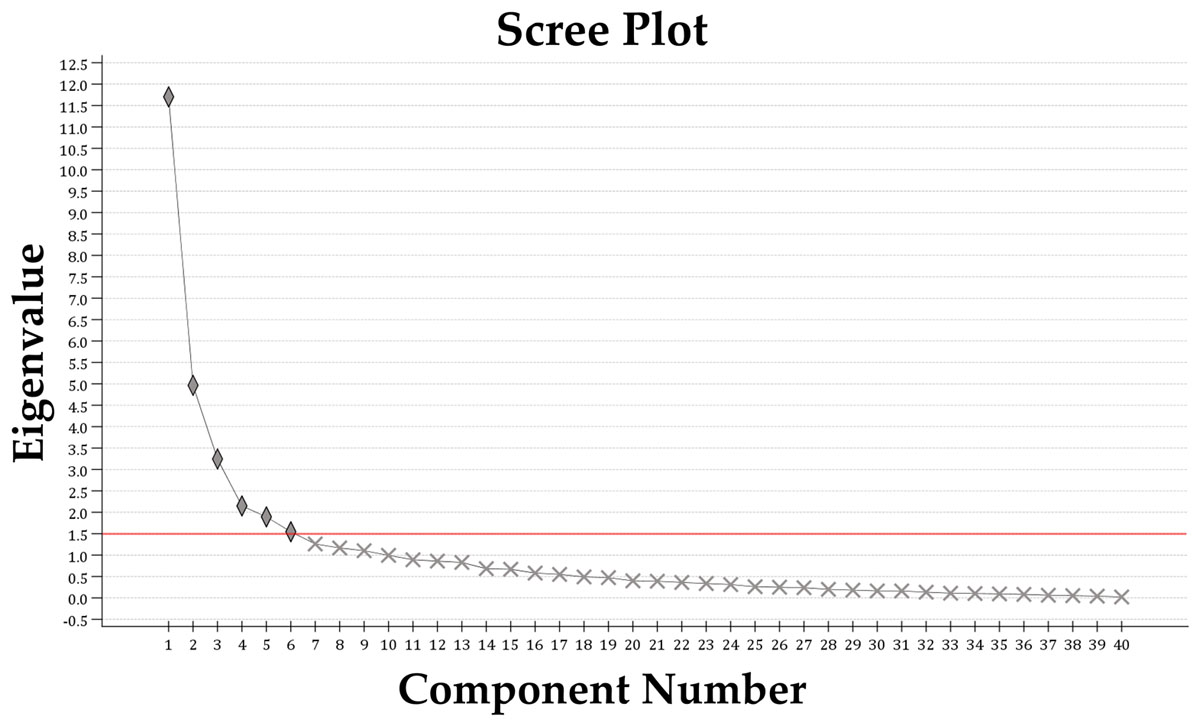
Figure 1
Scree plot representing the eigenvalues of the factors identified through principal component analysis. The red line indicated the eigenvalue cutoff specified at 1.50.
The eigenvalues for the six factors were 11.702, 4.964, 3.244, 2.148, 1.893, and 1.545, respectively. A total of 31 items out of the 40 tested items loaded significantly with absolute coefficient values > 0.50 on one of the six factors, and factor loadings ranging from absolute 0.515 to absolute 0.848.
Based on the content of the items for each factor, these factors were named as follows: Factor 1 was named “effectiveness” comprising 6 items (T3, T4, T6, T16, T17, T18) with a Cronbach α value of 0.845. Factor 2 was named “anxiety” comprising 5 items (T36, T37, T38, T39, T40) with a Cronbach α value of 0.862. Factor 3 was named “technology readiness” comprising 5 items (T31, T32, T33, T34, T35) with a Cronbach α value of 0.885. Factor 4 was termed “perceived usefulness” comprising 5 items (T1, T7, T8, T9, T10) with a Cronbach α value of 0.848. Factor 5 was termed “social influence” comprising 4 items (T22, T23, T24, T25) with a Cronbach α value of 0.803. Finally, factor 6 was termed “perceived risk” comprising 6 items (T19, T20, T26, T27, T29, T30) with a Cronbach α value of 0.796. The final educators TAME-ChatGPT (Ed-TAME-ChatGPT) validated items and constructs are illustrated in (Figure 2).
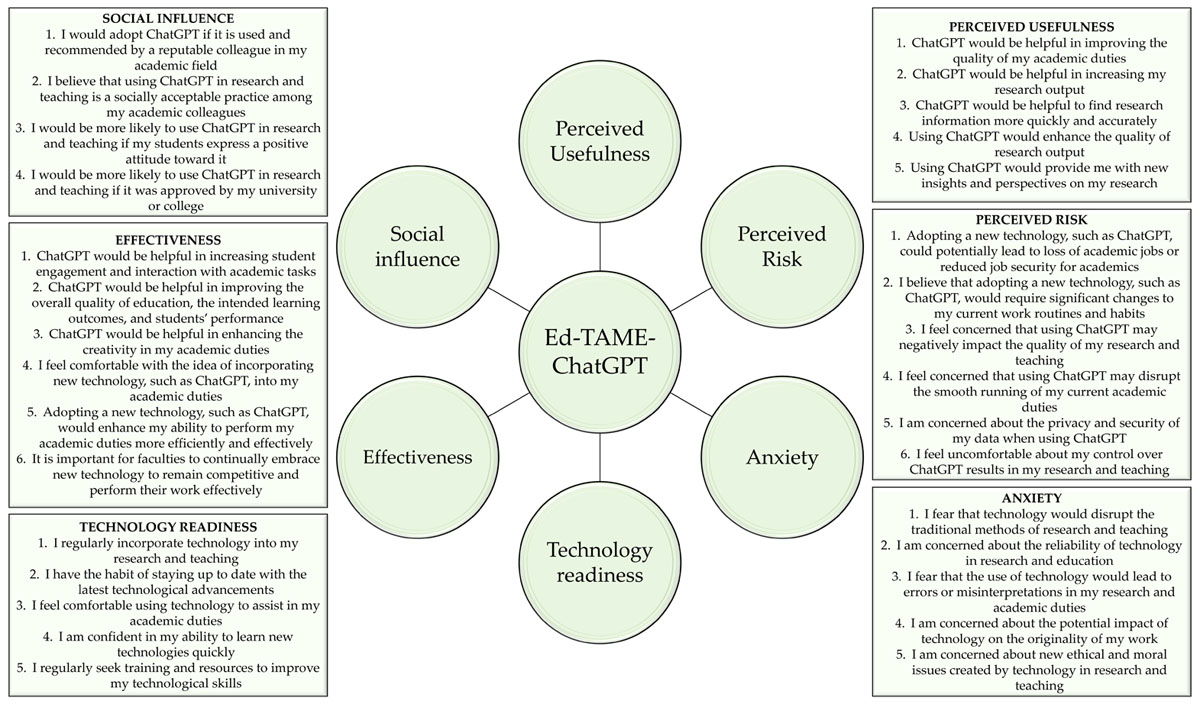
Figure 2
The final Ed-TAME-ChatGPT items and constructs.
Attitudes of Educators to ChatGPT Based on ED-TAME-ChatGPT and the Demograph-IC/Academic Variables
The overall Ed-TAME-ChatGPT score in the study sample was 3.50 ± 0.46 (range: 2.42–4.67) indicating a general neutral attitude towards ChatGPT use. Additionally, the individual Ed-TAME-ChatGPT scores fell into the positive or neutral categories (n = 27, 35.5% and n = 49, 64.5%, respectively) with complete absence of scores in the negative category. the Univariate analysis revealed that only Ed-TAME-ChatGPT constructs were significantly associated with the overall Ed-TAME ChatGPT scores (Table 2).
Table 2
Demographic, academic, and Ed-TAME-ChatGPT constructs’ association with the overall Ed-TAME-ChatGPT scores.
| CATEGORY | VARIABLE | TAME CATEGORIES | p VALUE, χ2 | |
|---|---|---|---|---|
| NEUTRAL | POSITIVE | |||
| COUNT (%) | COUNT (%) | |||
| Age | ≤43 years | 31 (63.3) | 18 (36.7) | 0.767, 0.088 |
| >43 years | 18 (66.7) | 9 (33.3) | ||
| Sex | Male | 27 (64.3) | 15 (35.7) | 0.970, 0.001 |
| Female | 22 (64.7) | 12 (35.3) | ||
| Nationality | Jordanian | 49 (66.2) | 25 (33.8) | 0.054, 3.728 |
| Non-Jordanian | 0 (0) | 2 (100) | ||
| School | Health | 30 (65.2) | 16 (34.8) | 0.551, 1.192 |
| Scientific | 14 (70.0) | 6 (30.0) | ||
| Humanities | 5 (50.0) | 5 (50.0) | ||
| University | Public | 32 (69.6) | 14 (30.4) | 0.251, 1.319 |
| Private | 17 (56.7) | 13 (43.3) | ||
| Education | PhD | 38 (67.9) | 18 (32.1) | 0.302, 1.064 |
| MSc | 11 (55.0) | 9 (45.0) | ||
| Country of highest attained degree | Non-Arab | 31 (67.4) | 15 (32.6) | 0.510, 0.433 |
| Arab | 18 (60.0) | 12 (40.0) | ||
| Academic rank | With tenure | 26 (61.9) | 16 (38.1) | 0.603, 0.270 |
| Without tenure | 23 (67.6) | 11 (32.4) | ||
| Perceived usefulness categories | Negative | 4 (100) | 0 (0) | <0.001, 21.776 |
| Neutral | 22 (100) | 0 (0) | ||
| Positive | 23 (46.0) | 27 (54.0) | ||
| Effectiveness categories | Negative | 4 (100) | 0 (0) | <0.001, 21.091 |
| Neutral | 24 (96.0) | 1 (4.0) | ||
| Positive | 21 (44.7) | 26 (55.3) | ||
| Social influence categories | Negative | 6 (100) | 0 (0) | <0.001, 22.659 |
| Neutral | 29 (87.9) | 4 (12.1) | ||
| Positive | 14 (37.8) | 23 (62.2) | ||
| Perceived risk categories | Positive | 6 (33.3) | 12 (66.7) | <0.001, 15.786 |
| Neutral | 24 (63.2) | 14 (36.8) | ||
| Negative | 19 (95.0) | 1 (5.0) | ||
| Technology readiness categories | Negative | 1 (100) | 0 (0) | 0.048, 6.060 |
| Neutral | 12 (92.3) | 1 (7.7) | ||
| Positive | 36 (58.1) | 26 (41.9) | ||
| Anxiety categories | Positive | 8 (44.4) | 10 (55.6) | 0.007, 9.894 |
| Neutral | 25 (61.0) | 16 (39.0) | ||
| Negative | 16 (94.1) | 1 (5.9) | ||
In multivariate analysis with the variables having p < 0.100 in univariate analysis, the ANOVA for the regression model yielded an F statistic of 14.343 with a p < 0.001, indicating the model robustness. The model, with an adjusted R2 of 0.555 and a standard error of 0.322, identified several significant predictors. Nationality (β = 0.138, p = 0.084), perceived usefulness (β = 0.198, p = 0.030), and effectiveness (β = 0.240, p = 0.011) positively influenced ChatGPT usage. Social influence was also a positive predictor of ChatGPT use (β = 0.260, p = 0.004). In contrast, perceived risk emerged as a negative predictor for ChatGPT use (β = –0.320, p < 0.001). On the other hand, the technology readiness construct (β = 0.108, p = 0.236) and anxiety construct (β = –0.104, p = 0.245) did not show statistically significant differences (Table 3).
Table 3
Regression analysis of the predictors influencing ChatGPT usage.
| MODEL | COEFFICIENTS1 | p VALUE | VIF3 | |||
|---|---|---|---|---|---|---|
| ADJUSTED R2 = 0.555, SE = 0.322 | UNSTANDARDIZED COEFFICIENTS | SE2 | STANDARDIZED COEFFICIENTS | T STATISTIC | ||
| ANOVA F STATISTIC = 14.343, p VALUE < 0.001 | B | BETA | ||||
| Constant | 0.787 | 0.392 | 2.009 | 0.049 | ||
| Nationality | 0.413 | 0.236 | 0.138 | 1.753 | 0.084 | 1.047 |
| Perceived usefulness categories | 0.162 | 0.073 | 0.198 | 2.218 | 0.030 | 1.343 |
| Effectiveness categories | 0.194 | 0.074 | 0.240 | 2.621 | 0.011 | 1.414 |
| Social influence categories | 0.197 | 0.067 | 0.260 | 2.947 | 0.004 | 1.307 |
| Perceived risk categories | –0.216 | 0.057 | –0.320 | –3.817 | <.001 | 1.180 |
| Technology readiness categories | 0.120 | 0.100 | 0.108 | 1.195 | 0.236 | 1.367 |
| Anxiety categories | –0.073 | 0.062 | –0.104 | –1.172 | 0.245 | 1.322 |
[i] 1Dependent Variable: Overall Ed-TAME-ChatGPT usage score; 2SE: Standard error; 3VIF: Variance inflation factor. Statistically significant P values are highlighted in bold style.
Findings and Discussion
In the present study, we explored the validity of a novel survey instrument specifically designed to assess the attitude to ChatGPT among university educators. Throughout the study period, a notable increase in ChatGPT use was observed among the participating university educators. This finding is indicative of ChatGPT’s growing popularity as a tool in higher education as indicated by several recent studies (Abdaljaleel et al., 2024; Faruk et al., 2023; Ibrahim et al., 2023; Strzelecki, 2023; Tiwari et al., 2023; von Garrel & Mayer, 2023; Weidener & Fischer, 2024). The trend of increasing ChatGPT usage suggests the recognition of generative AI tools’ potential as a valuable aid in teaching and learning processes. This shift can also be indicative of an impending broader transformation in educational methodologies manifested in increasing digitization and incorporation of AI in higher educational settings.
To reach reliable conclusions regarding attitudes towards ChatGPT, it is important to pursue such an aim using validated methodologies (Bubaš et al., 2024). This approach is necessary to ensure a comprehensive understanding of the motivators and barriers that could enhance or preclude the integration of generative AI tools in higher education (Xu, 2024). One popular, practical, and highly relevant framework that was used in this study is the TAM framework, with its suitable applicability to assess educators’ adoption of a novel technology as shown in a meta-analysis by Scherer et al. (Scherer et al., 2019). In the current study, six constructs were identified based on the TAM framework and appeared to explain a substantial degree of the university educators’ attitude towards ChatGPT use. These constructs were effectiveness, anxiety, technology readiness, perceived usefulness, social influence, and perceived risk.
The reflection on the TAM-based constructs inferred in this study suggests the relevance of psychological, social, and practical factors that would influence the adoption and integration of new technologies such as ChatGPT among university educators. Identification of these factors highlights the complex nature of AI integration into higher education, similar to issues faced with other technological advancements. For example, several factors were identified affecting the quality of distance-based online learning particularly during COVID-19 pandemic. These factors included unreliable internet availability, the lack of motivation, psychological distress, and institutional support (Akour et al., 2020; Alqudah et al., 2023; Saleem et al., 2022). Additionally, a systematic review by Regmi & Jones highlighted the complexity of e-learning in health sciences education in terms of challenges such as poor motivation, the need for resources and relevance of information technology (IT) skills (Regmi & Jones, 2020).
Under the lens of TAM, previous studies addressing the adoption of digital education tools focused mainly on the students’ perspectives (López-Sánchez et al., 2024; Saleh et al., 2022; Valencia-Arias et al., 2024). These TAM-based studies identified several constructs as relevant determinants of attitudes to novel technologies including the perceived usefulness, perceived ease of use, self-efficacy, behavioral intention, social influences, among others (Alassafi, 2022; Chahal & Rani, 2022; Saleh et al., 2022; Tawafak et al., 2023; Zobeidi et al., 2023).
In the current study, the perceived usefulness emerged as a significant predictor of attitude towards ChatGPT among the participating university educators. This result is understandable based on the previous evidence showing the higher likelihood of adopting a novel technology if it is perceived as beneficial (Al-Adwan et al., 2023; Mohammed et al., 2021; Nguyen & Simkin, 2017). A similar finding was recently shown by Wang et al. in the context of AI adoption in e-commerce (Wang et al., 2023). Usefulness in the context of generative AI tools such as ChatGPT pertains to its potential to enhance learning outcomes, to facilitate personalized education, and to streamline the tedious administrative tasks (Rejeb et al., 2024; Ruiz-Rojas et al., 2023). Thus, addressing the university educators’ perceptions of ChatGPT usefulness appears critical for the acceptance and adoption of ChatGPT among this relevant group in higher education.
In this validation study, effectiveness was also elucidated as an important TAM-based construct driving attitude towards ChatGPT. This result reflects the evident impact of perceived effectiveness of a novel technology on its adoption to achieve the educational objectives. The anticipation of significant benefits from ChatGPT in enhancing student engagement and interaction with academic tasks can play a crucial role in creating a positive attitude towards ChatGPT among university educators (Yilmaz & Karaoglan Yilmaz, 2023). Additionally, participants with a positive attitude towards ChatGPT perceived it as more effective. This result suggests that a favorable view of ChatGPT is an important factor for its adoption as a valuable tool to achieve academic excellence.
In this study, social influence was identified as an important construct expected to play a significant role in shaping university educators’ acceptance of ChatGPT. This construct captures the influence of peer opinions, institutional culture, and prevailing educational trends on the decision-making process regarding the adoption of novel technologies such as ChatGPT. Endorsement of ChatGPT by colleagues and the broader academic community appears to play an important role in shaping university educators’ willingness to accept and utilize ChatGPT in educational settings. Therefore, it is important to recognize and consider the role of social influence in facilitating the widespread adoption of generative AI technologies in higher education. The role of perceiving AI as a social norm was revealed in a recent study by Rahiman & Kodikal among academic staff members in Asia, which further supports the identification of social influence as a relevant TAM-based construct in this study (Rahiman & Kodikal, 2024).
Technology readiness was the fourth key construct identified in this study in relation to ChatGPT usage among university educators. This construct involved the assessment of university educators’ willingness and capacity to adopt and effectively use novel technological tools. Facilitating technology readiness involves providing necessary resources, training, and support. In turn, these measures would enable the university educators to confidently integrate ChatGPT into their teaching practices. A meta-analysis on the impact of technology readiness on technology use highlighted the importance of considering the motivators (optimism and innovativeness) and inhibitors (insecurity and discomfort) to further dissect this important construct (Blut & Wang, 2020).
Conversely, the barriers to ChatGPT use as identified in the current study were represented by two constructs, namely the anxiety and perceived risk. Anxiety represents a key factor in determining the hesitancy among university educators towards a novel technology. This issue could be ascribed to apprehension regarding the educators digital proficiency, as well as concerns over the potential impact of AI on conventional teaching methodologies, which was comprehensively reviewed by Hao Yu (Hadi Mogavi et al., 2023; Yu, 2024). Mitigating the educators’ anxiety can be achieved through targeted training, technological support, and clear guidelines for the ethical and responsible use of ChatGPT, which could lead to its successful integration into educational practices.
Furthermore, the perception of risks associated with technological adoption, including ChatGPT appeared to play an important role in its acceptance. The perceptions of risk could stem from concerns regarding data privacy, the potential spread of misinformation, and the negative effects on students’ critical thinking abilities (Dempere et al., 2023; Mijwil et al., 2023a; Ray, 2023; Sallam, 2023; M. Sallam et al., 2024). Addressing these concerns can be achieved by establishing ethical standards for ChatGPT use and advocating for transparency regarding AI tools development and training (Mijwil et al., 2023b; Stahl & Eke, 2024). The importance of perceived risks as a determinant of ChatGPT adoption and use has been recognized as a recurrent result in various recent studies among students (Abdaljaleel et al., 2024; Albayati, 2024; Jo & Bang, 2023; Menon & Shilpa, 2023; Malik Sallam et al., 2024; Sallam et al., 2023b). This highlights the central role of perceived risk as an important factor determining the attitude towards generative AI adoption in education.
In this study, albeit with a very small sample size, multivariate analysis showed the central role of four Ed-TAME-ChatGPT constructs (perceived risk, social influence, effectiveness, and perceived usefulness), to significantly shape the attitudes to ChatGPT use. This result needs further confirmation in future studies with larger sample sizes to enable reaching a conclusive evidence regarding the role of these factors in driving ChatGPT use among university educators.
Conclusion, Implications and Suggestions
In an intended follow-up study, we aim to implement confirmatory factor analysis (CFA). The future follow-up study aims to rigorously test and confirm the construct validity of the factors initially identified in the “Ed-TAME-ChatGPT” instrument. In turn, this can help to ensure “Ed-TAME-ChatGPT” applicability and consistency across different contexts.
Furthermore, we call for open utilization of the “Ed-TAME-ChatGPT” survey instrument and its adoption in diverse educational settings. This call is directed to enable a more granular analysis of university educators’ perceptions towards ChatGPT. This approach can facilitate a deeper understanding of the detailed mechanisms by which genAI tools such as ChatGPT can be integrated into educational systems, respecting ethical standards and enhancing instructional quality. The call for open use of “Ed-TAME-ChatGPT” aligns with the Open Praxis journal’s commitment to open access, which will enrich the scholarly dialogue that extends across cultural and geographic divides. This is essential for mapping the variable impact of genAI tools on educational practices around the world and to identify both universal and location-specific challenges and opportunities.
This study was not without limitations, which should be considered as follows. First, the small sample size could limit the generalizability of the results. The difficulty in reaching a larger sample size could be related to the lengthy nature of this exploratory survey which would cause respondent fatigue (Jeong et al., 2023). Second, the potential for selection bias should be considered in light of the participants’ recruitment approach. Utilizing a convenience sampling approach which involved the authors’ professional networks may limit the representativeness of university educators included in the study. Third, data collection was restricted to a single country, namely Jordan which could introduce a cultural limitation to the study based on the expected variation in the educational systems, technological infrastructure, and cultural attitudes towards AI across different regions. Consequently, confirmation of the study findings should be considered by conducting future multinational studies using a non-probability sampling approach.
The Ed-TAME-ChatGPT survey instrument explored in this study can offer a comprehensive framework for understanding the attitude of university educators towards ChatGPT. The results highlighted the significance of considering perceptions of risks, usefulness, attitudes towards technology, along with anxiety, social influence, and effectiveness when adopting ChatGPT in higher education. The insights gained by this validated instrument is crucial for higher education institutions, academics, and educational policymakers to strategically facilitate the effective and ethical use of ChatGPT. This survey instrument can also aid to identify potential barriers that could hinder the adoption of this transformative AI technology in education. Future studies in various settings are recommended to confirm and build upon the findings of this study. This can help to further elucidate the factors that would influence the successful adoption of ChatGPT in different higher educational settings, which would be essential to the advancement of AI-enhanced learning.
Data Accessibility Statement
The datasets used and/or analysed during the current study are available from the corresponding author on reasonable request.
Ethics and Consent
The study was conducted in accordance with the Declaration of Helsinki, and approved by the Institutional Review Board (IRB) at the Faculty of Pharmacy, Applied Science Private University (Approval number: 2023-PHA-4, on 24 January 2023).
An electronic informed consent was obtained from all subjects in-volved in the study.
Acknowledgements
The authors would like to thank Nada Atawneh for help in data collection.
Competing Interests
The authors have no competing interests to declare.
Author Contributions (CRediT)
Conceptualization: Malik Sallam; Data curation: Muna Barakat, Nesreen A. Salim, Malik Sallam; Formal analysis: MALIK SALLAM; Investigation: Muna Barakat and Malik Sallam; Methodology: Muna Barakat, Nesreen A. Salim, Malik Sallam; Visualization: Malik Sallam; Project administration: Muna Barakat, Malik Sallam; Supervision: Muna Barakat, Malik Sallam; Writing – original draft: Malik Sallam; Writing – review & editing: Muna Barakat, Nesreen A. Salim, Malik Sallam; All authors contributed to the article and approved the submitted version.