
Introduction
Artificial Intelligence (AI) is rapidly permeating the educational landscape, redefining traditional boundaries of knowledge creation and dissemination. Before the meteoric rise of OpenAI’s ChatGPT in November 2022 (OpenAI, 2022), AI tools historically served as adjuncts in technological systems orchestrated by humans, rather than as independent orchestrators capable of generating novel responses themselves (Dron, 2023). However, the advent of generative AI has reshaped this landscape, enabling diverse new educational applications – from curriculum development for teachers to analytical capabilities for researchers. Large Language Models (LMM), like ChatGPT, can now produce human-like written content using advanced natural language processing. Moreover, AI models like DALL-E, Hot Mods, AIVA, Sora, and others specialize in generating images, music, and videos. This progression suggests that AI will soon encompass a wide spectrum of multimedia creation, encroaching on domains traditionally viewed as exclusive to human creativity and innovation.
In the context of distance and online education, scholars such as Bozkurt and Sharma (2023) discuss the transformative potential of generative AI. This includes creating customized learning experiences, intelligent tutoring systems, adapting content to individual learning preferences, and providing targeted feedback to students. However, as these technologies exponentially expand across education, there is a pressing need to re-center learning around human-aspects necessary for meaning-making/sharing, creativity, identity development, and modes of self-expression to help offset algorithmic, rapid-fire content generation.
Thus, it is evident that this AI-dominated era presents an intriguing paradox; as immersion into the virtual world intensifies, the importance of emphasizing the human factor through tactile learning experiences crystallizes. In this paper, we explore the potential of tactile learning, specifically through engagement in fiber crafts, as a means of threading humanity back into the fabric of education and educational research. Our exploration intertwines education and educational research, acknowledging their symbiotic relationship – wherein research informs practice, and practice informs research. While we ground our discussion of education in scholarly work, our analysis of tactile learning also draws from our personal experiences with textile creation during the teaching and research process. In this regard, the images featured in this article, for example, were taken during the first author’s making of a tapestry that represents her doctoral research journey.
Background and Context
Although often overlooked in digital pedagogies, tactile learning through textile art and fiber craft has established a meaningful presence in educational settings, both metaphorically and literally.
Metaphorical Significance
Textile Arts, particularly weaving, frequently serve as metaphors for human interconnectivity, cultural heritage, and the integration of diverse knowledge systems. These metaphors offer insightful lenses through which to examine pedagogical strategies and promote inclusive learning environments. An example of these notions is found in the work of Tupou Vaitohi (2023), who uses a weaving metaphor to depict the creation of equitable and welcoming spaces for Pasifika students in New Zealand law schools and universities. Similarly, Soutter (2016) employs the weaving metaphor in the context of civic literacy, demonstrating how student involvement with social issues can be enhanced through projects that intertwine various components of civic engagement. The initiative Disrupting Colonialism: Weaving Indigeneity into the Gallery in Schools (Murphy, 2019) also illustrates how incorporating indigeneity into educational programs through weaving can challenge colonial narratives and foster a broader, more inclusive understanding of history and culture. Shifting focus from weaving, Zheng et al. (2018) use the metaphor of finger knitting in teaching to describe how Chinese pre-service teachers adapt to the Australian Early Childhood Education (ECE) system. This tactile activity illustrates the complex process these teachers go through as they try to blend their traditional Chinese teaching methods with the informal, play-based approach of Australian ECE. Finger knitting in this particular context symbolizes the teachers’ efforts to navigate and reconcile the differences in culture, pedagogy, and philosophy between the two education systems, reflecting their challenges in integrating new practices with their existing knowledge.
The aforementioned examples are just a few of many that demonstrate how the lens of tactile learning unlocks new dimensions of intellectual inquiry in an academic setting. Through this lens, educators and researchers bridge the tangible with the intangible, enriching their exploration of educational theories and practices with meanings derived from experiences with fiber crafts. However, this enrichment is not limited to metaphorical significance, as the literal application of thread manipulation in educational settings further exemplifies the versatility of incorporating tactile learning into academics as a multidisciplinary, human-centered pedagogical approach.
Literal Application
While tactile learning through textile arts and crafts may be viewed as nontraditional in modern educational settings, its enduring presence across cultures indicates its capacity to foster a more holistic educational approach. Despite the somewhat sparse literature in this area, experienced educators in this field suggest that tactile learning humanizes education due to its hands-on, embodied nature. This approach promotes deeper engagement with meaning-making, identity formation, self-expression, empathy, and community connections (Jones, 2022; Riley, 2008; Shercliff & Twigger Holroyd, 2016).
Scholarly explorations into the integration of fiber crafts, such as knitting and crocheting, as tactile learning strategies reinforce the previously mentioned notions about their potential to thread humanity back into the educational landscape. A notable example of this is found in Downer Anderson’s (2023) work with preservice teachers, where she skillfully incorporates knitting learning and practice into the curriculum. This integration demonstrates how tactile learning transcends mere skill acquisition, evolving into a reflective practice that fosters a deeper understanding of the learners’ future roles as educators. Knitting, in this case, serves as a practical embodiment of the pedagogical theories that learners will apply in their profession. This tactile approach to teacher education not only challenges conventional pedagogical paradigms, but also promotes a more inclusive and empathetic educational framework. Furthermore, it highlights the social dimension of tactile learning, a concept emphasized by Boon and Pentney (2017). The act of knitting in the classroom, as explored by Boon and Pentney, serves as an everyday act of defiance that opens up spaces for challenging conversations and alternative ways of learning. It exemplifies how craftivism can be a powerful tool for social change, emphasizing collaboration and critical self-reflection. Through such practices, learners also navigate complexities of social justice beyond traditional methodologies.
The application of tactile learning strategies extends beyond the humanities and social sciences, reaching into various disciplines, including Science, Technology, Engineering, and Mathematics (STEM) education. Recent studies in this area reinforce the importance of such an interdisciplinary approach, demonstrating how tactile engagement with fiber crafts can deepen understanding and appreciation of mathematically and computationally complex concepts. Keune’s (2024) work, for instance, explores the connection between computational thinking and materiality, illustrating how activities like weaving and sewing can facilitate comprehension of computational concepts. Through hands-on engagement with these crafts, learners develop a more intuitive grasp of computational processes, showcasing syntonicity – the alignment between internal states and external engagement. Thompson’s (2022) research also highlights the innate mathematical thinking embedded in weaving, demonstrating how experienced weavers naturally integrate mathematical concepts like patterns and shapes into their craft. This underscores the potential of fiber crafts to elucidate and humanize mathematics, rendering it more accessible and enjoyable for learners. Similarly, Saxena et al. (2023) examine the mathematical dimensions of fiber crafts, showcasing how these activities can enhance mathematical understanding across various domains, and Atherley (2015) teaches how to design knitting patterns, relying heavily on measurement, ratio, and schematic calculation and drawing. By immersing themselves in fiber crafts, learners explore mathematical concepts like geometry and algebra in a context that is both stimulating and relevant. Another example is found in the work of York et al. (2022), which discusses the efficacy of crocheting as an approach for teaching mathematical concepts, including geometric patterns and data representation. Their research emphasizes how hands-on learning activities can facilitate comprehension and retention of abstract mathematical theories by providing tangible models for visualization and manipulation.
While these examples collectively demonstrate the impact and versatility of tactile learning through textile crafting in academic settings, there remains a gap in their application within the online learning environment, suggesting an untapped potential for expanding these methodologies beyond physical classroom boundaries. Recognizing this gap and driven by our desire to narrow it, we, as educators and educational researchers with a background in distance and online education, embarked on a journey to explore how tactile experiences through weaving and knitting can serve as tangible representations of deeper learning and research processes, allowing for direct, physical engagement with ideas and fostering a multi-sensory understanding that complements cognitive processing.
Personal Experiences
The lack of academic studies on the role of tactile learning, such as textile art and fiber crafts, in online education underscores the value of our personal experiences. As researchers who have spent years exploring these tactile learning methods in digital settings, we aim to share insights gleaned from our journeys to inspire others to adopt similar approaches to weave a human touch back to virtual learning in today’s AI-driven world. Before presenting our insights, we briefly overview our backgrounds and formative experiences that led us to explore tactile learning.
Rima’s Background
Entering the world of distance education and online learning, incorporating tactile art into my academic endeavors was not something I initially considered. As an adult educator with a background in the arts and instructional design, I consistently integrated tangible learning experiences into my teaching strategies. As an online learner, I usually expressed my thoughts through words and visuals, which I mostly created using digital art software. Beyond engaging in knitting during my teenage years, I had not explored the use of fiber crafts for academic purposes. Yet, as I pursued my graduate studies entirely online, I developed an interest in researching nonverbal communication within textual interactions, such as asynchronous discussions.
My exploration led me to an enlightening analogy that compares nonverbal and verbal cues to strands in a tapestry, inextricably intertwined to form a cohesive whole (Burgoon et al., 2010). Intrigued by this analogy and curious to discover its true meaning, I decided to teach myself how to weave a tangible tapestry. This new venture started without any prior experience in weaving, fueled only by vague childhood memories of the craft and videos from the internet. Armed with information found online, I acquired a frame loom and began my weaving journey. Making a tapestry for my doctoral research not only enhanced my understanding of my research topic but also marked my transformation from a tactile learning novice to a researcher-weaver and deeper learner.
Debra’s Background
As a long-time distance and online educator, home schooler of gifted children, and avid textile crafter, I have long used and reflected on the applicability of various textile crafts in helping learners access and develop under-utilized pathways in the brain. In the area of instructional design, for example, the use of YouTube videos by student instructional designers to teach themselves a new and different hands-on skill such a knitting – or cake decorating, or guitar chords – provides invaluable experiential and tactile windows into the thought processes of future learners of the online learning experiences and designs they aim to create and produce. By encouraging and providing the opportunity for these students to reflect on both the tactile experience and the pedagogical processes involved as they engage in the activities, they become able and enabled to understand at a deeper and embodied level what is involved in teaching new skills and processes – particularly in online design where they as the designers are removed from direct instruction.
In my own textile crafting, I have often needed to engage in mathematical calculations and schematics for the design of socks, hats or sweaters, for example. As part of this journey, I have become acutely aware of the inter-relationship and mutual inter-dependence of the act of tactile creation with STEM thinking. While watching a YouTube video of certain complex knitting techniques, in order to create a visually more interesting effect in a piece I am working on, I often need to have the piece in my hands to be able to grasp the nuances of the complexities. Through reflecting on the techniques communicated, as well as the techniques used for communicating, I have frequently gained deeper insights into more creative and engaging approaches to my own online pedagogy. Similarly, when homeschooling gifted children, who are notoriously easily distracted or otherwise incapable of breaking their intense focus from a minor point that is not necessarily important for the learning objectives being introduced, using a tactile activity has the capacity to introduce a novel enough perspective to attract and hold their interest. Such tactile activities also serve to cross traditional curricular boundaries, combining human-focused objectives with scientific and mathematical or abstract thinking. It is this kind of crossover thinking that prompts our proposal of tactile activities as threading humanity back into AI- or technology-driven online approaches to pedagogy, and facilitating mastery, identity and creativity as discussed later in this paper.
Methodology
In this section, we describe our methodological approach adopted for the first author’s doctoral research, supervised by the second author. To explore the potential of tactile experiences during the educational research process, we utilized a methodological bricolage (Kincheloe, 2001; Kincheloe et al., 2018), positioning ourselves as artographers. Artography (Sinner et al., 2021), originally known as a/r/tography, merges art, research, and teaching, highlighting their interconnectivity by intertwining art and graphy (or writing) in educational research (Irwin, 2008; LeBlanc & Irwin, 2019; Springgay et al., 2005). Due to its rhizomatic, relational, and ever-evolving nature, artography focuses on process over product, thus embodying perpetual becoming (Irwin, 2013). This methodological approach allowed us to incorporate artistic processes into our scholarly work, thus acknowledging the value of creativity through the tangible act of making textile objects in our research journey. Moreover, we leaned into the use of reflexive narrative and critical reflexivity as fundamental components of our research practice (Graham & Johns, 2019; Johns, 2020; Lyle, 2014).
From this vantage point, reflexivity transcends the mere examination of assumptions; it propels us into a space of critical self-awareness based on Cunliffe’s (2016, 2020) insights into critical reflexivity. The repetitive over-and-under, back-and-forth motions of the tactile activity, namely weaving in the case of our study, invite similar dynamic movements of reflexivity revolving around the self and self-in-relation (Lyle, 2023). Drawing from Cunliffe’s work, reflexivity evolves into a multi-faceted process that allows us to ponder on existential questions like, “Who am I?” and “What kind of person do I want to be?” (p. 174). It pushes us to critically analyze our relationships with others and the world, and the impact of our interactions on ourselves and others. More importantly, it emphasizes praxis – the need for conscious, ethical action grounded on a rigorous questioning of our past actions and future possibilities. It thus fosters continuous and critical examination of our beliefs, values, and biases through a heightened sense of self-awareness, prompted by the hands-on, meditative nature of the crafting activity we are engaged in. This fosters a more profound understanding of our ways of being and becoming, illuminating paths for improved praxis in our personal, academic, and professional lives. This engagement involves not only questioning our assumptions but also understanding their origins, their implications, and their impact on our research. It entails acknowledging and interrogating the relationship between our individual identities and the broader societal and cultural contexts that shape our perspectives.
Researcher as Weaver and Maker
Expanding this methodological approach, we leaned into weaving a tangible tapestry to experience first-hand how this tangible learning experience resonates with the educational research process. Engaging in this activity while conducting her research allowed the first author to interact with the concepts she was exploring in a multi-sensory manner. Active participation in these hands-on activities led to moments of insight that could easily have remained hidden using traditional cognitive procedures. Thus, the act of weaving evolved beyond mere illustrative tools; it became the physical expression of insights gleaned throughout the research process. An example of such an insight lies in the experimentation with negative weaving to depict the communicative power of silence. As shown in Figure 1, intentionally leaving an unwoven area in the tapestry does not result in an absence of shape, but rather exposes the horizontal warp threads, which are completely covered by the vertical weft threads in a woven area. This experimentation opened up the space for a deeper understanding of the concept of silence being researched through this study, which, in the absence of words, can carry a message value, similarly to the unwoven area that forms a shape through what is woven around it.
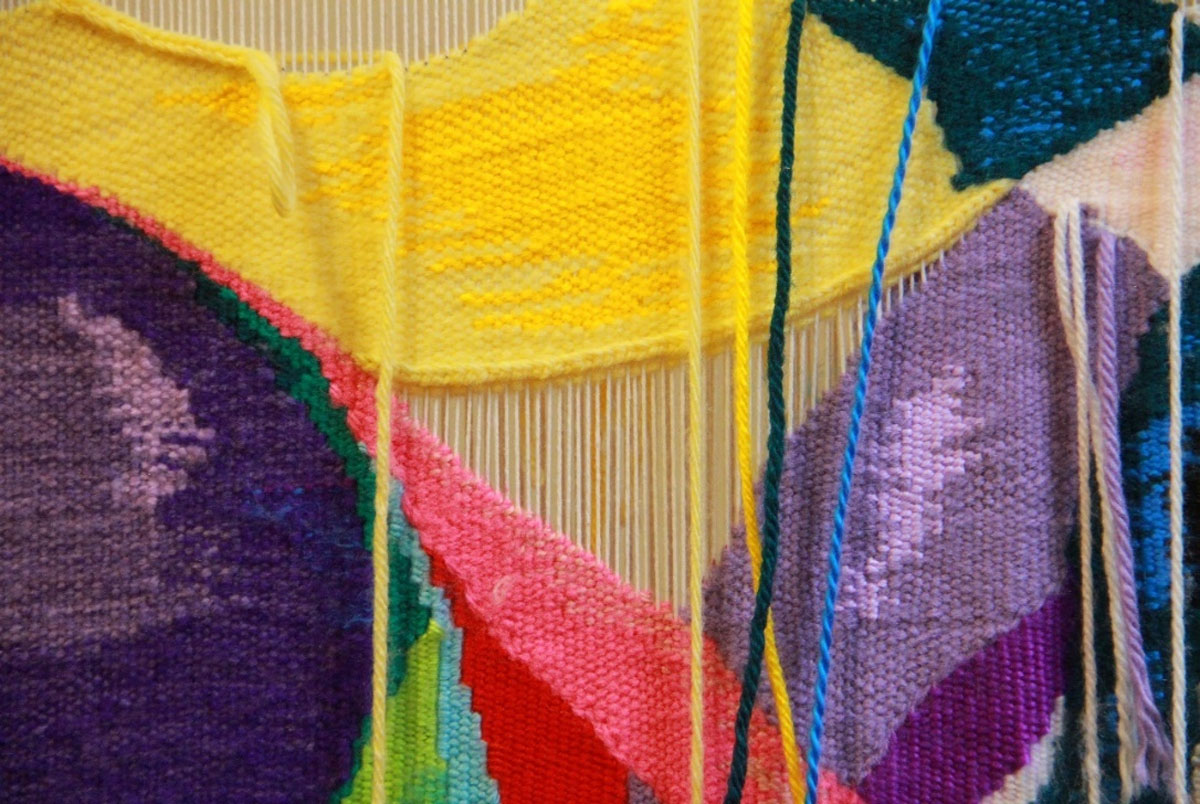
Figure 1
Unwoven area from the first author’s experience with tapetry-making representing the communicative power of silence.
The aforementioned example is one instance of many others that allowed the first author to experience the transformative power of weaving as a tactile learning activity during her doctoral research journey (Figure 2). The handling of physical threads, the twisting, knotting, and interweaving became a tangible metaphor for the intricate processes of exploration of the topic she was exploring. Each thread represented a concept or an idea, and the evolving tapestry reflected the progression of her understanding.
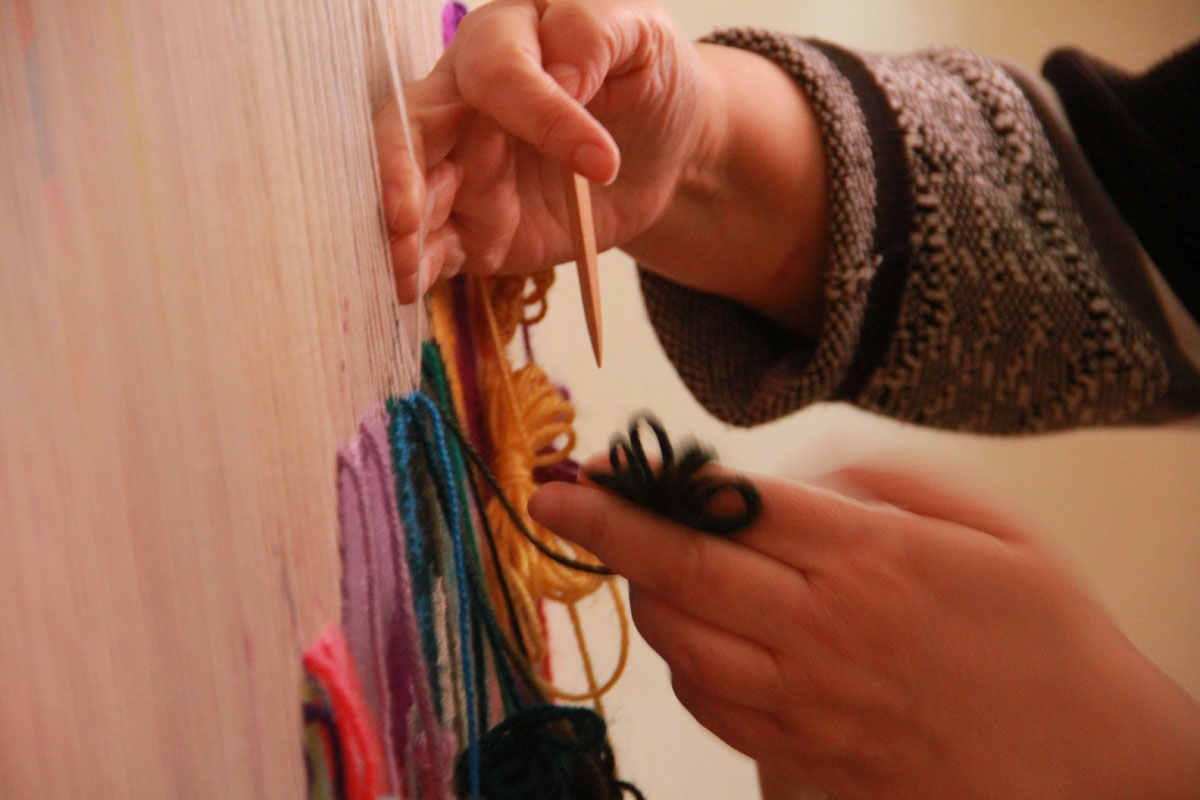
Figure 2
First author’s experience with weaving a research tapestry.
This act of creation, along with the sensory engagement with threads, carved out a meditative and reflexive space, enabling her to explore the implications and impact of her research. The tangible nature of the tapestry-making process allowed her to embody the research process. Within this context, she began to see the parallels between her journey as a researcher and that of a weaver and deeper learner. As her fingers moved rhythmically, intertwining strands of thread with strands of knowledge, they bridged the gap between the tactile and the intellectual. The repetitive motions of weaving, undertaken as a self-taught endeavor at the outset of her study, marked her evolution from a novice in the art to a researcher-weaver. This transformation was about more than mastering a craft; it was also about enhancing her capacity to weave threads of knowledge into a comprehensive research outcome. The resulting tapestry, a unified whole composed of separate yet inextricably intertwined threads, colors, and textures mirrored her growth. Though the tapestry was imperfect, with all mistakes left as visible evidence of her learning journey, the development she achieved through the process led to a profoundly transformative experience. Each imperfection in the tapestry became a testament to her journey, contributing uniquely to her growth as both an artist, teacher, and a researcher. Conducting her study in a distance and online format, physically separated from her learning and research community, she found weaving to be a way to innovatively connect members of this community. To do so, she used the continuous horizontal warp of her original research tapestry to weave smaller pieces for those who supported her throughout this journey (Figure 3). She then shared these woven pieces with their intended recipients, either by mail or in person when opportunities arose. This process highlighted the essential link between mastery, identity, and creativity in deeper learning, as outlined by Mehta and Fine (2019).
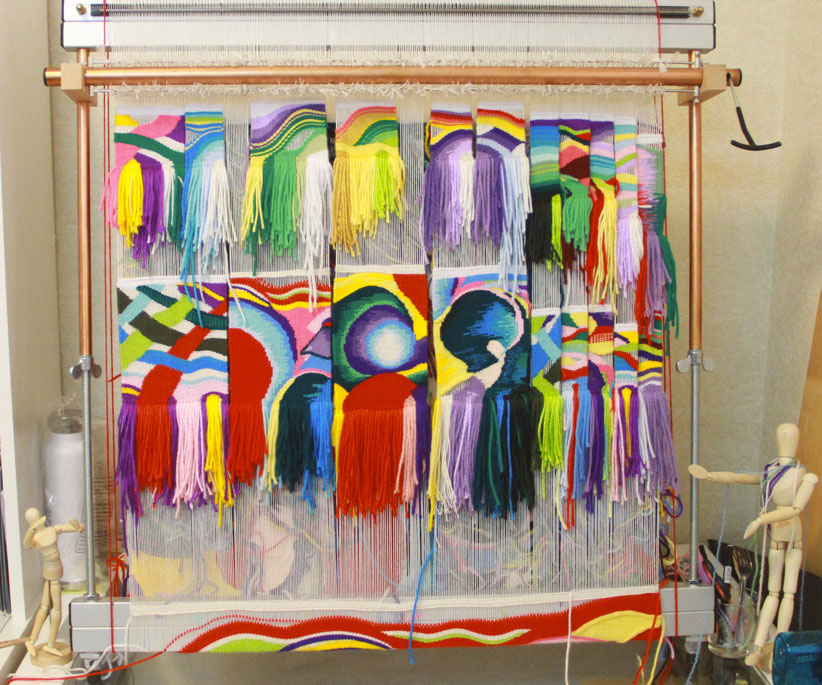
Figure 3
Picture of little woven pieces connecting the first author’s research tapestry with her research community.
Similarly, the second author has alternately used knitting to access mindful approaches to thinking through and coming up with creative solutions to complex problems. Through breath and focus on the repetitive movement of fingers, needles, and hooks, she is able to reach a meditative state wherein cognitive and creative processes, normally unconnected, are able to be interwoven – to both form a novel piece of textile art and also arrive at a novel approach to a complex problem. As with the experience of the first author, this process allows the integration of mastery, identity (melding cognitive, metacognitive, and maker perspectives), and creativity.
Textile Experiences and Deeper Learning
In the context of deeper learning, an umbrella term that encompasses contemporary education approaches and desirable attributes (Hewlett Foundation, 2013) we find distinctive features that aptly parallel the study of similarities between tactile activities and academic activities. Mehta and Fine (2019) effectively describe these features, explaining that deeper learning “emerges at the intersection of three virtues: mastery, identity, and creativity” (p. 6). These virtues not only form the cornerstone of deeper learning but also mirror the transformative processes we undergo when engaging in tactile activities.
Mastery, Development, and Growth
Mastery is a key aspect of both tactile activities, such as weaving, and research. Rather than viewing mastery as synonymous with perfection and absence of errors, in tactile activities, mastery is demonstrated through the skill development that happens through recursive motions that allow for incremental improvements over time. Similarly, in research, mastery emerges from accumulating knowledge, refining research skills, and synthesizing complex ideas and theories. Deeper learning involves achieving such mastery and leveraging it to generate novel insights in our field of study.
The development of mastery in both tactile activities and research necessitates dedication, persistence, and a growth mindset. Embracing challenges, learning from mistakes, and continually seeking improvement are fundamental (Costa & Kallick, 2015). As we refine our skills in these activities, we navigate the complexities of cognitive processes with heightened focus, leading to the formation of new connections that foster deeper understanding and expand our capacity for innovation.
Identity as an Evolving Tapestry
Tactile activities like weaving and knitting provide a profound reflection of the evolving nature of identity. Even when weaving or knitting involves following predetermined instructions, the presence of the weaver’s identity is unmistakable in the choices they make, and most importantly, in the distinctiveness of the touch of their hands. Just as the craft reflects the maker’s identity, the maker’s identity is also influenced by the craft. So, as the colors and patterns in a tactile creation evolve, so too does a researcher’s identity throughout the research process. Researchers’ identities are shaped and transformed as they engage in critical reflection and reflexivity, encounter new knowledge, and interact with diverse perspectives. The act of engaging in tactile activities becomes a metaphorical mirror, reflecting the researcher’s personal growth and transformation during the research journey. It highlights the dynamic and ever-evolving nature of identity and the reciprocal relationship between the researcher and their research.
Creativity – Completing the Triad
Creativity is central to both tactile activities and research. In tactile activities, creativity is evident in the uniqueness of the handmade craft, a reflection of the individual’s engagement with the activity, rather than a direct outcome of mastering the craft. Similarly, in research, creativity manifests in the originality of the researcher’s study, the emergent processes, and the novelty of their findings. Deeper learning fosters this creativity – it involves not only understanding existing knowledge but also generating new ideas, connections, and insights.
Creativity in both tactile activities and research results in uncovering novel insights, making new connections among previously disparate elements, and addressing complex challenges. By embracing creativity, researchers can make unique contributions to their fields, infusing their work with originality, and inspiring others to think creatively as well.
Discussion and Future Direction
While all the dimensions of tactile learning benefits cannot be explored in this article, many have, highlighting notions by other scholars that reinforce the idea that learning involves much more than educational outcomes or the acquisition of knowledge and skills (Downer Anderson, 2023). In the context of our discussion, we find resonance with Dron’s (2023) perspective on the intersection of technology and education, particularly the use of AI and other non-human entities in the teaching and learning processes. Dron cautions against the over-reliance on technology for not just automating tasks traditionally performed by humans, but also for delegating the critical cognitive processes of sensemaking and creative application. Sensemaking involves the ability to interpret and construct meaningful narratives from complex information, a deeply personal and inherently human process that draws from one’s experiences, values, and cultural context. Creative application extends beyond mere outputs; it involves the capacity to apply knowledge and skills in innovative ways, often reflecting the individual’s identity, purpose, and passion. These concepts of sensemaking and creative application are evident in the crafts discussed earlier in this article, underscoring their relevance.
As we navigate the integration of generative AI in education, recognizing and leveraging the potential of tactile learning is key for threading humanity back into the educational landscape. This underscores several future directions that we highlight in these points:
Tactile Learning as an Inclusive and Accessible Research Dissemination Tool: Recognizing the need for academic work to extend beyond the confines of academia and engage a wider audience, tactile learning can be utilized as a tool for fostering inclusivity and accessibility. A woven tapestry, for instance, could represent a non-traditional, creative way to disseminate research findings. This tactile representation offers an accessible, visible entry point into understanding complex concepts, narrowing the gap between academic discourse and public understanding. To further explicate this idea, we reference our experience at an international conference, where a non-English speaking staff member connected with our tapestry-based study findings through hearing the story of the tapestry creation, and the meaning the creator ascribed to different components, while also scanning these components visually. This individual’s background in traditional weaving helped her understand and relate to the academic concepts we presented, thus demonstrating how tactile methods can overcome language barriers and make research more accessible.
Enhancing Creativity in Academic Pursuits: The creativity cultivated through tactile learning extends beyond the immediate tactile activities themselves. Engaging in hands-on, creative endeavors like weaving and knitting enhances learners’ creative-thinking skills, which can be applied across various academic disciplines. Studies have shown that arts integration programs, which emphasize creativity, significantly improve students’ creative-thinking skills and overall academic achievement (Lee et al., 2017). The skills and mindset fostered through tactile learning can inspire learners to approach their other academic pursuits with increased creativity, originality, and innovative thinking, which are also valuable employability skills.
Creating a Holistic and Human-Centered Education: The integration of tactile learning experiences contributes to creating a more holistic and human-centered education in the AI-dominated era. While AI technologies offer numerous benefits, they cannot replace the affordances of human experiences, creativity, and embodied learning. Tactile learning experiences remind us of the paramount significance of hands-on engagement and the multisensory nature of learning. By embracing tactile learning, educators can ensure that education remains grounded in human experiences and values, balancing technological advancements with the rich tapestry of human expression and understanding.
Conclusion
Tactile learning through textile art and fiber crafts serves as a means to thread humanity back into education and research in the AI-dominated era. It enhances cognitive abilities, fostering creativity and innovation and promotes holistic development. By embracing tactile learning experiences, educators can create more well-rounded and human-centered educational activities that value the uniqueness of each learner and cultivate their intellectual, emotional, and physical growth. The integration of mindfulness through reflection and reflexivity while engaging in tactile activities further supports this endeavor, providing learners with tools to foster self-awareness and deeper learning. In a time where technology is advancing rapidly, tactile learning offers a powerful reminder of the fundamental importance of human experiences and the embodiment of knowledge and knowing.
Competing Interests
The authors have no competing interests to declare.
Author Contributions (CRediT)
Rima Al-Tawil: Conceptualization, methodology, investigation, visualization, writing—review and editing; Debra Hoven: Conceptualization, methodology, supervision, writing—review and editing. All authors have read and agreed to the published version of the manuscript.