
Introduction
Open distance learning (ODL) has a long history of being mediated by technology, depending on the communication technologies dominant at the time. Starting from a correspondence model in the 1880s to serve students at home or at work (Moore & Kersley, 2012), ODL evolved and will continue to evolve as new technologies emerge to support teaching and learning. Distance education (DE) and ODL are often used interchangeably and are difficult to define, also because the concepts are context dependent (Heydenrych & Prinsloo, 2010; Msweli, 2012). Bozkurt (2019, p.267) defines ODL and DE as “any learning activities within formal, informal, and non-formal domains that are facilitated by information and communication technologies to lessen distance, both physically and psychologically, and to increase interactivity and communication among learners, learning sources and facilitators”. Anderson and Rivera-Vargas (2020) argue that there has been an increased prevalence of online learning in the DNA of ODL. Investments in the development of staff, information and communication technology (ICT), infrastructure, and resources have constantly been made to best leverage the affordances of the online learning environment (Omidire & Aluko, 2022). The benefits of online learning are well documented in the literature in bridging the distance between the institution and the student by providing immediate access to study materials and the lecturer, interactive learning environments, and the opportunity for students to manage their own learning journey (Kara et al., 2019; Olson & Carroll, 2012; Venkatesh et al., 2014).
Against this background, ODL institutions are constantly deliberating on how best to harness and leverage the benefits of current information and communication technologies. Omidire and Aluko (2022) argue that reviewing strategies, practices, and online learning design in ODL is necessary. Pre- and post-pandemic research on online learning within the ODL space has increased its relevance, making it prudent to build on existing knowledge about theory, practical experiences, and knowledge (Bozkurt & Zawacki-Richter, 2021). Similarly, Brown (2021) indicates that trends in online learning prior to COVID-19 cannot be nullified, but need to be connected to the present in order to shape the future. From his research, Brown (2021, p.133) concludes that to move beyond “COVID-19 fixers”, new business models, instructors and teaching approaches need to be explored, which, he acknowledges, is risky because of the unknown future of online learning.
This research responds to the continued need to explore online learning practices within ever-evolving and dynamic ODL space. The study was located within an ODL institution in South Africa. The university, with more than 350,000 students, subscribes to an open distance e-learning delivery model. It offers qualifications based on national and international standards, offering learning programmes that are subject to quality assurance based on best practices in the higher education and ODL space. The university has eight academic colleges that cover various disciplines. In collaboration with the South African government, the university has provided free access to its website and learning management system to its students and staff since the COVID-19 pandemic. We considered it appropriate to conduct research at this university due to its open-distance e-learning context and alignment with digital technologies. Against this background, this study addressed the following research question:
How do lecturers implement online learning to teach their subject content in an ODL context?
Literature Review
Online learning is described as access to learning experiences via the use of technology (Heng & Sol, 2021), while others describe online learning as a more recent version of distance learning, confirming that the history of DE paved the way for the development of online learning (Hiltz & Turoff, 2005; Masalimova et al., 2022). Online learning is based on the principles of DE and aims to provide accessible education to students, regardless of geographic location. While earlier assumptions of DE focussed on geographical distance, more recent research focuses on transactional or psychological distance. In this regard, Moore and Kearsley (2012) indicate that transactional distance is influenced by three elements: the structure of online courses, the dialogue between the student and the lecturer and the student’s autonomy. Online learning can be successful if there is a balance between these three elements. As online learning and relevant technologies continue to evolve, several terms have been used interchangeably or in conjunction with online learning, such as e-learning, digital learning, blended learning, and hybrid learning (Heng & Sol, 2021). In the context of the current study, we describe online learning as the process of acquiring knowledge and skills using digital technologies and the Internet.
The history of online learning can be traced back to the early days of the Internet and computer technology. Research highlights that more and more universities have started to invest in online education (Hartnett et al., 2011, Naidu; 2014; Zawacki-Richter & Anderson, 2014). The prevalence of online learning is further supported by Zawacki-Richter (2021), who puts forward that ODL institutions have always been at the forefront and taken a leading role in the adoption of different types of media and technology. This trend increased dramatically during and after the COVID-19 pandemic, when face-to-face teaching and learning were impossible or restricted (Tareen & Haand, 2020). Various benefits of online have been noted, such as the fact that it appeals to diverse populations of students with ranging academic needs, regardless of location and time (Gilbert, 2015), better student participation (Tareen & Naan, 2020), immediate access to study materials, fellow students, and the lecturer (Olson & Carroll, 2012), which in turn creates a sense of community (Veletsianos, 2010). Garrison and Arbaugh (2001) argue that community is at the heart of online learning when they refer to three interconnected presences in the Community of Inquiry framework: teaching presence, social presence, and cognitive presence.
Authors such as Veletsianos (2010) and Naidu (2014) mention advantages such as the development of critical thinking and self-determined learning in students when learning online. Blaschke (2021) adds that lifelong learning skills such as critical thinking, reflection, autonomy, and self-determined learning are developed in an online learning environment as students do not only learn content. Online learning therefore has the potential to nurture the skills and attitudes necessary for lifelong learning. Anderson (2010) confirms that for students to succeed in online learning environments, they must practice some degree of self-determined learning. This means that they have to take the initiative and take responsibility for their own learning. Online presence and interaction provide the social context and support necessary for effective self-determined learning. In this sense, online learning can provide a platform to create democratic and easily accessible educational opportunities, as all students are treated equally in an online environment. Self-regulation is commonly associated with constructivist approaches to learning, which can be nurtured in online DE environments (Moore & Kearsley 2012; Dron & Anderson 2014). In addition, Zhu, et al. (2009) found that social constructivist approaches in online DE environments contributed to increased motivation, higher-order thinking, and independent students who regulated their own learning.
Despite the advantages that online learning offers, it also presents challenges. With specific reference to developing countries, in which the context of this study is based, a range of factors impacts online learning. These include a lack of ICT infrastructure, such as reliable electricity and up-to-date hardware and software, and a lack of high-speed Internet connectivity (Khan et al., 2012; Koi-Akrofi et al., 2020). Authors such as Todhunter (2013) state that the digital divide worsens educational inequalities, making it challenging to ensure equitable and effective online learning for all students. Furthermore, access is a challenge since students from different socioeconomic groups have varying degrees of access to ICT and varying capabilities of both students and staff to use ICTs further present a challenge. Another contributing factor is the lack of infrastructure for a diverse student population with varying levels of digital literacy (Bharuthram & Kies 2013; Paudel, 2021). Coupled with these challenges is the concern that while institutions have adopted online learning, it has not led to transformed pedagogical practices (Firmansyah, et al., 2021). Thus, the focus appears to be on technology itself, while pedagogical dimensions, such as how and what students learn, are often neglected. It is important to implement online learning in an appropriate way using suitable pedagogical practices. There needs to be an awareness of pedagogical dimensions regarding how and what students learn. In this study, awareness is defined as “an understanding of a situation at present based on information or experience” (Cambridge Dictionary n.d). We argue that if online learning starts from a point of awareness, all stakeholders will make conscious decisions, potentially leading to the effective and efficient use of online learning.
Theoretical Framework
Incorporating relevant theories into online learning practices will ensure that technology supports and enhances learning and leads to desired learning outcomes. Because online learning is such a dynamic and complex field, it needs a multidimensional approach. Therefore, we used four different but related theories and frameworks to underpin this research. These are the Transactional Distance Theory, the Community of Inquiry framework, Social Constructivism, and Heutagogy. By incorporating different theories, informed decisions can be made about aspects such as course content, interaction strategies, and how to integrate technology tools and platforms to adequately support the learning process.
Theory of Transactional Distance
In the Transactional Distance theory, Moore (1993) draws particular attention to the term “distance” which offers a different view from the traditional physical “distance” that is usually associated with DE. This view postulates that the “distance” should be viewed as a psychological and communication gap between the student and the lecturer, measured on a scale of dialogue and structure (Moore, 1993). This distance should be studied in terms of the results it has on the teaching and learning process and is particularly relevant to online learning due to its focus on understanding the interactions between students, lecturers, and the learning environment, which has direct implications for designing effective online learning experiences (Moore & Kearsley, 2012). Three dimensions of transactional distance underpin the theory: structure, dialogue, and autonomy. Online learning can be regarded successful when it effectively balances learner autonomy, effective interaction, and thoughtful course design. When this balance is right, it fosters engaging and successful learning experiences, while minimising the psychological and communication barriers that may exist between learners and instructors. Moore (1993) acknowledges that this is not an easy task and will be influenced by a variety of factors, including content, level of instruction, and student autonomy.
Community of Inquiry
The Community of Inquiry framework developed by Garrison et al. (2000) was chosen to give further direction and guidance to studying in online learning environments (Fiock, 2020). The model consists of three interrelated presences, which are social presence, cognitive presence, and teaching presence (Garrison & Arbaugh, 2007). Social presence implies that students should have a sense of belonging and identification with their classmates and with their course of study. Students must engage in online dialogue in an environment where they feel safe and develop relationships while expressing their personalities. If harvested effectively in online learning environments, social presence can lead to the development of critical discourse among lecturers and students, and between students and students (Garrison & Arbaugh, 2007). Cognitive presence is grounded in critical thinking (Garrison & Akyol, 2013). Cognitive presence is regarded as the crux of CoI and requires an active and present facilitator who can establish higher-order thinking and objectives (Garrison et al., 2001). Teaching presence refers to the integration of social and cognitive presence in the process of inquiry (Garrison & Arbaugh, 2007) and implies the selection of appropriate societal knowledge, the creation of opportunities to facilitate communication and reflection, and the evaluation of learning objectives (Garrison & Akyol, 2013). The online learning facilitator should carefully plan and structure this sense of community by incorporating social, teaching, and cognitive presence. Garrison and Akyol (2013) postulate that the CoI can respond to the challenges posed by online learning, such as the adoption of online learning in institutions of higher education that has not led to transformed pedagogical practices and understanding online learning from a pedagogical perspective which leads to higher-order learning outcomes.
Social Constructivism
Social constructivism, the third theory suitable for this study, argues that society’s members construct reality collectively (Vygotsky, 1978). Dron and Anderson (2014) contend that from a social constructivist perspective, meaning can be shared and negotiated through online discussion and debate, implying that it is a cognitive and social activity.
The theory can be seamlessly integrated with various online tools and technologies, such as discussion forums, video conferencing, and collaborative document editing, enhancing the learning experience and enabling learners to interact critically while allowing for different viewpoints and problem-solving, regardless of physical distance (Azhari, et al., 2020).
Heutagogy
Lastly, heautagogy, which can be regarded as a progression from pedagogy and andragogy, was chosen as it focusses on student flexibility, reflection, action learning in collaboration with others and self-directed learning (Hase & Kenyon, 2001). These characteristics enable the student to become an active agent and decision-maker in the learning process. In arguing why heutagogy is suited to online distance learning environments, Blaschke (2012) outlines that it holds promise for critical, creative, and independent thinking. In self-determined learning, a term often used as a synonym for heutagogy, students can critically analyse information, think creatively, and solve complex problems independently. Additionally, in online learning, learners can engage in research, explore resources, and determine what information is relevant and valuable to their learning objectives. Blaschke (2012) further argues that technology and heutagogy are symbiotic, as heutagogy could not exist without Web 2.0 technologies.
Each of the aforementioned theories holds distinct and crucial principles related to ODL, yet they share commonalities, centred around active learning, participation, and collaboration. Additionally, they collectively advocate for a shift from a teacher-centred to a student-centred approach and consider the student’s needs, interests, and experiences. Another shared characteristic is their focus on self-directed learning, which enables students to assume responsibility for their educational journey.
Research Design and Methods
Research Design
The study followed a qualitative approach, within an interpretative paradigm. Such a paradigm and approach emphasise the subjective experiences of participants and the interpretations they have for individuals (Starman, 2013). As researchers, this enabled us to do this research and report on our findings. An interpretative paradigm, as a paradigmatic basis of qualitative research, is closely linked to the characteristics of a case study (Starman, 2013). We selected a single case study. Although several authors have indicated that it is difficult to define a case study design, Sturman (1997, p. 61) provides a suitable description by stating that a case study is “a general term for the exploration of an individual, group or phenomenon”. The case we explored in this study was the group of academics using online learning within a specific context, representing the ODL institution where we did this study. Although qualitative case studies might be criticised for the researchers’ subjective judgements, Sturman (1997) believes that they can achieve their own form of precision by describing the entire research process in detail, which we believe we have done.
Research Methods
For this study participants were purposively selected, meeting the following inclusion criteria: participants had to teach more than one module, use online learning in their modules weekly, and have exposure and experience using online learning. To select participants, we initially used gatekeepers, who played an official role at the research site and who assisted in locating suitable participants (Creswell, 2012). Based on email communication, we requested the names of prospective participants who were participating in online learning at the respective universities and who met the inclusion criteria. Snowball sampling was used to identify more suitable participants (Cohen et al., 2011). After several staff members were contacted, a total of ten participants from various colleges at the institution accepted the invitation to participate in the study.
Data was collected through open-ended questionnaires, interviews, and non-participant online observation. Each participant was invited to complete an open-ended questionnaire. The questionnaire items focused on the number of hours spent online per week, tools to facilitate online learning, challenges and best practices regarding online learning. A 100% return rate was received as all participants completed the questionnaire. The participants were then invited to participate in a follow-up interview on Microsoft Teams. Eight participants agreed to participate in the interviews; the remaining two were unavailable. These interviews allowed us as researchers to follow up on questions that needed clarity and further explore the research phenomenon in more depth (Bowen, 2009; McMillan & Schumacher, 2010). The interview questions tapped into the pedagogic underpinnings the participants applied in their online teaching, their roles and their students’ roles in the online environment, the role of online learning in a DE context and their overall experiences of integrating online learning. For non-participant observation, the researchers additionally requested the participants to provide them with access to their online module sites. Access as ‘observer status’ was granted to eight module sites through the learning management system for twelve months (refer to Table 1 for a description of the participants who granted access to their module sites).
Table 1
Participant Information.
| PARTICIPANT | PARTICIPATION IN INTERVIEW | ACCESS GRANTED TO THE MODULE SITE | GENDER | AGE | NUMBER OF TEACHING YEARS | NUMBER OF MODULES THE PARTICIPANT TEACHES | NUMBER OF STUDENTS PER MODULE | NUMBER OF HOURS SPENT ON THE ONLINE LEARNING PLATFORM PER WEEK |
|---|---|---|---|---|---|---|---|---|
| Q1 /I1 * | Yes | No | Female | 30–39 | 9 | 2 | Module 1: 460 Module 2: 180 | 6–10 |
| Q2 /I2 * | Yes | Yes | Female | 30–39 | 14 | 1 | Module 1: 1500 | 16–20 |
| Q3 /I3 * | No | No | Male | 40–49 | 7 | 1 | Module 1: 150 | 0–5 |
| Q4 /I4 * | Yes | Yes | Female | 30–39 | 3 | 3 | Module 1: 2600 Module 2: 25 Module 3: 30 | 16–20 |
| Q5 /I5 * | Yes | Yes (access granted to 3 module sites) | Female | 40–49 | 10 | 2 | Module 1: 250 Module 2: 500 | 16–20 |
| Q6 /I6 * | Yes | Yes | Female | 30–39 | 5 | 1 | Module 1: 4500 | 6-10 |
| Q7 /I7 * | Yes | No | Male | 50–59 | 30 | 1 | Module 1: 600 | 0–5 |
| Q8 /I8 * | Yes | No | Female | 50–59 | 21 | 4 | Module 1: 76 Module 2:559 Module 3: 39 Module 4:14 | 11–15 |
| Q9 /I9 * | Yes | Yes | Female | 40–49 | 3 | 1 | Module 1: 250 | 6–10 |
| Q10 /I10 * | No | Yes | Female | 50–59 | 16 | 1 | Module 1: 1400 | 16–20 |
[i] * Q1–Q10 = questionnaire data.
* I1–I10 = interview data.
Access granted to 8 module sites for non-participant observation.
Data Analysis
An inductive thematic approach (Braun & Clarke, 2021) was used to analyse the data. Data analysis occurred during and after fieldwork. We relied on categories and patterns, with eventual themes emerging from the data analysis to guide us in answering the research questions (McMillan & Schumacher, 2010). In this process, we first did the coding individually and then compared our notes before finalising the themes. Various data methods ensured corroboration across the different data collection tools.
With regard to data availability, we are committed to promoting transparency and facilitating the reproducibility of our research findings. Therefore, we encourage interested parties to contact the authors for access to the data, and we will make reasonable efforts to provide the necessary information and support.
Trustworthiness
We ensured trustworthiness by adhering to transferability, credibility, dependability, and confirmability (Given & Saumure, 2008). Well-established qualitative research methods, including open-ended questionnaires, interviews and non-participant online observation, enabled the credibility of the study (Merriam, 2002; Shenton, 2004). Following the completion of the open-ended questionnaire, interviews with the participants were held. The interviews provided an opportunity to further explore the research phenomenon in depth and to probe further on questionnaire items which needed clarity. Member checks with the participants during the interviews additionally assisted in data accuracy. Finally, the non-participant online observation served as a data collection method to corroborate what was discovered in the questionnaires and interviews (Shenton, 2004). To ensure transferability, dependability, and conformability, we have reported on the research site and the context and described the participants and the data collection methods and processes used to collect data in the research design and methods section (Shenton, 2004).
Ethical Considerations
Permission and ethical clearance were granted by the Research Ethics Review Committee of the institution where the study was conducted. All participants were requested to sign consent forms and were duly informed that they could withdraw from the study at any given stage without penalty (McMillan & Schumacher, 2010; Strydom, 2005). We ensured the anonymity of the participants by using code names to ensure that they were not identifiable (Mitchell & Jolley, 2001).
Findings and Discussion
The study’s findings emanate from the questionnaires, the interviews and the non-participant observation of the module sites. Table 1 below summarises the participant profiles and further indicates whether they participated in the follow-up interview/granted access to their module sites.
Four major themes emerged from the study in relation to the main research question and the sub-research questions: content-centred approach, student support, pedagogical strategies, and low participation, as presented below.
Content-centred Approach
The data revealed that the participants followed a content-centred approach as a strategy for implementing online learning. McLoughlin (2009) defines a content-based approach as an approach that is driven by content, and not the instructor or the student. In the context of this study a content-centred approach refers to placing the content at the centre of the learning experience, as opposed to placing the student at the centre of the learning experience. In this regard, it became apparent that content was the primary factor in the online learning experience, while the student appeared to be the secondary factor. In addition, it appeared that participants invested a significant amount of time in structuring their online module sites with content.
The non-participant online observation confirmed that every online module site had a reasonable amount of content. The tools used predominantly across the module sites included podcasts, video links, frequently asked questions, and folders entitled “additional resources” which contained uploaded documents related to the module content. The authors engaged with the content (by listening to the podcasts, watching the video links and reading through the documents populated in the additional resources folder) with the intention of better understanding the strategies used to implement online learning.
While the module sites were well populated with content, conversations with all the participants highlighted that there was no purposeful planning of strategies that would prompt students to engage with the content. Therefore, it appeared that though the content was available for the students, there was no specific direction in terms of what students were expected to do with the content. Prompts for directing students to engage with the content online was not evident on the module sites. Participants were asked about the lack of directing students in terms of engaging with the content. One participant said:
“The content is for students’ own reading purposes” (I2), while another explained that “it is stuff that is available for them to understand the module, a different way of explaining it” (I9).
Similarly, participant Q6 expressed “everything in the folder is just interesting stuff” (Q6).
This perspective highlighted a content-centred approach, where the primary focus seemed to be on the content itself, and student engagement with the content appeared to take a secondary role. After the authors had engaged with the participants about what the next step was after uploading of the content, it emerged from the majority of the participants that their focus was on the content and they had not given much consideration to putting in place strategies which would prompt the students to engage with the content. The content-centred versus student-centred approach could be regarded as important to highlight in the context of the university where the research was carried out as the university espouses to a student-centred approach to teaching and learning. It could be suggested that placing content online without engaging the student with the content will not necessarily lead to transformed pedagogical practices.
The challenge of institutions adopting online learning without a significant change in pedagogical practices is supported by Firmansyah et al., 2021. Content placed online should be coupled with direction to students in terms of what to do with the content. A study by Kanuka (2011) identifies defining the roles and responsibilities of students as an essential factor for successful online learning. Creating an engaging and interactive learning environment where the students are engaged with the content is further advocated by authors such as Moore (1993), Garrison et al. (2000), Vygotsky (1978), and Hase and Kenyon (2001). In the context of this study, while participants provided relevant content for their students, there was a lack of consideration regarding strategies to encourage students to engage with lecturers, fellow students, and the content. Mbati and Minnaar (2015) confirm that students should be guided and allowed to apply the knowledge they have gained, as it will foster critical thinking skills.
Student Support
The theme of student support was closely linked to the ODL context of the institution. The participants expressed that owing to the nature of the ODL context the registered students often work and study simultaneously. This student profile suggests that students have to manage their studies in relation to their employment. The majority of participants expressed that finding the balance between their studies and their employment could be overwhelming for students. As such, they expressed the need for students to be supported in the respective modules so that they had more chance of success in the module.
The theme of student support was characterised through phrases such as: care, interest, safe space, guidance, sense of belonging (I1, Q8).
Participant (I4) regarded the online learning environment as a “[p]sychological and intellectual intervention, to make students aware that there is someone there when they need help” (I4).
Student support was further expressed by participant I5, who shared it is of importance that the student is aware “[t]hat we do care and that there is someone responding to queries and someone that is interested in them passing”.
Similarly, participant I8 argued that the online platform can be regarded as a vehicle to make, “students feel that they are part of a group.”
Participants expressed that they primarily made use of the discussion forum tool to offer support to students. This was corroborated in the non-participant online observation. Examples of practices used to support students were the participants initiating discussions asking students to introduce themselves and share their expectations of the module. Students were also encouraged to form study groups with their peers. Evidently, participants believed the online platform provided the opportunity and the space for students to be offered support in navigating the respective module.
Most of the participants expressed that support also implied attending to student queries on the online platform and creating a sense of availability for students. Below are examples of responses highlighting the participants views of being available online to assist students:
“I find that students have posed a question either to me directly or general questions to the other students. So, if it is something that they obviously don’t understand and it is an important thing, I think to myself, look I think it’s better if I just answer this, then everyone understands, and we are on the same page” (I4).
“I think I just get excited when I see a response, so I want to encourage them and be the person to communicate back.” (I1).
Studies conducted by Sun and Rueda (2012) and Cleveland-Innes and Campbell (2012) outline that it is important to create an online environment which displays characteristics of security, well-being, and confidence among learners. The creation of an environment which is open and welcoming in nature, in which students are able to communicate with their peers and their lecturer is important. Veletsianos (2010) similarly argues that the online environment has the ability to create a sense of community among all participants.
Pedagogical Strategies
A trial-and-error approach emerged from the manner in which participants implemented online learning. Participants cited a lack of specific guidelines for the implementation of online learning. Interestingly, participants revealed that they did not consult specific theories or guidelines when implementing online learning. Instead, they relied on their own teaching practices to navigate the online environment. This was reflected in the participants’ comments, as illustrated below:
“I am only now learning what I was doing wrong and where I was going. Some of the mistakes I made. So, in the future, I will do many things differently” (I5).
“I have learnt a lot from another module and how instructors assess their students, so I may use some of the tools they have used” (I1).
During the interviews, the participants mentioned their sense of uncertainty when it comes to implementing online learning. They elaborated on their reliance on a reflective approach, drawing from their experiences of successful strategies within their modules to modify their teaching practices. In this context, they explained that they expressed a desire for more guidance and a clear direction on how to implement online learning effectively. Such sentiments were expressed as follows:
“I would like more direction for teaching online” (I9).
“If you are not in education and don’t know about learning theories … with us, it is a bunch of chartered accountants in a teaching role” (I2).
“Lecturers cannot be expected to know educational pedagogics by osmosis” (I5).
Evidently participants felt a degree of uncertainty when implementing online learning and openly expressed a need for more direction in this regard. Consequently, they relied on learning from their experiences of what they believed to work well and continued with these strategies.
The need for more expertise by staff members is cited in the work of Oye et al. (2011) and Tarus et al. (2015). Gustiani (2020), in a reported study, found that during their pre-service training, lecturers needed to have exposure to mastering the instruction of online learning. Participants in the study were allocated in different disciplines and this also raised a concern among the participants. None of the participants were trained in the field of education and they therefore expressed that they had to take their subject knowledge and apply it to a teaching and learning role. Evidently the lack of prior training in pedagogics posed a challenge for the participants. Considering the teaching and learning process with care is essential in the online environment, as articulated in the theoretical framework of this study (Garrison & Akyol, 2013; Moore, 1993). As such, guidance and direction in terms of online learning therefore becomes fundamental.
Low Participation
The data revealed that although participants used the online platform, student participation remained significantly low. The online observation highlighted that student participation, specifically within discussion forums, increased significantly when the forum was labelled “examination” or “assessment” or had a direct link to assessment-related content. This implies that credit-bearing activities resulted in more participation from the students. Additionally, the participants described the low participation of the students as a challenge for them. This created a scenario where participants regularly used the online platform to facilitate their module. However, this was not reciprocated by the students whose participation was low.
One of the participants shared that it felt as if “[I am] teaching into an empty void” (Q6). Other participants shared this sentiment by expressing that there was a “huge section of the student population that never goes online” (Q4) and that students “are not using the online platform as they should” (I1).
The low participation rate raised concern among participants as they explained that “even when we send important documents, students do not seem to access them” (Q10). Another participant said, “I do not want to post something of such value if those who do not have access lose out” (I4).
In general, the participants were unsatisfied with the level of participation and engagement of the students. As an example, a participant said:
“Closer to exam time, they will ask a question related to the content of the guide, without having to go to the relevant section first and read the discussions to find out whether their question had already been addressed” (I6).
Participants alluded to low participation as a challenge. Gustiani (2020) similarly argues that student participation as primary users should be used to measure the success of online learning. Insufficient interaction with lecturers is also cited by Adnan and Anwar (2020) as a significant concern related to online learning. Blaschke (2012) and Garrison and Akyol (2013) stress the importance of creating opportunities for students to collaborate, share meaning, and develop critical thinking skills in the online environment.
There was a discrepancy between the participants’ expectations and the students’ actual engagement on the online platform, which raised concerns among the participants.
Reflection on the Study’s Findings to Delineate the Concept of Awareness
This study established to explore how lecturers implement online learning to teach their subject content in a specific ODL context. Overall, the findings revealed that participants engaged in online teaching and learning regularly. They primarily followed a content-centred approach and the main tools they used to deliver their subject content was (podcasts, video links, frequently asked questions, and folders entitled “additional resources” which contained uploaded documents related to the module content). The primary focus was on populating the module sites with content. There were no planned strategies for getting the students to engage with the content. As such the students’ roles were not clearly defined in the online environment in terms of what they should be doing to benefit from the available content.
The benefits which emanated is that the online learning environment is a useful tool for delivering subject content and making available to students, subject content in different formats (e.g. podcasts, video links etc). The online learning environment is also a useful platform for supporting students and bridging the distance between the students and their peers and the students and their lecturer.
Despite the efforts made by lecturers to deliver their subject content online participation from students was low. Students did not engage online as the participants would have wanted them to. Further a lack of guidelines regarding the implementation of online learning posed a challenge for the participants. They therefore relied on a trial-and-error approach to implement online learning.
Overarching the findings of the study was a lack of “awareness” in terms of implementing online learning. The concept of “awareness” has already been referred to in the literature review section as referring to an understanding of a situation at present based on information or experience” (Cambridge Dictionary n.d). The authors argue that decisions taken when implementing online learning should be undergirded by a foundation of “awareness”. In this regard, the authors argue for a framework which reflects “awareness” as a starting point for implementing online learning. The framework is explained below.
A Framework for Implementing Online Learning in ODL
This study sought to explore how online learning is implemented in ODL and culminates in the proposal of a framework for its effective application. Within this framework, we argue that online learning should start from a foundation of awareness (see Figure 1). We identified three types of awareness: institutional awareness, student awareness, and instructor awareness, each based on this study’s insights.
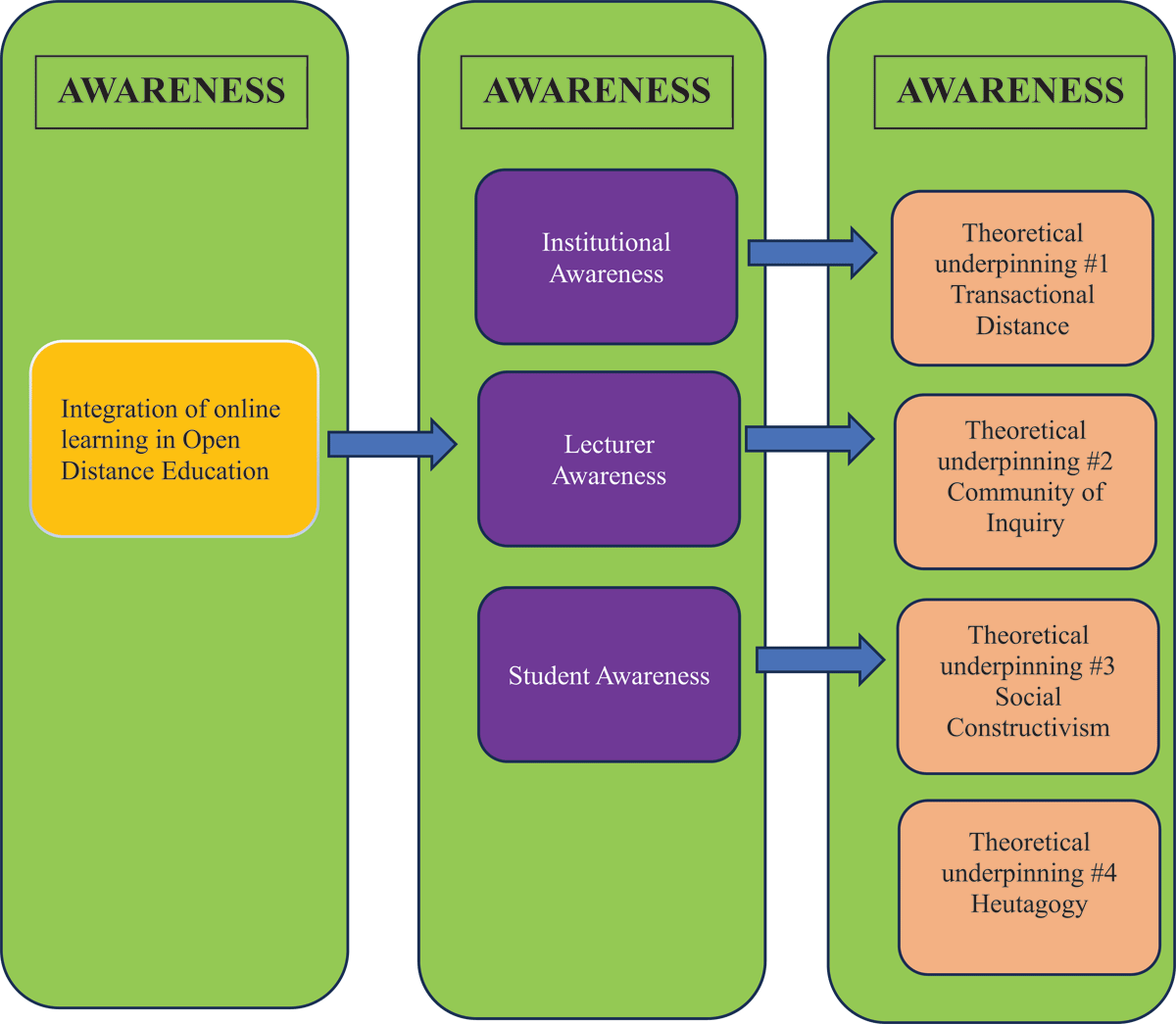
Figure 1
A Framework for The Integration of Online Learning in ODL.
Despite recognising good practices, there was a noticeable gap between the expectations of the participants and the actual participation of the students on the online platform. Additionally, the participants expressed the need for more institutional guidance on the effective use of online learning. Based on the study’s findings, we suggest that three different types of awareness should guide online learning.
The first is institutional awareness, in which the institution should provide clear guidance and benchmarks for the seamless implementation of online learning. Guidelines should outline in detail how online learning should be implemented. A step-by-step approach should be available for lecturers to refer to in this regard.
The second type of awareness is related to students. In this sense, the content presented online, and the support provided should incorporate specific mechanisms to engage the student actively. Strategies should be purposively planned so as to prompt the students to engage online, thereby leveraging the benefits of the online environment.
Lastly, lecturer awareness suggests that lecturers should deliberately strive to enhance student participation within the online environment. Beyond providing content and support, instructors should devise strategies to encourage students to use the online learning environment optimally. These strategies should be guided by the institutional strategies.
The authors argue that embracing each type of awareness has the potential to enhance the implementation of online learning. Each type of awareness can be effectively put into practice by integrating the study’s theoretical framework. Therefore, the principles of the four foundational theories: transactional distance theory, the community of inquiry framework, social constructivism and heutagogy should guide and inform each type of awareness to optimise the effectiveness of online learning.
In practical terms, considering transactional distance involves promoting student interaction online with an adequate level of autonomy and meticulously designing courses to strike a balance between learner autonomy, effective interaction, and thoughtful course design to develop successful learning experiences (Moore, 1993). Likewise, within the Community of Inquiry framework, creating an online learning environment should involve social, teaching and cognitive presence. Similarly, the principles of social constructivism and heutagogy should seamlessly integrate into each type of awareness, thus enriching and giving depth to their implementation. Therefore, the three types of awareness should work in unison with the theoretical framework presented in the study, forming a cohesive and effective approach to online learning.
However, this argument does not imply a one-size-fits-all approach, given the diverse contexts of institutions. Instead, institutions should tailor their approach by leveraging relevant principles from these theoretical underpinnings that best align with their unique context and requirements.
The framework is presented in Figure 1 below.
Conclusion
The aim of this study was to interrogate the implementation of online learning in ODL. The study’s findings shed light on the predominant adoption of a content-based approach by participants, emphasising the primacy of content over pedagogy in integrating online learning. Student support was harnessed through the online platform using discussions. However, it appeared that students needed explicit information about available support and a clear delineation of their roles. Participants in this study leaned towards a trial-and-error approach in terms of the pedagogical strategies employed when integrating online learning. Evidently, students could have benefitted from the support provided, but were unaware of their expected roles in the online environment. A significant issue observed was low student participation. It seemed essential that students make full use of the support offered, but their engagement was minimal. Interestingly, participation improved when credit-bearing activities were in question. Overall, the study underscored the need for a better alignment between instructor expectations and online interaction of students.
In response to the study’s findings, a framework for integrating online learning was suggested. This framework revolves around the fundamental concept of awareness. We argue that the integration of online learning should be thoughtfully designed and executed, with deliberate consideration of institutional, instructor, and student awareness, all-encompassing of each other. The principles and foundation of the theories of transactional distance, the community of inquiry, social constructivism and heutagogy should guide the operationalisation of each type of awareness. We emphasise the need to tailor the implementation of this framework to institutional contexts, steering clear of a one-size-fits-all approach.
Given that this study was limited to one case, future research in similar contexts is recommended for comparison purposes and to establish further best practices. Including students’ experiences and perspectives within the online learning environment would provide a more comprehensive understanding of the implementation of online learning. As the trajectory of online learning continues to travel along the road of ODL, it remains essential to continue interrogating online learning practices in this space. Within a changing and nebulous ODL context, maximising the potential of online learning for the success of all students involved is necessary.
Data Accessibility Statement
The datasets used and/or analysed during the current study are available from the corresponding author upon reasonable request.
Ethics and Consent
Ethical clearance was obtained from the Ethics Review Committee of the institution where the study was conducted.
Acknowledgements
This paper is based on the PhD study of Dr Faiza Gani, entitled: A Framework for the Integration of Online Learning in Distance Education.
Funding Information
Funding for this research was granted by the University of South Africa in the form of a bursary for the PhD study on which the paper is based.
Competing Interests
The authors have no competing interests to declare.
Author Contributions (CRediT)
Faiza Gani: Conceptualization, Methodology, Writing – original draft, Writing – review & editing.
Geesje van den Berg: Supervision, Validation, Writing – review & editing. All authors have read and agreed to the published version of the manuscript.