
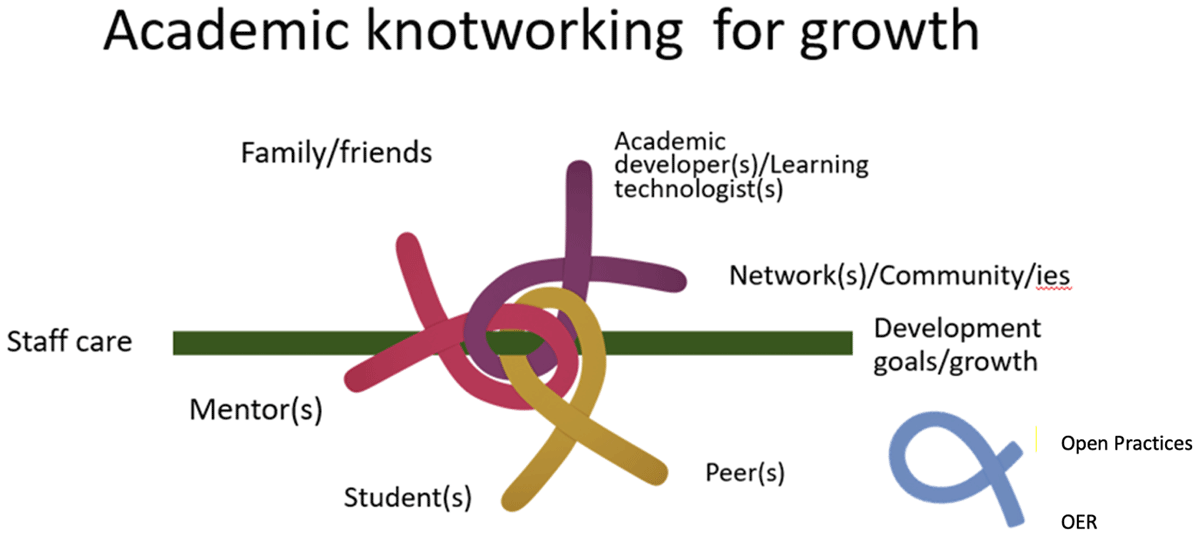
Figure 1
Academic knotworking for growth (Nerantzi, 2023) based on Engeström (2008) and visualisation by Mnaymneh et al. (2021) [adapted and used with permission granted by lead author Marvin Mnaymeh – Figure 1 was digitally created by Odysseas Frank].
Table 1
Mentoring characteristics of the case studies.
| CASE | MODE | BREADTH | SCALE – GROUP SIZE | TYPES OF MENTORING | MENTORING SCHEME/ TRAINING | MAIN GOALS | INNOVATIVE PRACTICES/ |
|---|---|---|---|---|---|---|---|
| SAI | Formal | National | Small | Individual; e-mentoring | Mentoring for mentors and mentees/ |
|
|
| NTF/CATE pipeline and support | Formal; Informal | Institutional; cross-institutional; national | medium | Individual; group; e-mentoring | Mentoring programme |
|
|
| OE4BW | Formal | International | large | Individual; group; e-mentoring | Mentoring programme |
|
|
| #creativeHE | Informal | National | large | Individual; group e-mentoring | Community with mentoring features build-in |
| Modelling a sustained community of practitioners, unfunded that is spreading creativity and innovation across the sector through collaboration and peer support and mentoring on a voluntary basis. |
Table 2
Mentoring practices in HE grounded on the open principles of collaboration, co-creation, transparency, sharing, and knowledge exchange.
| OPEN EDUCATIONAL PRACTICE | DESCRIPTION |
|---|---|
| Online Mentorship Platforms | Use online platforms for mentor-mentee connections, enabling global reach and fostering cross-cultural learning. |
| Open Access Resources | Promote the use ofOER that are diverse and inclusive, addressing different cultural andlinguistic backgrounds. |
| Community Engagement | Encourage participation in academic communities with a focus on diversity and inclusion, embracing the richness of varied perspectives. |
| Collaborative Projects | Facilitate collaborative research projects that span culturesand regions, allowing for cross-cultural mentorship opportunities. |
| Mentor Training | Train mentors to be culturally sensitive and aware, ensuring they can effectively support a diverse range of mentees. |
| Peer Mentorship | Establishpeer mentorship programs that consider the diversity of mentor-menteepairs, fostering inclusion and understanding. |
| Webinars and Workshops | Organise open events that address cross-cultural issues, equity, and inclusion, raising awareness and promoting learning in these areas. |
| Transparent Feedback | Promote clear, culturally sensitive feedback to support the growth of mentees fromvarious backgrounds and experiences. |
| Networking Opportunities | Foster networking events that encourage the exchange of ideas and experiences across different cultures, enhancing mentorship. |
| Cross-Cultural Competency Training | Provide mentorship and mentees withtraining on cross-cultural competency, promoting understanding and communication acrosscultures. |
| EDI in Mentorship Policies | Integrate EDI principles into mentorship policies, ensuring fairness and equal opportunities. |
| Inclusive Academic Communities | Create openand inclusive academic communities that value and support mentorship across diverse backgrounds and experiences. |