
Introduction
“Mentoring is one of the most important developmental relationships leading to academic and professional growth and success. Mentors support and facilitate the achievement of scholars’ goals.”
Mentoring plays a vital role in Higher Education and in the career development and success of academics at every stage of their professional journey. From early career academics and researchers embarking on their academic path to senior scholars seeking guidance in leadership roles, effective mentoring fosters growth, knowledge transfer, and personal development. Moreover, integrating Open Educational Practices into mentoring schemes, understood as formal and informal programmes aimed at supporting the professional development of individuals, enhances the value and impact of the mentorship experience. Our paper explores the value of mentoring across all career stages in academia, emphasising the significance of Open Educational Practices in facilitating knowledge sharing, collaboration, and the cultivation of a thriving academic community.
Open Educational Practices (OEP), are conceptualised by Inamorato Dos Santos & Punie (2016) as an approach to conducting education, frequently leveraging digital technologies, with the primary goal of broadening access and involvement for everyone by offering diverse methods for both teaching and learning, facilitating the creation and dissemination of knowledge in both formal and informal education. These are also understood as practices which aim to open-up a wide range of aspects of education in democratic ways (Havemann, 2020). For Cronin (2017), OEP include the creation, use, and reuse of Open Education Resources as well as open pedagogies. While for Rodés (2019) these include open sharing of teaching practices, and for Nerantzi (2017), Cronin & MacLaren (2018) and Bali, Cronin & Jhangiani (2020) these are transformative and collaborative cross-institutional educational practices in Higher Education which can catalyse transformation and enhancement of academic mentorship on a peer to peer level, as these offer a range of benefits for institutions, mentors and mentees.
By embracing openness in academic mentorship, institutions and individuals can create a supportive ecosystem that encourages collaboration and the democratisation of learning. OEP in academic mentorship, understood as the use of Open Educational Resources (OER), open platforms, and open pedagogies to promote accessible, inclusive, and collaborative learning experiences (DeWaard & Chavhan, 2020; Bossu & Stagg, 2017; Urbancic, Polajnar, & Jermol, 2019; Weller, 2014), providing valuable opportunities to connect mentees and experienced mentors, cultivating reciprocal professional growth through the engagement in meaningful interactions using collaborative approaches, promoting and enabling educational and research policies that effectively contribute to the development of the next generation of academics and researchers, fostering a culture of openness and boundary-crossing collaboration (Atenas et al., 2020; Nerantzi, 2017; Nerantzi, 2019; Bossu & Stagg, 2017).
OEP in academic mentorship can support a wide range of actors in promoting of the dissemination of knowledge and resources, including OER, research papers, articles, and educational materials. This unrestricted access enables mentors and mentees to explore diverse perspectives, engage with cutting-edge research, and gain a deeper understanding of their field. Furthermore, open and collaborative platforms and projects facilitate the exchange of ideas and expertise, creating vibrant learning communities where knowledge is freely shared and co-created. This can foster inclusivity and accessibility, breaking down barriers that hinder the participation of early career academics as well as more experienced academics and other professionals who teach or support learning in Higher Education, while broadening their horizons and connections with peers at international, disciplinary and professional areas as co-learners (Nerantzi, 2017).
OEP ensures that knowledge is not confined to a select few but rather available to anyone, and it extends to include students, institutions, and the wider public, being therefore boundary-crossing (Nerantzi, 2017). OEP emphasises on the collaboration of educators and learners in creating, sharing, and enhancing educational materials, irrespective of background or resources, institutional affiliation or financial constraints, as well as a lack of digital capabilities. This inclusivity promotes a diverse and equitable academic community, allowing talent to flourish. Thus OEP in academic mentorship encourages collaboration and networking, fostering collaborative projects between mentors and peers, fostering a sense of community and camaraderie, ensuring that mentees gain valuable experience, expand their networks, and develop critical skills required for successful academic careers.
OEP share a set of common values and principles with Open Science that transcend disciplinary boundaries. These encompass collaboration, co-creation, transparency, sharing, and knowledge exchange, underpinning the ethos of openness in academic practice, fostering accessibility, inclusivity, and democratisation of knowledge while transforming education, scientific research, and governance into more participatory, accountable, and innovative arenas (Cronin & MacLaren, 2018; Vicente-Saez, Gustafsson & Van Den Brande, 2020). For example, collaboration in OEP is not confined to educators, as it includes learners and other professionals in developing innovative approaches and resources for learning and teaching, while in Open Science it is rooted in the efforts of researchers within and across disciplines for the collective advancement of knowledge. Co-creation in OEP means involving students in the design of their learning experiences, allowing them to influence the curriculum while in Open Science it extends to the research process, where scientists engage with the public and diverse stakeholders to jointly shape research agendas, methodologies, and priorities.
OEP promotes transparency by supporting learners and educators in understanding how knowledge is created, fostering trust and accountability in education, while for Open Science, transparency is a cornerstone that encourages researchers to document and share their methodologies, data, and findings openly, enhancing the credibility and reproducibility of scientific work. OEP encourages the sharing of educational, resources, and teaching methodologies, to reduce barriers to access and fosters a culture of sharing within the education community, whereas sharing is integral to Open Science ensuring that scientific research is accessible to a global audience. In terms of Knowledge Exchange, OEP create an environment where knowledge is exchanged openly among educators and learners, contributing to continuous improvement in teaching and learning practices, and Open Science facilitates the exchange of scientific knowledge across disciplines, enabling interdisciplinary research, innovation, and problem-solving.
Mentors can guide early career academics in adopting open practices to foster a culture of collaboration and innovation within the broader academic community. As mentoring is a reciprocal learning pedagogical practice focused on “sharing experiences, hardships, and knowledge to help others to grow, advance and carry on a legacy” (Marino, 2021, p.748). Mentoring offers academics an opportunity to gain practical knowledge and insight from senior academic mentors and explore the best decisions for their career advancement.
In this conceptual paper, we reviewed the literature and four national and international initiatives for formal and informal academic mentorship or with integrated academic mentoring features. We reflect about the value of OEP to enhance academic mentorship, by promoting knowledge dissemination, inclusivity and collaborative learning. We argue that by embracing OEP, institutions, mentors and academics can engage in a dynamic, diverse and inclusive space, where expertise is shared, networks are expanded, individuals and the collective can grow and the scholarship ecosystem as a whole is enriched (Antonenko, 2015; Bossu & Stagg, 2017).
Literature Review
According to Pérez and Pasque (2013) there are two paradigms in academia: the “I” and the “we”. The dominant “I” is characterised by competitiveness and a focus on a single academic and their academic promotion, based on rewarding individual work in the area of research, teaching or scholarship, where collaboration is discouraged and not recognised. In contrast, the “we” very much focuses on fostering and recognising collaboration. Critical approaches reward activism and impact on society by a collective as recognition of collaborative “we” effort which seems very much aligned to the ethos and value of mentoring as well as open education, where the collective comes together for the social good (Calafell, 2007).
However, the “I” paradigm is still dominant in Higher Education (HE), this may explain why formal mentoring schemes, seem less common and in some institutions mentoring as a support mechanism remains nonexistent. Furthermore, evidence that suggests that formal mentoring schemes may be seen as organisational “spy systems” (Buzzanell et al., 2015 in Meschitte & Lawton Smith, 2017, p.184) and that generally mentoring is perceived as a weakness (Meschitti & Lawton-Smith, 2017). Also, as academics are free thinkers and their independence is important to them (Meschitti & Lawton Smith, 2017), they seem to seek relationships with like-minded people, informally (Johnson-Bailey & Cervero, 2004), so an “arranged marriage” such as a formal mentoring relationship, may not be something they are looking for (Nielson & Eisenbach, 2001, p.187).
The mentoring relationships academics are seeking may be within their own institution, or externally in professional networks and communities, to develop trust relationships to which they may feel an increased sense of belonging, and experience a state of being and becoming beyond perhaps perceived institutional control (Smith et al., 2019a; Smith et al., 2019b). Looking specifically at the literature around mentoring in cross-cultural mentorship, we see the importance of mutual openness and respect play in mentoring relationships to develop trust and feel connected (Batiste et al. 2022; Belcher et al., 2022; Calafell, 2007).
In recent years, the emergence of OEP has brought forth new possibilities for mentorship relationships within the Higher Education (HE) landscape, as openness both in education and research can potentially revolutionise academic mentorship, creating opportunities for collaboration and knowledge sharing, and inclusive learning environments fostering personal and professional development, to support students’ educational journeys (Nerantzi, 2017; 2019).
OEP can address several challenges often encountered by academics in early, mid and senior career stages through academic mentorship, which include limited access to resources, geographical barriers, and the need for a continuous professional development that is more diverse and wider reaching. By leveraging OEP, mentors can share a broader range of resources, encouraging exploration and knowledge exchange (Hodgkinson-Williams & Trotter, 2018). Furthermore, open platforms and online communities enable mentors to engage with mentees beyond the constraints of physical spaces, widening connections and collaborations worldwide, enabling academics to become lifelong learners and contributors to the knowledge society (Lunsford et al., 2013; Nerantzi, 2021; Veletsianos & Kimmons, 2012).
Research by Mantai (2017) about doctoral studies highlights the importance of support beyond the supervisory team. She says characteristically “It is no secret that it takes a village to raise a PhD graduate” (Mantai, 2017, online). While supervision and mentoring are distinct roles (Holland, 2009), there is recognition of an overlap especially linked to the recognition of the diverse support needs of a doctoral student and a mentee that requires a much wider network than just the supervisory team or a mentor.
Engeström’s (2008) concept of knotworking in healthcare provides a useful frame for academic mentoring especially when thinking of its complexity, depth and breadth. The knot metaphor is used to illustrate the tying, untying and re-tying of threads coming together with dynamism, fluidity and speed. Threads can be individuals, groups, networks and communities. The threads symbolise rapid capacity for timely collaboration and partnership, and the coming together with a purpose, harnessing individual and collective strengths to fulfil a specific goal in a specific timeframe. In Figure 1, knotworking for academic growth, has been visualised as the convergence of key agents for the development and growth of academics, presenting a form of connected and distributed mentoring (Nerantzi, 2023).
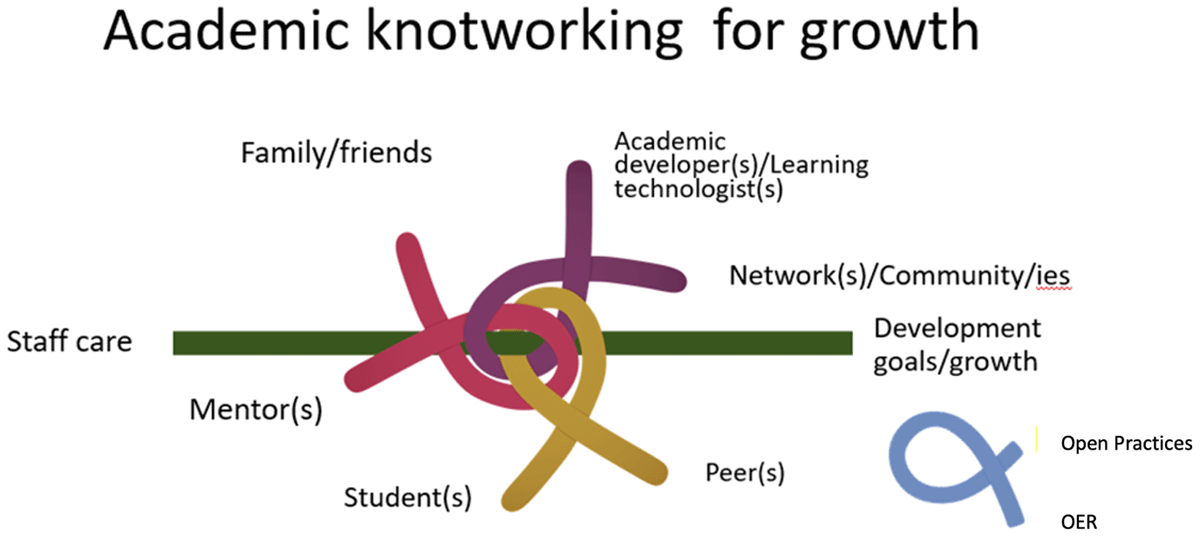
Figure 1
Academic knotworking for growth (Nerantzi, 2023) based on Engeström (2008) and visualisation by Mnaymneh et al. (2021) [adapted and used with permission granted by lead author Marvin Mnaymeh – Figure 1 was digitally created by Odysseas Frank].
The knots include family and friends, academic developers and learning technologists, peers, students as well as mentors and networks and communities. Further knots are also possible, represented in Figure 1 with α and will depend on the academic’s specific situation and circumstances as well as their professional aspirations, in our case, OEP and OER. Another key agent could also be Artificial Intelligence and chatbots. Chao (2007) and Holland (2009) talk about the value of multiple varying and diverse mentoring arrangements and agents that extend the support network for the mentee which seems to align with the proposed concept of academic knotworking.
Academic knotworking for growth (Nerantzi, 2023) embraces open pedagogies as spaces where mentors can co-create participatory environments, engaging in problem-solving and critical thinking (Hegarty, 2015). OEP promote mentorship approaches that emphasise the development of creativity, and digital literacy skills to contribute to the production and knowledge exchange, empowering participants in their academic journey.
Methods
For this conceptual article we framed our research through an integrative literature review (Torraco, 2005) and the report on four case studies (Kreber, 2001; Johansson, 2007) that have underpinned their mentorship schemes in OEP, formally or informally. These cases provided empirical data linked to mentoring applications in OEP or initiatives that have informal academic mentoring opportunities build-into the design.
First, we conducted an integrative literature review (Torraco, 2005). Integrative reviews are a type of non-systematic literature review (Souza, Silva, and Carvalho, 2010) aiming at addressing “new or emerging topics that would benefit from a holistic conceptualization and synthesis” (Torraco, 2016, p.410). So, rather than adhering strictly to a systematic approach, this integrative approach allowed us to explore the literature while mitigating algorithmic biases in terms of gender, and geographical representation and exclusion in scholarly databases, which tend to be present in systematic reviews.
Our research ethics approach acknowledges that traditionally, systematic reviews may inadvertently amplify algorithmic biases by focusing on a limited subset of research sources. The integrative model, in contrast, embraces a broader and more inclusive view of scholarship from diverse geographic regions to prevent reinforcing existing knowledge inequalities (Almeida & Goulart, 2017; Kordzadeh & Ghasemaghaei, 2022), to prevent reinforcing existing knowledge inequalities which we aimed to prevent in our paper by promoting a participatory, inclusive and open approach to scholarship practices (Atenas, Havemann & Timmermann, 2023).
Thus, we have reviewed a vast range of scholarly literature on OEP and mentorship in academic and researchers professional development. We included resources from the Global South and Global North, while excluding sources that did not meet our thematic requirements, mostly articles for areas such as counselling, coaching or students peer-to-peer support, and also, systematic literature reviews summarised research but did not significantly contribute to discover new findings about good practices in academic mentorship.
This integrative literature review model served us to develop a foundational approach for the development of a conceptual model aimed at fostering the adoption of OEP in academic mentorship, as we recognise that mentorship in academia can only thrive when it is informed by a diverse and comprehensive knowledge base as OEP in academic mentorship promotes the use of diverse resources, encourages collaboration and co-creation between mentors and mentees in academia (Abiddin & Hassan, 2012). In doing so, it seeks to bridge the gap between different regions and academic institutions, making mentorship more inclusive, equitable, and effective, while advancing open education and challenging existing knowledge inequalities in academia.
The case studies analysis enabled us to explore mentorship and OEP and its complexity in academia (Stake, 1995; Cousin, 2009). In this study, we report on four case studies with mentoring practices and features. We explored these using a collective case study approach to enable the study of characteristics across a number of cases as a collective (Stake, 1995). Our four cases allowed us to gain invaluable insights about applied mentoring approaches and practices. The collective case study approach complements the integrative literature review and provides specific examples in formal and informal, national and international settings across the Global North and the Global South.
Case study analysis: Review of Open Educational Practices in academic mentorship
This section showcases four distinct academic mentoring approaches in formal and informal, and national and international settings. These case studies were carefully chosen to represent scenarios at the national, international, and institutional levels, to offer a varied and multifaceted view of how OEP are employed within mentorship contexts, adapting to different scales and settings, highlighting a range of mentoring practices grounded or based in OEP.
The cases provide insights useful for the future design of formal and informal academic mentoring programmes and initiatives, within and beyond institutions in alignment with the ethos of open collaboration and peer-to-peer development and support in OEP.
A Peer Mentoring Programme Sociological Association of Ireland (SAI)
In 2022, a professional mentoring scheme was designed for the Sociological Association of Ireland (SAI). In its first edition, the scheme involved eight senior academic mentors and ten early-career academic mentees, mainly PhD students and postdoctoral researchers which used e-mentoring for capacity building, supervision and individual mentoring sessions (Bierema et al., 2002; Bussu & Moran, forthcoming).
The programme was based on mentors’ and mentees’ learning and emotional needs to express a sense of reciprocity and create balanced and reciprocal partnerships, where mentors identify their purpose for being mentors and articulate personal goals and benefits from the relationship. Openness and Reciprocity identified clearly at the outset, will foster the commitment for relationship building. Therefore, mentors and mentees need to have the ability to understand, read, interpret and respond appropriately to the reciprocal emotions of their mentees (Fox et al., 2010; Sorcinelli & Yun; 2007; Wilson et al., 2010)
The scheme has provided developmental sessions for peer mentors and mentees, actively involving them in the learning process and developing a community, fostering an effective and open space to discuss needs, goals, methodologies and boundaries. The mentors explored the mentee’s goals and supported them in developing a flexible action plan, by discussing challenges and resources, exploring formative and professional opportunities. The action plan included pathways, personal and external resources, timetables and deadlines, allowing the parties to explore the obstacles and challenges faced by the mentees, to outline the professional aims to be achieved as short and long-term goals (Bussu & Moran, forthcoming).
The community set up an instant messaging mentoring group, which remains active amongst the mentees and is used to disseminate various initiatives and opportunities, such as call for papers, conferences, and to organise informal coffee morning chats to discuss their career goals, consolidate relationships, motivating each other, and engaging in self-reflection (Bussu & Burton, 2023; Bussu & Contini, 2022; Bussu & Moran, forthcoming).
The National Teaching Fellows and Collaborative Teaching Excellence Award pipeline programme, turning competition into collaboration
The UK Higher Education Academy (HEA, now Advance HE) developed two prestigious and highly competitive national teaching awards: the National Teaching Fellowship (NTF) in 2000 and the Collaborative Award for Teaching Excellence (CATE) in 2016. NTF celebrates individual teaching excellence while CATE celebrates teaching excellence in teams. There are about 55 NTFs and 16 CATE awarded annually. Overall, there are over 1,200 NTFs and around 100 CATE in the UK.
A report of the NTF Scheme by Jones-Devitt and Quinsee (2018) identified the importance of mentorship across the process, before and after application and receiving the award. At UK level, Academic developers, PFHEA and Teaching Excellence Award recipients regularly work with mentors within and beyond institutions and countries, to support the development of teaching excellence through shared formal or informal mentoring arrangements, also within communities of practice (Jones-Devitt and Quinsee, 2018; Spowart et al. 2022). The Association for NTFs also provides support to aspiring NTFs and CATE, while the Advance HE Teaching Excellence Leads UK Network, supports institutional contacts co-ordinating NTF and CATE selection, mentoring processes and programmes.
This support and openness can be seen as threads in the knotwork of support available to aspiring NTFs and CATE. Each individual is also formally supported via their institutional Teaching Excellence Awards Lead and the support and mentoring in place locally in addition to any support that is led by the Association of NTFs and CATE Award winners annually, as well as the mentoring personal contacts, colleagues and collaborators. There are many NTF and CATE award recipients who are mentors on an individual and informal basis and take aspiring NTFs and CATE under their wings to help them, often over a number of years to become excellent educators and apply for a NTF or CATE.
Beyond the above support mechanisms, some institutions have networked to support their aspiring NTF and CATE turning a competitive scheme into an opportunity for collaboration. The NTF and CATE pipeline programme, a collaboration between the University of Liverpool, the University of Manchester, Manchester Metropolitan University and Northumbria University is an illustrative example of informal inter-institutional collaboration to peer mentor aspiring NTFs/CATE and the role NTFs and CATE winners play to raise the quality of teaching in their own institutions and gain recognition for it, despite the competitiveness of these schemes.
The pipeline includes a programme of activities, resources and access to NTF/CATE winners and informal mentoring and support. The collaborating institutions and educators involved in this pipeline programme, recognise the value of open collaboration and OEP across institutional walls and the importance to raise and recognise teaching excellence across the HE sector.
Open Education for a Better World Programme (OE4BW)
The Open Education for a Better World (OE4BW) programme, supported by UNESCO and led by Nova Gorica University and the Jožef Stefan Institute in Slovenia is an annual online open mentoring programme that operates in six continents and forty countries, since 2017. This programme has supported 330 projects and 447 developers so far. This open initiative is run by educators and scholars with expertise in open education as volunteer mentors, for specific open educational projects from the Global North and the Global South, which are also organised in hubs for more focused support and guidance.
Teams range from different sectors and work during their engagement with the programme on an authentic project aligned to specific Sustainable Development Goals (SDGs). Projects are often of strategic and sometimes of national importance, leading to specific outcomes and outputs that are implemented in practice to add value and address specific challenges.
OE4BW Mentors support small project teams over a period of six months to help them realise a vision, design and co-create a desired output based on real needs and aspirations. The live project outputs aim to make a difference to local or global communities, organisations and people aligned to specific Sustainable Development Goals (Urbančič et al., 2019).
The open and international Creativity for Learning in Higher Education community(#creativeHE)
The award-winning open Creativity for Learning in HE community, or #creativeHE for short, is a spin-off from a postgraduate module, the associated open course and the institution-wide Greenhouse community at Manchester Metropolitan University in 2015, bringing together creative practitioners across the sector nationally and internationally, to connect, collaborate and co-create, fostering a community of practice to stay connected beyond the life of a course. The grassroots cross-institutional, open and unfunded community today attracts creative educators and students from different parts of the world and has over 700 members.
It has been sustained over the years thanks to its participatory structure and diverse projects as well as its community-based leadership. The community provides a space for experimentation, peer support and informal individual and group mentoring. It has led to multiple successes and growth for its members including innovative practices, academic promotions, OER and OEP, as well as teaching awards. It acts as a knot in the staff care knotworking landscape, and provides connections and opportunities for collaboration and growth, which combined with OEP helps members to grow as creative practitioners using a mentoring community-based model.
The community organises events, courses and inquiries, co-create OER, share OEP and grow scholarly activities and research around creativity for learning and teaching. Mentoring is built into the fabric of the community and happens organically through collaboration and peer support. An inquiry into the #creativeHE leadership using Field’s conceptualisations of leadership within educational development (Fields et al., 2019) conducted as a collaborative ethnography showed that affective qualities as well as mentoring and empowerment were key characteristics that provide a leadership model and lived leadership experience based on harmony, refuge and stretch (Nerantzi et al., 2023).
The features linked to mentoring reported in the four case studies reviewed are presented in Table 1, which capture similarities and differences in the above cases, illustrating the breadth and diversity of mentoring as experienced in these schemes.
Table 1
Mentoring characteristics of the case studies.
| CASE | MODE | BREADTH | SCALE – GROUP SIZE | TYPES OF MENTORING | MENTORING SCHEME/ TRAINING | MAIN GOALS | INNOVATIVE PRACTICES/ |
|---|---|---|---|---|---|---|---|
| SAI | Formal | National | Small | Individual; e-mentoring | Mentoring for mentors and mentees/ |
|
|
| NTF/CATE pipeline and support | Formal; Informal | Institutional; cross-institutional; national | medium | Individual; group; e-mentoring | Mentoring programme |
|
|
| OE4BW | Formal | International | large | Individual; group; e-mentoring | Mentoring programme |
|
|
| #creativeHE | Informal | National | large | Individual; group e-mentoring | Community with mentoring features build-in |
| Modelling a sustained community of practitioners, unfunded that is spreading creativity and innovation across the sector through collaboration and peer support and mentoring on a voluntary basis. |
Bringing together the four case studies and the mentoring experiences and practices into a collective case the following emerges:
Mentoring is an effective pedagogical relationship, that can support academics at any stage for different purposes such as self-exploration of formative and professional needs; guidance in career choices and considering new opportunities; development and consolidation of “mentors-mentees communities” for mutual support in teaching and research, and co-creation of new creative projects in learning and research.
Formal (structured) and informal (unstructured) mentoring can be an effective pedagogical practice if participation is voluntary (in all four cases), as having an individual personal commitment allows projects to be developed in a positive, friendly and mutually respectful and “humane environment”.
Mentoring is a versatile pedagogical practice that can be structured as one-to-one; one-to -group or groups-to-groups, where academics can play at the same time the mentor and mentee roles, in different contexts and for different purposes, being also effective in small, medium and large groups.
The mentoring experiences through OEP we analysed, create alternative, new and diverse opportunities for mentoring, allowing the development of innovative practices, facilitating collaboration and cohesion between the parties involved, such as learning development; adoption of MDA and e-mentoring for community building; mentoring groups practices and modelling for supporting community of practitioners etc.
Discussion
In this conceptual paper, we argue that embedding OEP in mentorship schemes in HE can enhance its invaluable and pivotal role in supporting academics’ professional development and success. By establishing comprehensive and structured mentorship programmes, institutions can provide a nurturing environment where faculty members receive guidance, support, and opportunities for growth. One of the key values of academic mentorship schemes is to facilitate networking and collaboration as mentorship programmes, provide opportunities to foster interdisciplinary connections, collaborations and knowledge exchange, thus OEP provides opportunities for meaningful interactions and the cultivation of a vibrant academic community.
There is a need to recognise mentoring, as mentors invest extensive time and effort supporting and nurturing others normally on an open and voluntary basis as a form of academic citizenship, by including mentoring in academic promotion criteria, awarding, recognising and celebrating outstanding mentors, to motivate and publicly acknowledge those who excel in guiding, supporting, and fostering the academic and professional growth of their mentees. This includes mentors that promote diversity and inclusion, and participation in cross-cultural learning and development experiences.
A key element in academic mentorship schemes is to address inclusion and diversity. By establishing open guidelines and approaches that promote diversity in mentorship pairings, institutions ensure that academic members from underrepresented groups have access to mentorship opportunities and receive the support they need to thrive (Curran et al., 2019; Goerisch et al., 2019; Serafini et al., 2022). This encompasses aspects, such as mentorship and guidance from senior members with disabilities that are open about it, as the presence of role models with disabilities enhances cultural competency and addresses implicit biases (Dewidar, Elmestekawy & Welch, 2022; Wolbring & Lillywhite, 2021).
Academic mentorship schemes in HE require a multifaceted approach, that not only recognises and rewards mentorship excellence but provides opportunities for career progression and academic promotion (DeWaard & Chavhan, 2020), by encouraging knowledge exchange and open scholarship, fostering a culture of transparency and collaboration, promoting effective feedback cultures and opportunities for growth, to excel in their research, teaching, and leadership roles, ultimately strengthening the institution’s academic reputation and impact (McKiernan, 2017).
To foster the advancement of scholarship of learning and teaching, universities should offer research and development grants to promote mentorship-driven research clusters, where mentors and mentees collaborate on research projects that embrace OEP, including opportunities to share research outcomes in an open way, by promoting the development of OER and the publication in Open Access journals, to broaden knowledge exchange opportunities and further grow academic capacity in teaching, scholarship and research.
For early career researchers, mentoring provides essential guidance to start their journey in academia. Mentors offer insights into teaching, curriculum design, innovation and research methodologies, grant writing, publication strategies, and career planning. OEP amplify this value by enabling access to OER, mentorship networks and communities, as well as collaborative projects. By embracing openness, mentors empower early career researchers to explore diverse perspectives, access relevant materials, and engage in knowledge sharing within the research community (Denard Thomas, Gail Lunsford & Rodrigues, 2015).
In the mid-career phase, academics often face new challenges related to teaching, research management, and leadership. Mentoring becomes a valuable resource for navigating these complexities, providing guidance on balancing responsibilities, expanding research agendas, and taking on leadership roles (Gandhi and Johnson, 2016). Therefore, OEP further enhance this mentoring experience by promoting the use of online platforms, to upskill their digital literacies, and providing them with learning opportunities webinars, and workshops that offer mid-career academics further learning spaces to develop new skills and consolidate learning, network with peers in similar stages of their careers, and gain insights from experienced mentors (Boeren et al., 2015; Calafell, 2007; Rees & Shaw, 2014; Tangney & Flay-Petty, 2019).
Even seasoned scholars and academics in leadership roles benefit from mentoring. In this stage, mentoring shifts toward broader career advancement, strategic decision-making, and professional legacy. Reverse mentoring can be seen as beneficial for senior academic staff by connecting with early and mid-career academics, creating a sense of community, where “younger” mentors support senior scholars to navigate institutional politics, engage in interdisciplinary collaborations, and shape the direction of their research programs, engaging and enabling senior scholars to share their expertise with emerging researchers, contribute to the broader academic community, and foster a culture of open collaboration that transcends individual career milestones (Morris, 2017; Murphy, 2010; O’Connor, 2022).
An element often mentioned in mentorship and OEP literature refers to emphasising cultural sensitivity to ensure that mentors are well-prepared to support a diverse range of mentees, to understand and address the unique needs and challenges that academics from different backgrounds may face, this includes the incorporation of EDI principles in mentorship policies and programmes, to ensure these are accessible to all academics, irrespective of their background, thereby reducing disparities academia.
Collaborative projects and cross-cultural competency training in mentorship are key to enhance cross-cultural learning which is increasingly vital in our interconnected world, thus, the design of international e-mentorship platforms, provide global reach breaking geographical barriers, exposing mentors and mentees to international perspectives and best practices. This approach fosters holistic development and helps academics to gain a wide range of skills towards building a more inclusive and equitable HE sector.
Our analysis of the literature and case students showcase a wide range of OEP that can be used to incentivise, promote and foster mentorship in HE, including elements of collaboration, digital education, creativity, EDI and cross-cultural competency, to ensure that every academic is supported according to their needs and aspirations in their practice. Table 2 below, provides a list of practices, grounded on the open principles of collaboration, co-creation, transparency, sharing, and knowledge exchange, that can be widely adopted in formal and informal mentorship schemes.
Table 2
Mentoring practices in HE grounded on the open principles of collaboration, co-creation, transparency, sharing, and knowledge exchange.
| OPEN EDUCATIONAL PRACTICE | DESCRIPTION |
|---|---|
| Online Mentorship Platforms | Use online platforms for mentor-mentee connections, enabling global reach and fostering cross-cultural learning. |
| Open Access Resources | Promote the use ofOER that are diverse and inclusive, addressing different cultural andlinguistic backgrounds. |
| Community Engagement | Encourage participation in academic communities with a focus on diversity and inclusion, embracing the richness of varied perspectives. |
| Collaborative Projects | Facilitate collaborative research projects that span culturesand regions, allowing for cross-cultural mentorship opportunities. |
| Mentor Training | Train mentors to be culturally sensitive and aware, ensuring they can effectively support a diverse range of mentees. |
| Peer Mentorship | Establishpeer mentorship programs that consider the diversity of mentor-menteepairs, fostering inclusion and understanding. |
| Webinars and Workshops | Organise open events that address cross-cultural issues, equity, and inclusion, raising awareness and promoting learning in these areas. |
| Transparent Feedback | Promote clear, culturally sensitive feedback to support the growth of mentees fromvarious backgrounds and experiences. |
| Networking Opportunities | Foster networking events that encourage the exchange of ideas and experiences across different cultures, enhancing mentorship. |
| Cross-Cultural Competency Training | Provide mentorship and mentees withtraining on cross-cultural competency, promoting understanding and communication acrosscultures. |
| EDI in Mentorship Policies | Integrate EDI principles into mentorship policies, ensuring fairness and equal opportunities. |
| Inclusive Academic Communities | Create openand inclusive academic communities that value and support mentorship across diverse backgrounds and experiences. |
The practices mentioned in Table 2, reflect the literature and case studies on mentorship and in OEP in terms of fostering diverse and inclusive networks in academia, as mentorship programs that embrace EDI, and cross-cultural learning are per-se more diverse and inclusive, thereby enriching the academic community with diverse perspectives.
Recommendations and conclusions
Mentorship is the cornerstone of professional growth and development. It empowers scholars and educators by offering guidance, support, and invaluable insights. However, the efficacy of academic mentorship is not solely determined by the mentor-mentee relationship itself. It is, in large part, influenced by the broader academic culture, competition vs collaboration, and the landscape of policies and institutional frameworks that guide and shape formal and informal mentorship programmes. OEP can become a powerful catalyst for inclusivity and knowledge exchange, it is essential to recognise its role in fostering mentorship schemes to drive academic and research excellence and innovation.
Through OEP, educators, scholars and researchers come together within communities and networks and their ethos and values, such as collaboration, camaraderie and solidarity often provide a fruitful space for informal peer mentoring that is beneficial for the mentee. In an age of fierce competition and egocentric practice, OEP provides an oasis for collaboration and togetherness that places the collective above individual gains (Roberts et al., 2020).
Mentorship strategies, policies, frameworks and guidelines should provide a landscape to ensure that every academic can access learning and development opportunities regardless of their career stage, department, or background. Thus, having an open and co-created approach to develop such policies, frameworks and guidelines demonstrates an institutional commitment to promote and foster a culture of openness, collaboration and trust (Atenas et al., 2020).
National strategies should be designed and implemented ensuring that schemes are adequately staffed and supported, devoting sufficient effort and resources to enable peer mentoring promoting the development of guidelines, and toolkits using an OEP to ensure Universities have the means to invest adequate effort and resources to prioritise mentoring for new scholars. Institutional policies and schemes for academic enhancement, must prioritise mentorship, to demonstrate their commitment to academic development, by creating an environment conducive to growth and collaboration driven by integrating OEP in these schemes, further enhancing the impact of mentorship, fostering knowledge dissemination, inclusivity, and recognising the value of investing in the development of their academics, strengthening their institutional ecosystem.
Mentoring is usually seen as relevant for individuals and small groups. However, there is also potential in peer mentoring approaches for whole organisations. For example, the Knowledge Equity Network has been brought to life in 2023 to foster radical collaboration among HE institutions, publishers, organisations and activists to solve some of the biggest challenges of our time through open education, open research, recognising and rewarding efforts in these areas. The Knowledge Equity Network declaration (2023) provides a framework for global partners to collaborate. HE institutions are connected as organisational peer mentoring organisations to learn with and from each other.
Another international example, is the peer observation project “Mentore”, (“Modifying and ENhancing Teaching through Peer Observation and Reflections with Experts.”) from the University of Palermo (Cannarozzo et al., 2019; Felisatti et al., 2019). The project has been developed and implemented since 2013 by a group of academics for their peers (senior and young researchers) across topics and departments of the University of Palermo. Their main goal is to improve academic self-awareness about teaching practices and impact on learners. The scheme provides learning opportunities for the participants (capacity building, reflective workshops, etc,) where participants can share and discuss new teaching strategies and approaches for engaging learners (Cannarozzo et al., 2019).
From the experiences presented in this paper, we argue that OEP in formal and informal mentoring schemes are key for supporting academics in building volunteer peer-support relationships. We believe that a combination of approaches is beneficial, especially for early career academics. Capacity building and supervision sessions designed in “formal schemes” are useful for working on self-awareness about the mentor’s role and duties while informal relationships for personalised guidance and mentorship are useful for building new networks. In both cases, an effective mentoring relationship should be reciprocal and beneficial for mentors and mentees (Bussu & Contini, 2022; Bussu & Moran, forthcoming).
However, an important risk of failure of the mentoring relationship in academia is linked to the “University environmental culture” in which the informal mentoring and peer support networks are created. Often, informal mentoring groups, are created to fill gaps in formal support networks, or to provide spaces for diverse groups such as women in menopause, mothers, queer and trans collectives, international academic networks, black academics and other groups, which agendas that may not be aligned with institutional ones, therefore tend to be not only unsupported but also, counteracted, by setting for example similar networks be overseen by management, preventing spaces for informal yet safe relations between peers, creating tensions between individuals and unfavourable relational dynamics, and individual power plays.
Mentorship plays a key role in working with academics across disciplines to nurture professional relationships that lead to individual and collective growth. Harnessing the opportunities OEP brings for academic mentoring, through informal and communal approaches is something that should be considered more by institutions. When academic mentorship is anchored in the principles of openness, institutions can foster a culture of mentorship excellence, knowledge sharing, and transformative teaching practices, leading to a supportive and interconnected academic community that prioritises equity, inclusivity, transparency, and collaboration in mentorship and in academic and research practices.
Future Research
Academic mentoring is crucial for staff development. Currently, there is limited literature on the implications of mentoring for both senior academic mentors and early-career academic mentees (Bell & Treleaven, 2011; Boeran et al., 2015; Diggs-Andrews et al., 2021). Senior academics need to view mentoring as part of their professional responsibility and make themselves available to mentor others even without a system or structure for mentoring (Viator, 2001). Vice versa, junior scholars can offer mentoring to senior academics too using reverse mentoring, for example, supporting them in developing their digital and media skills (Morris, 2017; Murphy, 2010).
Furthermore, there is a literature gap on reverse mentoring, and in comparing the effectiveness of formal and informal mentoring programmes (online, hybrid, and face-to-face) (Denard Thomas et al., 2015; Holt et al., 2016; Sargent & Rienties, 2022), thus further research is urgently required to understand the factors that help and hinder academic engagement with these schemes; also, empirical studies on the value and impact of mentoring, to understand the effectiveness of mentoring on mentors and specifically on career progression and salary (Allen et al., 2006; Kalpazidou Schmidt & Faber, 2016); career satisfaction and organisational commitment and job performance (Ghosh & Reio, 2013; Mendez et al., 2019). We need more evidence on positive impacts that can support the dissemination of a good mentoring culture and improve recruitment efforts for mentoring programs. Therefore, longitudinal research is needed on mentoring impacts on a mentor’s career over time to provide an enabling atmosphere for an open mentoring culture.
Author Contributions (CRediT)
Atenas, J., Nerantzi, C. and Bussu, A. The three authors equally contributed to the ideas; formulation or evolution of overarching research goals and aims, as well as in the review of the literature, qualitative data analysis, and preparation, creation and/or presentation of the published work, both in the initial and the final draft. All authors have read and agreed to the submitted version of the manuscript.
Acknowledgements
We would like to thank Professor Ettore Felissati for inviting us to present at the Simposio Internazionale sul Mentoring in Palermo, Italy and to Marvin Mnaymeh for giving us permission to repurpose and reuse his visualisation of knotworking.
The authors would also like to thank Adam Frank who helped with the final proofreading, we are grateful for his help with this.
Competing Interests
The authors have no competing interests to declare.