
Introduction
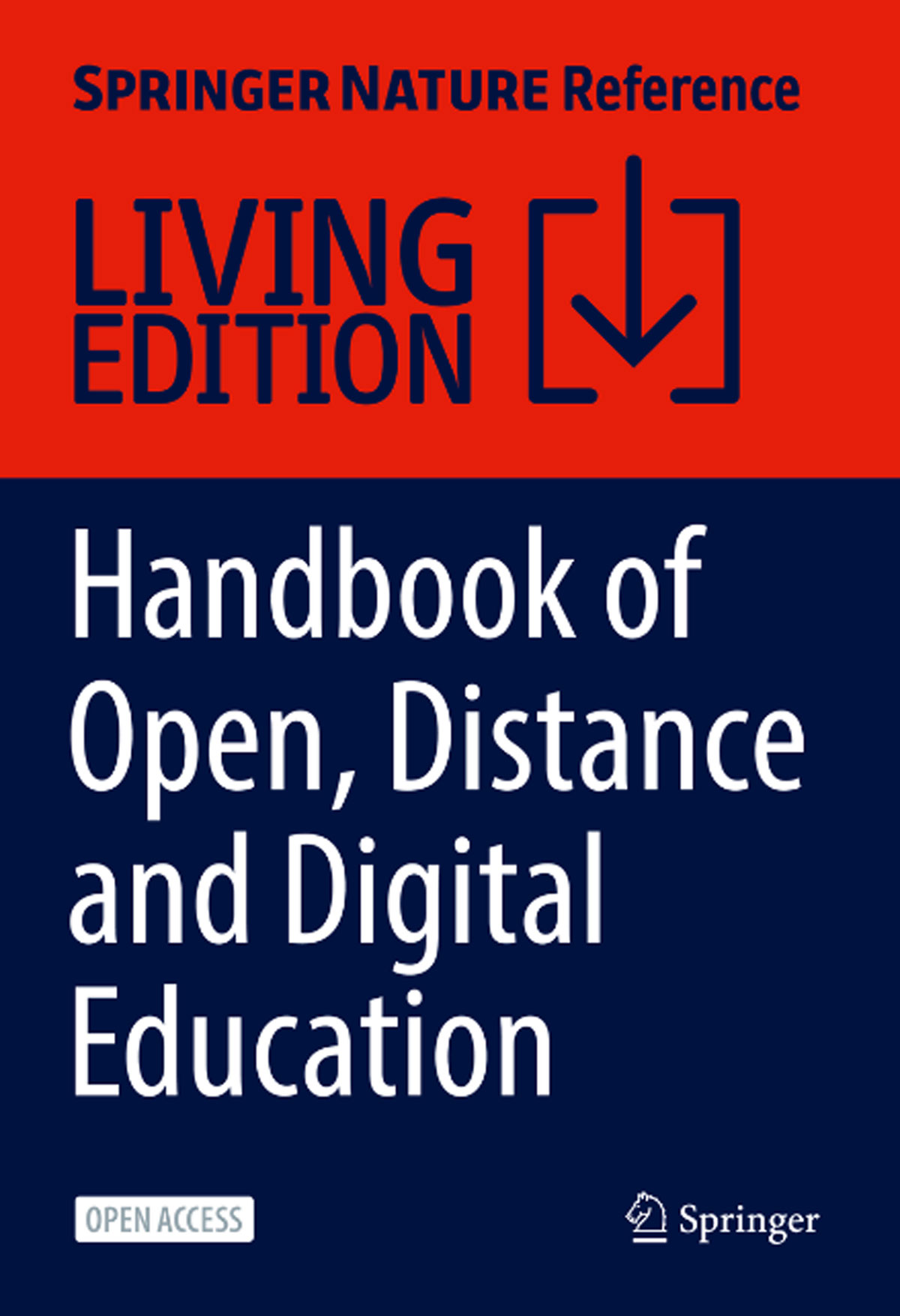
Handbook of Open, Distance, and Digital Education (HODDE), edited by Prof. Dr. Olaf Zawacki-Richter and Prof. Dr. Insung Jung, is an open-source reference book released in January 2023. Its purpose is to bridge a gap in the field by comprehensively covering open and distance education, along with digital learning. To achieve this, the editors have assembled 80 chapters authored by over 100 contributors. HODDE is commendable for effectively exploring a wide array of topics. The need for structured presentation is evident, spanning from the history of ODDE to the contemporary landscape of digital learning. Thus, the book adopts the 3M framework (Zawacki-Richter, 2009; Zawacki-Richter & Anderson, 2014), categorizing the content into macro, meso, and micro levels.
Structure, Scope & Contribution
The 3M layers are incorporated in the handbook within six sections, each of which is edited by a section editor (Zawacki-Richter & Jung, 2023):
Introduction by Olaf Zawacki-Richter and Insung Jung
Macro-Level: Theories and Systems
Section 1: History, theory, and research in ODDE by Junhong Xiao (China)
Section 2: Global perspectives and internationalization by Svenja Bedenlier (Germany)
Meso-Level: Institutional Perspectives
Section 3: Organization, leadership, and change by Ross Paul (Canada)
Section 4: Infrastructure, Quality Assurance, and Support Systems by Tian Belawati (Indonesia)
Micro-Level: Learning and Teaching
Section 5: Learners, Teachers, Media and Technology by Vanessa Dennen (USA)
Section 6: Design, Delivery, and Assessment by Richard E. West (USA)
As a “handbook” and as the main editors propose, HODDE “…aims to provide a comprehensive and solid overview of the field for educators, researchers, policymakers, and administrators in such sectors as K-12 education, higher education, adult education, and workplace training” (Zawacki-Richter & Jung, 2023, p. 5).
The book extends an invitation to readers who embark on a particular topic – be it to delve further into its depths, seek guidance in a particular direction, or gain inspiration to explore beyond. Each section within the book comprises chapters that do not give in-depth information about singular fields of study; rather, they presuppose a certain level of expertise and scholarly background knowledge. These chapters strive to foster critical thinking across the field. For instance, Chapter 59 by Prinsloo (2023) on Learning Analytics (LA). While the chapter hints a good reading list to learn more about LA, the aim of the chapter is neither to teach the utilization of LA nor to delve deep into the encyclopedic information on LA. It is, like all other chapters I have read – which equals to 80% of the book-, to initiate a critical thinking on the theoretical and practical scope of LA in ODDE with solid examples. Unlike other in-depth analysis papers about LA or highly technical study reports on the implementation of LA, the chapter problematizes skillfully the use of LA and its need for strong pedagogical decision-making processes before and during the implementation. I think that is how the book in general becomes a handbook of the field.
However, a potential critique lies in the expansive breadth encompassed by each section, which lacks some detailed focus for the educators who are seeking more hands-on guidance or sole information on a particular topic. However, the aim of the book hints that HODDE came out in the time of a shift from brick-and-mortar mainstream to digital mainstream to collect the vast influential know-how of the field, by gathering the authors even with opposing views under one umbrella. However, as an enthusiastic reader, I certainly expect a separate handbook for each section in the near future.
Shaping the terminology: Digital as the second “D” of ODDE
The plethora of definitions of different ‘ecoles’ especially in the field of social sciences does not work around the field of open, distance, and digital learning. The increasing accessibility to online learning and digital educational tools, alongside the capacity to introduce temporal and spatial separation even within traditionally campus-based educational institutions, has inadvertently exposed many educational institutions to the concept of “distance.” However, this exposure often occurs without a full comprehension of its relevance to distance education. Amidst this exploration of controlled spatial remoteness or distance within mainstream education, various terms have emerged, such as online learning, flexible learning, mobile learning, technology-enhanced learning, open learning, hybrid learning, open learning materials, digital learning objects, and the like. The outbreak of the pandemic in 2020 further compelled the global shift towards distance-based education due to emergency. The very essence of education pushed conventional practices to adapt their well-established pedagogies to distance learning, though this transformation was more of an emergency response than a deliberate transition (Bozkurt & Sharma, 2020; Hodges, 2020).
HODDE, with acumen, acknowledges the intricate labyrinth of terminology within the domain. This complexity arises due to the ceaselessly evolving and perpetually overlapping nature of open and distance learning – a predicament that may not astonish those well-versed in the field. However, for scholars and educators unacquainted with the origins, history, and theories of ODDE, this intricacy could be even more confusing. Reflecting on the historical backdrop of correspondence education, where the lone tool was a letter, the evolution of technology has undeniably revolutionized the tools at hand, whether it be a cassette, computer, disc, or intranet. This transition from tangible tools to digital forms is indeed unsurprising, as media is inherently subject to evolution. With the new large language models and generative AI, it is clear even “online” falls short to describe the space we refer to in the field. The term no longer encapsulates the entirety of connectivity, signaling the impending expansion beyond the realm of “online.” Consequently, a more encapsulating and also comprehensive terminology is required for the field ensuring durability for all educational stakeholders. Within this context, digital, emerges as a functional descriptor that encapsulates the present and future dimensions of open and distance education. Hence, “Open, Distance, and Digital Education” (ODDE) emerges as an overarching term to envelop the vast scope of the field.
HODDE, authored by distinguished scholars in the field, shoulders the responsibility of presenting the historical, contemporary, and prospective trajectory of digital education, tracing its roots to Open and Distance Education (ODE). The systematic, institutional, and pedagogical adaptation of establishments to the relentless acceleration of digitalization and digitization is not a novel concept, particularly within the realm of ODE. The expertise in this field is now firmly established. Yet, the pandemic underscored the realization within the ODDE community that this wealth of knowledge had not been effectively disseminated to the mainstream of education. Delving into the profound intricacies of this multi-layered field proves to be a formidable task. Nevertheless, the unification of these pioneering authors in a single volume to convey the core principles of their expertise is an ambitious yet commendable undertaking.
Discussing ODDE in the open
HODDE, positioned as both a handbook and a reference book, embodies openness by extending knowledge sharing to all. It is imperative to recognize the concerted effort by the main editors to uphold accessibility as a fundamental principle. Interestingly, the print version of this extensive work, comprising two volumes with a cumulative weight of 3 kilogram of nearly 1500 pages, commands a price tag of $69 in the US, as outlined in Bates’ 2023 blog post. Notably, it is listed at €699.99 on the platform https://www.easons.com in Ireland, and at €588.49 on https://www.lehmanns.de in Germany. This cost discrepancy likely emanates from stringent intellectual property regulations aimed at safeguarding the rights of the authors.
Evidently, someone, if not the reader, must bear the expense to uphold to the notion of “openness” of the book. This condition necessitates other contributors to offset the price of rendering the information accessible. This facet should not go unnoticed while commending the main editors for adhering to this inclusiveness and facilitating public access:
German Federal Ministry of Education and Research
The University of Oldenburg (Germany)
Brigham Young University (USA)
Japan Society for the Promotion of Science
The International Christian University (Japan)
Further insight into this openness is provided by Bates (2023), who, in his comprehensive review on his blog, alludes to the likelihood that “all the 100 or so contributors who offered their chapters without payment” and who even agreed to contribute on the condition that it would be open are instrumental in nurturing this spirit of openness.
Indeed, if openness construed as “a progressive movement towards a more equitable, accessible, and democratic global learning landscape” (Bozkurt et al., 2023, p. 78), then HODDE unequivocally aligns itself with the fundamental ethos of open education.
Conclusion
In the backdrop of the pressing need to disseminate ODDE knowledge amid the ongoing digital transformation in education, HODDE arrives at an opportune juncture. The capacity and strength of the handbook resides in its diverse perspectives from international authors who collectively span across more than 20 countries. Recognizing that HODDE is not a panacea for all inquiries, it remains resolute in its mission. Through the insightful contributions of authors possessing a comprehensive grasp of the intricacies, repercussions, and dilemmas within ODDE, this compilation serves as a catalyst in shaping the field through scholarly discussion.
Data Accessibility Statement
Data sharing is not applicable to this article as no datasets were generated or analysed during the current study.
Acknowledgements
As a researcher, I find it crucially important to elucidate my contextual association with HODDE, underscoring my potential influence of my bias within this discourse on ODDE. Dr. Olaf Zawacki-Richter is my PhD supervisor at the University of Oldenburg. Concurrently, I work and collaborate with him within his research group at the same institution and undertake the role of coordinating the Center for Open Education Research, which operates under his directorate. Having witnessed his enthusiasm about the book when it was just a newly-beginning project in 2020 and subsequently beholding its realization in published form, I stand in awe. Thus, I regard it as a privilege to review this piece for Open Praxis, an opportunity extended by the esteemed chief editor of this journal, Dr. Aras Bozkurt.
Competing Interests
The author has no competing interests to declare.
Author Contributions
Conceptualization, B.C.; writing—original draft preparation, B.C.; writing—review and editing, B.C. The author has read and agreed to the published version of the manuscript.