
Table 1
Total Word Frequency of International Quality Frameworks.
| INTERNATIONAL QUALITY FRAMEWORK | TOTAL WORD FREQUENCY |
|---|---|
| International A | 1700 |
| International B | 5653 |
| International C | 4191 |
| International D | 823 |
| International E | 4981 |
| Total | 17348 |
Table 2
Internationalization Indicators in International Quality Assurance Frameworks.
| INDICATORS | FRAMEWORK | |
|---|---|---|
| 1. | The institution has a clear policy statement of non-discrimination in genders and geographical/regional distributions for all the affairs and activities of the institution, including admissions, registration, and length of study | International A |
| 2. | The institution has a well-defined vision and mission statement, which incorporates the internal and external educational environment, its potential, national development agenda, and international trend in education | International A |
| 3. | The institution cooperates with relevant domestic and/or overseas organizations | International A |
| 4. | The institution has a stated vision and mission that is supported by specific and clearly defined goals and objectives within the context of national development priorities and the latest international trends in education | International B |
| 5. | The institution demonstrates its drive to develop itself into a Centre of Excellence and to maintain nationally and internationally comparable and acceptable standards | International B |
| 6. | The vision and mission reflect the latest international trends in education | International B |
| 7. | The institution publishes clear policies on the admission of local and overseas students | International B |
| 8. | The institutional plans and policies reflect national and international concerns | International B |
| 9. | Quality management mechanisms are in place at the institution to ensure that the content offered by external providers is of good quality and meets the national and institutional quality criteria | International B |
| 10. | The institutional plans and policies are continuously updated to meet national and international requirements | International B |
| 11. | The institution publishes clear policies on the admission of local and overseas students | International B |
| 12. | Quality management mechanisms are in place at the institution to ensure that the content offered by external providers is of good quality and meets the national and institutional quality criteria | International B |
| 13. | The offer of programmes is determined in response to national needs and reflects global trends | International B |
| 14. | Course design is focused on national and international priorities and trends and the needs of prospective learners and employers | International B |
| 15. | Mechanisms for adoption and adaptation are established to encourage linkages with national and international agencies for course design, development and delivery | International B |
| 16. | There are MOUs with national and international agencies to share good quality materials which demonstrate good practice in course design, review of materials, development and delivery | International B |
| 17. | The institution has linkages with national and international agencies to exchange expertise for content development and delivery methods | International B |
| 18. | Assessment is an essential feature of the teaching and learning process, is properly managed, and reflects institutional, national and international standards | International B |
| 19. | National and international benchmarks guide assessment | International B |
| 20. | The institution has strong links to and collaborates with various international, national, governmental and non-governmental agencies in undertaking research | International B |
| 21. | There are exchange agreements with other educational institutions providing e-learning programmes, and interoperabilities have been agreed and set out with these providers | International C |
| 22. | All programmes have a modular structure, and courses have credit points that are consistent with national and European norms | International C |
| 23. | The credit transfer system is aligned with national and European systems of credit transfer and operates bi-directionally | International C |
| 24. | Pre-requisites and student learning outcomes are developed within an institutional or national framework, facilitating student mobility between courses, departments and institutions | International C |
| 25. | Course materials comply with national and European standards on accessibility | International C |
| 26. | There are partnerships and collaborations with other institutions and organisations (e.g. HEIs, educational enterprises, international organisations, etc.) to support online and blended learning | International D |
| 27. | The credibility of courses is anchored in recognised national and European frameworks, applicable PSRB requirements and degree-level Apprenticeship Standards. These reference points help to maintain sector-recognised standards by offering consistency across the range of provision. Providers also develop and use internal guidance against which courses are designed, developed and approved | International E |
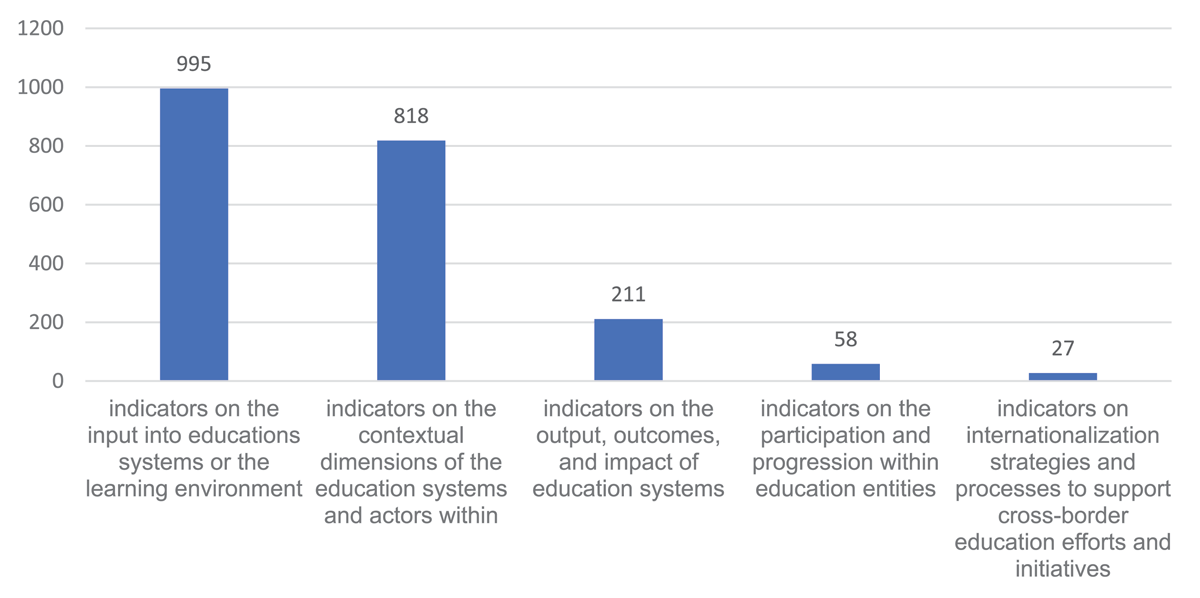
Figure 1
Code Reference Total Counts By Indicator.
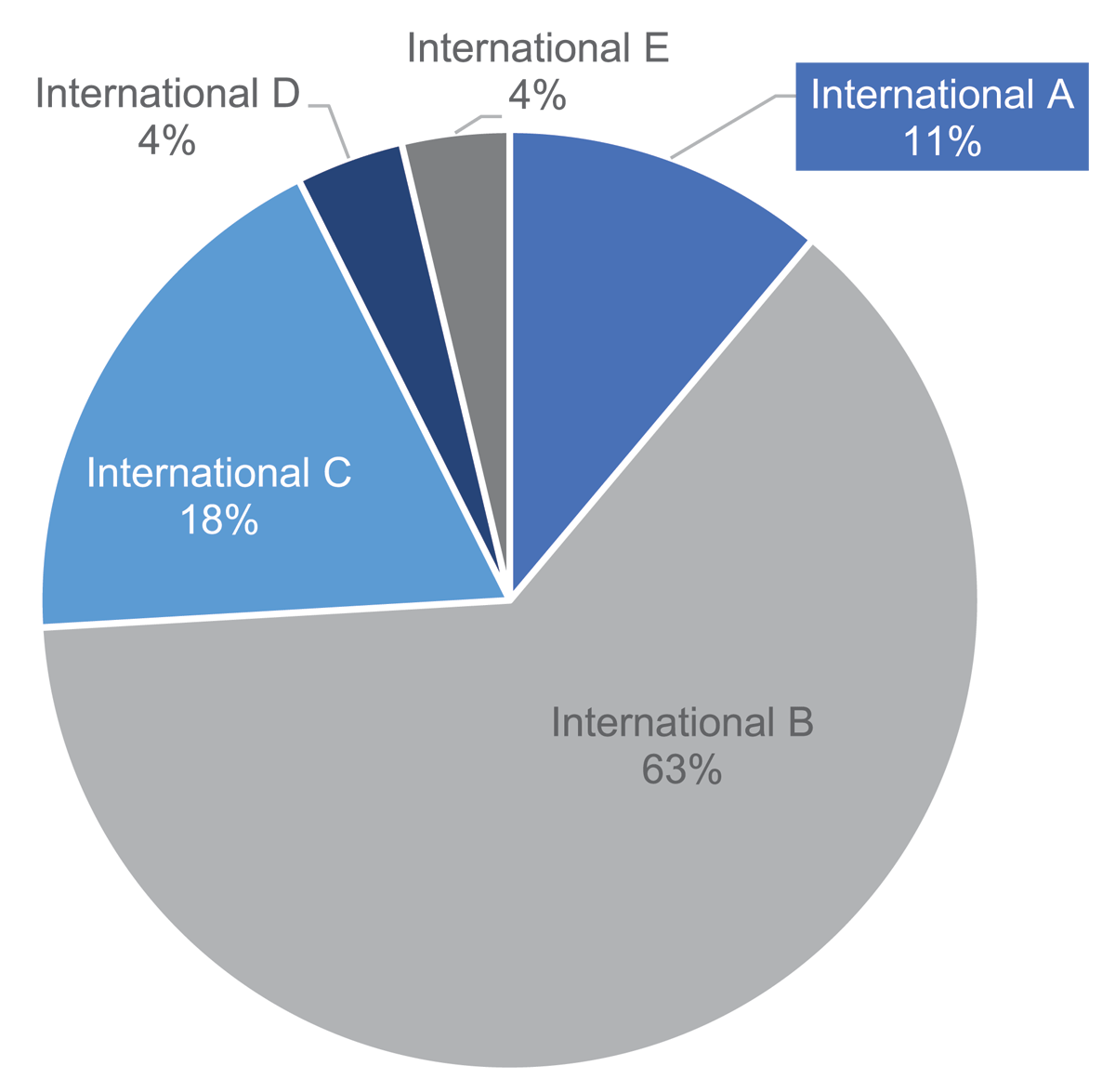
Figure 2
Internationalization Indicators By Quality Assurance Framework.
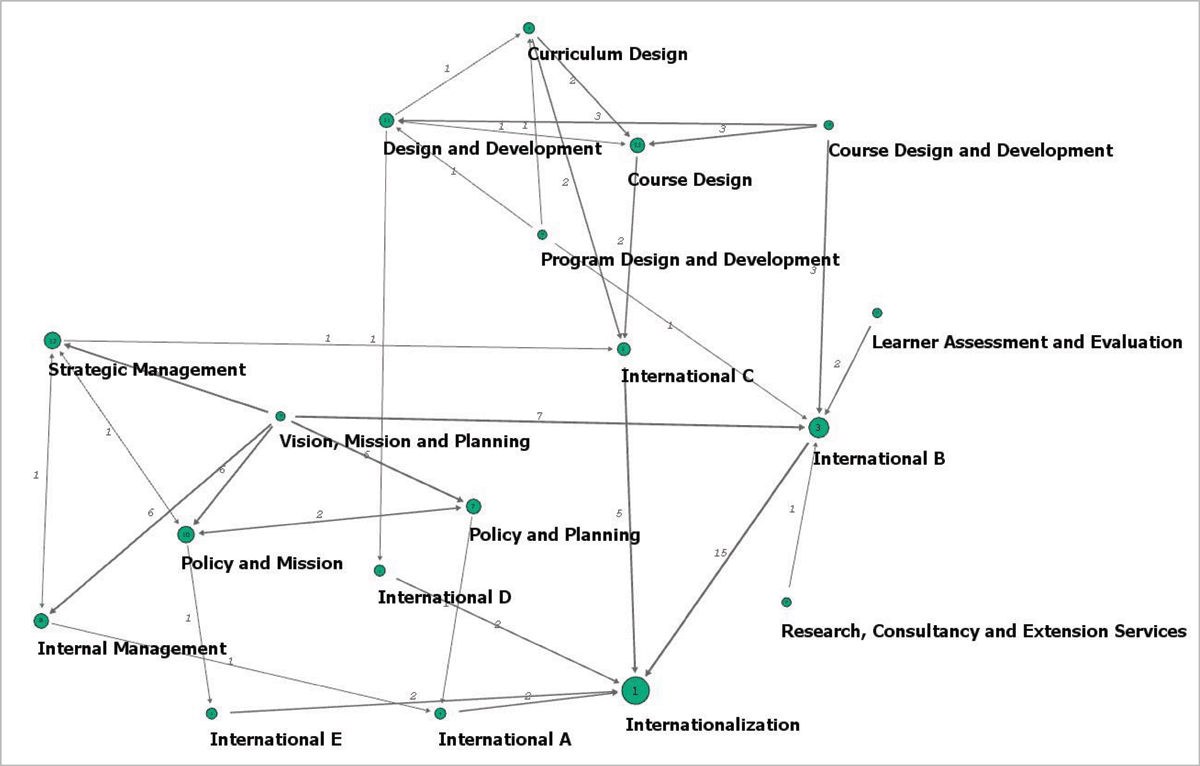
Figure 3
Network Analysis of Internationalization Indicators.
Note: Internationalization is the centrality node connected to all international quality assurance frameworks. The number on the lines represents the weight of the dimension related to the framework. Relationships are concentrated in leadership dimensions and learning design dimensions. Two outliers are present, learner assessment and evaluation, and research, consultancy and extension services.
Appendix A
The document matrix of the 25 most frequent words in the five quality assurance frameworks.
| KEYWORD | A | B | C | D | E | TOTAL FREQUENCY | WEIGHT PERCENTAGE |
|---|---|---|---|---|---|---|---|
| institution | 155 | 230 | 81 | 5 | 17 | 488 | 0.028099269 |
| learning | 21 | 82 | 78 | 112 | 52 | 345 | 0.019865262 |
| students | 19 | 23 | 90 | 130 | 0 | 262 | 0.015086083 |
| staff | 32 | 99 | 61 | 34 | 13 | 239 | 0.013761732 |
| learners | 46 | 128 | 15 | 0 | 13 | 202 | 0.011631255 |
| assessment | 23 | 53 | 33 | 77 | 8 | 194 | 0.011170611 |
| support | 16 | 60 | 58 | 37 | 20 | 191 | 0.01099787 |
| course | 18 | 60 | 64 | 40 | 8 | 190 | 0.010940289 |
| student | 8 | 14 | 51 | 100 | 0 | 173 | 0.009961421 |
| development | 13 | 45 | 48 | 21 | 11 | 138 | 0.007946105 |
| academic | 7 | 56 | 13 | 45 | 2 | 123 | 0.007082398 |
| appropriate | 10 | 45 | 32 | 30 | 3 | 120 | 0.006909656 |
| quality | 13 | 41 | 7 | 37 | 8 | 106 | 0.00610353 |
| providers | 0 | 2 | 3 | 100 | 0 | 105 | 0.006045949 |
| courses | 12 | 22 | 28 | 24 | 18 | 104 | 0.005988369 |
| activities | 9 | 37 | 27 | 24 | 5 | 102 | 0.005873208 |
| ensure | 18 | 32 | 3 | 46 | 2 | 101 | 0.005815627 |
| online | 0 | 1 | 59 | 0 | 38 | 98 | 0.005642886 |
| design | 6 | 29 | 29 | 25 | 3 | 92 | 0.005297403 |
| research | 10 | 34 | 13 | 33 | 0 | 90 | 0.005182242 |
| information | 6 | 36 | 27 | 18 | 1 | 88 | 0.005067081 |
| elearning | 0 | 0 | 85 | 0 | 0 | 85 | 0.00489434 |
| outcomes | 1 | 26 | 16 | 33 | 9 | 85 | 0.00489434 |
| needs | 20 | 29 | 13 | 18 | 2 | 82 | 0.004721598 |
| programmes | 0 | 44 | 18 | 1 | 19 | 82 | 0.004721598 |