
Introduction
The acceleration of globalization is forcing higher education to increase its participation in international partnerships. In response, institutions integrate internationalization practices to mobilize academic services and resources across borders to address micro- (e.g., program and institutional enrollment), meso- (e.g., accreditation recognition), and macro (e.g., globalization) -level demands. One of these practices is transnational distance education which leverages innovative communication technologies to enable learners to traverse across geographical borders without leaving their physical location or country to continue their education (Altbach & Knight, 2007). As more stakeholders engage in global cooperation and transnational distance education, higher education institutions require quality assurance frameworks to support effective practices, decision-making, and continuous improvement to meet intended learning outcomes and culturally-diverse expectations. Despite the exponential growth in open, online, and flexible education and the internationalization of higher education over the past few decades, there is a significant dearth in the research, measurement and practice of international quality dimensions and learning outcome indicators. To meet this growing demand, Jung (2022) highlights the urgent need to develop holistic quality assurance frameworks that address global and local learning outcomes. In an effort to support this call to action, this study sought to articulate the relationships among quality indicators from five internationally accepted frameworks to establish a quality dimension typology to support transnational distance education internationalization efforts.
As the forces of globalization continue to shorten the time and distance between learners and educational providers during the knowledge era, higher education institutions are positioned to enhance international cooperation and emphasize the importance of quality provision in transnational education (Vincent-Lancrin et al., 2015) and internationalization efforts (de Wit, 2020; Knight, 2016). In 2015, the United Nations Education, Scientific and Cultural Organization (UNESCO) encouraged intergovernmental organizations, governments, higher education institutions, academic staff, and student stakeholders to engage in global collaboration for equitable, accessible and quality learning outcomes (UNESCO, 2015). In order to meet the political and societal demands for more inclusive education, universal stakeholders identified open, online, and flexible education as an essential strategy. Additionally, international associations such as the International Council for Open and Distance Education (ICDE) and intranational organizations, including UNESCO, project that over 414.2 million students will be enrolled in higher education by 2030, a significant increase from 99.4 million enrollments in 2000, with many of those enrolled learning online (Guo et al., 2019; OECD, 2019; Ossiannilsson et al., 2015; UNESCO, 2019). This significant growth will accelerate transnational and internationalization efforts to support access and demand for higher education. Also, this acceleration challenges political, social, cultural and economic systems with the import and export of how stakeholders define quality learning experiences across geographical boundaries.
As institutions expand their capacity to open, online and distance learning modalities to support access to higher education, ICDE reinforces that “improving the quality of student experiences is more than ever extremely important” (Ossiannilsson et al., p. 6, 2015). In order to address this challenge, this study presents a conceptual typology to reduce the complexity of five international quality assurance frameworks framed by evaluation criteria defined by the Organization for Economic Co-Operation and Development (OECD). This preliminary research utilizes content analysis to organize networks of concepts and capture the dimensions of quality criteria for internationalization efforts in transnational distance education.
Literature Review
Due to recent technological innovations, globalization has enabled the flow of knowledge across cultures for economic, political, and societal interdependence (Altbach & Knight, 2007; Castells, 2011). As defined by Marginson and Rhoades (2002), globalization is “the development of increasingly integrated systems and relationships beyond the nation” (p.288). Globalization is not a new concept; it is a complex phenomenon transforming educational policy, practice and strategic plans (Torres, 2015). Higher education is a significant agent of globalization that not only develops technological innovations but also is a primary consumer subject to the limitations of technological innovations (Välimaa & Hoffman, 2008). These technological innovations require leaders and decision-makers to restructure the institutional fabric of higher education and influence the efforts of academic and administrative personnel to meet political and social responsibilities crucial to the development of global information societies (OECD, 2007; Ossiannilsson, 2018; UNESCO, 2005). As we continue to see significant increases in the movement of people, programs, institutions, research, and services across national borders at an unprecedented pace, OECD projects new models of internationalization practices are needed that will transform the trajectory of higher education (Vincent-Lancrin et al., 2015).
Internationalization
Internationalization is the academic mobility of people, programs, providers, policies and projects that traverse across geographic boundaries in response to globalization (Knight & de Wit, 2018). Scholars consider internationalization a dynamic practice that institutions engage with based on social, cultural, political, and economic motivations to provide access to higher education in international contexts (Altbach & Knight, 2007; de Wit, 1999; Gao, 2019). Internationalization practices incorporate a broad spectrum of mobility models, including study-abroad programs, branch campuses, targeted recruitment of international students for financial incentives, and distance learning programmes (Youssef, 2014). These practices, according to Qiang (2003), “…must be entrenched in the culture, policy, planning and organizational process of the institutions so that it can be both successful and sustainable” (p. 257–258). Due to the holistic requirements to support internationalization practices effectively, institutions must integrate a global dimension to policy, practice, service, and research in alignment with institutional goals and infrastructures (Knight, 2011). Internationalization is implemented internally across all stakeholder groups and through a distributed, international learning network supported by globalized universities and educational policy (Armengol, 2002). Institutions that engage in an international network embrace and incorporate knowledge from other countries and cultures into their local and global practices, thereby improving academic quality and increasing access.
Transnational Distance Education
Online transnational distance education is an innovative internationalization strategy and emerging learning model to address the forces of globalization in higher education. For the purposes of this study, transnational distance education refers to enabling international learners to pursue educational opportunities through internet technologies without physically relocating to the country of the educational provider (Bannier, 2016; British Council, 2013). With a focus on access and equity, internet technologies can transform education availability, affordability, and accessibility across borders and cross-cultural contexts (Daniel et al., 2005). Without the context of internet-enabled learning, transnational education is an internationalization strategy that multilateral agencies and scholars often refer to as “cross-border” (UNESCO, 2005; Knight, 2003), “off-shore” (Bohm, 2000; National Tertiary Education Union, 2004; Chapman & Pyvis, 2006) “borderless” (Cunningham & Training, 1998; Middlehurst, 2002), or “student mobility” (OECD, 2004) education (British Council, 2013). In 2002, the Lisbon Recognition Convention defined transnational education as “all types of higher education study programmes, or sets of courses of study, or education services in which the learners are located in a country different from the one where the awarding institution is based.” Current trends denote an emergence in transnational terminology with a concentration on cultural comparisons, teaching and learning practices, and complex processes that transcend one-dimensional views of traversing geographical boundaries (Kosmützky & Putty, 2016).
Quality Dimensions
As global online learning opportunities expand, concerns regarding quality assurance and cultural compromise dominate transnational initiatives (Bannier, 2016; Walsh, 2019). Unfortunately, economic factors often outweigh social, political, and academic motivations to compete for student enrollment in a globally engaged institution, resulting in low-quality experiences and providers (Youssef, 2014). Due to the commercialization of higher education or the pursuit of financial profits over quality learning outcomes, unaccredited online institutions or “degree mills” may fulfill the educational access gap (Knight, 2011; Piña, 2010). This situation leaves vulnerable recipients, often from countries without a national or regional quality assurance system, at risk of receiving unaccredited degrees or completing their program of study underprepared and underrecognized to contribute to their localized workforce. Therefore, it is pertinent that quality assurance systems guide, measure, and enhance services, practices, and scholarship for higher education institutions engaged in transnational distance education and nations responding to the forces of globalization.
Globally, higher education lacks a standard definition of quality and does not have a common metric to evaluate systematic assurance practices (Vincent-Lancrin et al., 2012). Without consensus on quality dimensions at the macro-level, intergovernmental agencies, including UNESCO and the OECD, have tried to address the need and created guidelines to encourage transnational higher education (Stella, 2006). Specifically, UNESCO and OECD recommended that cross-border quality assurance practices should be transparent in national policies and institutional procedures, promote diverse learning models, protect individuals engaging in the learning experience, ensure information is accessible to an international audience and increase collaboration across all stakeholder groups. In a follow-up report, OECD suggested that effective quality assurance systems require a supportive legal framework that enables institutions to comply without government oversight (Vincent-Lancrin & Pfotenhauer, 2012). Without national quality control, independent third-party providers may fulfill the need in situations and national contexts where national quality assurance mechanisms are deficient or nonexistent. In recent trends, national governments are responding and taking the lead in defining quality rather than third parties, including accreditation agencies (Eaton, 2017). This shift narrows the scope of quality to outcomes-based variables, such as graduation, employment placement and financial freedom.
A shift to an outcomes-based approach to define quality is consistent in distance education literature as well. Scholars recognize a dearth of research capturing an integrated, system-view of measurable quality dimensions in online distance education (Scull et al., 2011; Tait, 1993) and suggest future research focused on quality outputs and outcomes, not only quality inputs and processes, to develop benchmarks, standards, frameworks, and models (Esfijani, 2018; Jung, 2022; Latchem, 2014). However, defining quality is highly contextual by individual nations and government agencies (Guo et al., 2019; Middlehurst & Woodfield, 2006). The same can be true in open, online, and flexible learning models. For example, the ICDE Quality Network strives to centralize multicultural perspectives and value systems to assess the impact of growth in distance education across the globe (Tait et al., 2022). However, the spectrum of quality practices and indicators is diffuse and presents itself through various forms of certification, accreditation, benchmarking, and quality assurance processes at all systems levels (Ossiannilsson et al., 2015).
In this vast and rapidly evolving landscape of quality in education, transnational online distance education providers should develop integrated policies and quality assurance strategies focused on equity, access, workforce relevance and social development to protect and benefit from international partnerships (Smith, 2010; Tait & O’Rourke, 2014). Additionally, globally engaged institutions should embrace dynamic internationalization performance measurement strategies in order to provide quality learning experiences and outcomes. These strategies may include reflective practice through culturally relevant evaluations and consistent feedback loops for all stakeholders (Darojat et al., 2015; Gao, 2019; Jung, 2011; Shelton, 2010). In an effort to connect multiple concepts in this complex landscape, this research aimed to delineate and address, what are the quality dimensions to support internationalization efforts for transnational distance education?
Methodology
Defining quality in online distance education is a challenge because it holds different meanings for different distance learning stakeholders and is dependent on individual paradigms regarding the educational process (Garrison, 1993; Gift & Bell-Hutchinson, 2007; Hazelkorn et al., 2018; Jung & Latchem, 2007; Jung et al., 2013). In order to determine what quality means to support internationalization efforts for transnational distance education, this study cross-examined quality indicators by employing a content analysis approach to distill international indicators and variables (Darojat et al., 2015; Esfijani, 2018; Martin et al., 2017).
Framework Sampling
For this study, five internationally accepted quality assurance frameworks were reviewed, including the Asian Association of Open Universities (AAOU), the Commonwealth of Learning (COL), the European Association of Distance Teaching Universities (EADTU), the Quality Assurance Agency (QAA), and the International Institute of Online Education with UNESCO (IIOE). All frameworks were anonymized to reduce bias. The selection of frameworks was identified by geographical region, contextualized for institutional-level implementation, accessible in the English language, developed by stakeholders internationally dispersed throughout the geographical region they represent, and inclusive of distance learning modalities. Additionally, the African Council for Distance Education (ACDE) adopted the COL framework; thereby, the COL framework represents Commonwealth countries and distance education providers in Africa. To illustrate the data corpus used in this study, Table 1 summarizes the total count of word frequency for each international quality framework analyzed. This research studied a total of 17,348 words from five quality assurance frameworks. Also, Appendix A presents the 25 most frequent words in the five quality assurance frameworks.
Content Analysis
Scholars in the field of distance education have identified content analysis as an opportunity to further research. For example, Esfijani (2018) recommends that “content analyzing of the detailed quality factors in the existing body of knowledge might help to extract the quality factors that have perceived importance globally” (p. 70). Since the 1940s, researchers have categorized a diversity of content analysis techniques utilized to study trends, relations, transformations, patterns, differences, standards, evaluation, judgement, frequency, linguistic representations, conversations, and institutional processes by relating textual matter to social realities (Berelson, 1952; Krippendorff, 2018). According to Krippendorff (2018), content analysis requires unitizing text-driven research designs to conceptualize meaning to inquiry objectively. By explicitly operationalizing the context of the body of text through a network of stable correlations or contributing conditions in an analytical construct to ensure reliability and reduce bias (Berelson, 1952; Stemler, 2000), content analysis was deemed the most appropriate method for this study.
In order to objectively unitize international quality frameworks, I used a deductive, structural coding method (Saldaña, 2016) informed by evaluation definitions and criteria from OECD (2021) to establish key dimensions and organize complex networks of concepts (Jaakkola, 2020; MacInnis, 2011). Developing an organizational typology aims to create the necessary conditions for researchers to empirically test and evaluate complex theories (Doty & Glick, 1994). Additionally, Creswell and Cresswell (2018) claim that deductive reasoning enables researchers to test research questions in order to interpret and operationalize variables for measurement. Therefore, a deductive codebook informed by OECD’s Education at a Glance 2021: OECD Indicators annual report was employed to predict variance in dependent variables from the international quality frameworks data sample.
The Education at a Glance report serves as the authoritative source for global education statistics used to evaluate and monitor the performance of educational systems, and evaluation is a strategy that can inform quality dimensions (Irele, 2013; Pawson, 2013). Five categories were classified in the report to understand the complex relationship between international quality criteria and global evaluation metrics. The first category pertains to indicators of the contextual dimensions of the education systems and actors within. The second category includes indicators of the input into education systems or the learning environment. The third category focuses on internationalization strategies and process indicators to support cross-border education efforts and initiatives. The fourth category entails indicators of the participation and progression within education entities. Finally, the fifth category describes education systems’ output, outcomes, and impact indicators. All categories were coded and tabulated in Nvivo12 for analysis. Then, anonymized data was extracted from Nvivo software to R Studio for further interpretation to delineate the quality dimensions to support internationalization efforts for transnational distance education.
Findings and Discussion
This study analyzed five international quality frameworks and organized indicators into five categories based on OECD’s Education at a Glance Report (2021) in the content analysis and reported through descriptive and qualitative analysis. In a synthesis across frameworks which resulted in the analysis of 2109 coded references, only 27 were interpreted as internationalization strategies and processes to support transnational education efforts and initiatives. This section explores critical findings to address the research question: What are the quality dimensions to support internationalization efforts for transnational distance education?
Quality Dimensions for Internationalization
The first finding addresses the research question; 27 quality dimensions were identified to support internationalization efforts for transnational distance education. Table 2 presents the 27 quality dimensions of internationalization indicators deduced verbatim from the five international quality assurance standards employed in this study.
Table 2
Internationalization Indicators in International Quality Assurance Frameworks.
| INDICATORS | FRAMEWORK | |
|---|---|---|
| 1. | The institution has a clear policy statement of non-discrimination in genders and geographical/regional distributions for all the affairs and activities of the institution, including admissions, registration, and length of study | International A |
| 2. | The institution has a well-defined vision and mission statement, which incorporates the internal and external educational environment, its potential, national development agenda, and international trend in education | International A |
| 3. | The institution cooperates with relevant domestic and/or overseas organizations | International A |
| 4. | The institution has a stated vision and mission that is supported by specific and clearly defined goals and objectives within the context of national development priorities and the latest international trends in education | International B |
| 5. | The institution demonstrates its drive to develop itself into a Centre of Excellence and to maintain nationally and internationally comparable and acceptable standards | International B |
| 6. | The vision and mission reflect the latest international trends in education | International B |
| 7. | The institution publishes clear policies on the admission of local and overseas students | International B |
| 8. | The institutional plans and policies reflect national and international concerns | International B |
| 9. | Quality management mechanisms are in place at the institution to ensure that the content offered by external providers is of good quality and meets the national and institutional quality criteria | International B |
| 10. | The institutional plans and policies are continuously updated to meet national and international requirements | International B |
| 11. | The institution publishes clear policies on the admission of local and overseas students | International B |
| 12. | Quality management mechanisms are in place at the institution to ensure that the content offered by external providers is of good quality and meets the national and institutional quality criteria | International B |
| 13. | The offer of programmes is determined in response to national needs and reflects global trends | International B |
| 14. | Course design is focused on national and international priorities and trends and the needs of prospective learners and employers | International B |
| 15. | Mechanisms for adoption and adaptation are established to encourage linkages with national and international agencies for course design, development and delivery | International B |
| 16. | There are MOUs with national and international agencies to share good quality materials which demonstrate good practice in course design, review of materials, development and delivery | International B |
| 17. | The institution has linkages with national and international agencies to exchange expertise for content development and delivery methods | International B |
| 18. | Assessment is an essential feature of the teaching and learning process, is properly managed, and reflects institutional, national and international standards | International B |
| 19. | National and international benchmarks guide assessment | International B |
| 20. | The institution has strong links to and collaborates with various international, national, governmental and non-governmental agencies in undertaking research | International B |
| 21. | There are exchange agreements with other educational institutions providing e-learning programmes, and interoperabilities have been agreed and set out with these providers | International C |
| 22. | All programmes have a modular structure, and courses have credit points that are consistent with national and European norms | International C |
| 23. | The credit transfer system is aligned with national and European systems of credit transfer and operates bi-directionally | International C |
| 24. | Pre-requisites and student learning outcomes are developed within an institutional or national framework, facilitating student mobility between courses, departments and institutions | International C |
| 25. | Course materials comply with national and European standards on accessibility | International C |
| 26. | There are partnerships and collaborations with other institutions and organisations (e.g. HEIs, educational enterprises, international organisations, etc.) to support online and blended learning | International D |
| 27. | The credibility of courses is anchored in recognised national and European frameworks, applicable PSRB requirements and degree-level Apprenticeship Standards. These reference points help to maintain sector-recognised standards by offering consistency across the range of provision. Providers also develop and use internal guidance against which courses are designed, developed and approved | International E |
The second finding is that most quality assurance indicators in quality assurance frameworks are primarily input indicators (n = 995) and focused on contextual dimensions (n = 818).
Additionally, the total count of outcome and output indicators (n = 211) suggests that most frameworks are input-driven rather than outcome-focused. Regarding the document matrix presented in Appendix A, many of the word count frequencies are related to actors within the system, suggesting a strong alignment to the context dimension. Notably, indicators on the participation and progression quality dimension (n = 58), often related to student support systems, appeared significantly less than contextual and input quality indicators. Finally, with a particular focus on the aim of this study, indicators on internationalization strategies and processes (n = 27) were referenced the least of all indicators. Figure 1 presents the total counts of each category for interpretation.
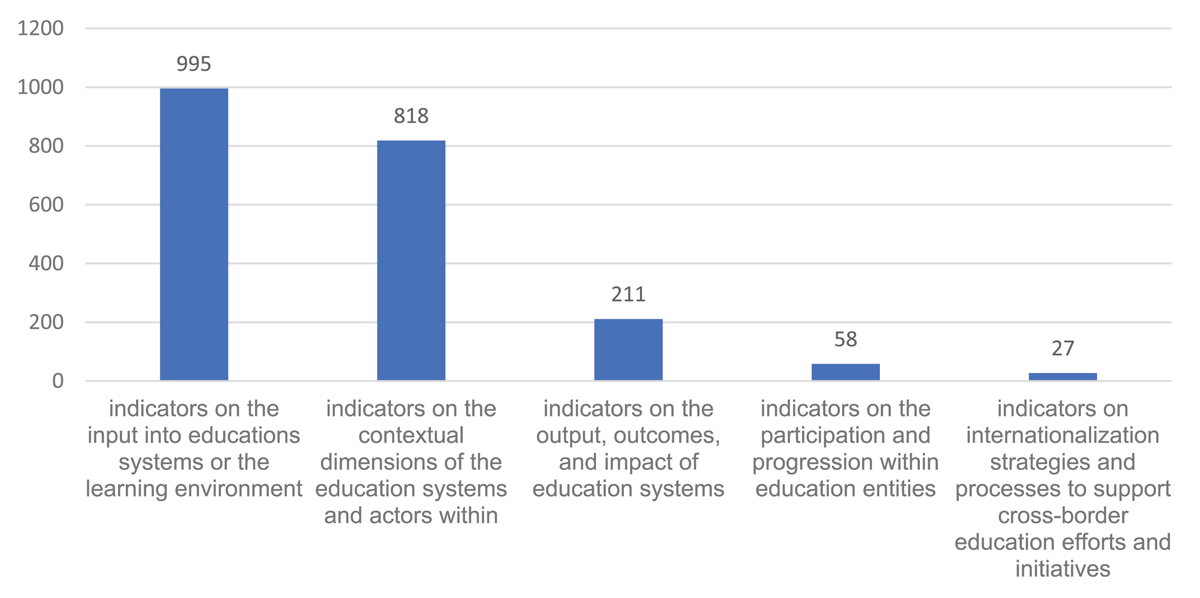
Figure 1
Code Reference Total Counts By Indicator.
The third finding, as demonstrated in Figure 2, suggests that the International B framework provides the majority (58%) of the internationalization indicators; however, this framework is also the most extensive dataset. Additionally, although based on a significantly smaller dataset, the International A framework makes up (13%) of the internationalization quality dimensions.
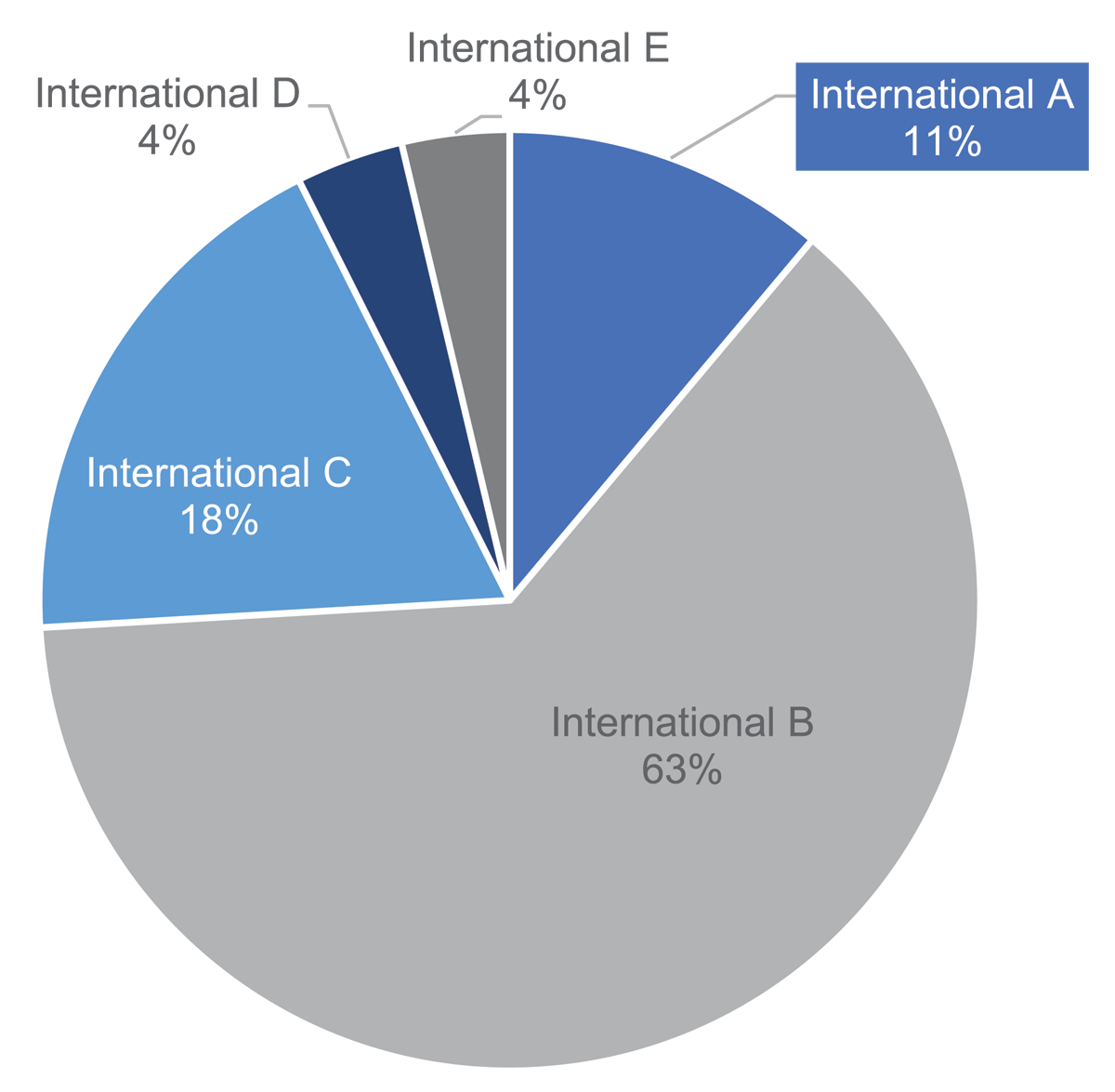
Figure 2
Internationalization Indicators By Quality Assurance Framework.
The fourth finding takes a critical focus on understanding the relationship of internationalization indicators within the schema of the frameworks. In this regard, each international quality framework is organized with a unique schema to categorize a set of quality dimensions, statements of expectations and practice, descriptions of assessment areas, guiding principles, or components and subcomponents. Therefore, Figure 3 demonstrates the location of the internationalization indicators within their frameworks and the interconnectedness between frameworks to develop a visual typology. Furthermore, by applying the Fruchterman-Reingold Layout to reduce the system’s energy through the placement of vertices to achieve equilibrium (Fruchterman and Reingold, 1991), the network analysis illustrates the degree of quality dimensions. All frameworks host internationalization indicators across categories such as course, curriculum and program design, and leadership functions, including strategic planning and policy management. Additionally, the International B framework offered internationalization strategies in two outlier categories: learner assessment and evaluation, and research, consultancy, and extension services. Notably, the categories that integrate internationalization indicators appear to have a stronger correlation with input and context indicators rather than progression and output indicators.
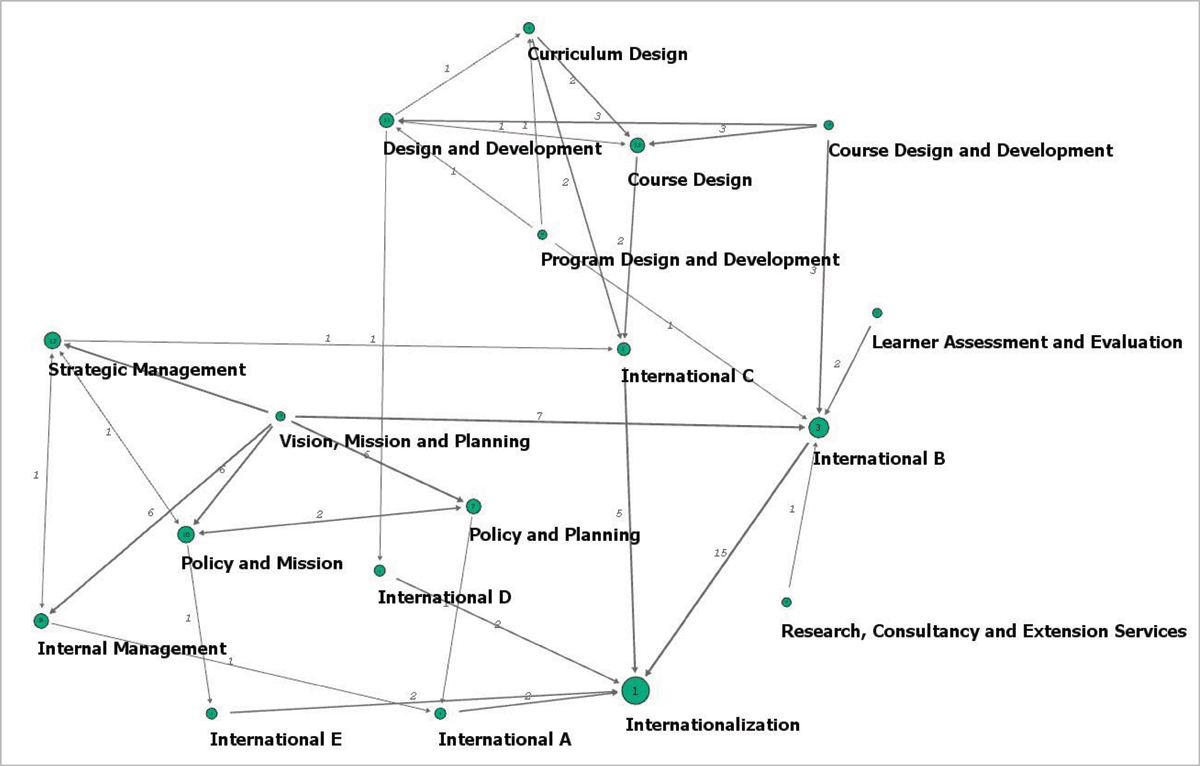
Figure 3
Network Analysis of Internationalization Indicators.
Note: Internationalization is the centrality node connected to all international quality assurance frameworks. The number on the lines represents the weight of the dimension related to the framework. Relationships are concentrated in leadership dimensions and learning design dimensions. Two outliers are present, learner assessment and evaluation, and research, consultancy and extension services.
Discussion
There is an opportunity for international quality assurance frameworks to address the growing need for internationalization strategies and practices in distance education. From the analysis, only 1.3% of criteria and indicators from the five quality assurance frameworks could be interpreted as internationalization strategies and processes to support transnational education efforts and initiatives according to OECD performance indicators. However, some may argue that quality indicators and practices should be considered generalizable and inclusive to all distance education models, not just transnational distance education, to support internationalization strategies. Additionally, internationalization and transnational distance education may not be a priority for all world regions or contexts. Instead, the quality assurance frameworks utilized in this sample may have been developed as a tool for institutions to meet and address localized needs, such as developing a systems infrastructure and increasing capacities for national student enrollment. Therefore, more research and transparent reporting are needed to improve the socio-cultural understanding and context shaping the development and creation of the international quality assurance frameworks.
As evident in the results, the majority of criteria and indicators for quality distance education are focused on system inputs and address areas such as resources invested in educational content and facilitation, actors within the system, and infrastructure. This finding is problematic as institutions require guidance on monitoring their relationship to the effects of output, outcome, and impact indicators for the greater good. Also, institutions must be able to evaluate system components to assess continuous improvement efforts and resource allocation (Gao, 2019; Knight, 2007; Maringe, 2010).
Drawing from the extant literature, scholars, policymakers, and practitioners argue for an outcome-based quality assurance framework, which is not apparent in the frameworks analyzed in this study (Darojat et al., 2015; Gao, 2019; Gift & Bell-Hutchinson, 2007; Latchem, 2014; Scull et al., 2011; Shelton, 2010; Tait, 1993). However, some scholars advocate for a more holistic, systemic perspective (Esfijani, 2018; Jung, 2011, 2022; Zawada, 2019). Situated in foundational literature, Moore and Kearsley (2011) summarize that an online distance education system is complex and requires leaders to take a systems approach to understand the interrelationships between system components in terms of inputs and outputs to be successful in practice. Additionally, Esfijani (2018) acknowledges “a need for a holistic approach to consider quality factors in different aspects, that is inputs, resources, processes, outputs and outcomes” (p. 69) rather than input-driven quality indicators and criteria. Consequently, there is an opportunity for a global partnership of scholars, practitioners and critical stakeholders to co-construct a more outcome-oriented approach to quality in online distance education and establish a universal framework for localization in national and institutional circumstances.
Finally, by taking a conceptual approach to understanding the relationship between international quality framework schemas, the network analysis illustrates that internationalization indicators are embedded within leadership functions and learning design. Internationalization is not an isolated process, strategy or set of activities but “a system in line with international standards” (Qiang, p.250, 2003). Knight (1997) recommends that international perspectives must be systematically integrated across an institution. However, the findings indicate that internationalization indicators appear to be centralized in macro-and micro-level organizational structures and not representative of a holistic system. By definition, internationalization in higher education is the flow of students, faculty, administration, research, innovation, service, and practice across borders. Accordingly, a structurally aligned quality assurance framework should have internationalization indicators threaded throughout the corpus of components, including learner support systems, human resources, research and scholarship, infrastructure, community and outreach, work-based learning, and performance evaluation. Perhaps this suggests that not all stakeholders’ perspectives are integrated or represented in the creation of these frameworks, which may pose challenges for institutions aiming to evolve into an open, internationally networked university (Agre, 2000; Standaert, 2012; de Wit, 2010) ingrained across political, economic and academic sectors to support lifelong learning (Hedge & Hayward, 2004), 21st-century competencies (Voogt et al., 2013) and global citizenship (Torres, 2015) in accordance to the implementation of Sustainable Development Goal 4 (UNESCO, 2015).
Conclusion
There is a need for intentional and purposeful integration of internationalization indicators to guide institutions with a system-view of measurable quality dimensions in transnational distance education (Gao, 2019; Yesufu, 2018). Informed by five internationally recognized quality assurance frameworks, only 1.3% of indicators were identified as internationalization quality dimensions, with the majority of indicators coded as systems inputs, not as systems outputs. Therefore, this study builds on previous literature, suggesting that more research is necessary to measure the results of system inputs and processes to create valid instruments to inform quality. By identifying system inputs and outputs and incorporating indicators into an evaluative framework, institutions can self-assess or engage in a quality certification process to determine their performance and improve practice (Jung & Latchem, 2007; Jung, 2022; Maringe, 2010; Zuhairi et al., 2020).
In addition to building on previous literature, this study addresses “the next leap in distance learning” (Bruhn-Zass, 2022, p.253), or transnational distance education, to elevate the need for internationalization performance measurement strategies. Although a complex process to establish international consensus (Tait et al., 2022) across socio-cultural value systems, Gacel-Ávila (2005) suggests that global performance measurement can only be effective if it moves beyond national borders and is adopted internationally. Therefore, this study addressed the research question, what are the quality dimensions to support internationalization efforts for transnational distance education and identified 27 internationalization indicators from five international quality assurance frameworks supporting distance education modalities. This study is an effort to develop an internationalization quality typology to support transnational distance education, and this article illustrates the complex dimensions of the findings. The findings suggest that more purposeful partnerships across all stakeholder groups and sectors are necessary to create quality dimensions to prepare learners for a globalized workforce and lifelong learning. Future research is needed to test and measure quality dimensions to determine the impact of the value gained from transnational student engagement at the higher education institution and on socio-economic benefits within local communities and cultures. Finally, the global pandemic has served as an innovative disruptor and catalyst for higher education institutions and prospective students to consider new learning models and opportunities. Therefore, transnational online distance education and internationalization efforts will continue to expand as globalization brings us closer together. In order to support the acceleration of internationalization in higher education and support successful outcomes across borders, educators, policymakers, and learners need practical guidelines to guide decision-making and continuous improvement efforts for quality transnational distance education.
Appendices
Appendix A
Appendix A
The document matrix of the 25 most frequent words in the five quality assurance frameworks.
| KEYWORD | A | B | C | D | E | TOTAL FREQUENCY | WEIGHT PERCENTAGE |
|---|---|---|---|---|---|---|---|
| institution | 155 | 230 | 81 | 5 | 17 | 488 | 0.028099269 |
| learning | 21 | 82 | 78 | 112 | 52 | 345 | 0.019865262 |
| students | 19 | 23 | 90 | 130 | 0 | 262 | 0.015086083 |
| staff | 32 | 99 | 61 | 34 | 13 | 239 | 0.013761732 |
| learners | 46 | 128 | 15 | 0 | 13 | 202 | 0.011631255 |
| assessment | 23 | 53 | 33 | 77 | 8 | 194 | 0.011170611 |
| support | 16 | 60 | 58 | 37 | 20 | 191 | 0.01099787 |
| course | 18 | 60 | 64 | 40 | 8 | 190 | 0.010940289 |
| student | 8 | 14 | 51 | 100 | 0 | 173 | 0.009961421 |
| development | 13 | 45 | 48 | 21 | 11 | 138 | 0.007946105 |
| academic | 7 | 56 | 13 | 45 | 2 | 123 | 0.007082398 |
| appropriate | 10 | 45 | 32 | 30 | 3 | 120 | 0.006909656 |
| quality | 13 | 41 | 7 | 37 | 8 | 106 | 0.00610353 |
| providers | 0 | 2 | 3 | 100 | 0 | 105 | 0.006045949 |
| courses | 12 | 22 | 28 | 24 | 18 | 104 | 0.005988369 |
| activities | 9 | 37 | 27 | 24 | 5 | 102 | 0.005873208 |
| ensure | 18 | 32 | 3 | 46 | 2 | 101 | 0.005815627 |
| online | 0 | 1 | 59 | 0 | 38 | 98 | 0.005642886 |
| design | 6 | 29 | 29 | 25 | 3 | 92 | 0.005297403 |
| research | 10 | 34 | 13 | 33 | 0 | 90 | 0.005182242 |
| information | 6 | 36 | 27 | 18 | 1 | 88 | 0.005067081 |
| elearning | 0 | 0 | 85 | 0 | 0 | 85 | 0.00489434 |
| outcomes | 1 | 26 | 16 | 33 | 9 | 85 | 0.00489434 |
| needs | 20 | 29 | 13 | 18 | 2 | 82 | 0.004721598 |
| programmes | 0 | 44 | 18 | 1 | 19 | 82 | 0.004721598 |
Acknowledgements
The creation and development of this manuscript would not have been possible without the guidance, mentorship, and exceptional support from my supervisor, Dr. Pamela Walsh. I am grateful for the generosity and expertise of my dissertation committee, Dr. Mohamed Ally, Dr. Tian Belawati, and Dr. Cindy Ives, for their insightful collaboration.
Competing Interests
The author has no competing interests to declare.