
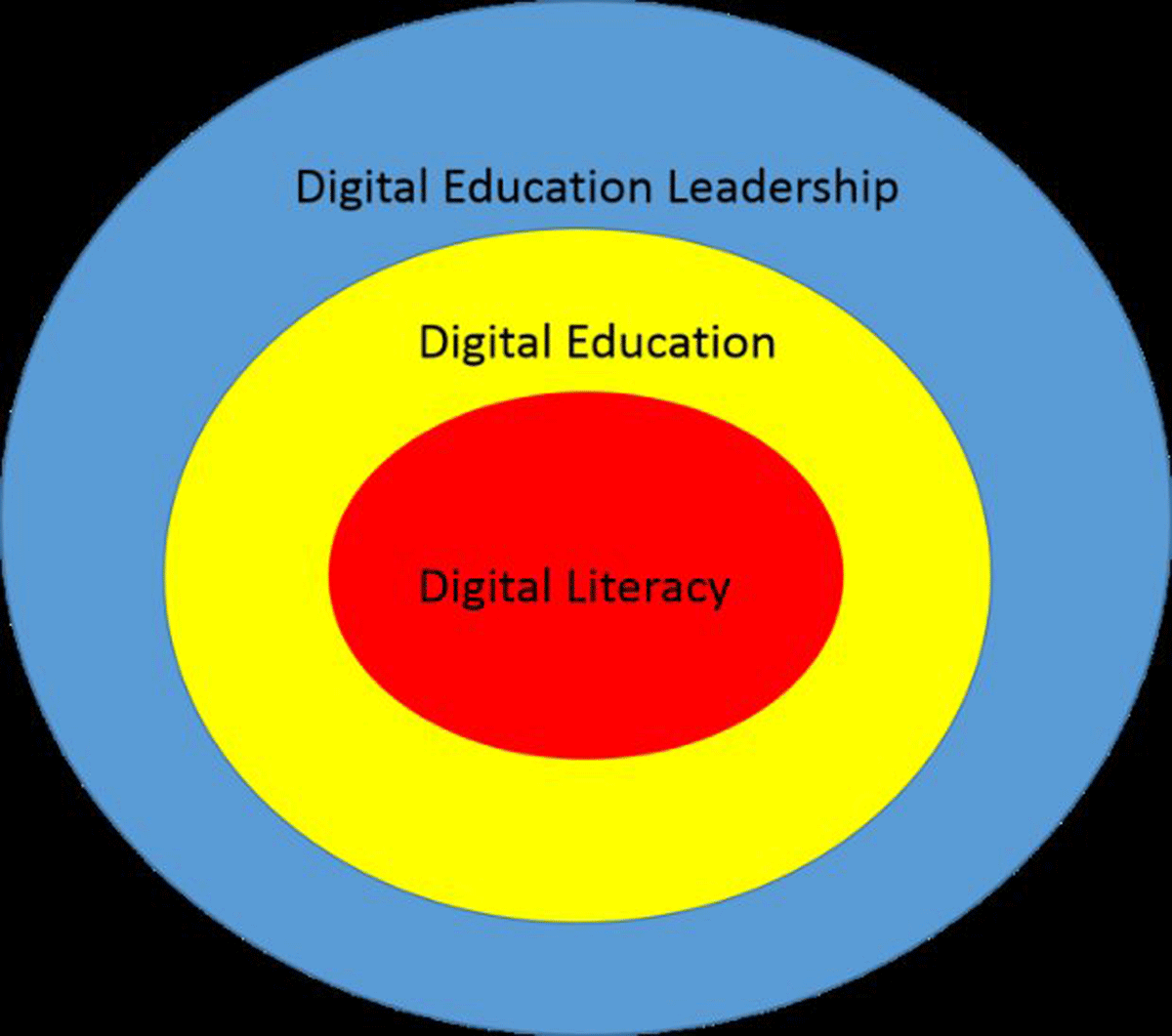
Figure 1
A holistic view of digital education leadership.
(Source: Brown et al. 2016, p. 10; Attribution: CC BY-SA).
Table 1
Participant Teachers’ Distribution.
| MEDIUM | GENDER | ||||
|---|---|---|---|---|---|
| PROGRAMME | SINHALA | TAMIL | ENGLISH | MALE | FEMALE |
| PGDE | 10 | 07 | – | 9 | 8 |
| PGDBE | – | – | 16 | 3 | 13 |
| TOTAL | 10 | 07 | 16 | 12 | 21 |
| 33 | 33 | ||||
Table 2
The Intervention Process.
| STAGE | ACTIVITIES |
|---|---|
| Phase 1: Capacity
development of the coordinating teachers
(November 2019–February 2020) | |
| Plan | Selection of coordinating teachers and
obtaining approvals from the Ministry of Education, Provincial
Ministries of Education, and Principals of the
schools. Design of the capacity-development workshop sessions. Development of data collection instruments. |
| Act | Conduct the three-day capacity-development
workshop for coordinating teachers. Monitor implementation in schools, encourage, motivate, and provide guidance. |
| Observe | Data collection via questionnaire survey, concept mapping, self-reflections, User Analytics in the C-DELTA Platform |
| Reflect | Evaluate effects of the
capacity-development workshop on teachers Find out challenges faced during implementation in schools. Revise the strategies of the intervention, based on the findings. |
| Phase 2:
Implementation of the intervention in schools, monitoring and
evaluation
(March 2020 – March 2021) | |
| Plan | Design Zoom-based evaluation workshop
sessions Development of data collection instruments and guidelines. Design novel data collection strategies via video narratives of teachers and students. |
| Act | Conduct of Zoom-based evaluation workshop
sessions Monitor implementation in schools, encourage, motivate, and provide guidance. |
| Observe | Data collection via focus groups, self-reflections, User Analytics in the C-DELTA platform; reflective stories, video narratives |
| Reflect | Evaluate effects of the overall
intervention on teachers and students. Find out challenges faced during implementation in schools. Based on data analysis of both cycles, identify the impacts of the intervention on changing digital education practices of teachers and students. |
Table 3
Summary of data collection strategies employed.
| STAGE | DATA COLLECTION STRATEGIES | |
|---|---|---|
| Pre-Intervention | Prior to the capacity development workshop | Preliminary Questionnaire |
| During the capacity development workshop | Concept
Mapping Self-Reflections Implementation Plans | |
| After the capacity development workshop | Post-workshop Questionnaire | |
| Mid-Intervention | C-DELTA Implementation in schools | User Analytics in the C-DELTA
Platform Email communications |
| Review Workshops | Interim Reports of teachers | |
| Post-Intervention | Evaluation Sessions (via ZOOM) | Focus group discussions |
| Final reporting | Final Reports of coordinating teachers | |
| Reflective video clips | Reflections of coordinating teachers via video clips (video narratives) | |
| Reflections of peer teachers and students via video clips (video narratives) |
Table 4
Development of digital thinking and practices.
| CODES | SUPPORTIVE QUOTES | SOURCE |
|---|---|---|
| Novel concepts | I could understand what digital literacy is, how digital knowledge could be beneficial…the importance of being digitally literate… | CT |
| I did not bother about license matters to educational resources until I participated in the C-DELTA program | CT | |
| I learned a lot of things about digital literacy which I did not know before. | S | |
| Digital Identity | My students…understood that they need to maintain a positive digital identity. | CT |
| Digital Identity and digital footprint made my online activities more secure. | S | |
| Digital safety | I never cared about privacy when using digital devices…Now I could understand the negative effects. | CT |
| Now I am using social media in a safe manner. | PT | |
| I learned about the proper and safe use of internet and e-mail. | S | |
| Competency development | I gained lot of experience related to digital technology that helps me to guide students towards the digital world. | CT |
| I was able to change the ways of teaching from traditional method to student-centered methods. | CT | |
| I added concept map drawing to my teaching process. | CT | |
| My leadership qualities were developed. | CT | |
| I was able to gain knowledge about professional ethics that I should protect while being a role model for my students | CT | |
| C-DELTA helped me to improve the e-learning skills. | PT | |
| …it contributes to improve students’ self-learning. | PT | |
| Now students are successfully using google translator in their work.” | CT | |
| These modules helped us not only to develop our IT knowledge but also the English language proficiency. | S | |
| Sharing knowledge | In the future, I will be more aware of digital identity and make the others aware too. | CT |
| I will share this knowledge with my friends. | S | |
| Motivation | I was determined to implement this program at my school successfully, whatever the obstacles I face. | CT |
| I knew that there are many barriers…but I was determined to somehow implement this project in our school. | CT | |
| This programme prompted me to enter into online education | PT | |
| Continuity | As this project is worthy for students as well as teachers, I hope to continue with a new group in the future. | CT |
| Innovative thinking | I took an idea from the C- DELTA platform to design and introduce a new e-learning platform for our school system. | CT |
Table 5
Supportive factors.
| CODES | SUPPORTIVE QUOTES | SOURCE |
|---|---|---|
| Capacity development workshop | Three days’ capacity building workshop…was a great opportunity to wake up and expand my vision towards Digital Education. | CT |
| I got the opportunity to do a lot of new activities in the workshop and work in a new environment… | CT | |
| C-DELTA course content | The modules were well designed and easy to learn and the quizzes that followed made me think and understand the concepts in the module | CT |
| The pretest itself is a challenging and interesting activity, and the assessments given after each unit are very useful… | CT | |
| School administration | …the school Principal admired the idea and gave permission for the task. | CT |
| My school principal and the other staff members gave theirs fullest support to implement this as successful programme. | CT | |
| Physical and human resources | My school has 2 ICT laboratory with basic facilities. Also, 4 ICT teachers are working with me | CT |
| Other than the ICT laboratory there are 3 SMART classrooms. I used one of these for the demonstrations of C-DELTA. | CT | |
| Peer support | …most of the teachers (especially ICT and English Language) volunteered… | CT |
| Students support each other when they get technical issues | CT | |
| Student enthusiasm | …[students] embraced the project with more enthusiasm… | CT |
| e-Certificate | They were interested to do this as they can have certificates and badges | CT |
| I am happy that I was able to obtain beginners level e-certificate for pre-test and ‘Fluent level and intermediate level’ e-certificate for post-test | S |
Table 6
Challenges faced.
| CODES | SUPPORTIVE QUOTES | SOURCE |
|---|---|---|
| COVID-19 Pandemic | Due to the Covid outbreak, I was not able to guide the students throughout the programme and as a result, they lacked the motivation to complete the course. | CT |
| To avoid the gathering…it was not allowed to conduct additional activities. Due to this restriction, I couldn’t do any activities after school hours. | CT | |
| Time constraints | Allocation of time for the students and getting permission amidst the learning process was the first challenge I faced. | CT |
| Limited facilities and resources | The laptop was the only machine with an internet connection […] had to do all the works with a single laptop… | CT |
| I faced lots of problems related to internet coverage and mobile devices. | S | |
| Technical issues | At that time students did not have email addresses. So, first I had to instruct them on how to create an email address. | CT |
| Parents’ restrictions | With my school principal’s permission, I requested parents to allow students take SMART phones to the schools…only 2 were allowed… | CT |
| Online delivery | Students encountered many issues in transitioning to online pedagogical delivery. | CT |
| English language | Some students disliked participating…due to the struggle of understanding the English language. | CT |
| …if these modules were in Tamil, it will be easy for us to comprehend and complete | S | |
| Negative thinking | Negative stereotypical thinking of some of the staff was a challenge at the initial phase. | CT |
| Socio-economic situation | …as most of the students at my school come from a lower socio-economic background and as well as with a lack of knowledge of information technology… | CT |
| …most probably it was a problem to pay for the internet facilities. As the majority of the students are from fishing families, their parents were jobless. Therefore, students were suffering… | CT |