
Table 1
Relating Theoretical Framework to the Admissions, Enrollment, Induction and Orientation Process Outline.
| THEORY | PROCESSES OUTLINED |
|---|---|
| Bounded Rationality (Simon, 1955) – Humans make decisions to achieve a satisfactory outcome, rather than an optimal one. | When students are being instructed during induction and orientation after accepting a place on the course, they are not sitting in a vacuum. In other words, the tasks given to them during induction and orientation are being balanced against the other activities and tasks they need/want to complete at the same time. In this instance, the students will aim for the satisfactory decision rather than the optimal one – and if they are already under cognitive strain from the information they are being asked to absorb or the new situation they are in, they will defer reading the information that they feel is going to overload them, as they will feel it is not a priority. However, when interviewing to achieve a goal they have decided upon by themselves, there are very few things that will outrank completing the actions associated with completing and submitting this interview form. |
| Framing Effect (Kahneman & Tversky, 1978) – Explains that the way information is presented to an individual changes how it is interpreted. | Framing the entire process, from initial phone calls, through reading documentation, answering questions and finally asking questions, as activities to complete before being able to be offered a place on the course – means that the applicants approach each task with an open mindset as something vital to complete to get to their key goal of being offered a place on the course. However, if the students would be asked to complete each of these same activities after accepting a place on the course, the students then view these as an “additional workload” that is being asked of them on top of their studies and therefore switches from being a target to be achieved, to a burden that has to be completed. |
| Simplification Theory (Samson, 2020) – Suggests that an individual is more likely to act on a message if it is easy to understand. | The interview questionnaire utilises MCQs in key areas which aims to simplify the procedures around contacting someone if they are struggling, requesting assignment extensions, understanding how many hours of study they should be doing, and their academic progression options post completing the course. This makes these processes appear much more simple to action by the student. |
| Dual System, Planner- Doer Model (Kahneman, 2012) – Explains self- control in decision making, and delayed gratification | When faced with a student handbook to read at the beginning of the module (while containing key information they need), most students are unable to practice the concept of delayed gratification and put off what they are currently doing to read a document that they don’t see as relevant to their current situation at that moment in time. However, when reading these documents is part of the interview process to be offered a place on the course, the applicant will override their System 1 thinking and make the decision to read the information. |
| Procedural memory needs practice (Dirksen, 2016) | Throughout the entire process, the students practice two key skills - (1) How to read documentation and pull the relevant information to answer questions; and (2) the important role of continuous communication between the programme administrators and the students when studying in an online environment, especially the importance of asking questions, which is covered during the one-on-one phone calls during stages one and three. |
| When learning something new, new connections are formed in the students brain, the connection is strengthened each time the connection pathway is used (Dirksen, 2016) | These adult learners are completing this programme to upskill/reskill into a new industry. These experienced workers are asked in the Interview Form to analyse the skills they already have and are bringing to the industry. In this way they will know their own skills gap and how it can be filled through this programme of study. This is re-enforced in the interview documentation when the applicant is asked to state why they want to work in this industry, what skills they already have that would be applicable to this industry, and what parts of the course they think will be most beneficial to them. |
| Embedded retrieval hooks at the time of learning make practising and using this skill easier (Colvin Clark, 2010) | The students on this programme are
planning on working in a life critical industry, where they are
expected to follow strict SOPs. The interview documents include key instructions on how to approach the interview questionnaire. It includes two simple MCQ questions where the students are tested to make sure they are paying attention and can follow instructions. If they answer either of these simple questions incorrectly they had not been paying sufficient attention to what they were asked to do, and so the student is then sent back to the beginning of the form to start again, reinforcing the importance of reading and answering the questions accurately. |
| Asking students to implement the information has the greatest learning impact in the long term (Stolovitch & Keeps, 2011) | The applicants are asked to implement what they had read to answer the key questions around summarising the module descriptors, noting who to contact if they are struggling or need assignment extensions, noting how many hours of study they are expected to do each week, and list any key assignment or exam dates |
Table 2
Details the number of students involved in each stage of the admissions, enrollment, induction and orientation process.
| CLASS 1 (2020) | CLASS 2 (2020) | CLASS 3 (2021) | TOTAL | |
|---|---|---|---|---|
| Stage 1: Initial Course Applications | 142 | 144 | 139 | 425 |
| Stage 2: Submitted Interview Form | 101 (71%) | 111 (77%) | 100 (71%) | 312 (73%) |
| Stage 3: Spoken to by Phone | 97 (96%)* | 106 (95%)* | 100 (100%)* | 303 (97%)* |
| Stage 4: Offer Made | 94 | 104 | 78 | 276 |
| Stage 4: Accepted Offer & Enrolled | 85 | 100 | 76 | 261 |
| Engagement: After 1-month Cooling-off Period | 75 | 92 | 71 | 238 |
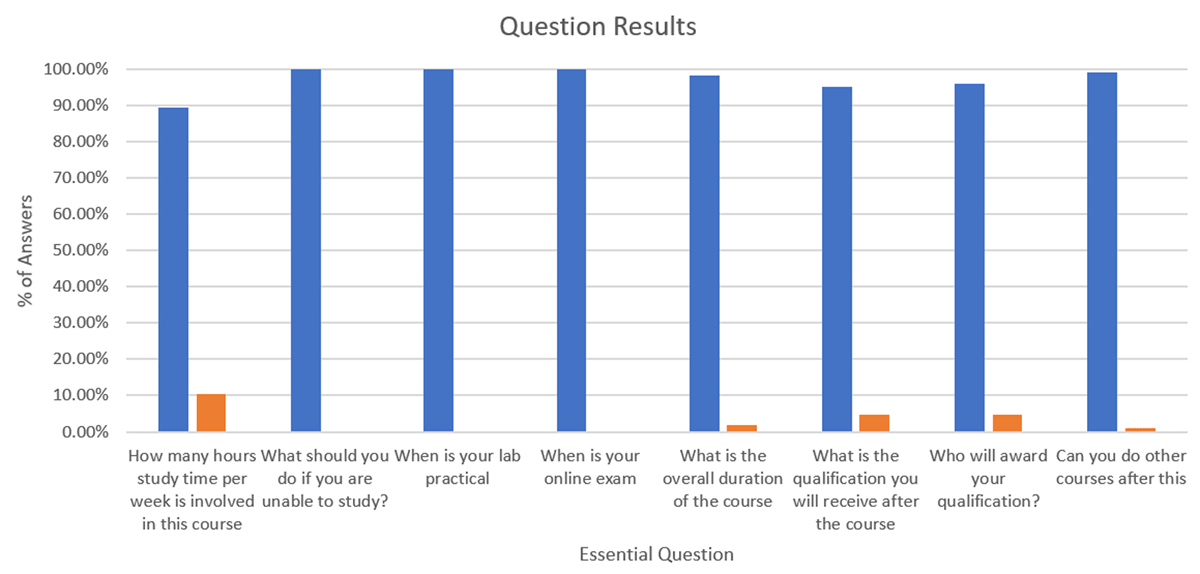
Figure 1
Answers to the 8 Key Questions Asked of Applicants As Part of the Interview Form.
Table 3
Number of Applicants with Comprehensive Answers to the Skills Analysis Gap Questions.
| QUESTIONS ASKED | COMPREHENSIVE RESPONSES | |||
|---|---|---|---|---|
| CLASS 1 (N = 101) | CLASS 2 (N = 111) | CLASS 3 (N = 100) | TOTAL (N = 312) | |
| 1. Why do you wish to pursue a career in
the pharmaceutical and/or medical device industries? 2. What skills do you already hold that you consider valuable to assist you with this goal? 3. What parts of this course do you think will be particularly helpful in helping you reach this goal? | 77 (76%) | 83 (75%) | 70 (70%) | 230 (74%) |
Table 4
Feedback from the Applicants on their Satisfaction with the Process.
| CLASS 1 REACTION (N = 101) | CLASS 2 REACTION (N = 111) | CLASS 3 REACTION (N = 100) | |
|---|---|---|---|
| Positive Feedback from Interview form | 91% | 85% | 95% |
| Applicant Feedback: | “I found the process
very professional and thorough. It ensures candidates have a full
understanding of the course and future career prospects available to
them.” “The interview form I thought was a brilliant idea as I am completely up to date on what this course entails in detail. With some courses, these details are not given until the induction day. I know what I am in for and I am mentally prepared.” “I have found the application process time consuming but beneficial. You can’t start the application without having a good understanding of the course you are applying for.” “This has been different, I liked it. It’s also a clever way to get students to actually read the syllabus, which, truth be told, I’ve rarely done in the past unless there was a problem.” | ||
Table 5
Comparison of theory to what was seen in the results across the three groups of applicants.
| THEORY | THE NEW PRACTICE GOAL | THE RESULTS |
|---|---|---|
| Bounded Rationality (Simon, 1955) – Humans make decisions to achieve a satisfactory outcome, rather than an optimal one. | When students are being instructed during induction and orientation after accepting a place on the course, they are not sitting in a vacuum. In other words, the tasks given to them during induction and orientation are being balanced against the other activities and tasks they need/want to complete at the same time. In this instance, the students will aim for the satisfactory decision rather than the optimal one – and if they are already under cognitive strain from the information they are being asked to absorb or the new situation they are in, they will defer reading the information that they feel is going to overload them, as they will feel it is not a priority. However, when interviewing to achieve a goal they have decided upon by themselves, there are very few things that will outrank completing the actions associated with completing and submitting this interview form. | Across the 3 class groups, 73% of applicants completed the tasks outlined in Stage 2 of the process (the detailed interview form). 27% of people self- selected themselves out of the process at this point, deciding not to complete the required tasks to move to Stage 3 of the process. This shows that this process works with the students’ innate bounded rationality for achieving a satisfactory outcome. |
| Framing Effect (Kahneman & Tversky, 1978) – Explains that the way information is presented to an individual changes how it is interpreted. | Framing the entire process, from initial phone
calls, through reading documentation, answering questions and finally
asking questions, as activities to complete before being able to be
offered a place on the course – means that the applicants approach
each task with an open mindset as something vital to complete to get to
their key goal of being offered a place on the course. However, if the students would be asked to complete each of these same activities after accepting a place on the course, the students then view these as an “additional workload” that is being asked of them on top of their studies and therefore switches from being a target to be achieved, to a burden that has to be completed. | Across the 3 class groups, 97% of applicants completed the telephone call with a member of the team to confirm their understanding – and most importantly to get any underlying questions answered on their part. The re-framing of this activity as part of the interview process meant that 100% of new students were already engaged with a member of the team in a pastoral support manner before even beginning their studies |
| Simplification Theory (Samson, 2020) – Suggests that an individual is more likely to act on a message if it is easy to understand. | The interview questionnaire utilises MCQs in key areas which aims to simplify the procedures around contacting someone if they are struggling, requesting assignment extensions, understanding how many hours of study they should be doing, and their academic progression options post completing the course. This makes these processes appear much more simple to action by the student. | The simplification around key processes sees that 91% of students who accepted a place on the course were still enrolled in their programme of study after the 1-month cooling off period. This is a particularly impressive figure considering the demographics of the audience, and the fact that two of these class groups commenced their studies during the lockdowns in Ireland |
| Dual System, Planner-Doer Model (Kahneman, 2012) – Explains self-control in decision making, and delayed gratification | When faced with a student handbook to read at the beginning of the module (while containing key information they need), most students are unable to practice the concept of delayed gratification and put off what they are currently doing to read a document that they don’t see as relevant to their current situation at that moment in time. However, when reading these documents is part of the interview process to be offered a place on the course, the applicant will override their System 1 thinking and make the decision to read the information. | Across the 3 groups of applicants, 73%
submitted the interview form, which required them to read the student
handbook in detail in order to be able to complete it. Therefore, it is hypothesised that all the students who started on the programme, had read, understood, and could action information from the student handbook. |
| Procedural memory needs practice (Dirksen, 2016) | Throughout the entire process, the students practice two key skills – (1) How to read documentation and pull the relevant information to answer questions; and (2) the important role of continuous communication between the programme administrators and the students when studying in an online environment, especially the importance of asking questions, which is covered during the one-on-one phone calls during stages one and three. | By the conclusion of Stage 3 of the process, before offers for the programme were made, 97% of applicants who submitted an interview form, had already had a telephone conversation with a member of staff for approximately 15 minutes. This started the important continuous communication between staff and students before the programme had begun. |
| When learning something new, new connections are formed in the students brain, the connection is strengthened each time the connection pathway is used (Dirksen, 2016) | These adult learners are completing this programme to upskill/reskill into a new industry. These experienced workers are asked in the Interview Form to analyse the skills they already have and are bringing to the industry. In this way they will know their own skills gap and how it can be filled through this programme of study. This is re-enforced in the interview documentation when the applicant is asked to state why they want to work in this industry, what skills they already have that would be applicable to this industry, and what parts of the course they think will be most beneficial to them. | Comprehensive answers were received from 74%
of the 312 experienced workers to the questions about: 1) why they want to work in this industry, 2) what skills they already have that would be applicable to this industry, 3) what parts of the course they think will be of most benefit to them This clearly demonstrated that the answers to these questions in the Interview Form strengthened their understanding of the relevance of the course to supporting their career plans. |
| Embedded retrieval hooks at the time of learning make practising and using this skill easier (Colvin Clark, 2010) | The students on this programme are planning on working in a life critical industry, where they are expected to follow strict SOPs. The interview documents include key instructions on how to approach the interview questionnaire. It includes two simple MCQ questions where the students are tested to make sure they are paying attention and can follow instructions. If they answer either of these simple questions incorrectly they had not been paying sufficient attention to what they were asked to do, and so the student is then sent back to the beginning of the form to start again, reinforcing the importance of reading and answering the questions accurately. | Across the 3 groups of applicants 73% submitted the required interview form, which required them to be able to follow the instructions in the form. As applicants had to complete the interview form in order to progress to the next stage of the interview process, it is hypothesised that all of the students who started on the programme, had the ability to follow the instructions on how to approach the interview questionnaire. |
| Asking students to implement the information has the greatest learning impact in the long term (Stolovitch & Keeps, 2011) | The applicants are asked to implement what they had read to answer the key questions around summarising the module descriptors, noting who to contact if they are struggling or need assignment extensions, noting how many hours of study they are expected to do each week, and listing any key assignment or exam dates. | 91% of the classes were still engaged with the programme after the one-month cooling off period, with no complaints about the expected workload or settling-in queries about what they were expected to submit/complete each week. |