
Introduction
The rising awareness of the multiple crises of climate change, biodiversity loss, and growing environmental and social injustice has brought into sharp relief the urgent need for architectural education to explore radical solutions to address these complex challenges. In 2018, the United Nations Intergovernmental Panel on Climate Change (IPCC) warned that there were only 11 years left for global warming to be limited to an increase of 1.5°C to avoid catastrophic impacts for millions of people globally [1]. Commitments by Governments globally to decarbonise by 2050, alongside Climate Emergency declarations made by national and local governments, universities, businesses, and other organisations, will require a rapid and radical shift in thinking and practice to achieve the necessary change to meet these targets.
Within the design and construction industry, there is a clear need for sustainability to become a core principle of practice in the twenty-first century, illustrated by the advocacy of the Architects Declare, Landscape Declares, and Architecture Education Declares movements. In the UK, the Royal Institute of British Architects’ (RIBA) recent ‘The Way Ahead’ [2] and the Architects Registration Board’s ‘Sustainability Competency Guidelines’ [3] identify the necessity for architects to develop a greater understanding of ethics and professionalism, sustainable design principles and building physics to ensure practitioners have the skills, awareness, and ability to tackle climate change and prepare industry for a rapidly changing future. As the normative means of educating architectural practitioners, universities have a responsibility to provide the knowledge, skills, and attributes to achieve the shift in thinking required to create sustainable futures. Within Architecture and Landscape Architecture courses in the UK, climatic design, environmental comfort, resource use, and biodiversity are captured in criteria prescribed by professional bodies [4; 5]. These criteria aim to assure quality and guarantee graduates have a minimum level of knowledge and understanding of sustainable design and its consequences [6].
However, it is increasingly clear that sustainable design—the principle of not doing any more damage—is not enough; we need to ‘fundamentally redesign the human impact on Earth from being predominantly exploitative and degenerative to becoming healing and regenerative’ [7]. In preparing practitioners with the necessary attributes to thrive in their future practice, this shift beyond sustainability toward being restorative or regenerative is an important and growing concern [8]. Regenerative design is grounded in the potential of place, is designed with an inbuilt evolutionary capacity, and engages with people through dialogue and imagination [9]. It requires a shift in thinking from a human-centric worldview to a worldview that sees humans as embedded within a web of systems, both human, and non-human. It is design thinking and more critical systems thinking that best define how students need to learn to achieve this shift [7]. However, there is an urgent need to consider how we educate practitioners with the skills, attributes, and knowledge to address the ‘wicked problems’ that will be the focus of practice in the twenty-first century [10; 11].
At the same time, universities have a civic responsibility to the cities and communities of which they are part [12]. They increasingly aspire to positively contribute to the progression and regeneration of local communities: ‘Universities play a key role nationally through their teaching and research work. But they are also hugely important to the economic, social, cultural and environmental wellbeing of the places in which they are located.’ [13]. There is a further suggestion that universities should focus on challenges such as high street regeneration and their role in ‘left behind areas’ and on less economically and socially advantaged communities such as post-industrial towns [14].
In response to these converging agendas, in this paper we reflect on how collaborative ‘live’ projects can nurture the conditions for both radical education and place-based transformation toward sustainable, or better still regenerative, cities [15]. Live projects are defined as a type of learning project which is distinct in its engagement of real external collaborators such as clients or users. The remit of the project is typically worked out in collaboration with external collaborators, rather than being imposed by the lecturer [16]. Through collaborative action-based design and research, all involved in the process—students, academics, collaborators, and community members—are brought together around a real-life problem to make positive physical and/or social change to their place.
Since 2020 Birmingham School of Architecture & Design and CoLab Dudley, a social innovation lab based on Dudley High Street, have collaborated to explore regenerative futures for the High Street in 2030. This partnership engaged students, academics, the social innovation lab, and a wider network of local people in a two-way collaborative learning process, generating new knowledge toward regenerative local change. Here we analyse the project from its conception to completion through the lens of Education for Sustainable Development (ESD) to tease out the qualities that were designed into or emerged during the collaboration that nurtured the conditions for radicality to emerge.
Understanding sustainable development in design education
The UN’s Sustainable Development Goals identify making ‘cities inclusive, safe, resilient and sustainable’ as one of the key 17 goals to transform the world [17]. The United Nations Educational, Scientific and Cultural Organization (UNESCO) promotes ESD as an important tool for developing curriculum structures and content aligned with the UN Sustainable Development Goals (SDGs) through its ‘ESD for 2030’ roadmap [18]. ESD is described by Higher Education Academy as ‘the process of equipping students with the knowledge and understanding, skills and attributes needed to work and live in a way that safeguards environmental, social and economic wellbeing, both in the present and for future generations’ [7]. It requires a transformational shift in learning environments from practices promoting the acquisition of skills and knowledge toward an emphasis on values, attitudes, and behaviours [19]. Tilbury and Mulà [20] identify future thinking, critical and creative thinking, participation and participatory thinking, partnerships, and systemic thinking as key aspects of successful ESD. Engaging students with real-world problems, creating opportunities for interdisciplinary or transdisciplinary learning, and thinking creatively about teaching and assessment practices plays an important role in developing these competencies [7]. The urgency of the climate emergency requires a rapid change to ensure educators and students are equipped to tackle this issue, but this shift can be difficult to achieve within the timescales of university and professional body validation processes [21]. It is often those modules that are designed with openness and relative freedom in mind that create the opportunity for experimental pedagogy that tests how this may be achieved.
The partnership
This paper reflects on such a module: a collaboration between the Birmingham School of Architecture and Design (BSoAD) at Birmingham City University and CoLab Dudley, a social innovation lab based on Dudley High Street in the West Midlands, UK. ‘High Street 2030’ was conceived as part of the School’s longstanding tradition of live architecture projects across the city and region [22], currently epitomised by the annual interdisciplinary Co.LAB module. The module brings together undergraduate and postgraduate students from varied design disciplines in experimental elective projects with community and industry partners. The instruments of academia such as student groupings, open learning outcomes, and timetabled experiments allow for an element of freedom that benefits open processes and innovative design thinking. External partners benefit from a unique way of thinking that is sometimes difficult to achieve within the public or commercial sectors [23]. Learning in the module builds upon insights from several ‘live’ collaborative projects over many years engaging students and local groups exploring the idea of the university as an ‘agent of change in the city’ [12; 23].
Over a 12-week period ‘High Street 2030’ brought together a group of 15 undergraduate and postgraduate students, two academics, three collaborators from CoLab Dudley, and a network of community-based ‘Time Rebels’ to explore regenerative futures for Dudley High Street. Taking as a prompt the provocation that a new kind of design is needed in the wake of the pandemic, students were encouraged to imagine radical alternatives to current conditions, founded on the principle of moving from sustainable to regenerative design. The project asked students to go beyond their disciplinary boundaries to engage with the systemic, complex, and multi-faceted ‘wicked problem’ that is sustainability [10; 11]. As tutors, our focus was on the implementation of ESD, emphasising creative thinking, collaboration, and the long-term perspective, particularly our responsibility towards future generations or being a ‘Good Ancestor’ [24]. By learning to think and act systematically [25: p. 157], students can engage with future scenarios through higher-level critical thinking, and participatory learning, and become empowered to go out into the world to make positive change.
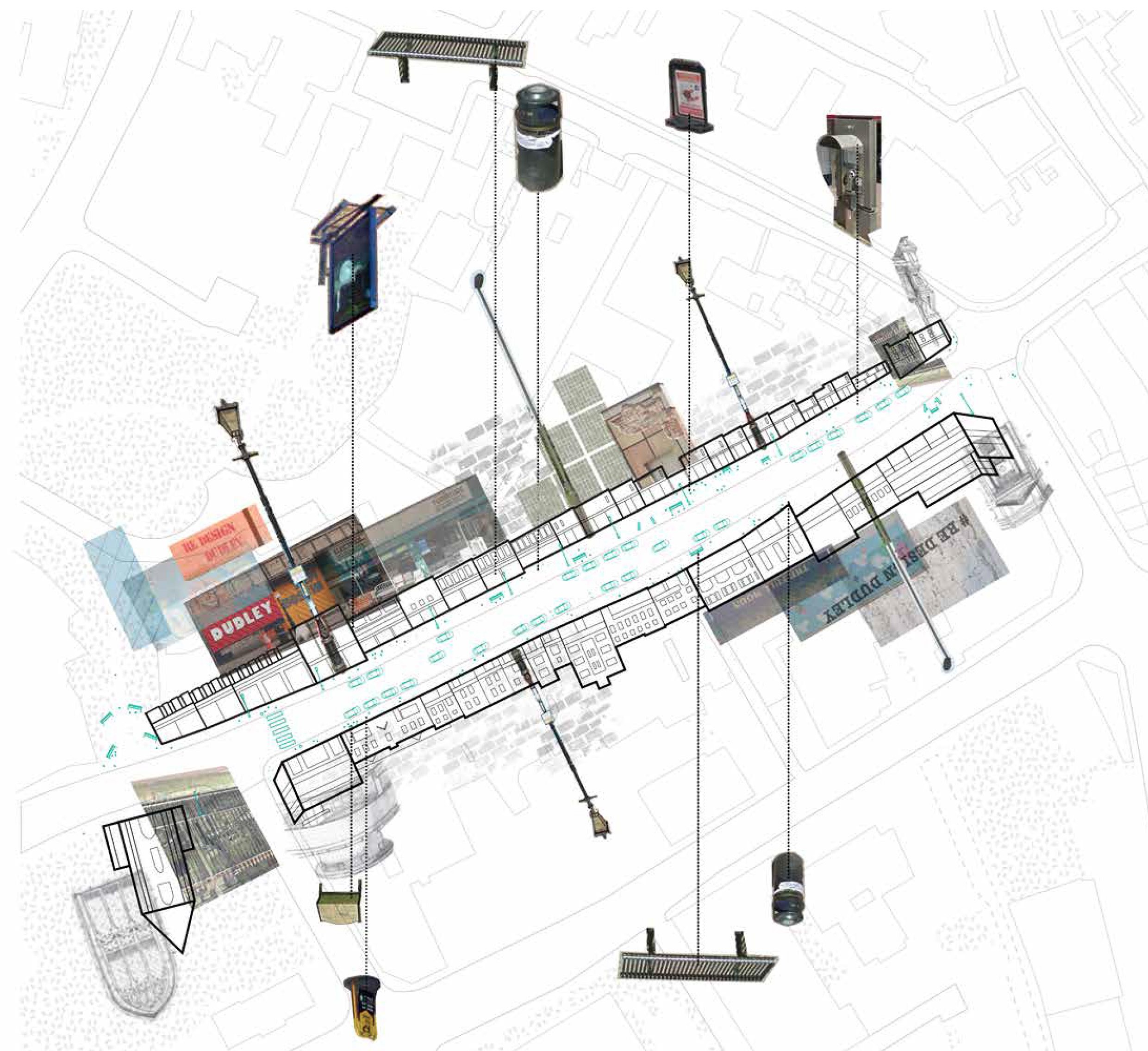
Figure 1
Students started by mapping, using online resources and mining the lived experience of CoLab Dudley to understand the High Street as found.
Taking place during the Covid-19 pandemic, the project ran in a virtual learning environment and made use of tools such as Teams, Slack, and Miro to collate and share knowledge and resources and bring the collaborators together. Students initially analysed the high street from different perspectives, building an understanding of physical and social aspects of the high street and how it is changing (Figure 1). This stage of the project culminated in the offering of a ‘gift’, an object crafted by each student from found materials that aimed to reveal something hidden or overlooked, draw attention to a certain aspect of the context, trigger memories, or make an aspect of the town more tangible or memorable. The gift created a bridge to the imagining of a future high street built upon regenerative design principles: moving beyond sustainability toward a net-positive, co-evolutionary and interdependent relationship between humans and the living world [26]. The group then worked through participatory processes to imagine and prototype a high street built upon regenerative design principles. Working from co-produced visions of 2030, students designed new physical and social infrastructures, the ‘stepping stones’ needed to support the shift toward a longer-term regenerative future for Dudley High Street. The many-layered creative process combined desktop research, exploration of critical urbanism texts, creative deep mapping methods, connections, and conversations with CoLab Dudley’s ‘Time Rebels’ network via a digital Human Library, navigation using CoLab Dudley’s lab guiding principles, collage, storytelling, poetry, and much more.
Methodology
Using the High Street 2030 project as a case study, this research aims to explore the qualities and conditions that can be designed into partnerships between universities and community organisations to enable a radical, transformative education process. The methodological approach was founded on a reflective process both during and after the project through a process of reflection-in-action and reflection-on-action [27]. The reflective process engaged students, partners from Co.LAB Dudley, and academic staff. For students, this took the form of both facilitated reflective discussions during the project and an individual reflective statement completed as part of their module submission. During the process of the project, partners at CoLab Dudley followed their guiding principle of ‘working out loud’, writing regular ‘Lab Notes’ which reflected on the stages of the project and situated the work within their ecosystem of collaborations. After the project, a focus group between academic staff and the partners at CoLab Dudley was hosted online. Hosted online due to limitations imposed by the Covid-19 pandemic, the focus group aimed to collect both individual and collective reflections on the project process. Initially, participants were asked to respond to questions posted on Miro, an online whiteboard, as individuals, before a collective discussion around the questions and responses. The focus group offered an interactive and responsive means to generate a wide range of data quickly with the potential for unforeseen insights to be gained through a discussion of unexpected topics, shared responses, and reflections [28].
Futures thinking: imagining preferred visions for the future and engaging local people in exploring their assumptions to build ownership and responsibility. This is underpinned by reference to the work of Rob Hopkins in nurturing the power of imagination to create transformative change [29] and RIBA’s Big Rethink competition which asks what kind of design is required in a post-pandemic world [30].
Critical and creative thinking: exploring new ways of thinking, acting, and making to create alternatives to present choices. This includes reflecting on how people interrelate, understanding cultural differences, and testing alternative ways of living together.
Participation and participatory learning: engaging diverse stakeholders and communities and valuing multiple knowledge systems and perspectives. The process of participation itself is important in building a sense of ownership and empowerment; Arnstein‘s ‘ladder of participation’ (1969) provides a useful analytical tool, demonstrating how activities with ‘informing’, ‘consultation’, and ‘placation’ at the bottom of the ladder (seen as forms of tokenism), whereas ‘partnership’, ‘delegated power’ and ‘citizen control’ at the top of the ladder are forms of participation which give citizens power [12].
Partnerships: A motivating force toward change, partnerships empower people and groups to take action and build capacity for change. Intercultural partnerships are particularly critical for ESD.
Systemic thinking: Going beyond problem-solving and/or cause and effect to avoid resolving one issue while creating others, promoting awareness of wider system contexts which are ‘complex, dynamic, unpredictable, connected at multiple levels and emergent’ [31: p. 24].
While it is acknowledged that there is no ‘one size fits all’ solution to successful ESD, Tilbury & Mulà’s [20] five points offer a framework through which the project can be analysed. The analysis that follows draws on data drawn from the phases of reflection-in-action and reflection-on-action as described above and aims to ascertain the potential strengths and weaknesses of ‘High Street 2030’ in creating an educational environment conducive to educating activist practitioners.
Futures thinking
The brief asked the student group to consider the future of the high street framed through personal experiences, desktop research, and analysis of critical readers. The early stages of the project focused on building a collaborative team and an understanding of the place. Each student, staff member, and partner shared a personal story of a high street and from this individual starting point built outwards towards more collective shared stories between group members and from wider readings. This early task bonded the group by encouraging open discussion and valuing different lived experiences and histories.
Following a stage of mapping and creation of the ‘gift’, students were introduced to narrative and storytelling to frame their imagined futures. Tasks included reflecting on their research and ideas through “How might we…?” questions followed by “Remember when…” narrative framing where students were asked to imagine looking back on 2021 and remembering Dudley’s response to the crises of the pandemic, spatial injustice, and the climate challenge. This enabled students to quickly imagine futures where change had happened and its consequences, before then considering the ‘stepping stones’ to making that future a reality. This was a new approach for many students and introduced a new way of finding connections, proposing questions, and considering the long-term impact of design decisions. Sharing sessions with the CoLab Dudley team enabled connections to be made to other projects and people within the social lab’s ecosystem but also ensured that, although founded on imagination and speculation, propositions were grounded in their place- albeit one student was unable to visit and explore. Connections facilitated by the partners were vital in broadening the scope and interdisciplinary nature of the emergent visions and projects; collaborating with the partner’s wider community of Time Rebels empowered both students and community members to imagine futures together in a two-way process rather than imposing expert visions from a distance. These took many forms such as poetry, social media posts, and collages, but each aimed to share particular narratives ranging from new technological visions to the reclaiming of the street by nature and wildlife to show the value of imagination and raise ambitions for the future of the high street (Figure 2).
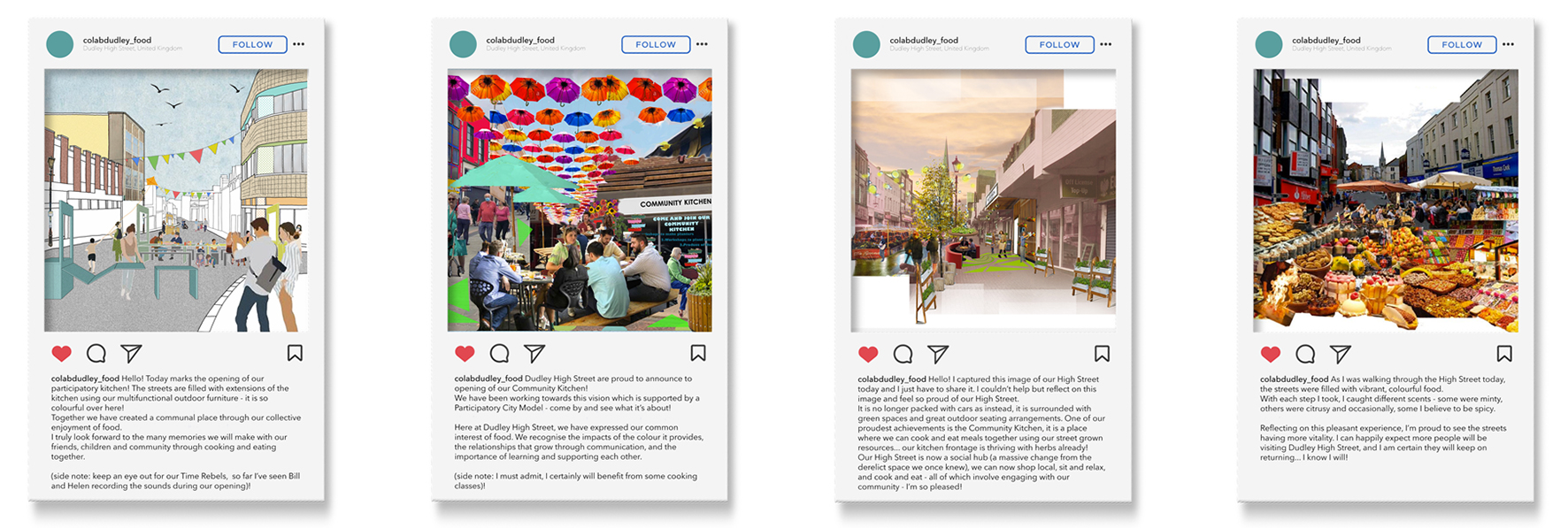
Figure 2
Students embraced narrative in presenting their future visions. Here, one group framed their ‘stepping stone’ projects through imagined social media posts.
Creative and critical thinking
The project explored alternative ways of thinking, learning, and doing to imagine alternatives to ‘business as usual’ approaches across design disciplines. The module itself, designed with open learning outcomes and focused on process rather than output, enabled the brief to be founded on the values-based guiding principles that underpin the work of CoLab Dudley: Create the conditions for curiosity and experimentation; learn and test through doing and prototyping; connections matter; design and build creative spaces and experiences together; move at the speed of trust; be Good Ancestors; use nature’s guidebook; join the dots; encourage abundance thinking and practice; and celebrate gifts and skills (not labels) [32]. Designing these principles into the project from the start enabled deeper connection and empathy between the students, the collaborators, the high street, and the more-than-human. It linked learning and doing, creating space for critical thinking and rapid prototyping across multiple disciplines.
This approach represented a shift from delivering against a clearly defined brief and outcomes to ‘walking in different shoes’. The brief was intentionally open, and the module assessment encouraged a focus on the process and journey rather than outcomes. For students this openness was a (and uncomfortable) challenge; used to clear identified outputs and requirements, the focus on process, risk-taking, and the need to take a position was unsettling. However, this openness enabled deeper connection and empathy between the students, the collaborators, and the high street. Careful scaffolding and confidence building from tutors and collaborators were important to reassure, amplify, reinforce, and celebrate emerging ideas.
By the end of the process, the student groups co-designed and visualised creative proposals for the future of the High Street before summarising the process into a design report. The collaboration revealed the power of visual communication in building connection, conveying complex ideas, and nurturing inspiration, with the visual outputs creating further potential for projects and alternative imaginings of the high street’s future. A number of the ideas and projects have led to further collaborations between students, CoLab Dudley, and the Time Rebels and have created a ripple effect through the work of the Lab. In this way, co-creating and gifting visual assets can help to inspire the change needed to create new narratives for regenerative futures.
Participation and participatory learning
This form of participatory project has a developmental and pedagogical benefit for students and participants. ‘Live’ projects such as Co.LAB are one of the few opportunities for students to interact and collaborate with others whose perspectives and experiences may be radically different from their own entering professional life [33]. The project engaged students with a range of unknowns including the collaborator group, fellow travellers such as Time Rebels, students on different professional journeys, and the unknowns of the future.
However, the means of realising participation was vital in this project. Arnstein’s ladder of participation (1969) sees ‘informing’, ‘consultation’, and ‘placation’ as forms of tokenism, whereas ‘partnership’, ‘delegated power’, and ‘citizen control’ are forms of participation where power is shared [12; 34]. While there were phases of ‘informing’ and ‘consultation’ where students were sharing their ideas and gifts, much of the process involved ‘partnership’ with the collaborators, for example co-developing the future visions, testing possibilities, and connecting with the Time Rebel network to develop ideas collaboratively. Since the project, the themes and ideas have been further developed into exhibition material, and gifts for local people and have become integral to the future direction of the social lab, indicating a shift toward delegated power.
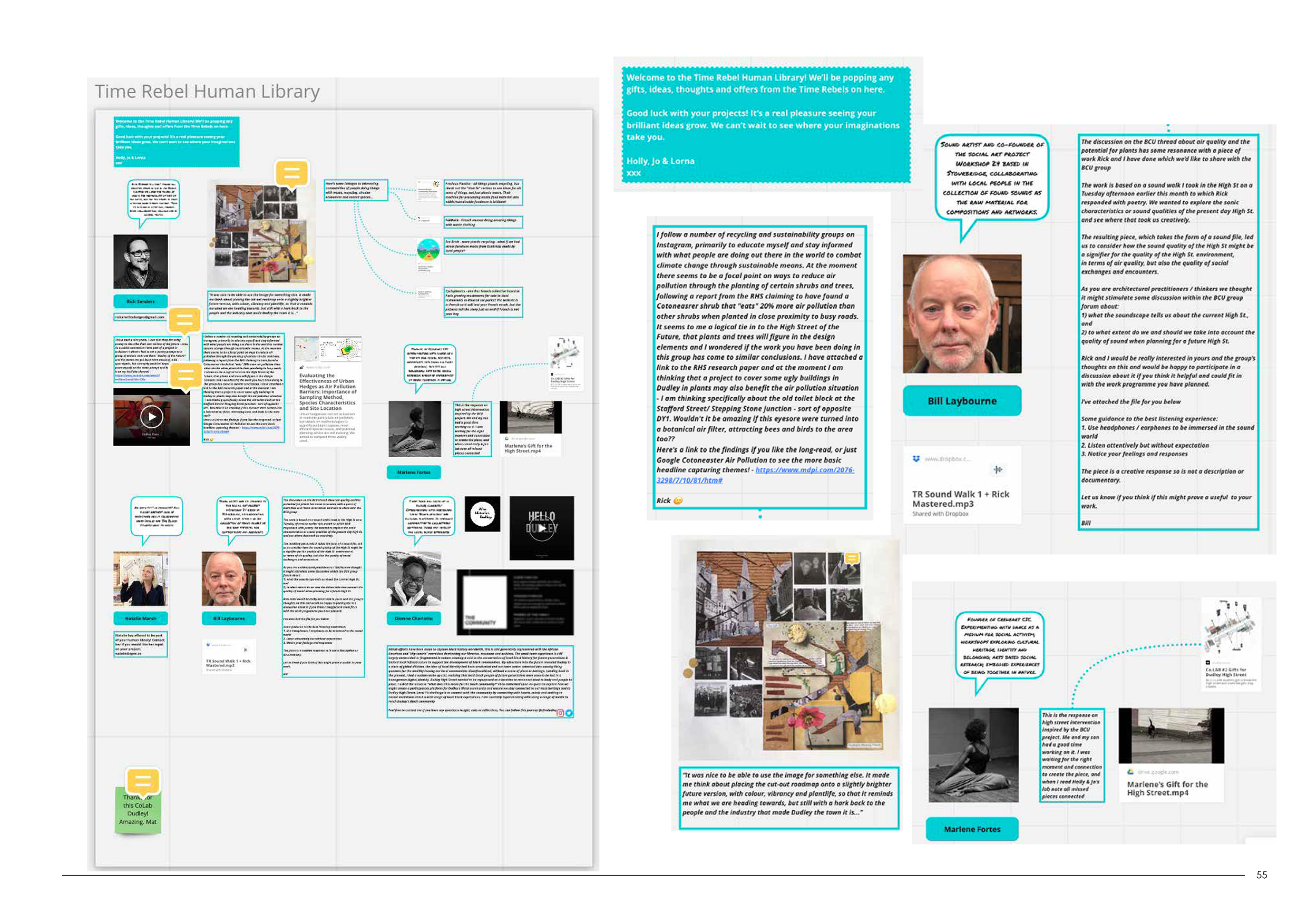
Figure 3
Sharing via Miro, Slack, and Teams, the students collaborated with partners at CoLab Dudley and a Time Rebel ‘human library’ sharing resources, skills, and knowledge.
Working during a pandemic, it proved difficult for students to make genuine human connections or generate in-depth situated knowledge of the High Street. As this issue emerged, steps were taken to try and facilitate knowledge sharing through participatory learning. Dudley’s Time Rebels shared photos and videos of the high street, while students harvested information available online to inform their studies (Figure 3). This revealed a disparity between ‘in real life’ and virtual narratives of the High Street and led the Time Rebels and CoLab team to develop various prototypes to reveal and connect different ways of knowing and experiencing the High Street, and how this could enrich existing online narratives. The use of collaborative digital tools such as Teams, Slack, and Miro enabled all participants to share ideas and resources and see the work grow. Students ‘worked out loud’ on Miro and welcomed other participants to add ideas, resources, make connections, and show gratitude, creating a genuine two-way exchange of ideas.
Partnerships
A motivating force toward change, partnerships empower people and groups to act and build capacity for change [20]. The project grew from a position of trust between the partners, built on an existing relationship between the teaching team and a graduate architect working with CoLab Dudley, who had experienced the Co.LAB module as a student. This lived experience of the module meant the compatibility of the module with CoLab Dudley’s ecosystem, values, and lab ways of working was known from the outset.
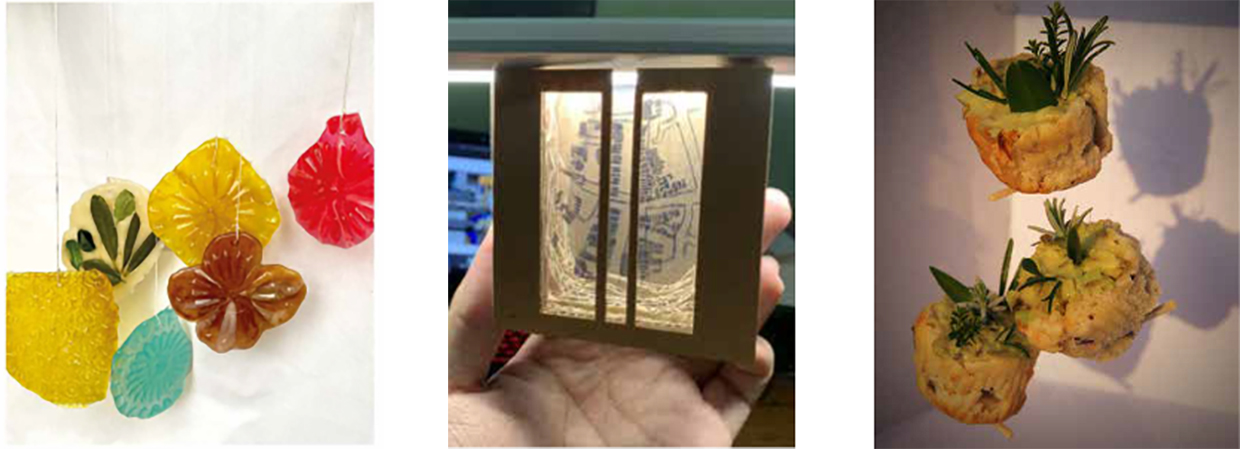
Figure 4
Examples of the gifts students made for the High Street.
The creation of a ‘gift’ for the high street (Figure 4) was a defining moment in the project. This aspect of the brief reflected the tradition of gifting in bonding people together and contrasts with High Streets defined by scarcity and individualism. Gifting is an act that deeply bound participants to the High Street and created points around which to connect to other projects and ideas [35]. Sharing students’ gifts with the wider network of Time Rebels inspired reciprocal gifts for the High Street, such as a dance, a poem, and a collage. This exchange demonstrated the value of connections in supporting the partnership: connections between people; between people and the High Street past, present, and future; between people and nature or the more-than-human; the connection between the people on the High Street and the built environment; and the more practical considerations of enabling a slower and more convivial social space of the high street to create the conditions for these connections to flourish.
Alongside careful documentation of the collaboration by CoLab Dudley, the project has involved an organic weaving of connections for long-term collaboration, for example learning exchanges, co-writing Lab Notes reflecting on the process, the reflective focus group, and celebration events to share ideas nationally. Since the project, the work has been used to inspire new visitors to the Lab and students have subsequently carried out their investigations with CoLab Dudley and local people, building on their Co.LAB design work.
Systemic thinking
Systems thinking is a means of approaching problems that goes beyond problem-solving and/or cause and effect to avoid resolving one issue while creating others, creating ‘the ability to see how everything is connected in a bigger picture and [zooming] between the macro and micro and across silos’ [39]. Learning to think and act systematically has a broader value in equipping students with capacity to think, practice, and respond to unknown future scenarios. Through critical thinking and participatory learning, they can become empowered to go out into the world to make positive changes. Students were asked to understand the complex, dynamic, connected ecosystem of the high street, its parts of the system, and their interconnections: the relationships between the elements and not just the elements themselves [. Students were encouraged to embrace this complexity, exploring it through creative mapping of themes and data, coordinated into multi-layered visual representations. Responses were place-based, allowing local identity and context to guide outcomes, and were focused on both human and non-human participants from multiple perspectives (

Figure 5
My Street 2030: a student vision communicated in collages founded on a community-led approach to increase biodiversity, enhance wellbeing, increase biodiversity and rewild areas of the high street.
Students from a range of disciplines brought their specific knowledge, skills, and attributes to bear on understanding the entangled and interrelated reality of the high street. This revealed how, even as emerging designers, they were already moving into silos. However, this limited worldview is insufficient in addressing twenty-first-century challenges and particularly in creating sustainable futures [37]. Gilbert suggests that understanding the complexity of systems requires greater flexibility in disciplinary territory, which is now ‘deeply entangled, inter-connected, unpredictable and open’ [38: p. 192]. The future of the design professions will operate through collaboration, multi-disciplinarity, disruption, and entrepreneurship [39; 40] and these are key competencies students need to develop to succeed in their future practice.
Discussion: transferring the process
The lessons learned from analysing the project and process identify numerous ways in which university-community partnerships can enable Education for Sustainable Development and create the conditions for radicality to emerge. The example discussed here is focused on a live project in a School of Architecture and Design, but the approach has potential to be transferable across disciplines. Four conditions emerge from the analysis that might facilitate successful ESD:
Building trust: Successful relationships take considerable time to develop. The project was founded on an existing relationship between partners, built up over a period of years, which ensured a clear sense of shared values and beliefs. Active reflective learning on the process, and the relationships behind this, is designed into the Co.LAB module and enables deeper connection and empathy between students, partners, staff, and the place. Rather than the partner attending only at the start and end of the project, multiple points of connection were made throughout, ensuring a sense of collaborative endeavour. Organic building and weaving of connections for longer-term collaboration, for example through learning exchanges, co-writing, future student projects, and follow-up celebration events, ensure that a project can have a meaningful impact over the long term.
A two-way exchange: The project was a genuine exchange of ideas, deep listening, and co-design with multiple connection points for two-way exchanges of ideas and shared learning resources. One of the key shifts through the process was the shift in the power dynamic of the community-tutor-student relationship. Initially, students were provided with a scaffolded learning experience. Guiding students through a series of tasks aimed to build learners’ confidence and sow the seed for the increasingly open process that followed. As the project developed, tutors stepped back from a ‘teacher’ role of imparting knowledge, instead facilitating a move toward a non-hierarchical peer-to-peer learning environment where tutors, students, and collaborators – and even the high street itself–acted as equals in a mutual exchange of ideas. This rhizomatic learning approach opens the possibility for learning to not come from a single point of origin (such as a tutor) but allows for multiple, non-hierarchical entry and exit points [41].
Openness and flexibility: Knowledge production was shared, inclusive, and open, posing a challenge to established academic ways of knowing [42]. The flexibility of the module design created space to experiment, share, and collaborate. By embracing more unorthodox methods, extremes of disciplinary conventions can be tested, and provocative responses generated to disrupt conventional design thinking. This messy, unbounded approach sits uncomfortably within normative academic structures. It poses a challenge to traditional modes of thinking, re-imagining the role of the teacher and encouraging the participants to adopt a mindset of unrestricted and creative inquiry [43]. It enables learners to react to emerging ideas and circumstances, acknowledge different knowledge systems, embrace unknowns, and constantly ask questions [41]. This has power in preparing students to address the complex and ‘troublesome knowledge’ of sustainability and regenerative design.
Place-based: Working in a ‘real life’ context is valuable for students in understanding different world views, negotiating conflicts of interest, uncertain knowledge, and contradiction [8]. Despite not being able to visit the High Street in person this was a shared enquiry with research through Google Maps, High Street reports, Digimap, and web research being supplemented by insights shared by the lab and Time Rebels who knew the High Street well. In non-lockdown circumstances, this evidence-building would be more rooted in the lived reality of the High Street but the project has also shown the power of virtual platforms in building this understanding of the essence of place.
These conditions have potential to be transferred to other settings and disciplines to create the potential for radical and transformative educational experiences – not only in creative design but more widely across disciplines. Collaborative partnerships founded on the principles of ESD have significant potential to engage students with real-life issues where they can see their impact, while simultaneously creating the possibility of radical education for sustainability and beyond.
Conclusion: nurturing the conditions for radicality
By analysing the process and outcomes of a collaborative live design project against Tilbury and Mulà’s principles of ESD [20], this research identifies the positive impact of engaging students with the complexity of real-world situations to drive the transformative education needed to create radical practitioners. The collaboration created rich conditions for the emergence of students’ insights founded on trust and generosity, seen in the sharing of resources, time, and energy. This created the conditions for regenerative visions grounded in the potential of their place to emerge, developed through dialogue and a genuine two-way exchange of ideas.
The project reveals the value of shifting the site of knowledge-making and power beyond the university institution. Participatory learning with local groups and championing the idea of the university as an ‘agent of change in the city’ is fundamentally different from learning as the imparting of knowledge in a traditional learner-teacher power dynamic. Rather, the approach created the space for participants to learn through collective reflection, imagining, paying attention to the experiences of others, valuing experience, engaging with the richness of a creative process, taking risks, and being in a more meaningful relationship with their colleagues, tutors, CoLab Dudley and the wider network of Time Rebels. This shifts the focus of education away from individual study toward notions of working within a community (albeit virtually) for the benefit of others: a place between the academy and the everyday [16].
By nurturing different competencies to normative design processes, ESD principles enable students to engage with the systemic and complex nature of societal challenges. Educators need to create the conditions for higher order deep learning that challenges established norms and values, enables peer-to-peer and rhizomatic learning, allows students to learn reflectively, and creates conditions for curiosity. This requires a radical shift in how we conceive, support, and deliver learning and teaching and raises the question of how this transformative education can be delivered within the restrictions and timescales of university and professional body validation processes. The research reveals that system-shifting design education beyond sustainability toward radical regenerative futures is possible. But is the higher education system ready to adapt to this urgent challenge?
Competing Interests
The authors have no competing interests to declare.