
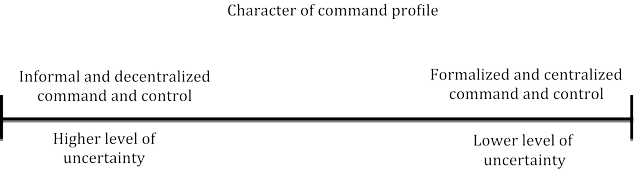
Figure 1
Character of command profiles and corresponding levels of uncertainty.
Table 1
Indicators of the formality of the command and control systems.
| Informal Command | Formal Command | |
|---|---|---|
| 1. Code of conduct | Informal code of conduct | Elaborated code of conduct and quasi-judicial enforcement mechanisms |
| 2. Indoctrination process | Intense ‘rites of terror’ | 2–3 months of political and military indoctrination |
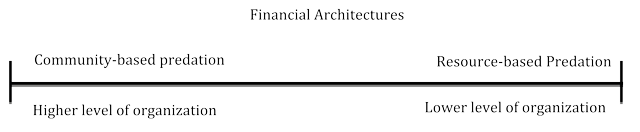
Figure 2
Financial architecture spectrum that ranges between community-based and resource-based revenue strategies.
Table 2
Indicators for type of financial architecture strategies of groups.
| Community-based predation | Resource-based predation | |
|---|---|---|
| 1. Primary source of funding | Community taxation | ‘Lootable’ resources |
| 2. Operational concentration | Decentralized across a large geographic area | Concentrated in specific geographic areas |
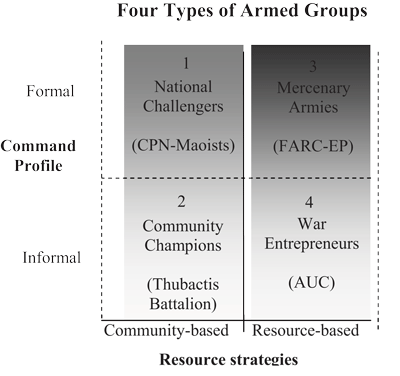
Figure 3
Four categories of armed groups and their respective case study.
Table 3
Summary of each proxy for the command profile and degree of militarization.
| Group feature | CPN-Maoists | Thubactis Battalion | FARC-EP | AUC |
|---|---|---|---|---|
| Command Profile | ||||
| 1. Code of conduct (Informal/formal) | ||||
| Formal systems of command | ✓ | ✗ | ✓ |  |
| Informal systems of command | ✗ | ✓ | | ✓ |
| 2. Initiation process | ||||
| Intense initiation rituals | ✗ |  | | ✓ |
| Extended political indoctrination | ✓ | ✗ | ✓ | ✗ |
| Resource strategies | ||||
| 1. Primary income source | ||||
| Resource-based | ✗ | ✗ | | ✓ |
| Community-based | ✓ | | | |
| 2. Revenue concentration | ||||
| Concentrated | ✗ | | ✓ | ✓ |
| Diffuse | ✓ | | | ✗ |
Legend: ✓ Significant evidence for; Some evidence for; ✗ Significant evidence against; Some evidence against.