
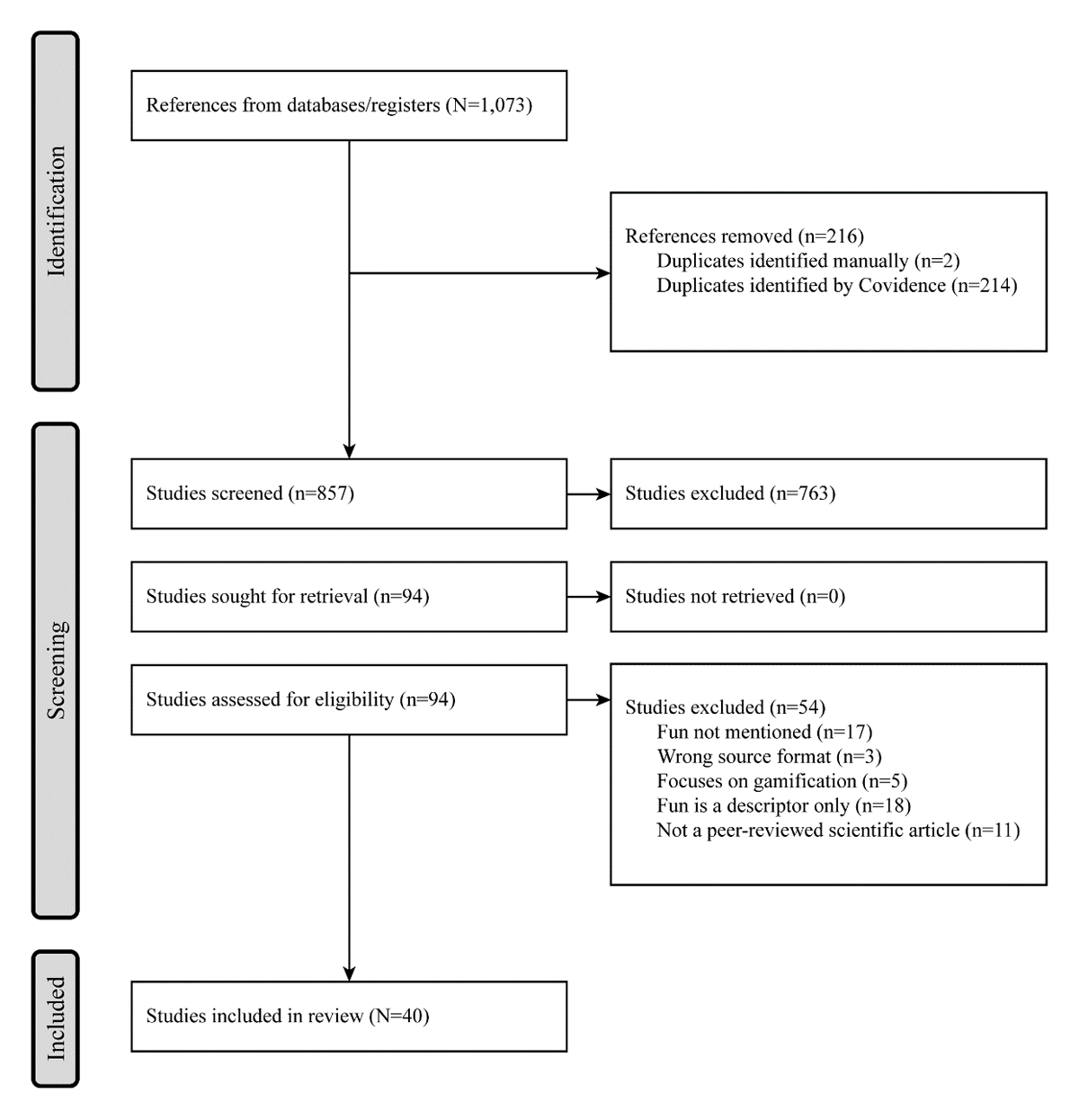
Figure 1
Flow Diagram for a Scoping Review of Fun in Education.
Table 1
Key Findings From Articles Identified in a Scoping Review of Fun in Education.
| FIRST AUTHOR, YEAR | ARTICLE TYPE | STUDY POPULATIONa | OUTCOME(S)b | FEATURES OF ACTIVITIESc | DEFINITION(S)d | |
|---|---|---|---|---|---|---|
| ENABLERS | INHIBITORS | |||||
| Ainley, 2011 | Cross-sectional | Ch, PE | Purp, Imm | 0 | ||
| Baid, 2010 | Review/editorial | N/A | Pos (PW, Soc, Motiv, Perf), Neg | Novel, Aut, Play, Imm, Soc | Novel, Imm | 0 |
| Becker, 2012 | Cross-sectional | Ad, Work, HC | Pos (PW, Soc, Perf), Neg | Play, Purp, Imm, Soc | Aut, Soc | 1, borrowed |
| Bolton, 2009 | Review/editorial | N/A | Pos (PW, Soc, Motiv, Perf), Neg | Novel, Aut, Play | Safe, Novel, Aut | 0 |
| Chan, 2019 | Cross-sectional | Ad, UE | Pos (PW, Soc, Perf) | Novel, Aut, Play, Imm | 1, borrowed | |
| Chu, 2017 | Qualitative | Ch, PE | Pos (Soc, Motiv, Perf) | Safe, Novel, Aut, Play, Purp, Imm, Soc | Safe, Novel, Aut, Imm, Soc | 0 |
| Dismore, 2011 | Qualitative | Ch, PE | Pos (PW, Soc), Neg | Novel, Aut, Play, Purp, Imm, Soc | Novel, Aut, Play, Imm, Soc | 2, borrowed |
| Elton-Chalcraft, 2013 | Qualitative | Ch, PE | Pos (PW, Motiv), Neg | Safe, Aut, Play, Purp, Imm, Soc | Purp, Imm | 1, novel |
| Fleming, 2005 | Qualitative | Ad, Work | Pos (Perf), Neg | Aut, Play, Imm, Soc | Safe, Novel, Aut, Soc | 0 |
| Fluegge, 2008 | Cross-sectional | Ad, Work | Pos (PW, Soc, Motiv, Perf), Neg | Play, Purp, Soc | Novel, Purp, Soc | 3, borrowed, novel, cited |
| Ford, 2003 | Cross-sectional | Ad, Work | Pos (PW, Soc, Motiv, Perf), Neg | Play, Purp, Soc | Safe, Imm | 2, novel |
| Fu, 2009 | Test/scale development | Ad, UE | Pos (Soc, Motiv) | Aut, Purp, Imm, Soc | 0 | |
| Hsbollah, 2022 | Qualitative | Ad, UE | Pos (Soc, Motiv, Perf) | Aut, Play, Imm | 2, borrowed | |
| Karl, 2005 | Cross-sectional | Ad, Work | Pos (PW, Soc, Motiv, Perf), Neg | Novel, Play, Soc | Safe, Aut, Play, Purp, Soc | 0 |
| Karl, 2006 | Cross-sectional | Ad, Work, HC | Pos (PW, Soc, Motiv, Perf), Neg | Play, Purp | Safe | 1, borrowed |
| Karl, 2007 | Cross-sectional | Ad, Edu, Work, HC | Pos (PW, Motiv, Perf), Neg | Imm | Aut, Purp | 1, borrowed |
| Karl, 2010 | Experimental | Ad, GE | Pos (PW, Soc, Motiv, Perf), Neg | Play, Purp, Imm | Purp | 2, borrowed |
| Karl, 2006 | Cross-sectional | Ad, GE | Pos (PW, Perf), Neg | Play, Purp, Imm | 2, borrowed | |
| Kazen, 2015 | Experimental | Ad, UE | Pos (Perf) | 0 | ||
| Lamm, 2009 | Cross-sectional | Ad, Work | Pos (PW, Soc, Perf), Neg | Safe, Play | Purp, Imm | 6, borrowed, novel, cited |
| Lucardie, 2014 | Qualitative | Ad, Edu | Pos (PW, Soc, Motiv, Perf), Neg | Safe, Aut, Play, Purp, Imm, Soc | Safe, Novel, Purp, Imm | 0 |
| McDowell, 2004 | Test/scale development | Ad, Work | Pos (PW, Soc, Motiv, Perf), Neg | Novel, Aut, Play, Soc | Safe, Novel, Soc | 3, novel |
| Peluchette, 2005 | Cross-sectional | Ad, Work, HC | Pos (PW, Soc, Motiv, Perf), Neg | Play, Purp | 1, novel | |
| Plester, 2009 | Qualitative | Ad, Work | Pos (PW, Soc, Perf), Neg | Safe, Novel, Play, Soc | Safe | 1, novel, cited |
| Pryor, 2010 | Review/editorial | N/A | Pos (PW, Soc, Motiv, Perf), Neg | Safe, Aut, Play | Safe, Imm, Soc | 2, novel |
| Read, 2002 | Test/scale development | Ch | Imm | 0 | ||
| Reis, 2017 | Experimental, qualitative | Ad | Pos (PW, Motiv, Perf), Neg | Soc | Soc | 1, novel, cited |
| Sim, 2006 | Test/scale development | Ch, PE | Pos (Perf) | 1, borrowed | ||
| Strean, 2000 | Qualitative | Ch, PE | Pos (Motiv) | Novel, Aut, Play, Purp, Imm, Soc | Novel | 3, borrowed, novel, cited |
| Tasci, 2016 | Test/scale development | Ad, Work | Pos (PW, Soc, Motiv, Perf) | Novel, Aut, Play, Imm, Soc | Safe | 3, borrowed, novel, cited |
| Tew, 2012 | Experimental | Ad, UE | Pos (PW, Soc, Perf), Neg | Aut, Play, Soc | Imm, Soc | 1, borrowed |
| Tews, 2013 | Cross-sectional | Ad, Work | Pos (PW, Soc, Motiv, Perf), Neg | Play, Purp, Imm, Soc | 2, borrowed | |
| Tews, 2014 | Cross-sectional | Ad, Work | Pos (PW, Soc, Motiv, Perf), Neg | Aut, Soc | 3, borrowed | |
| Tews, 2015a | Test/scale development | Ad, UE | Pos (PW, Perf), Neg | Play, Purp, Imm, Soc | Soc | 1, novel |
| Tews, 2015b | Cross-sectional | Ad, Work | Pos (PW, Soc, Motiv, Perf), Neg | Aut, Purp, Imm, Soc | 2, borrowed | |
| Tews, 2017 | Cross-sectional | Ad, Work | Pos (PW, Soc, Motiv, Perf), Neg | Imm, Soc | 1, borrowed | |
| Tews, 2019 | Review/editorial | N/A | Pos (Motiv, Perf), Neg | Safe, Aut, Purp, Imm, Soc | Safe, Purp | 6, borrowed, novel, cited |
| Tisza, 2023 | Test/scale development | Ch, PE | Pos (PW, Soc, Motiv, Perf) | Aut, Imm, Soc | Safe, Aut | 1, borrowed |
| Vieira, 2017 | Review/editorial | N/A | Pos (Soc, Motiv, Perf) | Novel, Play, Imm, Soc | 2, novel, cited | |
| Visek, 2015 | Qualitative | Ad, Ch, PE | Pos (Soc, Motiv, Perf) | Purp, Soc | 0 | |
[i] a Study population: Ad, adults; Ch, children/minors; Edu, educational environment other than PE, UE, or GE; Work, workplace environment/employees; GE, graduate education; HC, health care/medical environment; N/A, not applicable (the article is not a study); PE, primary education (K-12); UE, undergraduate education.
b Outcome(s) of fun identified in the article: Neg, negative effect(s) of fun identified in the article; Pos, positive effect(s) of fun identified in the article (Motiv, motivation; Perf, performance; PW, personal well-being); Soc, social connection.
c Enabler(s) and/or inhibitor(s) identified in the article: Safe, safety; Novel, novelty; Aut, autonomy; Play, playfulness; Purp, purpose; Imm, immersion; Soc, social connection.
d Definition(s) of fun identified in the article: No., number of definitions identified in the article; borrowed, borrowed definition verbatim or nearly verbatim from another source; cited, cited prior work in creating a novel definition; novel, definition appears novel to that article.
Table 2
Conceptual Frameworks Identified in a Scoping Review of Fun in Education, 2024.
| FRAMEWORK | EXPLANATION | EXAMPLE |
|---|---|---|
| Affective events theory [6] | “Transitory or ongoing favorable events tend to elicit positive emotional reactions; whereas unfavorable … events elicit negative emotional reactions” [6]. | Fun activities are proposed to enhance overall enjoyment and satisfaction. |
| Autonomous vs external self-control [34] | Autonomous, motivated self-control is less depleting than self-control for extrinsic reasons. | Fun activities are presumed to be less depleting. |
| Cognitive load [6] | Cognitive load refers to the capacity of our working memory to handle and process information at any given moment. | Fun is hypothesized to impose “an extraneous cognitive load on learners that impedes cognitive processing, resulting in less learning” [6]. |
| Constructivist learning theory [53] | An educational theory that suggests “humans construct knowledge and meaning from their experiences” [15] rather than passively through instruction. | Fun may promote engagement and enjoyment as learners construct their own understanding through interactive and enjoyable activities. |
| Core affect model [29] | All affects are explained in terms of a combination of 2 dimensions, hedonic valence (negative-positive) and level of arousal (low-high). | While having fun, people experience a positive-valence emotional state. Fun can be experienced as a low- or high-arousal state. |
| Culture [37] | “A group has a culture when it has enough shared history to have formed a set of basic assumptions that guide behavior, perceptions, thoughts, and feelings” [37]. | Culture mediates what may be considered fun in different social groups. |
| Dimensions of engagement [35, 58] | Dimensions of engagement are behavioral engagement (participation and involvement), emotional engagement (focusing on positive and negative reactions), and cognitive engagement (level of investment). | Engagement on these dimensions is hypothesized to mediate the experience of fun. |
| Ego depletion [34] | Self-control in a resource-demanding task depletes the limited resources that a person needs to carry out subsequent effortful tasks. | Fun activities may reduce ego depletion and help restore a person’s ability to exert self-control and focus on tasks. |
| Engagement [6, 7, 46, 59] | “Training engagement can be characterized as the harnessing of trainees’ selves in learning endeavors where they immerse themselves physically, cognitively, and emotionally” [6]. Engagement has also been defined as “psychological investment in and effort directed toward learning, understanding, or mastering the knowledge, skills, or crafts that academic work is intended to promote” [8, 60]. | Fun activities may enhance engagement, making people more likely to invest psychologically and exert effort toward learning, understanding, or mastering the knowledge and skills intended by the task. |
| Expectancy theory [51] | People are motivated to act when they expect their actions will be successfully performed (expectancy), leading to desired rewards (instrumentality) that they value (valence). | People may be motivated to seek out and participate in activities they perceive as fun, driven by the expectation of positive outcomes and intrinsic enjoyment. |
| Flow [6, 11, 12, 22, 23, 28, 29, 32, 56] | “An optimal experience, where the following characteristics were present: (a) an intrinsically rewarding experience, (b) a loss of reflective self-consciousness, (c) a distorted experience of time, (d) an intense and focused concentration on the present, (e) a merge of actions and awareness, (f) an optimal balance between challenge and skills, (g) a sense of control over the situation, and (h) clear goals and immediate feedback” [12]. | Flow relates closely to fun as both concepts involve immersive and enjoyable experiences. Fun was viewed as a natural outcome of achieving a flow state. |
| Four-phase model of interest development [36, 61] | Triggered situational interest, maintained situational interest, emerging (less-developed) individual interest, and well-developed individual interest. | Fun may trigger situational interest and is hypothesized to help maintain interest throughout all 4 phases. |
| Goal orientation [6] | “A preference to grow and develop one’s competence by acquiring new skills and mastering new situations” [6]. | Activities that yield positive results may be more likely to be fun. |
| Performance orientation [6] | “A desire to demonstrate competence and be positively evaluated by others, which can be further divided into prove and avoid dimensions. A prove goal orientation focuses on demonstrating competence, whereas an avoid goal orientation focuses on not revealing incompetence and avoiding negative ability judgments from others” [6]. | People may be more likely to have fun with activities that demonstrate competence and mitigate negative judgments. Conversely, activities that demonstrate incompetence or evoke negative judgments may be less likely to be viewed as fun. |
| Personality systems interaction theory [34] | “Personality systems interaction theory postulates 2 executive control modes in volitional action: self-control and self-regulation (self-motivation). Self-control should deplete energy, whereas self-motivation should maintain energy and result in invigoration” [34]. | Fun activities are proposed to engage the self-motivation mode, allowing people to immerse themselves in the fun experience. |
| Playfulness [28] | A predisposition to define and engage in activities in a nonserious or fanciful manner to increase enjoyment. May be more process oriented than work that is results oriented, also intrinsically motivated and more spontaneous. | Playfulness is closely associated with fun, especially with children, and may help inform how fun can be promoted. |
| Positive psychology [28] | The study of what makes people happy and fulfilled. Emphasizes concepts such as resilience, optimism, joy, flow, and creativity. | Fun is a positive affect state in the domain of positive psychology. |
| Psychological safety [6] | “A climate of psychological safety is characterized by trust, respect, concern for others, and confidence in members’ abilities” [6] | People may be more likely to have fun in an environment of psychological safety. |
| Returnance [12] | “The desire to do an enjoyable activity again and again” [12]. | Fun activities may demonstrate high returnance. |
| Self-determination theory [6, 57] | “When the 3 needs of competence, autonomy, and relatedness are satisfied, intrinsic motivation is increased. In a training context, motivation to learn can be enhanced by the degree to which the training design and delivery helps trainees meet these three needs” [6]. | When activities are fun, people are more likely to find intrinsic motivation, driven by personal interest rather than external rewards. |
| Social boundaries [37, 62] | “The outer limit of what one sees as allowable, understandable or feasible” [62]. | Social boundaries may mediate what is considered fun in different social groups. |
| Three stages of interest [36, 63] | Triggered situational interest is sparked by stimuli that attract attention. Stabilized situational interest is marked by active engagement and intrinsic motivation. Individual interest is characterized by enduring commitment and personal investment. | Fun activities may trigger interest and maintain interest throughout all 3 phases. |
Table 3
Features of Fun Activities Identified in a Scoping Review of Fun in Education.
| CLASSIFICATION LABEL | DEFINITION AND EXPLANATION | FUN ENABLERSa | FUN INHIBITORSa |
|---|---|---|---|
| 1. Safety | Safety refers to environments that minimize physical and psychological danger, threat, stress, and pain [6, 24]. An overwhelming sense of fear or danger is unlikely to be present during fun activities [13, 40]. | Peacefulness Pleasantness Psychological safety Relaxation Respect of boundaries Safe environment | Hostility Danger Pain Punishment Stress Threat |
| 2. Novelty | Novelty is a feature of activities that are fresh or spontaneous, often involving surprise or adventure. Activities may be less fun when they become repetitive, mundane, or boring [14, 22, 27, 28]. | Adventure Curiosity Freshness Spontaneity Surprise | Mundanity Repetitiveness Tedium Boredom |
| 3. Autonomy | Autonomy signifies freedom, agency, and choice, highlighting that individual decisions can influence outcome [22, 38, 41, 46]. Activities that present a lack of choice or involve mandatory participation may be less fun [13, 22]. | Sense of control Freedom Choice Flexibility Ownership Voluntary participation | Compulsion Obligation Constraint |
| 4. Playfulness | Playfulness indicates that the activity is humorous, informal, imaginative, or fantastic and may involve laughter, wackiness, frivolity, and storytelling [8, 11, 13, 24, 35, 37]. Activities may not be fun if they are too serious. | Creativity Fantasy Humor Imagination Storytelling Frivolity | Strictness Excessive seriousness |
| 5. Purpose | Purpose refers to the sense that activities are more fun if people have a reason to participate [8, 15, 21]. Activities seen as pointless or a waste of time are less likely to be considered fun [13, 52]. | Accomplishment Rewards Extrinsic positive outcome High personal value Intrinsic fulfillment Relevance | Pointlessness Excessive duration Focus on material gain Hassle Incompetence Time wasting |
| 6. Immersion | Immersion refers to activities that are engaging, interesting, experiential, and stimulating [6, 14, 22, 35, 36]. Activities are considered less fun if they are dull, uninteresting, or rushed [24, 30, 43]. | Active participation Attention Appropriate challenge Engagement Interest Physicality | Apathy Distraction Dullness Limited involvement Passivity Hurry |
| 7. Social connection | Social connection is present when activities are experienced with others and there is a sense of belonging, connection, cooperation, or bonding [14, 22, 26, 33]. Activities are less likely to be fun if they are associated with a negative social experience or isolation [8, 13, 22, 29, 30, 35, 38]. | Bonding Cooperation Friendship Loss of social barriers Social events Trust | Condescension Exclusion Isolation Loneliness Pretentiousness Unfriendliness |
[i] a For a complete list of features identified in the reviewed studies, see Appendix E.