Have a personal or library account? Click to login
“Nothing Comes to Mind…”: Challenges With Identifying One’s Own Role in Preventable Adverse Outcomes in Interprofessional Birthing Unit Teams, and the Implications for Quality Improvement Initiatives Cover

“Nothing Comes to Mind…”: Challenges With Identifying One’s Own Role in Preventable Adverse Outcomes in Interprofessional Birthing Unit Teams, and the Implications for Quality Improvement Initiatives

Open Access
|May 2025

Figures & Tables

Table 1

Description of Priming Intervention and Methodology.

EDUCATIONAL INTERVENTIONPARTICIPANTSSETTINGFHS CASE SCENARIOS AS PRIMING INTERVENTION
  • Twelve four-hour, mandatory interprofessional FHS Refresher courses, designed by the Canadian Perinatal Program Coalition, run from May through October 2022

  • All 260 birthing unit staff and employees at an academic, tertiary care centre in Ontario, Canada

  • The courses had not previously been conducted on the birthing unit and had strict interprofessional composition (members present from all five disciplines on the birthing unit and instructors representing at least two different disciplines for each session).

The interprofessional team composition at this academic institution consists of five disciplines, which is typical of most academic hospitals in Canada:
  • Nursing

  • Obstetrics

  • Family medicine-Obstetrics

  • Midwifery

  • Resident trainees in Obstetrics & gynaecology

A tertiary care centre was chosen because their birthing teams typically involve the widest range of professions and involve learners. LC and TT are certified FHS instructors and were involved in the delivery of the refresher courses at this institution.
  • Participants were primed with three simulated FHS case scenarios based on actual cases that involve challenging or ambiguous decisions regarding FHS decision making

  • Insights generated from the FHS case scenarios in the courses and documented in field notes were used to inform the development of our interview guide, in addition to existing relevant literature.

  • The field notes and insights from the courses were not used as part of the data analysis, but rather to assist with interview guide creation and sampling decisions.

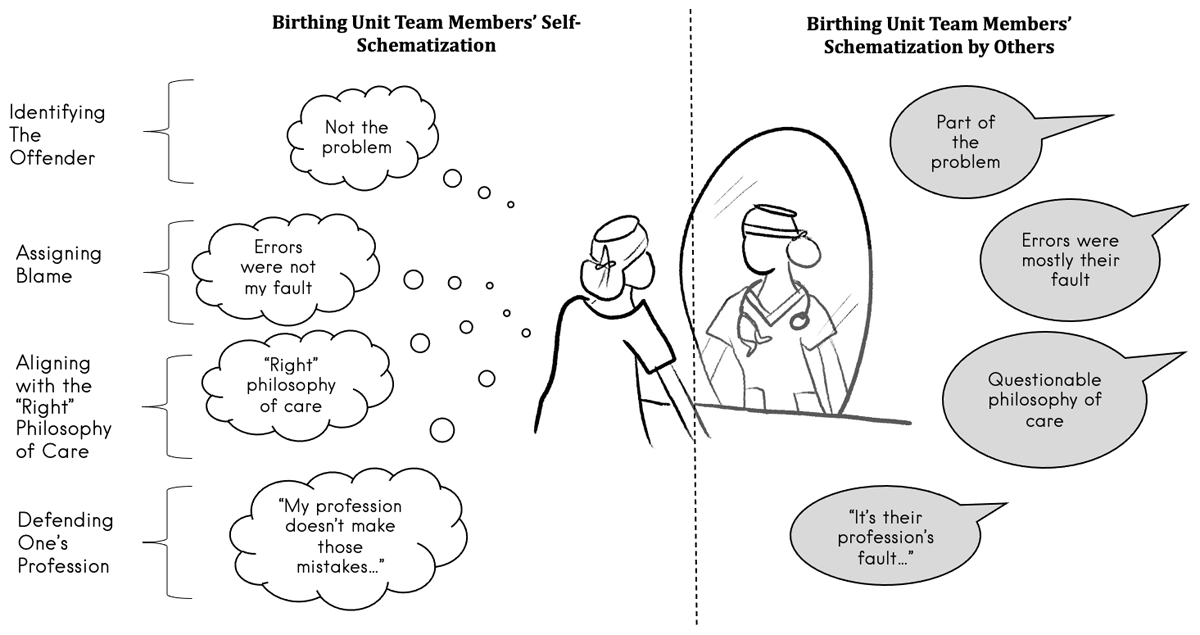
pme-14-1-1651-g1.png
Figure 1

Visual model of Self- vs. Person-Schemas that birthing unit team members may create, which demonstrates the difference across four categories of information in how they may self-schematize in contrast to their colleagues’ person-schemas about them.

DOI: https://doi.org/10.5334/pme.1651 | Journal eISSN: 2212-277X
Language: English
Submitted on: Dec 13, 2024
Accepted on: Apr 3, 2025
Published on: May 7, 2025
Published by: Ubiquity Press
In partnership with: Paradigm Publishing Services
Publication frequency: 1 issue per year

© 2025 Lauren Columbus, Ayma Aqib, Rachael Pack, Harrison Banner, Taryn Taylor, published by Ubiquity Press
This work is licensed under the Creative Commons Attribution 4.0 License.