
Table 1
Empathy level by gender and sample size.
| EMPATHY M (SD) | AFFECTIVE EMPATHY M (SD) | COGNITIVE EMPATHY M (SD) | |
|---|---|---|---|
| Sample of 89 students | 71.1 (+/–12.5) | 37.4 (+/– 7.9) | 33.6 (+/– 5.7) |
| Boys (n = 34) | 64.5 (+/– 10.8) | 32.9 (+/– 6.9) | 31.6 (+/– 5.6) |
| Girls (n = 55) | 75.1 (+/– 11.8) | 40.2 (+/– 7.3) | 34.9 (+/– 5.3) |
| Sample of 20 students | 77.7 (+/– 7.6) | 41.4 (+/– 4.9) | 36.3 (+/– 3.3) |
| Boys (n = 10) | 74.1 (+/– 7.7) | 38.9 (+/– 4.7) | 35.2 (+/– 3.9) |
| Girls (n = 10) | 81.4 (+/– 5.8) | 43.9 (+/– 3.9) | 37.5 (+/– 2.1) |
Table 2
Presentation of metacodes and codes used in the deductive approach.
| METACODES | CODES | |
|---|---|---|
| Forms of bullying (n = 4) | Physical; Verbal; Relational; Theft | |
| Affective empathy: emotions (n = 19) | Positive emotions (n = 9) | Admiration; Amusement; Contentment; Interest; Joy; Love; Pleasure; Pride; Relief |
| Negative emotions (n = 10) | Anger; Contempt; Disappointment; Disgust; Fear; Guilt; Hatred; Regret; Sadness; Shame | |
| Cognitive empathy: emotions (n = 20) | Positive emotions (n = 9) | Admiration; Amusement; Contentment; Interest; Joy; Love; Pleasure; Pride; Relief |
| Negative emotions (n = 10) | Anger; Contempt; Disappointment; Disgust; Fear; Guilt; Hatred; Regret; Sadness; Shame | |
| Neutral emotion (n = 1) | Compassion | |
| Behavioral empathy (n = 6) | LL; LH; HL; HH; NR; CMB | |
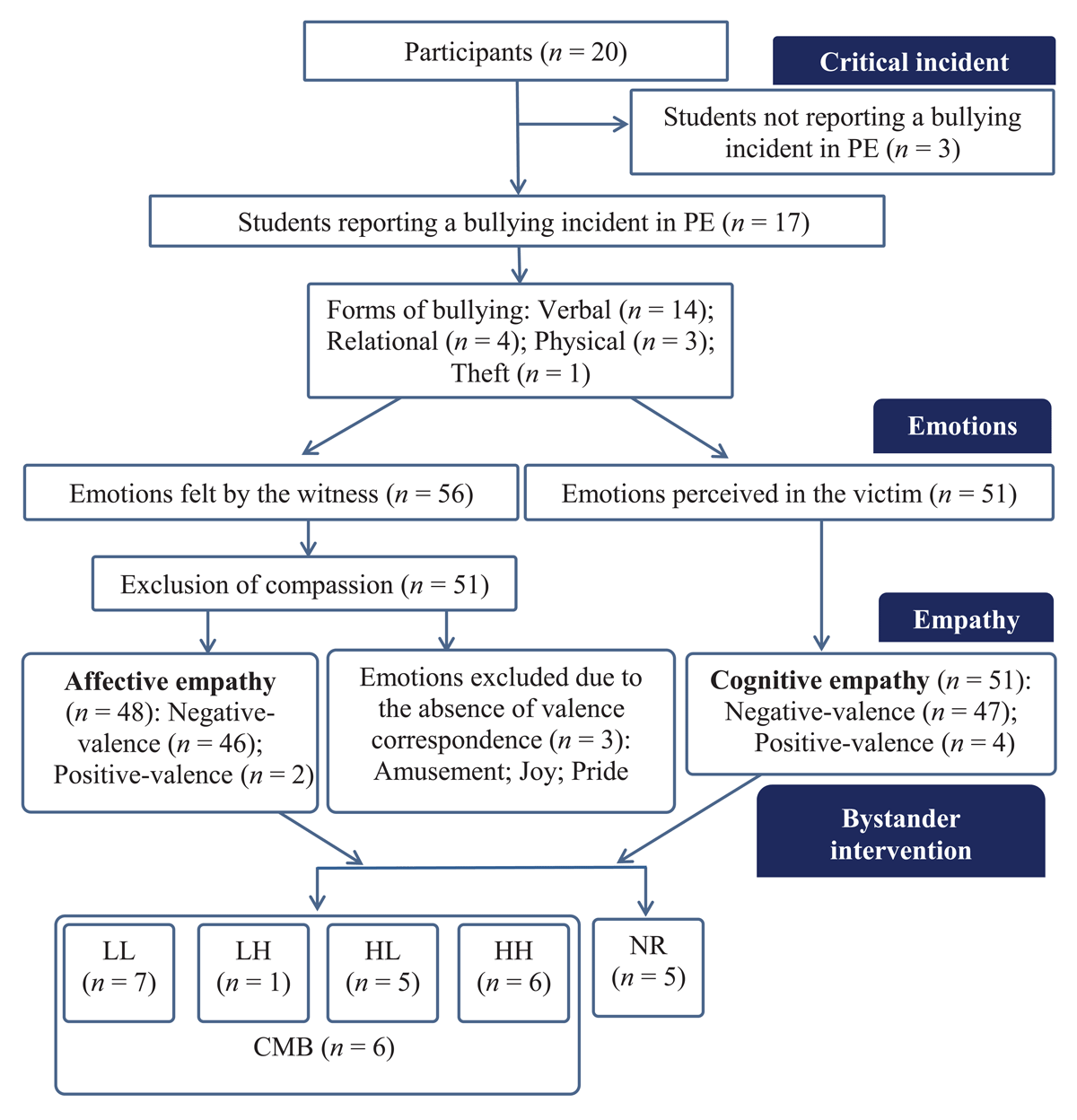
Figure 1
Schematic overview of the findings from the analysis of empathy in a critical incident.
Table 3
Distribution of students who experienced anger, disappointment, fear, and sadness (affective empathy) according to the different types of bystander reactions.
| LL (n = 7) | LH (n = 1) | HL (n = 5) | HH (n = 6) | NR (n = 5) | CMB (n = 6) | |
|---|---|---|---|---|---|---|
| Anger (n = 6) | 3 | 0 | 4 | 2 | 1 | 3 |
| Disappointment (n = 6) | 2 | 0 | 3 | 0 | 3 | 2 |
| Fear (n = 3) | 2 | 0 | 0 | 1 | 1 | 1 |
| Sadness (n = 10) | 4 | 1 | 3 | 2 | 4 | 4 |
Table 4
Distribution of students who perceived anger, fear, sadness, and shame in the victim (cognitive empathy) according to the different types of bystander reactions.
| LL (n = 7) | LH (n = 1) | HL (n = 5) | HH (n = 6) | NR (n = 5) | CMB (n = 6) | |
|---|---|---|---|---|---|---|
| Anger (n = 7) | 3 | 0 | 1 | 4 | 2 | 2 |
| Fear (n = 8) | 5 | 0 | 3 | 3 | 2 | 4 |
| Sadness (n = 14) | 6 | 1 | 4 | 5 | 5 | 6 |
| Shame (n = 7) | 4 | 1 | 3 | 2 | 1 | 4 |
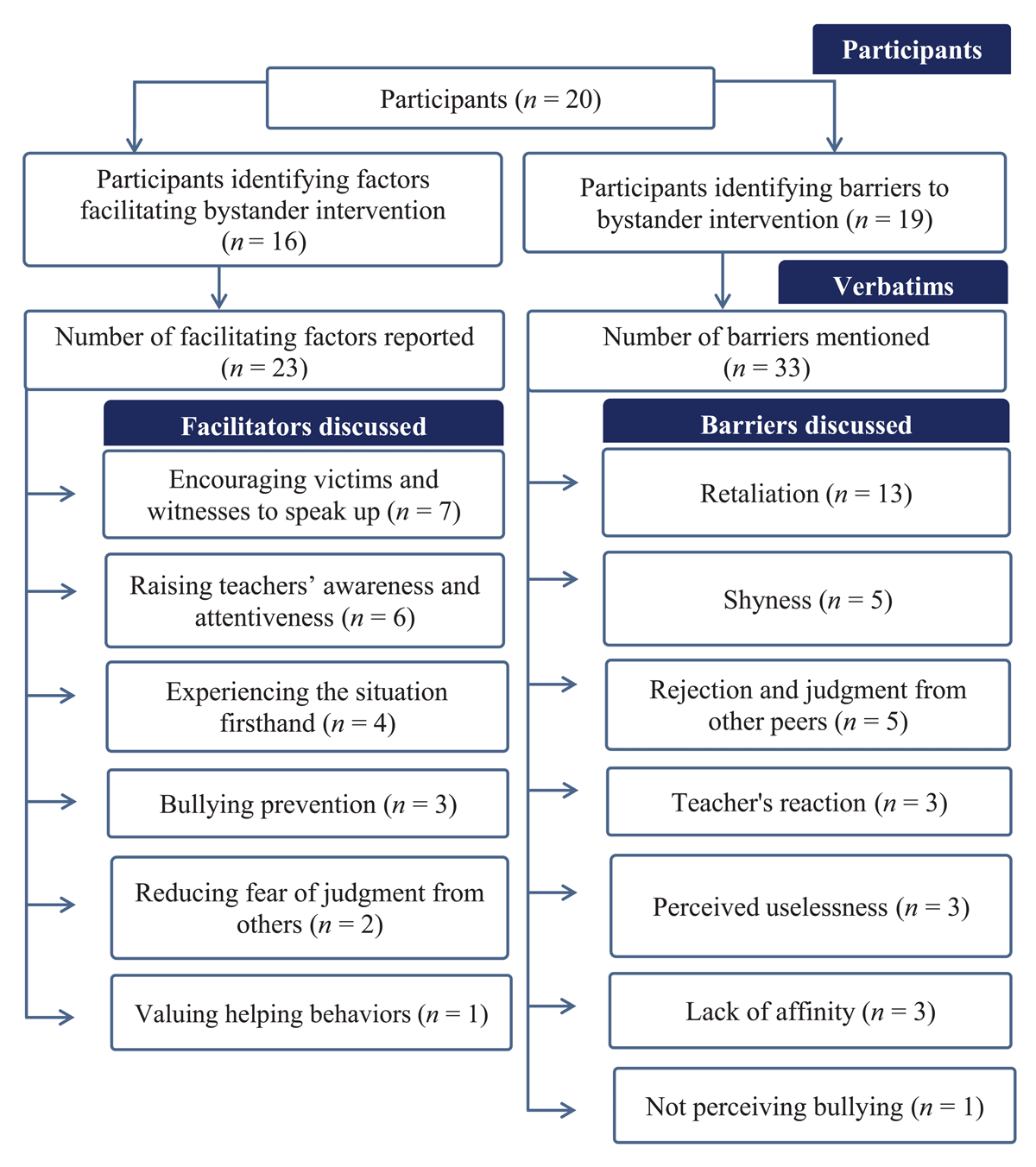
Figure 2
Schematic overview of codes and findings on facilitators and barriers to bystander intervention.
Table 5
Characteristics of students S2, S5, and S13 in non-intervention situations following critical incidents of bullying in PE classes.
| S2 | S5 | S13 | |
|---|---|---|---|
| Empathy score | 82 | 79 | 69 |
| Forms of bullying | Verbal | Relational | Verbal |
| Experienced emotions | Anger; Compassion; Sadness; Disgust | Compassion; Shame; Disappointment | Sadness; Hatred; Disappointment |
| Barriers | Fear of retaliation | Fear of rejection | Shyness, Fear of retaliation |