
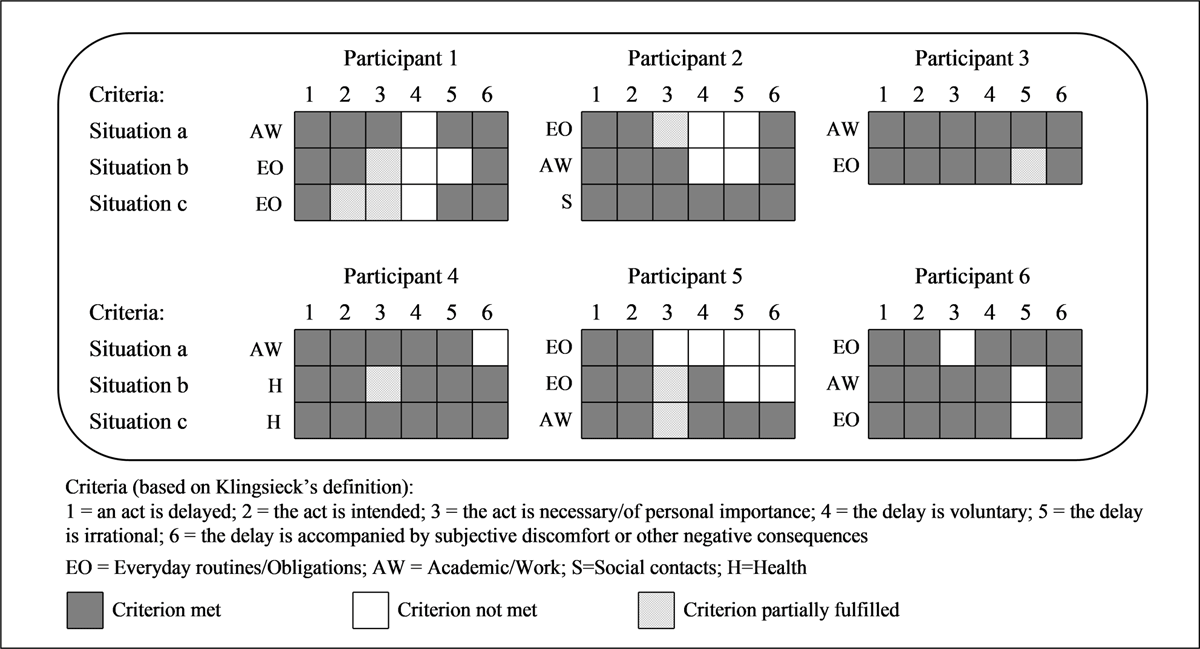
Figure 1
Criteria of procrastination definitions met by the participants according to the situation.
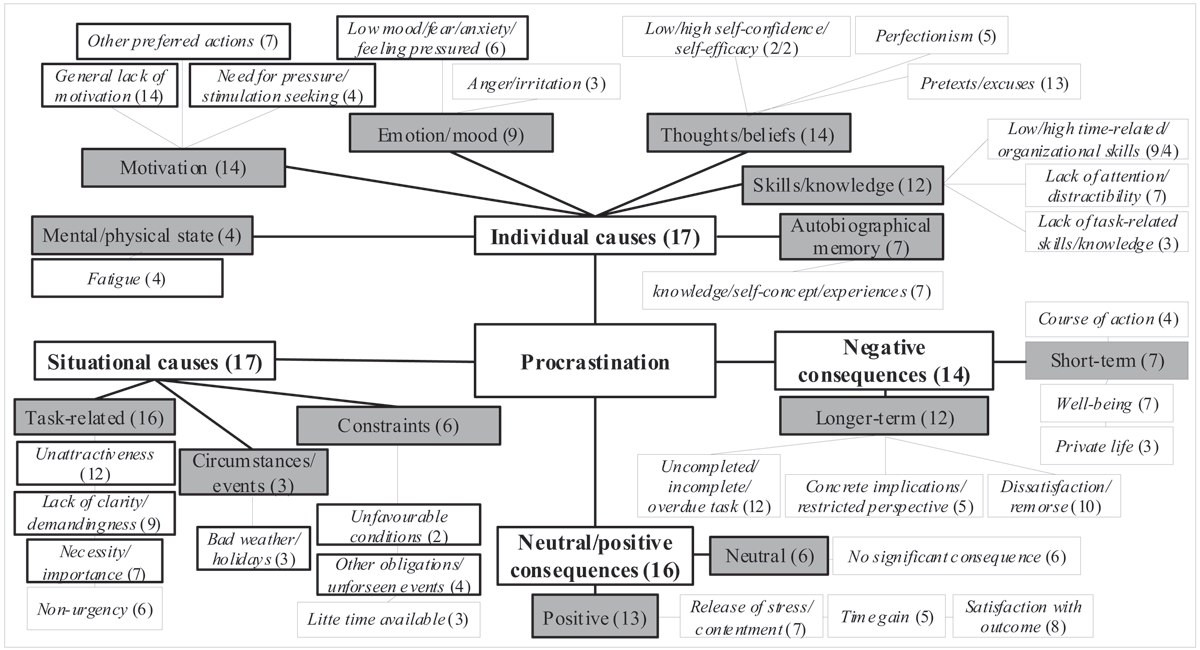
Figure 2
Causes and consequences of procrastination: main categories, subcategories, themes.
Note: Numbers represent the number of participants mentioning at least one statement per situation in each category.
Table 1
Examples of participants’ descriptions across different situations.
| Participant 1, male, 37 years, urban planner; PPS m = 3.09, PR = 70 | |||
|---|---|---|---|
| Situations a (AW): preparing a presentation for a meeting (Criterion 4 not met) | b (EO): buying foam mats (Criterion 3 partially fulfilled, Criteria 4–5 not met) | c (EO): weekly shopping (Criteria 2–3 partially fulfilled, Criterion 4 not met) | |
| Individual causes | |||
| Mental/physical state: fatigue (“I was tired”) | - | - | |
| Motivation: general lack of motivation (“I was not really motivated”); need for pressure/stimulation seeking (“I only started to work when I felt stressed, under pressure”) | general lack of motivation; other preferred actions (“I preferred to do other things; to do things of interest to me”) | general lack of motivation; other preferred actions | |
| Emotion/mood: - | anger/irritation (“Because it got on my nerves”) | anger/irritation | |
| Thoughts/beliefs:high self-confidence/self-efficacy (“I knew I could do it”) | pretexts/excuses (“I always found some excuse, such as I don’t have time, it’s too far away, the weather is not nice”) | pretexts/excuses | |
| Skills/knowledge: low time-related/organizational skills (“I didn’t realize that it would take so much time”; “I did other things that I could have done afterwards”); lack of task-relatedskills/knowledge (“I didn’t know how to do it”) | low time-related/organizational skills | low time-related/organizational skills | |
| Autobiographical memory: - | - | - | |
| Situational causes | |||
| Task-related characteristics: – | unattractiveness (“It’s really boring, I hate to go to malls”); low necessity/importance;non-urgency (“It’s not something urgent ; I don’t have a deadline”) | unattractiveness; low necessity/importance (“I don’t really need a fully stocked fridge, therefore it’s not that necessary”) | |
| Circumstances/events: - | - | - | |
| Constraints: unfavourable conditions (“Since I work in an open space, I am constantly interrupted when I work”);other obligations/unforeseen evets (“I was obligated to give some sessions that were unplanned”);little time available | unfavourable conditions;other obligations/unforeseen evets;little time available (“I really do not have enough time”) | unfavourable conditions;other obligations/unforeseen evets;little time available | |
| Negative consequences | |||
| Short-term consequences: course of action (“I had to work hard and late the day before the meeting”); well-being (“I was very tense”; “I was worried about not finishing on time”); private life (“I had to cancel a dinner that night”) | |||
| Longer-term consequences: - | uncompleted task; concrete implications (“I still do not have foam mats”); dissatisfaction/remorse (“I think to myself that I’m a little bit stupid [note having done it]”) | uncompleted task; concrete implications; dissatisfaction/remorse | |
| Neutral/positive consequences | |||
| Neutral consequences: no significant consequence (“There actually weren’t any consequences”) | - | - | |
| Positive consequences: satisfaction with outcome (“After the meeting, I was relieved that the job had correctly been done”) | release of stress/contentment (“The contentment of saying I’ll do it tomorrow”); time gain (“I had more time to do other things”) | release of stress/contentment; time gain | |
| Participant 2, male, 32 years, project manager; PPS m = 2.73, PR = 54 | |||
| Situations a (EO): daily shopping (Criterion 3 partially fulfilled, Criteria 4–5 not met) | b (AW): producing a report for a client (Criteria 4–5 not met) | c (S): phoning an old friend (all criteria met) | |
| Individual causes | |||
| Mental/physical state: fatigue | - | - | |
| Motivation: general lack of motivation; other preferred actions | general lack of motivation; other preferred actions; need for pressure/stimulation seeking | general lack of motivation; other preferred actions | |
| Emotion/mood: low mood (“My emotional state, I wasn’t very well”) | fear/anxiety (“I had the fear to begin”) | - | |
| Thoughts/beliefs: pretexts/excuses | high self-confidence/self-efficacy; perfectionism (“I must experience a feeling of perfection… that I never have”); pretexts/excuses | perfectionism (“I preferred not to do it, rather than not to do it well”); pretexts/excuses | |
| Skills/knowledge: - | both low/high time-related/organizational skills (“I noticed that there were reasons to wait, there were missing elements. I didn’t want to waste my time working on things that I should have changed later”) | low time-related/organizational skills | |
| Autobiographical memory: - | knowledge/self-concept/experiences (“It [postponing] happens to me in a lot of situations”) | knowledge/self-concept/experiences (“I am not saying that this is the perfect schema, but it’s always worked for me”) | |
| Situational causes | |||
| Task-related characteristics: low necessity/importance; non-urgency | lack of clarity/demandingness (“I was a little bit lost on the objectives”); high importance (“Because the task was very important”) | lack of clarity/demandingness (“Since we met a long time ago, I had the impression that it was more complicated to phone him”); non-urgency | |
| Circumstances/events: bad weather (“I did not feel like going out. It was cold and raining”) | - | - | |
| Constraints: other obligations | unfavourable conditions; other obligations | - | |
| Negative consequences | |||
| Short-term consequences: - | course of action; well-being; private life | - | |
| Longer-term consequences: uncompleted task; concrete implications; dissatisfaction (“I was not satisfied [with the situation]”) | - | uncompleted task; concrete implications; dissatisfaction | |
| Neutral/positive consequences | |||
| Neutral consequences: - | - | no significant consequence | |
| Positive consequences: release of stress/contentment; time gain | satisfaction with outcome | - | |
| Participant 3, female, 30 years, administrative assistant; PPS m = 3.73, PR = 90 | |||
| Situations a (AW): revising for a continuous assessment test (all criteria met) | b (EO): filing a tax return (Criterion 5 partially fulfilled and Criterion 6 not met) | ||
| Individual causes | |||
| Mental/physical state: fatigue | Fatigue | ||
| Motivation: general lack of motivation; need for pressure/stimulation seeking | general lack of motivation | ||
| Emotion/mood: fear/anxiety/feeling pressured (“Well, there’s somehow pressure on that”; “I am worried that others will judge me, I’m so afraid of not being able, and I think sometimes it paralyzed me”) | anger/irritation | ||
| Thoughts/beliefs: low self-confidence/self-efficacy (“If I fail because I didn’t work, I wouldn’t mind, but if I fail while having worked, because I have low self-confidence, I would say that I’m stupid”); pretexts/excuses | high self-confidence/self-efficacy; pretexts/excuses | ||
| Skills/knowledge: lack of time-related/organizational skills; lack of attention/distractibility (“I started to revise, and then suddenly, I started daydreaming. And the sun was shining. I thought to myself that it would be nice to be outside. And I went to my computer, I opened my emails, I looked at the news…”); lack of task-related skills (“I gave up when I had difficulties to understand what I did”) | high time-related/organizational skills (prioritization); lack of attention/distractibility (“I left it [the tax return] on a stack of paper and forgot it”) | ||
| Autobiographical memory: knowledge/self-concept/experiences | - | ||
| Situational causes | |||
| Task-related characteristics: unattractiveness | Unattractiveness | ||
| Circumstances/events: - | - | ||
| Constraints: - | - | ||
| Negative consequences | |||
| Short-term consequences: well-being (“I was stressed all the time,” “I felt a lot of guilt,” “I lost sleep over it, I was very tired”) | - | ||
| Longer-term consequences: incomplete task; dissatisfaction | overdue task | ||
| Neutral/positive consequences | |||
| Neutral consequences: - | no significant consequence | ||
| Positive consequences: release of stress/contentment; satisfaction with outcome | satisfaction with outcome | ||
| Participant 4, female, 27 years, graphic designer; PPS m = 3.64, PR = 87 | |||
| Situations a (AW): completing a project for a competition (Criterion 6 not met) | b (H): making a doctor’s appointment (Criterion 3 partially fulfilled) | c (H): initiating drug therapy (all Criteria met) | |
| Individual causes | |||
| Mental/physical state: - | - | - | |
| Motivation: generallack of motivation; other preferred actions | general lack of motivation | general lack of motivation | |
| Emotion/mood: feeling pressured | - | feeling pressured | |
| Thoughts/beliefs: - | - | low self-confidence/self-efficacy; perfectionism; pretexts/excuses | |
| Skills/knowledge: - | lack of attention | lack of attention | |
| Autobiographical memory: knowledge/self-concept | knowledge/self-concept | - | |
| Situational causes | |||
| Task-related characteristics: unattractiveness; lack of clarity/demandingness | unattractiveness; lack of clarity/demandingness | unattractiveness; lack of clarity/demandingness;non-urgency | |
| Circumstances/events: holidays (“And after I postponed during three weeks because I leaved in holidays) | holidays | - | |
| Constraints: - | - | - | |
| Negative consequences | |||
| Short-term consequences: - | well-being | well-being | |
| Longer-term consequences: - | uncompleted task; restricted perspective (“Since I’m being treated, it would have been better if I had seen him [the doctor] before to know if there were alternative treatments depending on the results”) | uncompleted task; restricted perspective | |
| Neutral/positive consequences | |||
| Neutral consequences: - | no significantconsequence | no significant consequence | |
| Positive consequences: release of stress/contentment; time gain; satisfaction with outcome | release of stress | ||
| Participant 5, male, 25 years, watchmaker; PPS m = 3.00, PR = 65 | |||
| Situations a (EO): opening mail (Criterion 3 to 5 not met) | b (EO): storing toilet paper rolls (Criterion 3 partially met and Criteria 5–6 not met) | c (AW): calling to receive information about a job (Criterion 3 partially met) | |
| Individual causes | |||
| Mental/physical state: - | - | - | |
| Motivation: - | - | - | |
| Emotion/mood: - | anger/irritation | fear/anxiety/feeling pressured | |
| Thoughts/beliefs: perfectionism; pretexts/excuses | - | perfectionism; pretexts/excuses | |
| Skills/knowledge: both low/high time-related/organizational skills | - | - | |
| Autobiographical memory: - | - | - | |
| Situational causes | |||
| Task-related characteristics: low necessity/importance; non-urgency | unattractiveness; lack of clarity/demandingness;low necessity/importance | unattractiveness; non-urgency | |
| Circumstances/events: - | - | - | |
| Constraints: otherobligations; little time available | - | - | |
| Negative consequences | |||
| Short-term consequences: - | - | well-being | |
| Longer-term consequences: - | - | uncompleted task; restricted perspective | |
| Neutral/positive consequences | |||
| Neutral consequences: no significant consequence | - | - | |
| Positive consequences: - | satisfaction with outcome | satisfaction with outcome | |
| Participant 6, female, 29 years, lawyer; PPS m = 3.36, PR = 80 | |||
| Situations a (EO): terminating the lease contract of a parking space (Criterion 3 not met) | b (AW): revising for a written examination (Criterion 5 not met) | c (EO): booking her scooter in for a service (Criterion 5 not met) | |
| Individual causes | |||
| Mental/physical state: - | - | - | |
| Motivation: general lack of motivation | general lack of motivation; other preferred actions; need for pressure/stimulation seeking | general lack of motivation | |
| Emotion/mood: - | - | - | |
| Thoughts/beliefs: pretexts/excuses | high self-confidence/self-efficacy; pretexts/excuses | pretexts/excuses | |
| Skills/knowledge: low time-related/organizational skills;lack of attention/distractibility; lack of task-related skills | high time-related/organizational skills;lack of attention/distractibility | low time-related/organizational skills; lack of attention/distractibility; lack of task-related skills | |
| Autobiographical memory: knowledge/self-concept/experiences | knowledge/self-concept/experiences | - | |
| Situational causes | |||
| Task-related characteristics: unattractiveness; lack of clarity/demandingness; low necessity/importance | Unattractiveness | unattractiveness; lack of clarity/demandingness | |
| Circumstances/events: - | - | - | |
| Constraints: - | - | - | |
| Negative consequences | |||
| Short-term consequences: - | course of action; well-being | - | |
| Longer-term consequences: uncompleted task; concrete implications/restricted perspective; dissatisfaction/remorse | incomplete task; concrete implications/restricted perspective; dissatisfaction/remorse | uncompleted task; concrete implications/restrictedperspective; dissatisfaction/remorse | |
| Neutral/positive consequences | |||
| Neutral consequences: - | - | - | |
| Positive consequences: release of stress/contentment; time gain;satisfaction with outcome | release of stress/contentment; time gain | - | |
[i] Note: PPS m = mean score on the French adaptation of the Pure Procrastination Scale (Rebetez et al., 2014); PR = percentile rank based on the French validation study of the PPS (Rebetez et al., 2014). AW = Academic/Work; EO = Everyday routines/Obligations; S = Social contacts; H = Health.
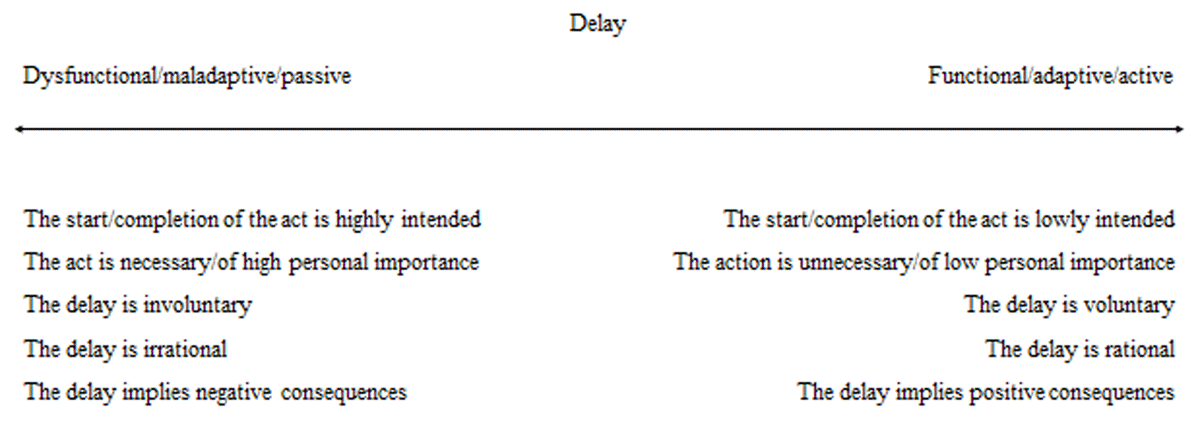
Figure 3
A dimensional approach to procrastination.