
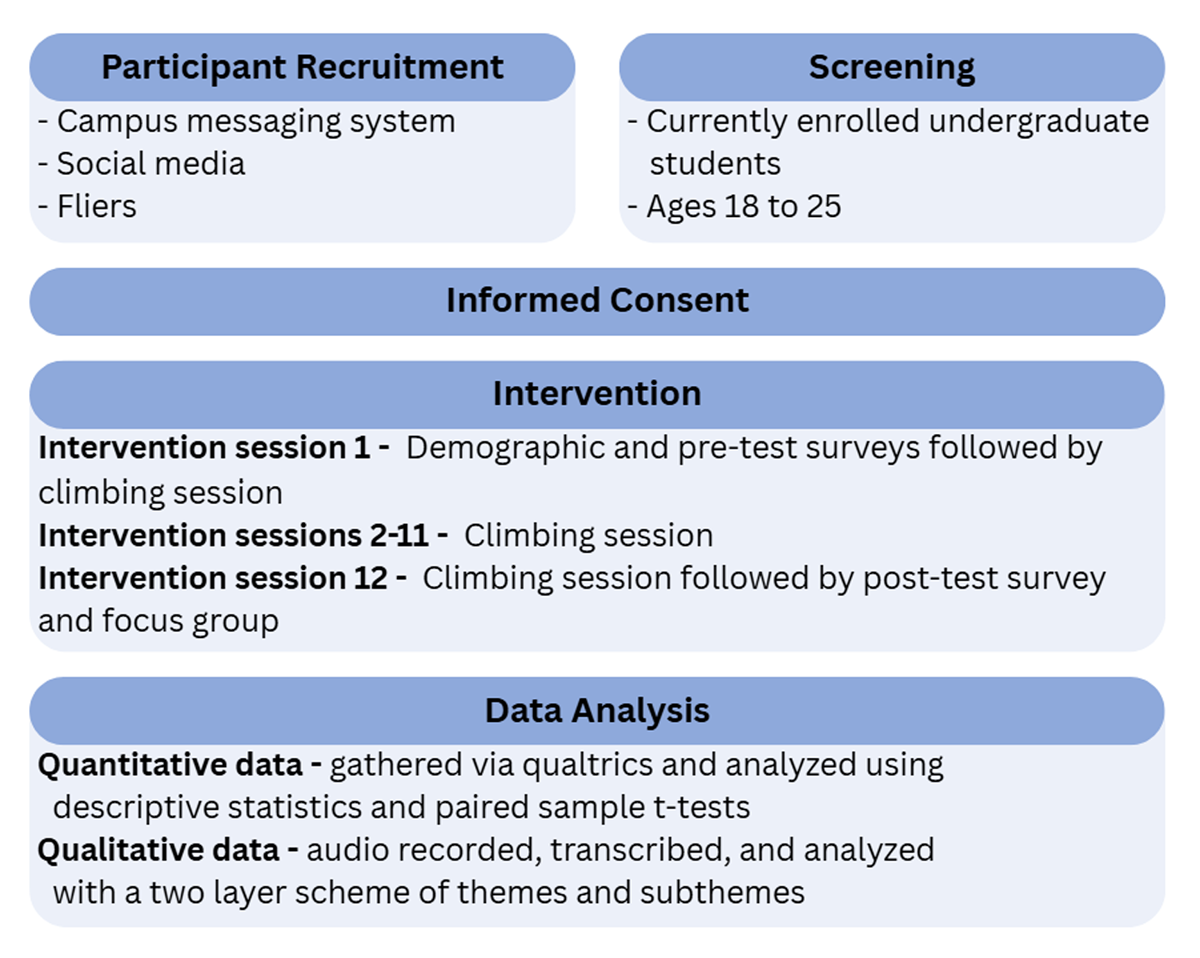
Figure 1
Study Flow Diagram.
Table 1
Participant Sociodemographic characteristics.
| CHARACTERISTICS (N = 30) | N | PERCENTAGE | |
|---|---|---|---|
| Gender | |||
| Male | 13 | 43.3 | |
| Female | 14 | 46.7 | |
| Non-binary transgender | 3 | 10.0 | |
| Race | |||
| Asian & other | 2 | 6.7 | |
| White & other | 1 | 3.3 | |
| Asian or Asian American | 3 | 10 | |
| Hispanic or Latina/o | 2 | 6.7 | |
| White or European | 22 | 73.3 | |
| Nativity | |||
| US Born American | 30 | 100 | |
| Residency Status | |||
| In-State Student | 27 | 90 | |
| Out-of-State Student | 3 | 10 | |
| Year in School | |||
| Freshman | 5 | 16.7 | |
| Sophomore | 6 | 20 | |
| Junior | 12 | 40 | |
| Senior | 5 | 16.7 | |
| Other | 2 | 6.7 | |
| Living situation | |||
| Alone | 3 | 10 | |
| With Family or Relative | 16 | 53.3 | |
| With Friend or Roommate | 6 | 20 | |
| Dorm, Residence Hall, Fraternity, or Sorority | 4 | 13.3 | |
| Other | 1 | 3.3 | |
| Major | |||
| STEM | 13 | 43.3 | |
| Social Science/ Business | 10 | 33.3 | |
| Humanities/ Arts | 5 | 16.7 | |
| Other | 1 | 3.3 | |
| No Answer | 1 | 3.3 | |
| Participant age at the time of pre-test | |||
| Minimum | Maximum | Mean | Std. Deviation |
| 18 | 25 | 20.45 | 1.76 |
Table 2
Results of Pre- and Post- tests (Paired Sample T-test: Paired differences).
| MEASURE | PRE-TESTMEAN | POST-TEST MEAN | MEAN DIFFERENCE | STD. DEVIATION | 95% CONFIDENCE INTERVALLOWER | UPPER | COHEN’S D (EFFECT SIZE) | TWO-SIDED P |
|---|---|---|---|---|---|---|---|---|
| Self-rated general health | 49.40 | 46.00 | 0.17 | 0.70 | –0.94 | 0.43 | 0.699 | 0.202 |
| Self-esteem | 71.08 | 77.33 | –2.50 | 2.98 | –3.61 | –1.39 | –0.839 | <0.001 |
| Life satisfaction | 63.06 | 71.34 | –2.93 | 4.60 | –4.68 | –1.18 | –0.638 | 0.002 |
| Anxiety level | 25.61 | 18.82 | 1.90 | 3.97 | 0.42 | 3.38 | 0.479 | 0.014 |
| Stress level | 35.58 | 30.26 | 2.76 | 4.03 | 1.22 | 4.29 | 0.684 | <0.001 |
| Social connection | 71.48 | 80.33 | –3.52 | 7.41 | –6.34 | –0.70 | –0.855 | 0.016 |
| Sense of belonging | 63.51 | 71.14 | –2.67 | 2.89 | –3.75 | –1.59 | –0.922 | <0.001 |
[i] N = 30.
Self-rated general health: Lower scores indicate higher levels of perceived general health.
Self-esteem: Higher scores indicate higher levels of self-esteem.
Life satisfaction: Higher scores indicate higher levels of life satisfaction.
Anxiety: Higher scores indicate higher levels of anxiety.
Stress: Higher scores indicate higher levels of stress.
Social connectedness: Higher scores indicate higher levels of social connectedness.
Sense of belonging: Higher scores indicate higher levels of sense of belonging.
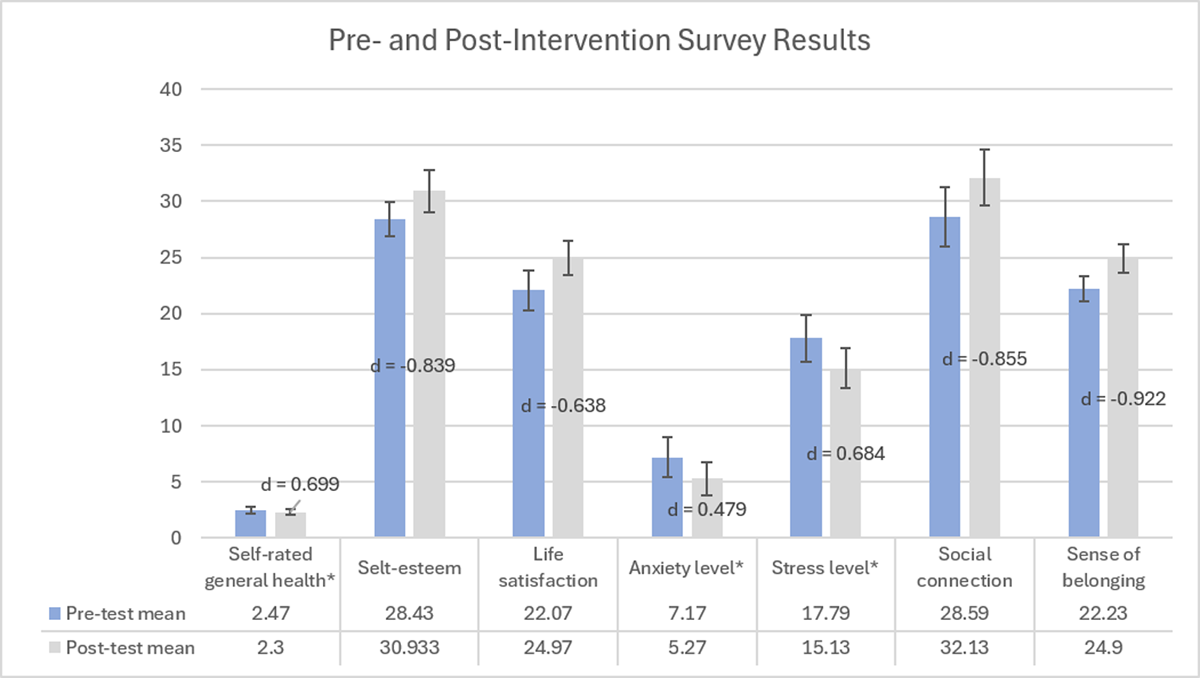
Figure 2
Results of Pre- and Post- tests.
Footnote:
- *Lower scores indicate positive change
- Error bars representative of the 95% confidence interval and Cohen’s d effect size are annotated with their associated scales.
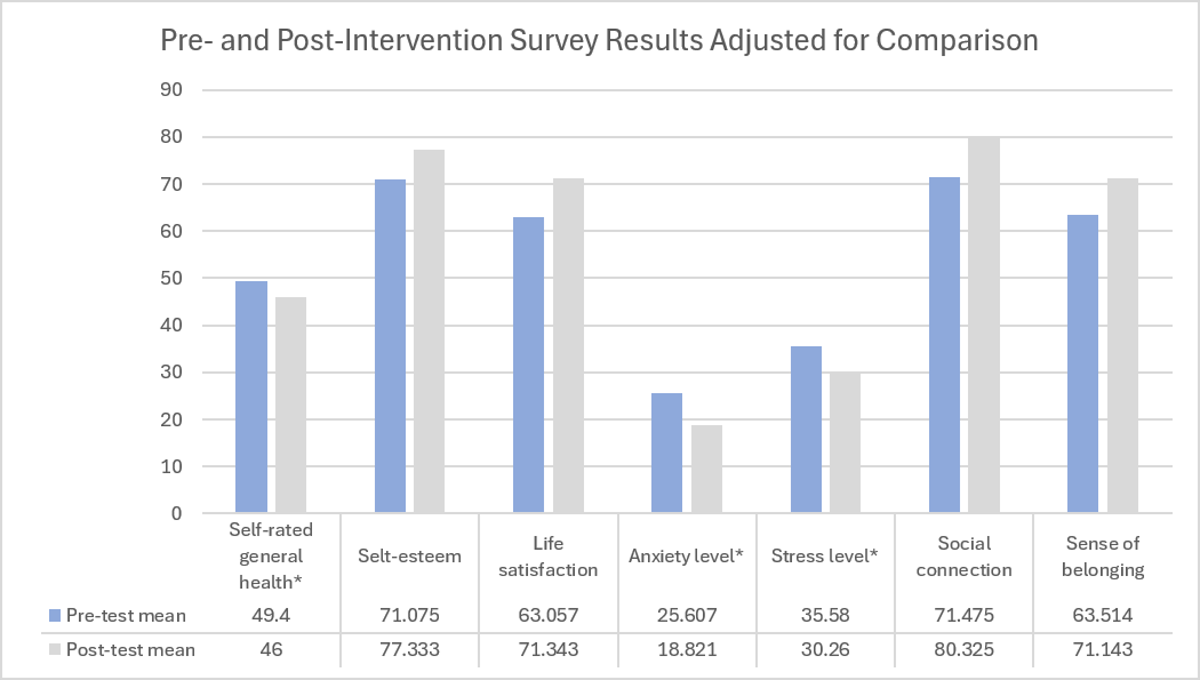
Figure 3
Results of Pre- and Post- tests: adjusted for comparison.
Footnote:
- *Lower scores indicate positive change
- Scale results were converted to percentages for visual comparison (ie. self-rated general health pre-test mean / total possible scale score *100 = 2.47 / 5 * 100 = 49.4, and social connection pre-test mean / total possible scale score *100 = 28.59 / 40 * 100 = 71.475).
Table 3
Themes and Quotes from the Qualitative Data.
| PRIMARY THEMES | DEFINITION OF THEMES | REPRESENTATIVE QUOTE |
|---|---|---|
| Comments about climbing | ||
| Progression | Consistent progression is good for mental health | “constant progression towards goals and being regular about something getting stronger and stronger just makes you feel good and it’s really good for your mental health” |
| Confidence | Overcoming challenges while climbing can improve confidence | “it’s increased my confidence in myself a little bit just like having these physical obstacles that I can overcome, like kind of translate into other obstacles in my life as well” |
| Teamwork | Climbing in a group setting provides a beneficial teamwork element | “We’re slowly getting closer and we’re developing techniques and we’re finding our skills together and we were able to push one another to become better climbers” |
| Social connection with friends | Climbing is a means of staying connected with friends | “this is also a way for me to stay in touch with, you know, a social group and see someone consistently even when I’m like, buried at work every single week” |
| Community | Climbing fosters a community of shared interest | “the climbing community in general is nice because there’s always like that one shared interest when maybe a lot of us like different majors, different hobbies, but like, we all share climbing and I think that does connect everyone which is nice” |
| Trust building | Top roping fosters trust building in relationships | “coming almost every week and like kicking it with some really cool people that was like a highlight of my Fridays and, you know, being able to put my trust in them while I was rock climbing was really something” |
| Community/ Social anxiety | Climbing in a group setting was beneficial for overcoming social anxiety | “there is no nervousness like I usually get talking to like random people. It’s like we’re all here for the same thing and that really helped just like you gotta belay people so you gotta talk to them and that, it was nice to kind of push me over that edge and see how it’s not that scary” |
| Consistency | The consistent climbing sessions provided a means of progression that has lasting effects | “it also helped me, like I said, like, get back into climbing… it just showed me like, yeah, if I choose a dedicated time to climb, I can have that consistency and then I can keep working out and keep getting stronger” |
| Physical, mental, and social wellbeing | Climbing provides several benefits to an individual’s health linked to social and mental well-being | “Just feeling physically healthy, makes me feel mentally healthy too. And climbing is such a good exercise, not just for our bodies but to like, solve puzzles and like, have a relationship with our belay partner and talk to people and communicate like it’s just all around super good.” |
| Anxiety and stress management | Facing fears in a safe environment boosts confidence | “I feel like it kinda helped me with my anxiety. Um I’ve always had a fear of heights so slowly conquering that was like a good feeling and made me a little more self-confident as well” |
| Overcoming Fear | Rock climbing is a unique sport because it can be intense and scary, pushing climbers to work to manage their fears | “I don’t think there are as many, um, exercising or sport things that are as like, literally terrifying as rock climbing… being able to do that something that, like, you know, is like, safe even though it still is like this big mental hurdle to get over of like having to go up super high and then fall and like, let yourself just kind of hang there like this is freaking scary, but you, but you do it and it’s great” |
| Stress relief | Climbing’s intensity can have stress relieving properties | “When I’m climbing, I like, I’m not thinking about anything besides climbing. Like, my brain just doesn’t have any room, so it gives me like a true, true break” |
| Regulate Stress | Due to its intense nature, climbing can help individuals learn to regulate their emotions | “if I’m doing something really hard on the wall and I’m starting to get, like, worked up because now I’m starting to get scared about it and taking a minute to just like, ok, I need to relax literally so I can keep doing this, that definitely applies to other places in your life where being able to take a step back so that you can actually approach a problem without, you know, overstressing about it” |
| Instinctual activity | Climbing is an instinctual activity to humans and so may have mental benefits | “We all have instinctual little monkey brains that want to go up the tall thing and like getting to do that, I think is really good for your mental health” |
| Physical progression | Participants experienced physical strength progression | “I can definitely tell that I’ve gotten stronger since I’ve been climbing and it’s a fun type of exercise because at the time when I’m climbing, it doesn’t seem like I’m exercising” |
| Great way to work out | Climbing, while providing strength benefits, does not feel like working out | “I feel like climbing is like a really good way to work out without really feeling like you’re like, working out because it’s just, it’s more like an activity but it like pretty much works out every part of you to some extent” |
| Unique physical benefits | Participants experienced physical benefits unique to climbing | “You definitely learn new muscle groups in your body” |
| No change in strength | No changes in physical well-being were experienced | “My level of physical activity hasn’t really changed since this program, so I feel like I’m at the same place that I was when I started it” |
| Motivation to workout | Climbing motivates further working out so that climbers can achieve their goals | “it definitely encourages me that it’s like if I have a climb I wanna do, I’m like, ok, I need to take steps outside of climbing in order to accomplish that, and so it’s like I try to push myself to like, eat healthier and like exercise at home” |
| Top roping and long term health | Top roping is better for long term health | “all the like micro muscles are used a lot more in top roping. I feel like, uh and it’s I just so much better too, especially if you’re going for a long term physical health” |
| Drawbacks of climbing and the intervention program | ||
| Stressful | Climbing can be stressful | “I have anxiety and I’m afraid of heights… So it technically stresses me out sometimes when I’m up on the wall” |
| Plateauing | Climbers can get stuck at at a grade level, and this can be disheartening | “I’ve had a few sessions where it feels like I’m kind of at a stump and it’s like, I can’t get to the next, um, like level” |
| Outdoor climbing | Climbing is better when it’s outdoors | “you don’t hear birds chirping and you’re not out in the sun” |
| Climbing gyms can be crowded | The climbing gym can get busy, making the climbing experience worse | “It also gets congested in here at least during our session, which is unfortunate” |
| Injuries | Injuries while climbing | “climbing related injuries, but not like, necessarily because of this program” |
| Cost | Climbing is expensive | “I can’t think of anything other than, you know, wanting to come back here and being too broke to do so”. |
| Comments about the intervention program | ||
| A way to start climbing | The program was a good way for individuals to try climbing for the first time | “it is my first time, like, ever climbing. So, now I feel like it’s kind of given me like, a foot in. So I’m like, oh, yeah, like I’ll definitely continue” |
| Get back into climbing thanks to program | The program helped individuals with previous experience get back into the sport | “I can get back into it in a bigger way. It also definitely made me realize I like top roping more than I like bouldering so, um there, yeah, like pushing towards the endurance mindset of it” |
| Motivated to continue climbing | The program encouraged individuals to continue climbing in the future | “it’s just kind of made me pretty determined to, like, not just climb but make it like a regular thing where I can… kind of just see my own growth and just be constantly on like a little journey and I think it very much encouraged me to, like, keep climbing and keep climbing regularly” |
| Community/ Program | The program fostered social connection and community building that will last beyond the program’s duration | “I feel like I met a lot of people that I wouldn’t have normally just in my classes in my day to day life. So I thought that was really cool that climbing brings together a very unique group of individuals. Um, and there’s a sense of community that I really do enjoy and I see myself engaging in, in the future as well” |
| Program was free | The program was free, providing an opportunity to some who could not afford to try the sport | “I really like that it was free… going forward, I cannot afford climbing but, but no, it was, it was super sick to get to learn it” |
| Shoes as good incentive | New climbing shoes as compensation for participation fostered continued engagement with the sport | “having the shoes be an incentive is a good enabler for people who are starting to climb. Um, it definitely encourages people to continue climbing after the studies that was good for me as an aspect”. |
| Structure | The structured style of the program was beneficial | “I like structured things. It’s like a practice, less mandatory though. It’s nice, it’s not stressful. It was really good” |
| Getting to top rope | The program provided the opportunity to top rope climb | “I got to top rope a lot, which isn’t as available at the gym I go to” |
| Once a week is good | Once a week sessions were good | “I like the one time a week too because I felt like it was not too crazy, but it still kinda let us get progress” |
| More climbing | More sessions, longer sessions, and longer duration of program would be good | “I would just make it longer, more weeks, more rock climbing” |
| Advanced climbing | Continuing with a second program with a more advanced climbing group | “Maybe having like a second session where it’s like you could do harder stuff like that. So it’s like people who, you know, have experience climbing” |
| Lead climbing | Create a program for lead climbing | “I would love to go even deeper. Uh, going into lead climbing” |
| Outdoors | Bring participant groups to climb outdoors | “I would maybe try to do more of, like, bring the group, maybe do an outside climbing thing too” |