
Introduction
College students in the United States report high rates of depression (38%), anxiety (34%), perceived loneliness (65%), and sadness (65.1%) (American College Health Association, 2015; Healthy Minds Network, 2024). Furthermore, rates of depression, anxiety, suicidal ideation, and suicide attempts have risen dramatically among college-aged individuals (18–25 years) over the past decade, with a 2019 study of college and university students reporting one in five students experience lifetime suicidal thoughts (Sivertsen et al., 2019; Lipson et al., 2022; Duffy et al., 2019). Treatment rates for mental well-being conditions among college students further reflect these trends, growing from 19% to 34% between 2007 and 2017 and with the percentage of students with lifetime diagnoses increasing from 22% to 36% (Lipson et al. 2019). Due to the rapidly growing population requiring their services, college counselling centers are at capacity and lacking sufficient resources to meet current demand for mental well-being services (Xiao et al., 2017). Additionally, the 2020–2023 COVID-19 pandemic resulted in increased risk for depression, anxiety, and stress among college students, although current literature is insufficient to determine if mental well-being trends resulting from the pandemic will persist (Zarowski et al., 2024). This trend of mental well-being issues in young adults is in dire need of further resources and targeted action. Interventions that focus on improving the mental well-being of college students may be an effective way of addressing this problem. Given these trends and the known benefits of physical activity for mental well-being, novel exercise-based interventions that also foster social connection warrant exploration.
Mental well-being is linked to many physical and behavioral factors of a person’s life: physical well-being, activity, diet, and consumption of substances are markedly paramount to an individual’s mental well-being (Badger et al., 2019; Herbert, 2022; Vankim & Nelson, 2013). Similarly, an individual’s level of social support shares the same benefits as physical activity. Social support and well-being are closely correlated with improved mental well-being, lowered stress, raised self-esteem, and greater physical longevity (Umberson & Montez, 2010). Interventions that target a student’s social connection and mental well-being will most likely provide long-lasting well-being and social benefits (Knowlden et al., 2015). Furthermore, well-being education programs that utilize physical activity and social support as a means of achieving these benefits may be particularly effective.
This study evaluates the use of indoor climbing as an intervention to promote mental and social well-being among college students. Indoor climbing was selected for this study as a proxy for exercise because it is understudied while also being popular among college students. Indoor climbing is a form of rock climbing that is performed on artificial walls with plastic hand and foot holds, and it has grown steadily among youth and young adults in the past seven years (Climbing Business Journal, 2023). Indoor climbing has a 35-year history in the U.S. and offers a much safer alternative to outdoor rock climbing. Indoor climbing routes are labeled on a scale of difficulty thereby allowing climbers of all skill levels, from beginners to experts, to enjoy and have success climbing. Climbing not only requires physical strength, but it also demands a great deal of strategy and problem solving for each climber to reach the top. There are three types of indoor climbing: lead, top roping, and bouldering. This study focuses on top roping. Top roping involves a belayer managing the slack and tension of a rope that is attached to the top of the wall and then to the climber. Top roping, being a sport that requires two people to work together, is not only beneficial for cardiopulmonary and muscular endurance and well-being but also exposes climbers to a unique cooperative experience (Mermier et al., 1997; Li et al., 2018). Indoor climbing has also been linked to improved sense of connection, mindfulness, mental well-being, and promotion of healthy lifestyles among young adults who are experienced climbers (Osborne et al., 2025). Excluding bouldering, which does not involve ropes and a climber-belayer dynamic, indoor climbing builds communication and trust between a climber and their belayer (Frühauf et al., 2021). This characteristic of indoor climbing is unique and different from solo sports such as running or gym workouts in building social connection. In addition, climbing enhances the development of a sense of community (U.S. Department of Veteran Affairs, 2020). A previous study found that a belayer-climber relationship is potentially associated with enjoyable and close social interactions (Osborne, et. al., 2025). This feature of top-roping climbing indicates that interventions using top-rope climbing can be distinct from other structured group-based exercise interventions. Given the rigorous physical activity and the climber-belayer dynamic which are integral parts of climbing, we believe that this sport contains several unique factors that make it optimal for use as an intervention for addressing mental and social well-being.
Although there are previous studies that have investigated well-being benefits of rock climbing, there is limited research evaluating the impact of indoor climbing on mental and social well-being and the effectiveness of setting-based mental well-being interventions among college students (Worsley et al., 2022). Furthermore, while previous studies examined exercise-based interventions targeting mental and social well-being among college students using different types of sports/exercise such as swimming (Wang et al., 2025), virtual reality exercise (Wang et al., 2026), dance (Akandere & Demir, 2011), yoga (Albracht-Schulte & Robert-McComb, 2018), resistance training (Faro et al., 2019), and self or online guided HIIT (High-Intensity Interval Training) (Zhu et al., 2023), most of the interventions were offered in a group setting for individual sports/exercise. Since top-rope indoor climbing requires two climbers working together, it provides a social connection in addition to exercise. This project aims to bridge this gap and develop a novel way to promote well-being among college students. The hypothesis of this project is that the exposure of college-aged students to the physical and social aspect of rock climbing in an intervention format will yield positive mental and social benefits.
Methods
Participants
This project was approved by the University of Utah Institutional Review Board (IRB) (IRB number 00169118). Figure 1 shows the study flow diagram. Data were collected across two academic semesters between August 2023 and May 2024 in an indoor climbing gym. Participants were recruited via online communications on the University’s learning management system Canvas, social media, and fliers on campus. Eligibility criteria included undergraduate students between the ages of 18 and 25. Informed consent was acquired from each participant. During the first meeting, participants completed a pre-test survey and a demographic survey, and on the final day participants completed a post-test survey identical to the pre-test survey in order to evaluate changes throughout the course of the program. Participants also took part in a focus group on the final day of the climbing program to share their experiences.
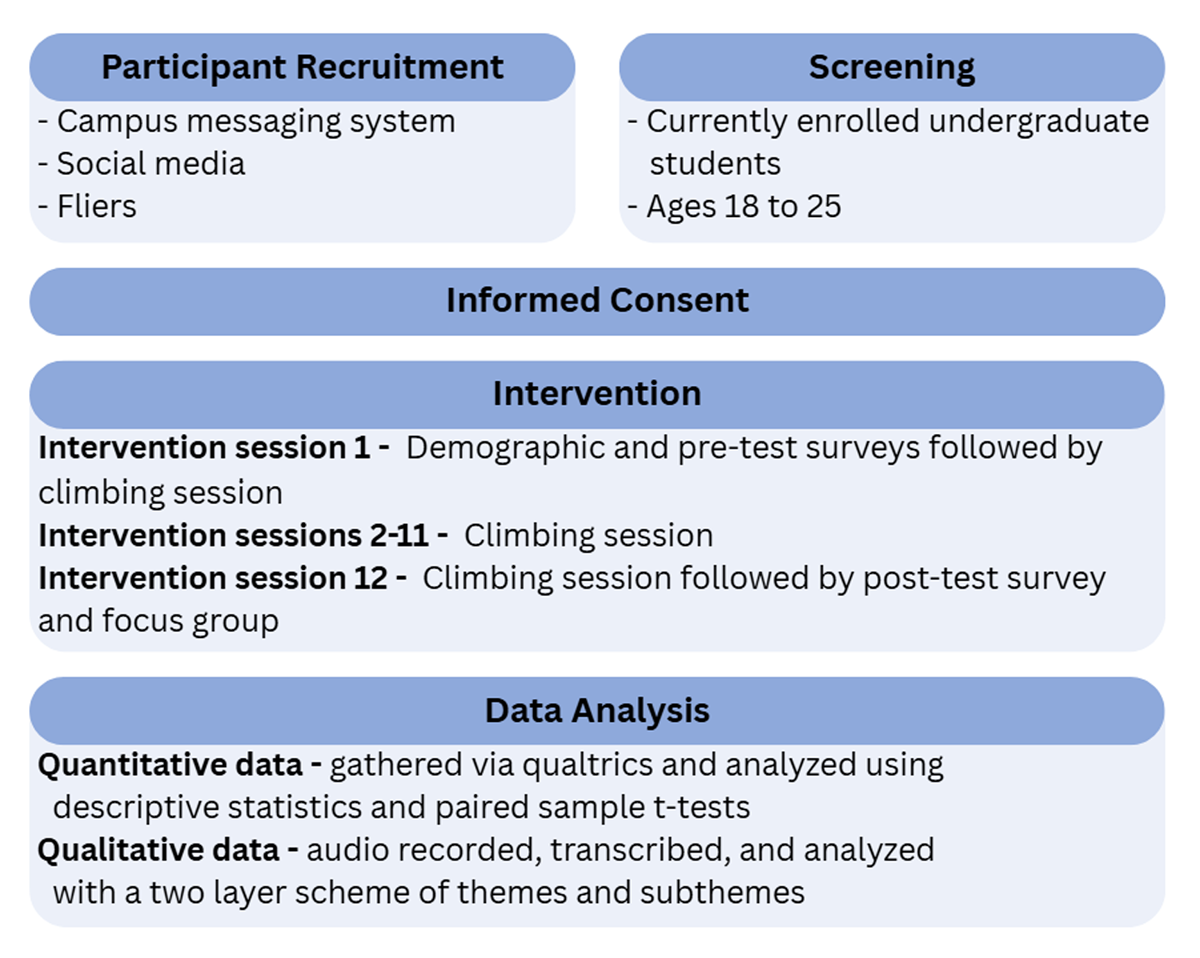
Figure 1
Study Flow Diagram.
Participants were compensated for their completion of pre- and post-test surveys, 10 climbing sessions, and participation in the focus group with a $40 visa gift card and a pair of new climbing shoes. From a total of 71 participants over 5 intervention groups, 30 participants completed the program resulting in a completion rate of 42.25%. Intervention group times and participant completion per group are as follows: 7 from fall 2023 Friday 10AM–12PM, 4 from fall 2023 Friday 12PM–2PM, 5 from spring 2024 Thursday 10AM-12PM, 6 from spring 2024 Friday 10AM–12PM, and 8 from spring 2024 Friday 12PM–2PM. Collected sociodemographic data included participant gender, race, country of origin, residency status (in-state or out-of-state), year in school, living situation, and academic major. Sociodemographic data is presented in Table 1.
Table 1
Participant Sociodemographic characteristics.
| CHARACTERISTICS (N = 30) | N | PERCENTAGE | |
|---|---|---|---|
| Gender | |||
| Male | 13 | 43.3 | |
| Female | 14 | 46.7 | |
| Non-binary transgender | 3 | 10.0 | |
| Race | |||
| Asian & other | 2 | 6.7 | |
| White & other | 1 | 3.3 | |
| Asian or Asian American | 3 | 10 | |
| Hispanic or Latina/o | 2 | 6.7 | |
| White or European | 22 | 73.3 | |
| Nativity | |||
| US Born American | 30 | 100 | |
| Residency Status | |||
| In-State Student | 27 | 90 | |
| Out-of-State Student | 3 | 10 | |
| Year in School | |||
| Freshman | 5 | 16.7 | |
| Sophomore | 6 | 20 | |
| Junior | 12 | 40 | |
| Senior | 5 | 16.7 | |
| Other | 2 | 6.7 | |
| Living situation | |||
| Alone | 3 | 10 | |
| With Family or Relative | 16 | 53.3 | |
| With Friend or Roommate | 6 | 20 | |
| Dorm, Residence Hall, Fraternity, or Sorority | 4 | 13.3 | |
| Other | 1 | 3.3 | |
| Major | |||
| STEM | 13 | 43.3 | |
| Social Science/ Business | 10 | 33.3 | |
| Humanities/ Arts | 5 | 16.7 | |
| Other | 1 | 3.3 | |
| No Answer | 1 | 3.3 | |
| Participant age at the time of pre-test | |||
| Minimum | Maximum | Mean | Std. Deviation |
| 18 | 25 | 20.45 | 1.76 |
Intervention Design
Program design involved 12 two-hour long intervention sessions which were offered weekly at a local climbing gym over the course of a single 16-week academic semester at a flagship university in the intermountain region. Participants were asked to participate in at least 10 intervention sessions over the course of a single semester. Participants were provided with top rope instruction, harnesses, belay devices, and chalk, and were allowed to climb together during the intervention sessions. Six research assistants with previous experience sport climbing were recruited to lead climbing sessions by facilitating pre- and post-test surveys, focus groups, managing equipment, and assisting climbers by belaying when no other participants were available. Each session consisted of warming-up and climbing. While there was a group curriculum, it was more individualized because each participant had a different level of climbing skills. Research assistants attended several meetings over zoom to prepare study materials and participated in a training day at the local climbing gym to rehearse a typical session with participants.
Outcome Measures
Pre- and post- surveys included scales that measure physical (using the Self-Rated Health scale), mental (Rosenberg Self-Esteem Scale, Generalized Anxiety Disorder-7, Perceived Stress Scale, Satisfaction With Life Scale), and social (Social Connectedness Scale, Sense of Belonging Scale) well-being.
Self-Rated Health
A single question was used to assess perceived physical health – “In general, would you say your physical health is poor, fair, good, very good or excellent?”. A five-point Likert-type scale ranging from “excellent” = 1, “very good” = 2, “good” = 3, “fair” = 4, to “poor” = 5 was adopted from the MOS 36-item short-form health survey, a survey used by researchers in many nationally representative studies (Ware & Sherbourne et al., 1992; Barger, 2006). Scoring indicates lower scores are better health.
Self-Esteem
Self-esteem was measured by the Rosenberg Self-Esteem Scale that has 10-items (Rosenberg, 1979) and are validated and reliable for college students (Calvo, 2023). The examples of the items include “On the whole, I am satisfied with myself,” and “I feel that I’m a person of worth.” Participants picked 1 = Strongly agree, 2 = Agree, 3 = Disagree, or 4 = Strongly disagree for each item. Some of the items were reverse-coded for scoring. Scoring was based on the total value of the individual 4-point items. Higher scores indicate higher levels of self-esteem. This scale has been used in research with global reliability to measure self-worth and has been proven effective for research among college-aged individuals (Pullman & Allik, 2000).
Life Satisfaction
Satisfaction With Life Scale (SWLS) was used to measure life satisfaction (Pavot & Diener, 1993). The SWLS has been validated for young adults (Pavot, Diener, Colvin, et al., 1991) and has five items – for example, “In most ways my life is close to my ideal,” “The conditions of my life are excellent,” and “I am satisfied with my life” – and utilizes a 7-point Likert scale ranging from “Strongly Agree” = 7 to “Strongly Disagree” = 1. Scoring is based on a total score. Higher scores indicate higher levels of life satisfaction. This scale has been proven reliable for research among adult and youth populations (Diener et al., 1985; Pavot & Diener, 1993).
Anxiety
Anxiety levels were measured by the Generalized Anxiety Disorder 7-item (GAD-7) that uses a 4-point Likert scale (Not at all = 0 to Nearly every day = 3) with 7 items, for example “Feeling nervous, anxious, or on edge,” and “Not being able to stop or control worrying” (Spitzer et al., 2006). GAD-7 has been validated and reliable for the college student population (White & Karr, 2023). Scoring is based on a total score. Higher scores indicate higher levels of anxiety. This scale has been proven reliable for research in the general population.
Stress
Perceived stress was examined based on the Perceived Stress Scale (PSS-10) which has been validated for college students (Lee, 2012). The PSS-10 uses a 5-point Likert scale with 10 items (e.g. “In the last month, how often have you been upset because of something that happened unexpectedly” and “In the last month, how often have you felt that you were unable to control the important things in your life?”) ranging from “never” = 0 to “very often” = 4 (Cohen et al., 1983). Four of the items are reverse coded. Scoring is based on a total score. Higher scores indicate higher levels of stress. This scale’s reliability has been validated among international populations and university students (Chen et al., 2021; Manzar et al., 2019).
Social well-being
Two scales were used to measure social well-being. The Social Connectedness Scale was used to assess perceived social connection and support (Lee & Robbins, 1995). The scale has eight items (e.g. “I feel disconnected from the world around me,” “Even around people I know, I don’t feel that I really belong”) with a 6-point Likert scale (1 = Strongly agree to 6 = Strongly disagree). Scoring was based on a total score. Higher scores indicate higher levels of social connectedness. This study has been validated reliable among college-aged populations.
In addition, the Sense of Belonging Scale was used to measure social well-being, and in particular, sense of belonging to the University (Yorke, 2016). This scale has seven items (e.g. “How well do people at [the name of the University] understand you as a person?” “How welcoming have you found [the name of the University] to be?”) with a 5-point Likert scale (1 = most negative answer to 5 = most positive answer). Scoring was based on a total score, with higher scores indicating higher levels of sense of belonging at the University. Validity and reliability for college students were tested in the process of developing the survey (Yorke, 2016).
Qualitative Data
The interview guide was based upon the Seidman method, a method aimed at encouraging storytelling and contextualizing experiences through participant perspectives (Seidman, 2019). In line with the structure of the Seidman method, the focus group guide was comprised of three sections: a focused history of experiences in the program (e.g. “What did you like most about the climbing program?”) followed by a perceptions, insights, and experiences section (e.g. “In what ways do you feel that this indoor climbing program has benefited you in terms of your overall mental health?” and “Are there any drawbacks of indoor climbing? If so, what are the drawbacks?”), and lastly a reflection and meaning section (e.g. “Did this program encourage you to continue climbing?”). The full interview guide can be found in the appendix. Focus groups were facilitated by a research assistant.
Data Analysis
Quantitative data analysis
Quantitative data was collected using Qualtrics, an online survey platform, and analyzed using descriptive statistics and paired t-tests. The statistical software IBM SPSS (ver. 28) was used to determine changes between pre- and post-tests.
Qualitative data analysis
Focus groups were audio-recorded, transcribed, and analyzed by trained research assistants. To ensure reliability and accuracy, research assistants were climbers who could communicate details of the climbing experience and community. A two-layer scheme was used to analyze data by organizing information into themes followed by subthemes and representative quotes for each subtheme.
Results
A total of 30 participants completed all pre- and post-tests and a total of 10 intervention sessions. Table 1 describes demographic characteristics of participants. The participant population contained a nearly equal distribution of those identifying as male (43.3%) and female (46.7%), with the remaining participants identifying as non-binary (10%). The majority of participants were white (73.3%) and Utah state residents (90%). All participants were born in the United States. Over half of participants lived with relatives (53.3%), while the remaining population reported living with a roommate (20%), in a university sponsored residence hall or Greek life housing (13.3%), alone (10%), or reported “other” (3.3%). All years of schooling were represented among the participant population: from greatest representation to lowest, participants reported as being juniors (40%), sophomores (20%), freshmen (16.7%), seniors (16.7%), or “other” (6.7%) for year in school.
Pre- and Post-tests
Table 2 and Figures 2 and 3 present the results of the pre- and post-tests. Pre- and post-test surveys resulted in statistically significant improvements in all measured categories except for self-rated general health from the beginning to the end of the intervention program. Lower scores in self-rated general health, stress level, and anxiety level indicate positive results, whereas the other four metrics indicate positive results with greater values. Self-rated general health was largely unchanged from a pretest mean of 2.47 ± 0.90 to a post-test mean of 2.30 ± 0.65, t(29) = 1.306, p = 0.101 representing a moderate effect size (d = 0.699). Self-esteem improved from a pretest mean of 28.42 ± 4.17 to a post-test mean of 30.93 ± 5.01, t(29) = –4.595, p < .001 representing a large effect size (d = –0.839). Life satisfaction improved from a pretest mean of 22.07 ± 4.73 to a post-test mean of 24.97 ± 3.99, t(28) = –3.433, p = .002 representing a moderate effect size (d = –0.638). Anxiety level decreased from a pretest mean of 7.17 ± 4.73 to a post-test mean of 5.27 ± 3.86, t(29) = 2.622, p = 0.014 representing a moderate effect size (d = 0.479). Stress level decreased from a pretest mean of 17.79 ± 5.38 to a post-test mean of 15.13 ± 4.70, t(28) = 3.684, p < .001 representing a moderate effect size (d = 0.684). Social connection improved from a pretest mean of 28.59 ± 6.99 to a post-test mean of 32.13 ± 6.57, t(28) = –2.555, p = 0.016 representing a large effect size (d = –0.855). Finally, sense of belonging improved from a pretest mean of 22.23 ± 3.08 to a post-test mean of 24.90 ± 3.51, t(29) = –5.049, p < .001 representing a large effect size (d = –0.920). Figure 1 displays comparisons of pre- and post-test means. Results indicate statistically significant improvement in participant perceived well-being in all categories except self-rated general health over the course of the intervention program.
Table 2
Results of Pre- and Post- tests (Paired Sample T-test: Paired differences).
| MEASURE | PRE-TESTMEAN | POST-TEST MEAN | MEAN DIFFERENCE | STD. DEVIATION | 95% CONFIDENCE INTERVALLOWER | UPPER | COHEN’S D (EFFECT SIZE) | TWO-SIDED P |
|---|---|---|---|---|---|---|---|---|
| Self-rated general health | 49.40 | 46.00 | 0.17 | 0.70 | –0.94 | 0.43 | 0.699 | 0.202 |
| Self-esteem | 71.08 | 77.33 | –2.50 | 2.98 | –3.61 | –1.39 | –0.839 | <0.001 |
| Life satisfaction | 63.06 | 71.34 | –2.93 | 4.60 | –4.68 | –1.18 | –0.638 | 0.002 |
| Anxiety level | 25.61 | 18.82 | 1.90 | 3.97 | 0.42 | 3.38 | 0.479 | 0.014 |
| Stress level | 35.58 | 30.26 | 2.76 | 4.03 | 1.22 | 4.29 | 0.684 | <0.001 |
| Social connection | 71.48 | 80.33 | –3.52 | 7.41 | –6.34 | –0.70 | –0.855 | 0.016 |
| Sense of belonging | 63.51 | 71.14 | –2.67 | 2.89 | –3.75 | –1.59 | –0.922 | <0.001 |
[i] N = 30.
Self-rated general health: Lower scores indicate higher levels of perceived general health.
Self-esteem: Higher scores indicate higher levels of self-esteem.
Life satisfaction: Higher scores indicate higher levels of life satisfaction.
Anxiety: Higher scores indicate higher levels of anxiety.
Stress: Higher scores indicate higher levels of stress.
Social connectedness: Higher scores indicate higher levels of social connectedness.
Sense of belonging: Higher scores indicate higher levels of sense of belonging.
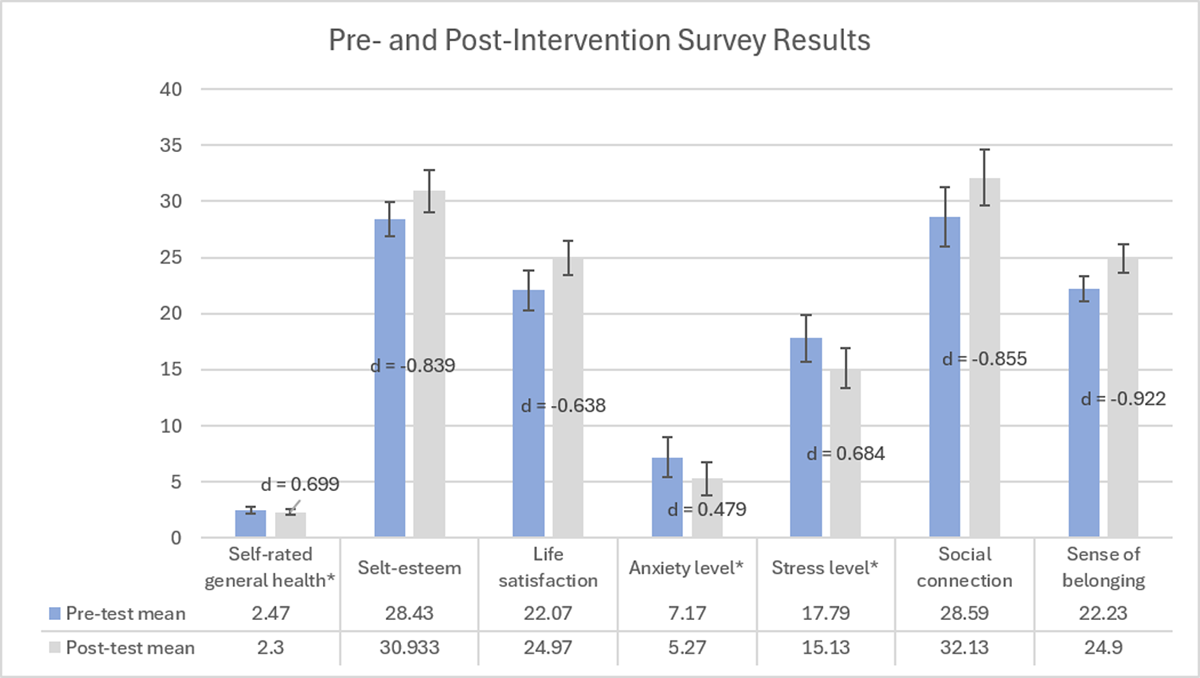
Figure 2
Results of Pre- and Post- tests.
Footnote:
- *Lower scores indicate positive change
- Error bars representative of the 95% confidence interval and Cohen’s d effect size are annotated with their associated scales.
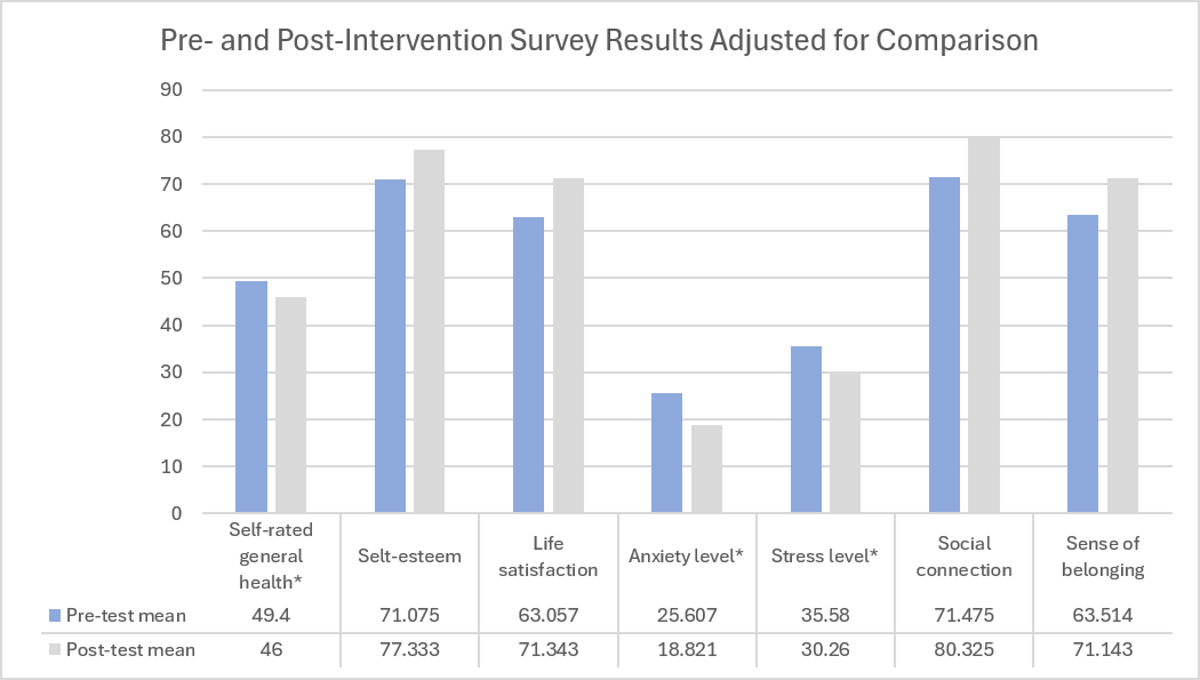
Figure 3
Results of Pre- and Post- tests: adjusted for comparison.
Footnote:
- *Lower scores indicate positive change
- Scale results were converted to percentages for visual comparison (ie. self-rated general health pre-test mean / total possible scale score *100 = 2.47 / 5 * 100 = 49.4, and social connection pre-test mean / total possible scale score *100 = 28.59 / 40 * 100 = 71.475).
Focus Groups
Table 3 summarizes the results from the focus groups. There were 5 focus groups (one focus group for each intervention group). On average, the focus groups took 45 minutes. All participants of the focus groups completed the pre- and post-tests and the climbing intervention program.
Table 3
Themes and Quotes from the Qualitative Data.
| PRIMARY THEMES | DEFINITION OF THEMES | REPRESENTATIVE QUOTE |
|---|---|---|
| Comments about climbing | ||
| Progression | Consistent progression is good for mental health | “constant progression towards goals and being regular about something getting stronger and stronger just makes you feel good and it’s really good for your mental health” |
| Confidence | Overcoming challenges while climbing can improve confidence | “it’s increased my confidence in myself a little bit just like having these physical obstacles that I can overcome, like kind of translate into other obstacles in my life as well” |
| Teamwork | Climbing in a group setting provides a beneficial teamwork element | “We’re slowly getting closer and we’re developing techniques and we’re finding our skills together and we were able to push one another to become better climbers” |
| Social connection with friends | Climbing is a means of staying connected with friends | “this is also a way for me to stay in touch with, you know, a social group and see someone consistently even when I’m like, buried at work every single week” |
| Community | Climbing fosters a community of shared interest | “the climbing community in general is nice because there’s always like that one shared interest when maybe a lot of us like different majors, different hobbies, but like, we all share climbing and I think that does connect everyone which is nice” |
| Trust building | Top roping fosters trust building in relationships | “coming almost every week and like kicking it with some really cool people that was like a highlight of my Fridays and, you know, being able to put my trust in them while I was rock climbing was really something” |
| Community/ Social anxiety | Climbing in a group setting was beneficial for overcoming social anxiety | “there is no nervousness like I usually get talking to like random people. It’s like we’re all here for the same thing and that really helped just like you gotta belay people so you gotta talk to them and that, it was nice to kind of push me over that edge and see how it’s not that scary” |
| Consistency | The consistent climbing sessions provided a means of progression that has lasting effects | “it also helped me, like I said, like, get back into climbing… it just showed me like, yeah, if I choose a dedicated time to climb, I can have that consistency and then I can keep working out and keep getting stronger” |
| Physical, mental, and social wellbeing | Climbing provides several benefits to an individual’s health linked to social and mental well-being | “Just feeling physically healthy, makes me feel mentally healthy too. And climbing is such a good exercise, not just for our bodies but to like, solve puzzles and like, have a relationship with our belay partner and talk to people and communicate like it’s just all around super good.” |
| Anxiety and stress management | Facing fears in a safe environment boosts confidence | “I feel like it kinda helped me with my anxiety. Um I’ve always had a fear of heights so slowly conquering that was like a good feeling and made me a little more self-confident as well” |
| Overcoming Fear | Rock climbing is a unique sport because it can be intense and scary, pushing climbers to work to manage their fears | “I don’t think there are as many, um, exercising or sport things that are as like, literally terrifying as rock climbing… being able to do that something that, like, you know, is like, safe even though it still is like this big mental hurdle to get over of like having to go up super high and then fall and like, let yourself just kind of hang there like this is freaking scary, but you, but you do it and it’s great” |
| Stress relief | Climbing’s intensity can have stress relieving properties | “When I’m climbing, I like, I’m not thinking about anything besides climbing. Like, my brain just doesn’t have any room, so it gives me like a true, true break” |
| Regulate Stress | Due to its intense nature, climbing can help individuals learn to regulate their emotions | “if I’m doing something really hard on the wall and I’m starting to get, like, worked up because now I’m starting to get scared about it and taking a minute to just like, ok, I need to relax literally so I can keep doing this, that definitely applies to other places in your life where being able to take a step back so that you can actually approach a problem without, you know, overstressing about it” |
| Instinctual activity | Climbing is an instinctual activity to humans and so may have mental benefits | “We all have instinctual little monkey brains that want to go up the tall thing and like getting to do that, I think is really good for your mental health” |
| Physical progression | Participants experienced physical strength progression | “I can definitely tell that I’ve gotten stronger since I’ve been climbing and it’s a fun type of exercise because at the time when I’m climbing, it doesn’t seem like I’m exercising” |
| Great way to work out | Climbing, while providing strength benefits, does not feel like working out | “I feel like climbing is like a really good way to work out without really feeling like you’re like, working out because it’s just, it’s more like an activity but it like pretty much works out every part of you to some extent” |
| Unique physical benefits | Participants experienced physical benefits unique to climbing | “You definitely learn new muscle groups in your body” |
| No change in strength | No changes in physical well-being were experienced | “My level of physical activity hasn’t really changed since this program, so I feel like I’m at the same place that I was when I started it” |
| Motivation to workout | Climbing motivates further working out so that climbers can achieve their goals | “it definitely encourages me that it’s like if I have a climb I wanna do, I’m like, ok, I need to take steps outside of climbing in order to accomplish that, and so it’s like I try to push myself to like, eat healthier and like exercise at home” |
| Top roping and long term health | Top roping is better for long term health | “all the like micro muscles are used a lot more in top roping. I feel like, uh and it’s I just so much better too, especially if you’re going for a long term physical health” |
| Drawbacks of climbing and the intervention program | ||
| Stressful | Climbing can be stressful | “I have anxiety and I’m afraid of heights… So it technically stresses me out sometimes when I’m up on the wall” |
| Plateauing | Climbers can get stuck at at a grade level, and this can be disheartening | “I’ve had a few sessions where it feels like I’m kind of at a stump and it’s like, I can’t get to the next, um, like level” |
| Outdoor climbing | Climbing is better when it’s outdoors | “you don’t hear birds chirping and you’re not out in the sun” |
| Climbing gyms can be crowded | The climbing gym can get busy, making the climbing experience worse | “It also gets congested in here at least during our session, which is unfortunate” |
| Injuries | Injuries while climbing | “climbing related injuries, but not like, necessarily because of this program” |
| Cost | Climbing is expensive | “I can’t think of anything other than, you know, wanting to come back here and being too broke to do so”. |
| Comments about the intervention program | ||
| A way to start climbing | The program was a good way for individuals to try climbing for the first time | “it is my first time, like, ever climbing. So, now I feel like it’s kind of given me like, a foot in. So I’m like, oh, yeah, like I’ll definitely continue” |
| Get back into climbing thanks to program | The program helped individuals with previous experience get back into the sport | “I can get back into it in a bigger way. It also definitely made me realize I like top roping more than I like bouldering so, um there, yeah, like pushing towards the endurance mindset of it” |
| Motivated to continue climbing | The program encouraged individuals to continue climbing in the future | “it’s just kind of made me pretty determined to, like, not just climb but make it like a regular thing where I can… kind of just see my own growth and just be constantly on like a little journey and I think it very much encouraged me to, like, keep climbing and keep climbing regularly” |
| Community/ Program | The program fostered social connection and community building that will last beyond the program’s duration | “I feel like I met a lot of people that I wouldn’t have normally just in my classes in my day to day life. So I thought that was really cool that climbing brings together a very unique group of individuals. Um, and there’s a sense of community that I really do enjoy and I see myself engaging in, in the future as well” |
| Program was free | The program was free, providing an opportunity to some who could not afford to try the sport | “I really like that it was free… going forward, I cannot afford climbing but, but no, it was, it was super sick to get to learn it” |
| Shoes as good incentive | New climbing shoes as compensation for participation fostered continued engagement with the sport | “having the shoes be an incentive is a good enabler for people who are starting to climb. Um, it definitely encourages people to continue climbing after the studies that was good for me as an aspect”. |
| Structure | The structured style of the program was beneficial | “I like structured things. It’s like a practice, less mandatory though. It’s nice, it’s not stressful. It was really good” |
| Getting to top rope | The program provided the opportunity to top rope climb | “I got to top rope a lot, which isn’t as available at the gym I go to” |
| Once a week is good | Once a week sessions were good | “I like the one time a week too because I felt like it was not too crazy, but it still kinda let us get progress” |
| More climbing | More sessions, longer sessions, and longer duration of program would be good | “I would just make it longer, more weeks, more rock climbing” |
| Advanced climbing | Continuing with a second program with a more advanced climbing group | “Maybe having like a second session where it’s like you could do harder stuff like that. So it’s like people who, you know, have experience climbing” |
| Lead climbing | Create a program for lead climbing | “I would love to go even deeper. Uh, going into lead climbing” |
| Outdoors | Bring participant groups to climb outdoors | “I would maybe try to do more of, like, bring the group, maybe do an outside climbing thing too” |
Feedback on the climbing program
The theme of benefits of the climbing program drawn directly from climbing included two major subthemes: consistency and the progression of getting stronger. Consistent weekly sessions became something that many participants looked forward to. A participant claimed that “I like structured things. It’s like a practice, less mandatory though. It’s nice, it’s not stressful. It was really good”. Furthermore, participants reported the act of climbing as a new form of progression that many found fun.
More participants reported that the social design of the program was conducive to getting to know and spend time with new people. Many participants expressed appreciation for the opportunity to be able to try climbing through this program. Participants also gave feedback on the program regarding the duration and frequency. Some participants wanted more frequent and longer sessions: “I would just make it longer, more weeks, more rock climbing.” Whereas others thought that once a week was adequate. Some participants felt having more challenging routes for those with more experience would have been helpful.
Some participants suggested different types of climbing such as lead, bouldering, and different settings such as outdoor climbing. As lead is a more advanced form of sport climbing, many participants, having learned top roping through the program, were interested in learning to lead.
Benefits of climbing for mental well-being
Some participants were pushed beyond their comfort zone during this program but added that this experience provided them with a sense of accomplishment. A climber claimed, “being able to accomplish something that’s visibly hard, um, feels really good for your self-confidence.” Climbing provides relief from stressors in a person’s life: “When I’m climbing, I like, I’m not thinking about anything besides climbing. Like, my brain just doesn’t have any room. So, it gives me like a true, true break” said one participant., For students climbing may help provide a mental break from the stress of schoolwork. Climbing provided participants something to be proud of – a participant claimed, “it’s increased my confidence in myself a little bit just like having these physical obstacles that I can overcome, like kind of translate into other obstacles in my life as well.” As participants climbed consistently, they progressed in their strength and technique, leading to improved self-image: “I also think like that constant progression towards goals and being regular about something getting stronger and stronger just makes you feel good and it’s really good for your mental health.”
Benefits of climbing for physical well-being
Participants expressed that climbing is an activity that is great for physical strength and well-being, but for many it doesn’t feel like working out: “I can definitely tell that I’ve gotten stronger since I’ve been climbing and it’s a fun type of exercise because at the time when I’m climbing, it doesn’t seem like I’m exercising” claimed one participant.
Benefits of climbing for social well-being
According to the participants, improved social well-being was linked to the friendships that participants found through climbing. The community fostered through climbing is supportive; “the sense of community is really nice and like, it’s nice to have a place to come and like, you know, people like, kind of checking in on you every week and definitely like that feels good too”.
Many participants, being students, expressed how their workloads as a college student made maintaining social ties difficult, but climbing provided a way to maintain their connections; “this is also a way for me to stay in touch with, you know, a social group and see someone consistently even when I’m like, buried at work every single week” said one participant. Participants expressed a great appreciation for the sense of community that they felt when climbing or socializing with other climbers.
Finally, participants stated that the format of the program in conjunction with top-rope climbing provided a way for participants to make new friends and overcome social anxiety. Additionally, the program allowed participants to learn to trust new people: “coming almost every week and like kicking it with some really cool people that was like a highlight of my Fridays and, you know, being able to put my trust in them while I was rock climbing was really something.”
Discussion
This study found that the use of an indoor climbing program can be an effective intervention in improving the well-being of college students. The findings align well with the growing body of evidence that indoor climbing, including top-rope variants, offers clinically meaningful benefits for mental well-being (e.g.) and contributes to the accumulating evidence base. Previous studies show that the format of an intervention program with weekly exercise can promote healthier lifestyles among college-aged students (Liao et al., 2023). However, most previous studies were cross-sectional or qualitative. This study supported the findings of the previous studies by using a pre- and post-test method which found significant benefits of indoor climbing on improving mental well-being among college students.
The findings of this study also suggest that positive social dynamics are reflected in the improvements seen in the social connection and sense of belonging measures of the pre- and post-test surveys. This study supports the results of a previous qualitative study that showed indoor climbing enhances a sense of social connection (Osborne et al., 2025). The climber-belayer interaction may contribute to the observed improvements in sense of belonging and social connection due to the trust intensive process of belaying. The climber must not only overcome the physical and mental demands of the route but also rely upon their belayer to properly manage the equipment in order to catch them when they fall. This may contribute to a sense of trust and teamwork that is unique to the sport; furthermore, climbing creates a sense of shared community and space for new connections that may yield the observed improvements in sense of belonging and social connection. The development of high-quality relationships plays a critical role in human life satisfaction and well-being (Ryan & Deci, 2001). As young people suffer from the highest rates of loneliness, promotion of social well-being among this demographic is of primary importance (Barreto et al., 2021).
Limitations
While this study contributes to the field of physical activity interventions and mental and social well-being, there are limitations. First, the number of participants was relatively small due to the time commitment and transportation requirements of the program. Future studies may utilize improved recruitment and retention strategies in order to have a larger number of participants. Second, the participants were not randomly selected – all participants were already interested in climbing. There is a possibility of selection bias. However, random sampling is challenging because not all college students want to try climbing. Future research may provide better participant incentives to recruit college students who are not interested in climbing. Third, this study did not have a control group. Therefore, it is not certain that the improvements were caused by climbing or simply by the passage of time/semester changes. Fourth, inclusion criteria did not select for individuals with or without previous climbing experience, therefore intervention groups consisted of participants with broad ranges of different climbing experience. Future research may target the impacts of an intervention program on participants new to the sport. Fifth, since the samples were from a single university and included those who had already been interested in climbing the generalizability of the findings to broader college student populations is limited. Sixth, due to the lack of a comparison group limits controlling confounders and raise a concern about a potential attribution bias.
Finally, the relatively low completion rate may raise concerns regarding feasibility and participant burden. The main reason for the dropout rate was time commitment based on what reported to the research assistants. For example, missing a section because of a conflict with an exam schedule was a common reason. While there was no difference between the completed and the non-completed in terms of the demographic characteristics, there was one statistically significant difference between the two groups based on the pre-test. The completed reported significantly lower scores of senses of belonging than those who dropped out. This may be because students who already have a sense of belonging did not need to participate in the program for social support. However, because this study did not include an exit survey for those who did not complete, there is no further detail. An exit survey would be an important addition to future research to better understand incompletion. The strategies such as alternative scheduling, reduced time commitment, or enhanced engagement strategies should be used to improve retention in future studies.
Conclusions
The findings of this study support a pilot feasibility using an indoor climbing program to reaffirm the benefits of physical activity for mental well-being. A follow-up maintenance program was offered in the fall of 2024. Practical next steps include potential scalability (e.g., integrating into university recreation programs or partnering with student wellness centers) or cost-effectiveness considerations (e.g., free/low-cost access as a barrier remover, as noted in focus groups). Future research should further examine the potential sustainability of the observed mental and social well-being benefits using a Randomized Controlled Trial (RCT) design, or structured, short duration with added mindfulness/reflection. In addition, incorporating elements like reflective journaling, goal setting, or more explicit mindfulness prompts might improve future retention and feasibility in university settings.
Ethics and Consent
The study protocol was reviewed and approved by the Institutional Review Board (IRB) of University of Utah.