
(1) Overview
Repository location
Context
This dataset was produced as part of doctoral research at the Doctoral Program in Visual Art and Design, Faculty of Arts and Design, Institut Teknologi Bandung (ITB), Bandung, Indonesia, investigating the adaptation of Sundanese oral-performative traditions to animation. The corpus supports the primary researcher’s ongoing doctoral work and is made available for broader academic reuse.
This corpus comprises a complete studio-recorded performance of Lakon Raden Cakra by Ayi Basajan, decomposed into its structural components, supplemented by musical reference materials and narrative resources. The total corpus contains approximately 57 minutes of audio across 32 WAV files (Waveform Audio File Format), with full Sundanese transcriptions and English translations. While live performance recordings circulate on public platforms, scholarly documentation stretches from colonial-era studies (Meijer, 1891; Pleyte, 1906, 1910a, 1910b, 1910c, 1916) through Rosidi’s systematic recording and transcription (1973) and van Zanten’s ethnomusicological fieldwork (2016). No available corpus systematically decomposes performance structure under controlled conditions for component-level scholarly analysis. This corpus addresses that gap. Carita pantun is among the most critically endangered oral traditions in West Java; active juru pantun capable of performing a complete lakon are exceptionally rare, making archival documentation of this kind both urgent and irreplaceable.
(2) Method
2.1 Performer
Ayi Basajan (Ayi Ruhyat, b. ca. 1967) is from Kampung Dukuh III, Sadawarna village, Subang Regency, West Java. He trained under two teachers: Aang Didi, a blind juru pantun from the Ujung Berung tradition who carries the Ki Endjum lineage documented in Sundanese oral narrative scholarship (van Zanten, 1993; Weintraub, 1994), and Didi Sukaman, a juru pantun from Subang Regency. Ayi has received formal recognition from the West Java Provincial Government and the Maestro Pantun award, and has performed internationally at G20 Indonesia Bertutur and Dark MOFO, Australia. The corpus emerged from sustained ethnographic fieldwork with Ayi Basajan and his household, beginning in 2023.
2.2 Controlled-Environment Recording: Rationale
This corpus employs a controlled-recording approach. While live recordings of Ayi Basajan exist on public platforms, field recordings exhibit variable acoustic conditions that constrain detailed analytical access to vocal, melodic, and textual elements. A controlled acoustic environment was prioritised to ensure consistent, high-fidelity audio across all components, enabling precise transcription, computational analysis, and comparison with future ethnographic recordings.
2.3 Structural Decomposition
Carita Pantun performance follows a structured sequence comprising three major sections, each with internal components. The subsection labels within the Lakon are the researcher’s analytical categorizations; Ayi Basajan treats the Lakon as a continuous, uninterrupted whole without formally designating its internal divisions. This corpus is organized according to those analytical categorizations.
The corpus preserves the complete performance as one continuous track while also providing separate tracks per structural component. Three kawih pieces (Ayun Ambing, Engko, Rincik Manik), adapted by Ayi Basajan from the gembyung frame-drum tradition and arranged for kacapi, supplement the main performance alongside four kacapi petikan variants and tuning references.
| SECTION | COMPONENT | FUNCTION |
|---|---|---|
| Rajah | Rajah Bubuka | Opening invocation – establishing spiritual context, addressing ancestors and divine forces |
| Rajah Pamunah | Cleansing mantra – purifying the ritual space, performers, and participants | |
| Kidung Buhun | Kidung Buhun | Ancient song – transitional passage connecting invocation to narrative |
| Lakon | Patwa | Prelude to the story – situating the juru pantun’s authority and the narrative’s cosmological frame |
| Carita | The story of Raden Cakra – semi-improvised narrative core including Béwara Léngsér (royal proclamation) | |
| Bobodoran & Sisindiran | Entertainment interlude – comic verbal play (bobodoran) and rhyming riddle-verse (sisindiran); sustains audience engagement | |
| Lakon – end | Closing – narrative resolution and reintegration, including the cosmological dispersal of the Cupumanik Astagina |
2.4 Recording Sessions and Processing
Session 1 took place at Bale Sora, Dawuan, on 11 August 2023, capturing the complete Lakon Raden Cakra performance. Session 2 took place at Ayi Basajan’s residence in Subang on 14 August 2025, under acoustically controlled conditions using the same equipment, capturing the kawih, petikan, and tuning references. Both sessions used a condenser microphone and professional audio interface; post-production was limited to normalization, noise reduction, and silence trimming.
2.5 Transcription Protocol
Transcriptions were produced manually in standard Sundanese orthography with English translations. Key terms were verified with Ayi Basajan; the complete Raden Cakra transcription was reviewed against performer-supplied audio notes.
2.6 Ethical Protocol
Informed consent was obtained from Ayi Basajan, documented through audio notes and video verification (14 August 2025). The corpus applies a differentiated licensing approach: audio files, Sundanese transcriptions, and English translations are licensed CC BY-NC 4.0, as these materials contain the performer’s voice, artistic expression, and traditional oral knowledge protected under Indonesian Copyright Law No. 28/2014 (Undang-Undang Hak Cipta); metadata and documentation are licensed CC BY 4.0. This is particularly significant given the endangered status of the carita pantun tradition, and follows precedent in cultural heritage archives (AILLA, ELAR, PARADISEC).
2.7 Limitations
Two limitations should be noted. First, the corpus spans two sessions conducted two years apart (2023 and 2025); while the performer is consistent, minor variations in vocal style may reflect temporal distance. Second, the transcription of rajah formulaic invocations required interpretive judgement: Ayi Basajan indicated that he performs these in a specialised register whose precise meanings are not always fully known to him, and independent expert verification was not available at the time of recording.
(3) Dataset Description
Repository location: Zenodo – https://doi.org/10.5281/zenodo.20688954
Object name: Carita Pantun Cakra Anatomy Corpus v1.0.
Format: Audio: WAV (44.1 kHz, 16-bit) · Transcription: UTF-8 .txt · Metadata: CSV · Documentation: Markdown, PDF.
Creation dates: Session 1: 11 August 2023 · Session 2: 14 August 2025.
Dataset creators: Muammar Mochtar (researcher: recording, transcription, documentation); Ayi Basajan (performer and content contributor).
Languages: Sundanese (original); English (translation, metadata).
License: CC BY-NC 4.0 (audio, transcriptions); CC BY 4.0 (metadata, documentation).
Repository: Zenodo (operated by CERN).
Publication date: 2026-06-14.
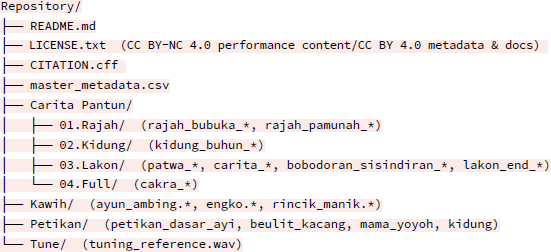
3.1 Repository Structure
3.2 Component Specifications
The corpus provides the complete Lakon Raden Cakra as an uninterrupted recording alongside its structural sections as discrete tracks. The corpus audio thus exists in three formats: mixed vocal-instrumental recordings (complete Lakon and structural sections), vocal-only recordings (kawih), and instrumental-only recordings (petikan variants and tuning references). The Rajah section comprises two ritual-framing components: Rajah Bubuka, an opening invocation addressing spiritual forces and ancestors, and Rajah Pamunah, a cleansing mantra purifying the ritual space. The Kidung Buhun is an ancient transitional song bridging the invocatory and narrative registers.
The Lakon section is provided across four components. The Patwa serves as a prelude, establishing the juru pantun’s authority and the narrative’s cosmological frame. The Carita carries the story of Raden Cakra, including the Béwara Léngser proclamation. The Bobodoran & Sisindiran is a 1 min 10 s interlude of comic verbal play and rhyming riddle-verse. The Lakon – end is the closing passage, resolving the narrative through the cosmological dispersal of the Cupumanik Astagina.
The supplementary materials include three musical components and one narrative resource. The Kawih folder contains three vocal pieces (Ayun Ambing, Engko, and Rincik Manik) adapted by Ayi Basajan from the gembyung frame-drum tradition and arranged for kacapi, each recorded vocal-only with full bilingual lyric transcriptions. The Petikan Variants provide four characteristic kacapi string patterns: Petikan Dasar Ayi, Beulit Kacang, Mama Yoyoh, and Petikan Kidung. Tuning references document Ayi Basajan’s laras salendro, and the Narrative Resources provide the story arc, character descriptions, and scene breakdown of Lakon Raden Cakra.
3.3 Total Size
The corpus comprises approximately 2.5 GB across 32 WAV files and 22 transcription files (54 files total; transcription files include per-component Sundanese-language files paired with English translations for all vocal audio content). The audio totals approximately 57 minutes of unique content. Transcriptions comprise approximately 2,983 words of Sundanese text and 3,820 words of corresponding English translation (6,803 words total). The master_metadata.csv documents track-level attributes that include duration, ritual function, and transcription status.
(4) Reuse Potential
4.1 Linguistics
The corpus enables register variation analysis across Sundanese functional registers, formulaic invocation (rajah), sung-poetic (kidung), narrative prose (lakon), and ritual prayer (doa). Bilingual transcriptions support translation studies and accessibility.
4.2 Digital Humanities
The structured organisation supports text mining, audio feature extraction, and time-coded alignment. The bilingual transcriptions and low-noise WAV files further serve as training data for low-resource Sundanese language and automatic speech recognition models.
4.3 Ethnomusicology
The four kacapi petikan variants enable comparative analysis of melodic structure, rhythmic organization, and contextual function. Tuning references document Ayi Basajan’s laras salendro. The three kawih tracks, adapted from the gembyung frame-drum tradition and arranged for kacapi, provide insight into creative arrangement within the living tradition.
4.4 Performance Studies and Heritage
The dual-format corpus (complete performance and isolated components) supports analysis of ritual phase transitions, performance arc, and musical-narrative integration. Building on precedents for West Javanese oral tradition documentation (van Zanten, 2016, 2021), this corpus models component-based intangible cultural heritage (ICH) documentation adaptable to other endangered traditions, supporting archival preservation and community-based pedagogy.
4.5 Creative Adaptation and Anticipated Users
Narrative resources, including story arc summaries, character descriptions, and scene breakdowns, support creative adaptation across film, drama, and animation. Anticipated users include linguists, ethnomusicologists, performance scholars, digital humanists, heritage practitioners, community educators, and filmmakers or animators developing adaptations of Sundanese oral narrative.
4.6 Decolonial and Postcolonial Studies
The corpus repositions an oral practitioner and indigenous knowledge tradition as the primary epistemic source. The dataset preserves Ayi Basajan’s own terminology and performance logic, enabling scholars working in decolonial and postcolonial frameworks to examine representation, attribution, and the politics of archiving in Sundanese intangible cultural heritage.
AI Declaration
Generative AI tools (Claude, Anthropic) were used to assist in editing and revising manuscript text. All factual content, scholarly judgements, and intellectual contributions are the authors’ own.
Data Accessibility Statement
The dataset described in this paper is openly accessible in Zenodo at https://doi.org/10.5281/zenodo.20688954 (Mochtar et al., 2026). Audio files and transcriptions are released under CC BY-NC 4.0; metadata and documentation files are released under CC BY 4.0.
Acknowledgements
The authors would like to express sincere gratitude to Dr. Wawan Setiawan (Hawe Setiawan), Vice Chairman of the Pusat Studi Sunda (Centre for Sundanese Studies), for his valuable insights and guidance during the course of this research. The authors are also grateful to Ade Intra, Head of Cultural Affairs, Education and Culture Office (Kepala Bidang Dinas Pendidikan dan Kebudayaan), Subang Regency, whose vision for the preservation and revitalization of local intangible cultural heritage made the studio recording at Bale Sora, Dawuan, Subang possible, and whose deep understanding of the living practice of Carita Pantun significantly informed the framing of this research. Gratitude is also extended to Ayi Basajan and his family for their generosity, trust, and willingness to share their practice and daily life with the researcher.
Author Contributions
Muammar Mochtar: Conceptualization, Data curation, Formal analysis, Investigation, Methodology, Project administration, Writing – original draft, Writing – review & editing.
Acep Iwan Saidi: Supervision, Writing – review & editing.
Banung Grahita: Supervision, Writing – review & editing.
Andryanto Rikrik Kusmara: Supervision, Writing – review & editing.