
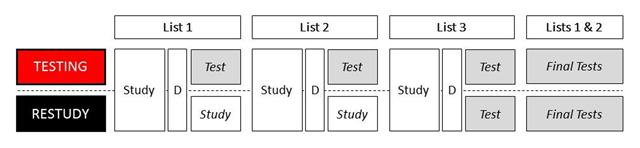
Figure 1
Procedure of the episodic memory task. In both the testing and the restudy condition, participants studied three lists of items. Each list consisted of 12 words and was followed by a short distractor (D). List 3 was tested immediately (after the distractor) in both conditions. Lists 1 and 2 were also tested immediately in the testing condition, but were restudied in the restudy condition. After immediate recall of list 3, lists 1 and 2 were tested in final recall tests.
Table 1
Results in the Immediate and Final Recall Tests as a Function of Practice Condition and Session in Experiment 1. Means and Standard Errors of the Mean (in Parentheses).
| Recall Rates | Intrusions | |||||
|---|---|---|---|---|---|---|
| Session | Test | Condition | List 1 | List 2 | List 3 | List 3 |
| Session 1 | Immediate Recall | Testing | 66.93 (2.75) | 68.88 (2.57) | 69.01 (2.56) | 0.17 (0.05) |
| Restudy | 48.70 (3.68) | 0.36 (0.10) | ||||
| Difference | 20.31 (3.29)** | –.19 (.11) | ||||
| Final Recall | Testing | 41.28 (4.11) | 56.64 (3.54) | |||
| Restudy | 51.69 (3.97) | 55.08 (4.00) | ||||
| Difference | –10.42 (4.40)* | 1.56 (3.87) | ||||
| Session 2 | Immediate Recall | Testing | 69.79 (2.93) | 68.49 (2.84) | 70.05 (2.55) | 0.05 (0.03) |
| Restudy | 60.16 (3.17) | 0.19 (0.08) | ||||
| Difference | 9.90 (2.97)** | –.14 (.08) | ||||
| Final Recall | Testing | 38.93 (4.50) | 49.61 (4.41) | |||
| Restudy | 58.98 (4.08) | 61.98 (3.86) | ||||
| Difference | –20.05 (5.53)** | –12.37 (4.89)* | ||||
[i] Pair-wise t tests (two sided, uncorrected) for differences between conditions (testing vs. restudy). * p < .05, ** p < .01.
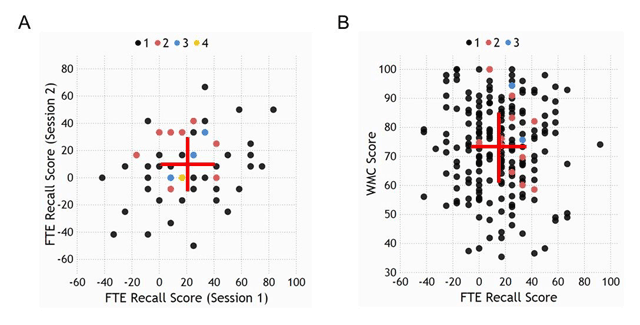
Figure 2
List 3 recall results. (A) Scatterplot of the significant test-retest reliability of the FTE recall score, i.e., the difference between participants’ immediate list 3 recall rates in the testing and restudy condition, in Experiment 1. The red marker indicates averaged recall rates from sessions 1 and 2. Error bars show ± 1 standard error of measurement (SEM), which is the square root of the error variance term calculated from the ICC and can be interpreted as the 68% confidence interval for an individual’s data point. Color coding of data points indicates the number of subjects having identical scores on both axes. (B) Scatterplot of the nonsignificant correlation between the FTE recall and WMC scores in Experiment 2. Error bars show ± 1 standard error or the mean for the FTE recall and WMC scores, respectively. Color coding of data points indicates the number of subjects having identical scores on both axes.
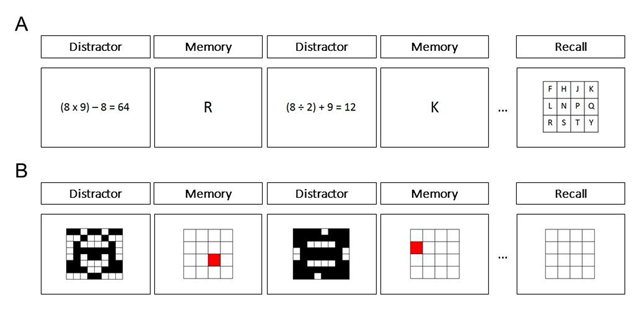
Figure 3
Procedure of the working memory task. (A) In the operation span task, trials with to-be-remembered letters and trials with distracting mathematical statements alternated in each sequence. At the end of each sequence, the letters were to be recalled by participants in correct order. Sequence length varied from 3 to 7. (B) In the symmetry span task, trials with to-be-remembered locations and trials with distracting symmetry judgments alternated in each sequence. At the end of each sequence, the locations were to be recalled in correct order. Sequence length varied from 2 to 5.
Table 2
Results in the Immediate and Final Recall Tests as a Function of Practice Condition in Experiment 2. Means and Standard Errors of the Mean (in Parentheses).
| Recall Rates | Intrusions | ||||
|---|---|---|---|---|---|
| Test | Condition | List 1 | List 2 | List 3 | List 3 |
| Immediate Recall | Testing | 66.32 (1.24) | 63.58 (1.35) | 64.72 (1.44) | 0.10 (0.02) |
| Restudy | 49.13 (1.85) | 0.38 (0.06) | |||
| Difference | 15.59 (1.48)** | –.29 (.06)** | |||
| Final Recall | Testing | 37.57 (1.86) | 45.80 (1.80) | ||
| Restudy | 52.26 (1.88) | 55.52 (1.90) | |||
| Difference | –14.69 (2.05)** | –9.72 (1.91)** | |||
[i] Pair-wise t tests (two sided) for differences between conditions (testing vs. restudy). ** p < .01