
(1) Overview
Context
The dataset consists of data obtained during the processing of archaeozoological materials by Alexey Rassadnikov (author) from 2007 to 2026. Experience working with animal bones and publishing the results has shown that the existing system for publishing archaeozoological research data does not facilitate the use of these data by other specialists and is almost unsuitable for constructing regional-level work. This is especially true for studies from the post-Soviet space. Most such archaeozoological studies typically do not provide access to the primary research data. You only have secondary data at your disposal, which cannot always be used for comparative analysis. This problem is most evident in the publication of livestock bone measurements. Most existing publications only provide a range of dimensions for a given livestock bone (minimum, maximum, and average). For example, if an archaeozoologist is tasked with tracing the evolution of sheep astragalus sizes from the Early to Late Bronze Age, they wouldn’t be able to use this range of values, as they need all sizes, not averages. This and other issues related to access to primary data from archaeozoological studies can be resolved by making the primary data of every archaeozoological study open access.
If, after a long period of work, a specialist has dozens of archaeozoological collections at his disposal, which he has processed, then the task arises of uniformly presenting them using generally accepted terminology so that other specialists can also use them. Another reason for creating this dataset was the abundance of material from pits rather than full-scale excavations. Such collections are typically very small, ranging from 10 to 300 bones. Typically, the results of processing such small collections are not published. This creates a situation where the results of analysis of dozens of such collections are excluded from scientific circulation. They are inaccessible to the archaeological and archaeozoological communities. This is a very serious problem, given that even very small bone collections have scientific potential and contain all the same data as large collections (from 3 to 30 thousand bones and often more), but only on a smaller scale. This dataset, which combines the results of processing settlement collections of 10 bones to 30,000 bones, is effectively the only way to make very small archaeozoological collections “visible” to the archaeological and archaeozoological communities and include them in the overall data system.
The main goal of this dataset is to enable other specialists to use these data, both for comparative analysis and for conducting independent research on Bronze Age pastoralism based on the information provided. Publishing a dataset ensures accessibility and search capability, compatibility/synchronization with previously published data, and reuse/verification. All these criteria are consistent with the FAIR and BIAD principles [5, 10].
Spatial Coverage
The dataset contains information on 123937 bones from 65 Bronze Age sites in the Southern Urals and Northern Kazakhstan. These 65 Bronze Age monuments include 11 burial complexes, 3 mines, and 51 settlements. A number of settlements in this dataset are characterized by multiple phases of occupation; consequently, the study actually examines more than 70 archaeozoological assemblages rather than 65. The vast majority of the sites are located in the steppe zone of the Chelyabinsk Region of the Russian Federation (51 sites; Figure 1A). Several settlements and one burial complex are situated in the forest-steppe zone of the same region. A number of sites lie outside this compact area—specifically, settlements in the Orenburg Region and Bashkortostan. These sites represent the westernmost points shown in Figure 1A. Nine sites in the dataset are located in the Akmola and North Kazakhstan regions of Northern Kazakhstan (Figure 1B). The site map in Figure 1 is highly approximate, as some settlements are located several hundred meters apart (for example, the settlements of Konoplyanka, Konoplyanka 2-1 and 2-2).
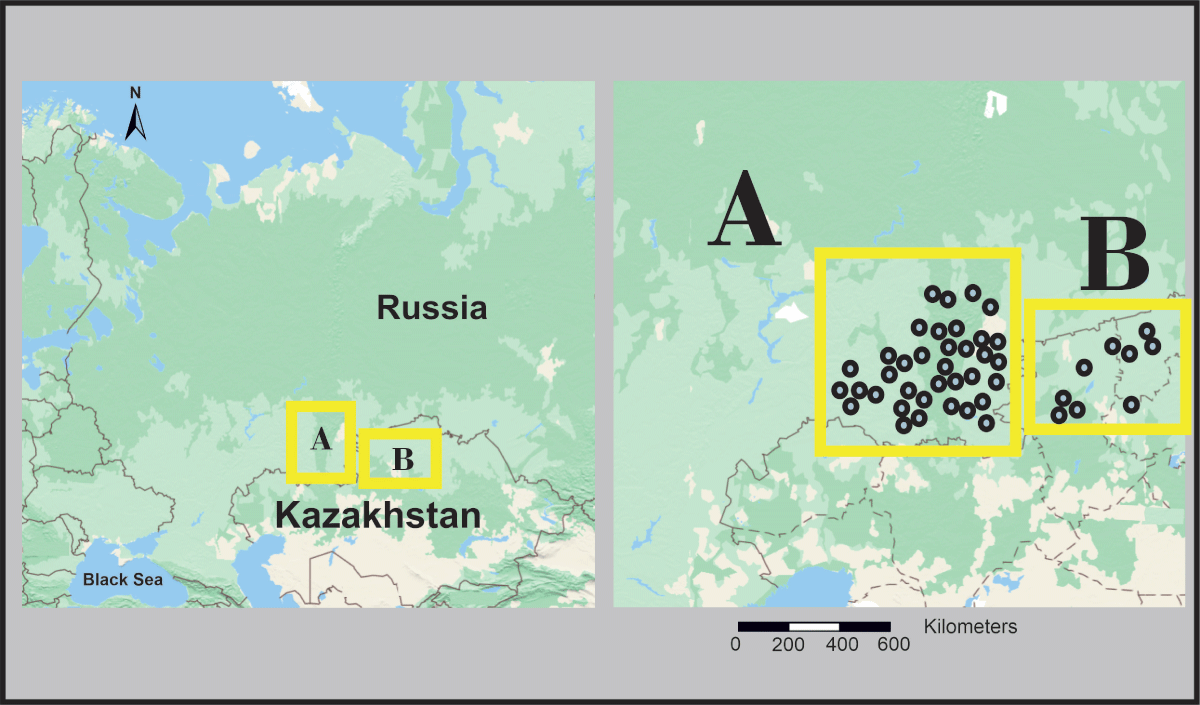
Figure 1
The territory of the Southern Urals and Northern Kazakhstan in the context of northern Eurasia. Right (A): the location of most Bronze Age sites in the context of the Southern Urals. The leftmost circles in square A show monuments of Bashkortostan (the Urals region). (B): The location of monuments in the North Kazakhstan region of Northern Kazakhstan. The upper right circle almost coincides with the location of the city of Petropavlovsk. Illustration by the author.
The compact zone from which the majority of the dataset’s sites originate is located in the forest-steppe and steppe zones of the Southern Urals or Southern Trans-Urals. This territory lies between the Ural Mountains and the western Siberian Plain (Figure 1). The Southern Urals region examined in the dataset is located in the Chelyabinsk region of the Russian Federation between 50°–54° N and 59°–62° E at an altitude of approximately 300 m above sea level. The current climate is continental, with an average annual temperature of 3.7°C. Average annual precipitation ranges from 300 to 400 mm, with high interannual variability. The predominant soils are chernozems, partially decalcified and/or saline. The natural vegetation consists of steppe covered with the weeds Stipa (feather grass) and Festuca/Stipa, as well as small patches of birch and pine [7].
Temporal Coverage
The dataset contains sites representing four periods of the Bronze Age in the Southern Urals and Kazakhstan: the Eneolithic/Early Bronze Age (EBA); Middle Bronze Age (MBA); Late Bronze Age (LBA), and Final Bronze Age (FBA). More than half of all materials represent the Alakul culture (about 42 complexes; see the “GENERAL INFO” tab of the dataset). In second place are complexes of the Sintashta culture (15). Other archaeological cultures are represented in single numbers (Abashevo, Petrovka, Srubno-Alakul, and Cherkaskul). The Late Bronze Age (LBA) is most fully represented in the dataset. A distinctive feature of the settlements in this region is the combination of several phases of activity, primarily represented by the Sintashta culture in the early stage of occupation and the Alakul culture in the late stage.
The dataset uses the following chronology for Bronze Age cultures:
Eneolithic and Early Bronze Age – XXXV–XXV centuries BC
Abashevo culture – XXI–XIX centuries BC/MBA
Sintashta culture – XX–XIX centuries BC/MBA
Petrovskaya culture – XIX–XVIII centuries BC/MBA
Alakul culture – XVII–XVI centuries BC/LBA
Fedorovo culture – XIV–XII centuries BC/FBA
Cherkaskul culture – XII–XI centuries BC/FBA
(2) Methods
Basic archaeozoological methods for processing material and interpreting the resulting data were used to create this dataset. The analysis of animal bones was conducted exclusively under laboratory conditions, utilizing physical comparative skeletal collections as well as various published osteological reference works and methodological guides for species identification. Once a specific bone collection had been processed, it was transferred to the institution where the respective archaeological teams were based. Further details regarding the processing location, the nature of the bone assemblage, and the storage location for each specific site are available under the “GENERAL INFO” tab in the dataset. The primary methods used to process the archaeozoological material are listed below for each individual dataset tab. This is because each table column or tab is dedicated to a specific type of data and, consequently, specific archaeozoological methods were applied in each case.
Steps
The overall data set was created using Excel. All archaeozoological data contained in the dataset was personally processed by the author. The database used has a very simple structure, consisting of placing individual archaeozoological data types on different tabs within an Excel spreadsheet.
When processing animal bones, the species, skeletal element, degree of fragmentation, all available measurements, bone surface modifications (BSM), age-related and pathological changes were recorded for each bone. If the bone was a dental fragment, the age was subsequently estimated based on the degree of wear on the chewing surface. In the case of cattle metapodials, X-rays were also taken to determine their approximate age.
Sampling Strategy
In creating this dataset, one strategy was used: to include the maximum amount of data to obtain the most complete picture possible of the Bronze Age pastoral communities in the Southern Urals and adjacent territories. Based on this, the dataset includes both pitted and full-scale excavation materials. The size of the archaeozoological collection is irrelevant—the dataset includes sites with collection sizes ranging from 10 bones to 28,000 bones. A collection of 10 bones also has scientific value and the right to be considered as an independent complex, especially if it contains bones that can be measured and this data can be added to a general dataset. By the same token, this dataset contains some unusual materials. For example, it includes data on sets of astragalus bones of sheep&goats from several burial complexes (Stepnoye 7 burial mound, pits 17 and 88). The funerary or ritual nature of a number of the assemblages included in the dataset does not preclude the inclusion of such data in a dataset consisting primarily of settlement materials. The same livestock used in burial complexes was bred by the inhabitants of numerous Bronze Age herding settlements. Therefore, information on bone sizes and pathologies from burial complexes can be considered without any limitations as a whole, in line with settlement materials. Such burial/ritual complexes contain valuable information on bone measurements and pathologies that can be used in future studies. The dataset combines the author’s published and unpublished materials.
Quality Control
A decisive factor in including data in this dataset was the availability of a precisely established provenance for the bones—specifically, their origin from a particular archaeological site. For sites excavated in the 1980s or 1990s, it is not uncommon to encounter boxes lacking information labels; however, these are often assumed to originate from the same settlement or burial mound as the labeled boxes. Materials from boxes lacking labels were not processed.
Constraints
This dataset has a number of limitations that limit its potential for use. Most notably, this concerns incomplete data on cattle age based on the degree of wear on the chewing surface of teeth using the method of A. Grant [3]. For a number of sites examined at the beginning of the Bronze Age archaeozoology study in the Southern Urals, such an analysis was not conducted. However, for these sites, approximate data on the age of the livestock is available, obtained using the tooth sequence described by I. Silver [6]. These data are listed in the “PRIMARY DATA” tab, in the “Tooth characteristics/age notes” column. Not all sites have data for determining the age of cattle using metapodial X-rays. Due to a number of factors, some bone measurements are missing, either due to an identified measurement error or because the parameter was not measured.
It’s also worth noting that some materials were collected in the early 1990s and 2000s using older methods, which didn’t involve collecting all bones (mostly, only whole bones or large fragments, as well as bones suitable for measurement). These materials are also included in this unified dataset, as, with some limitations, data from such collections can be used for comparative and future studies on Bronze Age herding communities (primarily, the sizes and pathologies of livestock bones).
(3) Database Structure and Terminology
The second tab or column of the dataset (“GENERAL INFO”) provides basic archaeological information: site names, their type (settlement, burial complex), settlement type (unclosed or enclosed), site complexes used in the study, and an approximate cultural-chronological attribution. If archaeozoological materials for a site have already been published, a link to that work is provided.
The third tab of the dataset (“FRAGMENTATION CODING SYSTEM”) shows the fragmentation coding system used in processing the archaeozoological material and is used in this dataset. The system is very simple and primitive. For example, if there is a whole proximal part of any tubular bone, it is designated as a “Proximal Part” If there is a split fragment from the proximal part of the tubular bone, it is designated as a “Fragment of the proximal part” and so on.
The “PRIMARY DATA” tab/column contains all the primary data obtained directly during the processing of the archaeozoological material. Following the site name is a series of “Supplementary information” columns—these columns contain all the information contained on the bone bag labels. Since the labels for different sites contain varying amounts of information, for some sites most of the “Supplementary information” columns are blank.
The archaeozoological data itself begins with the “Z” column (species, skeletal element, degree of fragmentation, epiphyseal condition, age notes, and approximate sex). The term “Caprines” is chosen to describe bones that belong to either a sheep or a goat (in cases where the bone lacks characteristics that would allow one to reliably classify the bone as sheep or goat). After the fragmentation column, there’s an indication of the epiphyseal condition (FUSED or UNFUSED). If necessary, you can independently estimate the age of the animal based on the epiphyseal condition.
Next come columns with age notes based on the dentition and postcranial bones. Here you can find tooth characteristics, wear stages, and so on. Another column contains age notes for the postcranial bones. For example, if a bone comes from an embryo or a newborn cattle, you might find the designation “embryo/newborn” or “calf.”
The “Approximate sex/notes” tab provides notes on the approximate sex of the animal from which the bone or bone fragment originates. You can find terms such as cow, bull/ox, ox, massive bull/ox, huge bull/ox, etc. It’s important to note that these conclusions are not based on bone measurements, but on a visual assessment of the massiveness of the bones or bone fragments (as a rule, there is a significant difference in size and massiveness between the bones of cows and bulls/oxen). Sexual dimorphism is weak in sheep and goats, but if you’re dealing with very small or, conversely, very massive bones, it’s acceptable to make an approximate estimate.
Following the notes and comments on age and approximate sex, there follows a column indicating the stages of natural bone preservation according to the method of A. Behrensmeyer [1].
All subsequent columns are devoted to describing various types of bone surface modifications (BSM). For convenience, I’ve decided to divide all bone surface modifications into several main types: bone artifacts and blanks, modifications of unknown origin, cut marks/miscellaneous, fragmentation marks, heat exposure, mineral deposits, and all types of animal and insect impacts.
Columns with animal bone measurements (“Cattle/sheep&goat/horse measurements”). All such columns are arranged using the same system. All measurements are arranged “top to bottom” – from the skull&lower jaw bones to the third phalanx. If a measurement parameter is missing, the row is marked “no.” In some cases, in addition to the system of A. Driesch [9]), the bone measurement system of V. Eisenmann et al. [2] is used. This primarily concerns horse bone measurements. All such measurements are listed separately, and the bone measurement system used is mentioned. For almost every skeletal element, there is a column indicating the approximate sex of the individual from which the bone originates (bull/ox, cow, small, massive, ram, etc.). These notes are extremely preliminary and are based solely on the visual massiveness of the bones or their fragments.
For the talus of cattle, sheep and goats, you can find the approximate height at the withers calculated using different coefficients.
For cattle metapodials, indices are provided for the ratio of the width of the upper and lower ends and the width of the diaphysis to the bone length. Sex is determined based on these indices. If the indices are missing, the approximate sex of the cattle metapodials is determined based on a visual assessment of the metapodials massiveness. In some cases, the table of cattle metapodials measurements includes an approximate age. This data was obtained by X-raying the bones and is included in this table for convenience. X-rays were not taken for all metapodials, so in most cases this data is missing. Many bones that were measured have numbers, which you can use to check the bone for age-related and pathological changes in the “LIST OF PATHOLOGIES” tab.
The “LIST OF PATHOLOGIES” tab is structured similarly to the “PRIMARY DATA” tab: first come columns with archaeological information, followed by basic archaeozoological information (species, skeletal element, degree of fragmentation, epiphyseal condition, age notes, and approximate sex). Next, separate columns list various types of pathological and age-related changes, beginning with dental pathologies. Almost all bones in the “LIST OF PATHOLOGIES” section have a number, which you can use to find bone measurements in the bone size tabs.
The “TOOTH WEAR STAGES” tab contains all currently available data on the age of livestock based on the degree of wear of the chewing surface. Wear stages were determined using the method of A. Grant. The conversion of the obtained M.W.S. values to specific age ranges was performed using the methodological manual of E. Hambleton [4].
The “X-RAY CATTLE METAPODIALS” tab contains all currently available data on cattle age obtained using X-rays of cattle metapodials. The methodology of Y. Telldahl [8] was used. The “Approximate Sex” column indicates the sex based on both a visual assessment of bone massiveness and the ratio of metapodial length to the width of its upper and lower ends, as well as the width of the diaphysis.
Object Name
Animal bones from the South Urals and Northern Kazakhstan.xls
Datatype
Primary data, secondary data, processed data, interpretation of data
Format Names and Versions
Excel
Creation Dates
2019/02/-2026/09/
Dataset Creators
Alexey Rassadnikov
Language
English
License
Creative Commons Attribution 4.0 International
Repository Location
The dataset is deposited at Zenodo at https://doi.org/10.5281/zenodo.22714190.
Publication Date
10/09/2026
(4) Reuse Potential
The data in this dataset can be used by anyone interested in the history of Bronze Age pastoralism. These data can also be used for comparative purposes. The same data can be used for independent research by any archaeologist, archaeozoologist and paleozoologist. For example, you can independently assess the proportions of skeletal elements of different livestock species in the presented sites. Any specialist can, for example, estimate the percentage of burnt bones in the sites under consideration, the percentage of a particular animal species, or the frequency of a particular bone pathology in livestock. If we consider this dataset as a source of data for comparative analysis, then any specialist can independently take the bone size dimensions of any domestic animal bone and add them to their dataset. The dataset can be used for educational purposes. Students can learn to analyze large datasets on the archaeozoology of the Bronze Age in the Southern Urals and conduct independent research using the data. This dataset is also of interest to paleozoologists, who can independently estimate the prevalence of a particular wild animal species during the Holocene.
Acknowledgements
I’m grateful to all the archaeologists who sent me materials for research and to those who assisted in my work: Alexey Strakhov, Anastasia Bukacheva, Andrey Epimakhov, Denis Sharapov, Evgeny Shimansky, Egor Bersenev, Elena Kupriyanova, Ivan Molchanov, Ilya Valiakhmetov, Ilshat Bakhshiev, Irina Alaeva, Larisa Petrova, Lyudmila Koryakova, Maria Makurova, Maxim Ankushev, Natalya Batanina, Natalya Roslyakova, Natalia Shishlina, Nikolay Petrov, Polina and Maxim Ankushev, Sofia Panteleeva, Vadim Mukhametdinov, Viktor Sidorin and Vlada Berseneva.