
(1) Overview
Context
Chronological precision is fundamental to reconstructing the dynamics of ancient societies and their environments. While radiocarbon (14C) dating has long served as a cornerstone of archaeological research, its analytical potential in the contemporary era is best realized through large-scale synthesis. However, the true utility of these dates is often hampered by their fragmentation across disparate reports, site-specific narratives, and varied publications. The curation of standardized, open-access radiocarbon databases has thus become a pivotal necessity, providing the quantitative framework required to transform isolated chronological snapshots into a coherent, regional understanding of demographic trends [1], migration patterns, and long-term socio-ecological shifts.
Geographically, Türkiye encompasses the Anatolian Peninsula and significant portions of Northern Mesopotamia. These regions that served as epicentres for transformative historical milestones, including the Neolithic Transition [2], the rise of complex administrative structures [3], and urbanization [4]. While decades of extensive collaborative research between national and international institutions have yielded a wealth of material evidence, the resource-intensive nature of chronometric analysis often creates a bottleneck in primary data production. In an environment where analytical resources are finite, every radiocarbon date represents a high-value scientific record. Consequently, consolidating and mobilizing these scattered data points is essential, as they provide the vital temporal scaffolding required to contextualize various other forms of archaeological and bioarchaeological evidence. Furthermore, by prioritizing Open Science principles, this dataset aims to democratize access to Anatolian chronometric data, ensuring that local findings, which are frequently published in non-indexed journals, are equitable and visible to the global research community. Beyond its chronological utility, the systematic curation of this information serves an ethical imperative because it enables a more sustainable and non-destructive approach to bioarchaeological research by optimizing the use of existing data before pursuing further destructive sampling.
The C-Turkey Dataset presented here is a comprehensive synthesis of radiocarbon determinations covering the post-Last Glacial Maximum (LGM) period in Türkiye (Figure 1). Comprising 3,390 14C dates, this collection represents the most extensive open-access radiocarbon repository for the region to date. Notably, 885 of these entries were systematically integrated from the Allen Ancient DNA Resource (AADR) (n = 164) [5, 6] and supplemented by newly curated data from published literature and excavation reports (n = 721). A defining characteristic of this dataset is its systematic focus on bioarchaeological precision; specifically, the annotation of dates derived from human and animal skeletal remains (Figure 2). Each entry is enriched with critical metadata, including Skeleton IDs and ancient DNA (aDNA) identifiers whenever reported in the primary sources. By explicitly linking chronological data to specific biological individuals, the C-Turkey Dataset facilitates high-resolution interdisciplinary research, allowing scholars to correlate bioarchaeological profiles with precise temporal trajectories while preventing the redundant and destructive sampling of previously dated remains.
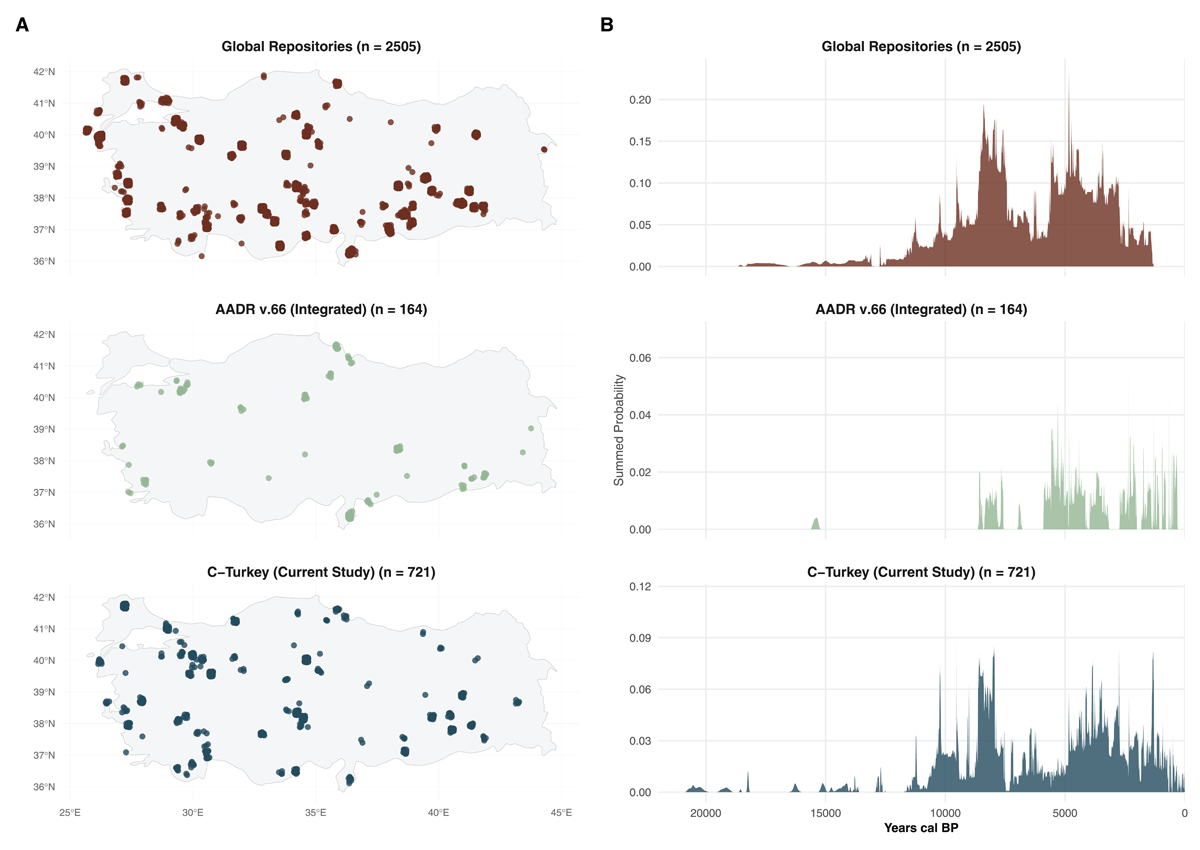
Figure 1
Spatial and Temporal Distribution of the C-Turkey Dataset.
(A) Faceted maps showing the density of radiocarbon sites across Türkiye. Top panel represents records harvested from global repositories via C14bazaar; middle panel shows direct dates integrated from the AADR v.66 [6]; bottom panel displays the newly curated entries from regional literature and excavation reports.
(B) Summed Probability Distributions (SPD) of radiocarbon determinations (calibrated with IntCal20) for each data source [7]. The SPD illustrate the chronological coverage and research intensity, highlighting the contribution of the C-Turkey dataset in filling regional temporal gaps. All dates are shown in years cal BP.
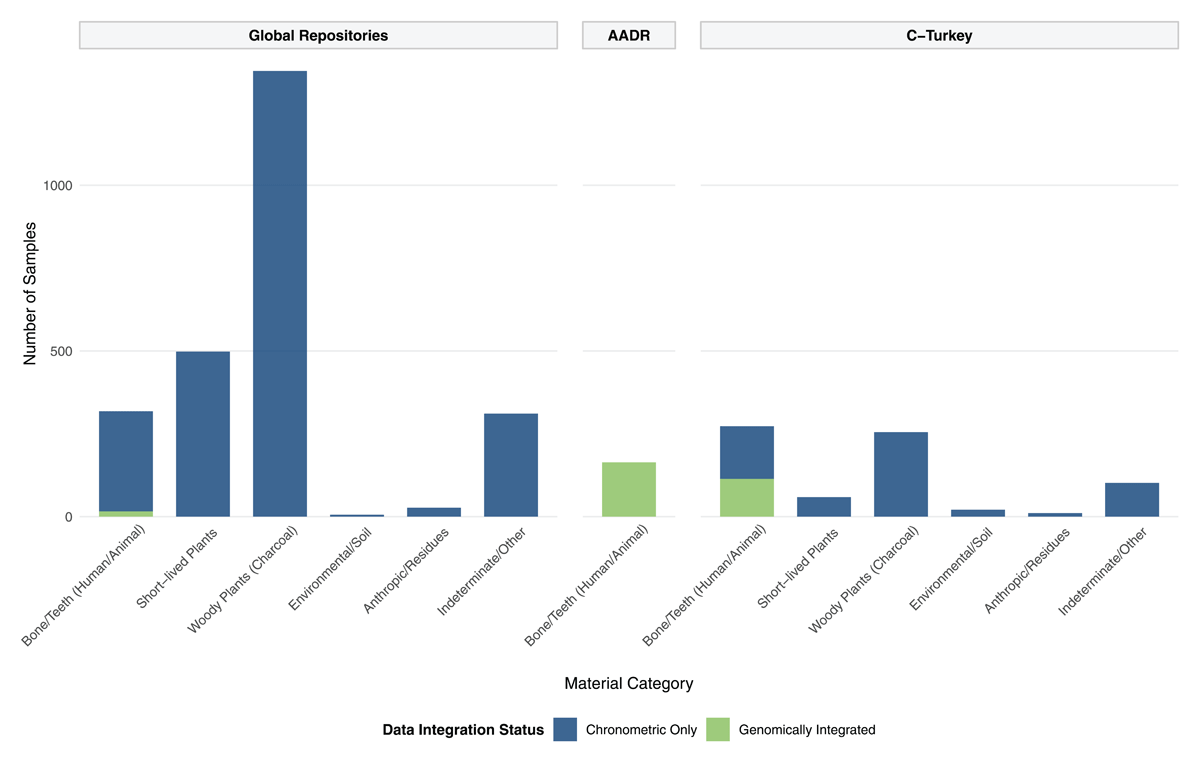
Figure 2
Taxonomic Composition and Genomic Integration of the C-Turkey Dataset.
A significant challenge encountered during the curation process was the inconsistent reporting of radiocarbon metadata across primary sources. A substantial number of publications failed to provide fundamental details, such as uncalibrated 14C ages, laboratory codes, δ13C values, or precise sample contexts. The absence of these parameters, particularly laboratory codes and uncalibrated BP values, severely complicates the validation of results and prevents future researchers from performing necessary recalibrations as calibration curves [e.g., IntCal [7]] are updated. This lack of transparency undermines the principles of data standardization and hinders the potential for high-resolution meta-analyses. It highlights an urgent need for a unified reporting standard in archaeology to ensure that chronometric data is truly “FAIR” (Findable, Accessible, Interoperable, and Reusable) [8]. Without such protocols, hundreds, if not thousands, of valuable dates remain functionally inaccessible or “hidden” within the literature, stripped of their long-term scientific utility and reuse potential.
Furthermore, a recurring issue in legacy data was the imprecision of spatial metadata. Many primary sources reported findings based on toponyms or general site descriptions rather than high-resolution geographic coordinates, requiring extensive manual georeferencing and cross-validation via gazetteers to ensure spatial accuracy for GIS applications. Another critical gap was the lack of bioarchaeological granularity. In many instances, samples were generically labelled as “bone” without specifying the species either animal or human. By re-examining primary excavation reports where possible, the C-Turkey Dataset attempts to recover these “lost” contexts, thereby transforming a simple chronological list into a multi-dimensional bioarchaeological tool.
Spatial coverage
Of the total 81, 59 cities in Türkiye have been covered in the dataset.
Description: Asian and European parts of Türkiye
Northern boundary: 41.86195
Southern boundary: 36.1664
Eastern boundary: 44.24923
Western boundary: 25.7084
Temporal coverage
22,000 cal BCE–1900 cal CE
Data covers the post-LGM period with boundaries from Epi-palaeolithic cultures to the Late Ottoman Period.
(2) Methods
Steps
The compilation of the C-Turkey Dataset involved a systematic series of computational and manual steps. Initially, data acquisition was executed via a computational harvest using the C14bazaar R package [9], which enabled the simultaneous extraction of information from international repositories: nerd, 14sea, calpal, rado.nb, 14cpalaeolithic, agrichange, BDA, eubar, euroevol, katsianis, pacea, and p3k14c [10, 11, 12, 13, 14, 15, 16, 17, 18, 19, 20]. Following this aggregation, a geographic filter was applied to isolate entries specifically originating within the modern borders of Türkiye. To ensure chronological precision and data quality, a threshold was implemented to exclude any data points with an uncalibrated standard error exceeding 150 years. Subsequently, a deduplication process was performed using the remove_duplicates function within the C14bazaar environment [9]. During this procedure, priority was assigned to the “nerd” dataset to maintain high metadata consistency [17]. This initial automated phase, accessed on 25.04.2025, resulted in a baseline dataset comprising 2,683 entries.
Following the automated phase, a comprehensive manual review was conducted, with a primary focus on resolving inconsistencies and missing information in the radiocarbon laboratory codes. Recognizing that typographical errors in lab codes across different datasets often lead to undetected duplicates, a cross-verification strategy was implemented. Entries from the same archaeological site were scrutinized for identical 14C ages, standard errors, and contextual features where these values matched despite differing or missing lab codes, primary sources were consulted, when available online, to reconcile the records and remove redundant entries. In many cases, typological errors were systematic (e.g., capital or small letter preferences in different datasets). This manual deduplication and quality control procedure resulted in a refined dataset of 2,505 records.
Subsequently, a targeted annotation process was initiated to enhance the bioarchaeological resolution of the data (Figure 2). For entries where the “material” column was either incomplete or generically labelled as “bone,” primary references were systematically reviewed to determine specific biological origins. Where archaeological reports confirmed human remains, the entries were enriched with associated context information and identification numbers. Throughout this phase, any misleading or conflicting contextual information encountered was rectified by referencing original excavation reports and primary publications, ensuring that the final metadata reflects the highest possible degree of accuracy.
To ensure the dataset’s comprehensiveness and regional depth, a targeted enrichment phase was performed by integrating 164 directly dated individuals from the Allen Ancient DNA Resource [6]. This was followed by an extensive survey of regional academic journals focusing specifically on the Turkish Journal Database (DergiPark) and the “Excavation Result Reports” (Kazı Sonuçları Toplantıları) published annually by the Republic of Türkiye Ministry of Culture and Tourism. Furthermore, a systematic search was conducted via Google Scholar for recent Turkish and English academic articles, books, and Thesis Center of Council of Higher Education in Türkiye for dissertations, with a particular emphasis on publications from the last five years to capture the most recent records. Strict inclusion criteria were maintained: only sources providing unique radiocarbon laboratory identification numbers and uncalibrated 14C ages were incorporated. Sources that exclusively reported calibrated dates were excluded to mitigate potential discrepancies arising from variations in calibration curves and differing calibration methodologies. This final curation effort added 885 new entries (comprising 164 from AADR and 721 from literature and reports), bringing the final C-Turkey Dataset to a total of 3,390 records.
In the final refinement stage of the C-Turkey Dataset, toponymic standardization was prioritized to resolve nomenclature inconsistencies arising from the diverse linguistic and academic backgrounds of the primary sources. All site names were unified using their primary archaeological or official designations to ensure internal consistency. Additionally, the “Region” attribute was systematically imputed and standardized according to the official administrative provinces (Tur. iller) of Türkiye. This final administrative alignment facilitates seamless spatial querying and ensures the dataset’s compatibility with regional demographic modelling and GIS-based analysis.
To enhance accessibility for the broader research community, the dataset is also provided as a searchable, interactive web portal (see Dataset Description).
Sampling strategy
The sampling strategy was designed to construct a comprehensive and high-resolution chronometric record for the Anatolian Peninsula and Northern Mesopotamia, covering the post-Last Glacial Maximum (LGM) period. The objective was to capture all available radiocarbon determinations that meet quality and metadata requirements. Data points were sampled through a three-tiered approach including global representative sampling, bioarchaeological targeting, and regional literature review. Data points with an uncalibrated standard error exceeding 150 years were excluded to ensure the chronological integrity and analytical utility of the final dataset.
Quality Control
Quality control integrated automated filtering and manual validation to ensure high data integrity. The core audit involved manual cross-verification of laboratory codes and site contexts against primary publications to resolve metadata inconsistencies and identify “hidden” duplicates. Geographic accuracy was ensured through manual georeferencing against official provincial boundaries, while bioarchaeological entries were verified by cross-referencing skeleton and aDNA identifiers. This multi-stage verification ensures a curated research tool.
Constraints
The production and curation of the C-Turkey Dataset were shaped by several structural and technical constraints. A primary challenge is the pervasive inconsistency in reporting standards across the archaeological literature. Many publications frequently lack critical metadata such as uncalibrated dates, δ13C values, laboratory identification codes, or precise contexts, which complicates the potential for recalibration and high-resolution taphonomic assessment.
Furthermore, while linguistic proficiency in Turkish facilitated the inclusion of regional “grey literature”, the technical state of some digital archives presented a significant challenge. Many older publications are available only as non-OCR (Optical Character Recognition) image-based PDFs, necessitating a labour-intensive, manual screening. Consequently, despite these curation efforts, the lack of searchability in these documents introduces a risk that some records may have been inadvertently overlooked, potentially leaving certain excavations underrepresented.
Analytical bottlenecks also introduce a significant sampling bias, as well-funded international projects and high-profile Neolithic sites are disproportionately represented compared to smaller rural settlements or later historical periods. These factors are compounded by regional variations in archaeological research intensity and poor biological preservation in certain Anatolian environments, which naturally limit the availability of direct radiocarbon dates. Consequently, researchers utilizing this dataset for demographic modelling, spatial density analyses, or population proxy reconstructions should exercise caution and explicitly account for these spatial, temporal, and taphonomic biases.
Additionally, there is a temporal factor regarding data synchronization: the baseline harvest from C14bazaar was conducted on 25.04.2025. Due to the significant time required for manual quality control and the parallel nature of ongoing data collection, some entries presented here as newly curated may have been integrated into international repositories in the interim.
(3) Dataset description
Object name
cturkey_v1_raw.tsv – tab-separated list of cleaned radiocarbon data including comments, references and direct links of the publications for newly collected data.
cturkey_v1.tsv – tab-separated list of cleaned and annotated radiocarbon data.
data_collection.R – the script that used to collect data from existing sources.
references.tsv – reference list for newly collected data.
C-Turkey: Dataset Explorer – A web-based, searchable interface for the dataset (https://altinisik.github.io/C-Turkey).
C-Turkey: Radiocarbon Calibration Tool – A web-based fast radiocarbon calibration tool which generates publication-ready figures. (https://altinisik.github.io/cturkey-app).
Data type
Primary and secondary data curated from public sources and literature.
Format names and versions
.tsv, .R, HTML (Interactive Portal).
Creation dates
The final version of the dataset was created on 13.08.2026.
Dataset Creators
The dataset was created by N. Ezgi Altınışık.
Language
English
License
Creative Commons Attribution 4.0 International
Repository location
Publication date
13/08/2026
(4) Reuse potential
The C-Turkey Dataset provides a foundation for multi-scalar archaeological and demographic research in Anatolia and Northern Mesopotamia. By synthesizing local literature with global repositories and applying a manual audit, the dataset offers immediate utility for demographic modelling. Researchers can utilize the standardized chronological metadata to perform Summed Probability Distribution (SPD) analyses to track population fluctuations, settlement intensities, and dispersal patterns across the Holocene. The removal of low-precision measurements and the sanitation of site nomenclature ensure that such models are built on a verified baseline, minimizing the noise typically associated with uncurated legacy data.
Beyond standard chronological applications, the C-Turkey Dataset Explorer allows researchers to perform real-time filtering and data sub-setting directly in the browser. This feature is designed for field archaeologists and bioarchaeologists who require rapid verification of existing dates for specific sites or material types without the need for advanced programming skills. To ensure long-term operational sustainability, the C-Turkey Dataset Explorer is deployed via GitHub Pages using a serverless WebAssembly framework (Shinylive). This architecture eliminates hosting fees and server maintenance dependencies, as all processing is executed client-side while data is dynamically retrieved directly from the primary repository. Consequently, the portal remains permanently accessible and zero-cost for the academic community, with updates automatically reflected alongside new repository releases.
Beyond chronology, the dataset’s primary strength lies in its interdisciplinary integration, specifically the bridge it builds between absolute dating and archaeogenomics. With the inclusion of the species_group and dna_status columns, the dataset allows bioarchaeologists to isolate human remains with known genomic associations for refined meta-analyses. Furthermore, the explicit categorization of materials enables researchers to apply specific reservoir effect corrections or old wood offsets with greater taxonomic confidence.
Finally, the C-Turkey dataset serves as a model for academic equity and data transparency. By making localized excavation results and non-indexed Turkish-language reports accessible to the international scientific community, it facilitates a more inclusive discourse in West Asian archaeology. The dataset acts as a synchronizing baseline for global database maintainers. It enables the systematic updating of regional records in broader Mediterranean and Near Eastern datasets. The availability of the underlying R scripts also encourages reproducibility, allowing other researchers to adapt the curation pipeline for different geographic regions or archaeological periods.
Artificial Intelligence (AI) Usage
During the preparation of this manuscript, the author utilized Gemini 3 Flash (Google) for language editing, proofreading, and stylistic refinement to enhance the readability and flow of the text. Additionally, the AI model was employed to assist only in the annotation and documentation of the R scripts used for data acquisition and visualization. The core logic and implementation of all codes were developed by the author. Following the use of this tool, the author conducted a comprehensive review and critical verification of all AI-generated outputs. The author remains solely responsible for the final content, scientific accuracy, and the overall integrity of the publication.
Acknowledgements
The author thanks to the global community of archaeologists, anthropologists, and geneticists who adhere to open science principles by sharing their primary data with high-quality annotations and clear metadata. Moreover, this curation effort was only made possible through the tireless work of the maintainers of the international repositories integrated into this study.
Author Contributions
N. Ezgi Altınışık: Conceptualization, Data Curation, Funding Acquisition, Investigation, Methodology, Software, Visualization, Writing – Original Draft, Writing – Review & Editing.