
(1) Context
Introduction
Urban areas drastically changed in Europe and around the world after the Second World War but also during the last 30 years. From the destruction of the two World Wars to the high migration flows from rural to urban areas in the 1950s and 1960s, urban planners and conservation experts tried to control change and protect urban heritage initially through the integration of conservation in all levels of planning. The Venice Charter, drafted by ICOMOS in 1964 [1] and the Recommendation Concerning the Safeguarding and Contemporary Role of Historic Areas by UNESCO in 1976 [2] were seminal to this endeavour on an international level. The Council of Europe Amsterdam Declaration laid the foundations of urban conservation within Europe in 1975 [3]. This effort culminated in the Charter for the Conservation of Historic Towns and Urban Areas (Washington Charter) drafted by ICOMOS [4]. This was the first charter that focused on urban conservation and heritage. It complemented the Venice Charter and addressed specific issues in urban conservation, e.g. traffic, infrastructure, new urban functions and their effect on the built environment [5].
During the last thirty years new conditions have emerged and presented urban centres with new challenges (e.g. continuous migration flows, further pressure on urban infrastructure, sustainability, climate change, changes in urban economies, tourism etc.). Additionally, the cultural landscape approach [6], intangible heritage [7] and cultural diversity [8] have changed significantly our perceptions of heritage. The Recommendations for the Historic Urban Landscape [9], based on the Vienna Memorandum and the Declaration on the Conservation of the Historic Urban Landscape [10, 11], were drafted in order to address emerging conditions [5]. ICOMOS’s own Valetta Principles for the Safeguarding and Management of Historic Cities, Towns and Urban Areas were drafted in tandem [12].
The Historic Urban Landscape approach, or else HUL [9], was adopted ‘to reinterpret the values of urban heritage’ and to usher urban conservation into the era of sustainable development. The aim was to take a ‘comprehensive and integrated approach’ to include ‘social and cultural practices and values’ (par. 5 and 9) and ‘the intangible dimensions of heritage as related to diversity and identity’ (par. 9), reconsider authenticity and integrity through the notion of diversity, to truly integrate historic and contemporary layers of significance [5]. Although material considerations still prevail in the text of the Recommendations and references to intangible and social aspects are vague and generic [13], the Recommendations mark a point of departure from exclusively material-focused past texts.
Public Engagement
The role of non-experts in urban conservation is the focus of this research project. Participation and involvement of non-experts, citizens and residents, in the urban conservation process is considered a pre-requisite for its success in all the above documents, starting from the Declaration of Amsterdam [3] and particularly emphasised in the Washington Charter (par. 3, 5 and 15) [4]. More recently, HUL [9] broadened its references to include ‘stakeholders’ or ‘communities’, including ‘local, national, regional, international, public and private actors’ (par. 6). It extends beyond communication with society (par. 27) and ‘public understanding and involvement’ (par. 28). It calls for the development of policies based on participatory approaches (par. 23), of civic engagement tools with the aim to ‘involve a diverse cross-section of stakeholders and empower them to identify key values in their urban areas, develop visions that reflect their diversity, set goals and agree on actions to safeguard their heritage and promote sustainable development’, ‘to facilitate intercultural dialogue by learning from communities about their histories, traditions, values, needs and aspirations and by facilitating mediation and negotiation between groups with conflicting interests’ (par. 24a) and involves communities and other main stakeholders in capacity building (par. 25). Finally, it calls for research in all aspects of the HUL, beyond identifying and understanding values (par. 26). ICOMOS’s Valetta Principles [12] address participation and involvement in more specific terms: first, in the criteria for intervention, where ‘direct consultation and continuous dialogue’ is deemed sine-qua-non (par. 3g), second, collaboration amongst all stakeholders is deemed a feature of good governance and imperative for successful safeguarding of historic urban areas (par. 3h) and third, proposals and strategies, where planning as a participatory process through information-sharing, support of conservation associations and financial measures (par. 4j).
The Case of Thessaloniki, Greece
How has the historic urban landscape of Greek cities, and Thessaloniki in particular, developed? Urbanisation in Greece has been uncontrolled in the last one hundred years. As a result, there has been a 70% increase in urban land and almost 50% decrease in urban density since 1990, pointing to the de-population of city centres [14]. This phenomenon, known as sprawl, is attributed to inefficient planning and land use policies combined with control by free market forces and has negative consequences on quality of life and efficient resource management [14].
Thessaloniki is the second biggest city in Greece, with a population of over a million in its metropolitan area, and is a major economic, industrial, commercial and political centre [15]. It lies in the north of Greece, on the northeast shore of the Aegean, and is a major port for southeastern Europe. Like the rest of the country, the city is imbued with history. Its foundation dates back to 316/5 BC and it was named after one of Alexander the Great’s half-sisters. In 146 BC it became the capital of the Roman province of Macedonia, an important station in Via Egnatia, and the seat of Galerius during the Tetrarchy (end of 3rd – beginning of 4th c AD). During the Byzantine Empire (330 – 1453) the city’s importance was elevated to co-reigning. After the fall to Murad II (1430) the city became part of the Ottoman Empire and developed into a multicultural port serving the Balkan peninsula. In 1492, thousands of Jews who were forced to leave Spain relocated to Thessaloniki, giving the city the name ‘Mother of Israel’. In 1912, during the first Balkan War, the city was surrendered to the Greek army and annexed to the then Kingdom of Greece [16] (Figure 1).
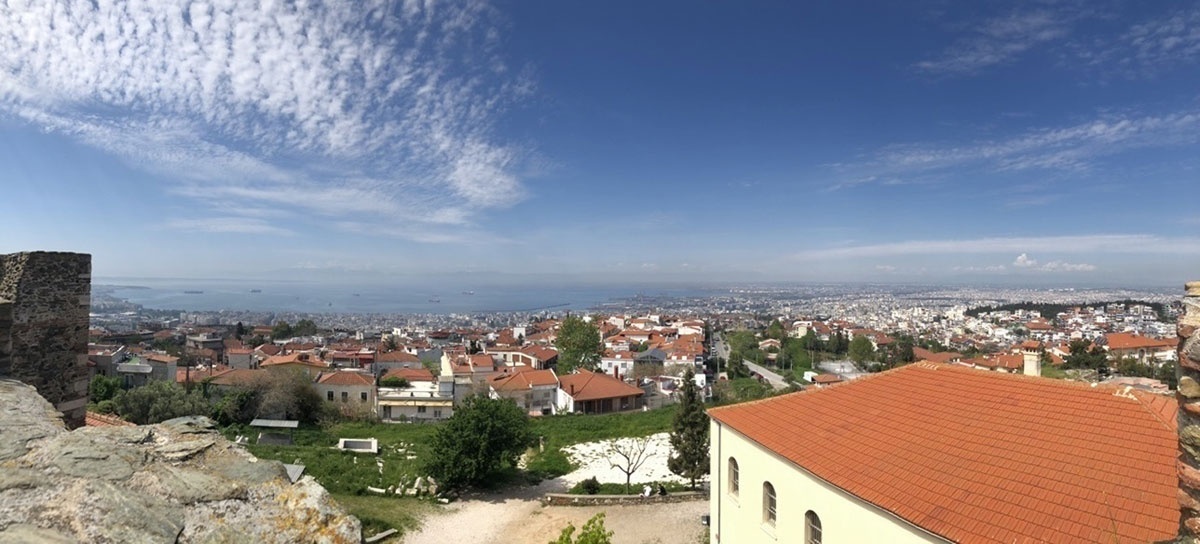
Figure 1
View of Thessaloniki from the Eptapyrgio fortress (photo by the author).
Thessaloniki’s urban development has been the outcome of many factors through the centuries: the various degrees of survival of remains from the earliest time periods of the city’s life, the monumental architecture of the more recent Byzantine and Ottoman time periods, the middle 19th c. growth triggered by reforms in the Ottoman Empire, the annexation of the city to the Greek state in 1912 and its consequent hellenisation, the fire that burnt most part of the city centre in 1917 and the new plan drafted by the French architect Ernest Hébrard at the request of the Prime Minister, Eleftherios Venizelos, the extent to which this was implemented during the middle- and post-war years and rapid urbanisation in the 1950s, 1960s and 1970s, as well as the effect of EU subsidies from the 1980s onwards, the nomination of the city as European Capital of Culture in 1997 and major public works, such as the ongoing construction of the Thessaloniki Metro since 2006 [17, 18, 19, 20, 21, 22, 23].
Hébrard’s plan gifted the city with its landmark central axis of Aristotle Square and Street, incorporating several historic and monumental sites. The northern part of this axis included the site where the Roman Forum was later discovered and was more recently developed in an extensive archaeological site with a site museum. The Plan also secured the preservation of the Upper Town, although later controversially redeveloped. Byzantine churches were freed from surrounding constructions and enhanced by becoming focal points to be viewed from several diagonal perspectives (e.g. Saint Sophia, Rotonda) [19].
All recent urban plans drafted for Thessaloniki (1985, 1995, 2000–2002, 2008–2014) take protection, preservation and enhancement of its cultural heritage into consideration in the context of the city’s sustainable development. Thessaloniki’s tangible urban heritage today consists of a range of sites and monuments, from prehistoric settlements (e.g. Toumba of Thessaloniki), sparse remains of the Hellenistic time period, mostly preserved in the basements of blocks of flats, extensive and well preserved sites of the Roman time period (e.g. Roman Forum, Galerius complex, the Arch of Galerius and the Rotonda), Paleochristian and Byzantine Monuments, included in the World Heritage List since 1988 [24], secular and religious monuments of the Ottoman time period (e.g. Bedesten, Aladja Imaret, Yeni Camii, Bey Hammam, Pazar Hammam, the Old Port market etc.), selectively preserved amongst the high-rise anarchic urbanisation of the city landscape from the 1950s onwards, public and private buildings dating to 19th – early 20th c. (e.g. the Villas of the Exohes neighbourhood) and post-war public and private modern and contemporary architecture (e.g. First Peer, Theatre of the Society for Macedonian Studies, Thessaloniki Concert Hall etc.). In 1994 the historic centre was listed as a historic site (Government Gazette 833/B/1994).
Public Engagement with Urban Heritage
Very little is known about people’s engagement with this heritage. A small survey conducted in 1991 by the 16th Ephorate of Classical Antiquities and the Department of Archaeology of the Aristotle University of Thessaloniki regarding the then ongoing excavation of the Roman Forum reported that only younger participants wished to see the excavation becoming an organised archaeological site [25]. A more recent population-wide survey conducted by the Archaeological Museum of Thessaloniki (AMTh) found that, although about three quarters of participants had visited the AMTh – albeit many of them as part of a school trip – only about a quarter have visited any other museum in the city [26]. An outlier in this exhibited lack of interest in cultural heritage in the city was the mobilization of thousands of residents that followed the decision to remove the late Roman – early Byzantine urban landscape excavated during the construction of the Venizelou Metro Station. The ancient material was partly reconstructed to decorate the newly opened Metro Station [22, 23, 27]. Another crowdsourced relevant initiative was the recording of approximately 1350 buildings dating from 1870 to 1940 in parts of Thessaloniki’s historic centre by the civic non-profit organisation MONUMENTA [28].
An event that has been organised for over a decade now offers some direct insights. Since 2012, the civic non-profit organisation Open House Greece has been guiding the public for free to urban heritage and contemporary architecture sites as part of the Open House Thessaloniki [29] festival. Visitation numbers and participants’ anonymized demographic data offer valuable insights as to who participates in Open House Thessaloniki and which sites have attracted the most interest so far.
The aim of this research project was to assess:
What types of monuments/buildings based on their chronology have been included in Open House Thessaloniki from the beginning of the festival in 2012 to 2025?
What types of monuments/buildings have participants visited the most?
What were the demographic features of festival participants in 2024 and 2025?
Statistical analysis of quantitative data demonstrated that about half of all the monuments/buildings included in every event (in total, 83 on average) were dated from the middle of 19th until the middle of 20th c. According to one of the organisers, this is the dominant type of built heritage in Thessaloniki. Primary group among them is the villas of the neighbourhood known as Exohes (trans. Countryside, because this neighbourhood lies outside the city walls) but also historic buildings of the middle-war period in downtown Thessaloniki. Many more visits are paid to these monuments/buildings than any other included in the event. Scatter plotting demonstrated that the high visitation numbers are not solely related to increased inclusion of these sites in the festival’s programme but it is dependent on more factors (Graph 1).
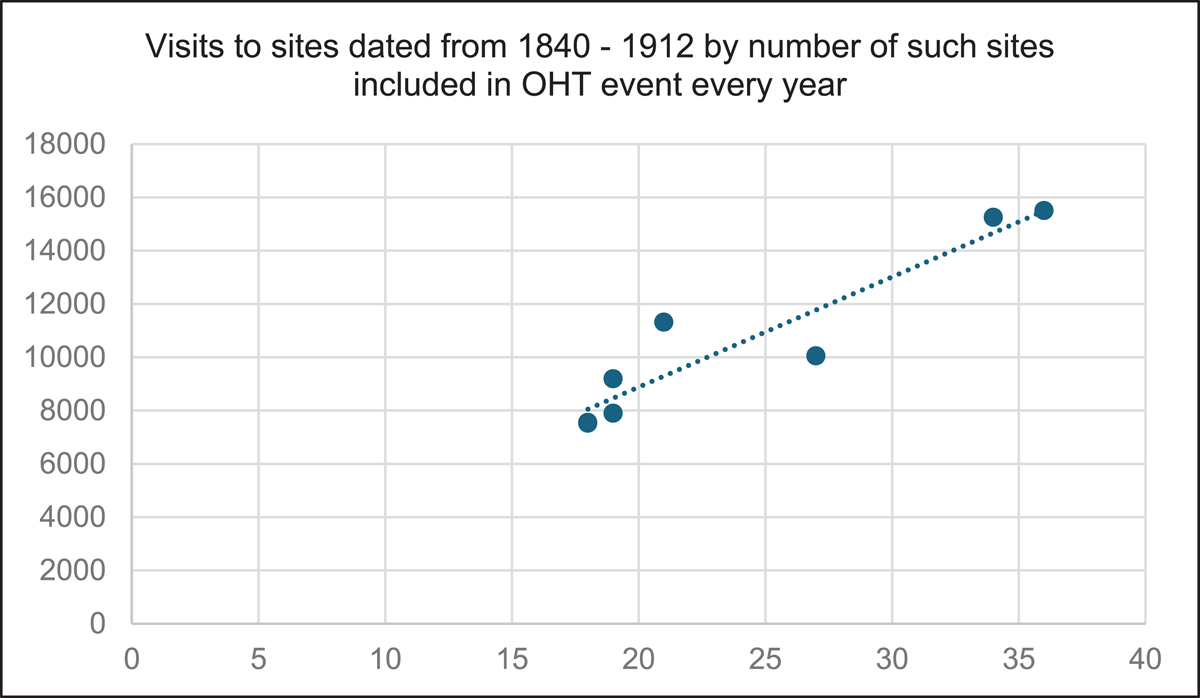
Graph 1
Example of Scatter Plot demonstrating the relationship between number of visits and number of sites dating from 1840 up to 1912 for the period between 2016 and 2025, excluding 2020 and 2021.
Exceptions to this rule were visits to Thessaloniki Metro Stations and the Metro Control Centre prior to its opening, to the much-awaited renovation of the historic Modiano Market and to the Masonic Hall, an old urban legend – sites that were either normally inaccessible or inaccessible until their official opening to the public. Monuments dated before the 19th c. were visited less. However, even these visits were not negligeable: the Rotonda, the White Tower and the Eptapyrgio (the seven-tower fortress at the top of the city walls) were often visited much more than the average number of visits of each event.
Participants’ demographic data from 2024 and 2025 demonstrated that the majority were women (60% and 65% respectively). Participants 18- to 29-years-old were the majority (42% and 38% respectively), followed by 30- to 49-year-olds (29% and 30% respectively) and last, by 50- to 64-year-olds (19% and 23% respectively). Only 16% and 17% of participants respectively were affiliated professionally with architecture. When it comes to educational attainment, 51% and 56% respectively were university graduates while 24% and 22% were university students. During both years, 83% were Thessaloniki residents. Almost half, 51% and 44% respectively, had never attended the festival before. Research in further likely correlations between this demographic dataset and the types of monuments/ buildings visited is in process.
In conclusion, the Open House Thessaloniki festival has had over a quarter of a million visits to urban heritage and contemporary architecture sites since 2016 only through its Open Tours (272.821 up to 2025, the festival also runs parallel events, such as Open Walks, Open Office, Open Schools and Made in Thessaloniki). It is the most important opportunity for people to engage with urban heritage and contemporary architecture in Thessaloniki. It is also an event that maintains relevance with current affairs in urban development in Thessaloniki as visits to Metro stations and other much-awaited projects demonstrate. Participants to the festival, the vast majority of whom are residents, are particularly interested in the more recent history of the city as visits to the monuments/buildings of the century between the middle of the 19th and the middle of the 20th c. demonstrate. Open House Thessaloniki fulfills the most basic requirement for participation and involvement in urban conservation, that is, sharing information and raising awareness about urban heritage.
Sixty Open House festivals are taking place around the world every year. In 2023 alone 1.2 million people participated in their activities with support from 14,460 volunteers [30]. These numbers render Open House the most important medium to keep societies worldwide informed and engaged in the protection and conservation of urban heritage today [9, ar. 23, 24a, 27, 28]. The festival highlights the diversity of urban society in history, the contribution of fragmentarily preserved monuments to the authenticity of the historic character of the city and communicates the values with which protection and conservation of urban heritage have been pursued so far.
Finally, according to the organisers, very few Open House events around the world collect as much data as systematically as Open House Thessaloniki does. Analysis and interpretation of this data demonstrate the importance of thorough data collection and management; one of the biggest challenges and weaknesses in the cultural sector internationally and a major hindrance to cultural policy planning and implementation [31]. This is of extreme importance at a time when the alignment of urban planning and integrated conservation within the framework of the 17 Sustainable Development Goals and a place for culture as a standalone goal is sought [31, 32]. This research project is presented in detail in a full-length research paper [33].
Spatial coverage
Description: Greece; Central Macedonia; Urban complex of Thessaloniki
Northern boundary: 40.713873, 22.940961
Southern boundary: 40.539294, 22.990724
Eastern boundary: 40.608311, 23.067555
Western boundary: 40.670501, 22.883128
Temporal coverage
2016–2025
(2) Methods
Quantitative data were manually collected from 2016 to 2023 by compiling lists of visitors for every site. From 2024, visitation numbers and participants’ demographic data have been retrieved directly from Eventora [34], the event management platform Open House Greece uses. Other quantitative data were acquired from the latest general population census [15]. Qualitative data were collected during a semi-structured interview with a member of the Open House Thessaloniki organising committee. Data regarding the chronology of each monument/building included in the event was retrieved from published sources [17, 18] or the festival’s website.
Steps
The dataset includes three distinct sets of data: First, visitation numbers for each monument/building included in the Open House Thessaloniki Open Tours from 2016 until 2025 (with the exception of 2020 and 2021, when the event did not take place in its usual format due to COVID 19 restrictions); second, anonymised demographic data of Open House Thessaloniki participants per monument/building during the years 2024 and 2025; third, the transcript of a semi-structured interview with one of the members of the organising committee. Quantitative data came in the form of Excel spreadsheets.
Regarding the visitation numbers by year, the file contained data for every year the event was organised in separate sheets with the exception of years 2017 and 2018, which were both included in one sheet (OHT_Visits_persite_peryear). This was broken into two separate sheets. Values in every sheet were organised in a descending order, starting from the monument/building with most visits. The average and the median value were calculated for every year.
This data was transferred and re-organised in a new file (OHT_Sites_peryear_pergroup_totalbuildingsandvisits). This time monuments/ buildings by year were organised in seven chronological groups, based on the date of their construction. The groups were based on Thessaloniki’s history and urban development history according to history of architecture and urban planning sources [17, 18]. The groups roughly correspond to the Hellenistic and Roman, Byzantine, Ottoman, Late Ottoman (1839, first Ottoman reform), middle-war, modern and contemporary time periods. This file also contains the sites of the 2012 – 2015 Open House Thessaloniki festivals although visitation numbers for these years were manually collected and not included in the dataset.
The groups were:
316/5 BC – 330 AD
331 AD – 1430
1431 – 1839
1840 – 1912
1913 – 1947
1948 – 1978
1979 until today
Total numbers of visits per chronological group of monuments/buildings and as a percentage of the total number of visits in every event were calculated. The number of monuments/buildings comprised in every group and as a percentage of the total number of buildings/monuments included in every event were also calculated. Finally, all this data was tabulated in a new file. Frequency tables, diagrams and scatter plots were created to investigate correlation between number of sites per chronological group offered and number of visits to the sites of each chronological group (OHT_analysis).
The second set of data includes three files, one for 2024 (OHT_Visitor_demographics_persite_2024) and one for 2025 (OHT_Visitor_demographics_persite_2025), consisting of one sheet per monument/building, and listing the demographic data of the participants who visited each monument/building. Gender, age group, professional affiliation with architecture, educational attainment, place of residence and participation in past Open House Thessaloniki events are noted. The monuments/buildings included in every Open Tour event vary year by year. The third file contains the same data in aggregated form (Table 1, OHT_Visitor_demographics_2024_2025).
Table 1
Total number of sites included in every Open House Thessaloniki event from 2016–2025.
| 316/315 BC – 330 AD | 331 AD – 1430 | 1431 – 1839 | 1840 – 1912 | 1913 – 1947 | 1948 – 1978 | 1979 – TODAY | TOTAL | |
|---|---|---|---|---|---|---|---|---|
| 2016 | 2 | 4 | 5 | 21 | 18 | 12 | 21 | 83 |
| % | 2% | 5% | 6% | 25% | 22% | 14% | 25% | |
| 2017 | 3 | 4 | 4 | 26 | 26 | 15 | 20 | 98 |
| % | 3% | 4% | 4% | 27% | 27% | 15% | 20% | |
| 2018 | 3 | 6 | 6 | 33 | 27 | 8 | 18 | 101 |
| % | 3% | 6% | 6% | 33% | 27% | 8% | 18% | |
| 2019 | 4 | 8 | 4 | 36 | 27 | 10 | 14 | 103 |
| % | 4% | 8% | 4% | 35% | 26% | 10% | 14% | |
| 2020 | . | . | . | . | . | . | . | . |
| 2021 | . | . | . | . | . | . | . | . |
| 2022 | 2 | 4 | 1 | 19 | 21 | 8 | 10 | 65 |
| % | 3% | 6% | 2% | 29% | 32% | 12% | 15% | |
| 2023 | 4 | 3 | 2 | 18 | 17 | 12 | 15 | 71 |
| % | 6% | 4% | 3% | 25% | 24% | 17% | 21% | |
| 2024 | 2 | 6 | 2 | 18 | 15 | 14 | 13 | 70 |
| % | 3% | 9% | 3% | 26% | 21% | 20% | 19% | |
| 2025 | . | 6 | 3 | 18 | 18 | 14 | 14 | 73 |
| % | . | 8% | 4% | 25% | 25% | 19% | 19% |
The third type of data is the transcript from a semi-structured interview with one of the members of the organising committee of Open House Thessaloniki and active member of Open House Greece, the civic non-profit organisation that organises Open House Thessaloniki. The interview was recorded on Zoom and transcribed with the use of TurboScribe. The transcription was then thoroughly reviewed and checked for errors by the interviewer and the interviewee. The interview sought to clarify the motivation behind the launch of the festival in Greece and in Thessaloniki in particular, the process of selection of sites included every year, organisers’ own insights in people’s participation in the festival and also to discuss the main findings of the research project.
Sampling strategy
All visits to the Open House Thessaloniki Open Tours events were included in the sample except for the ones to the Naval Battleship Velos – Museum of the Anti-dictatorship Struggle that is not an element of the built environment and the walking tours that included monuments of varied chronology (e.g. the one to the Upper Town of Thessaloniki). The walking tour of the Galerius Complex was included because of the relevant chronological uniformity of the monument.
Quality Control
Comparison of the final number of visits in the newly produced Excel files with those provided by Open House Greece confirmed that no data had been missed out.
Constraints
There are several limitations to this study that relate to the quality of the data. These datasets were compiled with the aim of informing the organisers of the event and helping them to improve it every year, rather than with the research questions set out in this study in mind. There is therefore data missing from the events prior to 2016. Another challenge was to match the sites described in the Open Tours events with the actual sites and date them. Sites are not always consistently titled in the programming of the event and dating of the lesser-known ones relied on morphological elements and the history of urban planning and architecture of Thessaloniki. There is also a degree of detail missing: some sites were open for both days the event runs for, while others were open only for one day. Opening times may also vary between sites, depending on availability of guarding staff and volunteers. Some sites are inaccessible during the rest of the year while others are always publicly accessible (e.g. the Galerius complex is an open-air archaeological site). Exclusivity of access was found to be an important factor in the decision to visit one site over another.
Other limitations relate to the chronological grouping of the sites. There were buildings planned during one time period but constructed during another. Buildings of the mid-war era that were recently renovated were dated based on their initial construction. Finally, it is acknowledged that participants do not choose which Open Tours sites to visit based on their chronology. The best data for this study would originate from an evaluation form where participants would directly record the reasons why they chose specific sites to visit and the impact of their participation to the event. Nevertheless, the dataset still provides valuable insights into the preferences of participants and the chronological grouping illuminates one facet of these preferences.
(3) Dataset description
Object name
OHT_Visits_persite_peryear
OHT_Sites_peryear_pergroup_totalbuildingsandvisits
OHT_Analysis
OHT_Visitor_demographics_persite_2024
OHT_Visitor_demographics_persite_2025
OHT_Visitor_demographics_2024_2025
OHT_Interview Transcript
Data type
Primary and processed data
Format names and versions
Excel, Word
Creation dates
11/09/2025 (OHT_Analysis, OHT_Sites_peryear_pergroup_totalbuildingsandvisits)
02/10/2025 (OHT_Visits_persite_peryear, data from the Open House Thessaloniki 2016 – 2024 events)
25/11/2025 (OHT_Visitor_demographics_2024_2025)
03/12/2025 (data from the Open House Thessaloniki 2025 event added to the above)
16/1/2026 (OHT_Visitor_demographics_persite_2024, OHT_Visitor_demographics_persite_2025, demographic data)
19/2/2026 (OHT_InterviewTranscript)
Dataset Creators
Anastasia Sakellariadi
Language
Greek
License
CC BY 4.0
Repository location
Zenodo https://zenodo.org/
Publication date
07/05/2026
(4) Reuse potential
This is the first data published by an Open House event anywhere in the world. Open House London annually publishes an impact report but the data itself is not published [35]. There are 60 Open House events taking place around the world every year and in 2023 1.2 million people participated with support from 14,460 volunteers [30]. If all Open House events ran surveys and collected data in the way published here, there would be a unique set of data on who engages with the urban landscape in these 60 locations all over the world.
This project and the publication of its data address two other interrelated and rather urgent matters in cultural policy and in the integrated protection and conservation of historic urban landscapes. In general, there is very little data on the relationship between urban communities and their heritage, especially in Greece. This dataset allows further investigation in the more subtle interest people have in urban heritage and the urban landscape beyond chronological typologies. There is a continuous need for FAIR data [36] on culture so that cultural policies can be evidence-based [31, with relevance to data on culture’s contribution to Sustainable Development Goals – SDGs]. This is of particular importance as work on managing historic urban landscapes at the time of SDGs has intensified for the last two decades [31, 32, 9] with converging interest from urban planning studies, conservation studies, heritage studies, heritage management studies. Open House Thessaloniki data can offer valuable insights and can be replicated by any other Open House organisation.
Ethics and Consent
This study followed the Declaration of Helsinki standards for research involving human participants. Personal data of participants to the Open House Thessaloniki Open Tour events in 2024 and 2025 were permanently discarded. The interviewee representing Open House Greece was informed about the study both in writing and orally, and signed an informed consent agreement. The interviewee had the option to stay anonymous. A data sharing agreement between the author and Open House Greece was signed and deposited with the data.
Acknowledgements
I would like to thank Open House Greece and Ms Katerina Doudoumi in specific, who has supported this investigation throughout, and Mr Matthaios Damigos, who helped source the demographic data included in the dataset. The research project was based on ideas presented at the session Underground Antiquities and Public Archaeology: Challenges and Perspectives of Urban Archaeology (Archaeological Dialogues, 31st May – 3rd June, Athens 2018) that I co-organised with Nota Pantzou and Eleftheria Theodoroudi. I would like to thank them and all the session participants.