
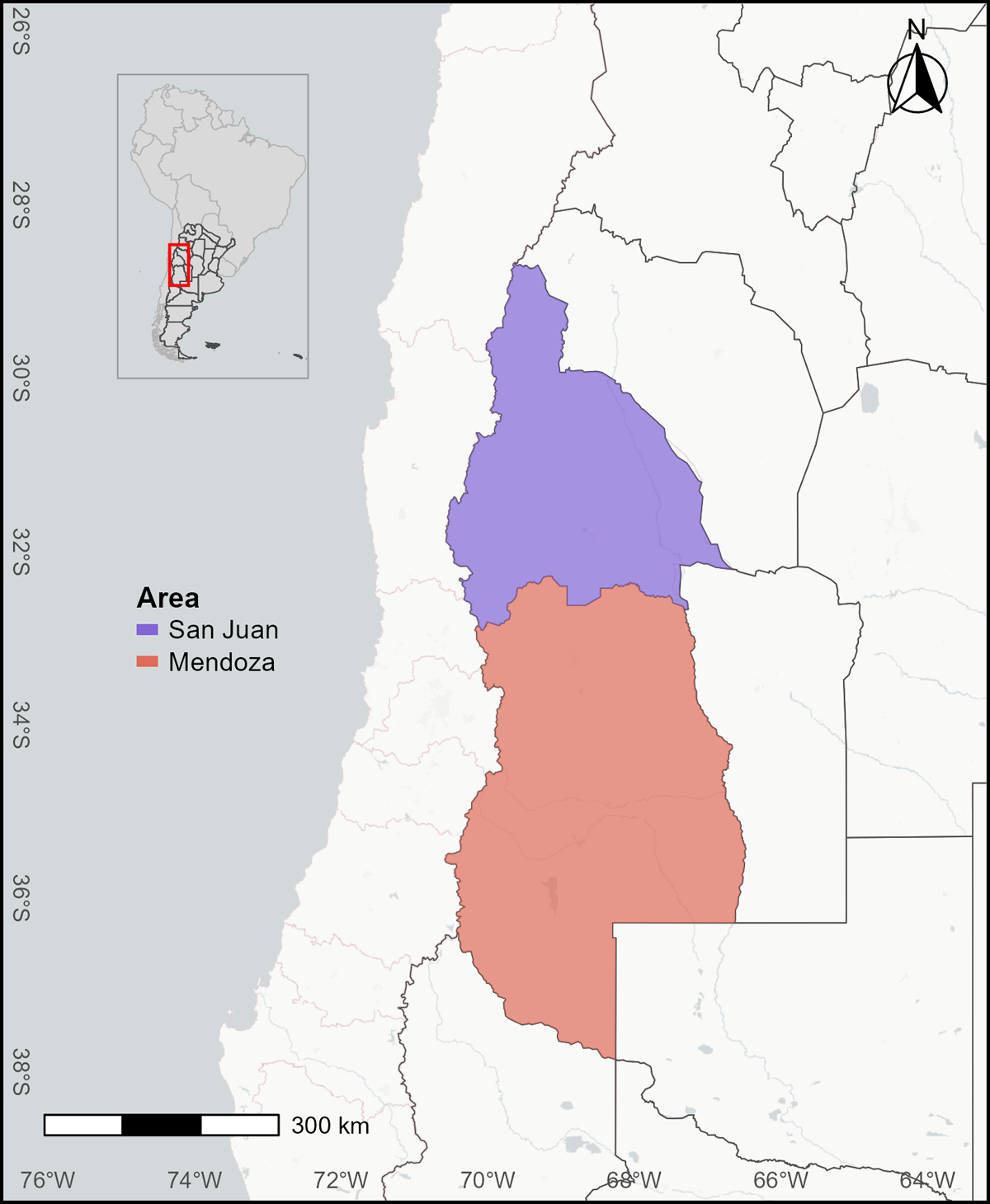
Figure 1
Spatial location of the provinces of San Juan and Mendoza.
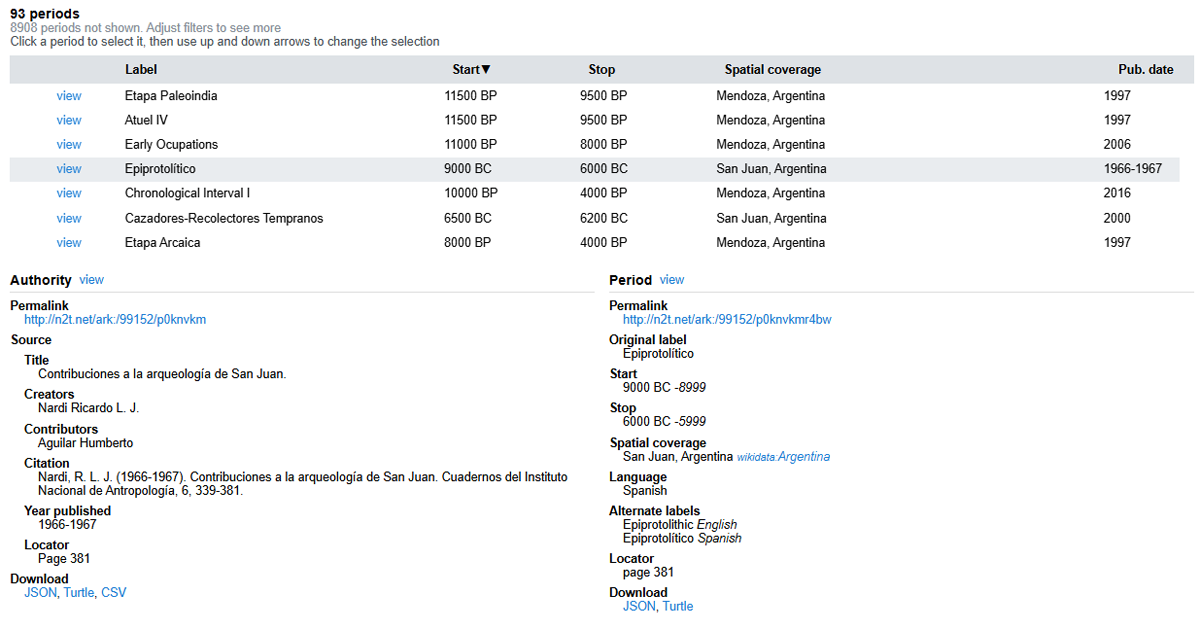
Figure 2
Example of a selection of periods from the dataset corresponding to Mendoza and San Juan in the PeriodO Project. In this case, the Epiprotolithic period is shown, where the minimum required metadata for its indexing can be observed (name, temporal coverage, spatial scope and source), along with additional information available and downloadable on the platform.
Table 1
Overview of the workflow used to extract, normalize, and prepare period definitions for inclusion in the dataset.
| STEP | DESCRIPTION |
|---|---|
| 1. Source identification and attribute verification | Selection of publications containing explicit archaeological period definitions for Mendoza and San Juan. |
| 2. Manual data extraction | Extraction of the four mandatory elements: period name, temporal coverage, spatial scope and bibliographic reference. |
| 3. Chronological and metadata standardization | 3a. Chronological normalization: Standardization of temporal boundaries into ISO 8601 extended year notation. This included calibration of the only radiocarbon-based definition in the corpus (OxCal v4.4 + ShCal20) and the formalization of vague expressions (e.g., “second half of the 16th century”) into computable intervals using OWL-Time conventions. |
| 3. Chronological and metadata standardization | 3b. Structuring of core metadata for PeriodO ingestion: Organization of fields into the PeriodO data model (original label, temporal span, spatial coverage, language, bibliographic source and basic relations such as has parts). |
| 4. Quality control and editorial validation | Review by PeriodO editors to ensure adherence to platform standards. At this stage, system-generated fields (alternate labels, page locators, download formats, authority links) are incorporated, and a persistent ARK identifier is assigned upon approval. |
Table 2
Field groups and key columns in temporal_definitions_mendoza_sanjuan_ESP.csv and temporal_definitions_mendoza_sanjuan_EN.csv.
| GROUP | MAIN FIELDS | PURPOSE |
|---|---|---|
| Identification | period (persistent URI), label/etiqueta, link source/enlace a la fuente | Gives each period a unique global identifier and a human-readable name. |
| Geographic | spatial coverage/cobertura espacial, getty tgn | Indicates the province and country where the period is used. |
| Chronological | start/inicio, stop/fin | Defines lower and upper bounds in Gregorian calendar years according to the extended ISO 8601 standard (negative values = BCE, with year 0 corresponding to 1 BCE), consistent with PeriodO’s implementation. |
| Relational | broader periods/períodos generales, narrower periods/subperíodos | Places each definition in a hierarchy so that broad cultural phases and local sub-phases can be queried together. |