
Introduction and background
In 2012, “the year of the MOOC” (Pappano 2012) marked the growth and expansion of a new form of open online education at scale, and the emergence of relevant platforms including Coursera and edX. Over the next decade, these courses reached more than 220 million learners globally (Shah 2021) and have been adopted by mainstream educational institutions in a variety of ways – to offer online formal and informal learning, blended learning, smaller and semi-open professional learning, community learning (Community Open Online Courses, or COOCs), language learning (LMOOCs), MicroMasters and microcredentials (Pilli & Admiraal 2016). While the initial hype around MOOCs has subsided (see Figure 1) and their form has changed significantly from the first large-scale courses, the Covid pandemic boosted interest in these courses (e.g. 8 million learners in 2019 to 20 million in 2020 for Coursera MOOCs) (Shah 2020). This led to further investment and then innovation in delivery through increased use of AI, and more personalisation of learning. Ahmad et al. (2022) predict future MOOC innovations will include the adaptation of technologies such as Digital Twins, Cloud Computing, Big Data, Machine Learning, Artificial Intelligence and Metaverse in education. These have the potential to support innovative pedagogies, enhance the chances of equitable education and increase possibilities for lifelong learning. They believe these technologies have the potential to create MOOCs with better security, learner engagement, adaptive learning, greater collaboration and universal access.
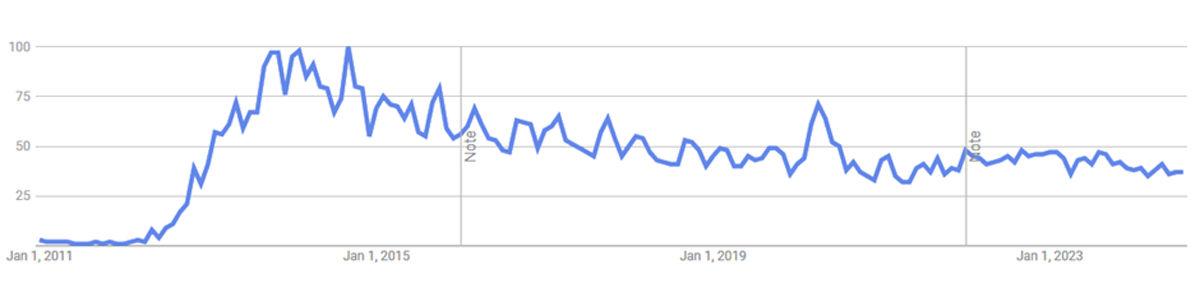
Figure 1
Interest over time on Google Trends for MOOCs – Worldwide, 1/1/11–8/9/24 (Google Trends 2024).
After “the year of the MOOC”, the first UK-based MOOC platform, FutureLearn, was launched and a year later The FutureLearn Academic Network (FLAN) was established by a group of academics. The network aimed to connect academics and research students based at FutureLearn partner institutions, to share research and scholarship, and explore shared research opportunities. During the last decade, more than 33 events and annual conferences, covering a wide range of themes and topics, have been delivered by 193 different presenters in this network (more details here). The work of some of these presenters is among the top 20 most-cited research papers on MOOCs (see Ledwon & Bowden 2024). The 10 years of FLAN research and scholarship inspired this special collection and encouraged us to look back at MOOC research and the evolution of open learning at scale.
MOOC research
The development of MOOC research and relevant timeline analysis shows distinct phases of work: the starting phase (2009–2012), the high-growth phase (2013–2015), the plateau phase (2016–2018) and second peak phase (2019–2021) according to a systematic review of 4,652 articles between 2009 and 2021 by Zhang et al. (2022). The first wave of MOOCs, as termed by Bozkurt, Keskin and De Waard (2016), created a scholarly landscape in which studies predominantly explored MOOCs as an open and participatory practice. In the high-growth phase until 2016 this focus shifted to the second (xMOOC) wave, during which hybrid practices and designs emerged (Bozkurt 2021). Overall, during these phases, the six major research topics were institutional approaches, pedagogical approaches, evaluation, analytics, participation and educational resources. While participation and evaluation have received most attention, the lowest number of publications belonged to pedagogical approaches and educational resources and therefore highlights a need for more MOOC research from a pedagogical perspective (Despujol et al. 2022).
Our analysis of MOOC literature published in JIME between 2012 and 2022 shows early publications (2011–2015) mostly focused on situating MOOCs as a novel mode of distance education in relation to the broader higher education ecosystem. The focus then shifted from conceptualising MOOCs to learning design and roles within higher education, which represented a move towards the ‘how’ and ‘who’ of putting MOOCs into practice. From 2019 onwards, a focus on inclusion, accessibility and language predominated (Jordan & Goshtasbpour 2022). As you will see later in this editorial, although there are studies about accessibility and language MOOCs in this collection, the focus of submissions seems to have shifted back to learning design. This being said, ‘professional learning and development’ is another major theme.
Over the last decade, case studies of professional development at scale through MOOCs (Stutchbury et al. 2023; Laurillard & Kennedy 2020), demonstrate the advantages of social learning pedagogy (for example Bandura 1971) underpinning some platforms, as well as the advantages of learning design that fosters learning spaces for professional networks and accommodates a diverse range of learning needs simultaneously (DeBoer et al. 2014). Over time, and with greater acceptance, MOOCs have been explicitly tied to addressing employment skills shortages, for example in the UK (Dunkerley et al. 2022; Walport & Leunig 2017) and Australia (Santandreu Calogne et al. 2019). This shows one dimension of change in the MOOC landscape. Early MOOCs were hailed as democratising education by providing access to education in a wide range of disciplines and regardless of the background of the learner. Access was free and payment was only required for certification. The landscape is quite different in 2024. The majority of MOOCs relate to workplace learning. Many early MOOCs did too, but the platforms gave an air of lifelong learning possibilities for all, on almost any topic. Today, FutureLearn’s emphasis on the acquisition of skills for continuing professional development ‘Get Access to 1400+ Courses and Develop Your Industry’s Most-Valuable Skills’ (https://www.futurelearn.com/) is similar to that on other platforms: Coursera, ‘Gain the Latest Skills’ (https://www.coursera.org/); edX ‘Build new skills. Advance your career.’ (https://www.edx.org/). As Kennedy and Laurillard note, the MOOC ‘is still a solution for mainly professionals rather than students…’ (2024: 11) due to the ability of professionals both to understand what they need and to learn independently.
The remainder of the editorial provides an overview and summary of papers in this collection.
Papers in the special collection
Overview
Analysis of author-specified keywords in this issue identified three recurring topics: MOOCs (3), learning at scale (2) and design for learning (2). The rest of the keywords were unique. A corpus analysis of abstracts, showed “learning” (24) to be the most frequently occurring word in the abstracts, followed by “online” (19), “course” (18) and “design” (13) which together imply a focus on the design aspect of online courses or materials. Moving beyond individual words, we grouped and presented the articles thematically. Four of the six articles are associated with the themes of “design for learning” and “professional learning/development”. “Impact of LMOOCs on student outcomes” and “accessibility” were the other two themes, each represented by one article. All the papers except one adopt a case-study approach and the majority are qualitatively oriented (Table 1). Most of these case studies focus on a single MOOC or a series of MOOCs.
Table 1
Comparative table of papers in this special collection.
| PAPER | FOCUS | METHODOLOGY | APPROACH |
|---|---|---|---|
| Beyond Boundaries: The Role of Learning Types in Shaping MOOC Learner Engagement and Progression | Learning design Learner engagement | Mixed methods | Case study (of a university’s MOOCs) |
| The Importance of Offline Options for Online Learners | Learning design online/offline material | Qualitative – phenomenology | Case study (of a module) |
| Educators’ Perceptions and Experiences of Online Teacher Professional Development | Professional development | Qualitative-phenomenology | Case study (of a MOOC) |
| Addressing Global Challenges By Contextualising Learning At Scale: Future Professional Learning For The Health Sector | Professional learning and development at scale | Qualitative | Case study (of a programme design) |
| The Effects of a Teacher-Curated LMOOC on EFL Students: A Case Study | Impact of blended learning with MOOCs on students’ outcomes | Mixed methods | Case study (of a language module) |
| Understanding Accessibility in MOOCs: Findings and Recommendations for Future Designs | Accessibility in MOOCs | Systematic review | Systematic review |
We also mapped the topics against the eight priority research areas identified by a report from FutureLearn’s UK partners (Ferguson et al. 2017) and found that papers in this issue quite lightly represent two areas of “identify and share effective learning designs” and “Develop appropriate pedagogy for learning at scale” (Table 2). This may be because most of the studies examined MOOCs offered on other platforms.
Table 2
Mapping of papers in current collection against research priority areas identified by Ferguson et al. (2017).
| BEYOND BOUNDARIES: THE ROLE OF LEARNING TYPES IN SHAPING MOOC LEARNER ENGAGEMENT AND PROGRESSION | THE IMPORTANCE OF OFFLINE OPTIONS FOR ONLINE LEARNERS | EDUCATORS’ PERCEPTIONS AND EXPERIENCES OF ONLINE TEACHER PROFESSIONAL DEVELOPMENT | ADDRESSING GLOBAL CHALLENGES BY CONTEXTUALISING LEARNING AT SCALE: FUTURE PROFESSIONAL LEARNING FOR THE HEALTH SECTOR | THE EFFECTS OF A TEACHER-CURATED LMOOC ON EFL STUDENTS: A CASE STUDY | UNDERSTANDING ACCESSIBILITY IN MOOCS: FINDINGS AND RECOMMENDATIONS FOR FUTURE DESIGNS | |
|---|---|---|---|---|---|---|
| Develop a strategic approach to learning at scale | ||||||
| Develop appropriate pedagogy for learning at scale | ||||||
| Identify and share effective learning designs | ||||||
| Support discussion more effectively | ||||||
| Clarify learner expectations | ||||||
| Develop educator teams | ||||||
| Widen access | ||||||
| Develop new approaches to assessment and accreditation |
Papers
Design for learning
Beyond Boundaries: The Role of Learning Types in Shaping MOOC Learner Engagement and Progression
Hannah John, John Kerr and Guillaume Andrieux
In this study, the authors investigate learner engagement and retention in MOOCs from a learning design perspective. Using a sequential mixed method approach, they examine the ways in which learning design influences learner experience and delve into factors within learning design that motivate learners to engage with and complete a MOOC. They focus in particular on MOOCs designed and produced on the basis of ABC Learning Design principles and six learning types: acquisition, discussion, investigation, collaboration, practice and production. Additionally, they consider the impact of frequency and sequencing of these learning types on creating opportunities for learner engagement.
Analysis of eight MOOCs revealed six key areas of impactful learning design when individual learning types are considered. These include: 1) ensuring good quality for media (acquisition) especially video content and minimising barriers such as poor audio, lack of transcripts, or improper resolution of on-screen images; 2) considering a balanced distribution of acquisition learning types, i.e. reading, video and audio; 3) considering the structure and number of discussion opportunities; 4) providing clear and effective guidance for learner exploration and investigation activities; 5) balancing the assessment and feedback opportunities for students’ practice, production and collaboration as the study showed a statistically significant negative correlation between the number of assessment opportunities and course completion; and 6) enabling effective and easy utilisation of tools for learners as findings revealed students do not complete a step if there is a technical issue, or unclear guidance on how to access a tool.
The study also found how the sequencing and combination of individual learning types can be leveraged for successful course design.
The Importance of Offline Options for Online Learners
Rebecca Ferguson, Leigh-Anne Perryman and Simon Ball
This study is closely linked to the previous paper as it investigates another aspect of learning design, that is offering multiple formats of content (online, offline digital and offline print). It uses a phenomenological approach and relies on learners’ lived experience to understand the benefits of offering downloadable and printable versions of online study materials and supporting offline study. It is a case study of 100 learners on a postgraduate module offered on FutureLearn and uses a dataset of learner comments (247 comments, 15,300 words). None of the module materials asked about the benefits of downloadable and printed resources, but several activities prompted learners to share their reflections on online learning, the FutureLearn platform and accessibilities. References in learners’ comments about these topics were extracted and produced the dataset for the study. Inductive thematic analysis of comments revealed the importance of the online/offline divide and showed that, as learners’ contexts change, the benefits and accessibility of online, offline and print versions shifts. Printed and digital materials support different ways of learning and can have an affective impact. The article concludes by emphasising the diversity of learners’ lived experiences and highlights the potential of identified benefits to underpin changes to learning design that enable learners and educators to take full advantage of the possibilities offered by digital materials, with the potential for a flexible approach grounded in Universal Design for Learning to increase equitable participation in learning.
Professional learning and development
Educators’ Perceptions and Experiences of Online Teacher Professional Development
Meaghan Brugha, Imran Arif, Sarah Peters, Farah Ahmed, Chiara Piccini, Gonzalo M.A. Bermudez, Jane Goodland, Deepthy Raghavendra and Kirk Weeden
This research is another phenomenological case study that, like the first paper, focuses on learner engagement but in a professional development context. The authors highlight the gap between, and limited understanding of, the ways in which educational practitioners engage with, experience and learn from an online teacher professional development MOOC. The paper addresses three questions about perceptions and experience of online professional development, factors that influence participation and engagement and ways through which the overall experience of professional learners pursuing online professional development can be enhanced.
To address the questions, the study uses data from pre- (n = 208) and post- (n = 47) course surveys which formed phase one of data collection, in addition to focus group data (n = 2) and reflective questionnaires (n = 8) in phase two. Findings illustrate that professional learners are intentional, reflective and critical and shape their own and others’ learning and experience. They perceive online professional development as: an opportunity to enact agency and autonomy in their professional development; a flexible environment to connect the learning with their context and a platform for engaging with diverse perspectives; providing resources for deeper thinking and reflection; and an opportunity for developing 21st-century skills. The results additionally revealed areas that significantly influence participation, engagement and retention in the course: course aims, structure, cost, time required, and opportunities to meaningfully connect with other practitioners while highlighting the varying engagement level of participants.
Addressing Global Challenges By Contextualising Learning At Scale: Future Professional Learning For The Health Sector
Koula Charitonos, Rachel McMullan, Allison Littlejohn and Hilary MacQueen
This is another case study in the special collection that focuses on professional learning and professional development at scale. More specifically, it focuses on the design and development process of learning paths (n = 10) and modules (n = 23) for the capacity building and professional development of healthcare professionals involved in antimicrobial surveillance, which is a rapidly changing context. The study is framed by the ACAD framework (Goodyear, Carvalho & Yeoman 2021; Goodyear & Carvalho 2014) and argues that the design for professional learning (in general and in MOOCs) should be treated as a holistic engagement across physical, social and epistemological elements in order to support professionals not only to learn new knowledge, but also to apply this knowledge to their work.
The investigation of the design process also highlights the importance of design considerations to encourage professionals to make connections with developments at the macro level (knowledge and skills) and with their local work environment, practices and communities, i.e. meso and micro levels.
Impact of LMOOCs on student language outcomes
The Effects of a Teacher-Curated LMOOC on EFL Students: A Case Study
Napat Jitpaisarnwattana
This study focuses on Language MOOCs (LMOOCs) and an under-researched area within its relevant literature. The author argues that most LMOOC studies have examined the potential of these courses to complement or replace a language class and as integrative educational technology; however, only a few studies have examined the impact of LMOOCs on learner language development. Therefore, the study investigates the effect of a teacher-curated LMOOC – a combination of lessons from five LMOOCs – on specific learner outcomes, the midterm and final exam scores. It also looks at learners’ attitudes towards integrating this LMOOC into their compulsory 15-week English course. The study adopts a mixed-methods approach and uses midterm and final examination scores (n = 179), an attitude questionnaire (n = 123) and semi-structured interviews (n = 5).
Analysis shows that, after participating in the LMOOC for 5 weeks, the learners’ final exam scores improved to a statistically significant extent. When disaggregated by exam components, however, the differences in score gains between the midterm and the final exam were attributable to improvement in the grammar and vocabulary portions, but not in the reading component. Based on this measure, it is reasonable to assume that the positive change in the students’ performance in the final exam was associated, though not entirely, with their participation in the LMOOC. Moreover, the LMOOC intervention benefited both the students who failed the midterm exam and those who passed it. As to the attitude component of the study, the participants generally showed a positive attitude and agreed that studying in the LMOOC was beneficial for their English language learning. While these findings are promising for using LMOOCs to improve learners’ language learning outcomes, studies considering a larger number of LMOOCs and in different locations with different learner profiles are needed.
Accessibility
Understanding Accessibility in MOOCs: Findings and Recommendations for Future Designs
Francisco Iniesto and Covadonga Rodrigo
This systematic review focuses on accessibility in MOOCs and explores the current state of accessibility in MOOC production, since there is limited research on the accessible design of these courses despite its importance. The study adopts a multiphase approach and examines relevant articles and book chapters published in English between 2014 and 2022 in two highly ranked databases: Web of Science and Scopus. The approach led to a final selection of 20 articles out of 295 found. The first publication is from 2014. They are quite evenly distributed in 2016, 2020, and 2021 with three publications each year, and four in 2021 and 2023. This indicates that, unlike the wider field of MOOC research, there was no significant increase in publications on this topic over the decade. Five of the articles are considered position papers and the other 15 are empirical studies using various research methods, including mixed methods (five studies), qualitative methods (four studies), and quantitative methods (one study). Additionally, five studies applied heuristic evaluations. Finally, five articles had a multinational context. Four studies were undertaken in Spain, two in France and the UK, and one in Chile, Korea, Poland and Russia.
Thematic analysis of selected studies identified five focus areas of “accessibility evaluations with experts and automatic tools”, “accessibility evaluations with learners”, “codesign for accessibility with stakeholders” and “personalisation of the learning experience”. Another set of findings from the systematic review revealed the design recommendations related to the platform, MOOC, educational resources and personalisation. The review concludes by highlighting the importance of involving all stakeholders, including MOOC providers, course developers, and learners in MOOC design and production by using co-creation and participatory design methodologies.
Competing Interests
The authors have no competing interests to declare.