
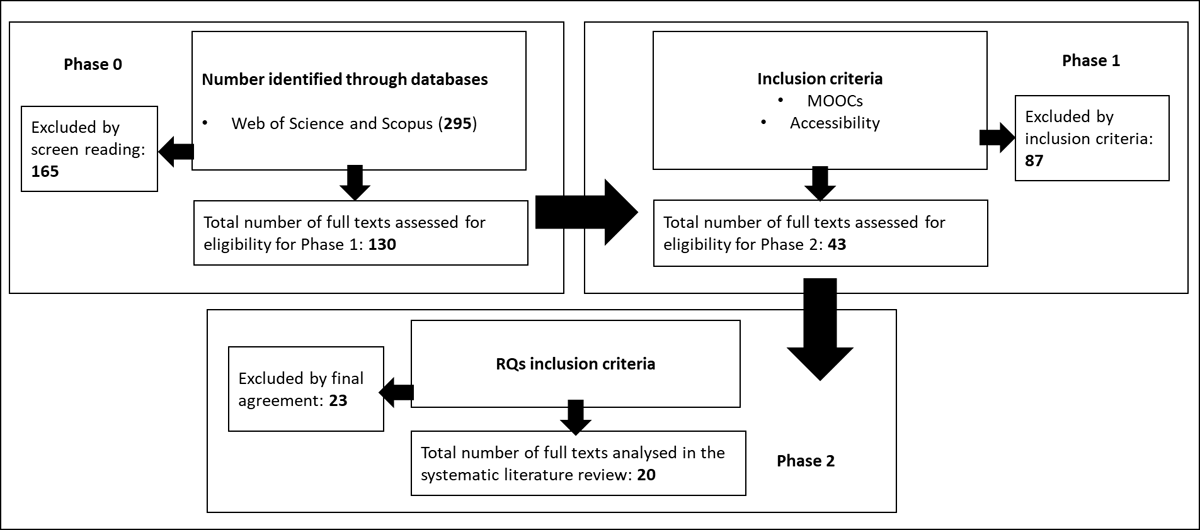
Figure 1
The selection process followed in this research.
Table 1
Sources used in the systematic literature review ordered by year of publication.
| AUTHOR(S) | YEAR | TYPE OF SOURCE | FOCUS | METHODOLOGY | METHOD AND SAMPLE | CONTEXT | |
|---|---|---|---|---|---|---|---|
| 1 | Rodrigo | 2015 | Book Chapter | Accessibility in language MOOCs and strategies | Position paper | Not applicable | Not applicable |
| 2 | Iniesto & Rodrigo | 2016 | Journal | Specifications to support accessible MOOCs integrating user preferences | Position paper | Not applicable | Not applicable |
| 3 | Martin, Salvatierra & González | 2016 | Journal | Evaluation of main MOOC platforms’ accessibility. | Heuristic evaluation | Coursera, edX, Udacity, MiriadaX, UNED Abierta, Udemy, Futurelearn and NovoEd using automatic tools and experts with WCAG 2.0 | Spain |
| 4 | Sanchez-Gordon & Luján-Mora | 2016 | Journal | Software design to incorporate features in MOOC authoring tools | Heuristic evaluation | Expert evaluation of Studio, the edX course authoring software with ATAG 2.0 | International |
| 5 | Rai | 2018 | Journal | Low bandwidth challenges and offline digital support model | Position paper | Not applicable | Not applicable |
| 6 | Park, So & Cha | 2019 | Journal | Identification of visual impairment barriers using mobile devices in MOOCs | Heuristic evaluation | Evaluation with 3 visually impaired learners and 3 experts using WCAG 2.0 | Korea |
| 7 | Kosova & Izetova | 2020 | Journal | Evaluation of Mathematics MOOCs in Russian by experts | Heuristic evaluation | Expert evaluation of 56 MOOCs in Open Education, Lektorium, Coursera15 and Stepik using WCAG 2.1 | Russia |
| 8 | Robles et al. | 2020 | Book Chapter | Production of guidelines for designing hearing messages that help blind learners navigate MOOCs | Position paper | Not applicable | Not applicable |
| 9 | Sanchez-Gordon, & Luján-Mora | 2020 | Book Chapter | Summarisation of accessibility requirements in the design, implementation, and evaluation of MOOCs | Position paper | Not applicable | Not applicable |
| 10 | Cinquin, Guitton & Sauzéon | 2021 | Journal | Codesign of new functionalities to enhance the accessibility of a MOOC player | Qualitative | Meetings and interviews with 13 experts and 6 ADHD learners | France |
| 11 | Lei, Jones & Brosnan | 2021 | Journal | Identification of why and how language should be used when describing autism analysing comments | Qualitative | 803 learners’ comments in 2 MOOCs in FutureLearn during 6 presentations | UK |
| 12 | Molanes-López et al. | 2021 | Journal | Evaluation of the accessibility of videos in MOOCs | Mixed methods | 72 learners in a WCAG 2.1 based questionnaire | Spain |
| 13 | Pérez-Martín, Rodriguez-Ascaso & Molanes-López | 2021 | Journal | Assessment of the quality of the captions produced using YouTube in MOOCs | Quantitative | 53 learners in a questionnaire | Spain |
| 14 | Iniesto et al. (a) | 2022 | Journal | Perspectives of MOOC providers on MOOC disabled learners and accessibility management | Qualitative | Interviews with 26 MOOC providers | International |
| 15 | Iniesto et al. (b) | 2022 | Book Chapter | Design and implementation of a MOOC accessibility audit | Heuristic evaluation | 4 components audit to evaluate MOOCs from FutureLearn, edX, Coursera and Canvas with experts | International |
| 16 | Królak & Zając | 2022 | Journal | Analysis of 8 MOOCs’ accessibility by disabled users | Qualitative | 10 disabled participants in research groups analysed WCAG 2.1 in a lay questionnaire in Coursera | Poland |
| 17 | Cinquin, Guitton & Sauzéon | 2023 | Journal | Evaluation of the accessibility of a MOOC player | Mixed methods | 646 learners, 87 declaring a disability using learning analytics and a questionnaire | France |
| 18 | Iniesto et al. | 2023 | Book Chapter | Disclosure of motivations of disabled learners in MOOCs and proposed improvements | Mixed methods | Survey data from FutureLearn, (with 29,000 and 5,000 respondents) and interviews with 15 disabled learners | UK |
| 19 | Iniesto, Rodrigo & Hillaire | 2023 | Journal | Testing of an evaluation framework for assessing MOOC accessibility by learners | Mixed methods | 23 learners using an evaluation framework and qualitative responses on UNED Abierta (edX) | Spain |
| 20 | Patiño-Toro et al. | 2023 | Journal | Methodology for designing MOOCs for deaf or hard-of-hearing | Mixed methods | Literature review, validation with experts and interviews with 22 deaf learners | Chile |