
Introduction
Most types of Massive Open Online Courses (MOOCs) are distinctive in the online learning landscape because of their characteristic of massiveness and openness within a structured learning framework (Papathoma et al. 2020). Additional advantages include individual planning flexibility, allowing learners to self-organise their time, use preferred devices, engage in social learning, and acquire new knowledge (Zhu & Doo 2022). While the importance of accessibility in online educational resources is widely recognised (Jordan & Goshtasbpour 2022), there is limited research on the accessible design of online learning courses, including MOOCs.
The UNESCO Inclusion and Education Report (2020) evaluates advancements in achieving Sustainable Development Goal 4, encouraging higher education institutions to prioritise the support and the creation of an optimal environment for learners with accessibility needs. Furthermore, the FutureLearn Academic Network (FLAN), established in 2013, has brought together academics and doctoral students on MOOC research exploring shared objectives including the relevance of accessibility in online courses (Ferguson et al. 2018). The lifelong learning paradigm seamlessly integrates education, work, and personal life, enabling learners to continuously access and develop knowledge both personally and professionally (EADTU 2014). In this context, if designed to be accessible, MOOCs possess features that can serve as a suitable mode of study for learners with accessibility needs (Lambert 2020).
The methodologies and processes supporting accessibility in MOOCs have changed over time (Ingavélez-Guerra et al. 2022). However, the assumption that accessibility practices are integrated into MOOC production has resulted in a knowledge gap in the context of MOOCs. This paper endeavours to fill this gap by presenting a literature review on accessibility in MOOCs. The systematic literature review explores the current state of accessibility in MOOC production and highlights key recommendations for ensuring the accessible design of MOOCs and their platforms.
Background
In the context of this research, it is important to define accessibility clearly and explore existing research on MOOC accessibility.
Accessibility definition in MOOC contexts
The terms usability and accessibility require clarification, emphasising their critical interconnection. Usability involves tailoring a product to meet user expectations, ensuring efficiency and ease of use (Lewis 2014). The relationship between accessibility and usability is intrinsic; lower accessibility implies reduced usability, and non-accessible content is inherently unusable. However, usable content does not necessarily guarantee accessibility (Petrie & Bevan 2009). The accessibility definition proposed here is adapted from those of the Global Learning Consortium (2015) and Petrie, Savva and Power (2015), as employed in Iniesto (2020). This definition, rooted in the relationship between accessibility and usability, is applicable within the context of learning design. It underscores the fact that accessibility considerations impact all learners (Dewi & Dalimunthe 2019):
Accessibility is the ability of the MOOC environment to adjust to the needs of all learners and is determined by the flexibility of the platform, with respect to presentation, access modality, and learner support and the availability of adequate alternative but equivalent educational resources and assignments. All learners can use MOOCs in a range of contexts of use, including mainstream and assistive technologies; to achieve this MOOCs need to be designed and developed, to consider technical and learning design aspects, to support usability across these contexts.
There are various alternative methodologies associated with designing for accessibility. The concept of barrier-free design was first coined in the 1950s in the USA (Berube 1981). Over time, new methodologies have emerged, including a user-centred approach present in User-Centred Design and Accessible Design, as well as Universal Design perspectives such as Design for All, Inclusive Design, and Universal Design for Learning (UDL) (Meyer, Rose & Gordon 2014; Persson et al. 2015).
MOOC research on accessibility
The literature about MOOCs is vast, including multiple reviews. Some of the most recent deal with topics such as quality (Stracke & Trisolini 2021), trends and prospects in MOOC research (Meet & Kala 2021), didactic applications (Palacios Hidalgo, Huertas Abril & Gómez Parra 2020), or motivation in MOOC retention rates (Badali et al. 2022). To the best of our knowledge, only three systematic literature reviews on MOOC accessibility have been published.
Sanchez-Gordon and Luján-Mora (2018) published the first systematic literature review on MOOC accessibility where they identified 40 pertinent studies in the intersecting domain of accessible MOOCs, spanning the years from 2012 to 2016, identifying 8 research dimensions where most publications were conference work-in-progress articles. Ingavélez-Guerra et al. (2022) identified 51 documents, including grey literature and Open Educational Resources (OERs), and concluded that the inclusion of accessibility details in educational resources, learning objects, and MOOCs significantly impacts the adaptive responsiveness of personalised search engines to effectively meet user needs and preferences. Zhang et al. (2020) undertook a systematic literature review of 31 papers including OERs, MOOCs, and Open Educational Practices (OEP). The findings underscored that accessibility in OERs is still in its early stages, emphasising the need for researchers to prioritise accessibility principles when delivering OERs.
As Ingavélez-Guerra et al. (2022), Sanchez-Gordon and Luján-Mora (2018) and Zhang et al. (2020) report in their respective systematic literature reviews, there is a lack of understanding of the diverse needs of MOOC learners and the application of existing accessibility standards. Within published studies on MOOC accessibility, the trend is towards technical reports where accessibility is evaluated using Human-Computer Interaction (HCI) techniques and the Web Content Accessibility Guidelines (WCAG) (WCAG, n.d.), which is the de facto standard of web accessibility.
To gain insight into challenges related to MOOC accessibility, it is essential to explore existing research on accessibility within OERs and virtual learning environments. Saripudin et al. (2019) noted the importance of addressing accessibility features in platforms and repositories containing OERs and emphasise the need for institutional technology designed to include accessibility considerations. Several European projects (Psycharis, Theodorou & Kydonakis 2022; McAndrew, Farrow & Cooper 2012) have emphasised the adaptation of online learning resources for universal accessibility, advocating for the availability of accessible content. However, Brahim, Khribi and Jemni (2017) noted a lack of accessibility awareness in repositories and platforms hosting OERs. Issues related to accessing LMS and challenges in learner interaction with educational resources have been extensively documented (Acosta & Luján-Mora 2016; Iglesias et al. 2014, Ingavélez-Guerra et al. 2023).
MOOCs are unique in that they encompass a variety of visual and audio materials, incorporating educational resources, assignments, quizzes, and tests seamlessly into their courses. The responsibility for shaping the learner experience within courses lies with the platform providers, including the organization of content and the structure of components. Meanwhile, course developers play a central role in crafting the learning design, ensuring that learners can perform tasks such as reading articles, watching videos, completing assignments, accessing discussions, and engaging with other learners and the course team. The learning design of a MOOC will be influenced by the platform, and some of its features can be quite inflexible, thereby limiting the design of learning activities (Iniesto et al. 2021).
MOOC platforms and courses contain a range of components that do not always exhibit consistency, such as forum messages, quiz feedback, video design, and the ability to download text-based files in different formats (Park, Jung & Reeves 2015). Additional challenges may arise in the collaborative processes of engaging with other learners during assignments or discussions (Balula 2015). In MOOCs, videos play a crucial role incorporating features such as subtitles, sign language adaptation, and alternative content for audio-visual resources, as well as recordings with audio descriptions, and production of these features can be challenging, even with detailed guidelines (Kessler & Pérez-Berenguer 2023). Additionally, text-based files like PDFs are frequently used to provide supplementary materials related to video content, serving as handouts. However, when submitting assignments, text-based files are typically in Word format, requiring adherence to accessibility guidelines (Rodríguez et al. 2017).
Methodology
A constructivist approach to data collection and analysis was adopted in this study. Constructivism employs various methods and approaches to assert that there is no singular truth, and that truth and reality are constructed, built upon, and interpreted based on multiple realities (Adom, Yeboah & Ankrah 2016). In this study, truth and reality were constructed based on the perspectives of the authors of the papers included in this systematic literature review. Their research and views were clustered and thematically analysed to identify gaps and to inform design recommendations in the field. The following research questions were considered for this study:
What are the key findings about accessibility in MOOCs?
What are the recommendations for accessibility design in MOOCs?
Recommendations from Moher et al. (2010) were followed, employing a multiphase process for the review. Two research databases, namely Web of Science and Scopus, were searched in December 2023. These databases were selected for their high academic ranking and extensive coverage of studies relevant to this systematic literature review. The inclusion criteria comprised articles published in English, including book chapters and journal articles. Conference proceedings were excluded because, despite their relevance, they signify work in progress. Research papers needed to focus on MOOC research discarding those about online courses but not defined as MOOCs since aspects of massiveness and openness were not covered. Master’s or doctoral theses were also discarded. The following search string was used:
(“MOOC” OR “MOOCs” OR “massive open online course” OR “massive open online courses”) AND (“accessibility” OR “disability” OR “disabilities” OR “special needs” OR “diverse functionality” OR “diverse needs”)
Other terms like “usability,” “inclusive “ and “universal” were intentionally excluded, as they had the potential to introduce concepts not directly aligned with the scope of this study and the definition of accessibility detailed above.
The search terms yielded 295 publications from the two databases. After eliminating duplicates, we meticulously assessed titles, abstracts, and keywords to determine inclusion based on relevance and alignment with the accessibility terminology defined in this paper. Consequently, 130 studies were included in Phase 0. Phase 1 involved applying further exclusion criteria to these 130 studies, filtering out those that: (1) did not provide MOOC-related research and (2) did not mention accessibility. This step identified 43 relevant studies. Subsequently, the authors carefully analysed these studies, categorising them based on their relevance to addressing the research questions, their contribution to the definition or interpretation of accessibility, and the recommendations or guidelines they offered for accessibility in MOOCs. This process led to a final selection of 20 studies for comprehensive scrutiny in Phase 2. See Figure 1 for an illustration of the described phases.
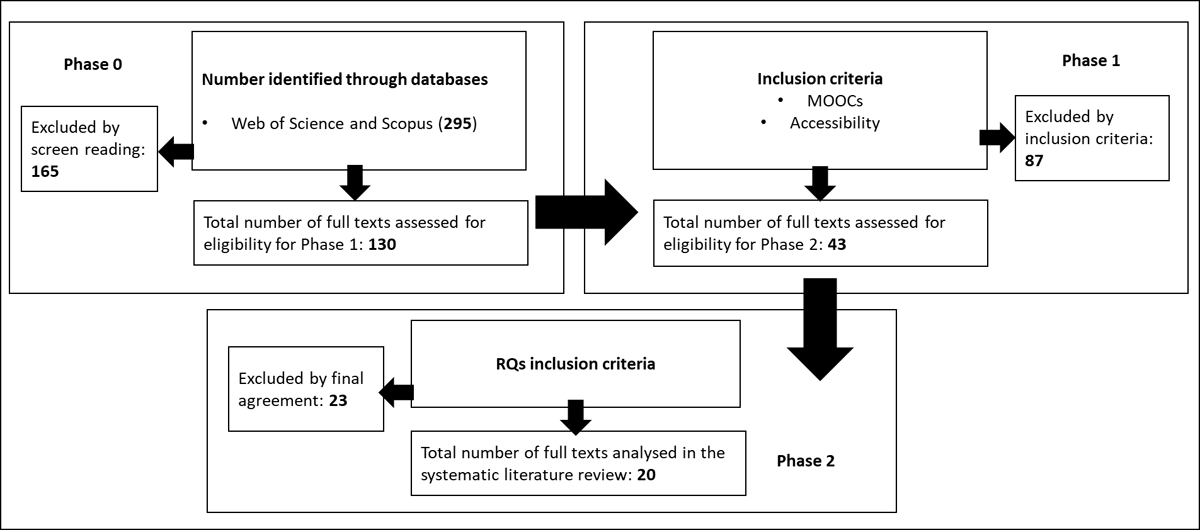
Figure 1
The selection process followed in this research.
Table 1 details the sources used in the systematic literature review ordered by type of research in chronological and alphabetical order. The majority (15) are journal publications. The first publication is from 2014. They are quite evenly distributed in 2016, 2020, and 2021 with three publications each year, and four in 2021 and 2023. This indicates that there is not a significant increase in publications in the following years, which is not aligned with general MOOC research (Meet & Kala 2021).
Table 1
Sources used in the systematic literature review ordered by year of publication.
| AUTHOR(S) | YEAR | TYPE OF SOURCE | FOCUS | METHODOLOGY | METHOD AND SAMPLE | CONTEXT | |
|---|---|---|---|---|---|---|---|
| 1 | Rodrigo | 2015 | Book Chapter | Accessibility in language MOOCs and strategies | Position paper | Not applicable | Not applicable |
| 2 | Iniesto & Rodrigo | 2016 | Journal | Specifications to support accessible MOOCs integrating user preferences | Position paper | Not applicable | Not applicable |
| 3 | Martin, Salvatierra & González | 2016 | Journal | Evaluation of main MOOC platforms’ accessibility. | Heuristic evaluation | Coursera, edX, Udacity, MiriadaX, UNED Abierta, Udemy, Futurelearn and NovoEd using automatic tools and experts with WCAG 2.0 | Spain |
| 4 | Sanchez-Gordon & Luján-Mora | 2016 | Journal | Software design to incorporate features in MOOC authoring tools | Heuristic evaluation | Expert evaluation of Studio, the edX course authoring software with ATAG 2.0 | International |
| 5 | Rai | 2018 | Journal | Low bandwidth challenges and offline digital support model | Position paper | Not applicable | Not applicable |
| 6 | Park, So & Cha | 2019 | Journal | Identification of visual impairment barriers using mobile devices in MOOCs | Heuristic evaluation | Evaluation with 3 visually impaired learners and 3 experts using WCAG 2.0 | Korea |
| 7 | Kosova & Izetova | 2020 | Journal | Evaluation of Mathematics MOOCs in Russian by experts | Heuristic evaluation | Expert evaluation of 56 MOOCs in Open Education, Lektorium, Coursera15 and Stepik using WCAG 2.1 | Russia |
| 8 | Robles et al. | 2020 | Book Chapter | Production of guidelines for designing hearing messages that help blind learners navigate MOOCs | Position paper | Not applicable | Not applicable |
| 9 | Sanchez-Gordon, & Luján-Mora | 2020 | Book Chapter | Summarisation of accessibility requirements in the design, implementation, and evaluation of MOOCs | Position paper | Not applicable | Not applicable |
| 10 | Cinquin, Guitton & Sauzéon | 2021 | Journal | Codesign of new functionalities to enhance the accessibility of a MOOC player | Qualitative | Meetings and interviews with 13 experts and 6 ADHD learners | France |
| 11 | Lei, Jones & Brosnan | 2021 | Journal | Identification of why and how language should be used when describing autism analysing comments | Qualitative | 803 learners’ comments in 2 MOOCs in FutureLearn during 6 presentations | UK |
| 12 | Molanes-López et al. | 2021 | Journal | Evaluation of the accessibility of videos in MOOCs | Mixed methods | 72 learners in a WCAG 2.1 based questionnaire | Spain |
| 13 | Pérez-Martín, Rodriguez-Ascaso & Molanes-López | 2021 | Journal | Assessment of the quality of the captions produced using YouTube in MOOCs | Quantitative | 53 learners in a questionnaire | Spain |
| 14 | Iniesto et al. (a) | 2022 | Journal | Perspectives of MOOC providers on MOOC disabled learners and accessibility management | Qualitative | Interviews with 26 MOOC providers | International |
| 15 | Iniesto et al. (b) | 2022 | Book Chapter | Design and implementation of a MOOC accessibility audit | Heuristic evaluation | 4 components audit to evaluate MOOCs from FutureLearn, edX, Coursera and Canvas with experts | International |
| 16 | Królak & Zając | 2022 | Journal | Analysis of 8 MOOCs’ accessibility by disabled users | Qualitative | 10 disabled participants in research groups analysed WCAG 2.1 in a lay questionnaire in Coursera | Poland |
| 17 | Cinquin, Guitton & Sauzéon | 2023 | Journal | Evaluation of the accessibility of a MOOC player | Mixed methods | 646 learners, 87 declaring a disability using learning analytics and a questionnaire | France |
| 18 | Iniesto et al. | 2023 | Book Chapter | Disclosure of motivations of disabled learners in MOOCs and proposed improvements | Mixed methods | Survey data from FutureLearn, (with 29,000 and 5,000 respondents) and interviews with 15 disabled learners | UK |
| 19 | Iniesto, Rodrigo & Hillaire | 2023 | Journal | Testing of an evaluation framework for assessing MOOC accessibility by learners | Mixed methods | 23 learners using an evaluation framework and qualitative responses on UNED Abierta (edX) | Spain |
| 20 | Patiño-Toro et al. | 2023 | Journal | Methodology for designing MOOCs for deaf or hard-of-hearing | Mixed methods | Literature review, validation with experts and interviews with 22 deaf learners | Chile |
The Australasian Journal of Educational Technology and Universal Access in the Information Society have two publications each, making them the most represented journals. Five of the articles are considered position papers, which is reasonable considering the novelty of the field. The most recent position paper is from 2020. The following studies (15 in total) used various research methods, including mixed methods (five studies), qualitative methods (four studies), and quantitative methods (one study). Additionally, five studies applied heuristic evaluations as part of HCI methods. Nine studies used learners as part of their sample and, of those, seven included learners with accessibility needs. Finally, five articles had a multi-national context. Four studies were undertaken in Spain, two in France and the UK, and one in Chile, Korea, Poland and Russia.
For the analysis method, we used thematic analysis following the methodology described by Braun and Clarke (2019), for the first research question an inductive approach was used; while for the second one, the structure proposed by Iniesto et al. (2023) was employed as a starting point following a deductive approach. The analysis provided a single-level set of general codes which were then organised as the main themes.
Findings and discussion
In this section, we present the results of our investigation along with the corresponding discussion. This is intended to improve clarity and avoid repetition. The findings are presented using a narrative approach (Pautasso 2019), which involves collecting, critiquing, and summarising topics within the scope of the systematic literature review. This approach aims to provide a thorough understanding of the accessibility landscape in MOOCs concerning the research questions.
What are the key findings about accessibility in MOOCs?
Key findings are thematically divided following the themes identified by the authors: “accessibility evaluations with experts and automatic tools”, “accessibility evaluations with learners”, “codesign for accessibility with stakeholders” and “personalisation of the learning experience”.
Accessibility evaluations with experts and automatic tools
Martin, Salvatierra and González (2016) evaluated the most important MOOC platforms using automatic tools and expert assessments based on WCAG standards. They ranked the platforms in the following order: edX, Futurelearn, UNED Abierta, NovoEd, Coursera, MiriadaX, Udemy, and Udacity. Common errors among the platforms included the low contrast ratio of text on several pages, the lack of options to skip content blocks, and the absence of labels in form controls to identify their purpose. The authors emphasised the need to incorporate accessibility considerations from the initial stages of MOOC development, allowing educators and institutions to make informed choices.
Kosova and Izetova (2020) evaluated the low accessibility of Russian mathematics MOOCs, especially for learners with severe visual impairments, with a sample of 56 courses. This indicated that most accessibility errors are linked to the improper inclusion of mathematical content. Focusing on visual impairments, Park, So and Cha (2019) identified accessibility issues in translation and language selection that limit equitable use. Barriers to full participation included screen readers’ inability to read the information in dropdown menus and the absence of alternative texts for non-text content and time-based media. Despite challenges, participants in the study expressed a positive perception of MOOCs as useful platforms offering diverse learning opportunities, especially on mobile phones.
Authoring tools used for creating educational resources should also be tested for accessibility (Sanchez-Gordon & Luján-Mora 2016), empowering MOOC providers to create accessible resources without requiring specialised expertise. Iniesto et al. (2022b) undertook an accessibility audit on four MOOCs from FutureLearn, Coursera, edX, and Canvas using a custom instrument created for the purpose. It consisted of four main evaluation areas, each with its checklist for heuristic evaluations: (1) technical evaluation using WCAG, (2) user experience including aspects of the user interface and pedagogical design, (3) quality evaluation including the quality of design and platform features, and (4) learning design evaluation employing UDL. Furthermore, exploring different accessibility barriers in MOOCs can uncover a range of issues, despite encountering complexity, repetition, and inconsistencies during WCAG evaluation.
Accessibility evaluations with learners
Królak and Zając (2022) evaluated how learners used Coursera and reported significant inconsistencies including a lack of descriptions for alternative graphic elements, reliance on sensory perception for content understanding and keyboard operation problems. They noted that some errors from previous research had been reduced in scale. Including learners in the evaluations seemed a useful approach for better understanding accessibility. Finally, Cinquin, Guitton and Sauzéon (2023) focused on a large sample of learners with accessibility needs. Their study demonstrated the effectiveness of their MOOC player in enhancing MOOC accessibility, with positive early interactions with accessibility features predicting persistence. The rapid adoption of accessibility features, regardless of initial motivation, was identified as crucial for those declaring accessibility needs.
Another approach is to use learners participating in MOOCs to evaluate their accessibility, in that sense Iniesto, Rodrigo and Hillaire (2023) indicated the potential of using UDL for MOOC accessibility evaluation, providing valuable feedback for inclusive online learning environments. Their findings emphasised the importance of a user-centred approach and the need for additional individual support in a MOOC environment, where UDL can serve as a starting point for providing such support. Learners can be involved in the creation of accessible resources while participating in the MOOC. Molanes-López et al. (2021) indicated that accessibility barriers in videos can be effectively identified by novice evaluators when organised into groups using specific statements based on WCAG. In addition the quality and accessibility of subtitles generated by YouTube’s automatic speech recognition tool are improved by the participation of non-professional subtitlers with basic training in captioning and certain aspects of subtitle quality, including text segmentation, grammar and orthography, and accuracy, are crucially improved by student participation (Pérez-Martín, Rodriguez-Ascaso & Molanes-López 2021).
Codesign for accessibility with stakeholders
A further step in engaging learners involves studies which propose codesign or participatory design approaches. Cinquin, Guitton and Sauzéon (2021) emphasised the significance of a codesign approach for creating more accessible tools such as MOOC players. Barriers and solutions were aligned with the needs and preferences of learners with cognitive impairments that were proposed by involving them in every phase of the design process. Patiño-Toro et al. (2023) worked with deaf learners indicating the need to use collaborative design approaches and the utilisation of existing resources, such as devices, apps, and social networks, for continuous interaction and idea-sharing among participants throughout the MOOC. The integration of real-life scenarios into MOOC content was suggested to help learners critically analyse situations, propose solutions, and apply concepts and theories for self-regulated learning.
It is important to consider the perspectives of stakeholders and to ensure that learners with accessibility needs are given a voice. Iniesto et al. (2023) report that learners with accessibility needs find MOOCs beneficial for personal development, continuous professional development, and as a pathway to access higher education. While the low cost of MOOCs is a significant factor for learners with accessibility needs, flexibility, self-paced learning, and a more friendly environment compared to traditional classrooms also make MOOCs attractive for them. Other stakeholders include platforms and course providers, their views are aligned with learners, indicating that MOOCs offer opportunities for professional development and certification due to their open approach to learning (Iniesto et al. 2022a). The views of the stakeholders while dealing with accessibility in MOOCs indicate the challenges in designing educational resources that consider different target groups and provide personalised learning experiences arise due to limited information on the demographics of MOOC participants. There is a disparity in processes among MOOC providers, and the design of MOOC platforms is primarily driven by legislation. Compliance with standards and legislation is the focus, with efforts to make learning fully accessible often overshadowed.
Personalisation of the learning experience
Several authors revealed the need for personalisation of the learning experience. Sanchez-Gordon & Luján-Mora (2020) indicated that current accessibility options often require explicit learner invocation which can be problematic when using assistive technologies. The authors proposed an approach based on learner profiling and questionnaires to address their accessibility needs; adaptive content presentation involves personalising content delivery to enhance accessibility. Consideration of learners’ abilities and learning goals is crucial in MOOCs, emphasising the need to describe learner preferences and needs through a profile that interacts with the platform interface and learning resources using existing metadata standards (Iniesto & Rodrigo 2016; Rodrigo 2015).
Other aspects related to accessibility include the use of language preferences. Lei, Jones and Brosnan (2021) showed varied preferences among stakeholder groups (for identity-first and person-first language, as well as medical and neutral terminology) among autistic learners. The study emphasises the importance of using preferred language that aligns with the individuals’ identity, advocating for a person-centred approach that prioritises autistic individuals’ choice of terminology. Rai (2018) noted that as MOOCs rely heavily on multimedia content, such as videos, audio, and images, learners face challenges due to limitations like low bandwidth, restricted computer access, and limited online time. The complete reliance on online learning is considered a weakness of existing MOOCs, especially in regions with power breakdowns and Internet limitations in the Global South, suggesting that making MOOCs more interactive can save data storage and highlight the benefit of offline collaboration. Therefore, for the global regions without strong and reliable internet, MOOCs that veer away from being completely online and have a greater offline portion might be more appropriate for learners. Finally, Robles et al. (2020) proposed audible markers as a powerful tool to enhance the accessibility of MOOC interfaces for functionally blind learners. Learners navigate the interface by moving a pointing device (e.g., mouse), and markers provide audible information about the elements in their path. They can control the amount of audible information received by holding or moving the pointing device.
What are the recommendations for accessibility design in MOOCs?
The recommendations arising from the systematic literature review presented here are thematically structured following Iniesto et al. (2023), including design aspects divided by “platform”, “MOOC”, “educational resources”, and “personalisation”.
Platform
The design considerations in the initial phases should prioritise responsiveness and compatibility across multiple devices, including desktops, laptops, and smartphones (Iniesto et al. 2022b). Maintaining consistency in design and structure is crucial, ensuring visual elements such as contrast, focus, and links remain visible. It is advisable to refrain from using colour as the only means of conveying information. Page design should eliminate the need for excessive scrolling, and potential distractions like notifications and extraneous information should be minimised (Martin, Salvatierra & González 2016, Park, So & Cha 2019).
The incorporation of built-in applications, such as word processors, calculators, and multilingual dictionaries accessible through the context menu, can enhance the learning experience (Patiño-Toro et al. 2023). Additionally, promoting platform availability in multiple languages and offering configuration options in learners’ profiles contributes to a more inclusive and user-friendly environment (Lei, Jones & Brosnan 2021). Constantly visible question mark icons should be offered, providing context-specific guidance to learners about the ongoing context. Similarly, including a persistent help button that does not redirect learners to a “generic help resource”, but allows them to directly contact the course team or technical specialists for assistance with accessibility issues (Iniesto et al. 2023; Robles et al. 2020).
MOOC
Well-organised information regarding the overarching objective, learning objectives, learning activities, and educational resources should be provided. A syllabus should be presented that systematically reveals information unit by unit, offering learners a transparent overview of included learning activities and a glossary with common terms and abbreviations (Iniesto et al. 2022b). It is advisable to furnish details about the accessibility features included, such as subtitles, transcripts, available languages, and the various formats of educational resources provided (Patiño-Toro et al. 2023).
The design should enable learners to access course content through various means (e.g., menu and sitemap), avoiding an essentially linear structure. When designing MOOCs, course developers should assess platform design, recognising that it may limit some proposed pedagogical approaches but could also offer opportunities to introduce features (e.g., encouraging the use of included tools for self-reflection, such as note-taking and saving favourite discussions) (Iniesto et al. 2022a).
A consistent structure should be maintained within the MOOC to ensure similarity across units. Examples to help learners establish goals and provide clear objectives can be included at the start of each unit. A summary of the previous unit’s content and objectives should be presented, together with an outline of what will be covered in the current unit, and a summary of the knowledge acquired after each one (Park, So & Cha 2019).
Educational resources
Brief videos should be created to maintain learners’ engagement. They can highlight essential elements using examples. Learners need to be able to adjust volume, refresh rate, and contrast in videos (Cinquin, Guitton & Sauzéon 2021, 2023). Accessibility can be guaranteed by ensuring that the content is clearly explained, particularly when using mathematical formulas, and by providing equivalent handouts or extended audio descriptions (Kosova & Izetova 2020). Accurate subtitles and readable transcripts with appropriate contrast should be provided, in multiple languages where possible (Molanes-López et al. 2021; Pérez-Martín, Rodriguez-Ascaso & Molanes-López 2021). Transcripts can be highlighted when played alongside a video, making them constantly visible on the screen. For visual content not covered by transcripts, handouts can be provided as text-based files (e.g., PowerPoint presentations as video handouts). Video, audio, transcripts, and subtitles in various formats (e.g., PDF or Word) should be easily available for download (Rai 2018).
Equivalent educational resources in various accessible formats should be offered, including video, audio, and text integrated into the page. Additionally, visual information like images or graphs can be included to complement the text. Design decisions need to be taken regarding the best format to use (PDF, PowerPoint, or Word) (Iniesto et al. 2023).
Personalisation of the learning experience
Learners should be able to set default configuration values within their profile, including the platform language, subtitles, and transcripts during video playback, notifications, font size, contrast, and content layout (Iniesto & Rodrigo 2016). These preferences should persist across different sessions, allowing learners to resume from the last visited page and play videos from where they were stopped (Sanchez-Gordon & Luján-Mora 2016, 2020).
The profile should also include a section for learners to record their goals and facilitate self-reflection (Rodrigo 2015). Personalisation of the learning experience should be possible, providing somewhere to store text-based files, a calendar for organising tasks, and a section for saving favourite discussions. Additionally, learners should be able to monitor their progress directly from the profile (Iniesto, Rodrigo & Hillaire 2023).
Limitations, future research, and conclusions
This systematic literature review has explored the present state of accessibility in MOOC development and provided recommendations for ensuring the accessible design of MOOCs and their platforms. The contributions of this research include an emphasis on the importance of inclusive platform design for online learning, focusing on responsiveness, compatibility, consistency across devices, and personalisation features within learner profiles, while key course design considerations include integrating built-in applications, providing visible guidance icons, and ensuring transparent syllabi, and flexible content access. Findings from this research, in terms of suggestions for accessible design identified in MOOC platforms, courses, educational resources, and personalisation, can be applied to other open and learning at scale settings because they often reveal universal principles and best practices that are applicable beyond the specific context of MOOCs.
The limitations of this research include the decision not to incorporate conference papers, since they may not have been formally published in journals or books because they contain work-in-progress research. Some of the discarded articles focussed only on resources, neglecting the diverse needs of learners. Several papers were identified but discarded because they used MOOCs that have a focus on accessibility for teaching purposes which, while adding value to the social need to learn about and understand accessibility, did not add to the current state of the art.
Considering previous research to embrace accessibility in MOOCs (Ingavélez-Guerra et al. 2022; Sanchez-Gordon & Luján-Mora 2018; Zhang et al. 2020), the contributions from this systematic literature review identify different areas for future research. Such research should involve empirical studies with learners, that could include case studies with varied accessibility needs, to understand several realities in-depth, moving forward from visual and hearing impairments (Cinquin, Guitton & Sauzéon 2023, Królak & Zając 2022, Patiño-Toro et al. 2023). In that sense, applying methodologies that suit diverse learners’ needs facilitates the research process (Iniesto et al. 2023). Regarding aspects related to the evaluation of technology, it is important to consider new regulations for the accessibility of websites and mobile applications of public sector organisations, as well as the accessibility limitations of authoring tools and their relationship to pedagogy in MOOCs (Sanchez-Gordon, & Luján-Mora 2016).
Stakeholders, including MOOC providers and accessibility experts, should be involved in determining the usefulness of evaluations in their organisations. Learners with accessibility needs should also participate in end-user evaluations (Iniesto et al. 2022a). Future research should include the development of guidelines to audit evaluations made during the MOOC design and development processes (for platforms and educational resources) and not when MOOCs are already in production (Iniesto et al. 2022b). To that end, codesign and participatory research empowering learners in the design processes should be considered (Cinquin, Guitton & Sauzéon 2021; Park, So & Cha 2019).
MOOCs and online learning need to evolve to meet society’s needs including advances in technology. It is essential to continue developing accessibility profiling standards and their practical applications in open education (Sanchez-Gordon & Luján-Mora 2020). The future of online learning implies providing more accessible platforms and courses, including a range of educational resources. This will enable learners to set their goals, access better guidelines for collaboration in discussions and assignments, receive feedback in quizzes, and benefit from improved processes to facilitate help (Iniesto, Rodrigo & Hillaire 2023). To achieve these goals, personalisation options are required, allowing for recommendations to be tailored to learners based on their accessibility needs.
Acknowledgements
Francisco thanks the FutureLearn Academic Network (FLAN) and the Global OER Graduate Network (GO-GN). We also express our appreciation to Tim Read for proofreading the article.
Funding Information
This research was supported by the Erasmus + project INCLUSIVE MEMORY (Inclusive museums for well-being and health through the creation of a new shared memory - 2021-1-IT02- KA220-HED-000031991).
Competing Interests
The authors have no competing interests to declare.