
The Earliest Days
(1996) Diana Laurillard, Emeritus Professor of Learning with Digital Technology, UCL Knowledge Lab
Three decades ago is a long time. With an ageing memory and my laptop and iPhone taking over, I am reliant on the bits and pieces of 90s technology still clogging up the attic. But technology doesn’t age very well either. None of it is giving up its hidden secrets, long since disconnected from anything that could find them.
My memory knows some things, fortunately. I wanted to be able to publish papers about interactive technology in ways that would allow me to demonstrate the wonder I was describing. The papers I was writing pre-1995 had titles like ‘Learning through collaborative computer simulations’ (Laurillard, 1992); ‘Computer simulation as a tool for developing intuitive and conceptual understanding in mechanics’ (Lindström et al., 1993); ‘Designing the stepping stones: An evaluation of interactive media in the classroom’ (Laurillard & Taylor, 1994); and ‘Multimedia and the changing experience of the learner’ (Laurillard, 1995).
The interactive digital experiences we were creating for learners were so exciting, so different from the teacher-controlled sequence of explanations with multiple choice tests that abounded then, and still do. The point of using digital media was that the students could interact with a model of something, explore it, find out what it could do, use it to test their own thinking – the design was to be learner-led.
So the big idea for a new journal was to be wholly online, so that you could link in an interactive simulation or demonstration of your wonderful new interactive medium, to enable people to experience your ground-breaking creation.
I then had three pieces of luck and one piece of bad luck. I was very lucky to be appointed as Pro Vice Chancellor for Learning technology and Teaching at The Open University. I was rather unlucky to discover that this was completely incompatible with becoming the founding editor of the Journal for Interactive Media in Education. Then very lucky that the Knowledge Media Institute was being established at the Open University at that time, and then even more lucky to find that Simon Buckingham Shum and Tamara Sumner, who had just joined it, were keen to take on this challenging and onerous task.
My own history of publication then went all over the place, as I entered a 10-year period of doing strategy and policy, for seven years as PVC at the OU and a further three as Head of the E-Learning Strategy at the Department of Education and Skills. I managed to complete some previous work with Matthew Stratfold, Rose Luckin, Lydia Plowman, and Josie Taylor, to publish ‘Affordances for Learning in a Non-Linear Narrative Medium’ in the Journal of Interactive Media in Education (Laurillard et al., 2000).
After 3 years in government I basically concluded that this is no way to run a country, and could hardly wait to get back to the rationality of academe. I was lucky again, to find a chair at the London Knowledge Lab, Institute of Education in 2005, and after another 20 years of project funding to explore several different roles for technology in education, finally came back to JIME last year, with my colleagues Tejendra Pherali, My Lai Chan, Wirachan Charoensukaran, Elaine Chase, Eileen Kennedy, Greg Tyrosvoutis, and Gabi Witthaus to publish ‘Pedagogical Approaches to Teacher Professional Development in Contexts of Mass Displacement: An Agenda for Research and Practice’ in JIME (Pherali et al., 2025).
That’s a lot of luck. I regret that I could not follow through at the start with Simon and Tammy, but I could not have matched what they achieved with the innovative developments of this genuinely online and interactive journal. And I am so grateful for and impressed with the later editors who built on those strong foundations.
It’s a joy to come together again after all these years, to celebrate the critical contributions the Journal of Interactive Media in Education has made to our field.
My sincere thanks to everyone on that long journey.
Launching JIME as “an interactive journal for interactive media”
(1996–2004) Simon Buckingham Shum, Professor of Learning Informatics, Director Connected Intelligence Centre, University of Technology Sydney
(1996–1998) Tamara R. Sumner, Professor of Computer Science and Fellow of the Institute of Cognitive Science, Interim Dean of the Libraries, University of Colorado Boulder
(Simon) I arrived as a research fellow at The Open University in September 1995, having been recruited with about 40 others in the New Technologies Recruitment Initiative led by PVC Diana Laurillard. Coming from a PhD at the University of York and Rank Xerox EuroPARC, I was bringing a human-computer interaction (HCI) perspective to join the freshly launched Knowledge Media Institute (KMi), led by Marc Eisenstadt, Tom Vincent and Paul Bacsich. I had been immersed for years in the hypertext community, an exotic name for linking nodes of text and multimedia in flexible, non-linear ways. This was suddenly going global through a new open source internet phenomenon, the World Wide Web. The sense of disruption and possibility has only been equalled since by what we’re now sensing with generative AI. Hypertext was converging with what became a career-long interest in the affordances of computer-supported dialogue and argumentation, inspired by Doug Engelbart’s pioneering work on personal computing and collective IQ.
(Tammy) I arrived shortly thereafter in early 1996 as part of the same New Technologies cohort. I had just completed my PhD in computer science, studying how to support lifelong learning and design with AI-enabled design environments. Like Simon, I was steeped in an HCI perspective and shared his interest in dialogue and argumentation, arising from her work in design environments. This shared interest would prove to be central to our approach to JIME.
In early 1996, Diana invited us to discuss her vision for a peer reviewed journal that would give reviewers and readers a first-hand, interactive taste of the author’s educational multimedia tools, rather than just reading about them. This certainly seemed exciting, and while the default option to deliver the interactive demos might have been shipping CD-ROMS or a simple download web page, two key Web affordances were just emerging. Firstly, it was now possible to embed interactive multimedia directly within the web browser (e.g., Apple QuickTime video, MacroMind Shockwave, Java applets). Secondly, there was an interesting experiment in the high energy physics community by Paul Ginsparg, who’d created something called arXiv for the rapid dissemination of new research findings as “preprints” — something we’re now all used to. This was also morphing into early “electronic journals”, powered by visions of open access publishing and evolving concepts of peer review, such as Stevan Harnad’s “scholarly skywriting” (Harnad, 1996).
What would happen if we fused all these new affordances, and stretched things further? Interactive multimedia embedded in the article, all within the web browser, plus open access publishing, plus (inspired by computer-supported discourse) review discussions, continuing with open commentaries after publication? Interactive not only with regard to the multimedia, but the scholarly discourse. Nobody knew how well this would work. We had never run an ejournal, never mind built a new web platform to deliver it. But we were in KMi, so this would be action research into “the knowledge web” (Eisenstadt & Vincent, 1999). This would certainly break new ground, but would it break us technically, or academically?
The technical mastery of another new KMi hire was critical here. Mike Wright knew the internet and now Web infrastructure inside-out, and could build custom user interfaces. We now had an open source platform powered by the dominant “LAMP” stack (Linux, Apache, MySQL, Perl) of home-grown code plus a customised version of the leading edge HyperNews discussion platform by Daniel LaLiberte at NCSA, originators of Mosaic, the original web browser. So, after doing our homework on the feasibility of such a platform, we concluded that KMi could host this. Diana offered us the extraordinary opportunity to launch it as inaugural editors.
While every JIME paper was a professionally formatted PDF, it was also available as an interactive HTML document. Figure 1 shows examples of interactive multimedia embedded in articles, and Figure 2 shows an annotated screenshot of discussion about the current section. This highly interactive interface had hundreds of links within the document (to navigate between sections, and to citations), also linking it to discussion threads associated with each section. The Digital Document Discourse Environment (D3E) was our publishing engine that made this feasible, coded by the OU’s computing services colleague, Malcolm Story, using the exciting new Java language, which converted an HTML file into this interactive document/discourse interface. As documented on the D3E website, numerous versions emerged, used in diverse projects, including a version that worked with the University of Southampton’s ePrints software that emerged from Harnad’s championing of preprints. While by today’s web interface standards D3E is of course very ‘clunky’, at the time, this was state-of-the-art, pioneering document interactivity that we now take for granted. Thanks to the Wayback Machine, you can browse the JIME website as it was back in 2006 (although minus the reviews/commentaries).
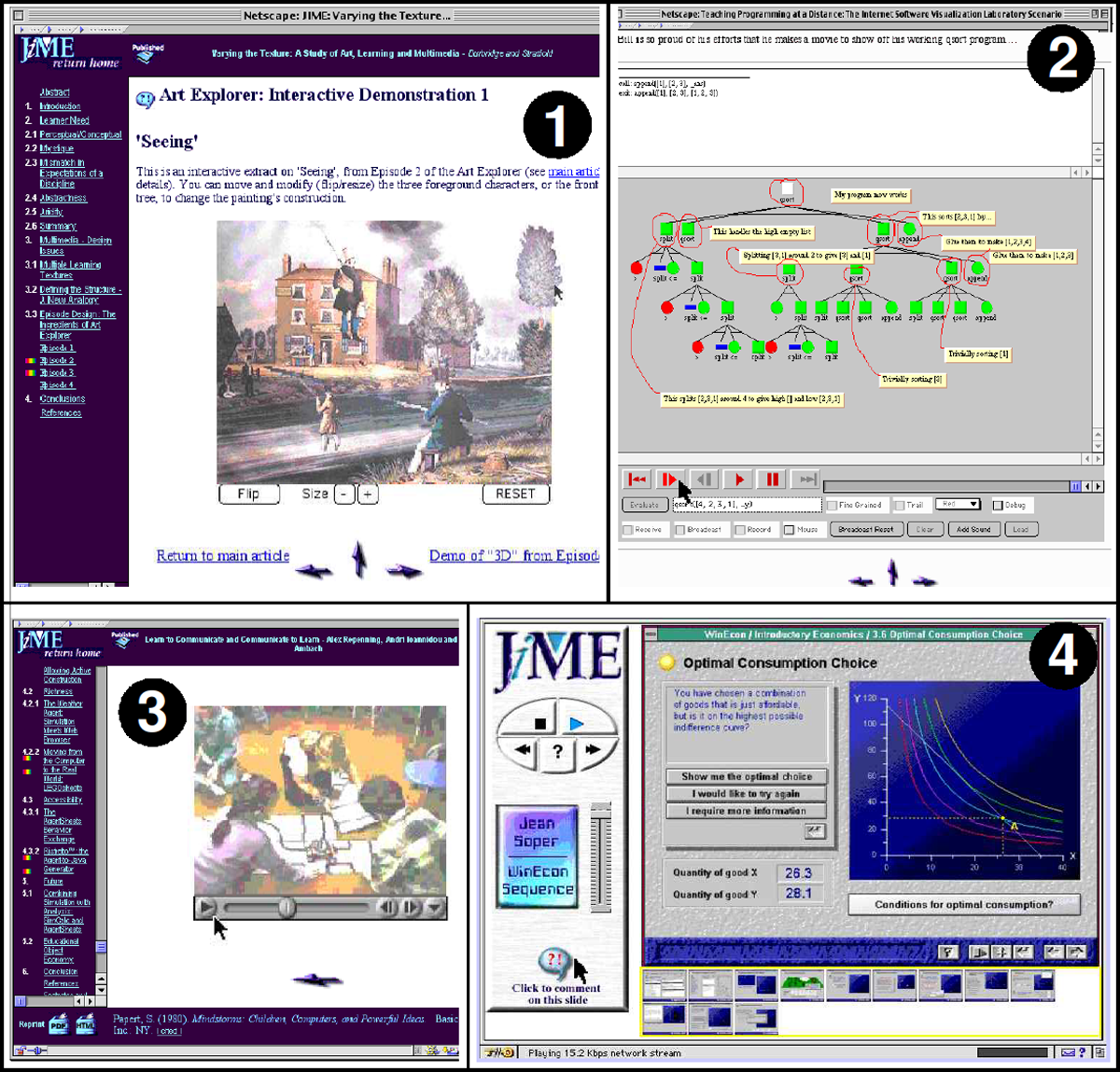
Figure 1
Interactive multimedia embedded in JIME articles rendered in a web browser. (1) Interactive extract from an art history CD-ROM that enables readers to play with the construction of a painting (Durbridge & Stratfold, 1996); (2) interactive Java applet for visualizing code execution over the internet (Domingue & Mulholland, 1997); (3) extract of video showing children programming a robot (Repenning, et al. 1998); (4) introductory walkthrough of an economics package with commentary from the author (Soper, 1997).
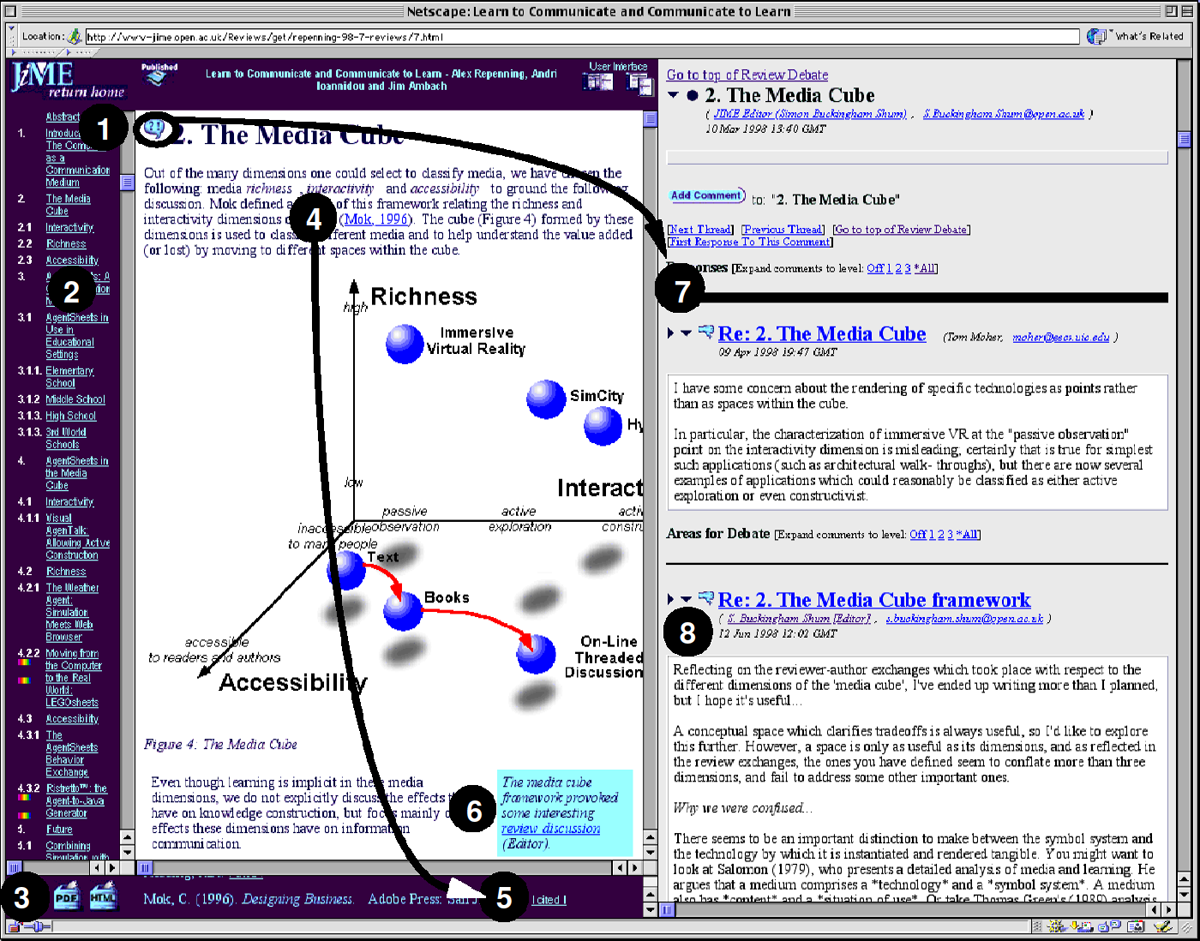
Figure 2
JIME’s document interface. On the left is the Article Window, on the right the Commentaries Window showing the top-level outline view of discussion about the document. Key: (1) Comment icon embedded in each section heading linking to section-specific comments; (2) active contents list extracted from the section headings; (3) print versions as HTML and PDF; (4) numeric or author/date citation automatically linked to corresponding reference in footnote window; (5) a reverse hyperlink is inserted for each citation of a reference; (6) an editorial note to draw attention to a controversial issue in the author–reviewer debate that ‘made it’ into the published version; (7) section-specific review comment; (8) an editorial comment summarizing the review discussion and specifying change requirements. (Note that there are two versions of the user interface: one as shown, and for smaller displays, the document and discussion are placed in separate browser windows.)
Conceptually, we envisaged a shift in scholarly communication from a sole focus on documents, to valuing the discourse (Sumner & Buckingham Shum, 1998), attending to how a new medium mediates discourse (Sumner, et al. 2000). A few years later, we reflected on how the JIME experiment was going, explaining how the review process had evolved (Figure 3), and illustrating how this new digital medium changed authorship and review discourse (Buckingham Shum & Sumner, 2001).
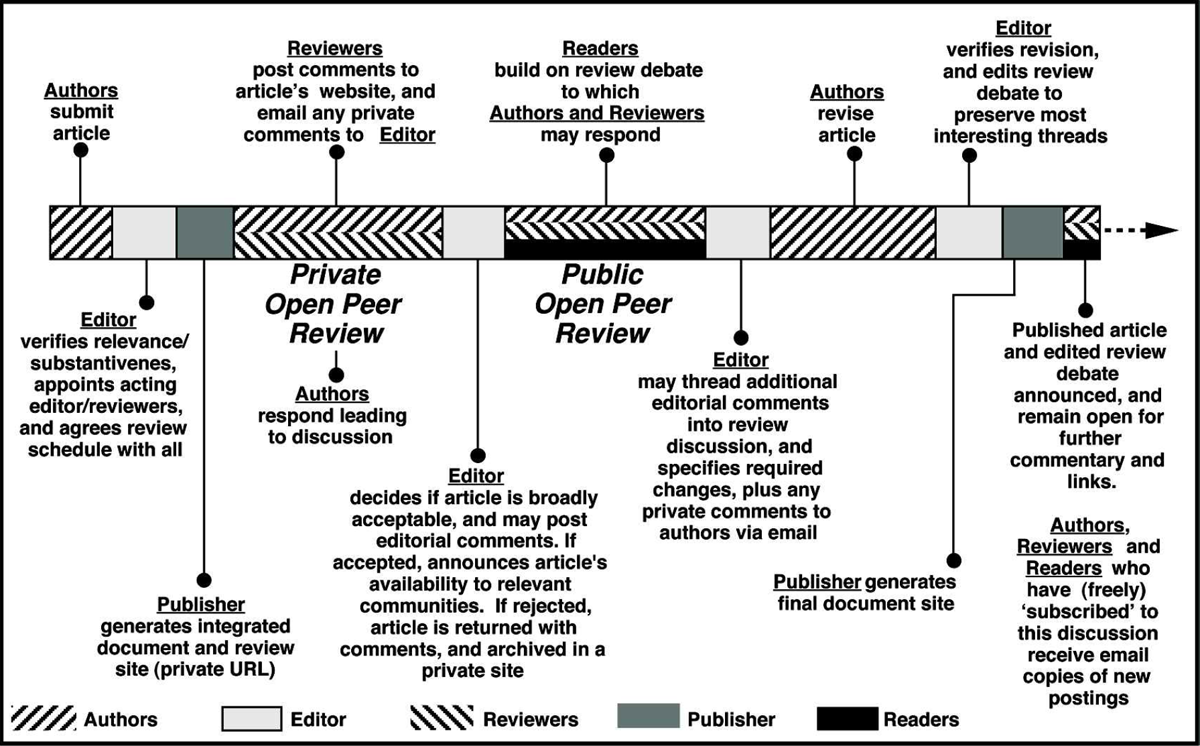
Figure 3
The JIME discourse-centric review process. This cycle includes private and public open peer-review phases, with active stakeholders involved at different points.
As illustrated by the review process diagram, the model we were implementing required new and different forms of engagement from all the participants: editors, authors, and reviewers. This required us, as the editors, to engage in change management and behavioral nudges to help shift behaviors to take advantage of the affordances of the new system. In our early career enthusiasm we had underestimated this social aspect of our new work. When the new discourse model ‘sparked’, it was exhilarating to watch the exchange between authors and reviewers. When it didn’t, it was still deeply informative to our learning and reflective processes, and sometimes even entertaining: one reviewer asked “Do I cyber smell?” after posting several comments and getting no response!
Looking back 30 years to these heady days of the early Web, we are proud of what we accomplished, modelling interactivity in scholarly documents and discourse that nobody had ever seen, placing the OU right on the leading edge of the nascent field of e-journals and web discourse research, and taking the time (and discipline) to problematise and study what we were doing, generating a series of peer-reviewed publications on the underlying technology, the publishing process and review model, and other attendant issues such as “digital fixity” (Yates & Sumner, 1997).
As senior academics now, we appreciate the risks Diana took in embracing this Web-native translation of her original JIME concept, moreover, handing it over to two early career researchers. Our open review process required a particular disposition of professional discourse and care which made it a rewarding process all round, but undeniably, more labour-intensive. Along with an advanced web infrastructure to maintain, in the end, this chapter of JIME came to a natural close as we handed editorship and infrastructure over to our successors. But as we now confront a crisis in academic publishing and peer review, now is the time to re-imagine, once again, how to make the scholarly discourse of peer review more effective, and more rewarding…
Ensuring sustainability in a new home for JIME
(2004–2013) Patrick McAndrew, Emeritus Professor of Open Education, Institute of Educational Technology, The Open University
JIME started out based on innovation with its home in the Knowledge Media Institute (KMi) of The Open University. I worked in another part of the University, The Institute of Educational Technology (IET).
I had always respected and admired JIME, however I must admit to some surprise when I became co-editor (with Josie Taylor) and then lead editor. I was with Josie for a meeting with Simon when he thanked her for being willing to take on JIME and re-host it in IET. He warned though that it was not a task for one person, and I found myself agreeing and then came away from the meeting as a JIME editor. It was not an unwilling appointment, but maybe an accidental one, that then lasted from 2004 to 2013.
We had both published and reviewed for JIME and appreciated its open and online approach at a time when most journals remained print focussed. Our aim was to preserve this approach as much as possible, while increasing the number and range of articles and providing greater security for the future of the journal.
We adopted the D3E software that allowed comments linked to text to support both reviewing and engagement. I was also pleased as a past programmer to develop some back-end scripts to support processing the texts and handling progress tracking and communication with reviewers. I also learned that automatically produced polite emails were not welcomed by the spam checkers of the time; I needed to alter “Dear Dr Smith” greetings to “Hi John” to lower rejection rates. I apologise now to anyone who found this too informal!
Being an editor is a great learning experience in many ways. I found out about the joys of Harvard referencing systems, HTML, CSS and PDF programming, time management, and the busy lives combined with goodwill of academics. I also learned the importance of not taking on everything alone. IET provided a great base for JIME. This included a willingness to help with the range of management tasks, such as progress tracking and document processing. A local associate editorial team operated alongside the international editorial board to address a range of academic tasks in co-editing and specific responsibilities such as book reviews and special issues. On reflection that team approach also helped nurture future editors.
A particular challenge at JIME was the software base and the philosophy it embodied. The D3E software was the work of an individual developer who had left the University. It proved to be resilient, nonetheless it needed to be updated and maintained. The approach of online-first, open access and interaction with named reviewers was a strength and remained ahead of its time. However, as other journals moved online and scrutiny of journals increased, it was difficult to maintain this approach.
Most online journals tended to draw on the print model, essentially offering online access to print-like articles, often behind a pay-wall. The interactive HTML content of JIME was also becoming less accessed than the more print-like PDF which was seen as the canonical version. Reviewers and authors, who had been attracted by the novelty of engaging online, lacked time and inclination to work their reviews and responses into an unfamiliar system. Instead, more conventional reviews need to be accepted to maintain flow and responsiveness. The rules of academic life also changed (in the UK through the Research Excellence Framework, REF). There was a risk that articles would be devalued unless “double-blind” reviewed. These pressures led to a recognition of the need to change the reviewing aspect of JIME. Identifying reviewers had allowed proper acknowledgement of this otherwise invisible task so the change to anonymised reviews was a reluctant decision.
The more mainstream approach for JIME also meant a move could be made away from bespoke software and the adoption of the open source Open Journal System, OJS. Initially supported with a bespoke implementation within IET, the use of OJS also paved the way for alternative models to sustain the journal. Throughout these changes access to JIME remained open and free.
I hope the details given here help reveal the often hidden challenges of journal editing. The core of any journal though is its articles. During this period a range of open and special issues were published. JIME continued to avoid the restrictions of a completely regular publishing while moving to more frequent issues. The area of educational interactive media was in an exciting period. Emerging topics of learning design, mobile learning, Open Educational Resources and MOOCs all were represented by key articles in the journal. Special issues also helped disseminate project results. This also meant some leniency in imposing the journal style on “European-Project English”, though submitting an article originally in Spanish translated through Google Translate certainly was not acceptable!
Key papers from this time cover Educational Modelling Language and Learning Design (Tattersall and Koper, 2005), Mobile Learning (Jones, Kukulska-Hulme and Mwanza-Simwami, 2006) and how to Research Open Education (McAndrew, Godwin, dos Santos and Okada, 2008).
My main lesson from my time as editor is to pay attention to the whole community of those involved in the journal. Those producing it, those writing for it, those reviewing for it, and the impact it can have within the academic community. I am also grateful to the editors who came before me, for their role in initiating JIME, and those who came after, for helping JIME survive and thrive. I am very pleased with its current health and impact.
A Changing Landscape
(2011–2022) Eileen Scanlon, Regius Professor of Open Education, Institute of Educational Technology, The Open University
My first connection with JIME was when I was chairing the development of an OU Masters module on Science Communication back in 1998. Communicating Science was a course that reviewed both ways of communicating science with the public but the mechanics of science communicating with other scientists. I interviewed Simon Buckingham Shum for an audio track shared with students, and two features of the Journal stood out: its commitment to Open Access, and its innovative model of open peer review.
Later on, when the Journal shifted its location to the Institute of Educational Technology, I joined the group of editors in my role as Associate Director of Research.
The landscape of how journals operate has changed over the years. When first developed JIME was groundbreaking in that it developed an open review process and open access (Buckingham Shum and Sumner, 2001; Sumner, Buckingham Shum and Yates, 2003). At the first stage of review the reviewers posted their reviewer and authors were encouraged to publicly respond, and these discussions were published alongside the final article. (It was many years later that Nature Communications ran an experiment with open review). Nature (2025) provides a summary of their experiments over the years which culminated in their contribution to transparency in the announcement in 2025 that publishing the peer-reviewer reports of all newly submitted Nature papers was becoming mandatory. Although the detail and the process by which the reviews are undertaken has shifted, JIME has maintained a rigorous approach to peer review.
As someone who has published a few papers in JIME, I (almost) always found the feedback helpful and constructive. Although one reviewer questioned whether English was my first language, which, while surprising, it was probably helpful. One feature of JIME which I particularly valued was the possibility of proposing and editing a special collection, and the range of topics and groupings who have made use of this possibility, and benefited from suggestions from the Editorial Board in the framing of such topics. My particular interests include the role of theory in educational technology, history of educational technology and the interdisciplinary nature of work in technology enhanced learning. I find it interesting that one paper on theory in the journal (Issroff and Scanlon, 2002) still is well cited and downloaded, but I am sure that the impulse to write it was due to the existence of a call for a special issue. Similarly my impulse to contribute to a special issue on history and to interdisciplinarity came from the opportunity offered by targeted special collections.
There is a financial challenge for JIME to continue its outstanding record of supporting the publication of research at no or low costs. Another key challenge (shared by many journals and grant giving bodies) is the availability of people to conduct such reviews.
Being Well Placed to Publish Research
(2013–2022) Ann Jones, Reader, Institute of Educational Technology, The Open University
I can’t remember when I started co-editing JIME, but I was asked to be co-editor of JIME alongside Martin Weller, a key advocate of Open Research. I was chairing the longstanding Computers and Learning Research group (CALRG), based at the Open University and there was synergy between CALRG’s aims and those of JIME: both aiming to be inclusive, accessible and to support researchers. One strong interest of mine was postgraduate research which I was very involved in supporting. JIME has focused on postgraduate research at different times – see, for example, the special collection on Doctoral Research in the autumn of 2019 (Iniesto et al., 2019). A further special collection in 2021 shared this postgraduate focus by featuring the Global OER Graduate Network, a global network of doctoral students. This issue followed the COVID pandemic and was concerned with supporting postgraduate students and early career researchers, “particularly in the disadvantaged global south during a pandemic” (Weller, 2021). As a consequence, this issue accepted different forms of submission, and mentored authors to help improve their submissions: the editorial provides further information about support offered in the review process.
As others have noted the two most significant aspects of JIME when it launched were that it had an open review process and was open access and this has been key. Indeed, Open Research has become one of its many themes over the years. As co-editors, we were fortunate to work with Ubiquity Press (UP), founded by researchers who wanted to help to move publishing to open access, and to promote community infrastructure. At the time UP started open access was unusual.
Developing a financial model that enables such open access is tricky and we have received a small amount of annual funding from the Institute of Educational Technology, within the Open University, where the journal has been based for many years. Running the journal on a very small budget requires paying particular attention to our use of resources; we are supported by an excellent part-time editorial assistant, and the academics’ time is effectively donated by their home universities.
During my time as co-editor, we started to focus more on special collections; similar to special issues in other journals. From 2002 onwards special collections increased with 25 such special collections over the 30 years. Special collections allow JIME to focus on upcoming and contemporary research issues and debates; for example, the Open Education and Social Justice (Lambert & Czerniwicz, 2020) attracted much attention. Special collections allow a focus on events or issues or relevant other research communities, such as the CALRG and the OER community. Thus in 2010, Issue 2 was a special issue on the 30th Anniversary of the CALRG, edited by Kim Issroff (Issroff, 2010). Several special collections have drawn on OER events starting with the Open Educational Resources collection (Boyle, 2010).
JIME’s open policy has allowed us not only to make research widely accessible but also to re-use articles where appropriate. For example, in 2014 a special issue of JIME (Jones & Weller, 2014) featured selected chapters from a (then) forthcoming book: ‘Reusing Resources: Learning in Open Networks for Work, Life and Education’ edited by Alison Littlejohn and Chris Pegler. Five chapters are reproduced in JIME under an open license with permission from the publisher Routledge. This would have been hard in a more traditional journal.
Perhaps not surprisingly, as JIME is located in The Open University, whose vision is “to reach more students with life-changing learning” there has always been an emphasis on research into teaching and evaluations of innovative teaching. An early example is the very first article published in JIME on a pioneering approach to teaching Art History: Varying the Texture: A Study of Art Learning and Multimedia by Durbridge and Stratford (1996).
Special collections have also allowed celebrations, for example an issue in 2024, marks 10 years of The FutureLearn Academic Network (FLAN) research and scholarship network on MOOCs, open learning and learning at scale (Goshtasbpour et al., 2024).
Such revisiting is, I would argue, a positive aspect, especially in a field where past contributions are often insufficiently acknowledged or ignored. In this vein, JIME included a special collection on the History of Educational Technology, edited by Martin Weller who in his editorial refers to his book “25 Years of Ed Tech”, (Weller, 2020) where he argued that (historical) “accounts …were necessary to counter the historical amnesia that affects much of educational technology, where every announcement of a new technology proclaims it is the first and a major disruption in the sector.”
Often educational technology research agendas do not fade away for good but reappear in different guises and forms, reflecting the amnesia Martin referred to above. When I first started research in educational technology. AI was an important and influential theme, and in particular, Intelligent Teaching Systems. Jones, Rienties and Blake (2019) provide an account of the influences in the late 1970s and early 1980s on work in the CALRG, and see also Du Boulay (2023) for a historical perspective of AI in education. However, with most AI applications at the time being very small scale, and in very limited contexts, interest faded over time, but nevertheless it had an impact. We cannot know what the future educational research trends will be. Pedagogies likely to be influential and included in the 2024 Innovativing Pedagogy report include Pedagogies of Peace and climate action pedagogy, so we may see research agendas based on these issues. With its flexible open model JIME is likely to be well placed to publish such research.
Sustaining Open Innovation
(2013–2024) Martin Weller, Emeritus Professor of Educational Technology, Institute of Educational Technology, The Open University
I became co-editor of JIME with Ann Jones, in 2013. I had published in it previously, with my first paper published in the journal in 2000, when it operated an innovative open peer review model. At the time I was the director of the OER Research Hub and also interested in open scholarship. MOOCs had just become the big thing and every article seemed to be about them. As a result of this the focus of the journal shifted more to open education and away from educational technology in general during this time.
During my time at the helm the journal published 197 papers with 604 papers being submitted. As well as editing general issues, I was the editor of 8 Special Collections, and encouraged guest editors to curate another 9 Special Collections.
I had some big ambitions for JIME, for instance I wanted it to be the arXiv site for educational technology, providing a pre-print site that focused more on free distribution than traditional peer-review. I had underestimated the resource required for such an endeavour however, and quickly appreciated that maintaining the journal was in itself a major undertaking.
When I took it over it was being run out of IET, with some internal support for hosting and developing the OJS (Open Journal System) platform. However, there was a round of cost-cutting and people were looking to make savings. It became difficult to make the case for a part-time OJS developer. This meant we had sporadic support and we could never really stay on top of updates and changes sufficiently. I think the most significant thing I achieved while co-editor was to oversee the shift from hosting a version of OJS ourselves, to working with Ubiquity Press.
We had always operated a free to publish model, but by moving to Ubiquity we would have to pay a per article charge. In return they operated an up to date version of OJS, hosted the site and engaged with aspects like library databases, DOIs, etc. Different models of open source publishing were being promoted at the time, such as Green and Gold. We wanted to ensure it remained free for authors, so we managed to establish a small internal grant which would cover the charges for a set number of articles per year. This model pre-empted the Diamond Open Access model, which has now become a desired approach.
By effectively outsourcing the operating aspect to Ubiquity, it meant we spent less time as a board dealing with process and technical issues and could focus on the issues more.
One approach I advocated for, without any success, was for the University to host a number of journals. They could share the OJS support, effectively running four or five journals, maybe one from each faculty, with different themes off the same base. I still feel that this is a model that is viable, but it is difficult to make the financial case for it when cost-cutting measures are in place.
During my time as editor there was a general trend in the sector for efficient time allocation. In annual reviews myself and members of the board would specify a number of days to running the journal and this would come under increasing scrutiny as to whether it was a good investment or use of time. Closing the journal down was mooted a few times by senior management during institutional reviews. We managed to fend these off by making the case that we were relatively low cost, and that it was important for a research institute to be engaged in the open education world.
The journal was less innovative in many ways than when it started, in terms of the platform and reviewing model. Perhaps the most significant thing I, and the board, realised during this time, was to keep it going. Running an open access journal on the edges of people’s time with a small budget is not always the most rewarding thing to do. I always wanted to do more with it, to innovate more, to publish more, to use it as a vehicle for change more. But sometimes doing the work is the real victory, and we published a lot of interesting articles, supported a lot of early career researchers and global south researchers. I am proud of the special collections we published, such as the Open Ed and Social Justice one, or History of Ed Tech, and more generally that we published articles open access, free to authors for so long. Perhaps the lesson from my JIME tenure is that keeping going is itself an achievement.