
Table 1
Theoretical framework: Explanations and examples of how NGOs can apply design principles (adapted from Agrawal, 2001; Barnes & van Laerhoven, 2015; Brass et al., 2018; Cox et al., 2010; Hasan et al., 2020; Ostrom, 1990).
| NO. | DESIGN PRINCIPLES | EXPLANATION | RELATION TO NGO ACTIVITIES | EXAMPLES |
|---|---|---|---|---|
| 1A | Clearly defined harvesting rights | Clearly defined rights of individuals or households to withdraw resource units from the CPR | Any activity aimed at helping communities clearly define harvesting rights. | NGOs could provide low-cost exclusion technology based on context and availability |
| 1B | Clearly defined boundaries | The physical CPR boundaries must be well defined | Any activity aimed at helping communities clearly define resource boundaries. | NGOs could help with mapping or markers |
| 2A | Locally apt appropriation rules | Appropriation rules restricting time, place, technology, or quantity of resource units are related to local conditions | Any activity aimed at helping communities frame rules appropriate to local conditions. | This can be done by matching harvest restrictions to resource regeneration, easing rule enforcement or framing simple, understandable rules. NGOs may help by providing information and advice |
| 2B | Benefits proportional to inputs | The benefits obtained by users from a CPR are proportional to the amount of inputs (labour, material, or money) required | Any activity aimed at helping communities on ensuring fairness in benefit allocation | NGOs can help ensure fairness in benefit allocation through advice |
| 3 | Participation of most individuals | Most individuals affected by operational rules can participate in modifying the rules | Any activity aimed at facilitating decision-making, participation of all community members in resource management and helping the community align their interests | This can be done through locally devised rules and homogeneity of identities and interests. NGOs can advise and raise awareness. |
| 4 | Presence of monitors accountable to appropriators | Monitors are present and actively audit CPR conditions and appropriator behaviour. Additionally, these monitors should be users or be accountable to users | Any activity aimed at ensuring a) the presence of monitors or b) ensuring monitor accountability to other users | NGOs could offer advice on resource monitoring |
| 5 | Graduated sanctions | Users who violate operational rules are sanctioned depending on the seriousness and context of the offense by other users or monitors | Any activity aimed at advising communities on or implementing graduated sanctions for users who do not follow rules | NGOs could provide advice on graduated sanctions |
| 6 | Accessible conflict-resolution mechanisms | Users have rapid access to low-cost local arenas to resolve conflicts among appropriators or between appropriators and officials | Any activity aimed at offering low-cost conflict resolution support or matching local rules with existing external rules | NGOs could provide conflict resolution support like low cost adjudication or advice on matching local rules with external provisions or external sanctioning institutions. |
| 7 | External recognition of community rights | The rights of appropriators to devise their own institutions are not challenged by external governmental authorities | Activities that improve community sovereignty over the forest resource, ensuring external aid in exchange for mutually beneficial activities or external recognition of community rights to organise | NGOs may use advocacy and lobbying to ensure that external governments do not undermine local authority |
| 8 | Nested enterprises | All appropriation, provision, enforcement and governance activities are organized in multiple layers of nested enterprises | Activities that the involvement of the community at different levels and scales. | NGOs can help set up nested advices through advice |
| 9 | Others: Social capital | There are examples of past successful experiences of community forest management | Activities that NGOs use to build trust with communities or to showcase other locations where such interventions were successful. | NGOs may be able to help through showcasing previous activities |
| 10 | Others: Community capacity/leadership | Community capacity and appropriate leadership (young, familiar with changing external environment, connected to local traditional elite) is necessary to ensure durable CPR governance | Activities aimed at community capacity building including leadership training, skill building etc. | NGOs could provide leadership and capacity building trainings |
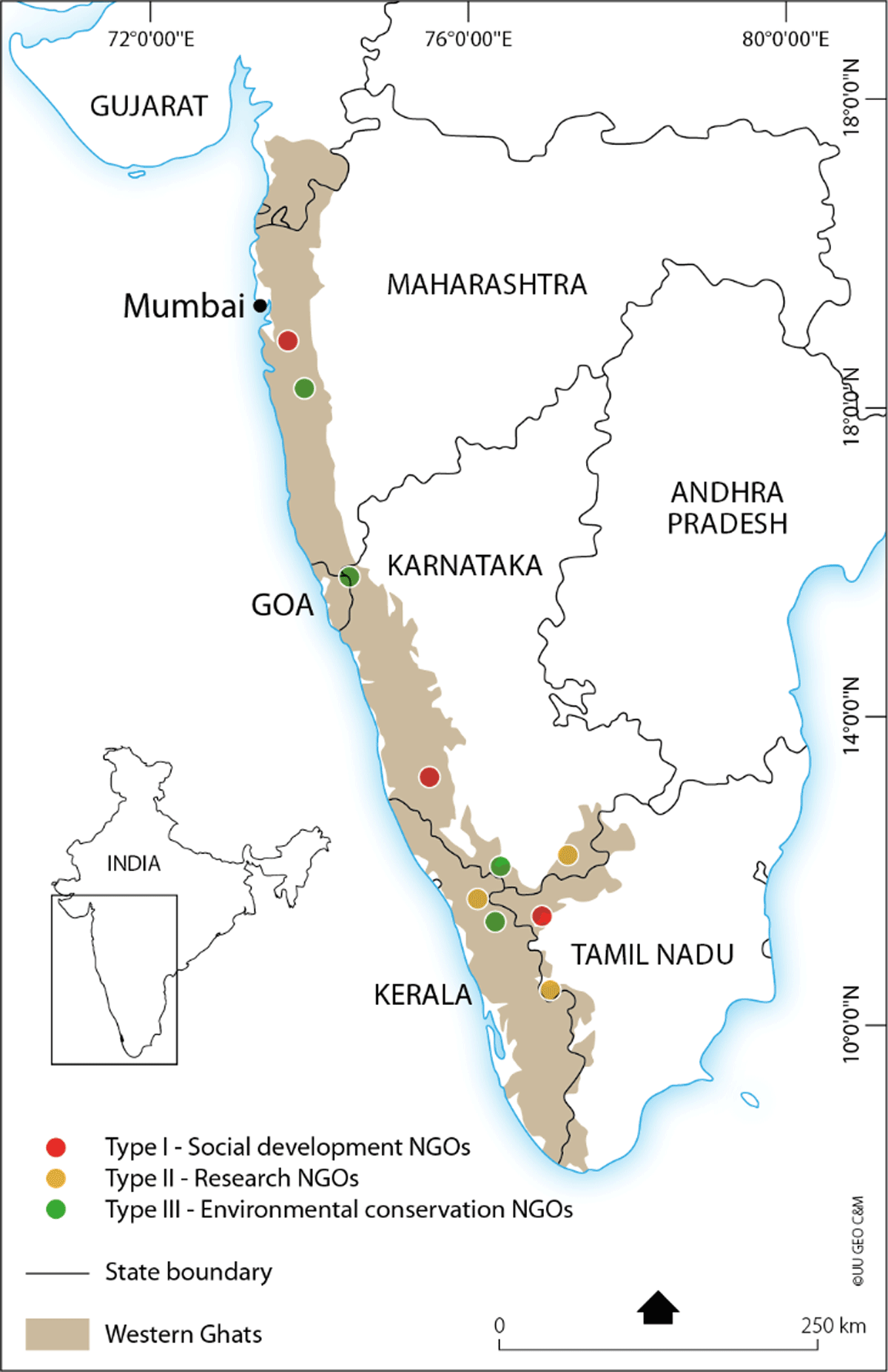
Figure 1
Map with locations of studied NGOs in the Western Ghats, India.
Table 2
Typology of NGOs.
| TYPE | NGOs | STATED OBJECTIVES |
|---|---|---|
| Type I | NGOs 1–3 | NGOs that are focussed mostly on improving community’s quality of life. |
| Type II | NGOs 4–6 | NGOs that are primarily concerned with research into the environment and local people there. |
| Type III | NGOs 7–10 | NGOs that work towards improving the quality of the environment. |
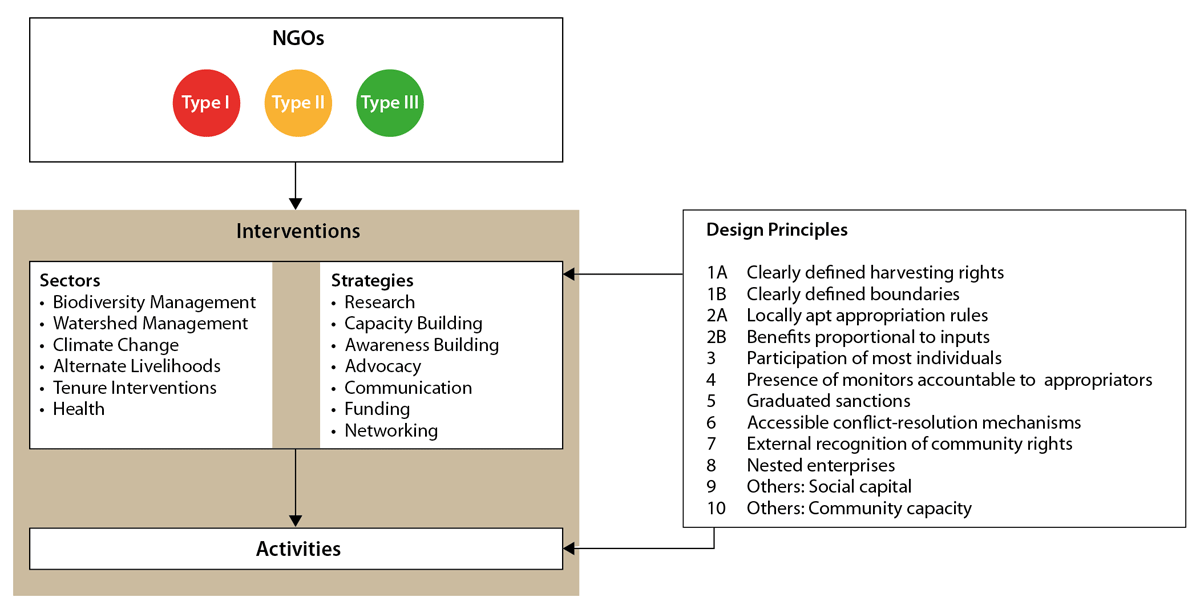
Figure 2
An overview of the framework used to analyse NGO interventions.
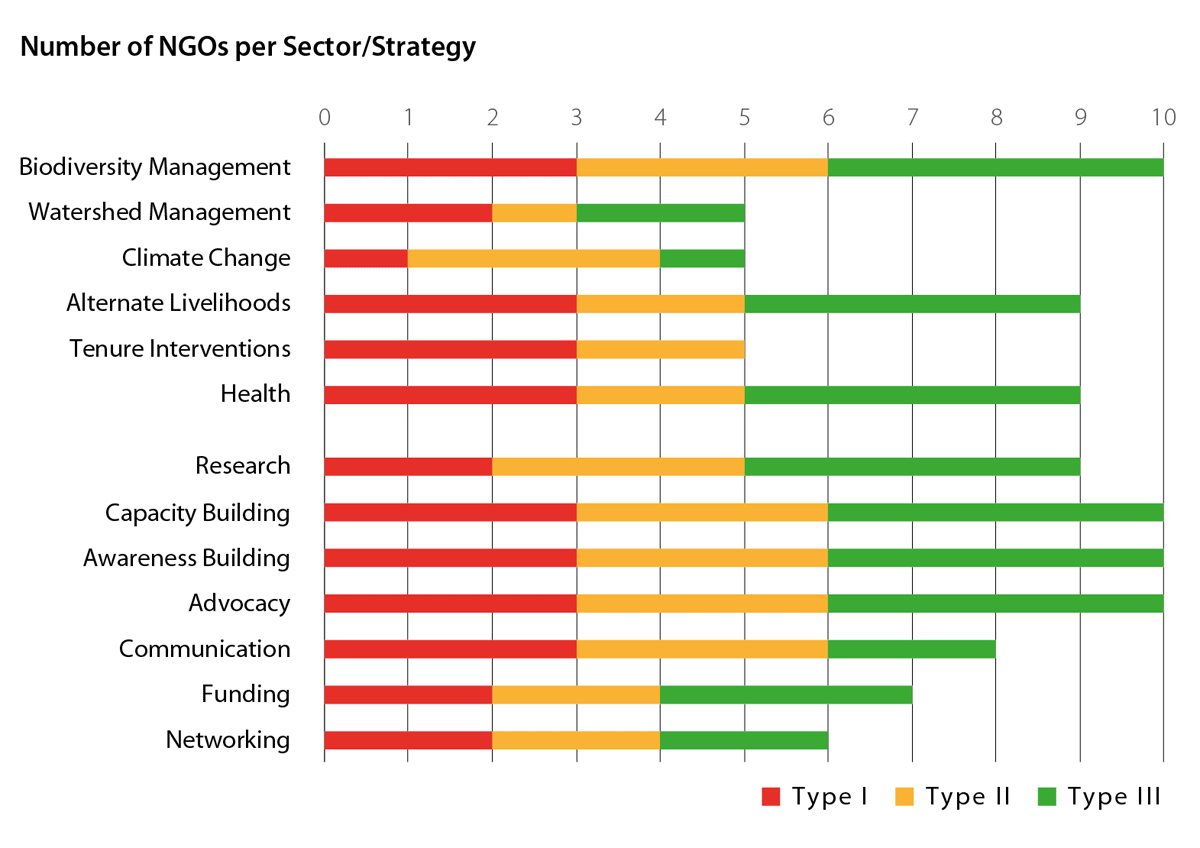
Figure 3
Sectors and strategies NGOs are active in.
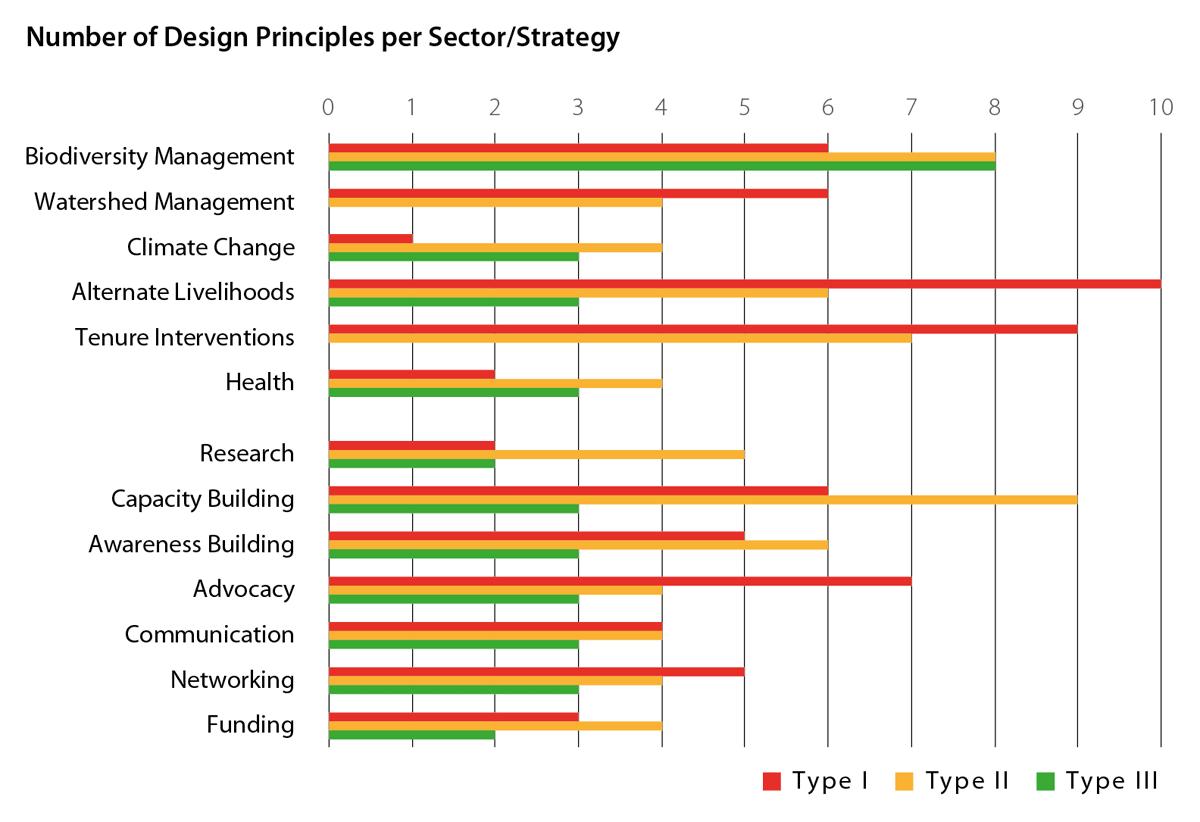
Figure 4
Number of design principles per sector and strategy.
Table 3
Design Principles per sector and strategy – Type I NGOs.
| 1A | 1B | 2A | 2B | 3 | 4 | 5 | 6 | 7 | 8 | 9 | 10 | |
|---|---|---|---|---|---|---|---|---|---|---|---|---|
| Biodiversity Management | – | – | 3 | – | – | 2 | 1 | – | 2 | – | 1 | 3 |
| Watershed Management | – | 1 | 1 | – | – | 1 | – | – | 1 | – | 2 | 1 |
| Climate Change | – | – | – | – | – | – | – | – | – | – | – | 1 |
| Alternate Livelihoods | 2 | 2 | 2 | 1 | 2 | – | 1 | – | 1 | 1 | 3 | 3 |
| Tenure Interventions | 3 | 3 | 3 | – | 2 | 1 | – | – | 2 | 1 | 3 | 2 |
| Health | – | – | – | – | – | – | – | – | – | – | 2 | 2 |
| Research | – | – | 2 | – | – | – | – | – | – | – | 2 | – |
| Capacity Building | – | – | 1 | – | 3 | – | – | – | 3 | 2 | 2 | 3 |
| Awareness Building | – | 1 | – | – | 1 | – | – | – | – | 1 | 2 | 3 |
| Advocacy | – | – | 2 | – | 1 | – | – | 1 | 3 | 1 | 3 | 3 |
| Communication | – | – | – | – | 1 | – | – | – | 1 | – | 2 | 3 |
| Networking | – | – | – | – | 1 | – | – | – | 1 | 2 | 2 | 1 |
| Funding | – | – | – | – | – | – | – | – | – | 1 | 1 | 1 |
| NGO interviewee response | 2 | 3 | 2 | – | 3 | 3 | 2 | 2 | 3 | 3 | 3 | 3 |
Table 4
Design Principles per sector and strategy – Type II NGOs.
| 1A | 1B | 2A | 2B | 3 | 4 | 5 | 6 | 7 | 8 | 9 | 10 | |
|---|---|---|---|---|---|---|---|---|---|---|---|---|
| Biodiversity Management | – | 2 | 3 | – | 3 | 2 | – | – | 2 | 1 | 3 | 3 |
| Watershed Management | – | – | 1 | – | 1 | 1 | – | – | – | – | – | 1 |
| Climate Change | – | – | 1 | – | – | – | – | – | – | 1 | 2 | 2 |
| Alternate Livelihoods | – | – | 2 | 1 | 1 | – | – | – | – | 2 | 2 | 2 |
| Tenure Interventions | 2 | 2 | 1 | – | – | 1 | – | – | 2 | – | 1 | 1 |
| Health | – | 1 | – | – | 2 | – | – | – | – | – | 2 | 1 |
| Research | – | – | 3 | – | 1 | 1 | – | – | – | – | 1 | 1 |
| Capacity Building | 1 | 3 | 2 | – | 2 | 1 | – | – | 2 | 2 | 2 | 3 |
| Awareness Building | – | – | 1 | – | 2 | 1 | – | – | – | 1 | 3 | 3 |
| Advocacy | – | – | – | – | 1 | – | – | – | 1 | – | 1 | 1 |
| Communication | – | – | – | – | 1 | – | – | – | – | 1 | 3 | 3 |
| Networking | – | – | – | 1 | – | – | – | – | – | 2 | 1 | 1 |
| Funding | – | 1 | – | – | 1 | – | – | – | – | – | 1 | 1 |
| NGO interviewee response | 2 | 2 | 3 | – | 3 | 2 | – | 2 | 3 | 1 | 3 | 3 |
Table 5
Design Principles per sector and strategy – Type III NGOs.
| 1A | 1B | 2A | 2B | 3 | 4 | 5 | 6 | 7 | 8 | 9 | 10 | |
|---|---|---|---|---|---|---|---|---|---|---|---|---|
| Biodiversity Management | – | 4 | 3 | – | 1 | 3 | – | – | 1 | 1 | 4 | 3 |
| Watershed Management | – | – | – | – | – | – | – | – | – | – | – | – |
| Climate Change | – | – | 1 | – | 1 | – | – | – | – | – | 1 | – |
| Alternate Livelihoods | – | – | – | – | 2 | – | – | – | – | – | 2 | 4 |
| Tenure Interventions | – | – | – | – | – | – | – | – | – | – | – | – |
| Health | – | – | – | – | 1 | – | – | – | – | – | 4 | 1 |
| Research | – | 1 | – | – | – | – | – | – | – | – | 2 | – |
| Capacity Building | – | – | – | – | 2 | – | – | – | – | – | 3 | 4 |
| Awareness Building | – | – | – | – | 2 | – | – | – | – | – | 3 | 2 |
| Advocacy | – | 1 | – | – | – | – | – | – | 4 | – | 1 | – |
| Communication | – | – | – | – | 1 | – | – | – | – | – | 2 | 2 |
| Networking | – | – | – | – | 1 | – | – | – | – | 3 | 1 | 1 |
| Funding | – | – | – | – | – | – | – | – | – | – | 2 | 2 |
| NGO interviewee response | – | 2 | 4 | – | 3 | 2 | – | – | 1 | 1 | 4 | 4 |
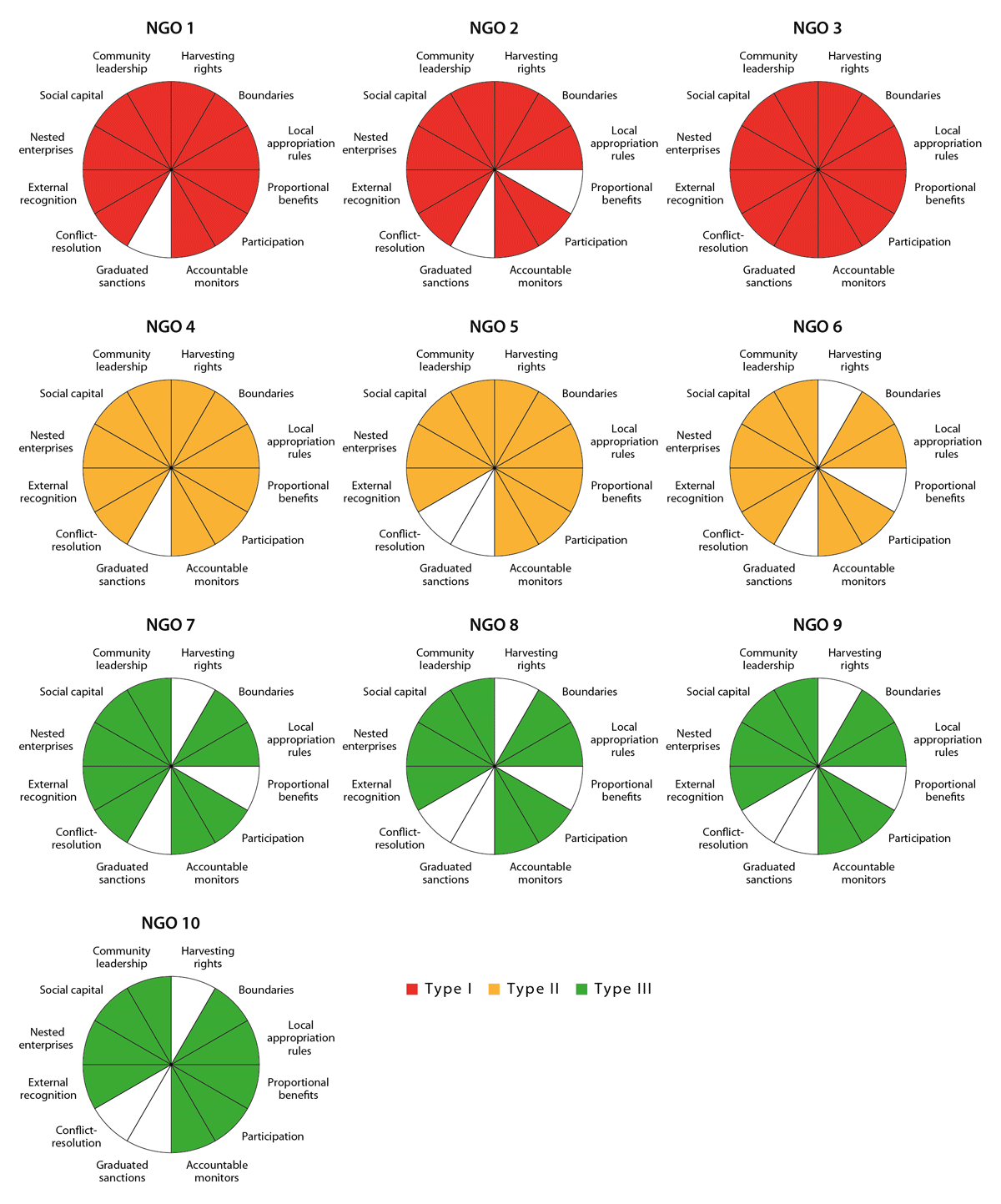
Figure 5
Design principles by NGO.