
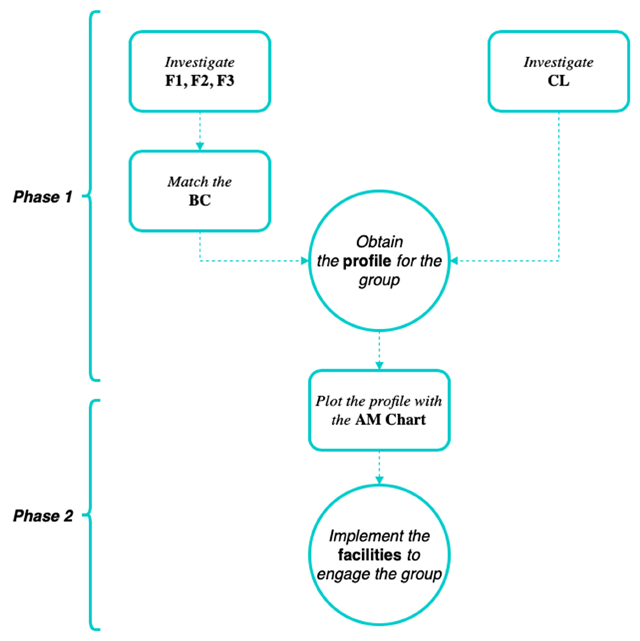
Figure 1
The workflow for the engagement of a group.
Table 1
Data management features.
| Features | ||
|---|---|---|
| F1 | Spatial data production | Feature 1 describes if the group associates its data to a geospatial coordinate system. This is necessary to refer data to a location or a geographical area. |
| F2 | Web-based data distribution | Feature 2 describes if the group provides access to data through web-based tools such as online databases, repositories, geoportals, or desktop applications. |
| F3 | Interoperable web-based data distribution | Feature 3 describes if the group provides interoperable access to data through standard web geoservices. |
Table 2
Data management competence levels and informative actions.
| Level | Competence | Description |
|---|---|---|
| 0 | Capturing competence | This level describes groups that have basic expertise in describing the phenomena that are their research objects and in acquiring and preparing data according to the practices of the specific domain or lab. |
| 1 | Digital competence | This level describes groups that have the necessary know-how and tools to digitally manage geospatial data. The informative actions to reach this level provides contents on how to collect georeferenced data (layer, observations or measurements) in digital formats, organize them in digital systems (spatial databases, relational databases, file systems), and store them in different types of repositories (institutional servers, projects repositories, desktop PCs, cloud systems). |
| 2 | Interoperability competence | This level describes groups that have the know-how and tools to share geospatial data by using standard web geoservices. The informative actions to reach this level provides contents on how to make datasets distribution interoperable with the datasets produced by other groups (e.g., by using an SDI). |
Table 3
Facilities chart.
| Behavior categories | ||||||
|---|---|---|---|---|---|---|
| Committed (1,1,1,) | Competent (1,1,0) | Web-ready (1,0,0) | Receptive (0,1,0) | Locked (0,0,0) | ||
| Competence levels | 0 | F2 = 1 → CL0 = 1a | F2 = 1 → CL0 = 1a | F1 = 1 → CL0 = 1a | Glossary, FAQ | Glossary, FAQ |
| 1 | F2 = 1 → CL1 = 1a | F2 = 1 → CL1 = 1a | Glossary, FAQ, Webinar | F1 = 0 → CL0 has priorityb | F1 = 0 → CL0 has priorityb | |
| 2 | On-demand (online), On-demand, Webinars | On-demand (online), Webinars | F2 = 0 → CL1 has priorityb | F1 = 0 → CL1 has priorityb | F1 = 0 → CL1 has priorityb | |
Table 4
HVE measure descriptions.
| Behavior categories | ||||||
|---|---|---|---|---|---|---|
| Committed (1,1,1,) | Competent (1,1,0) | Web-ready (1,0,0) | Receptive (0,1,0) | Locked (0,0,0) | ||
| Competence levels | 0 | – | – | – | + | + |
| 1 | +a | +a | + | +b | +b | |
| 2 | + | + | – | – | – | |
Table 5
RITMARE facilities.
| Behavior categories | ||||||
|---|---|---|---|---|---|---|
| Committed (1,1,1,) | Competent (1,1,0) | Web-ready (1,0,0) | Receptive (0,1,0) | Locked (0,0,0) | ||
| Competence levels | 0 | NO | NO | NO | Glossary, FAQ | Glossary, FAQ |
| 1 | To master | To master | Glossary, FAQ, Webinar | NO | NO | |
| 2 | On-demand (online), On-demand (F2F), Webinar | On-demand (online) | NO | NO | NO | |
Table 6
Facilities in the RITMARE USS.
| Facilities | |||||
|---|---|---|---|---|---|
| Class | Name | Contents | Items | Container | Identifier |
| Educational | Glossary | Definition of a common terminology (e.g. describing file formats, access protocols, and mandatory regulations) | 45 | Wiki | http://sp7.irea.cnr.it/wiki/index.php/ |
| Educational | FAQ | The RITMARE Data Portal, Data Nodes (DNs), RITMARE Data Policy | 24 | Wiki | http://sp7.irea.cnr.it/wiki/index.php/ |
| Educational | Webinar | Policy and Technological Components of the RITMARE SDI, How to create autonomous RITMARE DNs | 2 | Wiki | http://sp7.irea.cnr.it/wiki/index.php/ |
| Educational | Videotutorials, | How to create autonomous RITMARE DNs | 1 | GET-IT website | http://www.get-it.it/ |
| Supporting | Service | Installing and mantaining new RITMARE DNs | 4 | Help desk | help.skritmare@irea.cnr.it |
| Supporting | Service | External DNs Enablement | 2 | Help desk | help.skritmare@irea.cnr.it |
| Supporting | Service | Data Transfer to RITMARE DNs | 1 | Help desk | help.skritmare@irea.cnr.it |
| Supporting | Service | Data Connection to a RITMARE DNs | 1 | Help desk | help.skritmare@irea.cnr.it |