Table 1
Comparison of NSF Framework and LSIE strands.
| NSF Framework Category | LSIE Strands |
|---|---|
| Knowledge, Awareness, Understanding: Measurable demonstration of assessment of, change in, or exercise of awareness, knowledge, understanding of a particular scientific topic, concept, phenomena, theory, or careers central to the project. | Strand (2), Understanding: Come to generate, understand, remember, and use concepts, explanations, arguments, models, and facts related to science. |
| Engagement, interest or motivation in science: Measurable demonstration of assessment of, change in, or exercise of engagement/interest in a particular scientific topic, concept, phenomena, theory, or careers central to the project. | Strand (1), Interest and motivation: Experience excitement, interest and motivation to learn about phenomena in the natural and physical world. |
| Skills related to science inquiry: Measurable demonstration of the development and/or reinforcement of skills, either entirely new ones or the reinforcement, even practice, of developing skills. | Strand (3), Science Exploration: Manipulate, test, explore, predict, question, and make sense of the natural and physical world; and Strand (5): Participate in scientific activities and learning practices with others, using scientific language and tools |
| Attitudes toward science: Measurable demonstration of assessment of, change in, or exercise of attitude toward a particular scientific topic, concept, phenomena, theory, or careers central to the project or one’s capabilities relative to these areas. Attitudes refer to changes in relatively stable, more intractable constructs such as empathy for animals and their habitats, appreciation for the role of scientists in society or attitudes toward stem cell research. | Related to Strand (6), Identity: Think about themselves as science learners, and develop an identity as someone who knows about, uses, and sometimes contributes to science. Also, related to Strand (4), Reflection: Reflect on science as a way of knowing; on processes, concepts, and institutions of science; and on their own process of learning about phenomena. |
| Behavior: Measurable demonstration of assessment of, change in, or exercise of behavior related to a STEM topic. Behavioral impacts are particularly relevant to projects that are environmental in nature since action is a desired outcome. | Related to Strand (5), Skills: Participate in scientific activities and learning practices with others, using scientific language and tools. |
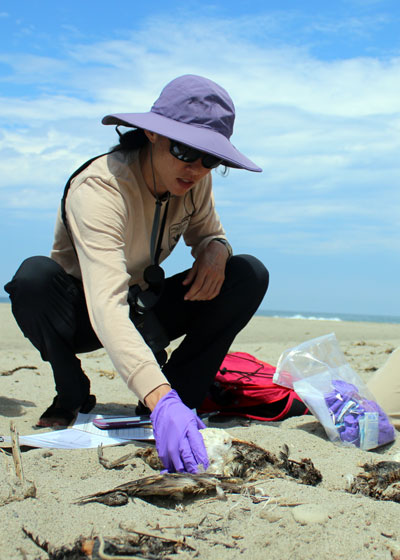
Figure 1
Participants in citizen science engage in a large number of activities such as designing studies, collecting and analyzing data, and disseminating project results. What do project designers hope that participants will learn from their participation? How are desired learning outcomes designed? How are they measured?
Credit: No copyright. Pacific Southwest Region USFWS/Flickr/Public Domain.
| • | Increasing scientific literacy and public understanding | ➔ | content knowledge |
| • | Citizens actively contribute to the development of a database | ➔ | data collection and monitoring, data submission |
| • | Help build understanding of the methods and results of scientific research | ➔ | Nature of Science knowledge |
Table 2
Count of specified learning outcomes as coded from 327 citizen-science project websites. Percentages represent the proportion of projects that described the stated outcome. Several projects stated more than one outcome.
| Stated Outcomes on project websites | Count of projects stating outcome (N = 327) | Percentage of projects stating outcome |
|---|---|---|
| Data Collection and Monitoring | 193 | 59% |
| Content Knowledge | 90 | 28% |
| Environmental Stewardship | 86 | 26% |
| No Education Goal Specified | 29 | 9% |
| Attitude/Awareness | 25 | 8% |
| Nature of Science | 20 | 6% |
| Data Analysis | 14 | 4% |
| Interest in the Environment | 13 | 4% |
| Civic Action | 12 | 4% |
| Submitting Data | 12 | 4% |
| Interest in Science | 10 | 3% |
| Community Health | 9 | 3% |
| Communication Skills | 7 | 2% |
| Using Technology | 6 | 2% |
| Science Careers | 4 | 1% |
| Designing Studies | 2 | 0.5% |
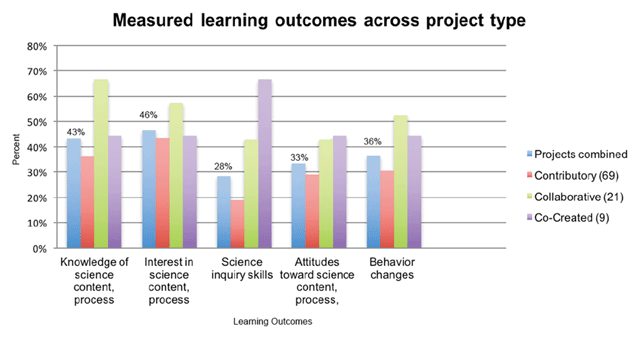
Figure 2
Measured learning outcomes from online survey of citizen science practitioners who reported having conducted some sort of evaluation (n = 99).
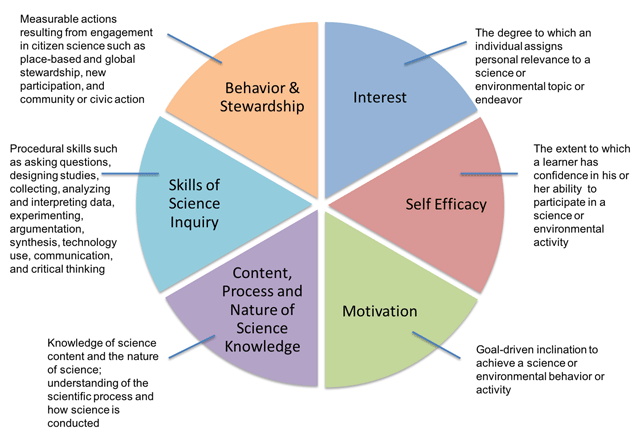
Figure 3
Framework for Articulating and Measuring Individual Learning Outcomes from Participation in Citizen Science.
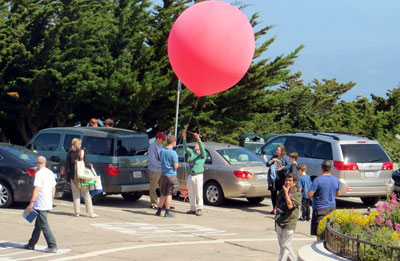
Figure 4
Many citizen science project designers hope not only to collect important scientific information but also to help project participants gain skills such as scientific reasoning. Here, a team of volunteers with Public Lab, a non-profit environmental science community, launch a weather balloon. Data collected via the balloon will be used in 3-D mapping surveys, but figuring out how to measure just what participants are learning as they conduct this research is a challenge for the citizen science field.
Credit: Alan Kotok/Flickr/CC BY-2.0.