
1. PROBLEM DEFINITION
At COP 30 in Brazil, it was noted that the built environment (sometimes called building, construction and real estate sector or building stock) is not making full use of its mitigation potential to achieve the Paris Agreement goals. Energy consumption and greenhouse gases (GHG) emissions for the operation of buildings are still too high. The implementation of measures to reduce energy consumption for space heating in buildings is lagging behind the goals formulated by climate science that have been endorsed by many central and local governments. In addition, the local consequences of global warming are increasing the energy demand and related GHG emissions for space cooling (i.e. air-conditioning). The topic of heating and cooling buildings requires urgent escalation, among other options, in the national mitigation pathways of forthcoming Nationally Determined Contributions (NDCs) 4.0.
This raises the following questions:
Why has the share of the built environment in national GHG emissions been underestimated so far?
How does the recording and reporting of national GHG emissions need to be further developed in order to be able to analyse and influence direct and indirect shares for space heating and cooling of residential and non-residential buildings?
How can the measurement, reporting and verification (MRV) approach be permanently implemented and further developed in all countries in relation to space heating and cooling of buildings?
2. BACKGROUND
During previous energy crises policymakers considered how the built environment can contribute to saving energy. For over a century, strategies have been formulated to improve thermal insulation and energy supply efficiency, especially in countries with a long heating season and high energy consumption for space heating and hot water supply. Space heating continues to create high energy consumption and related GHG emissions. With the analysis of climate change and its local consequences, it became clear that the additional demand for energy for space cooling is growing dramatically fast worldwide. This affects the countries of the Global South in the context of rapid urbanisation and the need to improve quality of life, but also the Global North, which is experiencing an increase in extreme summer heat events. There are major regional differences. Currently 33% of the population worldwide uses energy for both heating and cooling to ensure thermal comfort; the figures are 78% in Europe and 56% in North America (ETC 2025). The demand for cooling is accelerating quickly in the Asia-Pacific region (UNESCAP 2021).
3. CURRENT STATUS
Despite progress in the areas of energy codes, policy and market-based instruments as well as technical progress in energy saving technologies, it is clear that current efforts are insufficient to achieve mitigation targets in the built environment globally. All countries must step up their efforts particularly in the area of problem perception and political responses to it.
In the current NDCs 3.0, buildings may be included, but targets and pathways for mitigation of GHG emissions for the heating and cooling of buildings as parts of national building stocks are often unambitious or incomplete. In the majority of countries, GHG emissions caused by operation of buildings continue to be recorded as part of direct GHG emissions only according to the source principle.1 As a consequence, space heating and cooling is underestimated in its mitigation potential and indirect GHG emissions caused by electricity and district heating/cooling are excluded from considerations. The proposed end-use analysis (based on the polluter-pays principle) is intended to complement national emissions inventories and inform policy and NDC targets; it does not propose changing national inventory accounting.
Of the 128 NDCs published by the end of 2025, about 80% dealt with GHG emission reduction in the built environment, but only 4% arrived at quantitative approaches via baselines and targets (UN-Habitat 2026). Both methodologically and due to a lack of data, many countries find it difficult to develop specific mitigation pathways for their national building stock. Preparing for the NDC 4.0 reporting period offers an opportunity to change this. Dealing with space heating and cooling is a perfect starting point, if no detailed estimates for the building stock are yet available.
4. KEY CONSIDERATIONS
The GHG emissions associated with building operations vary according to regional climate, the energy supply and the size, composition and development of the building stock. The balance between heating and cooling, and the best measures to address them, will vary with climate, energy supply and national data availability. Globally, building operations account for 26% of energy-related GHG emissions: 9% are direct emissions (SCOPE 1), and 17% are indirect emissions from electricity and district heating or cooling used in buildings (SCOPE 2) (IEA 2023a).2 These operational emissions include those associated with heating3 and/or cooling (Figures 1 and 2). Other indirect (Scope 3) emissions include those associated with the manufacture of construction products and processes at the construction site. These contribute to buildings’ wider life-cycle emissions but are outside the focus of this briefing note.4
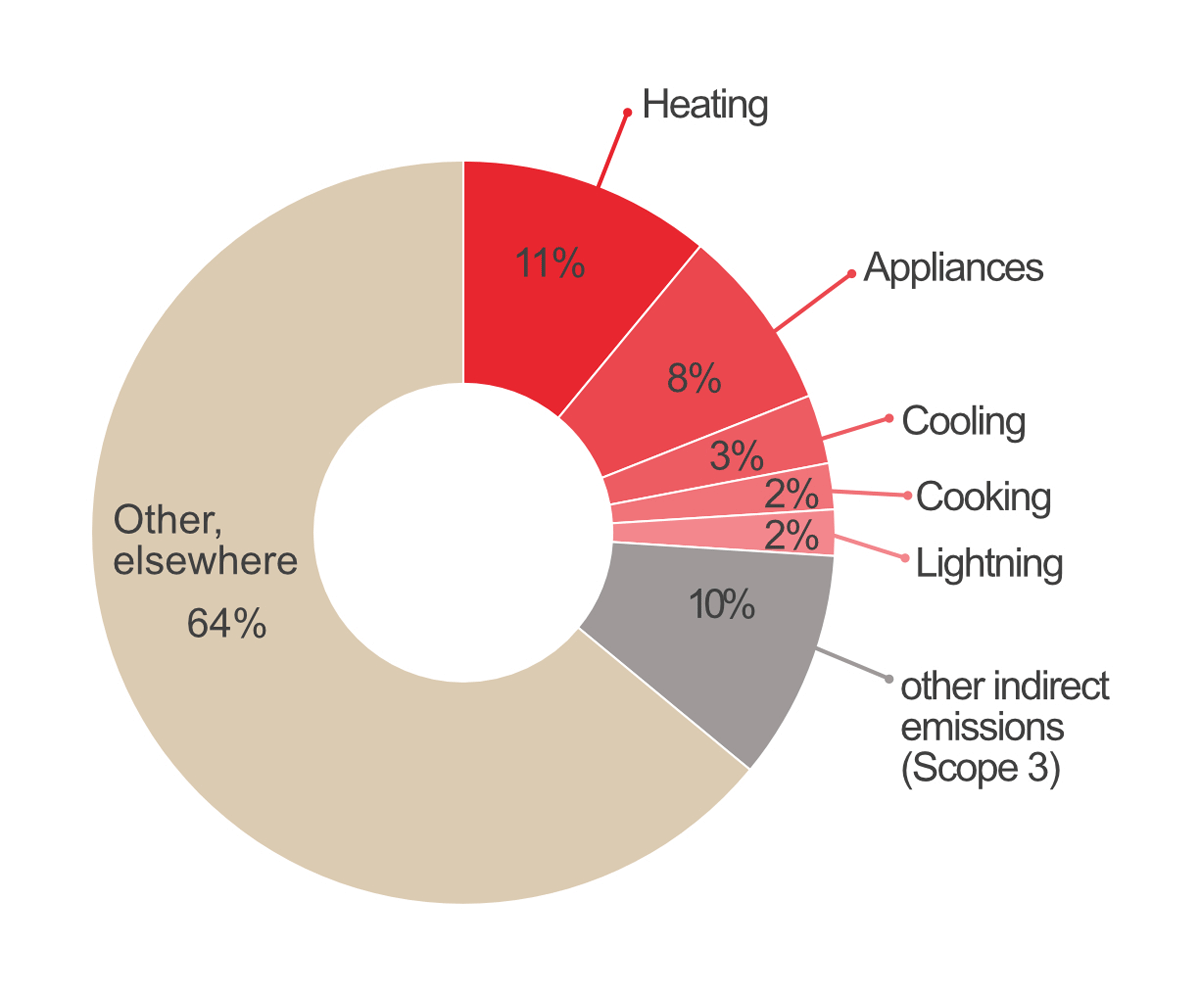
Figure 1
Greenhouse gases (GHG) emissions from the operation of residential and non-residential buildings at a global level, 2022.
Sources: Adapted from ETC (2025), IEA (2023c) and GlobalABC (2023).
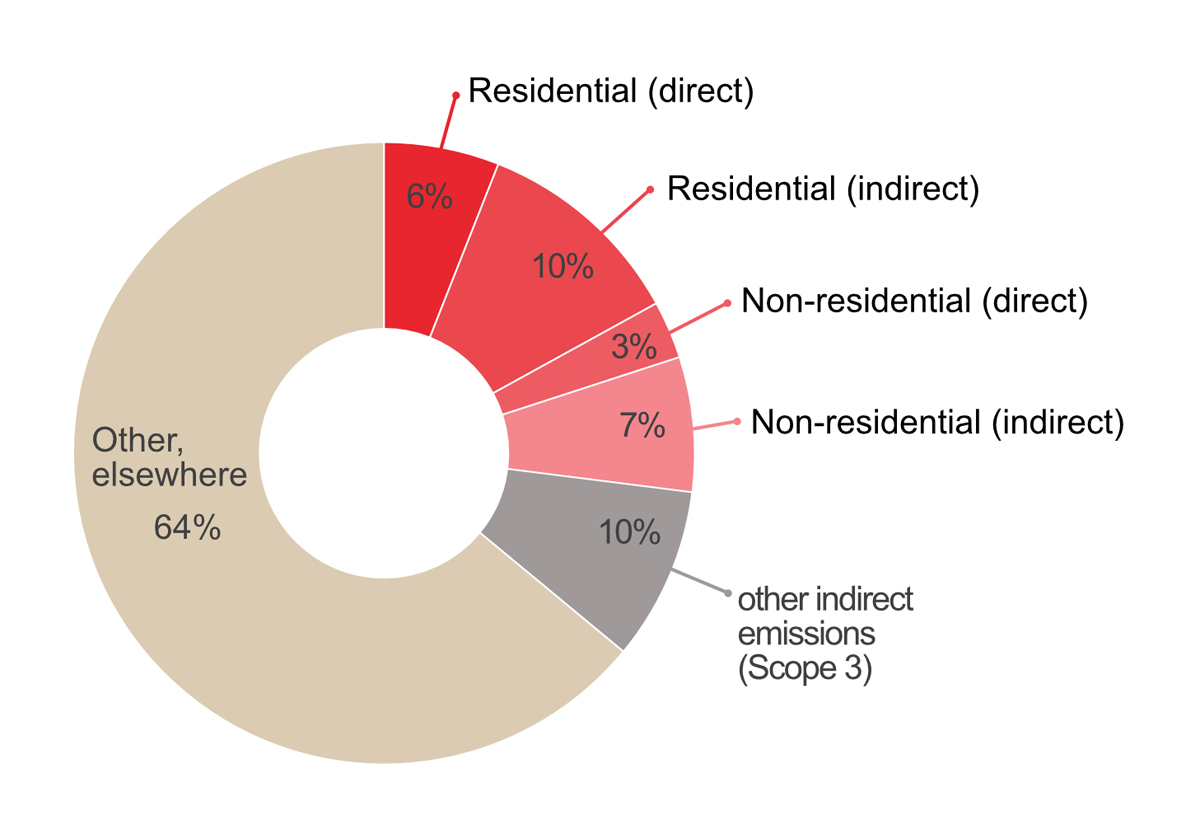
Figure 2
Building-related operational greenhouse gases (GHG) emissions by end use at a global level, 2022.
Most national statistics and mitigation targets significantly underestimate GHG emissions from the building stock. This is because the focus is on direct energy-related emissions, known as SCOPE 1. This records CO2 emissions, generated onsite by burning coal, gas or oil. Globally, direct CO2 emissions from heating residential buildings alone accounted for around 6% (GlobalABC 2023). This value is often assigned to the ‘building sector’, although the building sector is not always treated consistently in national statistical classifications.
Emissions from non-residential buildings must be included in the consideration—another 3% (GlobalABC 2023). In addition, there are indirect emissions (SCOPE 2) from the use of electricity and district heating for space heating that need to be taken into account. The share of GHG emissions caused by use of electricity and district heating are usually assigned to the energy sector as a typical macroeconomic sector.
The cooling of buildings (air-conditioning) is usually powered by electricity. Energy consumption and GHG emissions are therefore assigned also to the economic sector ‘energy’ and are not visible at all in the ‘buildings sector’. Cooling represents around 10% of global electricity demand (IEA 2023b), with a strong growing trend in absolute and relative sizes. This currently corresponds to about 3% of global GHG emissions (Ritchie 2024).
Even the recording and analysis of GHG emissions from heating and cooling of residential and non-residential buildings in the national building stock requires already consideration of the direct and indirect shares in relation to SCOPE 1 and SCOPE 2. This places high demands on the granularity of national statistics, but also provides a starting point for a gradual expansion of building related considerations in national GHG emission statistics and reporting.
International standards are available to account for the GHG emissions caused in the operation of buildings in addition to those for space heating and cooling (ISO 2017).
Efforts to strengthen circularity in the life-cycle of individual buildings, as well as the generation of renewable energy from buildings supplied to third parties or the national grid, can contribute to reducing GHG emissions in the industrial and energy sectors—avoiding double counting.
Similarities and differences between the life-cycle analysis (LCA) of individual buildings and GHG emission reporting on the national building stock must be considered. While the former are analysed over a reference study period of, for example, 50 years, the emissions caused by the building stock must be recorded per year. Production, construction and operation—including heating and cooling, dismantling, processing, and disposal—are then not stages in the life-cycle of an individual building, but take place in parallel as annual activities in the national building stock.
For the development of specific mitigation targets and roadmaps in future NDCs, it is important to model the national building stock and its further development based on scenarios in line with expected actions and to forecast in addition the effects of behavioural change, climate change, technological progress, energy supply decarbonisation and policy instruments. Such modelling should support a prospective approach that can inform national mitigation pathways, roadmaps and action plans. Further information can be found in the literature (e.g. Hong et al. 2025; Buildings & Cities 2026; WGBC n.d.).
Such a roadmap must also deal with the creation of the necessary preconditions (see Section 6). This includes, among other things, the decarbonisation of the energy supply, the further development of political instruments, codes and standards, and the education and training of involved stakeholder groups. Another important aspect is quality assurance in the implementation of measures.
5. CONCLUSIONS
With the publication of Nationally Determined Contribution (NDC) 4.0 in 2030, the course must finally be set towards achieving the national mitigation targets. Including space heating and cooling in NDC 4.0 is both feasible and desirable. A process for doing this is outlined below in the ‘recommended actions’.
The importance of the building, construction and real estate sector for achieving national goals of climate protection is increasingly recognised, but still often underestimated. Reasons include the application of the source principle in the recording of emissions rather than the end uses, the focus on direct greenhouse gases (GHG) emissions from heating of residential buildings, and problems in providing appropriate scenarios for current and future mega-trends, including local consequences of climate change leading to fast growing energy demand for cooling.
The systematic assessment of direct and indirect GHG emissions as a result of space heating and cooling of residential and non-residential (commercial) buildings is a good starting point. Identifying building-related SCOPE 1 emissions from onsite fuel use and SCOPE 2 emissions associated with electricity and district heating or cooling can help governments prioritise measures, set NDC targets and track progress.
The basis for obtaining the required data is provided by the measurement, reporting and verification (MRV) approach. In future, a distinction should be made between statistics on GHG emissions related to economic sectors and GHG emissions of the national building stock following a cross-sectoral approach, but they must complement each other (Habert et al. 2020).
6. RECOMMENDED ACTIONS
The following steps can be adapted to national circumstances and to the data and capacity already available.
6.1 STEP 1: PROBLEM PERCEPTION AND AWARENESS-RAISING
National governments should analyse their built environment to develop national mitigation targets. A good starting point is to focus on space heating and cooling which entails the consideration of direct (SCOPE 1) and indirect (SCOPE 2) energy related GHG emissions.5 Table 1 provides an overview of the scope of analysis.
Table 1
Overview of greenhouse gases (GHG) emissions associated with the construction, operation and use of buildings in the national building stock.
| BUILDINGS CLASSIFICATION: | RESIDENTIALBUILDINGS | NON-RESIDENTIAL BUILDINGS | ||||||
|---|---|---|---|---|---|---|---|---|
| INDICATOR: | ANNUAL GHG EMISSIONS | |||||||
| GHG EMISSIONS, CAUSED BY …: | SCOPE 1: DIRECT ENERGY-RELATED GHG EMISSIONSa | SCOPE 2: INDIRECT ENERGY-RELATED GHG EMISSIONS | SCOPE 3: OTHER INDIRECT GHG EMISSIONS | SCOPE 1: DIRECT-ENERGY RELATED GHG EMISSIONSa | SCOPE 2: INDIRECT ENERGY-RELATED GHG EMISSIONS | SCOPE 3: OTHER INDIRECT GHG EMISSIONS | ||
| Operation of buildingsb | Building-related energy use, regulated and non-regulated in energy codes | Energy for space heatingc | ||||||
| Energy for water heating/domestic hot water | ||||||||
| Energy for space coolingc | ||||||||
| Energy for air movement/ventilation | ||||||||
| Energy for lightingc | ||||||||
| Energy for indoor transportation (elevators) | ||||||||
| Energy for building auxiliary devices | ||||||||
| Use of buildingsb | User and use-related energy use, mostly non-regulated | Energy for supplementary lighting | ||||||
| Energy for household/office appliances | ||||||||
| Energy for cooking | ||||||||
| Energy for refrigeration | ||||||||
| Energy for devices in data centres | ||||||||
| Energy for other specific functional devices | ||||||||
| New construction, maintenance, repair, replacement of components, refurbishment and deconstruction of buildings | Raw material supply | |||||||
| Construction product manufactured | ||||||||
| Transporte | ||||||||
| Construction processes onsitef | ||||||||
| Waste processing | ||||||||
| Final disposal | ||||||||
| Other special aspects | Emissions from refrigerants in HVAC systems | |||||||
| Emissions from refrigerants in refrigerators | ||||||||
| Emissions from land use and land-use change | ||||||||
[i] Note: aSubdivided in CO2 emissions and emissions of other GHGs.
bIn line with ISO (2017).
cFixed and plug in.
dEnergy- and process-related aspects.
eIncluding transports of raw materials, transport to and from sites, and transport onsite.
fIncluding construction, maintenance, repair, replacement of components, refurbishment and deconstruction.
HVAC = heating, ventilation and air-conditioning. Darker boxes = starting point; lighter boxes = not applicable/not to be filled in.
6.2 STEP 2: CREATION OF PREREQUISITES
The following prerequisites should be created:
Improve the collection and detail of national statistics to support complementary analysis of emissions associated with space heating and cooling.
Implementation of an appropriate approach for recording and analysing building-related energy consumption and as well as direct and indirect GHG emissions in line with the MRV approach.
Derivation of the trend on future local climate conditions for the forecast of heating and cooling demand in specific climate zones.
Publication of current and prospective GHG emission factors (default values as well as provider-specific data) for specific types of energy supply, including upstream processes.
Improve national statistics on space heating and cooling by distinguishing fuel use from electricity and district heating or cooling, so the associated emissions can be assessed alongside existing sector-based reporting.
Introduction of reporting obligations on energy consumption and GHG emissions for buildings which are collected and analysed centrally.
6.3 STEP 3: DATA-GATHERING AND ANALYSES
It cannot be assumed that all the prerequisites are already in place in each country or that they can be created in a timely manner. It is possible to start at the level that has already been reached in the specific country, prioritising the most relevant heating or cooling uses for that country.
Analysis of existing data on energy consumption as well as on direct and indirect GHG emissions for space heating and cooling of residential and non-residential buildings in the country.
Implementation of a monitoring system for energy consumption and GHG emissions for space heating and cooling (as well as hot water supply). Indirect GHG emissions involving district heating and space conditioning using electricity also need to be accounted for.
Compare estimates of emissions from building heating and cooling with existing sector-based statistics to identify where these emissions are currently recorded and where further data are needed.
Introduction of additional analysis options, which include the observation of data in fields of action and needs. One field of action is the operation of buildings; one field of needs is housing.
If possible, mentioned elements should be developed in parallel where data already exist.
6.4 STEP 4: STRATEGY DEVELOPMENT, IMPLEMENTATION AND SUCCESS CONTROL
The activities described above will make it possible to create national and local statistics for final and primary energy consumption and GHG emissions caused by buildings in order to define a specific mitigation pathway with quantitative targets and to establish a roadmap as a basis for a process of continuous improvement.
In both the Global North and Global South, there are examples of national strategies that affect the building stock.6
Systematic monitoring and reporting will help to check success and adapt the roadmaps and action plans.
Notes
[2] When GHG emissions are measured and reported by ‘source’, they are attributed to the economic sector that emits them. In contrast, in a polluter-pays approach, emissions are assigned to the cause of their origin.
[3] The Greenhouse Gas Protocol categorises emissions as Scope 1 (direct), Scope 2 (indirect emissions associated with purchased energy) and Scope 3 (other indirect value-chain emissions). In source-based reporting, emissions are attributed to the economic sector in which they occur; an end-use approach considers the activity that drives them.
[4] In some cases, energy use and associated GHG emissions from hot water supply are included in estimates for heating. NDCs should clarify whether hot water supply is included.
[5] Emissions from making construction products and the process of constructing buildings are often called embodied emissions. Depending on how emissions are counted, they may be reported as Scope 3.
[6] Further action can be taken beyond NDC 4.0 to account for GHG emissions associated with the manufacture of the construction products for the construction, repair, maintenance and refurbishment of buildings as well as the processes on the construction sites, for transport, processing and disposal. These can be interpreted as additional indirect emissions and thus as part of SCOPE 3.
[7] Selected examples of roadmaps include Kenya (https://globalabc.org/resources/publications/kenyas-national-buildings-and-construction-decarbonization-roadmap) and the UK (https://ukgbc.org/our-work/topics/whole-life-carbon-roadmap/).
ACKNOWLEDGEMENTS
Findings from the ongoing IEA EBC Annex 89 project and international standardisation within the framework of ISO TC 59 SC17 were incorporated into the preparation of this briefing note. Thanks to all colleagues involved; and to the reviewers and editors.
AI DECLARATION
The author confirms that no original research data, figures or core analytical interpretations were generated, altered or manipulated by artificial intelligence (AI).
FURTHER READING
https://www.energy-transitions.org/publications/achieving-zero-carbon-buildings/
https://link.springer.com/article/10.1007/s10584-021-03229-3
https://www.oeko.de/publikation/renewable-heating-and-cooling-pathways/
https://www.eea.europa.eu/en/analysis/publications/decarbonising-heating-and-cooling
https://rmi.org/reshaping-the-future-of-heating-and-cooling/
As a result of the international project IEA EBC Annex 89, basic principles and aids for the development of national mitigation pathways as well as roadmaps and action plans for national building stocks will be available in 2027.