
Table 1
Data types and sources used in the study.
| DATA TYPE | DESCRIPTION OF THE INTERVIEWED ORGANISATION | INTERVIEWEE AND DATES OF THE INTERVIEW |
|---|---|---|
| Semi-structured interviews (n = 19) |
|
|
|
| |
|
| |
|
| |
|
| |
|
| |
| Ethnographic observation (93 ethnographic observation points; including meeting memos and field notes) |
| |
| Secondary data | News, company reports and media releases, media data, and relevant master’s theses |
[i] Note: Numbers in parentheses indicate the number of data sources.
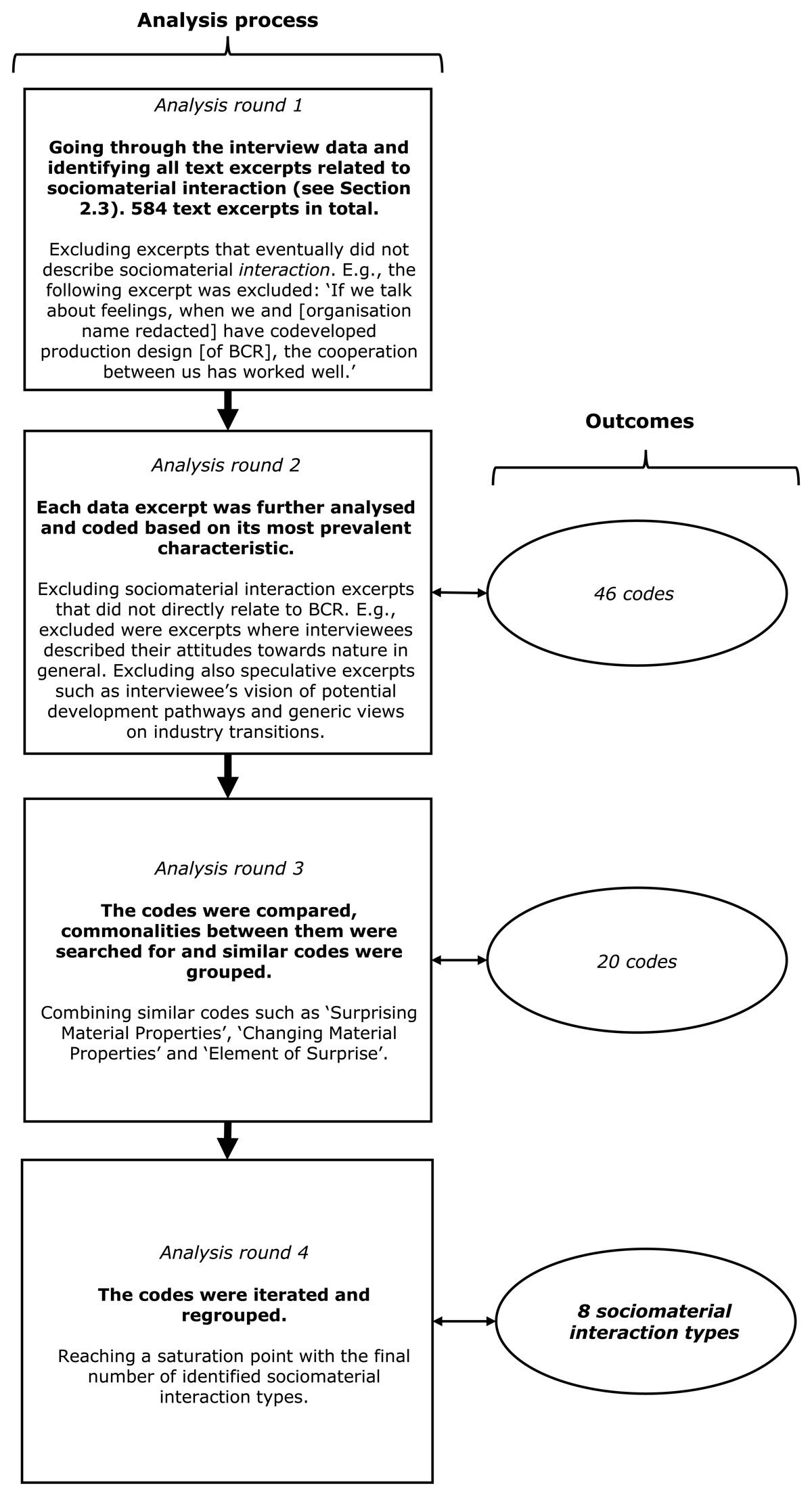
Figure 1
Data analysis process.
Table 2
Identified sociomaterial interaction types manifesting in precast concrete element reuse.
| SOCIOMATERIAL INTERACTION TYPE AND ITS … | DESCRIPTION | QUOTATION EXAMPLE |
|---|---|---|
| Compliance: humans’ possible ways of interacting with reused building components are restricted by the existing institutional frames | Institutional frames (e.g. organisational strategies, priorities, beliefs, culture, national regulation, standards) function as a normative context within which humans interact with reused building components | ‘In Finland, we have the BES system [from the Finnish abbreviation for ‘Concrete element system’; the national open construction system with standardised recommendations for building dimensions], and through that, apartment buildings are built with fairly similar technical solutions […] which in turn probably enables this kind of activity [the reuse of concrete elements] more easily here than in some other countries’ (concrete element manufacturer, chief technology officer) |
| Human orientation: building components cause reactions in humans and are affected by those reactions | A building component (e.g. its appearance, novelty or previous use history) causes reactions among humans (e.g. in their attitudes, beliefs, values and perceptions such as personal sustainability concerns or criticism, feelings towards old buildings or resistance to change) towards the building component. This in turn affects which ways of engaging with the component are seen (not) preferrable in the organisation | ‘[S]till, when this topic [the reuse of concrete elements] comes up, there can be these quite strong perceptions that aren’t really based on anything other than maybe a single experience of a building or something they’ve heard from other people, like “it’s not worth it” or “they’re just old pieces of crap” and things like that. So, we tend to run into fairly strong beliefs when we discuss this issue internally’’ (structural engineering company, head of unit/competence lead) |
| Interpretative framing: an individual’s profession and organisation affect the way BCR is addressed | Humans’ interest in and interface with reused building components is affected by the institutions they represent (including organisational values, strategies and procedures) | ‘So, if we [architects] look, for instance, at the second floor in any building—for us, the floor plan is a blueprint for floor. But an engineer looks at the floor plan and sees it as a blueprint for the ceiling of the first floor. They look at the blueprint from below, because they are thinking about how the floor stays up’ (architectural company, architect/CEO/owner) |
| Leverage: interest towards new ways of interacting with a building component spreads among entities | The reused building component arouses interest among humans for new kinds of interactions (e.g. new business models or economic benefits enabled by BCR). This interest continues to spread among organisations as they acknowledge there exists general interest toward the new interactions enabled by BCR | ‘And as a result of this [project on concrete element reuse] as well, there already are clients who have contacted us, asking, “What about this reuse of concrete elements?”. Now, we’re preparing an offer along the lines of, “Well, what if we designed the demolition of your buildings and the use of those elements in the next projects you have”’ (structural engineering company, head of unit/competence lead) |
| Proof of concept: successful ways of interacting with reused building components grant an organisation credibility among peers | An organisation’s (employee-based) capabilities related to BCR give it credibility and attractiveness in the eyes of other organisations | ‘After all, the world is full of various recycled products that have branded themselves. And now, of course, there is an opportunity to brand these as well [reused concrete elements] in some way. Because it does always bring a kind of slightly unique nuance [to the business]—a nuance that this is, sort of, a bit different and that can also resonate with some customers in a new way’ (construction company, business development manager) |
| Advocate for material: the possibilities one envisions BCR to have to motivate them to promote BCR | Some individuals (e.g. an employee, middle manager or chief executive officer—CEO) instigate changes in the practices, values, attitudes, etc. of others within and/or outside their own organisation regarding and based on the aspects of the reused building component | ‘The property on which everything is based and on which everyone is relying on [regarding the promotion of concrete element reuse]—alongside all the other good properties of concrete—is, most importantly, the strong sustainability performance [of the reused concrete elements]’ (concrete element manufacturer, chief technology officer) |
| Exaptation: repurposing the way a building component is used happens iteratively | Unknown or unfamiliar properties (e.g. CO2 emissions, drying after rain, safety issues) of the to-be-reused building component cause uncertainties for the business-as-usual and future interactions with the component that need to be solved | ‘In this kind of reuse [of concrete elements], what I think is an important point is that we don’t have any ready-made processes, and in fact, we don’t really have any established practices at all. It’s not even very clear to us what types of new buildings these old elements are best suited for. And that clearly also depends on the age of the buildings they come from—different periods have different element typologies and different material properties, and that, in turn, will clearly have implications for the possibilities of subsequent reuse’ (architectural company, architect/CEO/owner) |
| Uncertain business environment: reused building component challenges the existing ways of doing business | The reuse of building components unveils uncharted areas in organisations (e.g. in their procedures, values, know-how or capabilities) that humans need to deal with | ‘In my view, the reuse of concrete elements is a bit like a children’s LEGO set. Not the kind of LEGO set you buy from a shop and build a car from but rather leftover LEGO pieces from five or ten different households—they don’t really belong together in any way, except that they’re LEGO. So, in a certain sense, they do fit together. And then I have to think, “Right, how do I make something new out of these pieces …? How can I turn this situation into a new way of doing business?”’ (architectural company, architect/CEO/owner) |
[i] Note: BCR = building component reuse.
Table 3
The two forms through which a to-be-reused building component manifests and becomes valuable to humans in building component reuse (BCR).
| MAIN CATEGORY AND DEFINITION | SOCIOMATERIAL INTERACTION TYPES | CONNECTION TO EXISTING EXEMPLARY MODELS IN THE LITERATURE |
|---|---|---|
| Intermediary In these interactions, a (reused) building component mediates interactions between humans. Much like a catalyst, the building component is not the unit of interest per se but is still fundamental for mediating the interaction between humans. For humans, a building component of this type represents an individual’s leverage through which they affect another individual |
| Double mangle of practice (Martini et al. 2013) Actant (Latour 1988) Prefabricated concrete element as a catalyst for circularity (Huuhka et al. 2023) |
| Carrier In these interactions, a (reused) building component acts as a carrier for the interaction between two temporally and/or ontologically different social entities. The entities do not directly interact with each other (since they do not share the same space and time, e.g. the difference in the time horizons of companies and regulation), but they interact and deal with the consequences of material agency provoked by the other entity. For humans, a building component of this type represents a conveyor of interaction between individuals through material agency |
| Bricks as hidden sociomaterial entanglements (Berki 2022) Mangle of practice (Pickering 1993, 1995) |
Table 4
Practical implications of the eight identified sociomaterial interaction types.
| SOCIOMATERIAL INTERACTION TYPE | RECOMMENDATIONS FOR COMPANIES | RECOMMENDATIONS FOR PUBLIC SECTOR REPRESENTATIVES |
|---|---|---|
| Compliance | Recognise the prevalent visible and tacit norms in the construction sector, consider their influence on operations and challenge or utilise them where appropriate | Critically examine how established regulatory and procurement practices could be adapted to foster and enable more sustainable BCR solutions beyond conventional approaches |
| Human orientation | Acknowledge that individuals’ perceptions, including their attitudes, values and beliefs, may greatly affect the adoption of BCR practices | Recognise how attitudes and perceived risks influence responses to BCR requirements and incentives, and support awareness-building, stakeholder engagement and professional training |
| Interpretative framing | Consider how organisational structures and norms affect individuals’ decision-making and perspectives, and assess whether they promote or inhibit BCR mainstreaming | Consider how regulation, procurement structures and institutional responsibilities shape decision-making. Clarify aspects that may facilitate or constrain BCR |
| Leverage | Embrace the importance of word of mouth and successful cases in increasing demand for BCR practices and solutions | Utilise public procurement to create demand for BCR and promote credible reference cases to strengthen confidence in reuse practices and solutions |
| Proof of concept | Take the initiative to depart from traditional construction approaches and discover the opportunities that early adoption of BCR may offer | Support BCR pilot and demonstration projects and utilise their evidence and lessons to inform subsequent procurement, regulation and wider adoption |
| Advocate for material | Recognise individuals passionate about reuse solutions and utilise them as internal advocates for the broader adoption of BCR practices and pilot projects | Identify and involve reuse advocates in procurement, regulatory and policy development and utilise their practical knowledge to facilitate cross-organisational learning |
| Exaptation | Study how uncertainty may emerge through material properties, human attitudes and other aspects of BCR and manage the associated risks accordingly | Acknowledge that unexpected technical, regulatory and operational challenges may emerge as BCR develops and create flexible mechanisms for responding to them and integrating the lessons into future guidance and practices |
| Uncertain business environment | Acknowledge gaps in organisational know-how, practices and capabilities and embrace them as opportunities to develop capabilities that advance BCR mainstreaming | Identify wider gaps in BCR-related capabilities, services and infrastructure and support capability development, intermediary roles and the conditions required for functioning reuse markets |
[i] Note: BCR = building component reuse.