
1. INTRODUCTION
In a time of increasing resource scarcity (Mehta et al. 2019), building component reuse (BCR) has become a promising strategy for mitigating the environmental footprint of the construction industry, particularly by reducing greenhouse gas emissions and the need for virgin raw material extraction and production (Hopkinson et al. 2019; Rakhshan et al. 2020; De Wolf et al. 2020). In BCR, whole-building components (e.g. beams, columns, slabs and bricks) are recovered from existing buildings and returned to use with minimal or no reprocessing (Addis 2012; Rakhshan et al. 2020). In practice, this means maintaining the identity, preserving the shape and nurturing the materials of a building component (den Hollander et al. 2017) in order to retain the embedded value of existing building components at a higher level (Cai & Waldmann 2019; Hopkinson et al. 2019).
Reusing building components entails understanding their material side in detail, as material properties greatly determine value-creation options in the construction sector (Blomsma & Tennant 2020; Jemal et al. 2026). However, the value of materials is not determined by their material properties per se but by the human capabilities that emerge in human–material interaction (Uusikartano 2025). The ways materials (such as reused building components) flow in societies are a manifestation of human–material interaction (Alkki et al. 2024). Here, materials have powers that can ‘aid or destroy, enrich or disable, [or] ennoble or degrade us’ (Bennett 2010: ix) in ways that are never decisively known in advance but need to be continually explored by humans (Pickering 1995). This study therefore argues for a need to view BCR through a sociomaterial lens (e.g. Orlikowski 2007; Orlikowski & Scott 2008)—a lens that addresses BCR against the materials (e.g. their properties and characteristics) flowing in society and the societal context (e.g. values, norms, regulation and attitudes) in which the materials flow.
According to sociomateriality, all human actions happen in a material world, which in turn is always experienced through human interpretation. In other words:
there is no social that is not also material, and no material that is not also social.
Sociomateriality emphasises the interaction between humans and materials and acknowledges that materials may sometimes escape humans’ intentions and direct control (e.g. Fatimah & Arora 2016; Pickering 1995) or even shape humankind and its environment (Styre 2017). However, the ways materials become valuable and exceed human control (i.e. the concept of material agency; e.g. Knappett & Malafouris 2008; Latour 2005) have not been considered with regard to BCR. This is a fundamental gap in light of recent studies that characterise material flows in the construction industry as dynamic human–material interactions (Alkki et al. 2024). Furthermore, the construction sector-related literature often emphasises technical problem-solving and practice-oriented concerns in the field, while deeper theorisation of underlying phenomena and processes has received comparatively less attention (e.g. Addis et al. 2016; Klitgaard & Gottlieb 2019; Kokkonen & Alin 2015; Rakhshan et al. 2020).
To deepen the understanding of the material and social factors that configure, manifest and facilitate BCR business, this study examines BCR through sociomateriality. Compared with existing studies on BCR that focused on it as a question of human control, sociomateriality emphasises a non-anthropocentric view and thus focuses on the intricacies of materials—the non-human powers present in the sociomaterial interaction in BCR. Moreover, examining BCR through sociomaterial interaction unveils the involved human capabilities and material properties influencing value creation in BCR.
The research question is as follows: how does BCR manifest as sociomaterial interaction?
This work studies BCR through a qualitative single-case study on precast concrete element reuse in Tampere, Finland, where recovered concrete elements of a deconstructed old office building (i.e. a donor building) are reutilised in several new construction sites. The study draws from 19 semi-structured interviews, 58 months of ethnographic observations and extensive secondary data gathered over the period 2021–26. While precast concrete elements (i.e. reinforced concrete components casted offsite and assembled onsite) represent just one type of building component, they can be argued to have a significant universal nature as a material. That is, concrete was chosen as the unit of observation because it represents the single largest component of human-made mass on the planet (Elhacham et al. 2020) and is a pivotal material for urbanisation and infrastructure development globally. Furthermore, concrete production generates a considerable amount of greenhouse gas emissions (Higuchi et al. 2014), although possibilities for carbon sinks have emerged within the industry (Engelsen et al. 2005).
2. THEORETICAL BACKGROUND
The construction sector represents a major source of emissions and waste, accounting for 35–40% of CO2 emissions worldwide per year (Zhao et al. 2023). Accordingly, interest in BCR has steadily increased as BCR can reduce the consumption of virgin raw materials and, consequently, the environmental impact of the construction sector as a whole, as well as provide access to alternative materials through byproducts (Håkansson & Ingemansson 2013; Brinkman & Miller 2021). The sustainability transformation of the construction sector has been studied in multiple research fields. The circular economy business model literature highlights the value-creation perspective of BCR by describing renewed value creation, capture and transfer mechanisms (Riuttala et al. 2024; Rokio et al. 2024). In a similar vein, institutional entrepreneurship studies connect the implementation of BCR with the active role of entrepreneurs in promoting new technologies, their adoption and related markets (Bullinger 2025; Droege et al. 2023). The circular ecosystem literature highlights the systemic perspective of design processes and addresses BCR as a manifestation of interactions between multiple individuals (Alkki et al. 2025; Harala et al. 2023). The literature on sustainable transitions has focused on the political changes needed to depart from the linear use of concrete (Brinkman & Miller 2021; Shooshtarian et al. 2025). In general, the aforementioned streams focus on the technical and managerial changes that occur in BCR (Bullinger 2025).
Following recent studies that have simultaneously addressed the social and material aspects of the construction sector to fully grasp the complexity of the field (e.g. Alkki et al. 2024; London & Pablo 2017; Padilla Gil et al. 2025), this paper examines BCR as a sociomaterial phenomenon. To understand this approach, it is necessary to explain what social, material and their entanglement—sociomateriality—mean in the context of BCR and in general.
2.1 THE ‘SOCIAL’ IN BCR
BCR is initiated, motivated and performed by humans working typically in temporary interorganisational project arrangements. These arrangements usually involve both private and public actors (Harala et al. 2023; Riuttala et al. 2024; Rokio et al. 2024) that operate under certain institutional logics (Ingstrup et al. 2021) and social institutions (Scott 1995), such as procurement contracts (Håkansson & Ingemansson 2013; Khouja et al. 2021; Lizarralde et al. 2011) and regulation (Condotta & Zatta 2021; Jonker-Hoffrén 2023). Furthermore, as a relatively novel practice in the rather conservative construction sector, BCR calls for new capabilities from humans, including trust in (Chileshe et al. 2016), visions of (Huuhka et al. 2023; Rakhshan et al. 2020) and processing competences for (Bastien-Masse et al. 2025) the reuse of materials.
From a sociomaterial perspective, the ‘social’ in BCR denotes humans who operate in:
broader abstract social structures such as roles, statuses, hierarchies, power relations, communication networks, and other similar constructs
that influence and are influenced by humans (Leonardi 2013a: 41–42). Ultimately, humans in BCR are motivated by a specific goal of reuse that motivates them to engage with building components and against which they address the possibilities related to the to-be-reused building components (similarly, Pickering 1993). Hence, ‘social’ in BCR is relational: multiple actors of different organisations engage with existing human-made building components under the influence of various regulations, policies, industry norms, standards and personal mindsets (Alkki et al. 2025, 2026; Jonker-Hoffrén 2023; da Rocha & Sattler 2009). Against these policies, regulations, mindsets, etc., humans’ interpretation and meaning-making of building components take place.
2.2 THE ‘MATERIAL’ IN BCR
In current research related to BCR, materials manifest first and foremost as technical properties (e.g. durability and structural suitability of building components for reuse; Devènes et al. 2023; Lambec et al. 2025), environmental impacts (e.g. De Wolf et al. 2020) or quantified stocks and flows (e.g. Al-Najjar et al. 2025). Decisions made by humans related to these factors consider the selection, use, recovery and value retention of building components across the life-cycles of buildings and infrastructure: from design and manufacturing to construction, operation, maintenance, repair and demolition (e.g. Adams et al. 2017; Bajwa et al. 2025; Benachio et al. 2020; Çimen 2021; Pomponi & Moncaster 2017).
From a sociomaterial perspective, the ‘material’ in BCR denotes building components’ material performativity (for the concept, see Orlikowski 2005) that emerges when humans provoke materials (Leonardi 2013b). This performativity emphasises that materials such as building components have the ability to make a difference (also known as ‘material agency’; e.g. Knappett & Malafouris 2008; Latour 2005). That is, they can resist and reshape BCR practices, for instance, by changing themselves over time and space (Fatimah & Arora 2016) or causing certain feelings in humankind (DeLyser & Greenstein 2017). Hence, material in BCR is relational. When humans engage with it (see the ‘mangle of practice’ by Pickering 1995), it unveils performativity that is not always immediately or directly controllable by humans (Leonardi 2013a), but rather requires manipulation by humankind (Fatimah & Arora 2016).
2.3 THE ‘SOCIOMATERIAL’ IN BCR
In BCR, social and material collide in multiple ways—be it, for instance, regulation affecting the BCR, humans shaping building components for reuse or building components not aligning with humans’ processing methods or categorisations. Here, human capabilities and goals entangle with material properties and performativity. For example, the decision regarding which materials (e.g. concrete, wood or steel) to use for a building frame fundamentally determines which actors and capabilities are required for the purpose (Bajwa et al. 2025; Choi & O’Brien 2025; Donyavi et al. 2024).
Viewing BCR through a sociomaterial lens highlights:
(a) that all materiality […] is social in that it was created through social processes and it is interpreted and used in social contexts and (b) that all social action is possible because of some materiality.
Thus, humans and materials are entangled (Leonardi 2013b). Building on Berki’s (2022) idea of stamped bricks as hidden sociomaterial entanglements, building components manifest the building practices of contemporary humans while affecting the practices of the people of tomorrow. Hence, BCR manifests as sociomaterial debates in which building components become contested, undergo societal meaning-making and act back when humans provoke them. Here, humans can either try to shape the material world (see the ‘mangle of practice’ by Pickering 1993, 1995) or other humans via materials (see the ‘double mangle of practice’ by Jones 1999; similarly, Martini et al. 2013) while also possibly undergoing changes themselves in the process.
3. METHODS
A qualitative single-case study (Yin 2009) on precast concrete element reuse is presented as regards BCR in its everyday context. The data consist of 19 semi-structured interviews, 58 months of ethnographic observations and extensive secondary data gathered over the period 2021–26 (Table 1). Precast concrete element reuse was selected as the particular unit of observation for BCR because of concrete’s universal significance as a building material, its proportion in human-made mass and the environmental issues related to its use.
Table 1
Data types and sources used in the study.
| DATA TYPE | DESCRIPTION OF THE INTERVIEWED ORGANISATION | INTERVIEWEE AND DATES OF THE INTERVIEW |
|---|---|---|
| Semi-structured interviews (n = 19) |
|
|
|
| |
|
| |
|
| |
|
| |
|
| |
| Ethnographic observation (93 ethnographic observation points; including meeting memos and field notes) |
| |
| Secondary data | News, company reports and media releases, media data, and relevant master’s theses |
[i] Note: Numbers in parentheses indicate the number of data sources.
The case was studied as part of an EU Horizon 2020 research project (‘ReCreate’) dedicated to advancing precast concrete element reuse by examining related critical actors, business models and material characteristics. In the research project, the whole precast concrete element reuse process was examined simultaneously in multiple countries: from the deconstruction of a building and dismantling of related concrete elements to the reuse of those concrete elements in new buildings. In terms of data, this study relied on the Finnish pilot project conducted under the multinational ReCreate project. Of the four European BCR pilot studies in the ReCreate project, the Finnish pilot study was selected due to the authors’ access to the research data as well as the novelty of BCR in Finland. BCR in Finland is in its early phase, where organisations need actively and explicitly to readdress and redefine routines, norms, market structures and practices for reuse business. This makes BCR-related interactions between humans and materials more visible than in more established and institutionalised business contexts.
The research data are based on interviews with organisation representatives involved in the Finnish precast concrete element reuse pilot project. Interviews were conducted with key organisations related to the BCR process, including a demolition company, a construction company, a precast concrete element manufacturer, a structural engineering company, an architectural company and a local city. The interviewees were senior-level personnel, such as department heads or managers, who were asked to describe and explain the critical events, factors and capabilities connecting them to BCR (e.g. what motivates them to promote BCR of precast concrete elements or what economic, technological or social factors affect the BCR).
Ethnographic observation provided data on how organisations interact with the precast concrete elements that are, or could possibly be, reused. In practice, the researchers attended various planning meetings and conducted site visits for the ReCreate project (Table 1) and made written notes about them. The meetings and visits included a diverse range of companies, organisations and individuals involved in BCR. These observations enabled the identification and selection of key individuals from participating organisations for interviews (Table 1), providing a deeper understanding of phase-specific activities and organisational practices.
Thus, ethnographic observation enabled the researchers to identify and form a pre-understanding of meaningful data that could be acquired and analysed. While the interviews provided retrospective accounts of the participants’ experiences and interpretations at a particular point in time, ethnographic observation allowed the researchers to observe BCR as the events unfolded. The multiyear research project provided the authors extended access to the case and more opportunities for observation. This opportunity was utilised to fully grasp the whole BCR process, from dismantling the old office building to the construction of the new buildings—a process whose execution took multiple years due to its scale and novelty. The extended ethnographic observation period was also beneficial to the data validation of the research, as the researchers had more time to discover the case and thus achieve saturation in terms of the BCR-related phenomena observed in the case. The ethnographic observation data were accompanied by secondary data (e.g. news and annual reports) that provided an understanding of the general environment in which precast concrete element reuse takes place.
After the data were collected, they were recorded, transcribed and subjected to qualitative thematic analysis (Braun & Clarke 2006) following an abductive research approach (Tavory & Timmermans 2014) (Figure 1). In the first step, the data were analysed against the existing literature (i.e. the themes presented in Section 2.3), and all relevant text excerpts describing sociomaterial interaction were coded, resulting in 584 coded text excerpts. This coding was executed by two researchers, who first coded the same data independently and then compared the coded text excerpts and debated the differences. If the researchers could not reach a consensus on the differences, then a third researcher was asked for their opinion. In the coding, manifestations of human attitudes, values, social institutions, ways of organising and social meaning making were considered as representations of the social. The material was represented, for instance, by the material properties, technologies, tools, built environment, buildings and building components connected to BCR. A text excerpt describing social or material affecting the other was deemed as a manifestation of sociomaterial interaction. For example, the coded data included the following quotation by a production manager of a demolition company, which was categorised under the sociomaterial interaction type of ‘Compliance’:
When we [i.e. social] are deconstructing old buildings [i.e. material], […] [t]here will always be some surprises that weren’t in the [original building] plans.
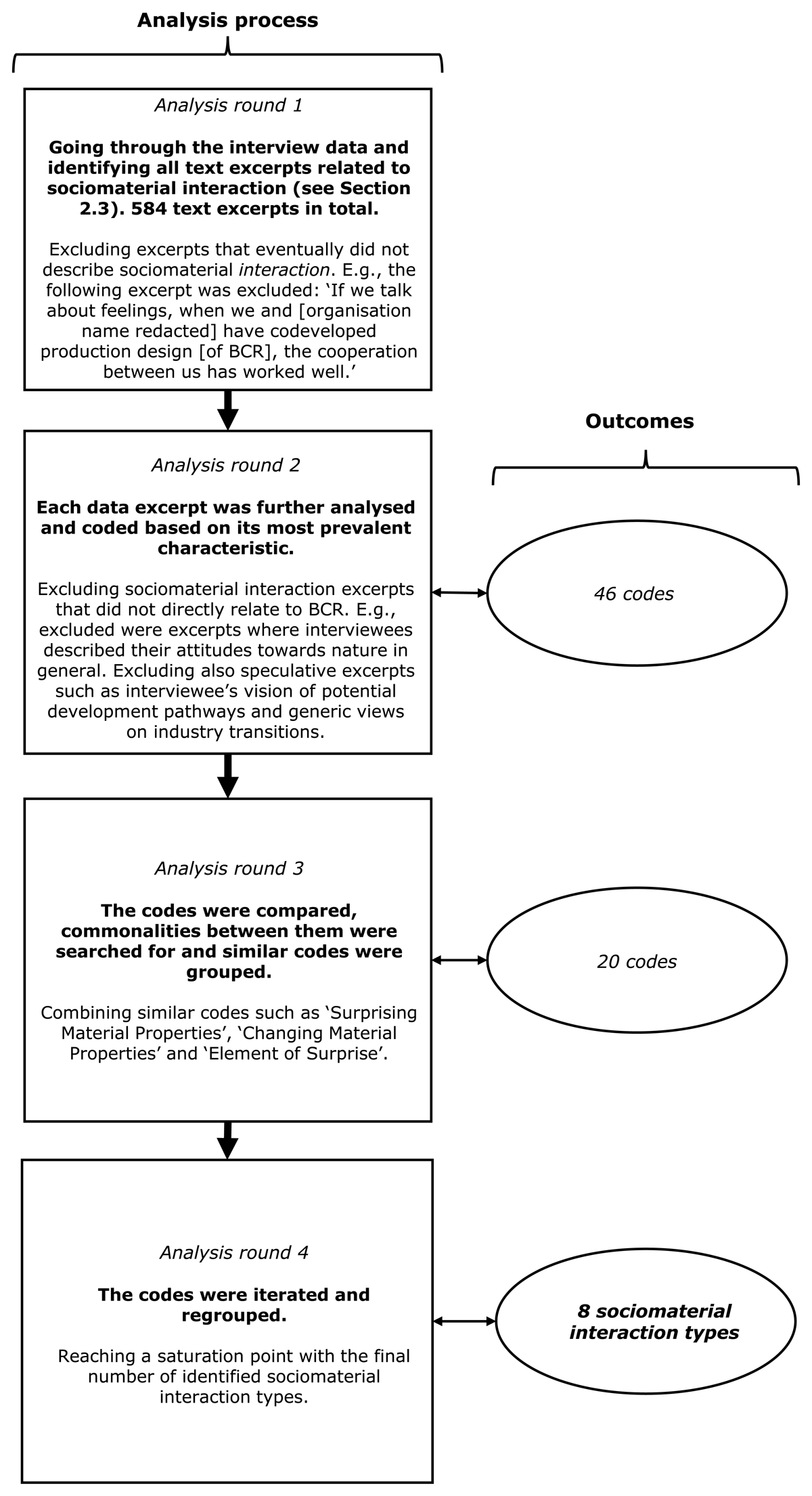
Figure 1
Data analysis process.
This example shows a situation in which humans operate with building components under certain standards and presumptions with which the components do not always align. For more examples of coding, see Table 2.
Table 2
Identified sociomaterial interaction types manifesting in precast concrete element reuse.
| SOCIOMATERIAL INTERACTION TYPE AND ITS … | DESCRIPTION | QUOTATION EXAMPLE |
|---|---|---|
| Compliance: humans’ possible ways of interacting with reused building components are restricted by the existing institutional frames | Institutional frames (e.g. organisational strategies, priorities, beliefs, culture, national regulation, standards) function as a normative context within which humans interact with reused building components | ‘In Finland, we have the BES system [from the Finnish abbreviation for ‘Concrete element system’; the national open construction system with standardised recommendations for building dimensions], and through that, apartment buildings are built with fairly similar technical solutions […] which in turn probably enables this kind of activity [the reuse of concrete elements] more easily here than in some other countries’ (concrete element manufacturer, chief technology officer) |
| Human orientation: building components cause reactions in humans and are affected by those reactions | A building component (e.g. its appearance, novelty or previous use history) causes reactions among humans (e.g. in their attitudes, beliefs, values and perceptions such as personal sustainability concerns or criticism, feelings towards old buildings or resistance to change) towards the building component. This in turn affects which ways of engaging with the component are seen (not) preferrable in the organisation | ‘[S]till, when this topic [the reuse of concrete elements] comes up, there can be these quite strong perceptions that aren’t really based on anything other than maybe a single experience of a building or something they’ve heard from other people, like “it’s not worth it” or “they’re just old pieces of crap” and things like that. So, we tend to run into fairly strong beliefs when we discuss this issue internally’’ (structural engineering company, head of unit/competence lead) |
| Interpretative framing: an individual’s profession and organisation affect the way BCR is addressed | Humans’ interest in and interface with reused building components is affected by the institutions they represent (including organisational values, strategies and procedures) | ‘So, if we [architects] look, for instance, at the second floor in any building—for us, the floor plan is a blueprint for floor. But an engineer looks at the floor plan and sees it as a blueprint for the ceiling of the first floor. They look at the blueprint from below, because they are thinking about how the floor stays up’ (architectural company, architect/CEO/owner) |
| Leverage: interest towards new ways of interacting with a building component spreads among entities | The reused building component arouses interest among humans for new kinds of interactions (e.g. new business models or economic benefits enabled by BCR). This interest continues to spread among organisations as they acknowledge there exists general interest toward the new interactions enabled by BCR | ‘And as a result of this [project on concrete element reuse] as well, there already are clients who have contacted us, asking, “What about this reuse of concrete elements?”. Now, we’re preparing an offer along the lines of, “Well, what if we designed the demolition of your buildings and the use of those elements in the next projects you have”’ (structural engineering company, head of unit/competence lead) |
| Proof of concept: successful ways of interacting with reused building components grant an organisation credibility among peers | An organisation’s (employee-based) capabilities related to BCR give it credibility and attractiveness in the eyes of other organisations | ‘After all, the world is full of various recycled products that have branded themselves. And now, of course, there is an opportunity to brand these as well [reused concrete elements] in some way. Because it does always bring a kind of slightly unique nuance [to the business]—a nuance that this is, sort of, a bit different and that can also resonate with some customers in a new way’ (construction company, business development manager) |
| Advocate for material: the possibilities one envisions BCR to have to motivate them to promote BCR | Some individuals (e.g. an employee, middle manager or chief executive officer—CEO) instigate changes in the practices, values, attitudes, etc. of others within and/or outside their own organisation regarding and based on the aspects of the reused building component | ‘The property on which everything is based and on which everyone is relying on [regarding the promotion of concrete element reuse]—alongside all the other good properties of concrete—is, most importantly, the strong sustainability performance [of the reused concrete elements]’ (concrete element manufacturer, chief technology officer) |
| Exaptation: repurposing the way a building component is used happens iteratively | Unknown or unfamiliar properties (e.g. CO2 emissions, drying after rain, safety issues) of the to-be-reused building component cause uncertainties for the business-as-usual and future interactions with the component that need to be solved | ‘In this kind of reuse [of concrete elements], what I think is an important point is that we don’t have any ready-made processes, and in fact, we don’t really have any established practices at all. It’s not even very clear to us what types of new buildings these old elements are best suited for. And that clearly also depends on the age of the buildings they come from—different periods have different element typologies and different material properties, and that, in turn, will clearly have implications for the possibilities of subsequent reuse’ (architectural company, architect/CEO/owner) |
| Uncertain business environment: reused building component challenges the existing ways of doing business | The reuse of building components unveils uncharted areas in organisations (e.g. in their procedures, values, know-how or capabilities) that humans need to deal with | ‘In my view, the reuse of concrete elements is a bit like a children’s LEGO set. Not the kind of LEGO set you buy from a shop and build a car from but rather leftover LEGO pieces from five or ten different households—they don’t really belong together in any way, except that they’re LEGO. So, in a certain sense, they do fit together. And then I have to think, “Right, how do I make something new out of these pieces …? How can I turn this situation into a new way of doing business?”’ (architectural company, architect/CEO/owner) |
[i] Note: BCR = building component reuse.
In the second step, in a data-driven manner, each data excerpt was further analysed and coded based on its most prevalent characteristic by one researcher, resulting initially in 46 codes (where the same text excerpt could have multiple codes). In the third step, new rounds of analysis followed: the coded text excerpts were compared, commonalities between the excerpts were searched for and similar text excerpts were grouped collectively by three researchers, resulting first in 20 codes and eventually in eight codes. The eight identified sociomaterial interaction types (Table 2) are ‘Compliance’ (mentioned in 123 excerpts/14 interviews), ‘Human orientation’ (77/16), ‘Interpretative framing’ (33/12), ‘Leverage’ (20/10), ‘Proof of concept’ (18/10), ‘Advocate for material’ (32/12), ‘Exaptation’ (54/16) and ‘Uncertain business environment’ (47/14).
To enhance data triangulation, several tactics and tools were employed (e.g. Flick 2004) during the research. Throughout the data-collection process, primary and secondary data were gathered from diverse sources. Moreover, the analysis proceeded iteratively, with researchers first independently analysing and coding the data and then jointly discussing, assessing and validating the results.
4. FINDINGS
Drawing from the empirical data, eight sociomaterial interaction types were identified that manifest in the BCR of precast concrete elements. These types, with examples of quotation, are summarised and discussed in Table 2.
5. DISCUSSION AND CONCLUSIONS
The findings of the single-case study on precast concrete element reuse in the Finnish context reveal how an established building material such as concrete undergoes a sociomaterial process in building component reuse (BCR) through which it becomes contested and reevaluated. BCR needs to be addressed as a broad phenomenon rather than as a mere techno-economic management issue to mainstream BCR and realise meaningful sustainability transformation of the construction sector.
Continuing on the path of previous sociomaterial studies on the construction sector (e.g. London & Pablo 2017; Padilla Gil et al. 2025), this research addresses BCR as a sociomaterial phenomenon. Further analysis of the eight recognised sociomaterial interaction types uncovers two forms through which a building component can manifest in BCR: intermediary and carrier. These forms are to be dealt with and understood when mainstreaming BCR.
5.1 VALUE OF REUSED BUILDING COMPONENTS MANIFESTING THROUGH THE FORMS OF INTERMEDIARY AND CARRIER
To answer the research question ‘how does BCR manifest as sociomaterial interaction?’, the building component was found to manifest in two forms: intermediary and carrier. The forms are presented in Table 3 and further discussed here.
Table 3
The two forms through which a to-be-reused building component manifests and becomes valuable to humans in building component reuse (BCR).
| MAIN CATEGORY AND DEFINITION | SOCIOMATERIAL INTERACTION TYPES | CONNECTION TO EXISTING EXEMPLARY MODELS IN THE LITERATURE |
|---|---|---|
| Intermediary In these interactions, a (reused) building component mediates interactions between humans. Much like a catalyst, the building component is not the unit of interest per se but is still fundamental for mediating the interaction between humans. For humans, a building component of this type represents an individual’s leverage through which they affect another individual |
| Double mangle of practice (Martini et al. 2013) Actant (Latour 1988) Prefabricated concrete element as a catalyst for circularity (Huuhka et al. 2023) |
| Carrier In these interactions, a (reused) building component acts as a carrier for the interaction between two temporally and/or ontologically different social entities. The entities do not directly interact with each other (since they do not share the same space and time, e.g. the difference in the time horizons of companies and regulation), but they interact and deal with the consequences of material agency provoked by the other entity. For humans, a building component of this type represents a conveyor of interaction between individuals through material agency |
| Bricks as hidden sociomaterial entanglements (Berki 2022) Mangle of practice (Pickering 1993, 1995) |
First, a (to-be-)reused building component can manifest as an intermediary. Here, the building component mediates interactions between humans. For example, an organisation can apply a specific set of rules concerning BCR that employees need to follow when operating with the components. Meanwhile, humans motivated to pursue BCR may push organisations to change their related practices to better enable the reuse. The building component hence represents an intermediary through which other entities interact with and affect other entities (aligning with the concept of double mangle of practice; Martini et al. 2013). While the building component is not the unit of interest per se, it is fundamental for mediating the interaction between humans (aligning with Huuhka et al.’s 2023 take on prefabricated concrete elements as a catalyst for circular economy actions). The building component brings the interacting entities together (see Latour’s 1988 example of a door having agency in the sense that it engages humans to go through it instead of trying to break and rebuild a wall each time they enter or exit a room).
Second, a (to-be-)reused building component can manifest as a carrier. Here, the building component acts as a carrier that conveys interactions between temporally and/or ontologically different entities that do not directly interact with each other. An example of a temporal difference is the fundamental difference between the time horizons of companies and regulators operating with a reused building component. Here, humans—with reuse goals—interact with a building component that, in turn, resists or complies with humans’ goals (i.e. humans provoke material agency; Latour 2005). This resistance or compliance of the building component with respect to the reuse goal further causes actions among (either the initial or the newly engaged) humans (Pickering 1993, 1995 calls this ‘the dance of agency’). Thus, the reused building component becomes a carrier that facilitates the interaction between entities and thus conveys interactions between humans through material agency (aligning with Berki’s 2022 take on bricks as hidden sociomaterial entanglements that convey humans’ messages over the decades).
5.2 CONTRIBUTION TO THEORY
This research extends recent sociomaterial scholarship on the construction sector (e.g. Alkki et al. 2024; London & Pablo 2017; Padilla Gil et al. 2025). The research contributes to the literature by explicitly focusing on building components (instead of a general view on whole material flows in the construction sector; e.g. Alkki et al. 2024) and unveiling how materials in BCR become valuable.
The findings of the empirical single-case study not only support the claim that materials sometimes escape humans’ direct control (e.g. Fatimah & Arora 2016; Pickering 1995) and even shape humankind and its practices (Styre 2017) but also show how these claims manifest in practice. That is, this study showed how human–material interaction defines and affects the ways materials are valued in BCR. The sociomaterial lens adopted in this study further highlights that human–material interaction and that BCR are non-linear; they are made of testing, dead ends, failures and countless attempts.
Furthermore, this sociomaterial study conceptualised the two forms in which (reused) building components manifest in relation to existing theoretical concepts and thus provides a robust foundation for BCR-related research to advance theoretically. The concept of a building component as an intermediary aligns with the concepts of double mangle of practice (e.g. Martini et al. 2013) and prefabricated concrete elements as a catalyst for circular actions (Huuhka et al. 2023). Conversely, the concept of a building component as a carrier aligns with the concept of material agency (e.g. Latour 2005), in which materials manifest agency as humans provoke them, thus placing humans and materials in constant dialogue with each other (‘the dance of agency’; Pickering 1993, 1995).
A building component as a carrier also represents what Berki (2022) calls hidden sociomaterial entanglements—materials representing and conveying social meaning-making and messages throughout time and space. Here, the findings of this study reveal how materials (through their properties and characteristics) can activate institutional change through the mediation of the interaction between humans. By doing so, humans and materials co-construct the meaning and positioning of materials—a novel perspective on the changes that materials can instigate at social institutions (e.g. Boxenbaum et al. 2018; Carlile et al. 2013). This paper extends the description of the process through which novel practices become legitimised, giving a fresh perspective on the creation of new meanings attributed to materials through experimentation and interorganisational exchange (Thornton et al. 2012).
5.3 IMPLICATIONS FOR PRACTICE
The findings of this study offer valuable insights into various organisations operating in BCR, enabling them to more effectively comprehend, manage and capitalise on opportunities arising from BCR. The eight recognised sociomaterial interaction types represent intervention points through which practitioners, such as operations and development managers, can facilitate the further mainstreaming of BCR. They can also inform public actors of regulatory development, procurement practices and circular construction policies by demonstrating that the mainstreaming of BCR depends on technical requirements, institutional conditions, demand structures and shared expectations that shape construction activities. Table 4 presents practical recommendations for practitioners regarding each sociomaterial interaction type.
Table 4
Practical implications of the eight identified sociomaterial interaction types.
| SOCIOMATERIAL INTERACTION TYPE | RECOMMENDATIONS FOR COMPANIES | RECOMMENDATIONS FOR PUBLIC SECTOR REPRESENTATIVES |
|---|---|---|
| Compliance | Recognise the prevalent visible and tacit norms in the construction sector, consider their influence on operations and challenge or utilise them where appropriate | Critically examine how established regulatory and procurement practices could be adapted to foster and enable more sustainable BCR solutions beyond conventional approaches |
| Human orientation | Acknowledge that individuals’ perceptions, including their attitudes, values and beliefs, may greatly affect the adoption of BCR practices | Recognise how attitudes and perceived risks influence responses to BCR requirements and incentives, and support awareness-building, stakeholder engagement and professional training |
| Interpretative framing | Consider how organisational structures and norms affect individuals’ decision-making and perspectives, and assess whether they promote or inhibit BCR mainstreaming | Consider how regulation, procurement structures and institutional responsibilities shape decision-making. Clarify aspects that may facilitate or constrain BCR |
| Leverage | Embrace the importance of word of mouth and successful cases in increasing demand for BCR practices and solutions | Utilise public procurement to create demand for BCR and promote credible reference cases to strengthen confidence in reuse practices and solutions |
| Proof of concept | Take the initiative to depart from traditional construction approaches and discover the opportunities that early adoption of BCR may offer | Support BCR pilot and demonstration projects and utilise their evidence and lessons to inform subsequent procurement, regulation and wider adoption |
| Advocate for material | Recognise individuals passionate about reuse solutions and utilise them as internal advocates for the broader adoption of BCR practices and pilot projects | Identify and involve reuse advocates in procurement, regulatory and policy development and utilise their practical knowledge to facilitate cross-organisational learning |
| Exaptation | Study how uncertainty may emerge through material properties, human attitudes and other aspects of BCR and manage the associated risks accordingly | Acknowledge that unexpected technical, regulatory and operational challenges may emerge as BCR develops and create flexible mechanisms for responding to them and integrating the lessons into future guidance and practices |
| Uncertain business environment | Acknowledge gaps in organisational know-how, practices and capabilities and embrace them as opportunities to develop capabilities that advance BCR mainstreaming | Identify wider gaps in BCR-related capabilities, services and infrastructure and support capability development, intermediary roles and the conditions required for functioning reuse markets |
[i] Note: BCR = building component reuse.
5.4 LIMITATIONS AND FUTURE RESEARCH AVENUES
This study has some limitations due to the research methods chosen. To enable a deep empirical take on sociomaterial interaction, a conscious decision was made to concentrate on an easily accessible Finnish case of precast concrete element reuse. This makes the research limited in terms of geography and material. However, the findings are assumed to be relatively generalisable, at least to European contexts, which seem to share many similarities, for instance, in terms of sustainability strategies (e.g. McDowall et al. 2017).
Moreover, as argued in Section 1, the global societal significance and universal characteristics of concrete make this case somewhat universal. Although the manifestations of the identified sociomaterial interaction types and the two related forms of reused building components may vary greatly between contexts, the authors regard their existence as universal. Testing the generalisability of the results of this study in other countries and continents is an important avenue for future research.
ACKNOWLEDGEMENTS
The authors thank all the interviewees for their vital collaboration in the research. They also extend their sincere thanks to Professor Leena Aarikka-Stenroos for funding acquisition and supervision that enabled the research. The authors thank Linnea Harala, Eeva-Leena Pohls, Mari Riuttala and Prabhat Thakuri for help in the data collection. They also thank the anonymous reviewers for their invaluable help in finalising this article.
AI DECLARATION
No artificial intelligence (AI) was used in the research, writing or editing of this publication.
AUTHOR CONTRIBUTIONS
J.U.: Conceptualisation, formal analysis, validation, writing—original draft, writing—review and editing. L.A.: Conceptualisation, methodology, investigation, formal analysis, validation, writing—original draft, writing—review and editing. V.C.: Conceptualisation, validation, writing—original draft, writing—review and editing.
DATA ACCESSIBILITY
The data supporting this study are not publicly available due to data privacy policies of the project in which the data were collected.
ETHICAL APPROVAL
Informed consent was obtained from each interviewee/participant before their involvement commenced.