
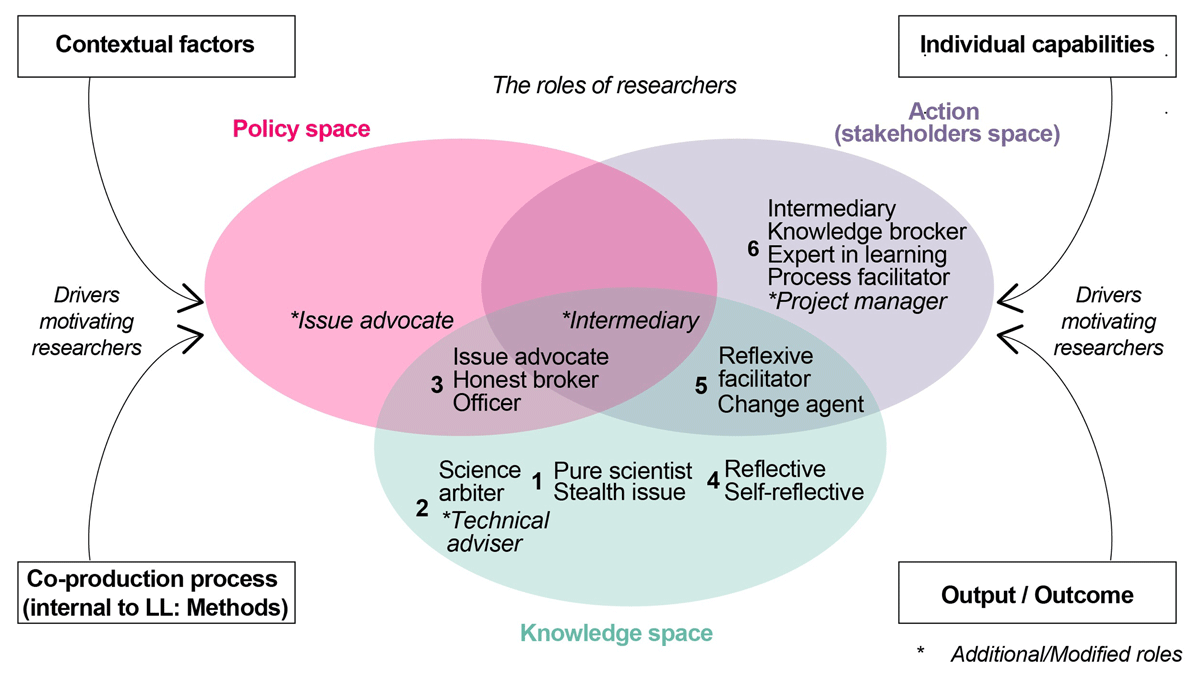
Figure 1
Scheme of the conceptual framework.
Source: Based on the conditions for knowledge co-production proposed by Schuttenberg and Guth (2015) and the typology of the role of researchers proposed by Kruijf et al. (2022).
Table 1
Conditions and potential drivers to influencing the roles of researchers, as adapted during the focus group discussions.
| MAIN CATEGORY | CONDITIONS AND POTENTIAL DRIVERS FOR THE ROLES OF RESEARCHERS |
|---|---|
| Contextual factors | Characteristics of social movements |
| Governing institutions and governance systems | |
| Funding schemes | |
| Academic environment* | |
| Cultural and social characteristics and values | |
| Consolidated power dynamics | |
| Ecosystems characteristics and services | |
| Co-production process | Consortium partnership* |
| Funding constraints* (specific to the LL) | |
| Engagement of representative stakeholders | |
| Facilitation of iterative learning (translation) | |
| Employ of adequate methods | |
| External recognition* | |
| Focus on meaningful issues | |
| Use conflict-resolution processes | |
| Individual capabilities | Management skills |
| Legal and policy expertise | |
| Cultural knowledge and practice (relation with the community) | |
| Facilitation capacities | |
| Physical, natural and social sciences | |
| Personal motivations and career status* | |
| Spatial analysis | |
| Outputs/Outcomes | Empowered stakeholders, transformative learning, social capital |
| Salient, legitimate and credible knowledge for policymaking | |
| Knowledge relevant for other scientists (academic products) | |
| Sustainability solutions and changes (effective for the territory) |
[i] Notes: Drivers with * were not mentioned in the Schuttenberg and Guth framework (2015) or were moved from one category of conditions to another.
Drivers in italics were not included.
For more details about each condition, see Appendix 2 in the supplemental data online.
Table 2
Categories and typologies of roles proposed by Kruijf et al. (2022) with the results of the research.
| CATEGORIES AND ROLES | MAIN OBJECTIVES OF EACH TYPOLOGY OF ROLES | OBJECTIVES IDENTIFIED BY RESEARCHERS INTERVIEWED DURING THE RESEARCH |
|---|---|---|
| Category (1) Knowledge space | ||
| Pure scientist | Deliberate distance from policy | N/A |
| Stealth issue advocate | Production of knowledge disconnected from decision-making process | N/A |
| Technical expert* | Data collection and analysis and restitution towards public authorities and residents. Integration of local knowledge from residents | |
| Category (2) Knowledge space close to policy space | ||
| Science arbiter | Production of evidence for policy | Support on the theoretical concepts used in the LL together with academic and non-academic partners |
| Category (3) Policy space | ||
| Issue advocate | Active contribution to policymaking | Provide knowledge on issues less known by public authorities |
| Honest broker | Production of policy alternatives | Convince public authorities and residents to take certain actions and get involved in experiments |
| Officer | Production of evidence for policy specific to environmental sciences | N/A |
| Category (4) Knowledge space close to action space | ||
| Reflective scientist | Production of knowledge with awareness of the power relationships involved in the process | Connection between the territory and involved communities with relevant theory. Little scientific production owing to time constraints |
| Self-reflective scientist | Production of knowledge with the focus on the own’s involvement in the process | N/A |
| Category (5) Knowledge and action spaces – engagement in the process of facilitation but with an objective to produce knowledge | ||
| Reflexive facilitator | Production of knowledge through an active participation in the process | Production of knowledge about the process in collaboration with others targeting other researchers |
| Change agent | Focus on motivating and providing advice for stakeholders to engage in processes of experimenting alternative practices | N/A |
| Category (6) Action space | ||
| Intermediary | Setting up connections between stakeholders from different spheres | Act between action and production of knowledge |
| Knowledge broker | Translation and combination of knowledge from different sources | N/A |
| Expert in learning | Assistance for stakeholders to learn from the process they engage in | Translate complex and technical knowledge to wider audience |
| Process facilitator | Organisation of the process in terms of who is involved and how | Animation and facilitation of activities without a purpose to produce knowledge. Mediation of internal conflicts (e.g. to find common grounds between partners) |
| Project manager* | Coordination and management of the LL | |
[i] Notes: N/A = not applicable to the researchers who participated in the study.
* = additions or modifications to roles (in terms of the categorisation in one of the three spaces) to the framework.
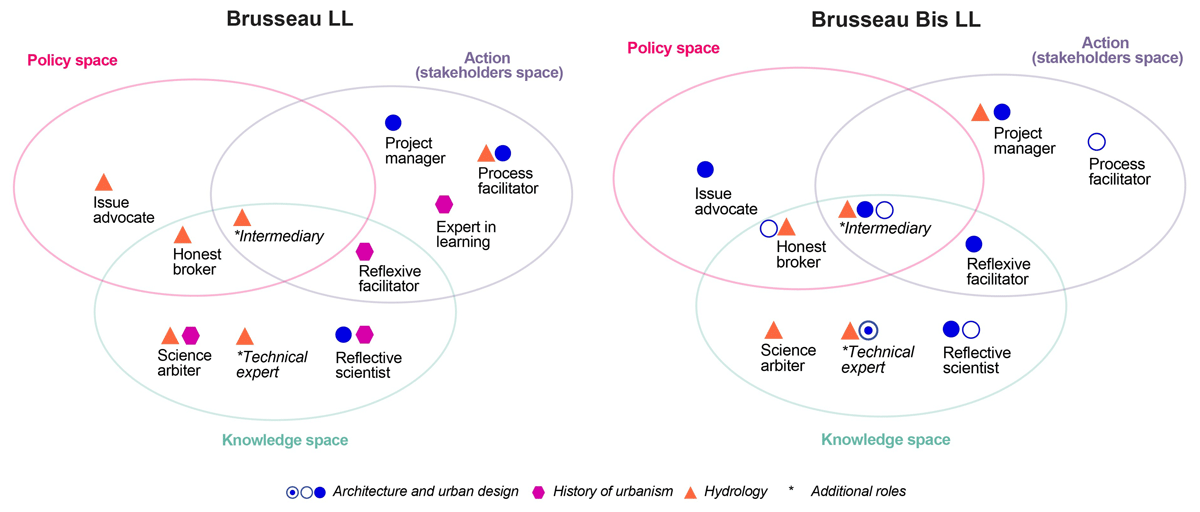
Figure 2
Scheme representing the roles taken by researchers in the two living labs.
Note: Each researcher is represented based on the main field of their affiliated research centres.
Table 3
The drivers identified by researchers respecting their different roles in the Brusseau and Brusseau bis LLs.
| TYPE OF SPACE | ROLE OF THE RESEARCHER | CONDITIONS (DRIVERS) | MOTIVATING THE ROLES |
|---|---|---|---|
| Action (stakeholder) space | Process facilitator | Contextual factors | Characteristics of social movements – rising awareness of environmental challenges (Interview 2) |
| Co-production process | Consortium partnership (Interviews 1 and 3) | ||
| Individual capabilities | Physical, natural and social sciences (Interviews 3 and 4) | ||
| Project manager | Co-production process | Consortium partnership (Interview 3) | |
| Expert in learning | Individual capabilities |
| |
| Knowledge space | Reflexive facilitator | Contextual factors | Academic environment and protocol (Interviews 3 and 4) |
| Outputs/outcomes | Knowledge relevant for other scientists (Interview 4) | ||
| Science arbiter | Contextual factors | Characteristics of social movements – Need of the community (Interview 1) | |
| Co-production process | Consortium partnership (Interview 1) | ||
| Technical expert | Individual capabilities | Previous training in natural and applied sciences (Interview 1) | |
| Co-production process | Consortium partnership (Interview 5) | ||
| Individual capabilities | Cultural knowledge and practice (Interview 5) | ||
| Reflective scientist | Contextual factors | Institutional context (Interview 1) | |
| Contextual factors | Academic environment and protocol (Interview 3) | ||
| Outputs/outcomes |
| ||
| Policy space | Intermediary | Co-production process | Engagement of representative stakeholders (Interview 4) |
| Individual capabilities | Intellectual stimulation (Interview 2) | ||
| Honest broker | Individual capabilities | Researcher taking a militant stance even under external criticism (Interview 2) | |
| Issue advocate | Co-production process |
|