
1. Introduction
Transformative adaptation aims to address the root causes of human vulnerability and exposure to climate change. Inclusive decision-making, equity and sustainability outcomes are cornerstones of this pursuit, which requires crafting futures that disrupt dominant practices of development (Pelling 2010). Despite consolidated traditions of participatory planning (Legacy 2017), adaptation investments continue to work within established development paths rather than stopping, questioning and opening spaces for different futures to be considered. If the inequities baked into dominant development pathways and practices are the root cause of human vulnerability and exposure to climate risk, then an urgent need exists to strengthen methodologies that can surface and act on alternatives (Scolobig et al. 2023) as part of climate resilient development (Werners et al. 2021).
Normative future visioning (NFV) is an approach to planning that responds to this need; it entails producing and discussing aspired future end-states, and the trajectories to move between past, present and future, and vice versa, to achieve collective goals (Uwasu et al. 2020). As part of a wider set of future visioning methods, normative imaginations sit alongside probabilistic and exploratory approaches. These stem from distinct epistemic traditions that can be combined to support adaptation planning that is realistic and yet disruptive (Lemp et al. 2008; Star et al. 2016). Practices for imagining the future have long existed (Shipley 2000) and are established across the public and private sectors (McCann 2001). Yet, within climate change adaptation, NFV methods have not been routinely deployed, which calls for more attention to its possibilities and challenges (Nalau & Cobb 2022).
While acknowledging the advantages of combining methods (generating hybrid future visioning), this paper focuses on the normative form (Pelling et al. 2023). This is because of NFV’s potential to facilitate imagination and critical thinking for challenging the present (Balug 2019; Davis & Hatuka 2011) and opening pathways for transformative adaptation towards a climate-resilient future (Pelling 2010). Yet normativity alone is insufficient in the pursuit of transformation, and could even disguise unjust processes. Pure wishful thinking without an attention to structural inequalities that shape plausible and desired futures can lead to unintended negative consequences in policy and planning (Frantzeskaki & Rok 2018; McPhearson et al. 2016). This calls for visioning approaches that focus on desirability but which are attentive to social learning dynamics and entrenched power imbalances. Such power can lie both in the describing of aspired futures and in the translation of visions into action, that is, in the process of NFV and its positioning within wider adaptation planning strategies.
This paper proposes that NFV can be seen and applied as a critical pedagogy for transformative adaptation in cities. It elucidates this potential through an analytical framework that borrows insights from critical (urban) pedagogies (Freire 1970; Allen et al. 2022) and which enables the examination of NFV’s process and positioning from a perspective of power. This is tested against an empirical NFV method deployed in nine urban contexts as part of a wider decision-support environment for inclusive risk management – the Tomorrow’s Cities Decision Support Environment (TCDSE).
The following question is addressed:
How may NFV support more inclusive and critical decision-making, as well as equity-conscious adaptation strategies?
The paper is structured as follows. Following this introduction, the paper contextualises its analysis through a review of the potentials and challenges of NFV (Section 2). The analytical framework is then presented with reference to critical pedagogies and critical urban theory (Section 3). Then the empirical and methodological context for testing this framework is described (Section 4) and applied (Section 5). The discussion (Section 6) highlights the utility of the analytical framework as an approach for understanding the transformative potential and challenges of NFV. The conclusion (Section 7) outlines key lessons for transformative adaptation policy and research in cities inspired by NFV.
2. Normative future visioning
Future visioning methods can be organised around three distinct approaches: probabilistic, exploratory and normative. Probabilistic future visioning asks what the future will likely be, which can offer more precision, but also more technocracy, to policy and planning activities (Palmer 2012; Menteşe et al. 2023). Exploratory future visioning asks ‘what if’ questions, which can reveal the consequences of decisions made today on different future states (Duinker & Greig 2007; Bizikova et al. 2015; Davidson & Kemp 2023). It relies on scenario-based thinking, which can cope better with uncertainty and complexity, and yet hamper concerted action if options become overwhelming (Chakraborty et al. 2011; Lord et al. 2016). NFV focuses on what is desired. It asks ‘what does a good future looks like’ and which policies/decisions might best lead to such a future (Van der Voorn et al. 2012; Tuominen et al. 2014).
In practice, these three types are seldom deployed in a pure form (Gladkykh et al. 2021); they combine different questions and knowledge traditions, generating hybrid future visioning methodologies. The literature on future studies has increasingly emphasised the complementarity of quantitative and qualitative methods despite their contrasting procedures (Lemp et al. 2008; Ratcliffe & Krawczyk 2011; Star et al. 2016). For instance, probabilistic approaches can help to make NFV more realistic and informed by trends (Uwasu et al. 2020), and exploratory approaches can lead to a more nuanced analysis of aspired futures, where different degrees of plausibility and desirability can be correlated (Sheppard et al. 2011; Iwaniec et al. 2020).
Combining methods is nonetheless a delicate task, as curated pieces of information on the future could bias discussions or reinforce power imbalances between scientists, communities and decision makers. For instance, are probable or possible futures used to trigger conversations on desirability (i.e. through the ranking of pre-prepared options) (Bizikova et al. 2011; Bolleter et al. 2024) or are desired futures a product of free and bold imagination, later constrained or challenged by trends and plausibility (Daffara 2011; van Vliet & Kok 2015; Iwaniec et al. 2020)? These decisions matter. Especially when future visioning has policy implications, more attention is needed on issues of authorship, that is, how methodological choices shape the thinking of futures (Morris et al. 2021) and the impact on action this could ultimately produce (Robinson et al. 2011).
While acknowledging the hybridity of future visioning in practice, this paper chooses to focus on the concept of NFV owing to its potential to unlock imaginations and motivate purposeful action, which can challenge or move away from dominant, unjust trends and towards transformative adaptation (Ratcliffe & Krawczyk 2011; Pelling et al. 2023). In this context, NFV can be seen in itself as an umbrella term that encompasses methods such as normative foresight (Andreescu et al. 2013), normative scenarios (Glenn & Gordon 1999; Skea et al. 2021) city visioning (Dixon et al. 2018) and backcasting (Robinson 2003).
Here we are more interested in the similarities – shaped by normativity – than in the differences between these methods, although some discrepancies are worthy of recognition. Within climate change studies, normative methods often appear as a subset of exploratory approaches (Iverson & Corry 2004; Ligmann-Zielinska & Jankowski 2010) aimed at unpacking options, and the process tends to be scientifically led and with longer timeframes for future exploration (Sheppard et al. 2011). Within urban/strategic planning accounts, normative city visioning tends to appear as a tool/procedure led by state institutions to guide policy and planning (Dixon & Tewdwr-Jones 2021), although the integration of scenarios can still be found (Ratcliffe & Krawczyk 2011; Dixon et al. 2018). In the latter strand, normative approaches are dominant, but they are often constrained by the pressures of shorter political cycles and, as critical views argue, too focused on finding consensus (a single, agreed future) at the expense of social differences and the inequalities surrounding them (Harrison 2006; Johansson 2021).
By and large, studies argue for the usefulness of NFV for communicating and localising global goals and agendas (such as the Paris Agreement) in local contexts (Skea et al. 2021) or for connecting different planning instruments across sectors and levels of government (Gaffikin & Sterrett 2006). Climate studies have also shown the role of future visioning (including normativity) in bridging science and policy (Iverson & Corry 2004). Trends and plausible scenarios could be useful tools for decision makers to anticipate events, create contingency plans and calibrate their normative goals (Chakraborty et al. 2011; van Vliet & Kok 2015). Moreover, scientists could have political roles, showing creative future alternatives to the public and policymakers or introducing visualisation strategies to incentivise bolder and transformative thinking (Waldhardt et al. 2010).
Whether closer or further from scientific spaces, NFV experiences have in common their ability to surface values as part of imagination exercises (Avin & Goodspeed 2020; Harmáčková et al. 2023), which could be made more or less explicit – and challenged – through chosen methods (Johansson 2021). That is, NFV can be more than just asking what a desired future looks like; it can be an examination of why that desired future is meaningful and the extent to which such a future could be equitable or sustainable (McPhearson et al. 2016; John et al. 2015).
Unpacking and discussing these nuances requires opening dialogical spaces where visioning becomes an opportunity for constructive social learning (Robinson 2003; Nikolakis 2020) and equitable partnership (the idea of co-production) (Frantzeskaki & Rok 2018). In these spaces, visioning could create opportunities for the production of radical narratives that raise marginalised voices and claim the future (Miraftab 2009). This shift calls for an inquiry into the very role of NFV in adaptation planning: spanning its application from therapeutic tool to an instrument for critical thinking, action and change.
2.1. Inquiring ‘process’ and ‘positioning’
Two areas of NFV deserve more attention. First, most of the literature on NFV claims some degree of public participation. Yet few accounts dig deep enough into methodological details (‘process’) that reveal how to deal with questions of power (see Gaffikin & Sterrett 2006; Frantzeskaki & Rok 2018; Dixon & Tewdwr-Jones 2021; Johansson 2021 for some critiques). For example, it is often common for experiences to report that a sample of the local community was invited to imagine futures or discuss scenarios. But who are exactly those groups? To what extent are they representing or surfacing issues of sociopolitical marginality or climate vulnerability? To what extent are methods opening opportunities for participants to learn from each other and challenge futures and the status quo that they might represent? And does inclusion in future thinking mean real capacity to influence decision-making?
Second, while there is evidence that NFV has been used as part of progressive policy reforms in the global south (Lipietz 2008; Marx 2011) and north (Peel & Lloyd 2005; Dixon et al. 2018), there is little investigation around the ‘positioning’ of NFV within wider policy strategies, and the consequences of its specific articulation with other technical or political activities. That is, when is NFV employed in a wider decision-making structure, and with what purpose? Currently, NFV seems to be loosely connected to policy scoping processes and does not generate robust pathways into the future, which limits its possibilities to have real impact (Quist et al. 2011; van der Voorn et al. 2023). In contrast, where NFV is embedded within policy or project planning processes, this tends to be in a more constrained form – as a means to gather inputs and legitimise plans (McCann 2001; Shipley & Michela 2006) rather than to strengthen potentials for transformation (McPhearson et al. 2016).
3. The encounter–change framework for evaluating normative future visioning
Acknowledging the imaginative potentials of NFV, but also mindful of its silences, this paper puts forward the Encounter–Change Framework to support practices that are future- and transformation-oriented. The framework adds detail to the questions of process and positioning through four interdependent components that unfold cyclically; a) encounter, b) connection, c) emancipation, and d) action and change; it will be henceforth called the ‘Encounter–Change Framework’ (Figure 1). This allows NFV experiences to be analysed and refined, and new interventions to be designed more intentionally towards transformation. Encounter exposes participants to new views, experiences, information and knowledge; connection links knowledge to critical thinking to foreground injustices and power imbalances; emancipation allows critical thinking to lead to the development of capacities for collective consciousness; and action and change translate consciousness and knowledge into transformation.
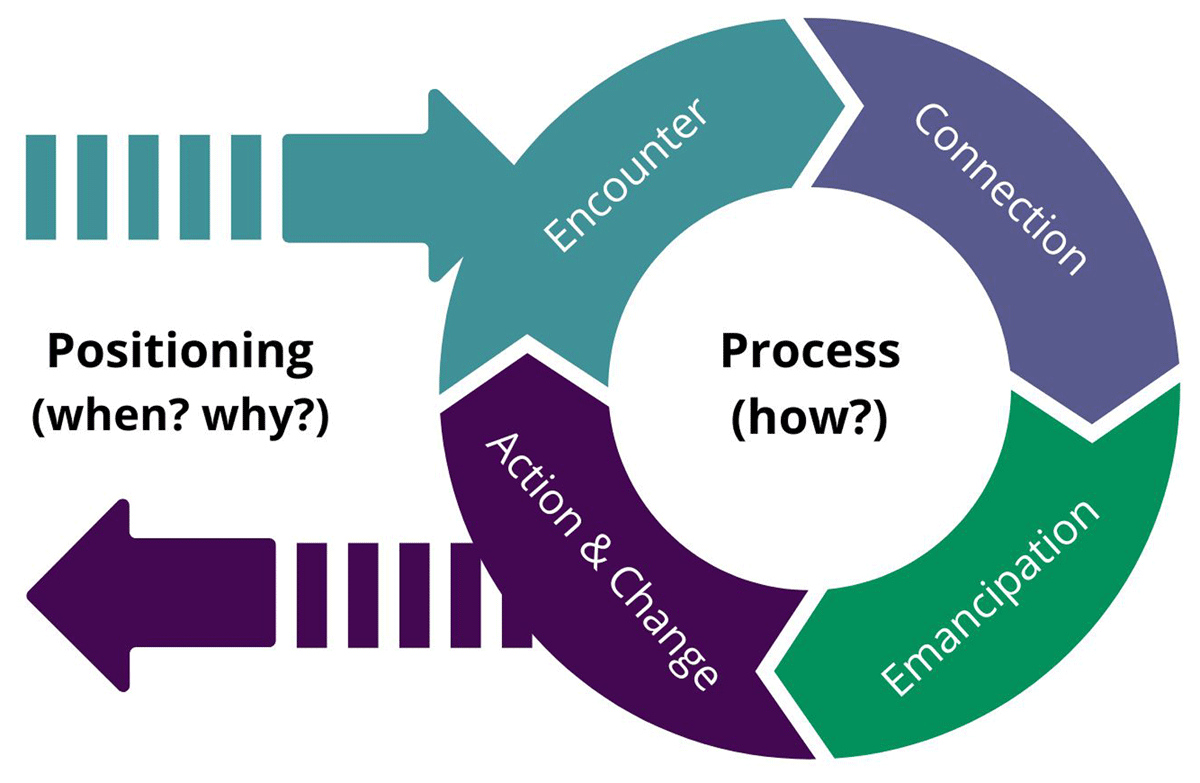
Figure 1
Encounter–Change Framework for evaluating the contributions of NFV.
This framework draws on key themes from the literature on critical pedagogies (Freire 1970, 1973; hooks 2003), which focuses on critical learning and its relationship to emancipation and change. It follows and unpacks Freirean theory, which posits that critical pedagogies have two distinct moments: the unveiling of inequalities (encounter, connection, emancipation) and subsequent action (action and change) (Freire 1970). Critical pedagogies can encompass diverse strategies but usually entail incentivising transgressive thinking for concrete social action (Steinberg & Down 2020). In this approach, learning is devoted to developing critical consciousness as the capability ‘to think critically and assess the world’ (hooks 2003: 8).
Critical consciousness can arise from encountering new knowledge (learning) or through confronting unjust social norms and behaviours that have been normalised (unlearning) (Thambinathan & Kinsella 2021). Unlearning is often connected to the ethos of decoloniality (Tiostanova & Mignolo 2012), since both epistemologies aim to free marginalised groups from their bonding with dominant thinking and values (Freire 1970: 22). In this sense, critical consciousness goes beyond learning; it is oriented towards the liberation from ways of being and knowing that have been accepted without reflection. According to Freire, emancipation is like a ‘painful birth’ (Ibid: 23) that leads to increased social capacities and hope for the future.
While critical pedagogies may be associated with individual and subjective learning processes, they can also unfold as collective learning and move towards action in the public sphere (Giroux 1983). They could be framed as bottom-up processes that move from small-scale moments of emancipation to large-scale social mobilisation. Those involved in learning may identify common experiences that speak to broader dynamics – for instance related to colonialism, race or gender. Although departing from a more atomised process of reflection, critical learning seldom stops at the scale of the individual; it ripples, bonds and connects, provided the process is indeed reflective and empowering (Teasley & Butler 2020).
Many of these ideas are further explored by critical urban theory, which focuses on understanding cities and urban processes from a perspective of power and inequality. Learning in different and transgressive ways – with/within/across diverse urban realities, and from uncommon sources – is part of critical urban theory’s proposal (Watson 2009). This could involve, for instance, encountering everyday coping and adaptation strategies that emerge from common urban residents (Simone 2004; Bhan 2019), questioning certain connections (e.g. urban agendas and best practices that conventionally travel from north to south and from west To East (Simone 2010; McFarlane 2010; Robinson 2016), or recognising action spaces of radical planning that emerge from emancipated marginalised groups (Miraftab 2009).
‘Critical urban pedagogies’ is a common subgenre within critical urban theory, where transgressive learning is approached through an urban lens. Recent accounts include, for instance, the work of Allen et al. (2022), which explored the strategies of social and housing movements in the global south, and identified different practices that were geared towards transformation: weaving (connecting different knowledges, and past with future), sentipensar (connecting rationality and emotions in an non-hierarchical way), emancipating (intertwined with action – thinking/crafting new pathways into the future), mobilising (connecting intersectional and intergenerational struggles through action) and reverberating (amplifying discourses to reach new audiences and increase impact). Meanwhile, Comelli (2022) and Ortiz and Millan (2022) have also emphasised the role of critical urban pedagogies for the building of local solidarity practices and urban citizenship performances in peripheral urban areas, all oriented towards action and change and all led by emancipated (critical, reflexive) marginalised urban actors.
Taken together, these are valuable lessons for NFV methods that pursue transformative adaptation. Table 1 suggests an approach to evaluating NFV through a critical (urban) pedagogies lens; each component indicates a learning stage (suggesting attention to NFV processes and methodological choices), as well as a transition from imagination to action (indicating need to reflect on positioning within wider adaptation and policy impact strategies).
Table 1
Examples of empirical indicators for an evaluation of NFV based on critical (urban) pedagogies
| COMPONENT | CRITICAL (URBAN) PEDAGOGIES | APPLICATIONS IN NFV |
|---|---|---|
| Encounters | New views and experiences, peripheral territories and marginalised urban knowledges, structural domination patterns. | Surfacing choices related to participation and inclusion (who is invited to imagine futures and why). |
| Connections | Across knowledges, between individual experience and social/collective consciousness, between dominant and marginalised practices. | Opening spaces for meaningful relationship building (e.g. between communities, scientists and decision makers), for sharing visions from collective lenses, and for understanding desires against trends and possibilities (connecting methods). |
| Emancipation | Through conflict and ‘unlearning’ of dominant views. New strategies for planning (e.g. from strict rationality to thinking-feeling, radical practices). | Empowering marginalised groups through visioning processes and outputs; surfacing values; fostering spaces where future assumptions, technical interpretations and dominant practices can be challenged. |
| Action and Change | Embodying learning and practising what is learnt. Increased capacities leading to concerted social action. Solidarity and urban citizenship performances practised. | Allowing spaces for strategising around impact on the basis of visions. Politicising visions and touching on the root causes and drivers of inequalities for critical adaptation practices. |
4. Evaluating normative future visioning experiences
The following sections of this paper deploy the Encounter–Change Framework through an evaluation of NFV undertaken as part of the Tomorrow’s Cities project. Tomorrow’s Cities is a large interdisciplinary and international hub aimed at breaking cycles of risk through inclusive and equity-oriented interventions in urban planning (Galasso et al. 2021). The Tomorrow’s Cities Decision Support Environment (TCDSE) methodology standardises the work across partner cities (nine to date). There are six phases to the project, which could be iterated as: a) project set-up and data scoping, b) normative future visioning, c) visioning scenarios, d) computational modelling, e) risk agreement and learning, and f) policy implementation (Cremen et al. 2023).
Because the TCDSE methodology incorporates NFV within a wider dynamic of future urban planning in each city, it allows assessment of both process and positioning. The present paper develops a structured evaluation of NFV as deployed by Tomorrow’s Cities through the testing of the Encounter–Change Framework. The framework provides a theoretical-methodological contribution to transformative adaptation and risk management more widely, while the Tomorrow’s Cities experience offers a way to test this contribution from an empirical perspective.
Empirical data is presented from the nine applications of the TCDSE: Quito (Ecuador), Nairobi (Kenya), Istanbul (Turkey), Kathmandu and Rapti (Nepal), Nablus (Palestine), Dar es Salaam (Tanzania) and Chattogram and Cox’s Bazar (Bangladesh) – all marked by rapid urbanisation, inequality and multiple hazards. Over three years, more than 18 NFV workshops were deployed (at least two per city) as part of a wider programme of stakeholder engagement. Each workshop gathered an average of 30 local participants from diverse social, economic and cultural backgrounds, often with representation of policy actors from local and municipal governments. Data reported on below draw from direct participation in each workshop as well as a review of the project documentation – workshop reports, minutes from debriefing sessions with facilitators following training and workshop deployment, and the city’s annual monitoring, evaluation and learning reports.
The deployment of a consistent TCDSE approach and NFV methodology in contrasting urban settings allows for a systematic analysis of challenges and opportunities that move beyond context-specificities. The present paper offers extensive lessons that could be valuable worldwide, particularly in the global south (owing to similarities in urban dynamics and social vulnerability to risk). For more information on individual or city-specific experiences, see www.tomorrowscities.org.
5. Normative future visioning for tomorrow’s cities
The Tomorrow’s Cities NFV method is structured around five elements (Figure 2). Each has a core methodological component that could be adapted to meet the specificities of each city. Drawing on the lessons from critical (urban) pedagogies, each element and its outputs were designed to open space for encounter, connection, emancipation, action and change according to the Encounter–Action framework.
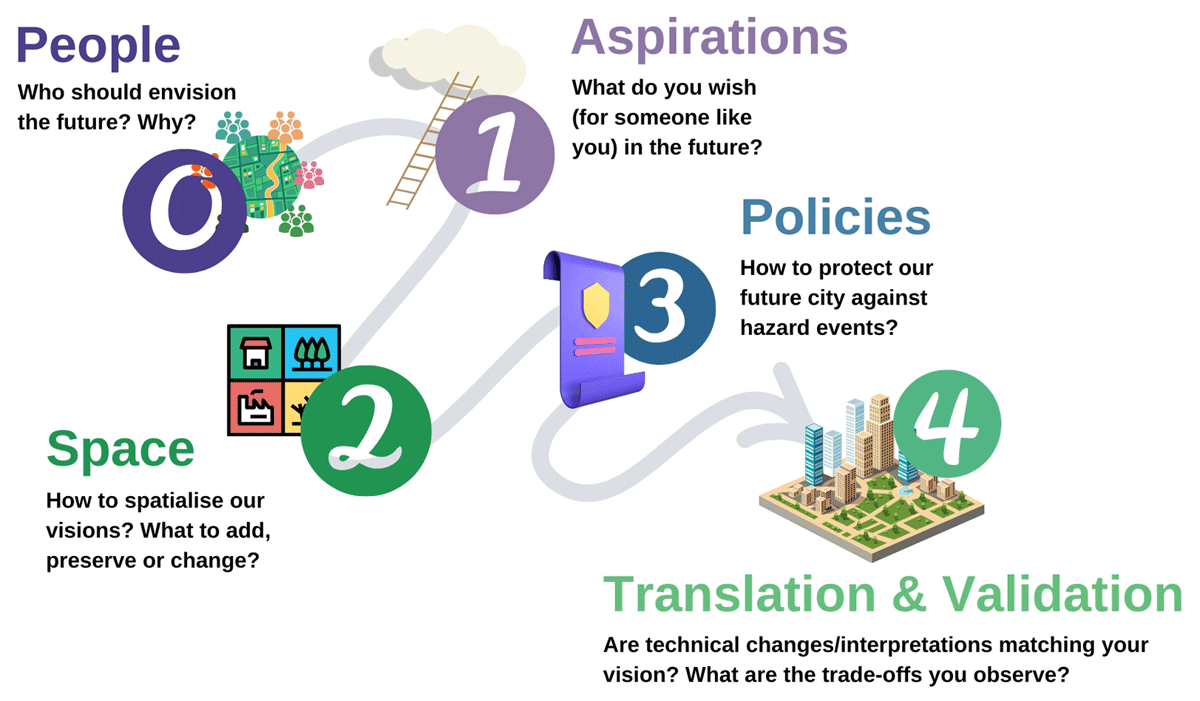
Figure 2
The Tomorrow’s Cities NFV approach.
People:
Focuses on fostering inclusive visioning. Activities include an analysis of the social landscape of the focus and surrounding areas (e.g. demographics, land-tenure, decision-making) and preliminary meetings or focus group discussions with local/community agents. The objective is to identify disaggregated groups that express power imbalances – in the present and future – and are likely to offer diverse visions (e.g. men–women; youth–elders; renters–owners). All following stages unfold through workshops with the chosen disaggregated groups.
Aspirations:
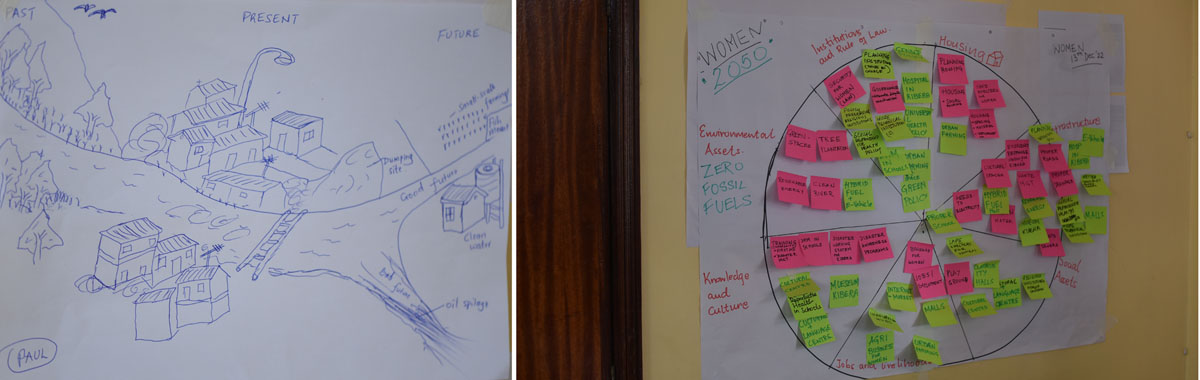
Consists of imagining good future cities and producing visions according to these steps: a) drawing of individual/personal storylines with statements or images about past, present and future (Figure 3); b) drawing/writing collective storylines (the story of the area/city) (Figure 5); c) extracting priority attributes of the desired city (organised around a ‘wheel of urban assets’ – with seven dimensions: housing, macro infrastructure and facilities, social assets, financial assets, knowledge and culture, environmental assets, and institutions and rule of law) (Figure 4); and d) producing a ‘visioning statement’ with key priorities for the future.
Figures 3 and 4
Individual life story and wheel of assets, Nairobi. Source: Tomorrow’s Cities archive.
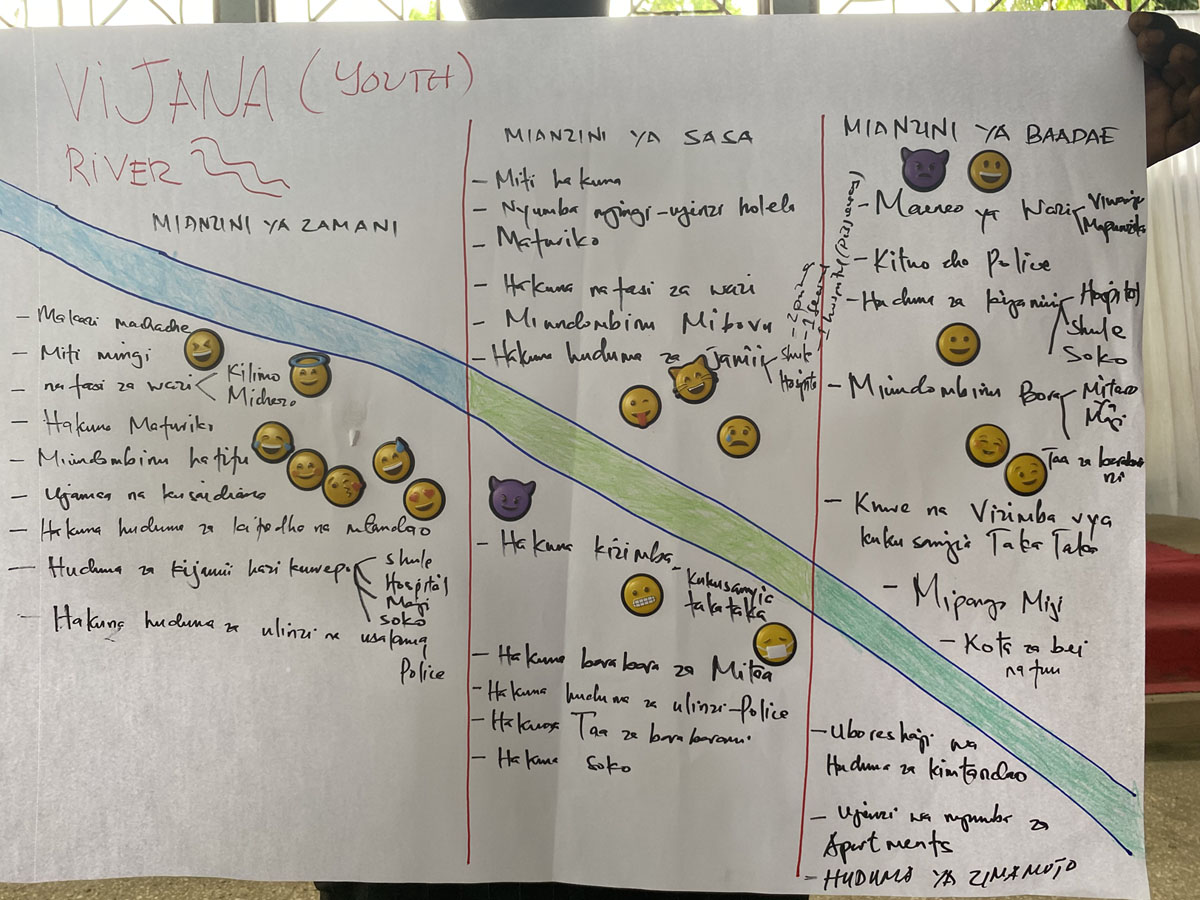
Figure 5
Collective storyline of youth group in Dar es Salaam.
Space:
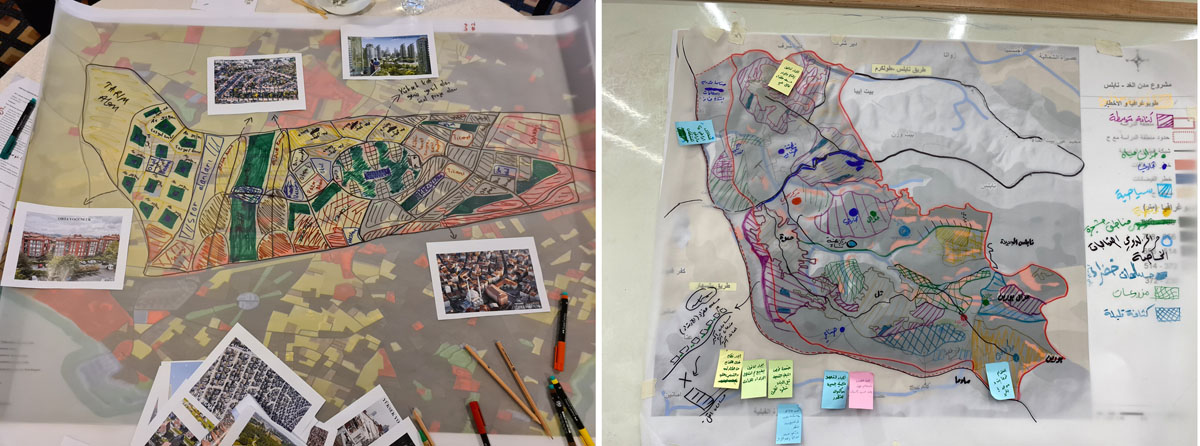
Groups are asked to ‘spatialise’ their visions using the aspired assets (Figure 4) as guides. This happens through a co-design activity that explores a series of maps (e.g. current land use, hazard maps, satellite imagery) so that visions can acquire a spatial expression. The result is a unique land use plan for the future (one per group) that highlights key assets and contains notions of urban form and social composition – see Figures 6 and 7 for examples).
Figures 6 and 7
Examples of sketched land use plans in Istanbul (left) and Nablus (right).
Policies:
Participants discuss future hazard events and how these could harm their future city. They suggest ‘solutions’ (policies) to protect their vision. ‘Policy cards’ with themes (e.g. housing retrofitting, investments in green infrastructure, capacity building) are used to animate discussions. Participants are asked to choose three priority policies and provide details that reflect any specificities of the context.
Translation:
As part of the TCDSE ‘visioning scenarios’ stage, technical teams provide an interpretation of the plans produced by each disaggregated group through geographic information systems – GISs. They analyse the content of the visions against local and national regulatory frameworks and future projections (trends related to population growth, density) to assess the extent to which visions are realistic and plausible. The translation is flexible and critical; there are iterative discussions within the team aimed at balancing the originality of visions with the essential trends and regulations. In follow-up workshops, participants are invited to assess and challenge the interpretations made by the technical teams. Discussions approach trade-offs related to equity, i.e. who wins and loses from each choice. The result is validated visions (each one a normative scenario) translated into a technical urban planning and policy language.
Once validated, normative visions are positioned to progress in the TCDSE. They are then tested using multihazard models, which will deliver bespoke metrics designed to highlight the potential consequences of the decisions made by each group, including infrastructural damage (e.g. number of damaged buildings) and systemic or cascading impacts (e.g. casualties, homelessness, loss of access to schools, health facilities or work). As participants develop a refined understanding of risk and its drivers, lessons feed into discussions about risk governance. The objective is to ultimately produce a pathway for an enabling environment that reduces risk in the future. Importantly, the original visions (as normative scenarios) are not merged in the pursuit of a single good future. Instead, the final stage harnesses common/cross-cutting lessons from each vision for transforming risk governance in the city.
6. Evaluating the tomorrow’s cities normative future visioning experience
Table 2 summarises lessons from the Tomorrow’s Cities NFV experience using the Encounter–Change Framework.
Table 2
Evaluating the Tomorrow’s Cities NFV approach
| EVALUATIVE COMPONENT | WHAT/WHO IS ENCOUNTERED | WHAT/WHO IS CONNECTED | HOW EMANCIPATION HAPPENS | HOW DOES IT TRIGGER ACTION & CHANGE |
|---|---|---|---|---|
| People | Different experiences, knowledges and worldviews. Stakeholder disaggregation emphasises power asymmetries. | Contrasts and commonalities across visions surfaced. | Stakeholders producing future claims through collective identities. | Diverse groups recognising each other and working towards shared goals while recognising differences. |
| Aspirations | Different ways of expressing feelings, past experiences, and future hopes through creative methods. | Between individual and collective aspirations. Between past, present and future. | A cohesive and desired travel trajectory and set of aspirations (as assets) is produced. | Clarity in aspirations may catalyse or support concrete claims and struggles from marginalised groups. |
| Space | Local actors using planning tools and data that are usually not accessible. | Between valued/desired assets and specific lands. | Participants realising own local expertise and being recognised as peers by other stakeholders. | Future lens challenging assumptions about aspirations and priorities could lead to changed behaviours from institutions. |
| Policies | Diverse strategies to tackle future hazards and equity challenges through the exploration of different policy themes. | Spatialised aspirations and measures that could either support such as aspirations or mitigate its negative consequences. | Realised capacity to engage in problem framing and produce concrete solutions. | Concrete policy designs that connect different themes (housing, environment etc.) could help to activate specific actors for concerted action. |
| Translation and Validation | Science-informed representations of priorities for the future. | Local priorities balanced with scientific rigour and essential planning norms (trade-off thinking). | Allowing the language of science to enhance the legitimacy of local priorities. Realised capacity to dialogue and challenge future assumptions and projections. | Mutual understanding between local and scientific practitioners expanding the influence of NFV on policy. |
NFV can be a rich learning experience where many encounters happen. The authors found that, in Tomorrow’s Cities, the decision to disaggregate social and institutional identities/conditions (People) was key to ensuring that a diversity of different voices were raised, leading to discussions and outputs that were attentive to power imbalances. This happened in different ways in each city. For example, in Rapti (Nepal) the disaggregation strategy emphasised intersections between land ownership and cast or ethnicity; some groups represented indigenous identities who own the majority of the land, while others represented marginalised castes. Newly arrived migrants were also brought in. In Nairobi, Dar es Salaam and Nablus, the disaggregation emphasised generational differences (e.g. through ‘elders’, ‘youth’ and ‘children’ groups) as well as differential housing conditions and exposure to hazards (e.g. residents living on lower land – and more exposed to floods – were invited as a separate group).
A consideration of internal diversity against group coherence, intersectionality and gender balance was also a criterion for disaggregation in all cities, although this also happened in different ways. In Chattogram – a more urbanised centre in Bangladesh – gender was balanced across groups with no distinct women’s group. In contrast, the less cosmopolitan city of Cox’s Bazar understood the need for a different strategy; besides emphasising conventional livelihoods such as farming and fishing, the local team understood the need to have a dedicated women’s group, so more private claims related to access to toilets and safety were freely voiced.
Further, in all cities there were attempts to incentivise encounters between community groups, decision makers and scientists – and, as a consequence, connections between different knowledges. This either happened through the facilitation strategy of the city (e.g. in Nablus and Dar es Salaam, municipal planners were facilitators) or through the preparation of a distinct group of planners/institutional actors that would also produce visions and normative scenarios (the case of, for example, Istanbul, Rapti and Kathmandu).
Designing NFV as a progression of several activities – rather than a one-off exercise – was also useful to support participants in making a series of other critical connections. The disaggregation of groups (People) illuminated contrasts and synergies between visions (Aspirations), as participants from different groups had to share their work and learn from each other. Within each group other important connections emerged. For instance, in six of the nine cities, the production of individual timelines followed by a collective city timeline fostered discussions that connected shared individual past and present experiences to future aspirations. Rather than a sum of individual experiences, each city timeline built from aspirations that were common across group. Participants were invited to imagine a good future city for ‘someone like them in the future’ – e.g. for other women, for migrants. Hence, while their immediate needs and individual aspirations were somehow part of the final products, the process required them to connect different life stories and produce a new one based on collective and intergenerational justice.
The Aspirations stage also stimulated participants to frame somewhat vague desires (e.g. to a ‘green/low-density city’ – the case of low-income groups in Istanbul) as concrete urban assets (e.g. parks, green infrastructure) that would be connected to specific lands and hazard information (Space). This discussion would be further problematised during the ‘Translation and Validation’ stage, when normative ideas were connected to the future trends brought by the science team. In this example of low-income groups in Istanbul, participants had to unpack tensions between their desires for plenty of green spaces, low rises and overall low density and the need to account for population growth in the area, which could lead to increased land prices, displacement or urban sprawl. The discussion of trade-offs related to equity deepened learning and made participants increasingly more aware of the consequences of their decisions – some of them addressed during a re-discussion of ‘Policies’.
Emancipation in the Tomorrow’s Cities approach arose from the process slowly allowing participants to realise and observe their own local expertise being recognised by peers and technical and policy actors. Positioning local/experiential knowledge as the starting point of NFV (Aspirations), and only later introducing more complex technical stages (Space, Translation and Validation) was key to mature ideas and build confidence in proposing adaptation solutions, and even in challenging the technical team. For instance, in Dar es Salaam, despite projections that predicted areas with 10- or even 19-storey buildings in the future, participants in most groups rejected these standards, arguing that such heights would not be culturally appropriate. Groups then suggested caps for high rises and marked areas where higher density would be desirable. This creative arc – from conceptual visions to sketched plans and, later, refined and plausible technical products – helped to clarify differences in communication/language and enabled healthy conversations between local, science and policy actors. The public presentation of these visions further marked a significant step towards recognition for hitherto marginalised groups.
Tomorrow’s Cities NFV is integrated within formal planning processes and concrete policy opportunities (e.g. a master plan for a new capital in Rapti, a UN-funded resilience programme in Nairobi), so it can inform Action and Change as an outcome of the full TCDSE methodology. Particularly through the exercises in ‘Aspirations’, we noted potential for institutional change, as municipality technicians and authorities were often acting as facilitators (e.g. in Nablus), as disaggregated groups (e.g. in Kathmandu and Rapti) or as observers (e.g. in Istanbul and Nairobi). As such, they often shared an increased willingness to change institutional procedures or, at the very least, interest in some of the ideas they learnt by encountering new visions. Also, when visions were finally materialised as adaptation strategies (Space, Policies, Translation and Validation), institutional actors could challenge their own assumptions of what marginalised groups aspired for themselves and for others in the future.
The TCDSE process is ongoing in cities but Action has already been observed through inputs to institutional processes. In Nablus, for example, the municipality has committed to integrating the Tomorrow’s Cities NFV method into its regular planning cycles. In Quito, visioning exercises triggered a nature-based solutions intervention led by the local community. In Nepal, the TCDSE methodology is informing national policy conversations that consider the experience of both Rapti and Kathmandu.
Finally, this NFV approach presented new learnings for the scientific community, which could potentially lead to other forms of Action and Change. By starting from what is desirable and only later challenging such notions through what is possible and probable, and by later returning to local perspectives for validation, the methodology disrupts the usual positioning of NFV while not undermining scientific and technical input. The balance between local, technical and science-based knowledge is made dynamic through interdisciplinary engagements and a reflexive positioning of NFV at the beginning of a wider process of adaptation and disaster risk reduction, which allow for deepened learning and more openings for impact.
The Tomorrow’s Cities NFV approach also highlights lessons that can help inform future research on NFV as an integral part of transformative adaptation and pathway transitions towards climate resilient development.
Time:
Considering the average duration of each workshop (two days), participants often moved too quickly from individual to collective positions. This could hamper emancipation. It is important to slow down this process to avoid reinforcing knowledge hierarchies that exist within local partners (e.g. between youth and elders) and between local, science and policy/technical actors. Normative visions should emerge from gradual interactions between stakeholders.
Ethics:
Prioritising marginalised voices often means hearing life stories marked by deprivation and hardship in the present. Participants understand the importance of visioning and most of the time gladly engage in imagination exercises that involve building a good city for others in the future, not necessarily for them. On the one hand, this momentary liberation from present-day assumptions, constraints and entrenched positions enables critical and collective learning. On the other hand, it could also trigger negative feelings and emotions about one’s condition. NFV should be safe spaces (with sensitive facilitation) so these emotions can be surfaced. This helps to build aspirations. Further, a transparent communication of NFV’s processes, expected outcomes and limitations is important to build trust and value the experiences shared.
Co-production:
Bringing powerful decision makers and authorities into workshops with local/community participants – as equal contributors to the process – was one of the most difficult challenges faced by Tomorrow’s Cities. Dedicated training and briefing sessions with key institutional partners helped to resolve this to some extent, although the issue is pervasive in most cities.
Diversity and consensus:
While participants are often willing to find synergies across different visions, there should be no monopoly on what a desirable future looks like. The Tomorrow’s Cities approach tried to emphasise this idea through the preservation of normative scenarios throughout the TCDSE. Yet negotiating a common pathway to reduce climate risk is eventually necessary, which could end up dissipating the values embedded in visions, or depoliticising marginalised narratives.
Equity:
Inclusive visioning does not mean equitable outcomes for risk and vulnerability reduction. The process should not be romanticised, as it is not uncommon for participants to propose interventions that do not take equity (e.g. displacement, gentrification, access to infrastructure) into account. A critical pedagogical approach should shed light on those issues, allowing participants to be reflexive in their own ways. For instance, workshops could have ‘equity checkpoints’ at key stages. This leads to groups encountering equity issues for themselves and making the appropriate connections for solving them.
Authorship:
The example of equity checkpoints illustrates how authorship is a critical part of visioning. By choosing to insert those moments of reflection, technical/scientific teams end up shaping NFV. While not necessarily a negative issue, any authorship decisions (including those related to the insertion of additional data and translation procedures) should be documented and communicated in transparent ways. Participants should be able to see and question these decisions so NFV spaces are open and dialogical.
7. Conclusions
Transformative adaptation requires freeing the imagination and building synergies for purposeful action. NFV can be helpful in this endeavour. Normativity brings values to discussions about the future and surfaces adaptation strategies that are not only reactive but also propositional and hopeful, offering pathways for more progressive development. This article proposes seeing and deploying NFV as a critical pedagogy, that is, as a form of collective learning that can trigger emancipation and action for transformative adaptation.
Evaluating the practical capabilities of NFV is an important step to identify how to bring this suite of methods into the mainstream of adaptation planning. Informed by the Encounter–Change Framework, which draws on critical (urban) pedagogies, this paper has unpacked and critically discussed the ‘process’ of NFV, as well as its ‘positioning’ within wider adaptation policy and planning strategies. Process highlights the nuances of NFV methodological designs: who is involved? Why? How do engagements happen? How are power imbalances managed through the methods? These issues are detailed by four concerns (encounter, connection, emancipation and action and change), which help to maximise the imaginative potentials of NFV already identified in the literature. ‘Positioning’ instead questions the strategic decisions behind the very deployment of NFV. This includes the relationship between normativity and other future approaches (how to position normative visions against probabilities and scenarios), as well as the insertion of NFV within a wider project or policy initiative.
Applying the Encounter–Change Framework to Tomorrow’s Cities NFV applications provides detailed insights for both process and positioning. The diversity of experiences in the project led to the generation of qualitative indicators that can be used for the assessment of similar NFV initiatives. This tested approach offers a robust method for the evidence-based refinement of NFV as a key –and as yet largely missing –element in wider adaptation and future methods applications both in research and as part of applied learning. In sum, both the Encounter–Change Framework and the detailed lessons from Tomorrow’s Cities introduce new knowledge to help refine and allow reflexive evaluation of NFV.
Acknowledgements
The authors thank our partners across all nine cities: Quito, Istanbul, Nairobi, Kathmandu, Rapti, Nablus, Dar es Salaam, Chattogram and Cox’s Bazar. The consolidation of this critical pedagogical NFV approach would not have been possible without the insights, commitment and passion of so many people around the world, including community leaderships, urban authorities, civil society organisations and research institutions.
Competing interests
The authors have no competing interests to declare.
Funding
The authors acknowledge funding from UKRI GCRF under grant NE/S009000/1, Tomorrow’s Cities Hub.