
1. Introduction
Due to the requirements of fire rescue, emergency rescue, and other tasks, firefighters need to conduct long-term specialized training such as weighted running, climbing training, and heavy object handling. Although this type of training helps build essential physical capacity, it also causes parts such as the lumbar spine and lower limb bones to continuously bear mechanical stress far exceeding that of the general population, leading to prominent injury issues related to high-intensity loads [1–5]. According to a study by Campbell and Evarts [6], in 2021, the number of U.S. firefighters injured during training accounted for 58% of the total number of injured firefighters, reaching 35,235; analyzing historical U.S. data, Carrpries et al. [7] also found that the ankle, knee, and leg are the most common injury sites among firefighters. To address this issue, existing studies have proposed intervention directions. For example, Vaulerin et al. [8] pointed out that rehabilitation training, personalized physical exercise, and improved working environments can prevent and treat ankle injuries in firefighting occupational training; Games et al. [9] found that personal protective equipment affects the dynamic balance of firefighters and suggested reducing negative impacts through balance and coordination training and designing lighter equipment.
Notably, excessive loading or high-frequency loading during firefighters’ training not only easily causes direct bone damage but also exerts a significant negative impact on the material transport function of the lacunar–canalicular system (LCS) – a key functional structure of osteocytes. This mechanism is crucial for understanding the pathological process of bone damage. From the perspective of the correlation between LCS material transport and loading parameters, multiple studies have verified the interfering effect of abnormal loading through various methods: Xing et al. established a multi-scale fluid–solid coupling model and found that excessive loading increases the flow velocity in superficial lacunae while expanding the pressure difference, high-frequency loading triggers countercurrent flow in deep regions, and abnormal gravitational fields can further exacerbate these effects [10]; Price et al. verified through in vivo experiments using fluorescence recovery after photobleaching (FRAP) that physiological loading can increase the proportion of solute convective transport in the LCS, while excessive or high-frequency loading can cause this proportion to drop sharply or even lead to transport stagnation [11]. Collectively, these studies provide multi-dimensional evidence for the claim that “abnormal loading impairs LCS transport function.”
From the perspective of the correlation between LCS structural integrity and bone metabolism, excessive loading can also trigger a metabolic cascade by damaging the LCS structure. Taking osteoporotic mice as the research object, Gatti et al. found that excessive loading (2500 µε, 1 Hz) leads to the collapse and inner diameter reduction of canaliculi, resulting in an exponential increase in flow resistance and a 45% decrease in the nutrient supply efficiency to deep osteocytes [12]. From the perspective of bone permeability, Murshid pointed out that excessive loading activates the osteocyte apoptosis pathway, reduces LCS permeability, and shortens the solute diffusion distance [13]. Such structural damage and impaired transport function ultimately lead to bone metabolic imbalance and decreased repair capacity. By establishing a chemo-poroelastic model for simulation, Dittmer et al. also emphasized that LCS transport disorders can double the bone repair cycle and increase the fracture risk by 35% [14].
In recent years, researchers have developed theoretical models to quantitatively describe the above mechano-biological coupling mechanisms and bone remodeling processes. Specifically, Scerrato et al. [15] proposed a novel formulation based on the hyperbolic Cattaneo equation to describe the mechano-transduction process occurring in bone remodeling, offering a new perspective on signal propagation under non-physiological loading. Daria Scerrato et al. [16] developed a quasi-brittle strain-driven microdamage-informed remodeling approach, which can predict damage and remodeling patterns in the proximal human femur under high-intensity loads. Barchiesi and Hamila [17] established a phase-field model based on the maximum mechano-damage power release criterion, enabling the analysis of mass diffusion in damaging deformable solids – a framework highly relevant to understanding transport disturbances in the lacunar–canalicular system under excessive loading. These theoretical advances provide valuable tools for further elucidating the pathogenesis of training-induced bone injuries in firefighters.
In summary, there are significant differences between the high-frequency loading of firefighters’ occupational training and the physiological loading of the general population. Although existing studies have confirmed that excessive or high-frequency loading impairs LCS material transport, there remains a lack of systematic understanding regarding the specific patterns of LCS nutrient transport in firefighters under high-frequency scenarios. This study intends to establish an LCS fluid–solid coupling model, quantify the transport patterns of nutrient particles under different frequencies and porosities, and conduct comparative research with the general population. The aim is to reveal the characteristic patterns of LCS nutrient transport in firefighters during high-load and high-frequency training, thereby providing theoretical support for optimizing training parameters and protecting bone health.
2. Materials and methods
2.1. Model and boundary condition setting
Osteocytes are not only regulated by fluid shear stress (FSS); solute transport in the LCS also provides essential nutrients to osteocytes. Therefore, a two-dimensional fluid–solid coupling model incorporating lacunae and canaliculi was established to investigate the effects of different porosities and loading frequencies in the bone matrix on the solute transport patterns of the LCS. Among them, the lacunae were designed as circles, while the canaliculi were designed as rectangles. The lacunae are interconnected via the canaliculi. For the mesh of the LCS model, a free triangular type was adopted, with a maximum element size of 0.9 μm, a minimum element size of 0.0018 μm, a maximum element growth rate of 1.1, and a curvature factor of 0.2, resulting in a total mesh count of 410,000. In the solid domain of the model, displacement loads of 1,500 and 3,000 με were applied to the top, corresponding to the physiological load of civilians and the weighted load of firefighters, respectively; a fixed constraint was applied to the bottom. For the fluid domain, the left end was set as the fluid inlet, and all other ports were set as fluid outlets. A pulsating pressure constraint was applied at the inlet, and the outlets were set as open boundaries.
The interstitial fluid flow is driven by the combined action of solid deformation and arterial pressure. Three frequency conditions (0.5, 1, and 2 Hz) were set for the displacement load [18,19], corresponding to the movement conditions of slow walking, brisk walking, and running, respectively. This is illustrated in Figure 1. Furthermore, five porosities (0.012, 0.032, 0.06, 0.14, and 0.32) were set by adjusting the sizes of lacunae and canaliculi to systematically investigate the effect of porosity on solute transport [20].
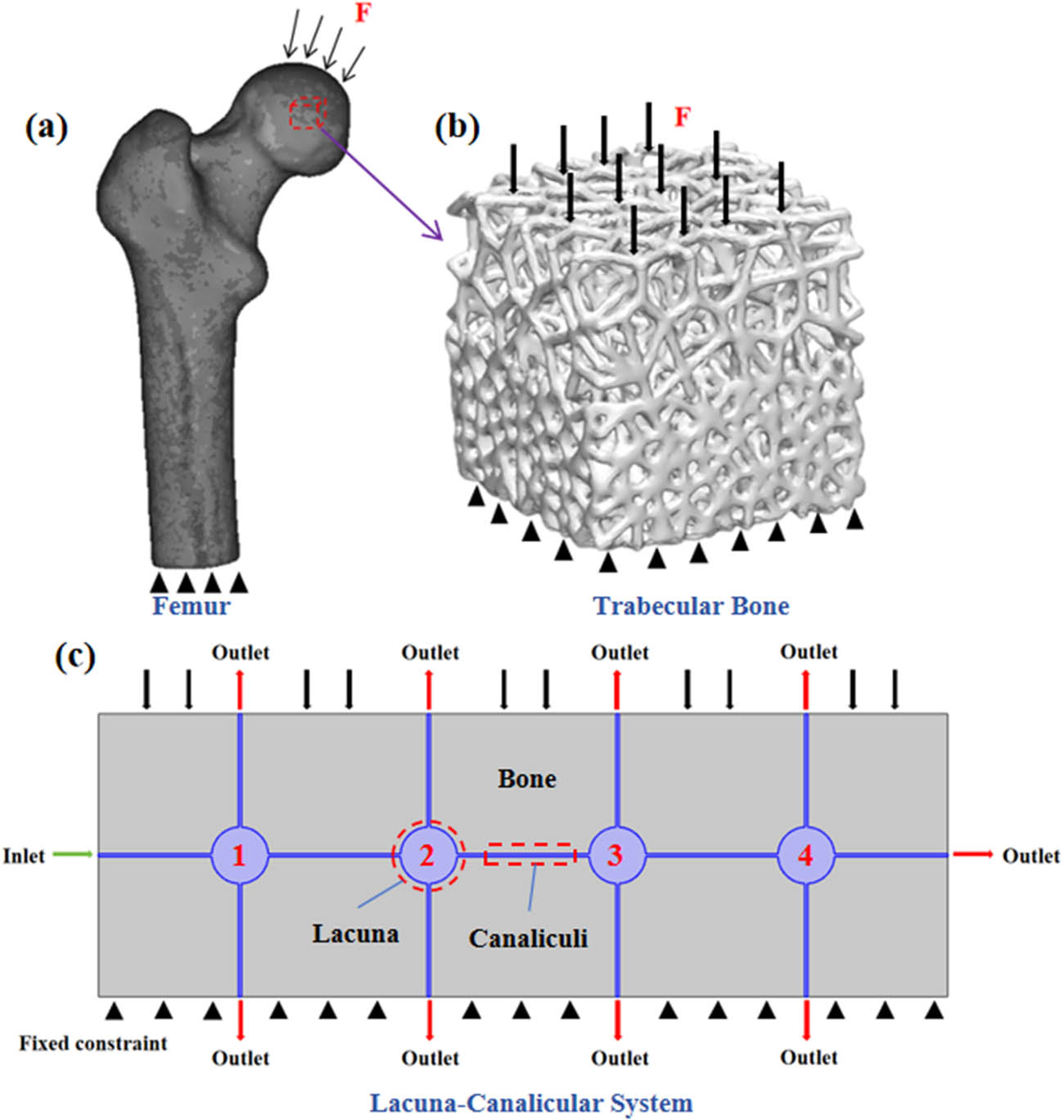
Figure 1
Model and boundary condition setting: (a) femur model and boundary condition, (b) trabecular bone model and boundary condition, and (c) LCS model and boundary condition.
In this study, COMSOL Multiphysics was employed to implement coupled simulations combining poroelastic fluid–solid coupling and fluid particle tracking. The multiphysics model was established using the Solid Mechanics, Fluid Flow, and Particle Tracing modules. A segregated transient solver was adopted to sequentially compute the fluid–solid coupling field and particle trajectories, with the maximum nonlinear iteration number specified as 50. The relative tolerance and absolute tolerance factor were both set to 1 × 10⁻⁵; the convergence termination criterion was tolerance-based; the maximum inner iteration was 10 with a tolerance factor of 1 × 10⁻³, and the solution convergence was defined as the stopping rule. For mechanical boundary conditions, sinusoidal periodic loads with varied frequencies were applied on the loading surface, and full fixed constraints were assigned to the bottom surface. Pulsating pressure was imposed at the fluid boundaries, while no-flow seepage was defined on all wall boundaries. Particles were uniformly released at the fluid inlet for subsequent solute transport statistics. Mesh files and raw experimental datasets are not publicly available; all core computational parameters have been fully presented in the manuscript to enable independent replication of the simulation by other researchers.
2.2. Material properties
Therefore, this study established a finite element model of the LCS based on the poroelastic constitutive theory, and porosity and permeability were set to represent the pore proportion of the LCS within the bone. The elastic modulus of the bone is 15 GPa, and the Poisson’s ratio is 0.3 [21]. The interstitial fluid is an incompressible Newtonian fluid with a density of 1,000 kg m⁻³ and a dynamic viscosity of 0.001 Pa·s [22].The inlet fluctuating pressure is set to 5,000 Pa at a loading frequency of 1 Hz [23].
In the LCS, interstitial fluid flow facilitates nutrient particle transport and maintains osteocyte viability. The particle tracking method was employed to simulate the motion of nutrient particles, which are governed by fluid forces within the flow field. Their movement trajectories were tracked by calculating velocity and position, thereby characterizing particle transport behavior under different flow conditions.
In this study, the particles have a density of 1000 kg·m⁻³ and a diameter of 20 nm [24]. At the inlet of the fluid domain, the particle release period ranges from 0 to 0.1 s, with a release interval of 0.0005 s, and 1,000 solute particles are released each time. The initial release velocity of the particles depends on the fluid flow velocity. At the outlet, the outgoing solute particles are frozen to facilitate counting the number of solute particles that pass through during the transport process.
3. Results
3.1. Study on the characteristics of particle transport patterns
A comparative analysis was performed on the results of firefighters and normal subjects at a loading frequency of 0.5 Hz and a time point of 0.1 s. The results show that although the particle number in the first osteocytic lacuna of normal subjects was significantly higher than that of firefighters, the values in the second and third osteocytic lacunae were notably lower, as shown in Figure 2.
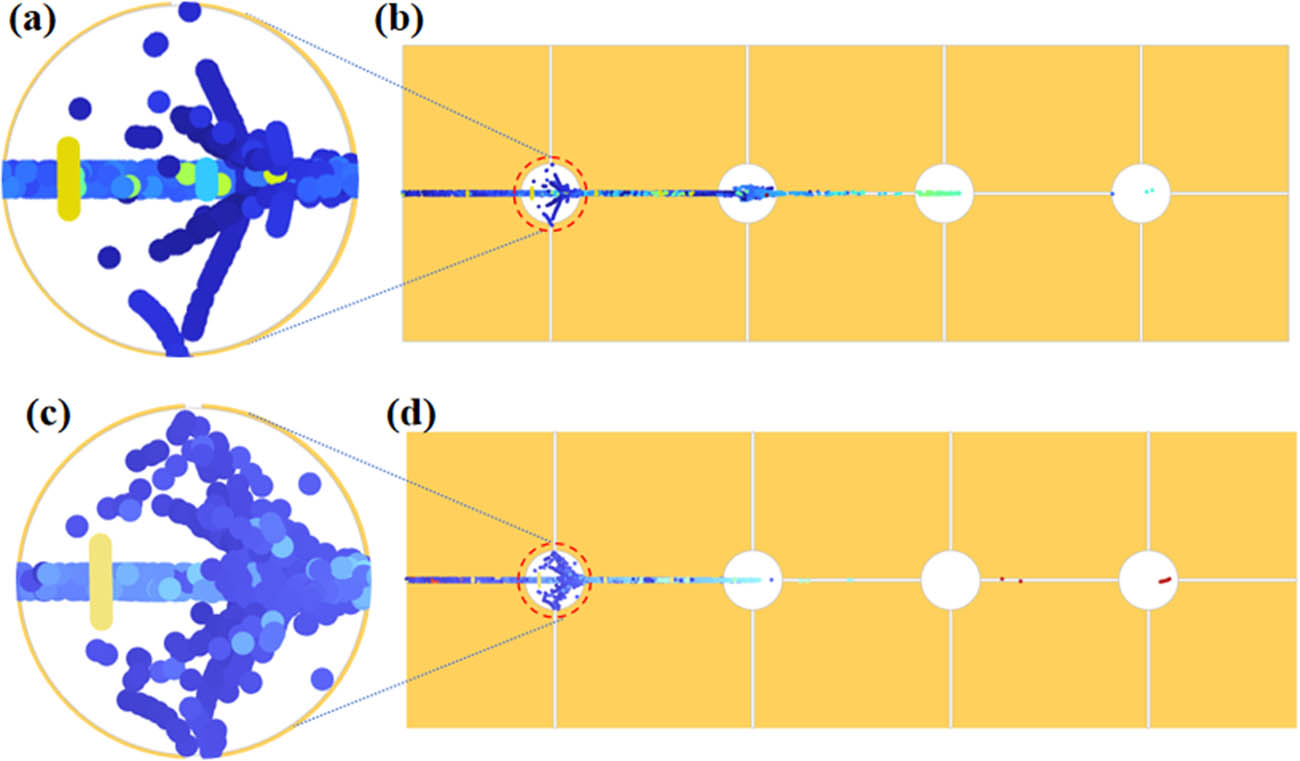
Figure 2
Comparison of substance transport rates in the LCS between firefighters and civilians under the same time condition: (a–b) firefighters, and (c–d) civilians.
Further investigations reveal that at a frequency of 0.5 Hz, the solute particle transport efficiency of firefighters is significantly lower than that of normal individuals within the period of 0.2–1 s, and the two values gradually converge over time (Figure 3a). When the frequency is increased to 1 Hz, the above trend is reversed, and the particle transport efficiency of firefighters is notably enhanced during 0.2–1 s (Figure 3b). At a frequency of 2 Hz, the pattern of particle transport is generally similar to that at 0.5 Hz (Figure 3c).
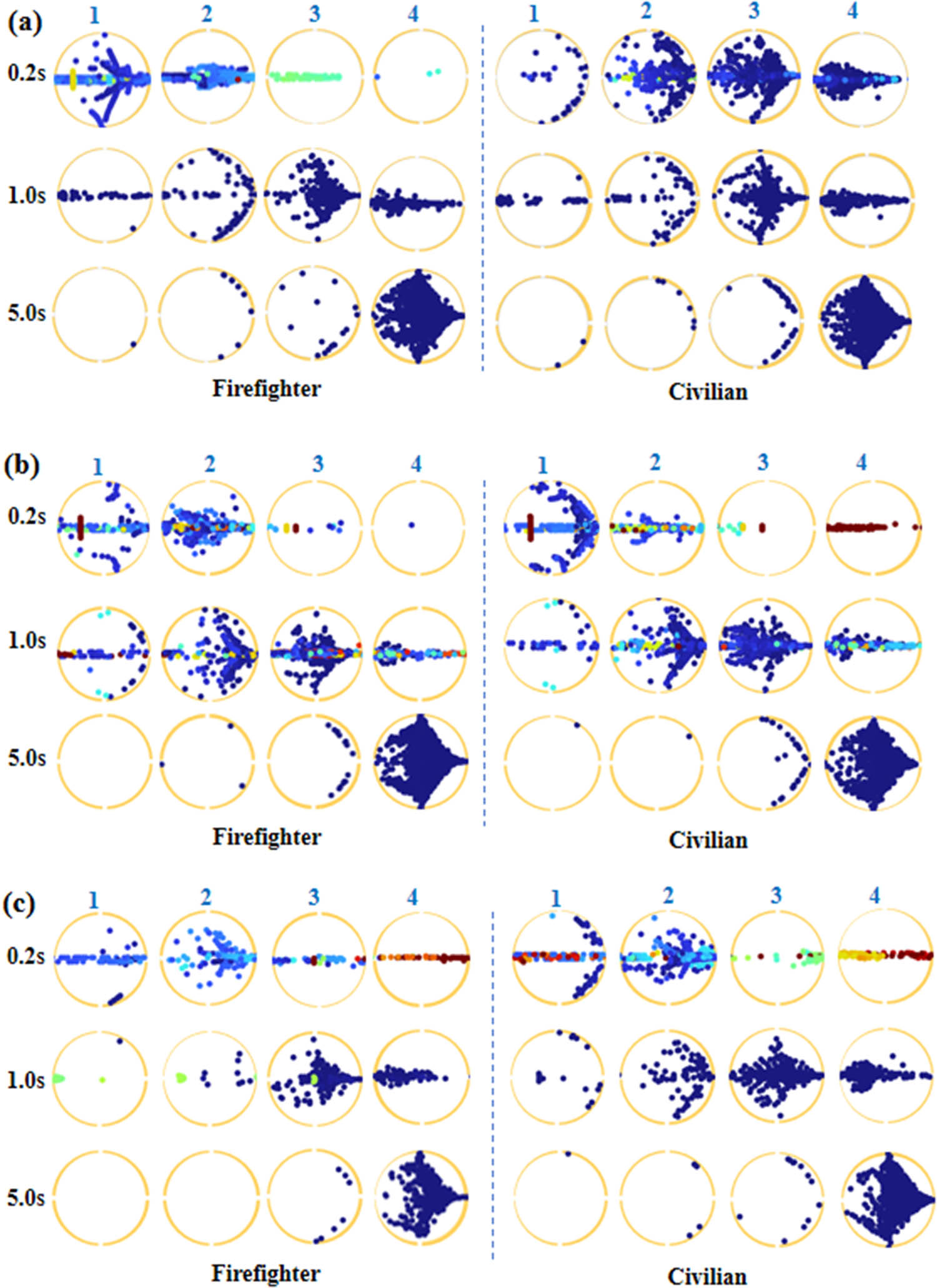
Figure 3
Solute transport patterns in the LCS for firefighters and civilians at different loading frequencies and time points: (a) 0.5 Hz, (b) 1 Hz, and (c) 2 Hz.
Quantitative statistical analysis was performed on particle counts under various working conditions. The results show that at a frequency of 1 Hz, the particle number in the first osteocytic lacuna of firefighters reached a peak, nearly twice that of normal people at the same frequency (Figure 4a). A similar trend was found in the second osteocytic lacuna, where the particle count was 10.5% higher than that in normal people over the same duration (Figure 4b). In contrast, in the third and fourth osteocytic lacunae, the particle numbers in normal individuals were significantly higher than those in firefighters at all frequencies and time points. These results confirm that 1 Hz can significantly improve the initial particle transport efficiency under high-load working conditions (Figure 4c–d).
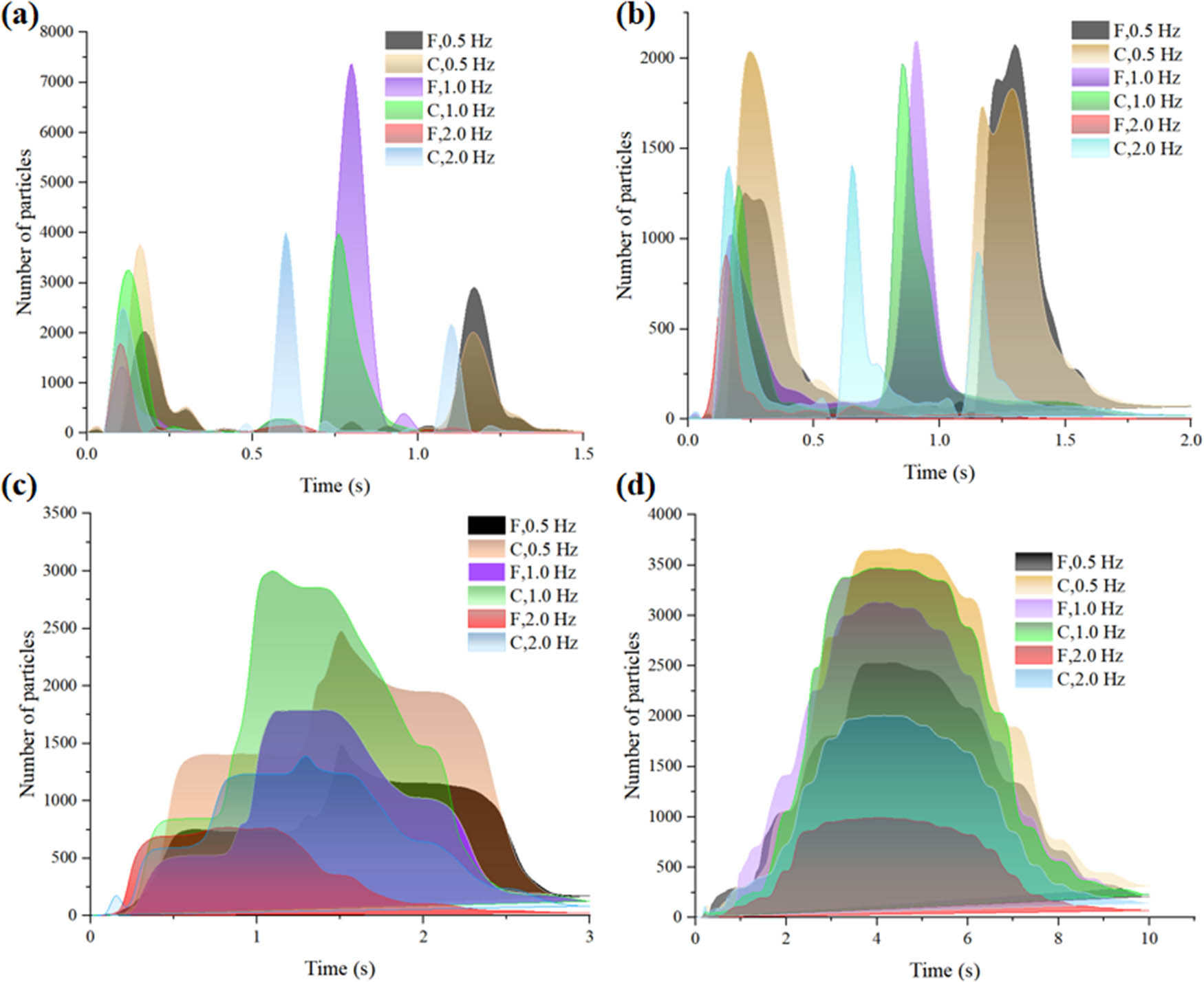
Figure 4
Quantity of substance particles in the LCS of firefighters and civilians under different loading frequencies: (a–d) correspond to lacunae 1–4, respectively.
3.2. Effect of different porosities on particle transport patterns
In addition, results from models with five different porosities show that with increasing loading frequency, the efficiency of solute particle transport is significantly improved, thus supplying nutrients to osteocytes, as shown in Figure 5b–e. However, for models with excessively low porosity, increasing the loading frequency fails to enhance the transport rate and efficiency of solute particles, as illustrated in Figure 5a.
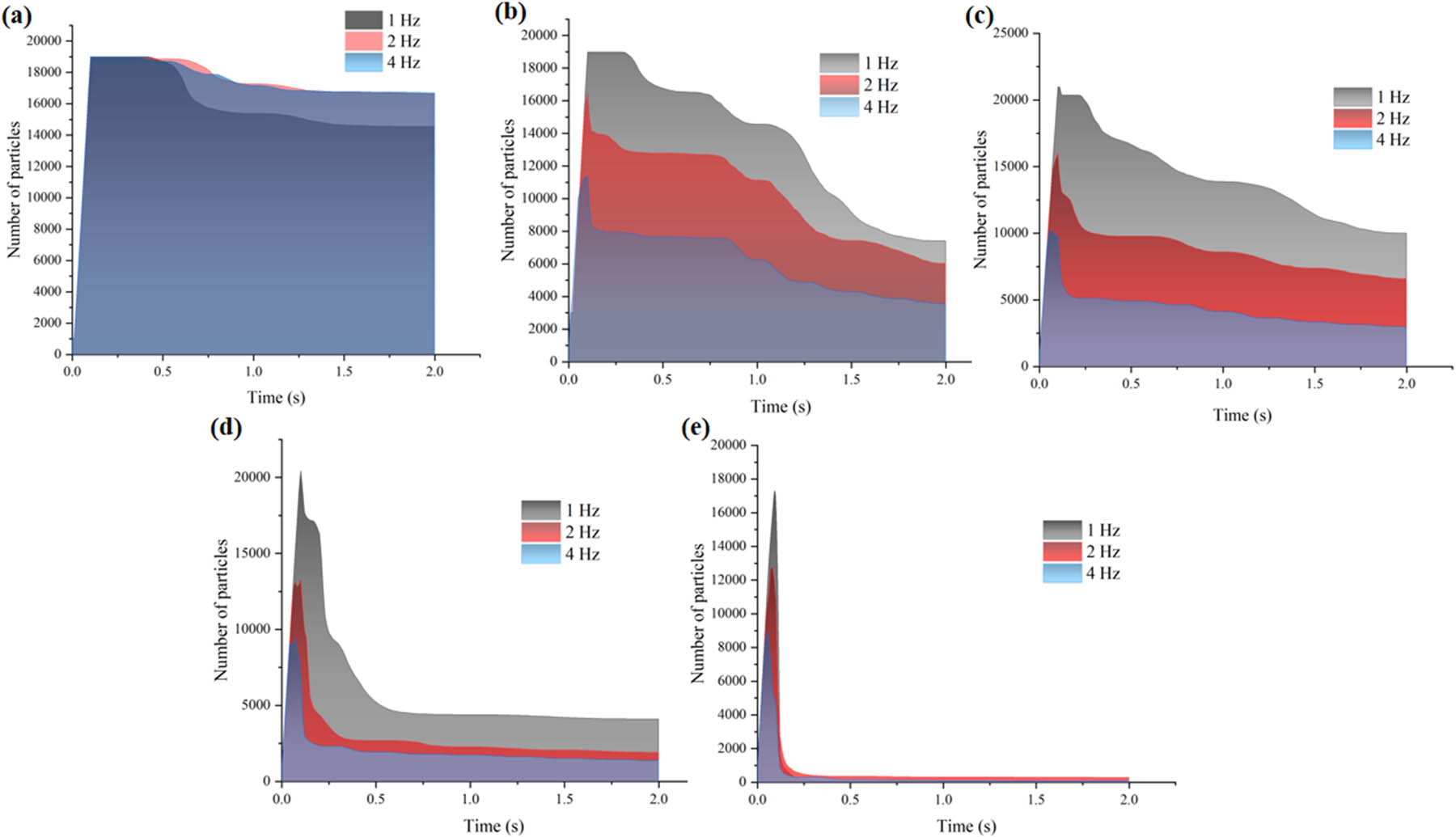
Figure 5
Statistics of particle transport quantity in the LCS under different cases: (a–e) the number of particles remaining in the LCS at different time points (with porosities of 0.012, 0.032, 0.06, 0.14, and 0.32, respectively).
4. Discussion
This study focuses on bone injury issues caused by firefighters’ occupational training. By setting displacement loads of 1,500 and 3,000 με, and a frequency gradient of 0.5–2 Hz, it accurately simulates the mechanical load characteristics of different intensities and rhythms in firefighters’ training. In particular, the 3,000 με load corresponds to high-intensity training scenarios, which constitutes a distinct difference from the physiological loads of the general population. Meanwhile, five porosity working conditions are introduced to cover pathological states such as osteosclerosis, normal compact bone, and osteoporosis. This not only accounts for potential pathological changes in firefighters’ bones due to long-term training but also provides a stratified research foundation for subsequent clinical interventions.
The results demonstrate that at frequencies of 0.5 Hz and 2 Hz, the solute particle transport rate in the LCS of the general population is significantly higher than that of firefighters; however, at 1 Hz, the transport efficiency of the firefighter group surpasses that of the general population. This “frequency inflection point” phenomenon holds important physiological significance. Further findings indicate that the optimal frequency for the firefighter group may shift toward lower frequencies. This difference may be related to the adaptive structural changes in the LCS of firefighters caused by long-term high-frequency training – as stated by Gatti et al. [12], excessive loading can lead to the collapse of osteocytic LCS tubules and a reduction in their inner diameter. The LCS of firefighters may form an “adaptive response” to the 1-Hz frequency through structural remodeling. It is speculated that this is because the flow resistance of interstitial fluid decreases at this frequency, increasing the proportion of solute convective transport. In contrast, insufficient load intensity at 0.5 Hz and excessive threshold loading inducing deep countercurrent at 2 Hz both result in decreased transport efficiency. Previous studies have demonstrated that loading frequency and strain rate significantly regulate the adaptive responses of bone [25,26]. Mechanical stimulation with high strain frequencies can accelerate bone formation, and mechanical loading within a specific frequency range contributes to enhanced bone anabolism and bone remodeling efficiency [27]. Consistent with these findings, the present study further complements and refines the frequency-dependent mechanical characteristics of bone.
For cancellous bone models with varying porosities under constant strain, rising porosity reduces trabecular FSS and suppresses the biological activities of osteoblasts [28,29]. By contrast, increasing loading magnitude or lowering trabecular porosity markedly elevates FSS and interstitial fluid pressure within bone marrow [21,30]. Results from working conditions with different porosities indicate that for working conditions 2∼5, the solute transport efficiency increases significantly as the loading frequency rises. However, for case 1, even increasing the frequency fails to improve the transport rate. From the perspective of substance transport, this result verifies the correlation between bone pathological states and mechanical load responses: the low porosity of osteosclerosis leads to poor connectivity of the LCS network and a significant increase in interstitial fluid flow resistance, thus resulting in no improvement in transport efficiency. In contrast, the pore structures of normal bone and osteoporotic bone retain a certain degree of connectivity, and increased frequency can enhance interstitial fluid convection.
For firefighters’ occupational health, this result holds important clinical guiding value: due to long-term training, firefighters are prone to developing bone hyperplasia or osteoporosis. Therefore, differentiated intervention plans need to be formulated for firefighters with osteoporosis based on different bone pathological states. Moderate-frequency training of approximately 1 Hz can be used to improve LCS transport efficiency, thereby assisting in enhancing bone nutrient supply. However, for firefighters with an osteosclerotic tendency, simply adjusting the training frequency has limited effects; it is necessary to integrate other scientific and technological approaches to repair the structural integrity of the LCS, creating conditions for subsequent load intervention.
This study still has certain limitations. First, the model adopts a two-dimensional (2D) LCS structure. Although it can simulate the basic connectivity between osteocytic lacunae and canaliculi, it differs from the in vivo three-dimensional (3D) LCS network. This discrepancy may lead to inconsistencies between the interstitial fluid flow paths in the model and the actual physiological conditions, thereby affecting the accuracy of the particle transport patterns. Second, particle tracking only accounts for fluid forces such as inertial force and buoyancy, and does not incorporate the influence of active transport by osteocytes (e.g., endocytosis and exocytosis) on solute transport. However, in the actual physiological environment, active cellular transport may further regulate the distribution of nutrients. Third, the study does not involve the dynamic remodeling process of the LCS structure triggered by long-term training, and thus cannot clarify the long-term evolution mechanism of frequency adaptability. Future research needs to verify this mechanism through longitudinal animal experiments or clinical follow-ups.
Focusing on the high-frequency training scenarios of firefighters, this study reveals the frequency-specific patterns of nutrient transport in the LCS and quantitatively analyzes the differences in LCS transport responses under different bone pathological conditions. The research findings can provide a basis for formulating personalized training and rehabilitation programs for firefighters with different pathological conditions, reduce the incidence of training-related bone injuries among firefighters, and further safeguard their occupational health.
5. Conclusion
In conclusion, this study analyzed LCS nutrient transport using a 2D fluid–solid coupling model (with particle tracking), examining loading frequencies (0.5, 1, 2 Hz), five porosity types, and comparing with the general population. Within the investigated frequency range, 1 Hz is the relatively optimal loading frequency. For normal and osteoporotic bone, LCS transport efficiency rises with increasing frequency, whereas such a tendency is absent in sclerotic bone. Owing to skeletal adaptive remodeling induced by long-term training, the optimal frequency for firefighters differs from the general population. The study enriches bone mechanobiology and provides a basis for optimizing firefighters’ training parameters and hierarchical bone health interventions.
Funding information
This work was supported by the Central Public-interest Scientific Institution Basal Research Fund (No. 2024SJ43).
Author contributions
S.Z. designed the research; L.W. and S.Y.D. analyzed data and drew the pictures; S.Z. and A.L.H. drafted the manuscript. All authors reviewed the manuscript.
Conflict of interest statement
No potential conflict of interest was reported by the authors.