
1. Introduction
Boxing is a high-intensity combat sport characterized by rapid, asymmetric, and explosive striking movements that require precise intersegmental coordination. From a biomechanical perspective, effective punching depends on efficient proximal-to-distal sequencing, whereby force and angular momentum are generated in the lower limbs and sequentially transferred through the pelvis and trunk to the upper extremities [1,2,3]. This kinetic chain mechanism is fundamental for maximizing joint angular velocity and mechanical efficiency during striking actions.
Among boxing techniques, the uppercut punch represents a complex close-range action involving combined vertical impulse and rotational torque. Unlike linear punches such as the jab and cross, the uppercut requires substantial pelvic rotation, lower-limb push-off, and synchronized trunk motion to accelerate the striking limb effectively [4,5]. Previous kinematic studies have highlighted the importance of segmental coordination and angular velocity in determining strike performance [6,7]. The contribution of trunk and pelvis rotation to punching effectiveness has also been emphasized [8].
Research on striking mechanics has demonstrated strong associations between angular velocity, impact force, and neuromuscular coordination [7,9]. Strength and power qualities, particularly in elite amateur boxers, have been shown to correlate with punching impact [10,11]. Similar biomechanical principles have been reported in other combat sports, where strike effectiveness depends on rapid limb acceleration and efficient energy transfer along the kinetic chain [12,13,14].
Lower-limb contribution is critical for force production and stabilization during striking. Studies have demonstrated that hip, knee, and ankle mechanics influence propulsion and rotational torque generation [12,13,15]. Motion capture analyses have further clarified the role of proximal segments in transferring energy toward distal segments [16,17]. Segmental velocity patterns in proximodistal sequencing have also been observed in combat-specific movements, reinforcing kinetic chain theory [15].
Neuromuscular determinants of striking performance include stretch-shortening cycle efficiency, explosive strength, and intersegmental coordination [18,19]. Plyometric and power-oriented training methods have been shown to enhance neuromuscular responsiveness and movement velocity in combat athletes [20,21]. Strength and conditioning strategies tailored to combat sports further support improvements in striking performance [22,23].
Biomechanics-based training models emphasize coordination-focused exercises designed to improve joint sequencing rather than isolated muscular development [24,25]. Such approaches may be particularly relevant for amateur boxers, who often display reduced synchronization and kinetic chain efficiency compared with highly trained athletes. Improved coordination has been associated with enhanced strike consistency and accuracy [6,11].
Despite extensive research on punching biomechanics, the uppercut punch remains comparatively under-investigated, especially in non-elite populations. Most previous studies have focused on straight punches or generalized findings across strike types [4,5,7]. Limited evidence exists regarding how maximum joint angular velocity during uppercut execution can be systematically improved through structured training interventions.
Therefore, the aim of this study is to perform a detailed kinematic analysis of the uppercut punch in amateur boxers and to evaluate the effects of an 8-week biomechanics-based training intervention on maximum joint angular velocity across key segments of the kinetic chain. It was hypothesized that the intervention would increase angular velocity of the shoulder, elbow, pelvis, and hip joints, thereby enhancing uppercut performance.
2. Materials and methods
2.1. Participants
All procedures complied with the Declaration of Helsinki. The study protocol was approved by the Ethics Committee of the Uzbek State University of Physical Education and Sport (Approval No. 14/AT2.10/2025). All participants provided written informed consent prior to enrollment.
Twenty-four male amateur boxers voluntarily participated in this study. All had a minimum of 3–4 years of systematic boxing training experience. The mean age was 21.25 ± 3.12 years, mean body height was 172 ± 6.9 cm, and mean body mass was 69 ± 6.83 kg. None of the athletes reported musculoskeletal injuries, neurological disorders, or cardiovascular diseases within 6 months preceding the study.
Participants were randomly assigned to an experimental group (EG, n = 12) or a control group (CG, n = 12). Baseline analysis confirmed no significant between-group differences in demographic or anthropometric variables (p > 0.05).
2.2. Study design
A controlled experimental design with pre- and post-intervention testing was employed to evaluate the effects of a biomechanics-based training program on maximum joint angular velocity during execution of the right-hand uppercut punch.
Both groups underwent biomechanical assessment before the intervention (BE) and after completion of an eight-week training period (AE). The EG completed a structured training program designed to enhance joint-specific angular velocity, intersegmental coordination, and kinetic chain efficiency through targeted technical, strength, and coordination exercises. Core-stability and combat-specific strength and conditioning principles were incorporated into the intervention [26,27]. The CG continued their regular boxing training without additional biomechanical emphasis.
2.3. Training intervention
The intervention consisted of 24 training sessions conducted three times per week over an 8-week period. Each session lasted approximately 90 min and included a standardized warm-up, a main technical-conditioning block focused on joint-specific angular velocity and intersegmental coordination, and a structured recovery phase. The duration of the intervention was selected to ensure sufficient neuromuscular adaptation and stabilization of movement patterns specific to the uppercut punch.
Exercises were performed for 2–4 repetitions per set, with 3–4 sets per session. Rest intervals ranged from 90 to 120 s between sets and 1–2 min between exercise blocks. Training intensity and physiological responses were monitored using Polar H10 heart-rate sensors to ensure load control and participant safety.
Pre-exercise heart rate (HR) values ranged from 79 to 118 bpm, indicating comparable baseline physiological readiness. During exercise execution, HR values predominantly increased to moderate (140–159 bpm) and high (160–179 bpm) intensity zones, with selected exercises reaching very high intensity levels (≥180 bpm). Post-exercise HR values consistently returned to the recovery range (152–181 bpm), indicating adequate cardiovascular recovery (Table 1).

2.4. Kinematic data acquisition
Three-dimensional kinematic data were collected at the Sports Biomechanics Laboratory, Scientific Research Center, Uzbek State University of Physical Education and Sport (Chirchik, Uzbekistan), using the STT Systems 3D Motion Analysis platform (3DMA 2023.0, Motive software; STT Systems, San Sebastián, Spain).
The system consisted of a 12-camera optoelectronic motion capture setup operating at a sampling frequency of 120–250 Hz. Prior to data collection, both static and dynamic calibration procedures were performed in accordance with the manufacturer’s guidelines to ensure high spatial accuracy of the recorded motion data.
Reflective markers were placed on standardized anatomical landmarks according to a full-body biomechanical model (Helen Hayes model), allowing accurate tracking of the shoulder, elbow, pelvis, hip, knee, and ankle joints. The system captured high-resolution three-dimensional coordinate data (X, Y, Z) for all tracked segments.
Participants executed the right-hand uppercut punch from a standardized boxing stance toward an imaginary target at maximal voluntary speed. Several familiarization trials were conducted prior to data collection to ensure consistent technique execution. The best trial was selected for further analysis to ensure technical consistency.
Kinematic data were processed using Motive 3D and 3D Motion Analysis software. Joint angular displacement was calculated from segmental coordinate data, and joint angular velocity was determined as the first derivative of angular displacement with respect to time.
All angular velocity values were expressed in degrees per second (°·s−1).
To ensure measurement reliability, repeated trials were conducted, and system calibration procedures were applied before each testing session. The standard error of measurement (SEM) for angular velocity ranged between 5 and 12°s−1 depending on the joint. The coefficient of variation (CV) ranged from 3 to 10%, indicating acceptable reliability of the kinematic measurements. Intra-session reliability was high (intraclass correlation coefficient, ICC = 0.91–0.96).
2.5. Measurement tools
To complement kinematic analysis, an instrumented striking dummy was used to assess strike accuracy and impact characteristics. The dummy was equipped with embedded accelerometer-based and force-sensing elements connected to a custom data acquisition system. This configuration enabled real-time recording of impact dynamics, strike frequency, and spatial deviation from the intended target.
Instrumented striking systems have been widely used to assess punch performance, impact force, and accuracy in combat sports [24,25]. In the present study, although impact force was estimated, strike performance was interpreted primarily through kinematic parameters, particularly joint angular velocity, in accordance with biomechanical principles of impulse-based force generation (Figure 1).
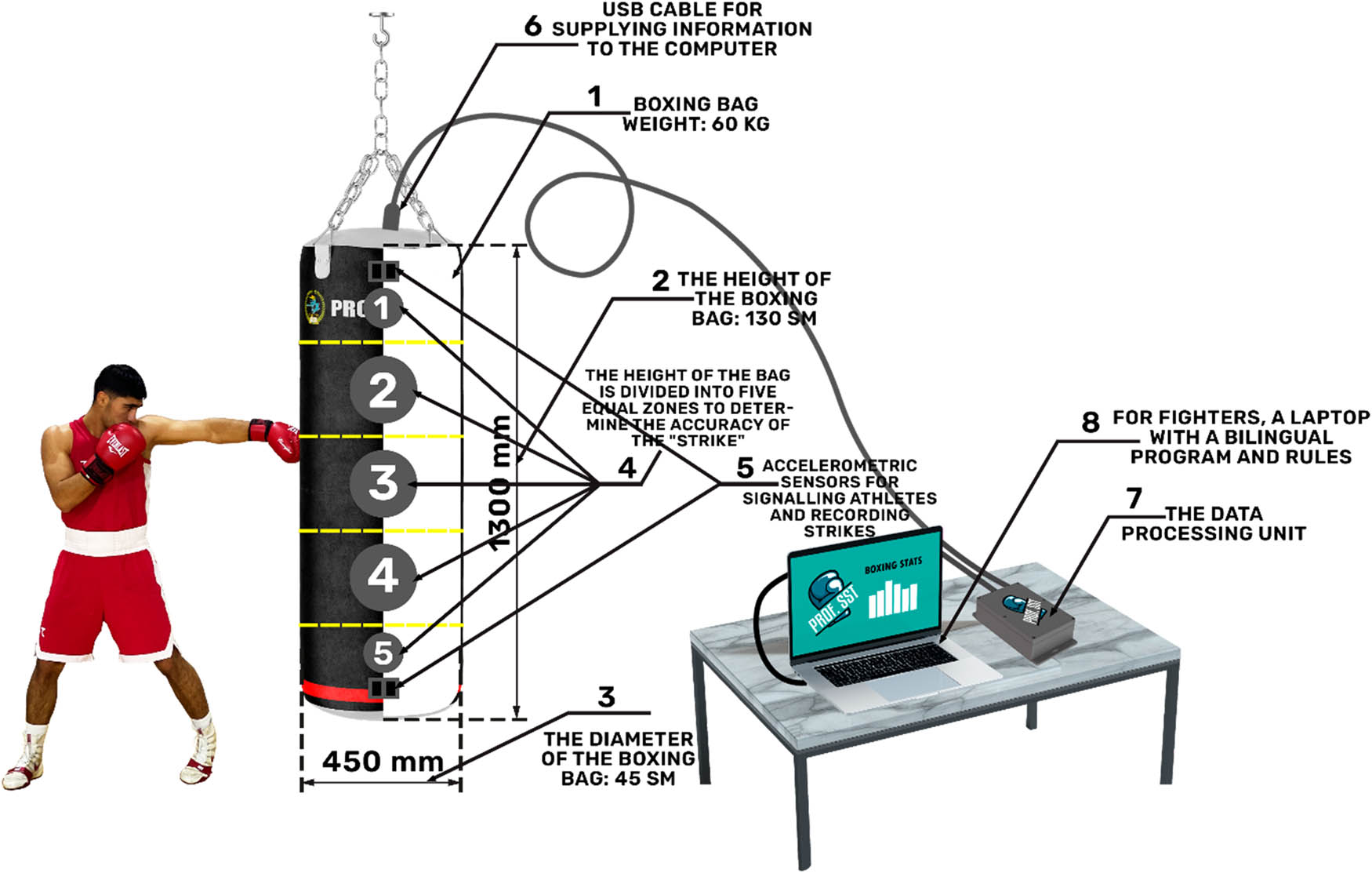
Figure 1
Hardware and software system for measuring punching performance in combat sports [24].
Source: Tajibaev et al. [24].
2.6. Statistical analysis
Statistical analyses were performed using standard statistical software. Descriptive statistics are presented as mean value ± standard deviation (M ± SD), and the CV% was calculated to assess movement consistency.
Data normality was evaluated using the Shapiro–Wilk test, and homogeneity of variances was assessed using Levene’s test. All variables met the assumptions required for parametric testing.
To examine the effects of the intervention, a two-way mixed-design analysis of variance (ANOVA) (Group × Time) was applied, with group (EG vs CG) as the between-subject factor and time (before vs after intervention) as the within-subject factor. When significant interaction or main effects were observed, post hoc comparisons were conducted using paired and independent Student’s t-tests with Holm–Bonferroni correction to control for multiple comparisons.
Pearson correlation analysis was performed to examine relationships between angular velocity variables across different body segments within the kinetic chain.
Statistical significance was set at p < 0.05. In addition to null-hypothesis significance testing, effect sizes were calculated using Cohen’s d to quantify the magnitude of differences. Effect sizes were interpreted as small (d ≈ 0.20), moderate (d ≈ 0.50), and large (d ≥ 0.80).
All analyses were conducted in accordance with established biomechanical and statistical standards to ensure the validity, reliability, and interpretability of the findings.
3. Results
This section summarizes the effects of the 8-week intervention on joint angular velocity, physiological load, and uppercut performance measured pre- and post-training.
At baseline (BE), no statistically significant between-group differences were observed for the majority of kinematic variables (p > 0.05), and Cohen’s d values were predominantly small, confirming group homogeneity prior to the intervention (Table 2). The highest angular velocities at BE were consistently recorded in the striking-side shoulder and elbow joints, while pelvic and lower-limb joints demonstrated moderate angular velocity values, reflecting their stabilizing and force-transmission roles within the kinetic chain.
Table 2
Maximum joint angular velocity (°·s−1) during right-hand uppercut execution in EG and CG before (BE) and after (AE) the 8-week intervention (n = 24)
| Parameters | Stages | CG (M ± SD) | CV (%) | EG (M ± SD) | CV (%) | t | P | Cohen’s d |
|---|---|---|---|---|---|---|---|---|
| Shoulders | ||||||||
| Right shoulder flex/ext | BE AE | 685.28 ± 40.43 | 5.90% | 681.12 ± 38.15 | 5.67% | 0.62 | >0.05 | 0.11 |
| 691.50 ± 28.21 | 4.87% | 702 ± 42.26 | 6.02% | 2.21 | <0.05 | 0.29 | ||
| Left shoulder flex/ext | BE AE | 79.83 ± 4.36 | 5.47% | 75.84 ± 4.12 | 5.43% | 1.23 | >0.05 | 0.94 |
| 82 ± 4.46 | 5.43% | 88 ± 4.78 | 5.43% | 2.64 | <0.05 | 1.30 | ||
| Right shoulder flex/ext with vertical component | BE AE | 606.81 ± 30.72 | 5.06% | 598.45 ± 29.03 | 4.85% | 0.78 | >0.05 | 0.28 |
| 615 ± 30.50 | 4.96% | 650 ± 32.50 | 5% | 4.31 | <0.01 | 1.12 | ||
| Left shoulder flex/ext with vertical component | BE AE | 181.52 ± 10.69 | 5.95% | 176.39 ± 10.15 | 5.75% | 1.23 | >0.05 | 0.49 |
| 187 ± 10.95 | 5.85% | 194 ± 11.70 | 5.85% | 2.25 | <0.05 | 0.62 | ||
| Elbows | ||||||||
| Right elbow flex/ext | BE AE | 364.76 ± 28.90 | 7.92% | 356.52 ± 21.45 | 6% | 1.32 | >0.05 | 0.33 |
| 370 ± 29.30 | 7.92% | 394.01 ± 26.68 | 6.77% | 3.41 | <0.01 | 0.86 | ||
| Left elbow flex/ext | BE AE | 29.88 ± 4.85 | 16.23% | 28.39 ± 3 | 10.56% | 1.23 | >0.05 | 0.36 |
| 31 ± 5.03 | 16.23% | 35 ± 4 | 11.43% | 2.67 | <0.05 | 0.87 | ||
| Pelvis | ||||||||
| Pelvis rotation | BE AE | 321.12 ± 20.23 | 5.93% | 314.06 ± 4.22 | 5% | 0.87 | >0.05 | 0.40 |
| 350 ± 20.76 | 5.93% | 367 ± 17.52 | 4.93% | 4.31 | <0.01 | 0.88 | ||
| Pelvis Rotation (right segment) | BE AE | 357.93 ± 31.49 | 8.45% | 354.28 ± 22.92 | 6.47% | 0.63 | >0.05 | 0.13 |
| 385 ± 32.53 | 8.45% | 402 ± 27.49 | 6.84% | 2.29 | <0.05 | 0.56 | ||
| Pelvis rotation (left segment) | BE AE | 322.49 ± 17.23 | 5.18% | 315.87 ± 12.36 | 4% | 0.51 | >0.05 | 0.44 |
| 344 ± 17.61 | 5.18% | 351 ± 14.17 | 4.04% | 4.67 | <0.01 | 0.43 | ||
| Hips | ||||||||
| Right hip flex/ext | BE AE | 84.28 ± 9.42 | 11.17% | 80.07 ± 7 | 8.74% | 0.32 | >0.05 | 0.50 |
| 87 ± 9.72 | 11.18% | 95 ± 9 | 9.48% | 2.61 | <0.05 | 0.85 | ||
| Left hip flex/ext | BE AE | 101.76 ± 9.14 | 8.98% | 96.67 ± 5 | 5.27% | 2.12 | <0.05 | 0.68 |
| 105 ± 9.43 | 8.98% | 114 ± 9 | 7.89% | 4.21 | <0.01 | 0.98 | ||
| Right hip abd/add | BE AE | 59.71 ± 4.99 | 8.37% | 56.72 ± 4.74 | 8.35% | 1.33 | >0.05 | 0.61 |
| 62 ± 5.18 | 8.35% | 68 ± 5 | 7.35% | 3.23 | <0.01 | 1.17 | ||
| Left hip abd/add | BE AE | 62.27 ± 7.44 | 11.94% | 59.16 ± 4.11 | 7% | 1.65 | >0.05 | 0.52 |
| 65 ± 7.77 | 11.95% | 72 ± 6 | 8.33% | 3.64 | <0.05 | 1.01 | ||
| Knees | ||||||||
| Right knee flex/ext | BE AE | 86.24 ± 9.27 | 10.75% | 81.93 ± 6 | 7.32% | 2.62 | <0.05 | 0.55 |
| 90 ± 9.66 | 10.75% | 102 ± 7 | 6.86% | 5.21 | <0.01 | 1.42 | ||
| Left knee flex/ext | BE AE | 122.96 ± 11.33 | 8.79% | 128.51 ± 8 | 6.22% | 1.16 | >0.05 | 0.56 |
| 132 ± 11.60 | 8.79% | 141 ± 9 | 6.38% | 6.67 | <0.01 | 0.86 | ||
| Ankles | ||||||||
| Right ankle flex/ext | BE AE | 93.92 ± 7.38 | 7.86% | 89.22 ± 6.45 | 7.22% | 0.77 | >0.05 | 0.67 |
| 96 ± 7.55 | 7.86% | 105 ± 7 | 6.67% | 4.34 | <0.01 | 1.23 | ||
| Left ankle flex/ext | BE AE | 50.90 ± 5.38 | 10.56% | 48.36 ± 3 | 6.20% | 0.87 | >0.05 | 0.57 |
| 53 ± 5.60 | 10.57% | 59 ± 5 | 8.48% | 4.31 | <0.01 | 1.13 | ||
Note: BE – before experiment; AE – after experiment; CG – control group; EG – experimental group. All angular velocity values are expressed in degrees per second (°·s−1). Data are presented as mean value ± standard deviation (M + SD). CV (%) – coefficient of variation. t – Student’s t-test value; p – level of statistical significance. Cohen’s d represents the between-group standardized effect size (EG vs CG). The SEM for angular velocity ranged between 5 and 12°·s−1 depending on the joint. The CV ranged from 3% to 10%, indicating acceptable reliability of kinematic measurements. Intra-session reliability was high (ICC = 0.91–0.96).
After the eight-week intervention (AE), the EG demonstrated significantly greater increases in maximum joint angular velocity across upper and lower body segments compared with the CG (Table 2). In the shoulder complex, significant between-group differences were observed for right and left shoulder flexion/extension (p < 0.05), as well as for right shoulder flexion/extension with a vertical component (p < 0.01), with moderate to large effect sizes (Cohen’s d = 0.62–1.12).
Elbow joint kinematics showed marked improvements in the EG at AE, with significant increases in right and left elbow flexion/extension (p < 0.01 and p < 0.05, respectively), accompanied by large effect sizes (d = 0.86–0.87).
Pelvic kinematics demonstrated substantial post-intervention adaptations in the EG. Total pelvic rotation and both right- and left-sided segmental rotations increased significantly (p < 0.05–0.01), with moderate to large effect sizes (d = 0.56–0.88), indicating enhanced proximal segment contribution to kinetic-chain efficiency.
Lower-limb joints also showed significant post-intervention improvements in the EG. Angular velocity increased significantly in hip flexion/extension and abduction/adduction, knee flexion/extension, and ankle flexion/extension (p < 0.05–0.01), with large effect sizes in most parameters (d = 0.85–1.42). Additionally, variability coefficients (V%) generally decreased in the EG, suggesting improved movement consistency and neuromuscular control (Table 3).
At baseline (BE), punch force did not differ significantly between groups, with a trivial effect size (Cohen’s d = −0.14), indicating comparable initial strike performance (Tables 2 and 3). Following the 8-week intervention (AE), the EG demonstrated significantly greater punch force and accuracy compared with the CG, corresponding to a moderate effect size (Cohen’s d = 0.70). These improvements were accompanied by reduced performance variability (CV%), particularly in the EG, suggesting enhanced strike consistency and practically meaningful gains in uppercut effectiveness.
Table 3
Analysis of uppercut punch force and accuracy in control and EG boxers (n = 24)
| Punch type | Stages | CG (Mean ± SD) | CV% | Accuracy | EG (Mean ± SD) | CV% | Accuracy | Cohen’s d |
|---|---|---|---|---|---|---|---|---|
| Uppercut punch (right-handed) | BE | 163.67 ± 14.32 | 8.74% | 70% | 161.67 ± 14.01 | 8.67% | 66% | −0.14 |
| AE | 174 ± 11 | 6.32% | 79% | 182.33 ± 12.74 | 6.98% | 84% | 0.70 |
Note: BE – before experiment; AE – after experiment; CG – control group; EG – experimental group. Data are presented as mean ± standard deviation (SD). CV% – coefficient of variation. Accuracy is expressed as the percentage of successful strikes delivered to the intended target. Cohen’s d represents the between-group standardized effect size (EG vs. CG), calculated separately for BE and AE. Effect sizes were interpreted as small (d ≈ 0.20), moderate (d ≈ 0.50), and large (d ≥ 0.80).
Overall, the biomechanics-based training intervention resulted in statistically significant and practically meaningful enhancements in joint angular velocity across the kinetic chain during execution of the right-hand uppercut punch. These kinematic improvements in the EG were accompanied by concurrent gains in punch force and accuracy, whereas the CG exhibited only minor and non-significant changes.
The present findings indicate that the 8-week biomechanics-based intervention significantly increased maximum joint angular velocity throughout the kinetic chain during execution of the right-hand uppercut in amateur boxers. These adaptations were not confined to the upper extremity but also involved the pelvis and lower limbs, reflecting coordinated system-wide modifications in movement mechanics. The concurrent improvements in punch force and accuracy suggest that the observed kinematic changes translated into functionally meaningful enhancements in strike performance. The following discussion interprets these findings within the framework of kinetic chain theory, intersegmental coordination, and neuromuscular adaptation relevant to combat sport performance.
4. Discussion
The present study examined the effects of an 8-week biomechanics-based training intervention on maximum joint angular velocity during execution of the uppercut punch in amateur boxers. The primary finding was a significant increase in angular velocity across multiple segments of the kinetic chain, accompanied by improvements in punch force and accuracy. These results suggest that the observed adaptations were not limited to isolated upper-limb changes, but likely reflect coordinated neuromuscular improvements across the entire movement system.
4.1. Shoulder–elbow coordination and proximal-to-distal sequencing
Significant post-intervention increases in shoulder and elbow angular velocity highlight the importance of terminal segment acceleration in punching performance. Previous biomechanical studies have demonstrated that effective striking relies on proximal-to-distal sequencing, whereby energy generated in proximal segments is transferred to distal segments to maximize velocity [2,5]. Studies examining straight punches have also reported strong associations between shoulder–elbow kinematics and punch velocity [6,7].
The present findings extend this evidence to the uppercut punch, which involves a more vertically oriented acceleration pattern. The greater improvements observed in the EG suggest that conventional training alone may not sufficiently stimulate joint-specific velocity development, whereas coordination-focused interventions may enhance intersegmental timing and acceleration capacity.
4.2. Pelvis–hip interaction and kinetic chain function
The observed increases in pelvic rotation and hip angular velocity highlight the importance of proximal segment contribution during close-range striking. Previous research has emphasized that trunk and pelvis rotation contribute substantially to punch impulse and distal segment acceleration [5,8]. According to kinetic chain theory, efficient intersegmental coordination enables effective energy transfer from the lower limbs to the upper extremities [2,15].
In the present study, increased pelvic and hip velocity may have facilitated improved angular momentum transmission toward the shoulder and elbow joints. These findings are consistent with studies demonstrating that combat sport techniques rely on coordinated activation of proximal segments [12,13]. The observed improvements are also aligned with kinetic chain dynamics reported in phase-specific analyses of punching movements [28]. The duration of the intervention (8 weeks) may have been sufficient to support stabilization of these coordination patterns.
4.3. Lower-limb contribution to force generation
Although the uppercut is often considered an upper-body-dominant technique, the observed increases in hip, knee, and ankle angular velocity indicate a substantial contribution of the lower limbs. Previous studies have demonstrated that lower-limb propulsion and force generation are important determinants of punching performance [17,29,30]. Enhanced push-off mechanics may have contributed to improved vertical impulse, which is particularly relevant for the upward trajectory of the uppercut.
These findings are consistent with research highlighting the role of strength and power characteristics in combat sport performance [10,11]. Plyometric and stretch-shortening cycle-based training methods have been shown to improve neuromuscular responsiveness and movement velocity [18,21]. Strength-oriented interventions have also been associated with improvements in punching performance and neuromuscular efficiency [31]. Therefore, the improvements observed in this study may reflect both mechanical and neuromuscular adaptations induced by the training intervention.
4.4. Angular velocity and functional performance
The concurrent increases in joint angular velocity, punch force, and strike accuracy suggest a functional relationship between kinematic optimization and technical performance. Previous research has shown that improved intersegmental coordination reduces temporal delays between body segments, thereby enhancing movement efficiency [7,14]. Similar associations between kinetic output and movement performance have been reported in combat-specific tasks [32].
The reduction in performance variability (CV%) further indicates improved motor control and movement consistency. Such adaptations are particularly important in close-range combat situations, where precise coordination is required under time and spatial constraints [11,23].
Collectively, the findings support the use of biomechanics-based training approaches that emphasize coordinated kinetic chain activation and joint-specific velocity development. For amateur boxers, such an approach may enhance both movement efficiency and technical reliability during complex striking actions.
5. Conclusion
The present study demonstrates that an 8-week biomechanics-based training intervention significantly enhances maximum joint angular velocity throughout the kinetic chain during execution of the right-hand uppercut in amateur boxers. The observed adaptations involved coordinated contributions of the upper extremities, pelvis, and lower limbs, reflecting improved intersegmental coordination and movement efficiency.
Increases in angular velocity were accompanied by improvements in punch force and accuracy, indicating functionally meaningful enhancements in strike performance. These findings support the integration of joint-specific and coordination-focused training strategies grounded in kinetic chain principles to optimize punching effectiveness in amateur boxing.
Acknowledgement
The authors used AI-assisted language editing tools to improve the clarity and grammar of the manuscript. All scientific content, analysis, and interpretations are solely the responsibility of the authors.
Funding information
This research received no external funding.
Author contributions
Soyib Tajibaev: study design/research program preparation, investigation, statistical analysis, data interpretation, and manuscript preparation; Davron Omonov: statistical analysis; Ian Gatt: data interpretation and manuscript preparation; Djamshid Umarov: data interpretation; Abdukarim Tangriev: manuscript preparation; Nodrbek Yusupov: statistical analysis; Akmal Khasanov: manuscript preparation; Zulfiyakhon Abdulkhaeva: data interpretation; Bobobkhon Khojaniyozov: manuscript preparation; Shakhzodbek Mukhsinov: data interpretation.
Conflict of interest statement
Authors state no conflict of interest.
Data availability statement
The data supporting the findings of this study are available from the corresponding author upon reasonable request.