
1 Introduction
The generalized use of information technology (IT) in justice, e-justice, is often driven by a pressing need to improve court efficiency and other performance metrics. Primary objectives include streamlining processes, reducing backlogs, expediting trials, and lowering costs (Cerrillo and Fabra 2008; Rosa, Teixeira, and Sousa Pinto 2013). The expected outcome is the elimination of unreasonable delays in delivering justice (Xu 2016; M. Sousa, Kettiger, and Lienhard 2022). The European Commission (EC), for instance, affirms that “Member States have deployed IT tools with a view to improving the performance and efficiency of their judicial systems” (CEPEJ 2016). Nevertheless, it remains difficult for many countries to identify the level of actual use of IT tools in their judiciaries, let alone the impacts on efficiency.1
Academic literature confirms an overall lack of evaluation of IT use in justice. The scarcity is even more significant when pertaining to evaluating the impact of its actual use. It is worth mentioning that justice institutions have been slower than other public sectors, particularly the executive branch, in using IT intensively. This might contribute to the lack of data for quantitative evaluations of IT use and its impact (Velicogna, Errera, and Derlange 2011; Al-Naimat et al. 2021). Thus, despite efficiency being the primary rationale for implementing IT in court procedures, it remains poorly evaluated. Fabri (2024), referring to EU countries, criticizes the absence of empirical evaluation on “how well the various applications function, or whether they contribute significantly to improving court or judicial efficiency” (p.7).
Our study aims to contribute to understanding the role of IT in the justice domain. It focuses on assessing the impact of IT on justice efficiency—a key area of concern worldwide (Olugasa and Davies 2022; Yavuz, Karkin, and Yildiz 2022; W. G. Sousa et al. 2021). It addresses whether the actual use of IT fulfils the promise of higher efficiency in courts. The study exploits 14 years of records associated with the use of the Court Case Management System (CCMS) in Brazilian courts.
CCMSs are IT platforms that support the main processes in courts and are used in the management of cases, from initial case submission through sentencing and filing. They facilitate the exchange of legal documents between case participants and judicial organizations, the online payment of fees, and the notification of parties. CCMS is crucial for dealing with court information, generating court statistics, populating computer-based judicial repositories with legal content, and supplying essential input for promising artificial intelligence applications in justice-related organisations. The information trail left by CCMS comprises information on the actual use of CCMS and other platforms that assess court performance and efficiency indicators. The Brazilian National Council of Justice (NCJ) has also been providing regular information on the resources assigned to each court, including the number of judges and court clerks, as well as the budget.
CCMS is expected to improve efficiency by automating several tasks, providing easy access to documents, and facilitating communication among case participants (lawyers, judges, prosecutors, court clerks, litigants, witnesses, bailiffs, etc.). Thus, our study hypothesizes that the use of IT (CCMS) leads to improvements in three efficiency indicators: length of proceedings, clearance rate, and number of pending cases.
Section 2 of this paper begins with a review of existing literature on this topic, covering both qualitative and quantitative studies. Section 3 introduces the research model. Section 4 justifies the study’s object. Section 5 presents the methodology, with emphasis on the quantitative analysis that is performed. Section 6 reports the findings, provides the conclusion, and discusses the study’s limitations.
2 Court Efficiency Evaluations in the Context of e-Justice
Academic literature evaluating the deployment or use of IT in justice administration assesses diverse IT tools in a variety of ways. It is worth noting that most studies in e-justice are descriptive, analyzing single cases that contribute to understanding the complexity of IT deployment and operation in justice. They depict various aspects of the design, implementation, and use of IT within the justice sector. Those studies reveal lessons to learn and challenges to face. Empirical research examining the impact of actual ITuse is scarcer (CEPEJ 2022; Fabri 2021, 2024). While the claim that e-justice reduces the length of court proceedings and improves the court’s efficiency is frequently made, it is backed by little to no empirical support. Indeed, the language reflects the empirical uncertainty, stating that e-justice “can,” “has the potential to,” or is “believed to” improve court efficiency. This is not to suggest that information technology has no positive impact on judicial operations, but rather that current evidence is insufficient to substantiate such claims. To illustrate the limited appreciation of the subject, 17 EU Member States recognize that they do not measure the impact of IT on areas such as court processes, court workload, costs or human resources (CEPEJ 2022, 117).
Our systematic review of previous studies focused on empirical research on the relationship between e-justice—especially CCMS—and court efficiency. Although efficiency is better known as an economics concept, it is a cross-disciplinary term used in various areas of study (Voigt 2016). In the administration of justice, productivity—measured as the number of sentences and the length of court proceedings—is commonly used to gauge efficiency.
Beyond efficiency, we searched for related terms, such as performance, productivity, efficacy, effectiveness, and celerity of courts. Studies exclusively addressing online hearings and trials, artificial intelligence tools, and online dispute resolution2 were excluded as they fell outside the scope of this review. Research lacking substantial evidence to support the relationship under investigation was also excluded. Additionally, studies based on speculative perceptions of the future were omitted. For instance, research involving questions such as ‘Can e-justice reduce the duration of proceedings?’—while empirical and concerned with the relationship between e-justice and efficiency—does not examine the actual outcomes of e-justice, but rather explores its perceived potential (Frade et al. 2020; M. Sousa, Kettiger, and Lienhard 2022). The following analysis details the specific findings, methodologies, and contexts of these studies.
In Lithuania, remote criminal courts were evaluated by surveying judges, prosecutors, and lawyers to identify their advantages and disadvantages. The primary benefit highlighted was time savings, alongside reductions in costs and resource consumption, as there was no need to travel to courts, and cases could be accessed more quickly. Videoconferencing was also recognized as a key factor contributing to improved efficiency (Povylius 2024). The IT adopted in the Jilin Province of China covers payments, filing, submitting and exchanging evidence, making petitions online, and videoconferencing. Based on governmental reports, the author claims that efficiency has been tangibly improved through a significant reduction in the average time required to adjudicate online cases compared to traditional ones, owing to the online submission and exchange of documents and the online payment of judicial fees, which save litigants time (Xu 2016, p. 65). In the Sulaimaniyah Appellate e-Court in Iraq, a study based on structured expert interviews analyzed areas of improvement in court efficiency and concluded that the use of IT resulted in enhanced internal daily operations and case management, demonstrated by reductions in time spent managing processes, exchanging information and notifying parties (Ahmed et al. 2020).
A quantitative study found a negative relation between the cases electronically filed in Brazilian state courts and judicial productivity growth from 2009 to 2014 (Fauvrelle et al. 2016). A study in a specialized tax enforcement court comparing cases filed in a traditional paper-based manner with those filed through a digital counterpart showed no impact on the duration of cases (Procopiuck 2018). The relation between innovation—represented by the electronic process index and investment in IT—and performance in Brazilian labour courts from 2003 to 2013 did not reveal a reduction in court inefficiency (M. Sousa and Guimaraes 2018). There was also no relation found between the index of digital cases and court efficiency in Brazilian state courts from 2015 to 2019 (Tenório and Sousa 2021). Another study on Brazilian state courts adopted a comparative approach, concluding that IT harmed court efficiency from 2017 through 2019 (Yeung 2022). The effect of electronic case processing on court efficacy during the adjudication and enforcement phases in Brazilian labor justice constituted higher productivity and clearance rates and reduced disposition time (Castelliano, Grajzl, and Watanabe 2023). The impact of e-court in Indonesia was a positive effect on judicial process efficiency, as end users found it efficient, user-friendly, reliable, secure, and satisfactory (Djamaludin et al. 2023). Another study on the Brazilian Labor Courts concluded that the primary foundation for using the electronic process failed, as efficiency was not proven (Marques Filho and Cabral 2021).
Brazil emerges as a frequent object of study in the reviewed literature, reflecting its sustained, long-term use of e-justice systems and the consequent availability of longitudinal data for analysis. We also use data from the Brazilian judiciaries for the reasons detailed in Section 3.
Past attempts to correlate e-justice and efficiency in justice systems, have yielded consistently controversial results. This highlights a research gap and the need for further analysis of IT’s effects on court efficiency. Several methodological and analytical distinctions can contribute to the existing knowledge base.
Our study has characteristics that differ from others and offer significant methodological and analytical contributions to the existing knowledge. Much of the prior quantitative work based on statistical data from judiciaries’ efficiency indicators has focused on specialized courts, such as labor courts, with particular procedural rulings. Others focus on specific case law types, such as the case of tax enforcement for federal courts. These studies cannot analyze the efficiency of the justice system as a whole, as we intend to with this research. In addition, our analysis focuses on all legal matters in the state courts, which are the entry point for the justice system. The study employs a more extensive time range than prior research on state courts and is the first to consider nearly 100% use of IT in the judicial system (CNJ 2024), yielding more consistent results.
3 Object of study
Brazil is a large and diverse country with 217 million inhabitants—almost twice the geographic size of the EU—encompassing profoundly different realities. Brazil is a Federative Republic composed of the union of 26 states and a federal district, which adopts a civil law system. The judiciary comprises five segments: three specialized branches dealing with electoral, military, and labor matters, and the ordinary justice segment, which is divided into state and federal justice units. Federal courts judge cases in which the government is a party. State justice is present in all 27 Brazilian federal units and constitutes many judicial cases. Small claims courts deal with less complex civil matters, small claims, misdemeanours, and less offensive crimes with a maximum sentence of two years.
Unlike many jurisdictions where digitalization is limited to electronic filing or partial adoption of IT solutions, Brazilian courts conduct proceedings entirely in digital format. Once a case is filed, the entire judicial process—from initial pleadings to final judgment—is managed digitally through mandatory IT use by all judicial actors, including judges, clerks, lawyers, and court staff (CNJ 2013). This phenomenon surpasses the mere availability of technological resources, evidencing their effective incorporation into institutional routines and decision-making processes. It represents complete digital integration, where all procedural acts, documents, and decisions exist within the digital environment. The system provides for videoconference hearings as the default method, though parties retain the right to request physical presence. Only a few specific cases (such as custody hearings for prisoners, sensitive testimonies by children and adolescents, and jury sessions) follow their own rules and are conducted in person. This comprehensive digital approach means that a case initiated in the CCMS remains digital throughout its lifecycle until its conclusion, with all judicial stakeholders required to perform their respective roles through the system, making Brazil’s system an example of full digital justice implementation, with nearly 100% actual use, rather than partial or hybrid digitalization.
The route to this e-justice achievement began with the enactment of Law no 11.419/2006, which aimed to enhance efficiency in civil justice. This legislation marked the beginning of a new era in procedural justice nationwide, changing the paradigm from the physical paper-based format to a digital one while safeguarding all legal precepts. The Law explicitly addresses the informatization of judicial proceedings, presenting general rules on adopting electronic means for judicial acts. Since then, the electronic process has become the standard. Although the initial emphasis was on civil justice, the scope has expanded to include all legal matters. Today, several CCMSs with similar functionalities are operational across Brazilian states (Yeung, Silva, and Osse 2020). Over time, CCMS became mandatory, as they proved suitable for specific court types, instance levels, and legal matters (Bartolazi et al. 2021).
The following reasons make Brazil a notable case:
– Widespread use: The percentage of CCMS use in Brazil significantly surpasses traditional paper-based proceedings. The rate of actual use is 99.8%3; in other words, only 0.2% of lawsuits are filed and conducted on paper. Of Brazil’s 27 states, 24 have 100% of new cases filed and handled electronically. This widespread actual use shows Brazil’s commitment to modernizing its judicial system and provides a unique opportunity to study the impacts of digital transformation on a national scale.
– Extent and volume: Brazil handles a substantial volume of cases digitally. In 2023 alone, courts in the country judged 33.2 million cases.”. 253.3 million new cases have been filed electronically since 2008 (CNJ 2024, p. 239). Brazil’s ability to manage a massive volume of court cases digitally is relevant for other countries facing challenges with large caseloads.
– Comprehensive coverage: The systems are used across all areas of law. In many countries, e-justice is limited to specific sectors (such as family courts, youth courts, or civil matters), whereas in Brazil, it is implemented broadly and covers all law subjects, including civil, criminal, and administrative proceedings.
– Long-term implementation: Brazil has been systematically deploying CCMS since 2006. Unlike other countries, Brazil not only reports on the dissemination of digital judicial tools but also provides data on their actual use.4 The longitudinal data offers an opportunity to examine the impact of its use, which is not possible in other cases due to unavailability or low quality of data. Figure 1 presents the historical series of the percentage of new cases submitted electronically in Brazil:
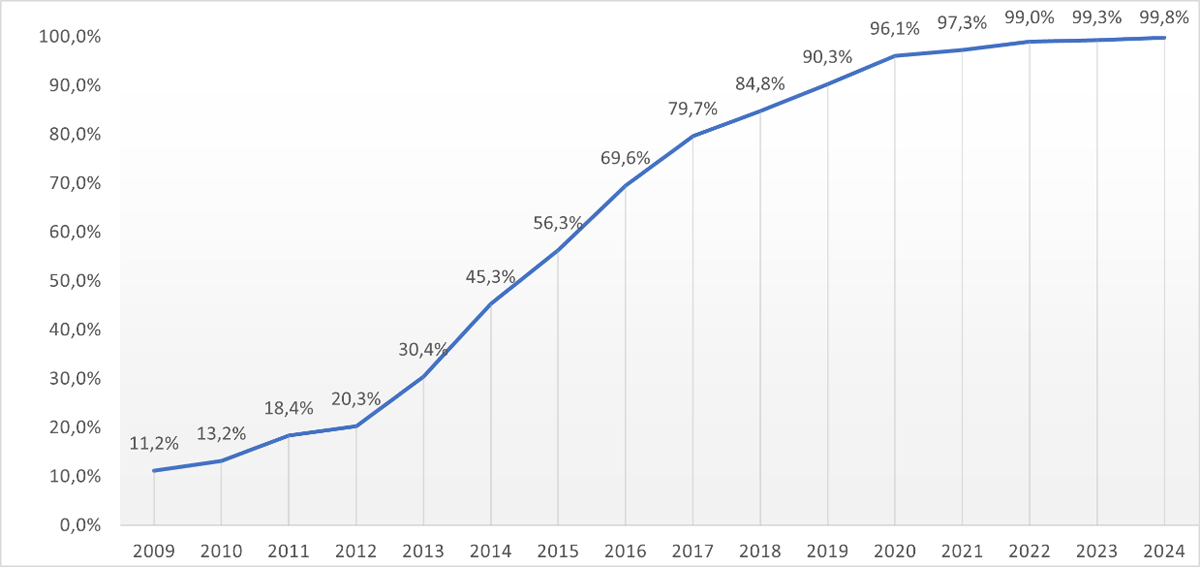
Figure 1
Historical series of the percentage of new electronic processes in Brazil. By the authors based on (CNJ, 2024).
The sheer size of the country and the differences between the Brazilian federal states could be reasons to question the Brazilian case, as it supposedly treats the legal frameworks of different states as similar. This argument is flawed, as the country has a stable and standard set of federal legal norms, including procedural laws that give all states the same core rules and rites. This enables the evaluation of court proceedings on a comparable basis.
4 Research Model and Hypothesis
To assess the impact of CCMS on the efficiency of justice, we adopt the rate of CCMS use in courts as the independent variable. It represents the ratio of electronic cases to the total number of cases filed over a specific period. As already emphasized, once filed electronically, the case remains in electronic format throughout its entire lifecycle. The assumption is that as the rate of technology use increases, the efficiency also increases. The three dependent variables reflecting judicial efficiency are the length of proceedings, the clearance rate, and the number of pending cases. The indicators are part of the European Commission’s (EC) efficiency measurement methodology, which results from the evolution of over ten years of accumulated experience and studies and relies on the cooperation of numerous individual and institutional actors within the European judicial system.5 Three main hypotheses are being considered.
Hypothesis 1 (H1): The rate of IT use is negatively associated with the length of proceedings.
The length of court proceedings is the most cited variable related to court efficiency in literature (OECD 2013; Rosales-López 2008; Tenório and Souza 2021; Voigt 2016; Yeung, Silva, and Osse 2020). The duration of proceedings directly impacts costs and may discourage citizens from seeking justice when excessively prolonged (Yeung, Silva, and Osse 2020). Ensuring a reasonable length of proceedings goes beyond operational efficiency; it constitutes a fundamental right as a core component of a fair trial. Therefore, timely justice is more than a theoretical right; it is essential to upholding fairness, as prolonged proceedings risk undermining justice altogether (Reiling 2009). The duration of the process is also linked to a critical court performance metric: confidence in the judicial system (OECD 2013). The hypothesis is that as more proceedings are conducted digitally, the duration of processes is reduced.
Hypothesis 2 (H2): The rate of IT use is positively associated with the clearance rate.
The clearance rate represents the ratio of resolved cases to incoming cases. It informs about the court’s capacity o clear cases at a rate at least equivalent to the inflow of new cases. When the indicator stays above 100%, the court decreases its number of pending cases. Conversely, when the indicator falls below 100%, the backlog expands. Facilities provided by the use of CCMS are expected to contribute to a rise in clearance rates.
Hypothesis 3 (H3): The rate of IT use is negatively associated with the number of pending cases.
The number of pending cases indicates the backlog of unresolved cases at the end of a specific period. Pending cases continue to increase in many countries, which is a severe challenge for the justice administration (European Commission – EC 2022). Backlog is expected to reduce as more cases are held digitally. Figure 2 presents the research model.
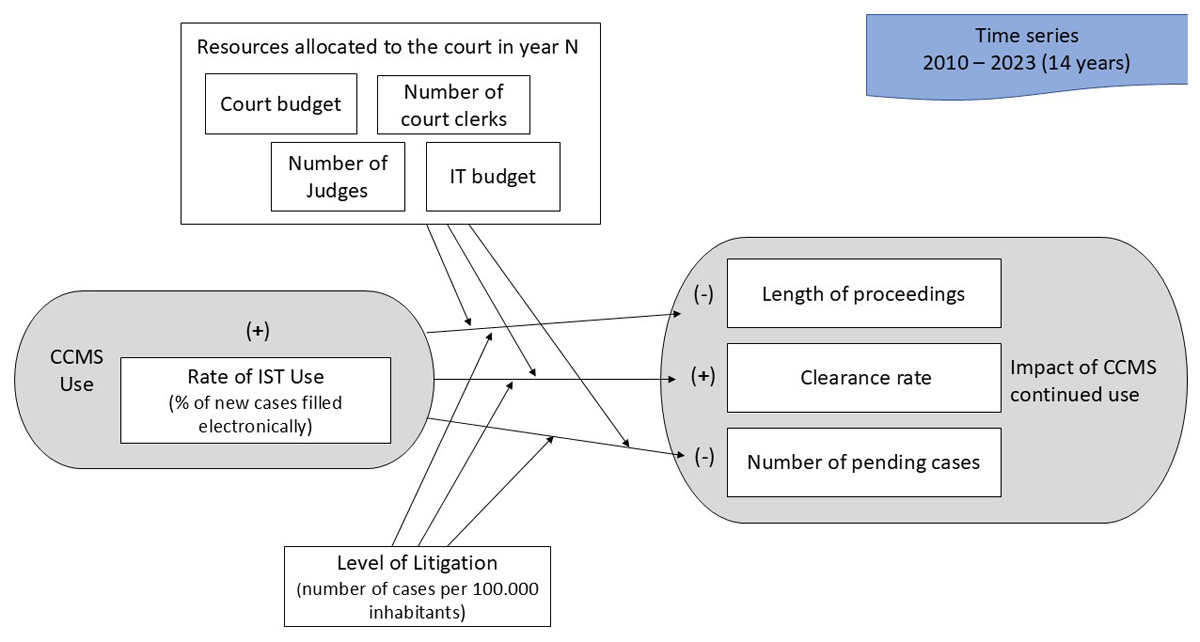
Figure 2
Research Model.
Drawing on prior studies, we selected five control variables capable of influencing the dependent variables. Their inclusion increases the precision of the model, as the relationship between the independent and dependent variables can be observed without interference from these factors. Four of the control variables are related to resources: court budget, IT budget, number of court judges, and number of court clerks allocated for each year. Studies have related them to the performance of courts (Fauvrelle, Tony, and Almeida 2016; Nissi, Giacalone, and Cusatelli 2019; M. Sousa and Guimaraes 2018; Tenório and Souza 2021). The level of litigation is our fifth control variable, representing the number of new cases per 100,000 inhabitants. Where the demand for justice is high, justice is more efficient (Castro and Guccio 2014; Dimitrova-Grajzl et al. 2012; Nissi, Giacalone, and Cusatelli 2019). By reducing potential confounding effects, the five control variables increase the internal validity of the model.
5 Data and Empirical Methodology
The empirical analysis follows a quantitative approach based on annual secondary data from the official annual report of the Brazilian judiciary, Justice in Numbers (CNJ 2024). The data covers fourteen years, spanning 2010 to 2023.6
The analysis focuses on first-instance adjudication data from the state-level justice system, which operates in all 27 states and accounts for a majority of Brazilian judicial cases (78%).7
Enforcement proceedings were excluded from the research, as they present many implementation difficulties that are unrelated to inefficiency within the justice system. For example, in cases involving fraud or embezzlement, a defendant may hide assets in offshore accounts or transfer them to third parties to avoid seizure, and a debtor may be unable to pay a court-ordered judgment due to insolvency or bankruptcy proceedings. In these scenarios, delays in concluding cases are unrelated to potential court inefficiency.
Criminal and non-criminal cases are analyzed separately, as the complexities and rites of the respective processes differ substantially concerning the law applied, the degree of participation of institutional actors external to the justice system, the sentential force, and several other factors capable of impacting efficiency indicators. The distinction helps determine whether the dynamics of the impact vary between criminal and non-criminal cases. The judicial appeal level was excluded, as the available data does not distinguish between criminal and non-criminal justice. The analysis also differentiates between data from ordinary courts and small claims courts. Small claims courts deal with less complex civil matters, small claims, misdemeanours, and less offensive crimes carrying a maximum sentence of two years. Small claims courts are designed to solve legal cases more quickly and easily. The aim is to identify potential differences in the impact of IT use between small claims courts and ordinary courts.
The combined time-series and cross-sectional dimensions led us to use a Data Panel to verify our hypothesis. As explained earlier, the dependent variables correspond to three aspects of court efficiency: the length of proceedings, the clearance rate, and the number of pending cases. Our main independent variable, which relates directly to H1, H2, and H3, is the rate of IT use (procel), measured as the percentage of new cases filed electronically. The five control variables were also included:8
– The Court Budget, measuring total state expenditure on maintenance and payment of active staff (dpjio);
– The IT Budget, measuring expenditure on IT-structure maintenance as a ratio of the total budget (dinf);
– The ratio of Judges to the total court staff, excluding those on leave (mag);
– The ratio of Court Clerks to the total court staff, excluding those on leave (sajud);
– The Level of Litigation, measured as the number of new cases per 100,000 inhabitants (ch).
Table 1 shows the descriptive statistics of the variables, which are already categorized by type of court and justice.9
Table 1
Descriptive statistics of variables.
| VARIABLE TYPE | VARIABLE | DESCRIPTION | UNIT OF MEASUREMENT | N | MEAN | STANDARD DEVIATION | MIN | MAX |
|---|---|---|---|---|---|---|---|---|
| Treatment | procel1 | Percentage of cases filed electronically, to the total number of cases filed in the ordinary 1st level instance in the base period. | % | 378 | 0.587 | 0.420 | 0 | 1 |
| procelje | Percentage of cases filed electronically to the total number of cases filed in small claim courts in the base period. | % | 378 | 0.813 | 0.300 | 0 | 1 | |
| Dependent | iadccrim1 | Clearance rate: ratio of adjudication solved cases to the total of new cases in 1st instance of criminal ordinary courts in the base period. | Ratio | 378 | 1.164 | 0.545 | 0.323 | 5.201 |
| iadccrimje | Clearance rate: ratio of solved cases to the total of new cases in 1st instance of non-criminal ordinary courts in the base period. | Ratio | 378 | 1.090 | 0.247 | 0.402 | 2.127 | |
| iadcncrim1 | Clearance rate: ratio of adjudication solved cases to the total of new cases in 1st instance of non-criminal ordinary courts in the base period. | Ratio | 378 | 1.512 | 4.186 | 0 | 78.857 | |
| iadcncrimje | Clearance rate: ratio of solved cases to the total of new cases in 1st instance of criminal small claim courts in the base period. | Ratio | 378 | 1.092 | 0.383 | 0.424 | 6.232 | |
| tpsentc1m | Length of proceedings: duration of adjudication cases judged in 1st instance of ordinary courts between the date of filing and the day of sentence in the base period | The mean number of days | 239 | 766.31 | 480.21 | 75 | 6989 | |
| tpsentcjem | Length of proceedings: duration of cases judged in small claims courts between the date of filing and the day of sentence in the base period | The mean number of days | 239 | 303.37 | 174.22 | 75 | 1999 | |
| cpccrim1 | Pending cases: pending cases in 1st instance of criminal courts at the end of the period. | Number of cases (in thousands) | 378 | 162.58 | 220.95 | 1.39 | 1699.97 | |
| cpcncrim1 | Pending cases: pending cases in 1st instance of non-criminal courts at the end of the period. | Number of cases (in thousands) | 378 | 576.35 | 804.75 | 10.89 | 4488.06 | |
| cpccrimje | Pending cases: pending cases in small claims criminal courts at the end of the period. | Number of cases (in thousands) | 378 | 35.59 | 70.66 | 0 | 523.42 | |
| cpcncrimje | Pending cases: pending cases in small claims criminal courts at the end of the period. | Number of cases (in thousands) | 378 | 135.54 | 165.85 | 0 | 852.82 | |
| Control | dpjio | Court Budget: total state expenditure on the maintenance and payment of active staff (excludes expenditure on inactive staff and work) | Brazilian Real R$ (in billions) | 378 | 1.547 | 1.966 | 0.095 | 13.970 |
| dinf | IT budget: total state expenditure on the maintenance and payment of active staff (excludes expenditure on inactive staff and work) | Ratio of the total court budget | 378 | 0.026 | 0.015 | 0 | 0.087 | |
| mag1 | Number of judges in 1st instance ordinary courts, excluding leaves. | Ratio of the total court staff | 378 | 0.067 | 0.016 | 0.029 | 0.131 | |
| magje | Number of judges in small claims courts, excluding leaves. | Ratio of the total court staff | 378 | 0.019 | 0.009 | 0.004 | 0.048 | |
| sajud1 | Number of court clerks in 1st instance ordinary courts, excluding leaves. | Ratio of the total court staff | 378 | 0.771 | 0.082 | 0.538 | 0.944 | |
| sajudje | Number of court clerks in small claims courts, excluding leaves. | Ratio of the total court staff | 378 | 0.143 | 0.081 | 0 | 0.383 | |
| ch1 | Level of litigation: number of new cases in 1st instance ordinary courts | Number of cases per 100,000 inhabitants | 378 | 4724.56 | 1800.20 | 1589.83 | 13893.94 | |
| chje | Level of litigation: number of new cases in small claim courts | Number of cases per 100,000 inhabitants | 378 | 2263.45 | 1193.71 | 472.97 | 6360.70 |
The main empirical strategy involves employing panel data methodologies, namely the fixed and random effects models, to estimate the relationship between IT use and the three judicial efficiency dimensions outlined above. This can be analytically represented by equation (1):
where i denotes a given court and t a given year. JudicialEfficiency represents one of the three considered measures of judicial efficiency (the length of proceedings, the clearance rate, and the number of pending cases). As explained above, procel—either at first instance or small claims courts—is the main dependent variable. X’ represents the set of five control variables mentioned above, λ’ stands for time effects (which, in this study, are captured by a set of year dummy variables), and μ represents either court fixed effects or a random element specific to court i, depending on the estimated model. Finally, β0, β1, and ρ are vectors of coefficients to be estimated, and ɛi,t is the error term.
Considering the distinctions between ordinary and small claims courts, and criminal and non-criminal cases, ten regression models were estimated. Each model was estimated by fixed and random effects, and the Hausman test was used to assess which was more appropriate. As the fixed effects can control for unobserved heterogeneity at the individual level, while the random effects—being the most efficient of the two—cannot, the Hausman test is a valuable tool for assessing the consistency of the random effects estimator, which, when consistent, can be preferable due to its efficiency. Lastly, a battery of robustness tests, detailed in Section 6.2., was implemented.
6 Results and Discussion
Subsection 6.1 presents the results. Subsection 6.2 details the tests conducted to validate the presented results. Subsection 6.3 discusses these results.
6.1. Main Results
Tables 2, 3, and 4 display the outcomes of our regression analyses for the dependent variables related to the length of proceedings, clearance rate, and pending cases, respectively. Therefore, the coefficients associated with the procel variables in Table 2 relate directly to H1, those in Table 3 to H2, and those in Table 4 to H3.
Table 2
Results for the length of proceedings.
| VARIABLE | DESCRIPTION | (1) TPSENTC1M/100 DURATION OF ADJUDICATION CASES JUDGED IN 1ST INSTANCE OF ORDINARY COURTS | (2) TPSENTCJEM/100 DURATION OF CASES JUDGED IN SMALL CLAIMS COURTS |
|---|---|---|---|
| procel1 | Percentage of cases filed electronically out of the total number of cases filed in the ordinary 1st level instance in the base period. | –1.690 (1.656) | |
| procelje | Percentage of cases filed electronically out of the total number of cases filed in small claim courts in the base period. | 0.621 (1.220) | |
| dpjio | Court Budget: total state expenditure on the maintenance and payment of active staff | 0.187 (0.189) | –0.029 (0.026) |
| dnif | IT budget: Ratio of IT expenditure to total budget | 0.278 (15.527) | –13.707 (10.716) |
| sajud1 | Ratio of clerks to total court staff | –2.374 (4.650) | |
| sajudje | Ratio of clerks to total court staff | 1.192 (1.655) | |
| mag1 | Ratio of clerks to total court staff | 2.956 (31.404) | |
| magpje | Number of judges in small claims courts, excluding leaves. | 48.375*** (9.959) | |
| ch1 | Level of litigation: number of new cases in 1st instance ordinary courts | –0.001** (0.000) | |
| chje | Level of litigation: number of new cases in small claim courts | –0.0003* (0.0001) | |
| Observations | 239 | 239 | |
| R-squared | 0.127 | 0.184 | |
| Model | RE | RE |
[i] Notes: All models were estimated including a constant and year dummy variables. Robust standard errors are reported in parentheses. Regressions were estimated using either the Random Effects (RE) or Fixed Effects (FE) model, depending on the Hausman test results. Dependent variables were divided by 100 to facilitate reading of the coefficients. Statistical significance: ***p < 0.01, **p < 0.05, *p < 0.1.
Table 3
Results for the clearance rate.
| VARIABLE | DESCRIPTION | (1) IADCCRIM1 CLEARANCE RATE FOR ADJUDICATION CASES, 1ST INSTANCE OF CRIMINAL ORDINARY COURTS | (2) IADCNCRIM1 CLEARANCE RATE FOR ADJUDICATION CASES, 1ST INSTANCE OF NON-CRIMINAL ORDINARY COURTS | (3) IADCCRIMJE CLEARANCE RATE FOR ADJUDICATION CASES, CRIMINAL SMALL CLAIM COURTS | (4) IADCNCRIMJE CLEARANCE RATE FOR ADJUDICATION CASES, NON-CRIMINAL SMALL CLAIM COURTS |
|---|---|---|---|---|---|
| procel1 | Percentage of cases filed electronically, to the total number of cases filed in the ordinary 1st level instance in the base period. | –0.127 (0.231) | –0.030 (0.086) | ||
| procelje | Percentage of cases filed electronically to the total number of cases filed in small claim courts in the base period. | 0.563 (0.385) | –0.106 (0.156) | ||
| dpjio | Court Budget: total state expenditure on the maintenance and payment of active staff | 0.029 (0.020) | 0.011*** (0.004) | 0.009 (0.035) | 0.003 (0.006) |
| dnif | IT budget: total state expenditure on the maintenance and payment of active staff (excludes expenditure on inactive staff and work) | –0.847 (1.857) | –0.607 (1.092) | –8.281 (5.774) | –3.353** (1.690) |
| sajud1 | Number of court clerks in 1st instance ordinary courts, excluding leaves | 0.339 (0.462) | 0.032 (0.249) | ||
| sajudje | Number of court clerks in small claims courts, excluding leaves. | –1.415 (1.308) | 0.298 (0.464) | ||
| mag1 | Number of judges in 1st instance ordinary courts, excluding leaves. | 3.677** (1.826) | –1.282 (1.324) | ||
| magpje | Number of judges in small claims courts, excluding leaves. | –20.198 (15.919) | –3.314 (3.231) | ||
| ch1 | Level of litigation: number of new cases in 1st instance ordinary courts | –0.00002 (0.00003) | –6.20E-06 (0.00001) | ||
| Chje | Level of litigation: number of new cases in small claim courts | –0.0002 (0.0002) | –0.0001* (0.00003) | ||
| Observations | 378 | 378 | 378 | 378 | |
| R-squared | 0.079 | 0.090 | 0.046 | 0.089 | |
| Model | RE | RE | RE | RE |
[i] Notes: All models were estimated including a constant and year dummy variables. Robust standard errors are reported in parentheses; Regressions were estimated using either the Random Effects (RE) or Fixed Effects (FE) model, depending on the Hausman test results. Statistical significance: ***p < 0.01, **p < 0.05, *p < 0.1.
Table 4
Results for pending cases.
| VARIABLE | DESCRIPTION | (1) CPCCRIM1/100 PENDING CASES IN 1ST INSTANCE OF CRIMINAL COURTS | (2) CPCNCRIM1/100 PENDING CASES IN 1ST INSTANCE OF NON-CRIMINAL COURTS | (3) CPCCRIMJE/100 PENDING CASES IN SMALL CLAIM CRIMINAL COURTS | (4) CPCNCRIMJE/100 PENDING CASES IN SMALL CLAIM CRIMINAL COURTS |
|---|---|---|---|---|---|
| procel1 | Percentage of cases filed electronically, to the total number of cases filed in the ordinary 1st level instance in the base period. | 0.144 (0.218) | –0.394 (1.062) | ||
| procelje | Percentage of cases filed electronically to the total number of cases filed in small claim courts in the base period. | 0.043 (0.217) | 0.027 (0.450) | ||
| dpjio | Court Budget: total state expenditure on the maintenance and payment of active staff | –0.680** (0.320) | –0.633*** (0.158) | –0.212 (0.224) | –0.083 (0.219) |
| dnif | IT budget: total state expenditure on the maintenance and payment of active staff (excludes expenditure on inactive staff and work) | 6.172 (3.751) | 21.486* (10.662) | 0.727 (1.987) | 5.027 (7.520) |
| sajud1 | Number of court clerks in 1st instance ordinary courts, excluding leaves | –1.145 (0.904) | –0.830 (1.886) | ||
| sajudje | Number of court clerks in small claims courts, excluding leaves. | 0.151 (0.432) | 0.037 (1.700) | ||
| mag1 | Number of judges in 1st instance ordinary courts, excluding leaves. | 1.277 (3.202) | 18.287* (10.071) | ||
| magpje | Number of judges in small claims courts, excluding leaves. | 0.119 (3.056) | –3.580 (5.772) | ||
| ch1 | Level of litigation: number of new cases in 1st instance ordinary courts | –0.00002 (0.00004) | 0.0002 (0.0001) | ||
| chje | Level of litigation: number of new cases in small claim courts | 0.00008 (0.00006) | 0.0002** (0.0001) | ||
| Observations | 378 | 378 | 378 | 378 | |
| R-squared | 0.636 | 0.585 | 0.277 | 0.012 | |
| Model | FE | FE | FE | FE |
[i] Notes: All models were estimated including a constant and year dummy variables. Robust standard errors are reported in parentheses. Regressions were estimated using either the Random Effects (RE) or Fixed Effects (FE) model, depending on the Hausman test results. Dependent variables were divided by 100 to facilitate reading of the coefficients. statistical significance: ***p < 0.01, **p < 0.05, *p < 0.1.
Starting with the results for the length of proceedings, Table 2 presents the results for first instance courts in column 1, and the results for small claims courts in column 2. These results do not corroborate H1, suggesting no influence of IT in courts’ length of proceedings, both in first instance and small claims courts, as the coefficients associated with the procel variables are never statistically different from 0.
Table 3 presents the results for the clearance rate. Column 1 displays the results for criminal justice in first-instance courts, column 2 for non-criminal justice in first-instance courts, column 3 for criminal justice in small claims courts, and column 4 for non-criminal justice in small claims courts. As in the case of H1, the results do not corroborate H2, suggesting no influence of IT on court clearance rates, as the coefficients associated with the procel variables are statistically different from 0. The only case with very marginal evidence of a statistically significant relationship between IT in courts and clearance rates is the model in column 3 for criminal justice in small claims courts, where the procel coefficient is nearly statistically significant at 10%.10
Finally, Table 4 presents the results for pending cases. As in Table 3, column 1 shows the results for criminal justice in first-instance courts, column 2 for non-criminal justice in first-instance courts, column 3 for criminal justice in small claims courts, and column 4 for non-criminal justice in small claims courts. The results suggest that the use of IT in courts has no statistically significant impact on judicial efficiency, as measured by the number of pending cases. Therefore, H3 is also not corroborated by the results. Regarding the other variables, in this case, the results strongly suggest that a higher budget is associated with higher efficiency in first-instance courts.
6.2. Robustness Tests
This subsection describes several tests conducted to assess the robustness and sensitivity of the main results presented in the previous subsection.11 They include use of alternative empirical methodologies, variables, and model specifications.
As some of the dependent variables had a few observations with abnormally high or low values that deviated substantially from their distribution means, the first test consisted of estimating the regressions after removing these outlier values. The outliers were identified through the Stata outdetect procedure, and the number of identified outlier observations ranged from 0 to 22, depending on the variable being analyzed. The results confirmed that H1, H2, and H3 are not corroborated. They also revealed that a higher court budget is associated with higher clearance rates and fewer pending cases.
Three sensitivity tests were implemented. First, to address the possibility that the impact of IT use on judicial efficiency may manifest only after some time, the regressions were re-estimated with the independent variable lagged by one period (i.e., one year in this case). The results did not provide evidence of a statistically significant relationship between procel and the ten dependent variables. Second, the regressions were re-estimated using the number of new cases, instead of the level of litigation, as a control variable. The level of litigation may remain stable even as the number of new cases fluctuates, which justifies use of this test. The results essentially confirmed the main results presented in the previous subsection. However, there were two minor exceptions: the coefficient associated with the procel variable was revealed to be positive and marginally statistically significant in the regressions for the clearance rate and the number of pending cases for criminal justice in small claims courts. Third, additional regressions were estimated using alternative measures for the budget (dpjio) and staff variables (sajud1, sajudje, mag1, magpje): court budget per case, IT budget per case, number of judges per case, and court staff per case. These alternative specifications provide metrics that are more comparable than the original variables. The results from these alternative specifications confirmed the main findings presented in Tables 2, 3, and 4, providing further evidence that our conclusions are robust to different measurement approaches for the control variables.
The dependent variables related to the number of pending cases are count variables and are not normally distributed. Therefore, regressions with these dependent variables were estimated using a method specifically suited to modelling count data: the Poisson regression for panel data.12 As in Table 4, the coefficients associated with the procel variables were not revealed to be statistically significant.
Our results suggested that IT in courts do not affect judicial efficiency. However, these results are average and do not explore the possibility of variations in the impact of IT use on judicial efficiency along the conditional distribution of the dependent variables. As we could not rule out the possibility that the impact of IT in courts varies across different levels of length of proceedings, clearance rates and pending cases, we estimated quantile regressions for all the dependent variables using the same set of controls as in Tables 2, 3, and 4. These were estimated using the Machado and Silva (2019) approach for quantile regressions in a panel data setup for quantiles 0.1, 0.2, 0.3, 0.4, 0.5, 0.6, 0.7, 0.8, and 0.9. The coefficient associated with the variable that measures IT in courts was not statistically significant in any quantile, confirming the main results.
6.3. Discussion
The regression results deviated from our expectations and were somewhat surprising, considering the rationale behind the introduction of IT in the justice domain, its common-sense efficiency gain, and the judicial-specific empirical studies that have produced results contrary to what we found, as detailed in the literature review section. On the other hand, our results align with other quantitative studies that showed no correlation between technology and court efficiency.
It is important to highlight the differences in research methods used in previous studies. Studies that found positive effects of IT use on justice efficiency mostly employed approaches that draw on the perceptions of judicial actors, e.g. interviews, observation or surveys (M. Sousa, Kettiger, and Lienhard 2022; Djamaludin et al. 2023; Ahmed et al. 2020; Povylius 2024). In contrast, most studies based on quantitative statistical court data found either no effects or adverse effects. It appears the observable benefits of reduced case filing time (by eliminating manual handling, transportation requirements, storage, etc.), simultaneous access to judicial cases by lawyers, clerks, judges, and prosecutors, online notifications, and virtual hearings and trials, suggest that IT optimizes case handling and generates efficiency gains. It has improved judicial case management, eliminated the time spent travelling to the court, and reduced bureaucracy, which may explain the similar outcomes reported by perception-based studies. The increase in efficiency is visible; however, it is observed at specific stages in the trial flow of a case.
Conversely, previous quantitative analyses, based on objective official statistics from courts and employing different research designs, are aligned with our results, indicating that IT use is unrelated to efficiency gains when considering the entire judicial process (Tenório and Souza 2021; M. Sousa and Guimaraes 2018; Tavares and Mota 2016; Procopiuck 2018; Marques Filho and Cabral 2021). Only one quantitative study has reported a positive relationship between IT and efficiency in Brazilian courts, specifically labour courts13,14 (Castelliano, Grajzl, and Watanabe 2023). This finding receives additional context from recent data: the Brazilian National Council of Justice reports that labor court productivity increased by 20.1% from 2022 to 2023, significantly higher than the 6.9% increase across all courts (CNJ 2024). This rate suggests that the specific legal framework and institutional characteristics of labor courts may make them more responsive to performance-enhancing factors, such as IT, compared to other Brazilian courts.
Interestingly, some studies have even found a negative relationship between IT and performance indicators. Fauvrelle, Tony, and Almeida (2016, 22) discovered a decrease of approximately 0.22% in judicial productivity associated with the informatization of justice. According to Sousa and Guimaraes (2018), investing in IT contributes to increased inefficiency. A study by Yeung et al. (2020, p. 27) suggests that technology harmed efficiency indicators. They emphasize the need for a deeper investigation of these controversial results.
One question that arises is whether the perception-based results which reported positive effects of IT on justice efficiency contradict the quantitative results based on statistical data—including our own—which present a different outcome. The optimal conclusion is that these findings are complementary. Information Technology has generated efficiency gains in parts of the judicial process, particularly in administrative manual tasks, by reducing the need for physical court appearances and improving communication between courts, prosecutors, lawyers, and parties. However, other factors are likely to constrain improvements in the overall judicial process.
An explanation provided by previous studies for the unexpected results is the learning curve. The novelty surrounding new technology may impact people, who will require a period of adjustment.15 However, this interpretation is unlikely to apply to our case, as Brazil has more than fifteen years of IT use, the initial learning phase has concluded, and the skills required to use the system are probably consolidated. In addition, despite not being digital natives, 75% of judges in Brazil are at least 55 years old, and 83.1% of court clerks at least 45 years old. These relatively young individuals who have been exposed to technology from the beginning of their judicial careers are excluded from the group considered to have more difficulties with IT (CNJ 2023).
Procedural legal deadlines may offer explanations for the research results. Although information technology has expedited several phases of the judicial process, statutory time limits remain fixed by law; they are non-compressible, and procedural acts must respect them. Put differently, it is impossible to accelerate some steps within the judicial process.
Another relevant factor pertaining to Brazil is that the rules for electronic proceedings extend the deadline for undertaking any judicial action by ten days relative to paper-based justice. So, considering the procedural context applied to the case, the proceedings may be delayed by ten days, often whenever an act is carried out during the procedural phases. However, this explanation is only valid if these ten days exceed the time previously required for judicial notifications, which traditionally involved physical mail delivery and processing time in the court secretariat.
Another justification is the increase in the number of court appeals. Some protracted appeals have no grounds or arguments and are used strategically to delay the natural progress of the case. This practice has always existed, but given the option to file a petition digitally—as opposed to facing the inconvenience of appearing physically at court—it is now over-adopted, adding steps to the judicial procedure and contributing to minimizing efficiency gains of IT use. Procopiuck (2018) emphasizes that such methods may form part of a legitimate prosecution and defense strategy but may also be misused, influencing the timing of legal cases.
Thus, while IT implementation may foster judicial efficiency, certain detrimental concurrent factors also benefit from IT improvement, thereby diminishing potential efficiency gains. For example, the ease provided by IT favors predatory litigation and dilatory measures (Melnikova 2023). In Brazil, the official Annual Data Report on Judiciary for 2024 indicates that new legal cases grew by 9.4% compared to the previous year (2022 to 2023) for no apparent reason (e.g., legislative expansion). A potential contributing factor could be the adoption of automated filing systems by law firms in Brazil. These firms are using software robots to file large-scale cases, which may have lowered the practical barriers to initiating legal proceedings.
Other concurrent systemic factors unrelated to IT may neutralize or diminish its potential benefits. Specifically, during the adjudication phase, factors such as the unnecessary judicialization of evidence collection, jurisprudential instability, insufficient sanctions for bad-faith litigation, and the excessive use of dilatory measures serve as examples of these challenges (Castelliano et al. 2024). The Brazilian context presents additional challenges that compound these issues. The low cost of filing claims, combined with a strong ‘culture of judicialization’ and an unusually high number of lawyers per capita, creates an environment where the volume of proceedings consistently undermines efficiency improvements (Castelliano et al. 2024).
Lastly, the CCMS had limited impact on the intellectual work of judges. Although advancements in efficiency from the perspective of the judge’s work have been achieved through streamlined case searches, access to caselaw, and the elimination of travel time for certain court appearances, the fundamental tasks of constructing legal arguments and rendering judicial decisions remain practically unchanged. These tasks are time-demanding, as they require careful analysis, thorough reasoning, and high precision, underscoring the importance of judicial decision-making in ensuring fairness. While some stages of the judicial process have benefitted from these efficiency gains, the decision-making phase continues to act as a bottleneck, often causing cases to be held up, thereby contributing to a significant workload for judges.
7 Final Considerations
This study assessed the impact of CCMS use on court efficiency. The empirical analysis indicated that the actual use of IT in Brazilian State courts has no statistically significant relationship with the length of proceedings, the clearance rate, or the number of pending cases, considering data from all 27 Brazilian States over 14 years. Our results suggest that the use of IT in justice does not impact the system’s overall efficiency indicators. However, it has generated considerable gains in case management, such as facilitating case filing, enhancing information organisation, supporting case monitoring and tracking, improving communication among judicial actors, and generating court statistics. These results have policy implications for Brazil as well as for other countries, as our findings are, to a certain degree, applicable beyond Brazilian state courts. Policymakers should be well-informed on the limits of the overall efficiency gains generated by the CCMS and the procedural phases most affected by its use.
The technological transformation of legal procedures has introduced novel, yet often unrecognized, nuances into the complexity of the legal system, which need to be further understood. For example, legal submissions to courts have become increasingly comprehensive and sophisticated. This additional complexity results from improved access to judicial cases, case law databases, and advanced legal reasoning tools, which, in turn, make judicial analysis more demanding. Another example is the mass filing of judicial cases by robot systems. These shifts, along with other factors yet to be systematically identified, shape contemporary digital judicial proceedings, highlighting the limitations of traditional metrics in capturing this fundamental transformation.
When analyzing the effects of CCMS through conventional efficiency metrics alone, we risk overlooking their broader impact on socio-legal dynamics. While the expected improvements in processing speed and case clearance rates may not have fully materialized, CCMS could be producing benefits or harms that traditional metrics fail to reflect. This raises important questions about the nature and scope of these technological impacts: What unforeseen advantages and disadvantages have emerged? How do these benefits or harms influence the quality and administration of justice? Understanding these broader implications is crucial for developing more comprehensive frameworks for assessing the influence of technology on judicial systems.
A limitation of the study concerns measuring the efficiency of Brazilian state justice with a high level of aggregation (criminal and non-criminal), disregarding the lawsuit particularities, law subject, and Brazilian region. This suggests that, in certain cases subject to greater direct impacts from IT advancements, the durations of court proceedings may be reduced, and the clearance rates may rise, leading to improved efficiency metrics within those specific categories of cases. Since disaggregated data on Brazil is available, future research could explore this hypothesis by focusing on specific courts, legal subjects, or individual Brazilian states.
It is also important to stress that the independent variable indicates the use of CCMS, a technology that has yet to incorporate features for automated decision-making. Future studies should focus on the impact of these tools on overall court efficiency.
Notes
[4] Only in the latest 2024 CEPEJ Evaluation Report on European judicial systems were data included about IT systems’ usage rates in practice, with the caveat: “These data on usage rates and their analysis should, however, be seen as a first step in exploring the capacity of court systems to collect such data, and its interpretation, particularly when compared with deployment data, is not straightforward” (CEPEJ 2024, p. 146).
[5] Online Dispute Resolution (ODR) was excluded as it often refers to the use of technology to facilitate the resolution of disputes as an out-of-court process, typically including methods like negotiation, mediation, and arbitration conducted through digital platforms.
[6] Brazilian Judicial Statistics Panel. Available at https://justica-em-numeros.cnj.jus.br/painel-estatisticas/. Accessed on 01/18/2025.
[8] Another recognized institution, the International Consortium for Court Excellence (ICCE), composed of international judicial institutions with expertise in court and judicial administration, also sets the duration of case processing, clearance rate, and case backlogs as core measurements of court performance.
[9] The exception is the variable length of proceedings, for which data is only available from 2016 onwards. Therefore, the coverage period for this variable is eight years and not fourteen years. The length of proceedings is calculated in calendar days, from the day a case is presented before the court until the day the court adopts its decision and files it.
[11] To avoid high correlations between the control variable and multicollinearity issues in the estimations (i.e., large variance inflated factor values) and to make sure that not all four of the controls are capturing court size, the IT budget is measured as a ratio of the total budget, and the number of judges and court clerks as ratios of the total staff (i.e., judges plus clerks).
[12] A “1” is added to the variable’s name when it refers to first instance ordinary courts and “je” when it refers to small claims courts. Analogously, “crim” is added when the variable refers to criminal courts, and “ncrim” to non-criminal courts.
[16] They avoid the term efficiency due to its economic concept and use efficacy as the capacity to satisfy the demand for justice.
[17] They used the total digital caseload rather than newly filed digital cases, which could justify different results. However, adopting the percentage of new digital cases does not disqualify our analyses. The low current rate for paper-based proceedings demonstrates that new cases filed electronically are reflected in solved cases (currently, a rate of 96% solved digitally).
[18] Other authors already justified the controversial results of the research using the learning curve argument. See Sousa and Guimaraes 2018; Yeung, Alves Da Silva, and Osse 2020.
Competing Interests
The authors have no competing interests to declare.
Author Contributions
Cinara Rocha and João Carvalho prepared the manuscript. João Martins contributed to the statistical analysis. Antônio Suxberger and Delfina Soares critically reviewed the manuscript.