
Introduction
Surprisingly, the popular word innovation is associated with an economist of Czech origin, J.A. Schumpeter. A native Czech raised, for example, the famous economist Samuelson, but he was also the Minister of Finance of the Austria-Hungary empire. Schumpeter was one of the first to contribute to the knowledge and need for innovation in business (Schumpeter, 1942). The initially negative notion of innovation, which represented an unwelcome change in a conservative society, gradually symbolized wanted and necessary development. Innovations have penetrated all areas of society in recent years, are a frequent topic of experts and academics and have become an integral part of the business.
The private sector, which is to a certain extent regulated by the state, has been putting considerable pressure on the digitalization and pro-customer orientation of public administration over the last decade. However, performance is generally difficult to measure in state administration, and innovation in this sector is not a priority. Is there a reason to innovate the state administration or even the administration of the judicial system? According to research into the innovation and efficiency of the state administration, the answer is undoubted yes. At present, the public sector of the Czech Republic belongs to the group of less innovative EU 27 countries (Hollanders et al., 2013). The state administration of the Czech Republic cannot keep pace with digitization with its western neighbours and countries such as Estonia. Many actors in public life agree that the problem of the Czech state administration is not in the lack of innovation incentives but the leadership of innovations, i.e. in their management, implementation and sustainability (Aspen Institute Central Europe, 2019). As recent studies suggest, the issue of innovation leadership in public administration has become increasingly important in recent years, especially in the founding countries of the EU (Hart & Tummers, 2019; Kettiger et al., 2019). In the Czech Republic, the discussion on this topic is still developing.
Combining leadership with innovation in the corporate environment is a desirable topic with extensive literature for academic research. Innovative leadership in public administration is significantly less represented in the academic literature because the main emphasis is on responsibility, compliance with regulatory rules and ethics. An essential element of this research is the influence of innovative leadership on employees’ attitudes and their perception of leadership effectiveness.
Professionals and the lay public expect the courts to make quick and fair decisions. The quality of this decision-making depends not only on the level of judges and court officials but also on supporting financial and administrative services, such as the degree of digitization of the judicial system processes and their efficiency. Unlike the business community, the judicial system cannot be improved by creating competition.
Based on the above reasons, the main goal of this article is to define the role of innovative leadership in the economic administration of the courts of the Czech Republic.
The position of innovative leadership in the court management
The judicial system is a specific part of the state administration. The Constitution defines the judiciary in democratic states as independent of government and parliamentary power. Still, it is subject to funding from the state budget, either directly or by the Ministry of Justice. In general, there are different models of judicial self-government in EU countries. In the Czech Republic, the judicial system is directly subject to the budget of the Ministry of Justice. At the same time, in the Netherlands, Finland, France and other countries, for example, there is a Supreme Judicial Council. Independent courts exercise judicial power in the Czech Republic. The judiciary can be divided into general, administrative and constitutional. Civil and criminal matters are decided within the general judiciary. There are district, regional and high courts and the Supreme Court. Organisational justice is administered by regional courts and the Supreme Administrative Court. Within the administrative judiciary, decisions or other acts of public administration are reviewed for their compliance with the law. The Supreme Court and the Supreme Administrative Court issue opinions to ensure consistent court decisions. (Ministry of the Interior of the Czech Republic, 2017) Judicial activity can be generally divided into so-called court enforcement – decision-making and court administration. This article deals with the economic and other operational administration of the district and regional courts.
Academic research in judicial administration deals with the efficiency and quality of court proceedings: the budgeting method and the possibilities of monitoring court performance using various indicators (CEPEJ, 2016, 2022). Innovation is mentioned mainly in connection with the acceleration of court cases. The issue of leadership and innovation in the economic administration of the courts has not yet been addressed.
There is a well-established notion that courts are essentially rigid institutions. However, the judicial administration has recently looked for a functioning management model. The professional judiciary that forms the basis of the system must be respected. The organization and management of courts should be reserved for judicial officers with managerial skills. Otherwise, the quality of court decisions risks declining with declining management and administration (Friesen, 1971). Innovations in the judicial system are a critical success factor for achieving better court performance. Only a radical change in the management of the courts will make it possible to meet the current growing demands on the courts (Bunjevac, 2011).
Similarly, the Council of Europe for the Efficiency of Justice (CEPEJ, 2016) sees the inadequacy of existing court governance as the main shortcoming. One way out is to choose integration procedures, which means that judicial, administrative and human resources and financial operations should be integrated by the local courts themselves and not centrally by, for example, the Ministry of Justice. Integrated management enables courts to plan their operations strategically and thus provides an effective response to identified structural deficiencies (Bunjevac, 2011).
Piana (2012) considers innovation in judicial systems to be an essential activity of judicial policies accepted in all advanced democracies at various levels of the judiciary. These innovations are a tool to remedy the inefficiencies that affect the judiciary. In principle, these are extreme lengths of court proceedings, unequal access to justice and a lack of public confidence in the courts in general. It has been shown that a dysfunctional civil procedure system could cause unnecessary costs and burdens for litigants (Edel, 2007). Compared to the previous period, when innovations were primarily promoted from a top-down approach, they are now implemented locally and following the ideas of New Public Management (Pauliat, 2007). Unfortunately, this innovation effort suffers from a lack of dynamism in the implementation phase. In addition, neither researchers nor management experts have provided any theoretical evidence for the management of the innovation process in the judicial system. Innovation appears to improve the judiciary system effectively only if relevant staff permanently monitors the process (Piana, 2012).
To provide clear information on the role of innovation in case law, Piana (2013) examined the innovation process at the Prosecutor’s Office in Naples. The presented case study found that the office operated in a relatively rigid and inflexible way, hindering the effective implementation of innovations. This dysfunction was even more significant when the innovation required the cooperation of both judicial and administrative staff. Surprisingly, the office has resorted to external capacities, such as a local university, where a specialized organizational unit has been set up to facilitate innovation. In this way, the office organized managerial and monitoring capacities, which became a prerequisite for reviving the innovation process in the office. This change made it possible to create additional building blocks such as a work experience model, an innovation office and a quality assurance mechanism. The main benefits of this program were faster motivation efforts, better operational knowledge management and deeper employee involvement in innovation. Czarniawska & Mazza (2003) also discuss external consultancy. The authors link the concept of individuals’ rites of passage in society (liminality) with external consulting activities in firms. Liminality is when customary practices and order are eliminated and replaced by new rituals. They develop three concepts: consultant conditions, consultant rituals and the liminal environment of the organization – using examples from consulting practice. Their observations support the notion that “counselling can be imagined as a liminal space for both consultants and their client organisations” (Czarniawska & Mazza 2003, p.267).
Peyrache & Zago (2015) conducted research to review the effectiveness of the courts. For this article, the authors divided the overall inefficiency into three subgroups: technical, inefficiencies in court size and inefficiencies in court allocation. They found that most of the court’s inefficiency was technical inefficiency (38%). This type of inefficiency is related to the lack of best practices. The remaining two subgroups represent inefficiencies in court size (22–25%) and inefficiencies in the redistribution of money (30–40%). The authors see a solution to this problem in implementing innovation, which can either merge smaller courts into larger ones or divide large courts into smaller and more operable units. These organizational provisions should be strengthened by using best practices and good practices.
Murillo et al. (2013) also positively assess the standards developed by the following institutions: the Australian Benchmark, the Rovaniemi Benchmark, the Netherlands Judicial System Standards and the International Judicial Excellence Framework (IFCE). IFCE attracts the most attention. It intends to compare court performance in several detailed areas, regardless of the location, size, resources or technology available and provides clear guidelines for improving performance through the inclusion of case studies.
The Thomson Reuters Executive Institute expresses concern that by reducing the court’s budget, it will be possible to politically influence the operation of the judiciary in the future (Legal executive institute, 2017). Viapiana (2018) mentions similar experiences introducing innovation in court budgeting in Finland and the Netherlands. In moving to a more efficient system of court budgeting based on court case evaluations, judges strongly expressed concerns about their independence, which was undermined by intense pressure to increase efficiency. In practice, the new budgeting system forced judges to decide more quickly on court cases, thereby jeopardizing their independence to decide. It is possible to influence the independence of judges through financial instruments and the introduction of innovations to increase efficiency. To what extent this is realistic will be a question of further research.
Based on an expert discussion in the field of public administration management (ŠpaČek, 2016; Ochrana & PůČek, 2011), the practical experience and knowledge of the author of the article, it can be stated that innovation leadership is underestimated in the state administration of the Czech Republic. Innovative leadership is gradually becoming the domain of the business sector in particular, mainly due to pressure to increase the competitiveness of companies. The public sector is slowly emerging from the bureaucratic procedure given primarily by the Austria-Hungary Empire and the period of communism. These periods are characterized by excessive adherence to strict legislative guidelines without the specific responsibility of the actors.
Judicial administration is traditionally understood as the most conservative part of public administration. In this article, attention is paid to the economic and administrative aspects of the judicial system. Excessive adherence to a functional view of innovation appears to be a significant problem in the financial management of innovation in the judicial system, becoming a topic for relatively isolated organizational units. Innovations arise chaotically and spontaneously; their leadership is unsystematic, and “ad hoc” management predominates. There is a lack of feedback that would address the benefits of implemented innovations and, at the same time, create the preconditions for the emergence of further innovations. The available Czech and world professional literature show that the issue of leading innovations in the economic administration of courts has not yet been addressed.
The leadership roles concept
The role is a term initially adopted from social psychology; it is expected behaviour related to a particular social status and relationship with other people (Výrost & Slaměník, 2008). The social role also includes looking at the individual, modulating relationships, approaching the individual, and the whole process of communication. Individual leadership theories define the roles or dimensions of leaders primarily according to the course of research (behavioural approach, psychodynamic approach, etc.). In organizational theory, the leader and follower interaction occur according to the defined roles (Northouse, 2016). In this article, leadership roles were chosen that are typical of the judicial environment and at the same time appeared to be essential for assessing their impact on followers, specifically on their work commitment and intention to work in the judiciary for a long time (dimension of commitment to the organization). The concept of leadership roles used in this work was elaborated in detail by Tummers & Knies (2016) in the Netherlands government. The idea seems suitable for application in the Czech Republic’s judicial system based on the authors’ recommendations, who call for its validation in other countries and other areas of state administration.
In this work, we use the term “follower”, which can be understood as any subordinate worker. It can be the head of a department or an independent specialist in the administration of a district and regional court. These are mainly employees of the judicial system’s economic, accounting, personnel, and IT departments. Their superiors are in this job in the following positions: Director of the court administration, head of departments (larger organizational units), and head of a small department in a local court. The head of the entire court administration is called the Director of the court administration. In the organizational structure of the court, he is a partner of the President of the court – the principal court manager, who organizes the work of judges. The impact of leaders on public administration followers is briefly described in the available literature (Tummers & Knies, 2016; Vogel et al., 2020).
In an extensive survey, Tummers & Knies (2016) confirmed the presence of the following four leadership roles in the Dutch public administration in a sample of 503 respondents: The role of accountable leadership, the role of rule-following leadership, the role of political loyalty leadership, the role of network governance leadership. The author of this paper supplemented this range of roles with the fifth role of innovative leadership based on the following facts: a detailed search of academic literature, which demonstrates the importance of the innovative role of leadership and the absence of research on innovation and leadership roles in judicial administration. After studying the available literature, the following hypothesis can be generated:
H1: Each of the examined five leadership roles is present in the economic administration of the courts of the Czech Republic.
In Tummers and Knies (2016), leadership roles are positively associated with followers’ attitudes: perceived leadership effectiveness, commitment to the organization, and work engagement. These roles symbolize the critical values of the state administration. It can be assumed that even in the judicial environment, these four roles and the newly intended role of innovation leadership will positively affect followers’ attitudes. The following hypothesis is based on the above assumptions:
H2: Each of the five leadership roles examined is positively associated with perceived leadership effectiveness, commitment to an organization, and follower engagement.
According to available literary sources (Kearns, K.P. 1996; Currie, Grubnic and Hodges, 2011), research or proposals for theoretical models of leadership dimensions have not yet been carried out in the judicial administration. In addition, the influence of innovative leadership on followers’ attitudes to the organization and their perception of leadership effectiveness is underdeveloped in the academic literature.
H3: Within the existing five leadership roles, the role of innovation is strongly positively associated with the perceived leadership effectiveness, the commitment to the organization and the work engagement of the followers.
Based on a critical search of available sources, identification of gaps in contemporary knowledge and several years of experience, the following research question was determined:
What effect does innovation leadership have on followers in the Czech judicial administration?
This central question is divided into two sub-questions:
Sub-research question 1: To what extent do the following leadership roles exist in the economic administration of courts: the role of innovation, the role of accountability, the role of compliance with rules and regulations, the role of political loyalty, the role of network governance?
Sub-research question 2: How do these leadership roles affect the perception of leadership and followers’ attitudes towards the judicial administration of the Czech Republic?
Research context
This research focused on identifying the areas of court administration with the most significant innovation potential. Judicial administration processes are characterized by different management modes and different legislation levels. Some operations, such as budgeting, are very tightly bound to the legal norm – Act on the State Budget of the Czech Republic. Others allow a certain degree of creativity and the possibility of innovation within the framework of ministerial regulations. Attention will be paid to these less-regulated processes.
The judicial administration system of the Czech Republic
To understand the judicial environment, it is necessary to adequately describe how the court system in the Czech Republic is administered. The central body of state administration of courts is the Ministry of Justice. The role of the state administration of courts is to create conditions for the proper administration of justice. The state administration of courts must not interfere with the independence of courts (Act No. 6/2002). The President of the court and the Director of the administration are the official representatives of the courts. The administrative Director ensures daily court operations. The court’s administrative body director is appointed and dismissed by the court’s President.
The political independence of justice is one of the pillars of a democratic system. However, political influences in the judiciary may be mainly due to limitations in budgetary resources, the size of the budget allocated and the number of judges and staff in the judiciary (Supreme Court of the Czech Republic 2022). The issue of politically motivated changes in the leadership of the Supreme Court and the erosion of the judicial system in Poland are currently much debated (Perez Bernardez, 2016). Such a situation has not yet occurred in the Czech Republic, but there are some uncertainties among Czech journalists in the Czech media regarding selecting the relevant judges and presidents of regional courts. An important factor influencing innovation in the judiciary is the quantity and quality of implemented regulations and ordinances. There may be many regulations with unclear or ambiguous purposes. In addition, regulations can be very bureaucratic and thus do not allow for innovative activity. This issue should be further discussed in the literature and research.
The administration of courts and their economic management in the Czech Republic is one of the less developed areas of public administration. They are now in the process of transformation into a modern judicial system. Although the innovation occurred in many European countries, introducing innovations in the Czech Republic differs in overcoming specific obstacles. These come from the previous socialist regime and the rigidity of the former Habsburg Empire (1526–1918). It is a so-called ministerial model with its roots in Austria-Hungary (Černý, 2019). The Ministry oversees the distribution of funds, thus better controlling the system. The Ministry also affects the appointment of judges and prosecutors. In countries such as Belgium, Denmark, Finland, France, Estonia, Ireland and Sweden, there are budget-independent Supreme Judicial Councils. They ask the parliament directly for funding and are not dependent on the often political decisions of the country’s Ministry of Justice.
The system of Czech courts is based on a situation that has been in force since 1850 (Schelleová & Schelle, 2004). The basic, though not entirely positive, transformation of the Czechoslovak judicial system was created by the communist coup in 1948. The judiciary lost its autonomy because the prosecutor prepared court decisions in advance (Schelleová & Schelle, 2004). This approach manifested itself primarily in trials against so-called class enemies. After the advent of democracy in 1989, the autonomy and independence of the judiciary were restored. Professional judges are beginning to be appointed by the President for an indefinite period. Nevertheless, the judicial administration system has not changed significantly and does not achieve the performance of the advanced EU judiciary EU Justice scoreboard (2019).
The Czech Republic courts system includes eight regional courts, which directly manage 86 district and district courts, the high courts in Prague and Olomouc, the Supreme Court and the Supreme Administrative Court. The system employs 9,377 court staff and around 2,900 judges. Court staff are divided into assistants (1,000), court waiters (74), other professional staff (7,794) and auxiliary and service staff (511) (State Final Account of the Ministry of Justice, 2018). The judicial system is administratively and budgetary subject to the Ministry of Justice of the Czech Republic. Judges are independent of the point of view of the Czech Constitution and may not be transferred to another court without consent.
The court administration is the de facto service part of the court system, which ensures the proper operation of court offices, the IT administration of individual agendas, the economic function of courts and administrative activities. Each court has a different administrative background and, therefore, many employees. The administration of courts in regional courts is usually best staffed, providing practical support and advice to district courts. They also distribute the budget funds for the relevant year to the district courts. The courts’ administration is highly decentralized, in contrast to, for example, in Germany, where there are service organizations in the ministries of justice of the Bundesländer, which provide services centrally for all courts in the Bundesländer.
The differences between the district and regional courts lie mainly in court agendas and different types of court proceedings. Regional courts economically administer subordinate district courts in the region but do not directly intervene in the decisions of district court judges. Therefore, it can be stated that the courts are independent in caseload agendas but are not independent in economic and administrative activities from the decisions of superior courts. The Director of the court’s administration reports directly to the President of the court, who is the judge. He also manages the individual departments and divisions of the administration.
The court administration environment is characterized by its complexity, budgetary turbulence and the constant tension between the executive part of the court (court case decisions) and the servicing of its activities. A significant factor in this tension is the pay gap between judges and other judicial staff. The average judge’s salary is about four times higher than a court administration employee (Annual Report of the Ministry of Justice, 2019). According to EC Judicial Statistics CEPEJ (2018), the Czech judiciary belongs to the countries with the highest number of judges per 100,000 inhabitants. This fact is due to a historical development that dates back to the time of Austria-Hungary and continued through the socialist judiciary to the present day. The necessary reform of the judiciary, which would reduce the number of judges and increase the number of assistant judges and judicial trainees and cheaper service and support staff, has not yet begun. Another tension factor remains the different approach to the judiciary, which is not subject to austerity measures in times of crisis. The salary structure is linked to the salaries of constitutional officials. Budget cuts only concern the courts’ administration in various forms if budget cuts are made.
Methods of research
Two research methods are used in this paper. These are statistical methods of factor analysis and qualitative research in the form of semi-structured interviews. Due to the large number of items in the scales of leadership roles and in the attitudes of followers, which were included in the quantitative research part of this article (56 items), a step-by-step explanatory mixed method was used. This method made it possible to enrich and refine quantitative research results through further semi-structured interviews (Creswell & Clark, 2018). This combined research method was used in this article due to the need to understand innovation in the judicial system in detail. This work’s quantitative factor analysis method does not fully describe all aspects of employees’ innovation potential. It is necessary to broaden and deepen the view of this issue through explanatory interviews.
Figure 1 shows a theoretical model of the five leadership roles and the variables of followers that respond to these dimensions. The roles are based on research by Tummers and Knies (2016), and the crucial role of innovation has enriched them.
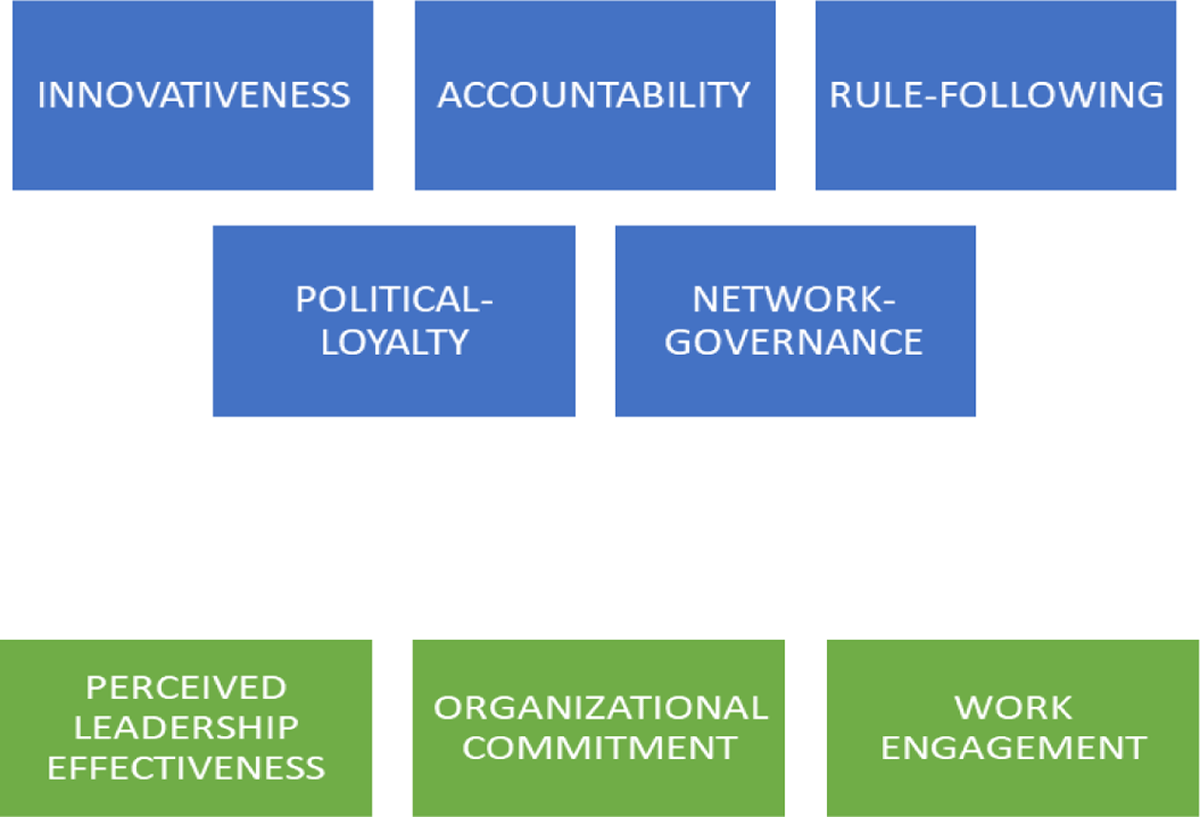
Figure 1
Leadership roles × followers’ attitudes; theoretical model.
Data source: Authors’ research.
Research process
The first phase aimed to operationalize public leadership roles based on a critical literature search (Tummers & Knies, 2016; Fernandez, 2005). Leadership innovation was evaluated as a dimension with significant potential and influence on followers’ attitudes. Therefore, it was decided to create a new scale of innovation, tested together with other leadership roles. It was assumed that each leadership role is a latent factor based on the theory. The existence of a factor must be demonstrated based on the number of variables observed, in this case using scales for each leadership role (Brown, 2015). The items were chosen to be internally consistent, and not too long, and the claims should be formulated to address only one fact. The items were clearly worded.
For this paper, four verified scales directly created for the public administration environment were taken over, and the article’s author developed the scale of innovation leadership. In the case of the scales taken over, these were: the role of accountable leadership, rule-following leadership, political loyalty leadership and network governance leadership (Tummers & Knies, 2016). These scales were translated from English into Czech, and their factual accuracy was verified by several independent experts from academia and the judiciary. Based on preliminary contextual interviews of experts, some scales were slightly adjusted for the conditions of research in the judicial system of the Czech Republic.
The role of accountability was measured by six items (reliability 0.87), such as this: “My manager encourages us to inform stakeholders about how we work.”
Five items were used for the leadership role based on rules and regulations (reliability 0.86). Example: “My supervisor makes sure we follow the rules and procedures exactly.”
The role of political loyalty was covered by five items (reliability 0.92). An example of the statement: “My leader encourages my colleagues and me to defend the policy of government laws and regulations, even though we see shortcomings in them.”
The role of network governance was covered by seven items (reliability 0.89). Example: “My manager motivates my co-workers and me to make many contacts with people outside our department.”
According to the authors’ recommendations, a five-point Likert scale was chosen, based on which respondents expressed their degree of agreement with the submitted statement (Tummers & Knies, 2016).
In the case of the role of innovative leadership, a scale was developed by the author of this paper following the literature describing the development of scales in general (De Vellis, 2016) and the specific use of innovation scales in business and public sector research (De Jong & Hartog, 2010). The final form of the innovation scale was consulted with innovation experts in the industry and public sectors and adapted to the specific corporate culture of the judicial system. The role of innovation leadership was represented by four items (reliability 0.89).
The questionnaire survey took place in 2019 and 2020. The questionnaire was sent to all 86 presidents of the district courts. They subsequently forwarded it to employees who work in support activities of the courts of the Czech Republic. The support staff of the district and regional courts was seen as a homogeneous group with the same characteristics in all districts and regions of the Czech Republic. These were staff in the human resources, finance, investment and IT departments with secondary and tertiary education. The number of completed questionnaires: 142.
The response rate was therefore calculated at 46.71%.
Factor analysis
Factor analysis was performed using the SPSS AMOS system and Jamovi software. The Kaiser-Meyer-Olkin test was first performed in Jamovi software. All values of the items in the questionnaire are in the range 0.8–1, which means that the file data is suitable for factor analysis.
In the next step, a principal component analysis (PCA) was performed using Jamovi’s software to determine the number of factors that contain the most significant percentage of variability – the so-called factor load. OBLIMIN was chosen as the rotation method, which best describes the factor load of the items. A factor load more significant than 0.5 was taken into account.
The so-called eigenvalues are also crucial in the PCA analysis. “They express the variance that is extracted by the factor. Factors with an intrinsic value greater than 1 are significant” (Brown, 2015, p. 21). In this research, five factors were identified, the overall variability of which was 70% Hinkin (1998) identifies 60% variability as a minimum for scale development. Questionnaire survey results supported the existence of predetermined factors.
PCA analysis was followed by confirmatory factor analysis (CFA) in AMOS SPSS. In the first phase, the leadership role model tested six leadership roles: accountability leadership roles, rule-following leadership roles, political loyalty leadership roles, network governance leadership roles and innovation leadership roles. To evaluate the suitability of the proposed model, several indicators were used. Comparative fit index (CFI), Tucker-Lewis index (TLI) and mean square error of approximation (RMSEA). The CFI is designed so that the values range from 0 to 1. CFI values close to 1 indicate a perfect fit. Acceptable CFI and TLI values are around 0.9 or more, with an RMSEA of 0.08 or less (Bentler, 1990). Another important indicator is CMIN/DF, i.e. Chi-square/degrees of freedom. The value should not exceed 2 (Byrne et al., 1989). Due to the low model fit values, the second phase needed to adjust the model by covariation errors for individual items of the same factors and remove some items.
The final values after adjusting the whole model were as follows: CFI 0.912; TLI 0.901; RMSEA 0.06; PCLOSE 0.007; Chi-square 1017, 663 degrees of freedom; CMIN/DF 1,535.
Qualitative part
The qualitative part of the research consisted of conducting semi-structured interviews. These interviews explain the surprising and unclear associations between leadership roles and followers’ attitudes to those roles. Individuals from the same group of respondents who completed the questionnaire commented on the results of the previous questionnaire survey, which was evaluated in the form of factor analysis. During the spring of 2019 and 2020, a total of 10 semi-structured interviews took place over two days in two courts in the Czech Republic. The semi-structured interviews were roughly divided into three parts, corresponding to three areas of inquiry: the role of innovation, political loyalty, and responsibility. Each circle was represented by four essential questions created based on factor analysis results. The respondents tried to answer these questions or further elaborated and commented on them. Additional guiding sub-questions supported each question if the respondent did not know what to answer. The length of the interview was about 60 minutes.
Coding based on these researched associations was chosen for the interrogation. The interview process was discussed with several qualitative research experts in the first phase of question preparation. In the second phase, pilot interviews were conducted with two employees of the regional court. The results of the interviews were again discussed with experienced academics. In the third phase, the remaining interviews were conducted.
In the last stage, the coding itself took place. While respecting the coding process, qualitative researchers must shape the entire research process, ensuring the validity and reliability of their research findings (Guba & Lincoln, 1981). The relevant codes were assigned to the qualitative data based on role factors.
Data analysis results
Results of quantitative research
The research aimed to determine how the assumed key leadership roles (responsibility, compliance with rules and regulations, political loyalty, networking and innovation) affect output variables (perceived effectiveness of leadership, commitment to the organization and work engagement).
Correlations between the five leadership roles and the three output factors mentioned above were calculated using the statistical program AMOS SPSS, which allows a visual representation of the relationships between the factors. Table 1 summarises the values:
Table 1
The correlations between leadership roles and outcomes.
| ESTIMATE | |||
|---|---|---|---|
| Accountability | <—> | Perceived lead.effectiveness | ,171 |
| Accountability | <—> | Organizational commitment | ,070 |
| Accountability | <—> | Work engagement | ,160 |
| Rule- following | <—> | Perceived lead, effectiveness | ,524 |
| Rule- following | <—> | Organizational commitment | ,182 |
| Political- loyalty | <—> | Work engagement | ,347 |
| Network- governance | <—> | Perceived lead, effectiveness | ,148 |
| Network- governance | <—> | Organizational commitment | ,138 |
| Network- governance | <—> | Work engagement | ,219 |
| Innovative | <—> | Perceived lead, effectiveness | ,757 |
| Innovative | <—> | Organizational commitment | ,434 |
| Innovative | <—> | Work engagement | ,420 |
| Political- loyalty | <—> | Organizational commitment | ,154 |
| Rule- following | <—> | Work engagement | ,252 |
| Political- loyalty | <—> | Perceived lead, eff | ,162 |
[i] Data source: Authors’ research.
Results of qualitative research
Innovative leadership – perceived effectiveness of leadership and attitudes of followers
In the factor analysis, a strong positive association was identified between the innovative role of leadership and all output variables. Therefore, attention in the second qualitative part of the research was focused on explaining this association and other surprising and unclear results of factor analysis through semi-structured interviews with court staff.
Nearly three-quarters of respondents to the quantitative survey said that the leader inspires them to find more innovative solutions to work activities and acts as an initiator of effective teamwork. Almost 70% of respondents in the quantitative questionnaire survey perceive rather significant or very significant organizational and procedural changes that have taken place in the courts during the last five years.
The relationship between innovation leadership (0.4–0.76) and all output variables, i.e. perceived leadership efficiency, commitment to organization and work commitment, was interpreted by respondents as a critical relationship that affects their interest and desire to work even under challenging conditions of routine judicial administration. Heads of the court administration perceive responsibility for litigation, which is reflected in creating new IT platforms to increase efficiency. They feel a passion for work and belonging to other court staff and think that management is open to innovation.
All interviews supported the hypothesis of a robust positive association between the innovative role of leadership and the perceived effectiveness of leadership, commitment to the organization and work commitment that results from the factor analysis results.
Political-loyal leadership – leadership effectiveness and attitudes of followers
The online survey on the specific role of politically loyal leadership was to determine whether or not respondents feel the political influence in implementing laws in the justice sector. Given the constitutionally enshrined independence of the judiciary, the assumption was that the association between the role of politically loyal leadership and the attitude of followers would not be substantial.
In percentage terms on the Likert scale, the respondents in the questionnaire survey answered the most I am undecided (33% to 48% of respondents). They disagreed with allegations of political interference with laws and regulations. It was interesting to find out how the respondents reacted in personal interviews and commented on these facts.
Respondents assessed the relationship between leadership’s role in political loyalty and perceived leadership effectiveness (0.16), organizational commitment (0.15) and work engagement (0.34) by not perceiving their employment as a job for a state system or political party, but de facto “kick behind the team” of the competent court. The court must function effectively as a whole. They do not perceive the influence of politicians on their work so strongly that it affects their motivation to work. The intensity of political pressures that respondents admit is not such as to hamper their passion for work.
Based on the interviews on the role of political loyalty and the impact on followers, the following conclusion can be drawn: Respondents do not feel a direct or indirect political influence on the area of the back office of the judiciary. This fact charges them to a certain extent with positive energy during their career. They perceive the independence of the judiciary as a great added value, unlike other parts of the state administration. There is some tension in their position regarding the annual size of the state budget for the judiciary, where there may be some influence on the judiciary’s performance by political power.
Accountable leadership – leadership effectiveness and attitudes of followers
The results of factor analysis in accountable leadership towards stakeholders were surprising. A weak association was noted between the perceived effectiveness of leadership and the commitment to the organization and work commitment. Respondents also expressed conflicting views on the exact formulations of accountable leadership in online surveying. Based on the literature, it was assumed that accountable leadership strongly influences all followers’ attitudes.
The low dependence of the role of accountable leadership on perceived leadership effectiveness (0.17), organizational commitment (0.07), and work engagement (0.16) was discussed by one was explained by one leader as follows: Leaders sometimes mistake responsibility for cowardice. They are afraid to make decisions and call their hesitancy a responsibility. Respondents also state that to be accountable, they have to comply with many ordinances and regulations, which increases the time of individual procedures and reduces efficiency and effectiveness. The complexity of the tenders they have to assess under public procurement law is enormous. The great responsibility of managers brings much more work to their subordinates; this fact does not contribute to their strong organizational commitment and work commitment to the judiciary. On the contrary, they require more detailed knowledge from the operators. In many cases, forensic staff do not have the required IT competence. All these facts reduce the efficiency of the court.
Discussions, conclusions and recommendations
This paper aimed to answer the main research question: What effect does innovative leadership have on followers in the Czech judicial administration?
Leadership’s innovative role
In this paper, the innovative role of judicial administration leadership was placed at the centre of research. The research supported the hypothesis that the innovation role (0.4–0.76) has a significant impact, or the greatest impact, on the perceived effectiveness of leadership, work engagement and commitment to the organization. Despite the conservative approach of judges to innovation, the economic court administration in the Czech Republic is innovative. Respondents of the semi-structured interviews explain this fact as follows: Court administration is innovative thanks to influential personalities in the positions of directors of court administrations. Another point that complements the previous finding is that executives come from the private sector, where innovation is introduced more often.
Thus, research suggests that innovative leaders can change the workplace climate in a courtroom environment and encourage followers to find more efficient ways of working. Dorman’s study (2017) highlights leadership’s role in following rules and regulations and highlights its strong impact on team innovation in the Dutch government. These conclusions are not supported by research in the Czech judicial administration. The role of responsibility and compliance does not contribute as much as innovation to stabilising followers in the judicial administration. On the contrary, followers appreciate finding room for innovation within these rules when it is possible. The new procedures make the work of the judiciary more attractive to followers. On the contrary, the research results in this paper support previous findings in the literature on the inefficiency and impossibility of innovation efforts in “top-down” leadership – excessive monitoring and controlling (Anderson & West, 1998). Employees are more proactive when speaking freely if the manager encourages them.
The findings from the questionnaire survey and interviews suggest that innovation is more or less the result of a confluence of fortuitous favourable circumstances (bricolage) in which judicial administration staff are enabled to be innovative. These favourable circumstances can be described as follows: the professional history of the leader or follower in the private sector, the specific creative personality of the innovator, the high ability to navigate the system of rules and regulations of the judicial administration in which the worker finds a place for Innovation (especially in the field of ICT).
Role of accountability and compliance
The most surprising finding was indicated by the correlation between the role of accountability and the perceived effectiveness of leadership. The value of the correlation coefficient of 0.17 is deficient. The assumption was that accountable leadership would be perceived as effective by followers. The value of the correlation coefficient with followers’ attitudes – a commitment to the organization and work engagement – is also low. Tummers & Knies (2016) define an accountable manager as encouraging employees to justify and explain their actions to stakeholders in their research. According to a representative sample of managers, Van der Wal (2008) states that responsibility is considered the most critical value in the public sector. The research in this paper does not confirm the above assumptions and presents the view of followers on this issue, which is entirely different from the leaders. Leaders see responsibility as the essential trait, but subordinates see limitations, bureaucratic approaches, and sometimes even cowardice and alibis in this role. Surprisingly, respondents said in interviews that accountable management brings a significantly higher workload and reduces efficiency. Deploying IT systems does not increase efficiency either; on the contrary, it requires more time for employees to acquire the skills necessary to master new programs. Subsequently, paper documents, IT tools and software applications were used simultaneously. The role of accountable leadership does not contribute to the engagement to work for the judiciary, nor does it affect employees’ work engagement.
Nevertheless, the literature states that public sector leaders should be accountable to all stakeholders. They should inform stakeholders in a timely and adequate manner about decisions that affect them. It is also necessary to distinguish between the accountability of leaders to establishers and followers when they defend the results achieved and accountability as a characteristic of behaviour in the environment of laws and regulations of the judicial system. This research primarily describes the latter view of accountability and does not address achievement in judicial performance. However, the economic and support activities of judicial administration are difficult to quantify because of the nature of the activity. These could be a topic for further research in judicial administration and public administration in general.
The role of political loyalty
The association of politically loyal leadership to perceived leadership effectiveness has been hypothesized weak, as the independence of the judiciary is a prerequisite for a stable and functioning democracy. This role has been placed in research primarily to verify whether subordinates perceive the independence of the courts from law-making, which can and often is politically motivated. Quantitative and qualitative research has clearly shown that followers do not feel politically influenced. They have the opportunity to participate in the creation of laws through the so-called comment procedure.
Answer to the main research question
In the previous parts of this paper, the answers to the partial questions of the paper were discussed, which aim to answer the main research question:
What effect does innovation leadership have on followers in the Czech judicial administration?
Research findings suggest that innovation leadership is a significant driver of fundamental procedural and organizational changes in the economic section of the Czech courts. Innovation leaders create a climate for creativity and encourage employees to look for more effective work styles. Although the governance structure is formal and there is not much room for an initiative in the relevant Ministry of Justice decrees, the innovation leader creates significant added value for court management by increasing the commitment and engagement of followers to the judiciary.
The questionnaire survey results show that respondents mostly agree with the statements that portray their superior as an innovation leader, which inspires them to look for new ideas and more effective procedures. The people interviewed agree that their leaders transform these ideas into innovative concrete solutions. At the same time, they state that there have been rather significant and very significant organizational and procedural changes in the judicial administration over the last five years.
In addition to the role of innovation leadership, the research supported the hypothesis of the existence of other leadership roles that affect followers in the judiciary. These are the roles of leadership towards networking activity, the role of compliance with rules and regulations, the role of leadership towards political loyalty and the role of accountable leadership towards stakeholders. These roles show a positive association with followers’ behaviour, but this association does not reach the same intensity as the role of innovation. Surprisingly, the role of accountable leadership shows a positive but negligible association with followers’ attitudes. The followers do not associate this role with innovation in any way; on the contrary, they characterize it as a limiting factor.
Research limits
This research is limited to the support process of court administration; it does not cover the whole second robust area of court enforcement: handling and decision-making. However, the section of court enforcement is strongly subject to the legal provisions of the relevant legal codes. The research would significantly exceed the economic and administrative framework of this article.
The second limiting factor is that the research was performed only once and on a limited sample, however, according to the principles of triangulation using several mutually supportive and complementary analyses. I believe that this fact balances certain limits with the sample size. It will be necessary to repeat the research over several years and follow the shifts in the opinions of leaders and followers.
Additional File
The additional file for this article can be found as follows:
Competing Interests
The author has no competing interests to declare.