
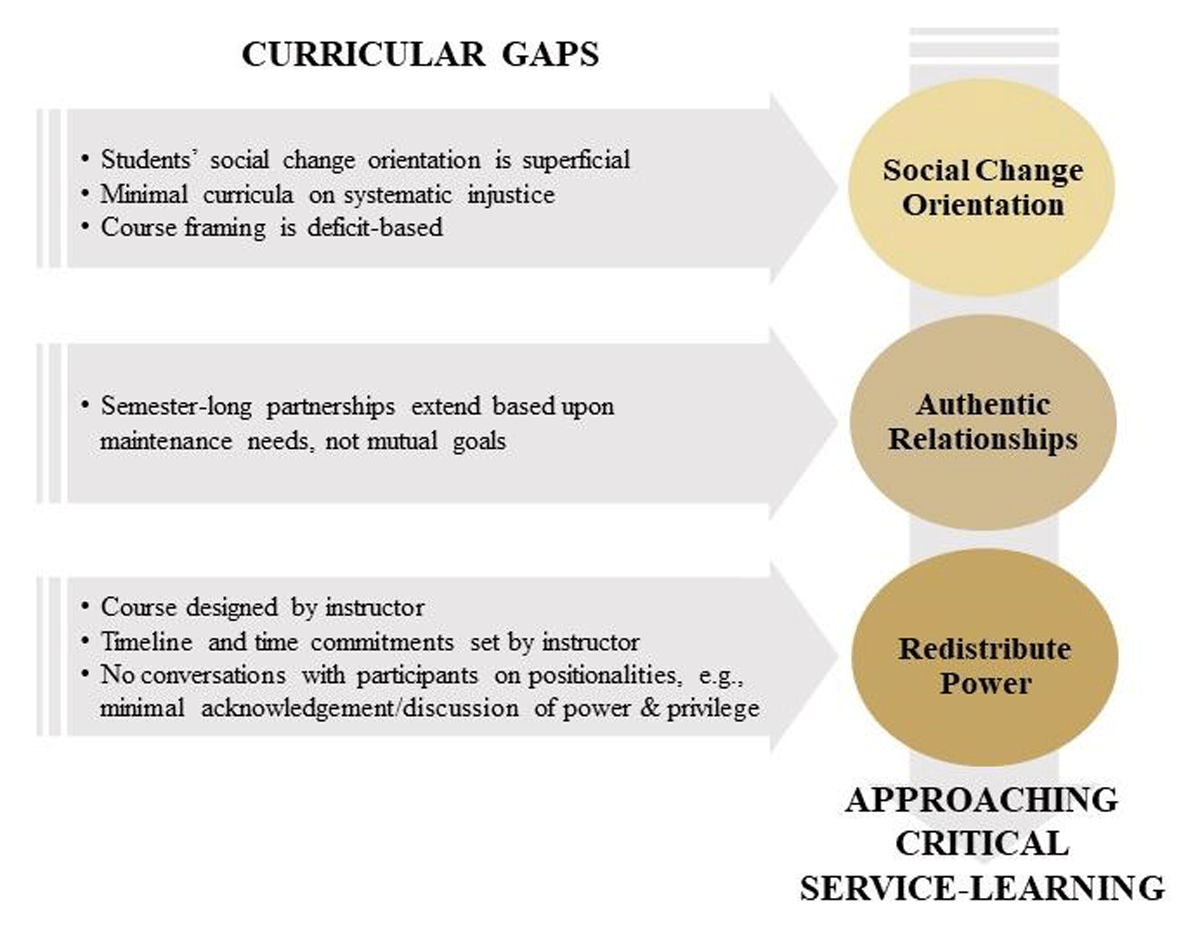
Figure 1
Gap analysis of course mapped to Mitchell’s (2008) critical service-learning framework and Latta et al.’s (2018) Approaching Critical Service-Learning framework.
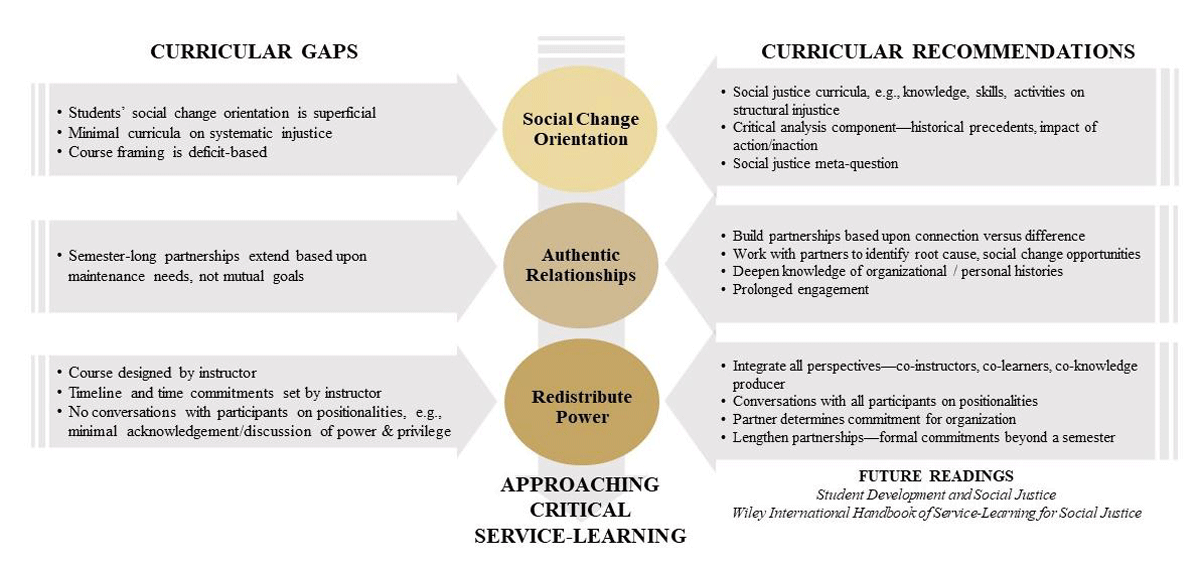
Figure 2
Recommendations for shifting towards a critical service-learning praxis.
Table 1
Future readings on community engagement, service-learning, and social justice.
| STUDENT DEVELOPMENT AND SOCIAL JUSTICE: CRITICAL LEARNING, RADICAL HEALING, AND COMMUNITY ENGAGEMENT (HICKS PETERSON, 2018) | ||
|---|---|---|
| CHAPTER | FOCUS | AUDIENCE |
| 2 | Deepening understanding of ways to make meaningful social change | Instructor |
| 3 | Positionality and ways in which our “mind, body, spirit and social consciousness” are developed | Instructor |
| 4 | How to enact critical community engagement efforts with a social change orientation | Instructor |
| 5 | Tools for community engagement activities that are more proximate to communities and injustices, shift narratives, create spaces of uncomfortableness, and foster hope | Instructor |
| THE WILEY INTERNATIONAL HANDBOOK OF SERVICE-LEARNING FOR SOCIAL JUSTICE (LUND, 2018) | ||
| CHAPTER | FOCUS | AUDIENCE |
| 1 | Complexity and tension between service-learning and social justice | Instructor |
| 6 | Case example of ethical community engagement integrating Indigenous and Western approaches | Students |
| 9 | Critique of existing service-learning practices | Students |
| 14 | Community as a teacher and source of knowledge | Instructor |
| 20 | Lessons in civic engagement, service-learning, and power-mapping | Students |