
The COVID-19 pandemic presented community-engaged service-learning practitioners with challenges as well as opportunities for critical analysis and reinvention. Yet there is hard work in deconstructing our practices, and risk in bravely sharing our shortcomings publicly. Service-learning provides an opportunity to embrace, name, analyze, and learn from failure. It is my hope that this learning from failure has the potential to shape more critical service-learning practice, especially in the field of engineering where acknowledging failure is often absent. This piece shares such failures and lessons learned from a critical examination of an environmental and ecological engineering service-learning course I developed that focuses on the design and implementation of small-scale stormwater management projects at community partner sites. What began as a passion project for building sustainable communities and enhancing student learning quickly turned into a journey of competing and often opposing outcomes: student learning versus community impacts.
In spring 2021, unable to offer the course as in previous years due to pandemic restrictions, I modified the course with an eye toward critically examining past projects. In this new iteration, students were tasked with designing an assessment framework to analyze five past projects’ successes and failures. In this narrative, I share the data collected by students from a series of virtual, semi-structured interviews and surveys with community partners and juxtapose this data with student learning outcomes (Payne & Jesiek, 2018) and previously collected project assessment data (Payne et al., 2018) to highlight the tension between enhancing student learning and sustainable community impacts.
In response to the data and grappling with reinvention, both as a practitioner and through a course redesign, I embarked on a critical, reflective assessment of myself and my praxis.1 I used Latta and colleagues’ (2018) work supporting practitioners’ development of a critical consciousness to guide this critique. Harnessing this reflection, I conclude this piece with recommendations for shifting service-learning engineering design courses toward a more critical service-learning practice using Mitchell’s (2008) critical service-learning framework.
The Shifting Field of Service-Learning
Service-learning offers educational opportunities in which students participate in and reflect upon an organized service activity that meets an identified community need while simultaneously increasing understanding of the academic concepts being taught (Bringle & Hatcher, 2000). In the service-learning literature, student learning outcomes such as developing intellectual, personal, and professional skills and increasing civic-mindedness (e.g., Eyler et al., 2001; Hatcher et al., 2016) are well-known and robust. Less is known regarding faculty outcomes (Bringle et al., 2013) and even less about community impacts (Bringle et al., 2010; Clayton et al., 2012). Ensuring high-quality community impacts is challenging work and often deprioritized in higher education where the emphasis is on student learning rather than true reciprocity in the service-learning experience (Butin, 2006). In recent years, the field of service-learning has critically assessed its own praxis leading to a shift from traditional service-learning approaches to more critical service-learning strategies (Mitchell, 2008). Tania Mitchell, a leading scholar in this movement, asserts that critical service-learning has an “explicit social justice aim” framed around three main elements: a social change orientation, work to redistribute power, and the development of authentic relationships (2008, p. 50).
Having an intentional social justice approach centers service-learning courses on the root causes of societal challenges. This requires instructors and students to critically examine community issues and develop social responsibility in addressing these challenges. Additionally, positioning oneself as a social change agent tasked with redistributing power and developing authentic relationships means one must do the hard work of unpacking one’s own biases, stereotypes, and assumptions (Latta et al., 2018). Ultimately, if intentionality and mindfulness are not applied to these three elements of critical service-learning, one risks creating experiences with “thin reciprocity,” or failing to balance student learning outcomes and community impacts for the mutual benefit of both partners (Jameson et al., 2011). On the other hand, the converse, “thick reciprocity,” mirrors the tenets of critical service-learning and “…emphasizes shared voice and power and insists upon collaborative knowledge construction and joint ownership of work processes and products” (Jameson et al., 2011, p. 264).
Importance of Learning from Failure
Service-learning is increasingly common in engineering design courses that teach students to create functional products through a series of systematic and iterative steps, (e.g., Bielefeldt et al., 2011; Budny & Gradoville, 2011; Dinehart & Gross, 2010; Duffy et al., 2011). Learning from failure in these engineering design courses has the potential to increase student learning, as well as shape more critical service-learning practice. Jackson and colleagues (2022) argue that learning from failure is critical to design learning and that there are key elements that make this learning successful, such as providing “varied meanings of failure” and “collecting positive and negative reactions to failure experiences” (p. 1860). Failure can also “uncover key concepts for students” and “induce thoughtfulness in problem-solving” if educators “foster a classroom culture that embraces failure and learning together” (Jackson et al., 2022, pp. 1860, 1864). Arshad-Ayaz and colleagues (2020, introduction, para. 2) support the notion that failure provides an “educational moment and learning opportunity” for students.
Unfortunately, failure acknowledgment in engineering service-learning design courses is often absent—an ironic outcome given the iterative nature of design, which at its fundamental core is driven by points of failure. There are a few books that focus on learning from catastrophic failures (Firestein, 2015; Petroski, 2006) and other studies that evaluate failure; however, this work only addresses student-focused outcomes and participation in service-learning courses (e.g., Aslam et al., 2014; Edmondson & Sherratt, 2022; Liguori et al., 2014; Mazzurco & Jesiek, 2014; Udoewa, 2018), as well as using failure to teach design (Sleezer et al., 2016). The instructor’s voice and critique of their own praxis are excluded. Given the need to increase reciprocity among those in service-learning partnerships, learning from failure as an instructor is crucial.
Role of Critical Reflection for Reinvention
Critical reflection is a key pillar of service-learning that provides students with opportunities for “…analyzing, reconsidering, and questioning” their own experiences, specifically within the context of broader societal issues and course content knowledge (Jacoby, 2014). For students, reflection creates a bridge between classroom learning and service activities and allows them to connect the two. Without this explicit, intentional exercise, conclusions drawn from service activities may lead to reinforced stereotypes, simplistic solutions, or even inaccurate generalizations (Boyle-Baise, 1998; Green, 2001; Vaccaro, 2009). However, critical reflection linked effectively to learning outcomes can generate and deepen student learning (Ash & Clayton, 2009).
While we may informally apply these exercises as instructors to improve our curriculum, rarely do we share our personal critical self-assessments and reflections on our praxis publicly. Therefore, not only is there an opportunity to enhance our own engineering service-learning design courses, but perhaps also to humbly share strategies and best practices about our critical service-learning journey such that others can learn from or even avoid our failures. Additionally, reflective praxis can help center social justice in engineering education (Carroll et al., 2022). The path to doing critical service-learning is not a straight line. It is a journey of self-exploration and growth toward a “new way of seeing” (Latta et al., 2018, p. 46). It requires developing a critical consciousness through examining one’s own positionality and participating in an iterative reflective process. With this intent, we can shift our own praxis from a traditional service-learning approach toward critical service-learning.
The Context
Course Development
From 2008 to 2012, I was a volunteer with a local water quality-focused non-profit and a graduate student passionate about student learning and community engagement. In 2012, my first passion project took root. My community partner and I developed a course to intentionally connect the goals of the watershed management plan (increasing the health of the local river and creating educational demonstration sites) to a community-engaged service-learning opportunity for university students. In 2013, we received a $50,000 grant from the Ford College Community Challenge. The small-scale stormwater management projects, e.g., bioswales, rain gardens, and native savannas, were funded by: Ford College Community Challenge; Indiana Department of Environmental Management Section 319 Funds; Purdue University Office of Engagement Service-Learning Grants; and Alcoa. Then in spring 2014, I offered a three-credit, semester-long service-learning course in environmental and ecological engineering (EEE 495) that focused on the impaired river in our Midwestern city. The health of the river had been severely compromised due to stormwater runoff, so the course paired students with community partners to identify stormwater management issues, design technical solutions, obtain grant funding, maintain budgets, and implement small-scale projects, e.g., bioswales, rain gardens, and native savannas. Students were taught about the complex relationships between social, economic, and environmental dimensions in community-engaged design projects, as well as how to use a transdisciplinary knowledge production model (Appendix A: Learning outcomes and objectives).
Participants and Processes
Throughout the semester, upper-level undergraduate students participated in off-site design charrettes with their community partners and collaboratively developed their designs through multiple iterative feedback sessions via face-to-face contact, phone calls, and/or emails. Community partners represented non-profit agencies, schools, or governmental bodies located in the urban core of the city. Partners were recruited to participate based upon the following criteria: a) identified small-scale stormwater management issues, b) visibility of site for educational purposes, and c) staff capacity to work with students. Students also integrated expertise in stormwater management, hydrology, and native ecosystems. To complement the academic perspective, practitioners were brought into the classroom to talk about local conservation efforts surrounding the river. Lastly, students worked closely with a landscaping company to integrate their real-world, professional expertise into the project. This multi-pronged approach provided a foundation for applying the transdisciplinary knowledge production model in context. Furthermore, sending students off campus to meet with their partners and bringing outside individuals into the classroom inherently placed value upon partner expertise, as well as exposed students directly to multiple knowledge channels relevant to the project.
Previously Collected Course Data
Prior to 2021, the course had been offered six times, engaging approximately 100 students and 15 community partners, implementing 66 projects, and diverting over 3,130,000 gallons of stormwater from the river annually. While successful in many ways, I felt as though my course was teetering on the edge of “thin reciprocity” (Jameson et al., 2011). While preparing for the spring 2021 semester and considering the university’s COVID-19 protocols, an opportunity emerged to shift the focus of the course toward that of learning from past failures in course projects. My process for analyzing the course integrated not only student and community partner voices but also my own through student learning outcome evaluations, project assessments, and critical self-assessment. Findings from the following data sources are shared in turn as a way of bringing failure to light. All studies were approved by the Purdue University Institutional Review Board.
Existing data offered on student learning outcomes was part of my PhD dissertation on analyzing an educational intervention in my 2014 course (Payne & Jesiek, 2018).
Previous project assessment data collected in 2018 in partnership with two undergraduate research assistants included eight observational site assessments and two focus groups with ten community partner participants (Payne et al., 2018).
Sharing the Data with Students
In January of 2021, I nervously stood in front of my spring EEE 495 class and proposed a new course structure, one that would have us critically examining the five previous service-learning course projects using an assessment framework designed by the students. As I stood there apprehensively describing the previous iterations of the course, I shared that traditionally students gained a lot from this course and read the following testimonial from one of their peers:
“My future is in researching naval policies on green infrastructure. My future is trying to challenge all the bases I have contact with to implement BMPs [best management practices]. My future is creating events to promote these implementations on base to get the community involved with BMPs…My future is in attending local government council meetings and speaking on my knowledge of environmental systems. My future is in speaking with my neighbors about how to create a holistic water management plan for our block. My future is teaching and encouraging my sailors to truly believe in the environmental protective policies we are required to implement. I could go on, but this class has not only given me the confidence to see these future endeavors but given me the skills to do those things.”
Student Learning Outcomes
Data also supported students’ gains. Specifically, data from a 2014 educational intervention in the course focused on the introduction of a transdisciplinary knowledge production model demonstrated an increase in students’ awareness and understanding of non-technical dimensions in design such as stakeholder knowledge, policy, and cultural values. (Payne & Jesiek, 2018). This data also suggested that a transdisciplinary knowledge production model may enhance students’ abilities to integrate non-technical dimensions, as well as engage with stakeholders in community-based design projects (Payne & Jesiek, 2018). This work greatly enhanced my understanding of appropriate learning environments, teaching methods, and assessment tools for developing engineering competencies in sustainability problem solving, as well as demonstrated enhanced student learning. This data, however, did not tell the whole story. It was time to look beyond the narrow focus of student learning outcomes.
Community Impacts
With that in mind, I shared a second study with my students that evaluated how projects from this service-learning course contributed to building a more sustainable community, ultimately uncovering concerns in achieving reciprocal benefits between service-learning partners, e.g., students and communities (Payne et al., 2018). Benefits were organized around the three pillars of sustainability: environmental, economic, and social. Environmentally, the projects were successful at capturing and diverting stormwater, which provided clear benefits to both the community partner site and the river. Some sites even noted economic benefits such as “cost-savings from reduced water usage” and “improvement of property value” (Payne et al., 2018). Additionally, most sites listed “increased educational opportunities for clients,” “improved engagement with the community,” and “improved green space” (Payne et al., 2018) as social sustainability project benefits.
However, challenges also occurred. The most frequently cited concern was “maintenance, e.g., weeding, debris removal, dead plants, etc.” (Payne et al., 2018). Additionally, the data revealed “lack of staff capacity” to perform the necessary maintenance, and most projects were erratically supported and most often with only “volunteers” (Payne et al., 2018). Although partners overwhelmingly reported that they would like to participate in a project like this again, “more volunteers/workers for maintenance” and “more educational resources” (Payne et al., 2018) were called for as the most critical improvement needed for future project success.
Call to Action for Students
During spring 2021, I continued the 2.0 version of the course. I planned for us to conduct a holistic analysis of past projects. We were going to talk about, analyze, embrace, and learn from failure. I shared my story, successes, and failures with the goal of improving the course to enhance both student learning and community impacts.
My students dug in. Over the course of the semester, three teams of students developed assessment frameworks based on the three pillars of sustainability and evaluated five past project sites by conducting 14 interviews and 25 surveys, as well as five observational site assessments. Data collected in 2021 mirrored results from the previous project assessments done three years prior. Environmental, economic, and social benefits were clearly apparent. However, challenges centered on lack of maintenance support, e.g., “lack of consistent maintenance personnel,” “hard to maintain due to lack of knowledge and difficulty differentiating between weeds and natives,” and lack of educational resources, e.g., “quarterly training or monthly training,” “giving me resources and tools on how to go about explaining what a rain garden does” emerged. Additionally, two community partners noted that stormwater management was secondary to their mission, so it was relegated to a lower priority, stating that “site maintenance for staff and volunteers comes second to getting food to those in need.”
Learning From Failure Begins
Being a Critically Reflective Practitioner
As the story unfolded, it became clear that there was tension between student learning outcomes and community impacts. The former most often outperformed the latter. Where was I to go from here? Over the last eight years, I had participated in the good instructional practice of soliciting and integrating student and community partner feedback, but I hadn’t explicitly examined my own positionality, i.e., how differences in social position and power shape identities and access in society (Madge, 1993; Rose, 1997), and how that might be affecting the development, delivery, and resulting outcomes of this service-learning course. Guided by Latta and colleagues (2018), I sought to increase my critical consciousness by reflecting on a series of critical questions, e.g., “What are my multiple cultural identities and how do they inform and/or affect my practice?” Latta and colleagues (2018) offer that this reflection is part of the process toward approaching a critical service-learning praxis. In other words, by critically analyzing course failures, my instructional failures, and my positionality, I might be able to create a more critical service-learning experience with “thick reciprocity” (Jameson et al., 2014).
Positionality
In terms of my positionality, I am white; identify as female; was educated in a white, neo-liberal system; am influenced by a formative study abroad experience highlighting harmful white savior mentalities; am a long-time community volunteer; am a hopeless fixer; am someone who highly values and prioritizes sustainability; am privileged and upper-middle class; am a conflicted, guilty mom (career versus caregiver); am part of the Ivory Tower; and was raised in a white, white-washed world. Later in the semester, I shared this with my students, fearful of their judgment yet liberated by voicing this truth to them. I challenged them to do the same.
Gap Analysis
During that same class, I shared a gap analysis of the course based on Mitchell’s (2008) critical service-learning framework and Latta and colleagues’ (2018) Approaching Critical Service-Learning framework (Figure 1). The gap analysis revealed shortcomings in achieving a social change orientation. The course included minimal curricula on systemic injustices, due to my own lack of knowledge of the intricacies of the issues. This was likely leading to a very superficial social change orientation among students. Additionally, I identified problematic deficit-based framing of issues and communities within the course as opposed to asset-based framing. Truly authentic relationships were also absent, as the course was short-term, semester-bound, and based upon course-prioritized stormwater management goals and not necessarily on the mission-driven goals of the community partners. Lastly, power was inadequately distributed. I designed the course, set the timeline, and determined time commitments rather than collaboratively doing this with the community partners. As co-educators in the process, my community partners and I also failed to engage in conversations on positionality and how power and privilege might impact projects and partnerships. Additionally, these conversations did not occur with the students, even though community-engaged instructors have demonstrated the benefits of students reflecting on their own power and positionality for their professional identities (Thurber & Suiter, 2018).

Figure 1
Gap analysis of course mapped to Mitchell’s (2008) critical service-learning framework and Latta et al.’s (2018) Approaching Critical Service-Learning framework.
Reinvention and Future Iterations
It was time for reinvention. Reviewing the data from the aforementioned efforts, my own critical reflection, and the gap analysis, I developed key recommendations for future iterations of the course (Figure 2) with the intention of shifting this engineering service-learning design course toward a more critical service-learning practice and “thick reciprocity” (Jameson et al., 2011).
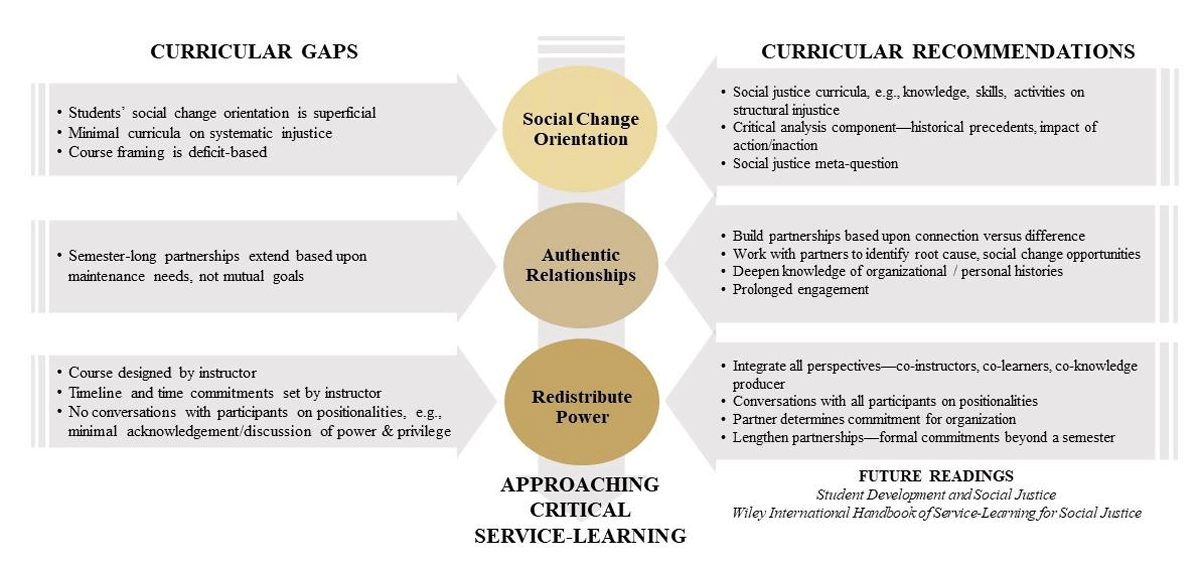
Figure 2
Recommendations for shifting towards a critical service-learning praxis.
As I develop future iterations of the course, I will work to incorporate each of Mitchell’s (2008) tenets while taking into consideration Latta and colleagues’ (2018) recommendations for continuing along the path of approaching a critical service-learning praxis.
Social Change
To foster a social change orientation as an instructor, I will explore two books on community engagement, service-learning, and social justice by Hicks Peterson (2018) and Lund (2018). Table 1 provides key chapters and focus areas for increasing my own knowledge and instructional efficacy, as well as student understanding of social justice. Furthermore, to increase student understanding of the systematic challenges in the community of interest, additional class time will be spent on examining opportunities and challenges; historical precedents; and federal, state, and local environmental policies. Consideration will also be given to including additional guest speakers from city government that can speak about community demographics and historical trends. These lessons could be framed around social justice meta-questions such as: “What are the implications of reduced environmental regulations on waterways for marginalized populations? How do community demographics influence project outcomes and acceptance?”
Table 1
Future readings on community engagement, service-learning, and social justice.
| STUDENT DEVELOPMENT AND SOCIAL JUSTICE: CRITICAL LEARNING, RADICAL HEALING, AND COMMUNITY ENGAGEMENT (HICKS PETERSON, 2018) | ||
|---|---|---|
| CHAPTER | FOCUS | AUDIENCE |
| 2 | Deepening understanding of ways to make meaningful social change | Instructor |
| 3 | Positionality and ways in which our “mind, body, spirit and social consciousness” are developed | Instructor |
| 4 | How to enact critical community engagement efforts with a social change orientation | Instructor |
| 5 | Tools for community engagement activities that are more proximate to communities and injustices, shift narratives, create spaces of uncomfortableness, and foster hope | Instructor |
| THE WILEY INTERNATIONAL HANDBOOK OF SERVICE-LEARNING FOR SOCIAL JUSTICE (LUND, 2018) | ||
| CHAPTER | FOCUS | AUDIENCE |
| 1 | Complexity and tension between service-learning and social justice | Instructor |
| 6 | Case example of ethical community engagement integrating Indigenous and Western approaches | Students |
| 9 | Critique of existing service-learning practices | Students |
| 14 | Community as a teacher and source of knowledge | Instructor |
| 20 | Lessons in civic engagement, service-learning, and power-mapping | Students |
Authentic Relationships
To address shortcomings in developing authentic relationships, I will develop and integrate a skills session on asset-based versus deficit-based approaches and continue to emphasize that differentiation throughout the semester. Additionally, I will seek to increase connectivity points with community partners prior to and after completion of the course to build a more meaningful, deeper relationship. With the COVID-19 pandemic, there was an increase in virtual meetings between students and their community partners. While this did, perhaps, increase efficiencies, I observed a decrease in authentic relationships. I hope to discuss this with my community partners and establish a strategy for more face-to-face interactions, and thus the potential to foster more authentic relationships with their student team. Finally, I will seek to develop prolonged engagement structures beyond the course by establishing a volunteer corps through the EEE student society.
Redistribute Power
One of the ways in which I hope to begin to redistribute power is to formalize feedback and assessment opportunities for all stakeholders. Currently, there are formalized assessments for students and informal assessments for community partners. Leveraging work from Gelmon and colleagues (2018), I compiled three resources with question banks for assessing the service-learning experience. Resources can be used by students, community partners, and instructors to foster conversation around outcomes, challenges, and opportunities (see Appendix B for a select list of questions by stakeholder group). Additionally, collaborating with the partner at the onset of the partnership to determine goals and commitments, as well as timelines for the projects would support redistributing power (Warren-Gordon, 2021).
Conclusion
I conclude that this narrative is a snapshot of my journey toward approaching critical service-learning with the acknowledgment that there is no final endpoint in this story, but rather an opportunity for continued improvement and growth as an instructor. As I move along this path, I will seek repeated moments of critical reflective praxis and integration of learning from failures. It is my hope that this story offers other practitioners ways in which they can examine their own course (i.e., reflective prompts, critical service-learning gap analysis, and research), as well as provides concrete recommendations for changing and reinventing their own praxis.
Additional File
The additional file for this article can be found as follows:
Notes
[1] The first author designed, taught, and evaluated the course described in this manuscript. The second author, a graduate teaching assistant, provided thought-provoking questions and critical analysis of the narrative for the first author as the manuscript unfolded. The remaining authors are students who participated in the course. They contributed to the data collection and analysis for the 2021 study.
Acknowledgements
The research team would like to thank our community partners who generously shared their time and experiences, as well as Laura Weaver who shared thoughtful insight and provoked stimulating dialogue.
Competing Interests
The authors have no competing interests to declare.