
“This course was dynamic in that I learned, but I also taught.” – CEC student
Introduction and Purpose
Partnerships between communities and learning institutions are essential to higher education’s mission (Maurrasse, 2001). Community-engagement courses (CEC) have gained popularity for their ability to enhance student learning with rich educational experiences while also allowing for assessments of the school’s effect on the community (Bailis, 2000; Bringle & Hatcher, 2002; Dorado & Giles, 2004; Gelmon et al., 1998; Jacoby, 2003; Jones, 2003). Academics argue that community partnerships should be more deliberately integrated into higher education’s strategies and goals (e.g., Benson & Harkavy, 2000; Boyer, 1990; Bringle, 1999; Enos & Morton, 2003; Tinkler, 2012). CECs typically involve a collaboration between students, a University Partner (UP), and a Community Partner (CP) who all work on a specified project for a defined length of time, usually a semester (Chopyak & Levesque, 2002). The project’s success most often depends on the strength of the collaboration among the organizations and individuals (Catlett, Proweller, & Crabtree-Nelson, 2019; Sandmann & Kliewer, 2012). Therefore, insights on effective collaborations are critical to advancing the success of CECs and improving the outcomes for students, UPs, and CPs.
The purpose of this paper is to bridge the gap in the literature between theories in business – nonprofit collaboration and collaboration methods in community-engagement courses. In order to build such a bridge, this research uses a specific case study and thus provides an actionable framework for future community-engagement collaborations. The use of case studies has been a popular research method for providing theoretical insights into collaboration (Gray & Wood, 1991). As such, it is important for all members of the collaboration to have a voice in creating this framework. Therefore, this manuscript is authored by each entity in the collaboration – the Student Partner voice, the Community Partner (CP) voice, and the University Partner (UP) voice – and presents a summary of reflections from the students in the course. Finally, some tangible outcomes from the case study are documented in the appendix and supplemental materials.
There are many reasons for championing collaboration between practitioners in the community and teaching institutions. Practitioners seek the latest research findings from educators and modern applications of traditional techniques from students. Educators often rely on practitioners to enrich student learning with perspectives and examples pulled from their practical experiences. Collaborations often result in integrated, diverse experiences and viewpoints that deepen understanding of educational practice and the application of research findings (Macduff & Netting, 2000).
Research shows that successful collaborations between nonprofits and businesses have four alliance drivers: (1) alignment of strategy, mission, and values; (2) personal connection and relationships; (3) value generation and shared visioning; and (4) continual learning (Austin, 2000). This manuscript utilizes a case study to apply these alliance drivers to a collaboration among students, a UP, and a CP in a community-engagement course. The application of this research to community engagement differs from the original application between nonprofits and businesses in two distinct ways.
First, the collaboration goals of the organizations involved in community engagement differ from those of the organizations involved in nonprofit-business collaborations. Often, the CPs selected for community-engagement courses are indeed nonprofit organizations, which have goals that align closely with nonprofits that partner with businesses for other reasons (e.g., outsourcing important functions for little to no cost to the nonprofit, utilizing expert resources). However, educational institutions are notably different from businesses. An educator’s collaboration goals focus on student development. Some of these goals include creating an optimal learning environment for teaching students marketable skills and producing citizens who are aware of and involved in the social and cultural issues that affect their surrounding community. The students’ collaboration goals center on success and learning and include goals such as successfully completing the course, learning skills that make them desirable hires, and giving back to their communities. In contrast, collaboration goals for businesses may include a number of profit-based goals (e.g., positive public relations, tax credits, brand awareness) that are not present in a collaboration with an educational institution.
The second difference arises from the number of collaborators. Community engagement courses involve three or more entities (UP, students, CP) rather than simply two entities. Building an alliance with three or more entities presents more communication challenges than does an alliance with two entities because, as the number of individuals to whom information must be disseminated increases, so does the potential for error in the encoding and decoding of messages. Further, identifying and achieving common goals may be more difficult with three entities than it is with two entities due to the increased number of varying individual goals.
Even considering these two minor differences, the alliance-drivers approach found in the business/nonprofit collaboration literature still serves as the most appropriate framework for a CEC collaboration in this case. The theories outlined in business/nonprofit collaborations are not limited to two entities; the framework is certainly applicable to the three or more entities involved in CECs. Further, the alliance drivers themselves are highly relational, focusing as they do on communication, relationships, and shared goals. These attributes are vital to any collaboration regardless of the number of collaborators or whether the enterprise has a for-profit or nonprofit focus. Finally, business/nonprofit collaboration theories were selected for this project because the course resides in the University’s School of Business and, therefore, is most appropriately aligned with theories in business research.
Theoretical Background
Business and Nonprofit Collaboration Theory
The main framework for collaboration used herein (Austin, 2000) is founded upon philosophies and practices that have worked in the creation and execution of real-life collaborative alliances between businesses and nonprofits. The research rests on the assumption that there are challenges in the intricacies necessary to establishing and sustaining interorganizational relationships and projects; further, the paper argues that certain refined proficiencies are essential for such endeavors. The alliance drivers offer guidelines that should help collaborative relationships to move beyond philanthropic and transactional alliances and into integrative alliances.
Alignment of Strategy, Mission, and Values
The most significant and dynamic alliances are developed via a central alignment of each organization’s strategy and mission with the main goal or purpose of the collaboration (Austin, 2000). In other words, the stronger the congruence between the alliance mission and the individual organizations’ missions, the more cohesive the collaboration. Compatible values among members of the alliance lead to powerfully cooperative collaborations.
Personal Connection and Relationships
Austin (2000) finds that there exists a synergy between the social mission of the alliance and the emotional connections among individuals in each organization. That is, the success of the collaboration is intensified when alliance members develop personal connections to their counterparts in the other organizations and to the collaboration’s communal purpose. It is not just enough that all members of the collaboration see value in the objective of their actions. Partnerships are most successful when individuals form interconnected relationships with members of the other organization. Indeed, relationships are integral to CECs (e.g., Cruz & Giles, 2000; Dorado & Giles, 2004; Jacoby & Associates, 2003).
When the members of each organization have interpersonal affiliations with each other, those relationships contribute to the collective’s success by deepening trust, commitment, and awareness within the collaboration (Larson, 1992). Guo and Acar (2005) look at this issue using a network perspective and find that tighter social networks make for more successful partnerships. Additionally, personal connection and relationships impact the other alliance drivers of collaboration. For example, the interaction process between individual members of a collaboration is critical to value generation, shared visioning, and continual learning (Robinson & Berkes, 2011). Indeed, the connection and relationship among the individuals in the collaboration is critical to a successful venture.
Value Generation and Shared Visioning
From a resource-based view, organizations enter into a collaboration for the purpose of creating new resources in order to generate value (Austin, 2000; Waddell, 2000; Rondinelli & London, 2003; Selsky & Parker, 2005) Resources can be defined as strengths, advantages, or capabilities—including knowledge and interpersonal skills—that can be used to increase organizational effectiveness (Barney, 1991). Capabilities refer to the organizations’ ability to modify, incorporate, and reconfigure internal and external organizational proficiencies and competencies (Teece, Pisano, & Shuen, 1997). Consequently, one incentive that drives collaboration is the chance to partner with others and co-create new external resources such as tacit knowledge and competence-related resources that generate value for each participating organization (Peteraf, 1993; Gulati, 1999; Prahalad & Ramaswamy, 2004).
The added value that partnerships offer includes synergistic and shared value creation for the participants that is based on goal-related performance. (Van Tulder et al., 2016). That is, when the organizations in a collaboration have a similar vision for the alliance, value is created for each of the organizations beyond the value that they would have individually. Thus, an effective collaboration is based upon shared vision and value generation.
Continual Learning
Continual learning is the iterative progression of sharing and merging the capabilities, experience, and knowledge of each of the participants in a collaboration in an attempt to find new methods with which to approach existing challenges (Murphy, Perrot, & Rivera-Santos, 2012). In other words, each member of the collaboration has limited knowledge resources (Barney 1991), but when that knowledge is shared in a collaboration in order to address a certain issue, each participant acquires more knowledge from the partnership. Interacting with partner organizations results in co-creation of innovative solutions to shared challenges (Murphy, Perrot, & Rivera-Santos, 2012). The newly created collaborative knowledge is not exclusive to the collaboration; rather, the competencies endure within each organization long after the collaboration has dissolved.
Austin (2000) argues that, in the most effective collaborations, participants are invested in learning about new ways to engage more effectively, in the win-win outcome of the partnership, and in generating more value. Indeed, learning does not only refer to the societal issue which the organizations are collaborating to address. Continual learning is concerned with each organization learning “about themselves as organizational and sectoral entities” (Selsky and Parker, 2010, p. 32). In the strongest collaborations, each participant in the collaboration learns about solutions to the shared challenge in addition to learning about the collaboration process itself.
Community-Engagement Collaboration Theory
Enos and Morton (2003) use the transactional vs. transformational framework from Burns (1978) to construct guidelines for building successful collaboration in CECs. Transactional partnerships are elementary and frequently created for short-term undertakings. In transactional partnerships, organizations and individuals collaborate simply for an exchange of what the other wants. Although each partner finds value in the exchange, neither partner is changed in the long term. This stands in contrast to transformational partnerships, in which more robust and committed relationships lead both partners toward sustainable change and growth (Catlett, Proweller, & Crabtree-Nelson, 2019). In transformational partnerships, organizations and individuals have conscious and intentional objectives: to cultivate new processes, reevaluate and adjust their own identities and objectives, and discover evolving opportunities. Partners use an open-ended progression for long-term advantage.
Clayton et al. (2010) extend the transactional vs transformational relationship framework to include exploitative relationships in CECs. The researchers identified three main types of relationships. In the first, exploitative relationships, one party takes advantage of the other for personal gain or benefits without giving much in return. In the context of community-engagement, this could manifest as students or volunteers exploiting the communities they serve solely for resume building or fulfilling course requirements without genuinely contributing to the community’s well-being. The second, transactional relationships, are characterized by straightforward exchange of goods and services or efforts between the parties involved. In the context of the paper, this refers to a more businesslike approach to community engaging, where students or volunteers fulfill their obligations but don’t engage in deeper connections or long-term commitments with the community. Finally, the researchers identify transformational relationships as the ideal form of relationship for community engagement courses. In this type of relationship there is a profound and reciprocal exchange between participants, leading to growth, social change, and genuine connection within the community. Participants are deeply affected by their experiences, and both the students and the community members are transformed positively.
Stewart and Alrutz (2012) further extend the Enos and Morton (2003) theory by using a metaphor to compare happy CEC partnerships with ten items that contribute to happy romantic relationships. The ten items are: (1) Put yourself on the market; (2) Build on existing relationships; (3) Make quality face time; (4) Name what you need and want; (5) Actions speak louder than words; (6) Opposites attract; (7) Managing baggage; (8) Addressing conflict; (9) Routine maintenance; (10) It’s not you, it’s me. Interestingly, it can be argued that each of these ten items for a happy CEC collaboration is housed under one of Austin’s (2000) four alliance drivers for collaborations between a business and a nonprofit (see Table 1).
Table 1
Theory on Happy Romantic Relationships vs. Theory on Effective CEC Partnerships.
| ROMANTIC RELATIONSHIP ITEM | MEANING | COORELATING ALLIANCE DRIVER |
|---|---|---|
| (Stewart and Alrutz, 2012) | (Austin, 2000) | |
| Put yourself on the market | Understand your goals and needs | Alignment of strategy, mission, and values |
| Build on existing relationships | Expand connections you already have | Personal connection and relationships |
| Make quality face time | Communicate often | Personal connection and relationships |
| Name what you need and want | Know what will generate value for you | Value generation and shared visioning |
| Actions speak louder than words | Generate value for your partner | Value generation and shared visioning |
| Opposites attract | Create new missions and values for the partnership | Alignment of strategy, mission, and values |
| Managing baggage | Learn what constraints the CP has and how to overcome those | Personal connection and relationships; Continual learning |
| Addressing conflict | Work through challenges together | Personal connection and relationships |
| Routine maintenance | Continue to make sure the partnership is beneficial | Personal connection and relationships; Value generation and shared visioning |
| It’s not you, it’s me | Evaluate when a partnership has come to an end | Continual learning |
This theoretical background examined two streams of research. While both streams explore inter-organizational collaboration dynamics and the significance of meaningful connection therein, they do so in different contexts and with different focuses. The community-engagement stream centers on understanding relationships in community-engagement settings, whereas the Austin (2000) framework is specific to collaborations between businesses and nonprofits. This framework has yet to be applied in the community engagement context. Utilizing a community-engagement course in a business school is the basis of the application for the following case study.
Case Study
This case study was conducted at a small private college in the southern United States. The course chosen for this case study was a course in Marketing Communications (MarCom) with 25 enrolled students. This course focuses on the theories behind different forms of MarCom (e.g., advertising, social media, public relations) and the reasons behind the usage of different types of messages (e.g., action based, informational) and appeals (e.g., fear based, emotional) aimed at constituents. Pedagogical learning outcomes include being able to create a cohesive story based upon the goals of the organization and to effectively integrate and execute various methods of marketing communication to convey the chosen messaging.
The college recently formalized the community-engagement process for courses, providing an application process and then a training protocol for instructors and departments attempting to have a course designated Academic Community Engagement (ACE). The MarCom course fit well into the parameters required to achieve this designation and is a good example for a study on CECs because community organizations often have small budgets and frequently seek help with promotional activities. Additionally, students were required to complete a project that had a positive impact on their community; the projects enriched student learning and presented the students with unique challenges they wouldn’t have faced in a traditional classroom environment.
The unique challenges that nonprofits bring to the table coupled with the tenets of a MarCom course made this an excellent choice for a successful ACE course. One fundamental principle of MarCom is that the communication sent on all platforms, regardless of outlet type, needs to be integrated so that it tells a cohesive story. For nonprofits, this principle can be particularly challenging, since they may have multiple constituencies including volunteers, potential donors, and community members who need the nonprofit’s services, each of whom require different messaging. However, these different messages should all be housed under the same story umbrella. The message to a potential donor asking for a financial contribution will differ from the message to an individual in the community who could benefit from the services the nonprofit provides. For example, consider a local animal rescue organization. “Please make a financial donation to help feed the animals in the shelter” is a different message than “Your next 4-pawed best friend is here waiting to be adopted,” but both messages are important parts of the story of the organization’s mission: to rescue animals. Therefore, a MarCom ACE course, with its focus on the integration of such disparate messages, is a great way to challenge student thinking for a practical application while also promoting the CP to its constituents.
For this collaboration, the local CASA (Court Appointed Special Advocate) was chosen for the CP. CASA is a national association in the United States consisting of over 85,000 volunteer advocates who support abused or neglected children. In many jurisdictions, CASAs are known as Guardian ad litems (GAL). In both cases, the role of the CASA is to gather information and make recommendations to the judge that help ensure that children live in safe and healthy environments and that all decisions made are in the best interests of the child. Our collaboration occurred with the local CASA branch.
Before the semester began, the CP and the UP met to discuss how a collaboration could create a unique learning experience for students while also creating sustainable marketing materials for CASA. This meeting laid the foundation for a dynamic partnership between academia and community advocacy. In the brainstorming session, the CP and the UP worked closely to design a comprehensive marketing project for the students to complete. The CP expressed that CASA’s main need was to gain awareness in the community and to attract more volunteers to be a CASA. The initiative would involve students conducting in-depth research on CASA’s target audience and purpose, followed by devising creative marketing campaigns to amplify CASA’s outreach efforts. By aligning the project with the marketing course’s learning objectives, the plan assured that students would gain practical skills in market analysis, campaign planning, and execution, all while contributing to a meaningful cause. We found the best way to do this was for the UP to teach one step or concept in the classroom, follow that with putting the concept into practice as part of the project, and then move on to teaching the next step or concept, followed by putting it into practice in the project. Through this iterative collaboration, the students would not only gain valuable hands-on experience, but also develop a deeper understanding of the impact marketing can have on advancing social causes.
The class was divided into five competing teams. The teams were incentivized with extra credit, which they received if the CP chose their project as the winner. The teams met with the CP several times as a class (with the instructor) and as individual teams (without the instructor). The meetings were conducted in a consultative style to uncover the needs of the CP and discuss how the teams could best meet those needs. After several meetings, the students and the instructor brainstormed to decide the five best communication outlets for their projects. Since the teams were competing against each other, they needed to each use the same outlets in order to be judged fairly. The five types of communication outlets we agreed upon were a website, a brochure and business card, a video, a press release, and a form of social media promotion. After the types of communication outlets were chosen, teams continued to meet with the CP to select and ensure proper messaging. The CP was extremely open and communicative, even giving the teams her personal cell phone number. Frequent, open communication fostered a connection and forged a relationship between the students and the CP. Teams also benefitted from communicating with me about my perspective as a volunteer with the CP. The collaboration among all three partners converged on our shared mission: to create strategies that would draw new volunteers to the CP.
At the conclusion of the projects, students completed individual reflections regarding what they learned about themselves, their community, and the population being served by the CP. Reflections were integrated and transformational rather than simply transactional in that they prompted students to revisit and revise their own goals and identities, explore how the students grew over the course of the partnerships, and identify what new systems were developed for the community and the CP. The transformational reflections promoted synthesis and continual learning for the students.
University Partner
I chose CASA as our CP for two reasons. The first was value alignment and accessibility. I am a volunteer CASA and thus have a strong value alignment with the CP. One of my roles in this collaboration was to lead the students. I am well connected to the larger social issue the organization addresses and could easily translate and transfer my enthusiasm to the students, which had an inspirational impact on them and ignited students’ shared values for this collaboration. I was also able to answer many of the questions students had because I know the internal workings of the organization.
The second reason for partnering with CASA was that I have a personal relationship with our contact at the CP. The contact and I have volunteered together in different capacities for quite some time, and we developed a friendship that now goes beyond these interactions. I knew how much the collaboration excited this contact, who was especially open to new ideas and extremely flexible. She was also interested in involving herself with the process and in learning how to deploy the projects so that they would be sustainable after the semester-long partnership ended. Overall, CASA was a great choice for our CP in this collaboration.
When I reflected on the community engagement aspect of the course and compared and contrasted that to CECs in other disciplines and also to traditional business courses, it was evident that I had packed a lot into a one-semester course. Many upper-level business courses combine theory with application and call on students to complete a semester-long group project based upon the teachings. Typically, the students choose the topic, work solely in their group, and then present the materials to the class at the end of the semester. This group work presents the students with challenges that teach valuable skills needed in the business world. But this particular CEC project added extra layers to the traditional business course group project. First, students were assigned the topic because of the CP. In traditional projects, students often choose a focus with which they are intimately familiar, which reduces their learning curve. Being assigned to CASA as a CP gave students in this course the opportunity to expand their knowledge in a new topic area, but also brought challenges such as requiring more cognitive effort at the onset of the project. Second, rarely in non-CEC group projects are students challenged to partner with a non-student. In this CEC, students faced all of the usual challenges of group work (e.g., scheduling, delegation), but they were also tasked with collaborating with the CP, which effectively added another entity to the group. The CP is not working for a grade, does not have a student schedule, and has a very different demographic than the students in the group, yet the CP was to be consulted as an equal partner at each step along the project.
The students learned new cooperation and conflict management skills because of this added layer of CP collaboration. Finally, conventional course presentations occur with only the class and professor as the audience, which provides a comfortable environment for students because they have gotten to know their classmates all semester, and the other classmates are required to present as well. It is an even playing field and a safe, low-stakes presentation environment. The audience for this CEC presentation included constituents from the CP, which raised the stakes in the presentation environment and tasked students to expand their presentation skills.
Some CECs have one remarkable goal for the community-engaged portion of the course. For example, a Sociology CEC might involve interviewing members of a community or population to get a deep knowledge of their structure. A Biology CEC might involve building a neighborhood garden to feed a community. Finally, a Spanish CEC might involve teaching non-native speakers a new language. This CEC added value for both parties by using three goals regarding the community-engaged portion of the course: (1) They were to consult with the CP to understand the organization, constituents, and the entire foster care system; (2) they were to synthesize the course theories with the culture and mission of the CP to deliver usable marketing materials; and (3) they were to teach the CP enough marketing skills to make those materials sustainable. This course was different than other CECs in that typically, other CECs involve one or two of the three aforementioned goals. While each of these individual outcomes is valuable to the students and the CP, delivering on all three goals notably increased the value added for each party.
Community Partner
I am the Advocacy Coordinator for the local CASA. We worked on this collaborative project with the students in the marketing class. The teams in the class helped us develop a marketing plan and provided us with resources we would not have been able to otherwise obtain. CASA’s specific mission is to advocate for and serve as the voice of foster children in the courtroom. In order to effectively complete that mission, we need more volunteers to become CASAs as well as to increase awareness of our work in general to generate funds.
First and foremost, my organization and I valued fresh, creative ideas built on a sustainable model that we could maintain after the project ended. It was important to us that the materials be new and creative but also made so that they could maintain their relevance beyond the immediate present, and our ability to independently implement the proposed strategies after the class ended was critical. Our end goal for the collaborative efforts was to bring awareness to CASA so that new volunteers and donors could become involved.
My personal strategy for achieving these goals was to reach out to the students and guide them through the organization’s praxes, making clear what our organization legally can and cannot do. For example, one group had a great idea to have a “Sponsor a Child” program, but legally it would not work because we cannot release information about or photos of the children in the program. As I mention above, the mission for this project was to bring CASA into the local spotlight among the many nonprofits in our geographical area.
When they met with me, the students’ communications were pleasantly professional. I genuinely felt as if I were an important client to each group; the groups seemed like true marketing consulting firms. They were receptive to my honest feedback, and as a result, we were able to adopt some of the well-thought-out fundraising ideas once we adapted them to best fit our needs and abilities. After the initial meetings, most communication was done through emails, but I did, on occasion, meet in person with some of the groups.
The value and vision shared among the teams, the professor, and CASA allowed us to receive marketing materials that we will be able to use for a long time moving forward. We were given access to free tools such as Canva.com and our easily editable business cards that we would not have been able to access previously. Lots of great ideas were given to us, and we plan on using many of them in the future. We are keeping a lot of them in our back pockets for when we have a little more funding to implement them, but they are great ideas that we would not have had otherwise.
Through this partnership, the students and I learned a significant number of skills. I know the students figured out how to come up with a plan that could actually be implemented. Thanks to the partnership, I learned how to use basic graphic design tools and now effectively understand “Insights” on Facebook. My role as the students’ guide and the organization’s representative in this process helped the students better understand the program so that they could best help us.
Overall, CASA’s goal for this partnership was to obtain a marketing plan and the know-how for us to implement it in order to generate more awareness (and thus funds and volunteers) for the program. We received great resources from each of the groups, including a video we plan to take to a national competition for Best Video for CASA and a website that is so easy for me to update and edit on my own. Each of the groups contributed strong materials that we have taken and used (or will soon use). The project was successful in helping CASA reach its goal of having an effective marketing plan and the skills to continue updating the materials to keep them relevant.
Student Partner
I am a college senior studying marketing and management and I had the opportunity to participate in this Marketing Communications community-engagement course (CEC) as a marketing elective. The team I was a part of created the marketing plan that was ultimately chosen as a winner by our community partner. I finished the class feeling not only that I had successfully honed and applied my marketing skills, but also that I demonstrated my ability to walk into a previously unknown organization and gain a working knowledge of their current marketing efforts and goals and help them find solutions to their challenges.
Going into this CEC, my personal values included the integrity of hard work and supporting those around me with my skills. As a student, I have always valued putting forth effort in proportion to the importance, impact, and outcome of an assignment. Having these values worked out well; I could offer my best effort to this project. Knowing that the amount of quality work that I put into this project could potentially have direct results in volunteer-recruitment numbers encouraged me to continually put forth only my strongest work. Similarly, I believe that I possess certain skills and interests in marketing for a reason: I can use them to help others who might have different skill sets than I do. Given this belief, I was inspired to help CASA with their marketing efforts because I was able to recognize a need for my area of expertise and to supplement their work using my skills. During this project, particularly due to our communications in planning meetings, it was evident that CASA and the professor valued high-quality work. Overall, I delegated my efforts and resources strictly and in a way that was proportionate to the end result and those outcomes; knowing that this project could potentially have a substantial impact on recruitment for a much-needed cause justified expending focused and thorough efforts on the project, which brought to fruition the finished product: a well-structured marketing plan.
It is important to discuss the impact that the personal connections and relationships surrounding the project had on the outcome. One benefit of our small college is that by the time students are in upper-level courses, we get to know other students in our major and our professors very well. I had taken several other classes with my teammates, had lots of interaction with them outside of courses, and would consider them friends. I was aware that one teammate strives for all A grades and that two seniors on my team took this course to leave a positive social impact. That knowledge motivated me to invest even more effort in the project. I did not want to let down my team members, since I recognized the importance of the project to those students and I felt an allegiance to them as friends. I had taken two prior courses with this professor; she was my academic advisor, club advisor, and mentor. We share a mutual respect, which drove me to want to make her proud of our project. Understanding how invested my professor is with the organization had a substantial impact on my performance. The professor’s personal connection and passion for the organization increased my desire to produce good marketing materials. Finally, our contact at CASA was open, friendly, and available every time we needed to bounce an idea off of her or gather more information about the organization. She was down to earth and easy to talk to and even gave us her cell phone number so that we could text her with questions, which was convenient for us as students.
Going into this project, I envisioned all organizations, including CASA, planning and implementing a long-term, goal-driven marketing strategy like we learn in coursework. This project was eye opening to see that the workers at CASA were not trained in marketing concepts like me and my classmates. CASA would do their best to get from point A to point B and use periodic social media postings that, unfortunately, were not effective at reaching goals. My team and I were tasked with creating valuable marketing content for CASA, but more importantly, we were challenged with educating CASA to use the tools and materials so the marketing impact would be sustainable once the semester ended and we were no longer working together. This course was dynamic in that I learned, but I also taught. Applying the classroom concepts to the actual project provided a depth to the concepts that can’t be taught in a classroom alone. Facing the challenges that arise in a real-world setting taught me to be adaptive and creative in applying my marketing skills. The partnership taught me social, academic, and industry knowledge. For example, learning to communicate with the community partners and one of the (now-adult) children from the program in a professional, relational, and compassionate manner was essential to accurately telling the CASA story and establishing an effective marketing plan. Furthermore, during this experience, I obtained industry knowledge about the nonprofit and foster-care realms to which I would not have otherwise been exposed. The partnership also allowed us to teach CASA helpful marketing concepts so they can sustain the results from the project. We had to show up each day ready to contribute with the knowledge we had and also open to learning something new and challenging that knowledge. Working with the CP was a give and take. We needed to bring value to the table, but we were also learning as the course progressed. The project pushed me to understand that collaborations are often an evolution of all parties rather than a transactional relationship where there is a giver and a receiver; a teacher and a student.
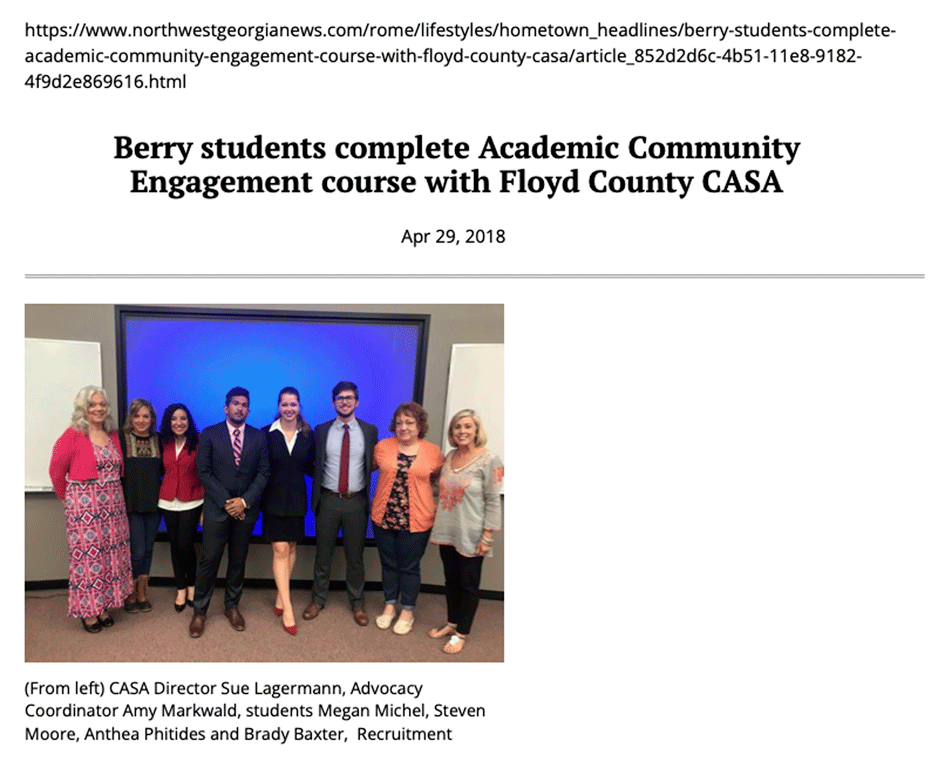
Overall, my goals for this course involved deepening my knowledge about marketing, making my professor proud, and creating a social impact through our marketing plan as a result of its successful implementation. I am pleased to say that my goals were met. Our group’s project was chosen as the winner, and we were even featured in the local newspaper in celebration of the impact that our efforts had on the community.
Summary of All Student Reflections
All students in the course were required to complete a reflection at the end of the semester. It is important to acknowledge that because the reflection was to be submitted to the instructor for a grade, some of the reflections may have been skewed toward a positive bias. To protect student anonymity, the reflections have been summarized into the following eight themes that arose:
Students expressed the course felt intimidating and overwhelming at first because it was unlike standard classroom courses yet in the end, it became one of the most memorable and impactful courses in their college career.
Students gained confidence by having open (unfiltered by the UP) communication with the CP.
Some students expressed that they began the course thinking businesses exist to make a profit, but learned the goal of many businesses is to provide a greater benefit to the consumers.
Students felt challenged and out of their comfort zone.
Students felt challenged by working in groups to create one final project.
Some students discovered that they enjoy the freedom of unstructured creativity, while others expressed that they learned they work better with more structure.
The hands-on application solidified the concepts from the classroom.
Students expressed an increase in their empathy and seeing other perspectives and the ability to tie this to their community.
Synthesis and Findings
Upon analyzing the input from each of the three collaborators, several themes emerged that are of interest. The first was the alignment of strategy, mission, and values. The goals of the CEC were to facilitate applied student learning and to create useful marketing pieces for the CP. Accounts from the CP such as “…reach out to the students and guide them through the organization’s praxes” and “…my honest feedback” demonstrate that the CP aimed to be fully transparent and forthcoming with feedback and guidance for the students. Further, the CP was fully invested in student learning reflecting on her “role as the students’ guide and the organization’s representative in this process helped the students better understand the program so that they could best help us.” It is evident that the alignment of goals was reciprocal, with student quotes like “this project could potentially have a substantial impact” and “Knowing that the amount of quality work that I put into this project could potentially have direct results in volunteer-recruitment numbers encouraged me to continually put forth only my strongest work.”
The second theme that surfaced was the personal connection and relationship among the partners. The CP “genuinely felt as if I were an important client to each group; the groups seemed like true marketing consulting firms.” While the student recounts “I did not want to let down my team members” and thought “our contact at CASA was open, friendly, and available.” Finally, the student proclaimed, “understanding how invested the professor is with the organization had a substantial impact on my performance.” There was clearly a bond linking the UP and the CP, the student and the UP, and the CP and the student, and even a bond among each of the students in the groups.
The value generated from the CEC was priceless. Each party came together with a shared vision of having a transformational impact on the community and the CP efforts by crafting much-needed, useful, quality marketing pieces that were sustainable and easy for the CP to implement. The student felt the course “brought to fruition the finished product: a well-structured marketing plan.” The CP undoubtedly found the collaboration valuable, expressing, “…allowed us to receive marketing materials that we will be able to use for a long time moving forward.” Thus, it is evident that the alliance was quite successful in terms of building value for the partners.
Finally, each of the partners came away from the CEC with worthwhile acquisition of knowledge. This is apparent in statements from the CP such as “…access to free tools such as Canva.com and our easily editable business cards” and “I learned how to use basic graphic design tools and now effectively understand ‘Insights’ on Facebook.” The student also demonstrated continual learning in that she gained the “ability to walk into a previously unknown organization and gain a working knowledge of their current marketing efforts and goals and help them find solutions to their challenges.” Perhaps the essence of the course can be best summed by this testimony from the student “this course was dynamic in that I learned, but I also taught.”
Conclusion and Recommendations
This case study applies Austin’s (2000) four alliance drivers as a framework for a successful CEC collaboration. Alignment of strategy, mission, and values; personal connection and relationships; value generation and shared visioning; and continual learning were weaved into every element—from the forethought involved in the course design to the student reflections at the semester’s end. Insight was captured from and shared by and among the UP, the CP, and a student.
There are several recommendations that should help facilitate the use of alliance drivers in a CEC collaboration. First, the success of the partnership is dependent upon the participants’ effort and commitment to the partnership. When embarking on a CEC, it is essential to carefully choose a community partner that can understand the needs of the course learning objectives and verbalize their needs within the community-engagement scope. When selecting a community partner, it can be helpful to draw on existing community relationships that the instructor, students, and the university already possess. Selecting a CP who is willing to participate and exchange ideas rather than simply receive free student labor is critical. Encouraging students’ intrinsic motivation will also ensure full commitment. Course grades are not enough to drive student effort; the students need to understand and adopt the CP goals as their own. These relationships may open doors to meaningful collaborations that foster mutual benefits and long-term impact. In other words, intrinsic motivation is more effective than extrinsic motivation. Each collaboration is unique, requiring flexibility in the partnership elements.
Second, it is recommended that all partners communicate often and in clear terms about expectations and requirements for success. According to Spekman and Sawhney (1990), unsuccessful partnerships are most often attributed to two main issues. The first cause is unclear or unmet expectations regarding what the collaboration was supposed to accomplish. The second cause is unclear requirements or the lack of requirements necessary for the partnership’s effectiveness. Therefore, continual open and honest communication is crucial to successful collaboration. To ensure the CEC project’s success, scheduling frequent contact among all members of the collaboration is crucial. Regular meetings allow for effective communication, idea sharing, and progress updates. Open lines of communication help address any challenges or adjustments needed during the project, ensuring that everyone remains on the same page. Allowing the students to meet with a CP both with and without the instructor present can enhance their sense of responsibility and independence. When students can interact independently with the CP, they can build stronger connections and take ownership of their roles in the project. However, as a facilitator, it is essential to strike a balance between student independence and being available for guidance and support when necessary.
As with many collaborations, conflict may arise during the CEC partnership. Being prepared to manage conflict in a constructive manner is vital. Often, ideas will be met with opposition. Student proposals will not all be feasible in practice. One of the partners might not follow through on commitments. A good CEC will anticipate these challenges and be prepared to resolve them. Encouraging open dialogue, active listening, and empathy can help resolve issues and strengthen relationships among all parties involved. Periodically incorporating the CP’s insights into the student’s projects can be highly beneficial. This allows the students to take away a deeper understanding of the community’s needs and aspirations while enhancing the overall impact of their initiatives. To promote a sense of ownership and inclusion, outline how the students will contribute to the CP’s decisions. By involving students in the decision-making process, they can feel more invested in the project outcomes and witness the direct impact of their ideas and actions. The best plan is to outline the parameters of the project, division of responsibilities, and consequences in the syllabus and provide a copy to the CP.
Additionally, incorporating prompts for transformative student reflections helps in extracting meaningful lessons from the community-engagement experience. Reflection encourages students to analyze experiences, recognize personal growth, and identify areas for future development. Self-awareness fosters a deep appreciation for community engagement and social responsibility.
Finally, celebrate the success of the partnership and the project with the community partner’s communication channels, the school’s media channels, and local news outlets. This not only acknowledges the student’s efforts, but also raises awareness about the CP’s mission and the impact of the project on the community. Public recognition can inspire others to get involved and create a ripple effect of positive change and can be a great experience for your students.
Appendices
Appendix
Local News Story
Competing Interests
The authors have no competing interests to declare.