
The challenge: Finding community-based educational opportunities
This article examines a ten-year experience of community-based student research and related educational opportunities in a specific Kentucky neighborhood and adds to the literature on the value of high impact practices (HIPs) to students. In addition, this article contributes to the growing body of evidence that long-term, place-based engagement has greater value to communities than engagement that is incremental and short-lived. This is the first study to demonstrate that a 10-year university commitment to a community is sustainable and delivers collective impact.
Universities are embracing HIPS as defined by the American Association of Colleges and Universities (AAC&U), which include undergraduate student research and community-based learning (Reilly & Langley-Turnbaugh, 2021). As they do, one challenge is finding community partners to generate new opportunities to draw more faculty and students to these approaches. The success of this approach rests on building and sustaining trust. If a community partner has a poor experience with a university, then trust is eroded, and the probability of a repeat engagement diminished. Conversely, if the community partner has a positive experience, then additional engagements materialize. This article explores our solution to the challenge of building trust and assuring sustainability, and, in doing so, building an inventory of opportunities for community-based undergraduate research as well as opportunities for other varieties of community-engaged learning.
The study of HIPs is not new. Faculty and researchers have examined the benefits of HIPs for several years (e.g. Kilgo et al., 2015). Our study focuses on the evaluation of undergraduate research in relation to other high-impact practices defined by Kuh (2008) and through the best practices established with COEUR (Hensel, 2012). We posit that it is not just about student participation in undergraduate research but how that research experience interacts with other high-impact experiences (including community engagement, first-year experiences, study abroad, and internships) to impact student success. Research also has suggested clear benefits to stacking student research with international and service-learning experiences (Banks & Gutiérrez, 2017; Huber, 2010).
Research conducted on the value of learning communities, service learning and student research suggests that service learning had the strongest associations with learning outcomes (Eyler et al., 2001; Tukibayeva & Gonyea, 2014). This is echoed in larger studies (albeit without comparison to other student research) that demonstrate that service participation showed significant positive effects on: academic performance (GPA, writing skills, critical thinking skills), values (commitment to activism and to promoting racial understanding), self-efficacy, leadership (leadership activities, self-rated leadership ability, interpersonal skills), choice of a service career, and plans to participate in service after college (Yorio & Ye, 2012; Olberding, 2012; Astin et al., 2000; Astin & Sax, 1998). Timing of the service-learning course seems to be an important discussion in the literature—particularly encouraging participation early in a student’s academic career (Bringle et al., 2010; Roldan et al., 2006). However, Yue & Hart (2017) argue that service learning should occur across a student’s university career to provide the best outcomes on academic and personal development.
In addition, research has shown that community-based organizations expressed frustration with short-term commitments (Vernon & Foster, 2002; Vernon & Ward, 1999; Ferrari & Worrall, 2000). They felt that students interacted with their organizations for too little time to make a meaningful difference. Generally, community organizations prefer commitments of a semester or more so that their investment of time is warranted and so students gain a broader sense of the community partner’s mission and operation.
There is divergence between community and university members in terms of goals, knowledge and expectations (Machimana, Sefotho, and Ebersohn, 2018; Preece, 2016; Stoecker, 2016). As such, creating a long-term relationship that continues to engage a university in the same community can only strengthen those relationships and negate the issues of diverging paths. Many issues also develop as universities work in areas of poverty and inequality. Service learning, student research, and community engagement in communities where students are present for a transitional relationship (credit or service hours) are more likely to breed distrust and negativity in the community (Strier, 2011, 2014). Thus, creating a long-term connection where students are purposefully engaging in the community with the university can mitigate those issues.
Our approach: Programmatic and place-based
Too often universities come into a community one class at a time, one semester at a time, one project at a time, one partner at a time. After each engagement, we move on. What if a university made a longer and more diversified commitment? What might the collective benefits be both for the community and the university? Would there be enough “needs” and “projects” to keep a lot of classes and students engaged? Northern Kentucky University (NKU) asked these questions in structuring its sustained engagement in one geographic location.
NKU is a public, regional comprehensive university in northern Kentucky located seven miles southeast of Cincinnati, Ohio, in Campbell County (see Figure 1). NKU offers 68 bachelor’s degrees, 24 master’s programs, a juris doctor, and doctoral degrees in educational leadership, nursing practice, and occupational therapy (NKU Fast Facts). NKU enrolls students from 104 Kentucky counties, 40 states, and 54 countries. Total enrollment at the university currently exceeds 16,000 students, with almost 10,000 undergraduate students and over 3,500 graduate students served by almost 600 full-time faculty members (NKU Fast Facts). Many of NKU’s students are non-traditional, part-time, and commuters.
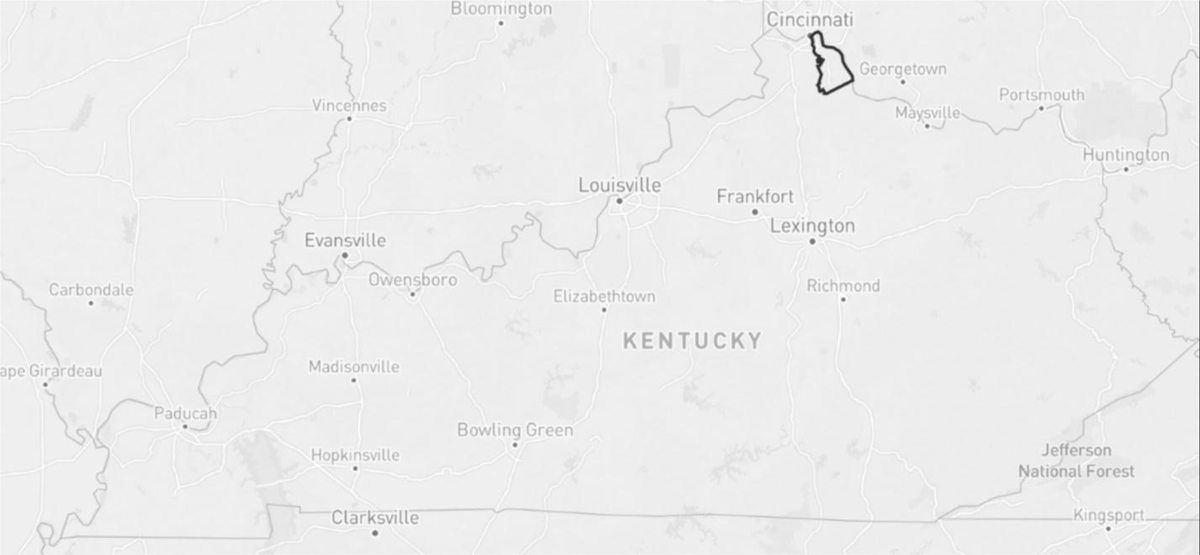
Figure 1
Map of Kentucky with Campbell County highlighted.
Note: From Kirkwood (2021).
NKU has a long history of institutional commitment to service learning and student research. The university received one of the first Carnegie classifications in community engagement in 2006. The classification is given by the Carnegie Foundation for the Advancement of Teaching, which was chartered by Congress in 1906 to advance transformative ways to teach. The foundation awards the classification to colleges and universities that demonstrate an institutional commitment to using community engagement to teach. NKU places great emphasis on engaging students in experiential learning, and experiential learning also is emphasized in our institution’s recent strategic plan. Further, we have the Scripps Howard Center for Civic Engagement (SHCCE), dedicated to connecting our classrooms to the communities around us, and the Institute for Student Research and Creative Activity (ISRCA) to support student research. SHCCE was established in 2003 and houses a full range of community engagement activities, including the oldest student philanthropy program in the nation, a lecture series featuring student and faculty research; town hall events for civil, civic discussion of public issues; voter registration and information programming; and, importantly, a commitment to the expansion of community-based learning. To fulfill the community-based learning commitment, the center hosts workshops, provides financial support, and acts as a matchmaker in connecting community-learning opportunities to classes. ISRCA was created in 2017 as the final piece in NKU’s longstanding commitment to student research. It funds student projects and travel, organizes celebrations of student work, tracks student research metrics, and facilitates faculty/student connections. Both SHCCE and ISRCA have developed course designations for courses that are student research and/or service-learning intensive to efficiently track our work in these areas. With both offices situated in a vice provost’s office, a natural synergy emerges to create a climate for community-based student research, and adequate university support is present to support community engaged teaching and learning.
For NKU, the idea of selecting a place-based source for community-based student learning and research opportunities was born in 2012 during ongoing discussions facilitated by the Greater Cincinnati Service Learning Network (GCSLN), an alliance of community engagement offices at public and private universities in our region. GCSLN’s intention was to increase the quantity and quality service learning in the region while also making sustained, collective contributions to places with documented needs. The team’s hypothesis was that a place-based focus would bring a stream of opportunities for community-based learning with reciprocal benefits for the students involved as well as the community partners.
NKU decided to take the ideas born from the GCSLN discussions and actualize them. The first step was to find a place where our work might have more meaning to students—a place where students would feel they could make a difference. We turned to a demographer at a regional planning agency who identified census tract 505 in Newport, Kentucky (which, like NKU, is located in Campbell County) as the most distressed northern Kentucky neighborhood (Figure 2). The median household income in tract 505 was less than half the national median ($23,578 versus $51,144). Other indicators painted a fuller picture of need in 505:
17% of families earned less than $10,000 a year;
over 25% lacked a high school diploma;
37% of households didn’t have a car; and
4% of households consisted of grandparents living with and taking care of grandchildren.
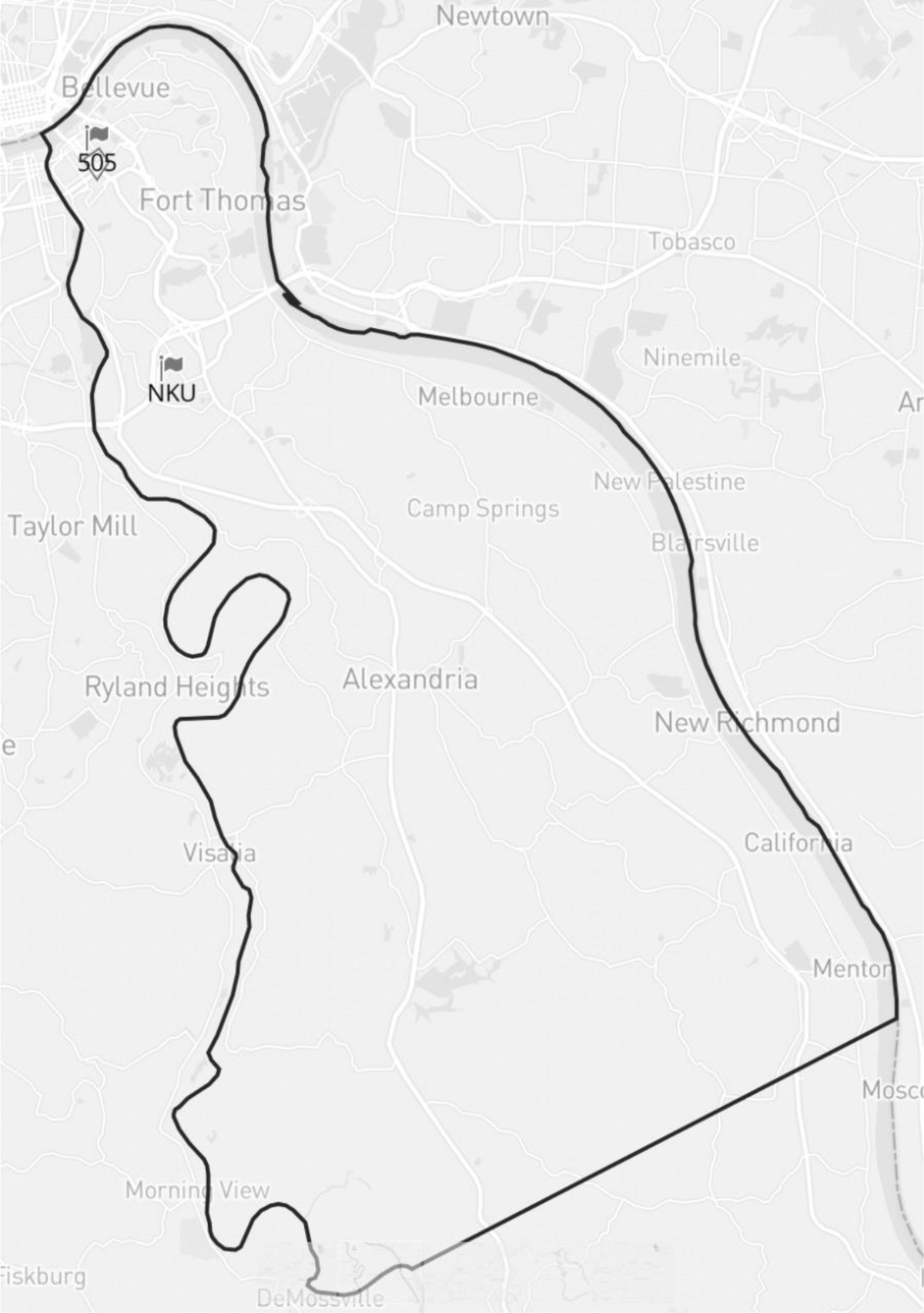
Figure 2
Campbell County, KY showing locations of NKU and 505.
Note: From Kirkwood (2021).
Census tract 505 is in the oldest neighborhood in northern Kentucky’s oldest city. That history would play an integral part in our engagement, as the neighborhood’s history provided recurring research opportunities for NKU students and faculty.
With a geographic area identified, NKU’s next step was to identify a lead community partner so that we could learn about community needs and potential projects; we wanted to respond to the community’s interest, not impose our own. We identified the Brighton Center, a community service agency founded in 1966 and located in tract 505. The nonprofit center provides a range of services, including housing, after-school programs, safety-net programs (food, clothing, shelter), and financial literacy programs. With the Brighton Center as an ally, NKU had a listening post for navigating 505 and a gateway to opportunities and additional partnerships. The NKU organizing office for what we named Project Hope: The 505 Initiative (“505” became our shorthand for the project) was the SHCCE.
Discussions with the Brighton Center launched the project in late 2012. Within a year, the roster of community partners grew to include the neighborhood’s Boys & Girls Club, a startup nonprofit called Mentoring Plus, the local public school district, Habitat for Humanity, Hosea House (a “soup kitchen”), the Westside Neighborhood Coalition, and several other nonprofit agencies. From listening to those community partners, dozens of potential projects emerged for NKU students.
Since launching the 505 Initiative in 2012, NKU has engaged with more than 25 community partners in Newport and has engaged with many of these partners repeatedly. At least 90 courses have engaged with partners and projects in the 505 and adjacent areas, resulting in hundreds of students having at least one community-based learning experience across a variety of disciplines (see Table 1). Projects ranged widely: one class created public art. Another created digital maps. Classes produced public health assessments, conducted local history research and archaeological digs, analyzed soil for lead contamination, and helped launch a new local history museum. A multi-year participatory research project informed the development of new green spaces (for a partial breakdown of the projects, see Table 2). The variety made it apparent that there were enough community needs to keep many courses and students engaged for a prolonged period.
Table 1
Service Learning Courses in the 505.
| TERM | NUMBER OF COURSES |
|---|---|
| Spring 2013 | 13 |
| Fall 2013 | 5 |
| Spring 2014 | 6 |
| Fall 2014 | 12 |
| Spring 2015 | 13 |
| Fall 2015 | 9 |
| Spring 2016 | 1 |
| Fall 2016 | 2 |
| Spring 2017 | 3 |
| Fall 2017 | 6 |
| Spring 2018 | 4 |
| Fall 2018 | 8 |
| Spring 2019 | 5 |
| Fall 2019 | 4 |
| Spring 2020 | 1 |
| Fall 2020 | 1 |
| Spring 2021 | 4 |
| Summer 2021 | 1 |
| Fall 2021 | 8 |
| Spring 2022 | 2 |
| Fall 2022 | 1 |
| Spring 2023 | 3 |
| Total | 112 |
Table 2
Examples of projects by discipline.
| DISCIPLINE | # OF COURSES | TYPE OF WORK |
|---|---|---|
| Anthropology | 5 | Conducting a variety of research projects, including slave history, and levels of hope of current residents |
| Art | 11 | Designing and creating public art including murals and little libraries, photo essays, etc. |
| Biology/Neuroscience | 5 | Researching, creating, and delivering health talks at community locations; developed nutrition materials |
| Business, Marketing and Management | 7 | Working with neighborhood nonprofits, student philanthropy projects; developed projects with the Wood Hudson Cancer Research Center |
| Communication | 12 | Researching board voices and structure and the increasing numbers of young professionals in the area, producing a documentary, PR for local nonprofits |
| Criminal Justice/Spanish | 4 | Designing interactive activities for a family night at Brighton Center |
| English | 9 | Assisting with grant writing, creating an interactive walking tour |
| History | 14 | Researching potential exhibits for a new African American history museum and exhibit installation, researching neighborhood history |
| Honors | 5 | Researching and developing stories about micro-neighborhoods in the 505; examining hidden stories of the city’s African American residents; examining poverty through the lens of Westside neighborhoods |
| Journalism | 5 | Writing investigative news stories; photojournalism |
| Nursing | 7 | Public health presentations, assessments, community garden planning |
| Organizational Leadership | 2 | Conducting neighborhood surveys |
| Public Administration | 3 | GIS mapping of the 505 Census Tract; community planning research |
| Psychology | 4 | Surveying residents for “hope” and purpose of museum project |
| Social Work | 7 | Researching social welfare; developing policies and procedures to assist with tutoring |
| Theater | 4 | Constructing costumes; theatrical renderings for flood wall |
[i] Note: *other disciplines with limited course offerings: public relations, integrative studies, mathematics, computer science, learning communities (two or more disciplines) and education.
Getting started: Undergraduate Research led the way
The foundation for NKU’s engagement with Newport was built on undergraduate student research and related HIPs in several disciplines. Among the early adopters were nursing, journalism, psychology, and the honors program. Those provided the proof of concept and rationale to continue engaging with the neighborhood as each engagement brought benefits both to the students and to our community partners. What follows is a closer look at these early examples.
Nursing
In an upper-division level class, students investigated the food resources available in 505. They visited the neighborhood’s many corner markets to see whether healthy foods were available. Generally, they were not. Students presented their findings to a group of residents and nonprofit leaders and made some recommendations, including that local farmers’ markets accept food stamps.
Journalism
Several classes got involved, writing stories and taking photographs in 505. One of those classes learned that lead contamination was a significant concern among residents, who worried about the health implications. One of the students took on the topic as an investigative journalism project. The student investigated historical lead sources, collaborated with a biology class that did soil testing, read current government inspection records, interviewed residents, and in the end, wrote a lengthy story that was published in the Cincinnati Enquirer about the site (Schultz, 2015).
Psychology
Students surveyed residents on hope and meaning of life, then analyzed their findings and compared them to results from a control group to see whether hope and meaning of life were substantially different in 505 from the control group. They were not. The class research resulted in a journal article (Clark & Stubbeman, 2021). The students’ work also provided a direct benefit to 505, as it became part of a report designed to guide the neighborhood’s revitalization. A new private nonprofit agency, ReNewport, emerged from that report—and became a partner with future NKU classes.
Anatomy of an engagement: How one opportunity generated many more
As referenced earlier, the Brighton Center was NKU’s first guide to understanding 505 and its needs. Nearly simultaneously, NKU connected to the Westside Neighborhood Coalition, a residents’ group that meets monthly. The coalition is the formal umbrella of several micro-neighborhoods in 505. Early on, the president of the coalition contacted the SHCCE with a need he and his fellow residents wanted to see fulfilled. The request was that NKU students, with research and other projects, contribute to telling and celebrating the Westside’s history. That began to happen almost immediately and would continue uninterrupted since.
Students in one course created an architectural inventory of the housing and other buildings in 505, documenting different styles, while students in another course researched and wrote book chapters about 505 and its history. Over time, this has resulted in over 60 stories about Newport’s history published in a local digital newspaper. Those stories, in turn, provided content for a series of historical podcasts that can be listened to while on a walking tour of Newport. The tour, “Newport History Walk,” can be download from a smartphone’s app store. It is a museum without walls, telling the city’s story.
The neighborhood association president requested that NKU play a role in elevating 505’s history, and also wanted help addressing the 505’s many vacant homes. Those two requests would eventually be rolled into one. First, the SHCCE worked with Habitat for Humanity to find two vacant 19th-century homes to renovate. NKU students volunteered with Habitat. Because of the age of the old houses, the City of Newport’s historic preservation team was on site. That led to discussion about the city’s plans to open a new local history museum in a segregation-era “Blacks only” school. The museum project opened an entirely new inventory of opportunities for student research and HIP engagement. A range of NKU classes have since engaged in museum projects, researching small museum budgets (a business class); providing guidance on forming a board with community voices (a communications class); designing public art around the museum (a painting class and a sculpture class); conducting focus groups on the museum’s vision (a psychology class); and designing museum exhibits (several history classes).
What we have found repeatedly in Newport is that engagement breeds engagement. One project opens doors to more.
Assessing our efforts: Value to students, faculty and the community
Assessment was part of NKU’s launch of the 505 Initiative. Students in the first classes participated in a survey adapted from one designed by the National Campus Compact. The results suggested significant benefits and provided NKU with the confidence to continue. To evaluate the long-term impacts of the 505 program, we conducted three surveys in late spring 2021 with three constituencies: students, faculty, and community partners. We surveyed students in both recently completed classes and from previous semesters, dating back to the launch of 505. These surveys were adapted to fit NKU and our audiences from well-known community partner surveys and service-learning assessments (see Stewart, 2019; Waters & Anderson-Lain, 2014; James & Logan, 2016; Ngai et al., 2018). To identify participants, we pulled course lists for students who participated in community-based learning in 505 going back to 2013 and through the Spring 2021 semester (the survey was conducted before the Fall 2021 semester).1 We then contacted both current students and alumni. Despite a large pool of students, surveying proved problematic. Some students, for example, had graduated; using NKU emails to contact alumni is notably unreliable as many do not keep up with changing their passwords every 60 days. We had 116 respondents click on the survey and 71 complete the survey. While the response rate may be concerning, we do not know how many students actually received the email which alleviates some of the concern. However, the data should be taken as a sample rather than an analysis of the feedback from all students who were engaged in 505. For our community members’ survey, we emailed 17 engaged members and received 13 completed surveys (a response rate of 76%). We also sent the survey to the 34 faculty who taught courses with a community-based research component in Newport and received 29 responses (a response rate of 85%).2
Student respondents (90%) indicated that they were more interested in their classes as a result of their experiences, that their grades improved as a result of taking these classes (47%), and that these experiences had a somewhat or extremely positive change in their attitude towards service and volunteerism (81%). Further, 72% felt like they made a difference in Newport because of the community-based learning experiences, 76% felt that the experience allowed them to serve their local NKU community, and 83% felt that their community-based learning courses fostered a sense of belonging in the community. In terms of long-term impact, students cited projects such as building exhibits that celebrated Newport’s 225th anniversary, conducting community needs surveys, designing and implementing public art (a mural project), and assisting in the creation of relationships between community members through a participatory project centered around public green spaces. In an earlier study in 2019, NKU students who participated in any community-based student research (not just in 505) reported feeling more connected to the university and their community than those who had just done student research alone. Those students also had a 0.10 increase in their GPA versus those who participated in community engagement alone (Reilly & Langley-Turnbaugh, 2021).
Most of the professors and instructors surveyed (54%) had taught one course connected with Newport, but 15% had taught four to six classes, and 7% had taught over six separate sections of classes focused on 505. The majority (94%) said they would participate in community-based research and learning again and that their facilitation of community-based research classes increased their own connection to the community. In comments, faculty indicated that “knowing that both student participants and the community benefited” was important to their decision to engage. A faculty member also commented that “as a citizen [of the neighborhood], I have seen several nonprofits continue to use and discuss our work long after the project is completed.”
All faculty felt empowered by the chance to serve the local community, and the majority (94%) felt that it increased their sense of belonging in the community and assisted them in creating meaningful connections in the community. In fact, a faculty member commented “It raises awareness of the needs so close to campus.”
The majority (76%) also indicated that teaching community-based classes very much changed their attitude towards service and volunteerism. Faculty (94%) also felt that the participation enabled their students to make a difference in the community, understand the value of community building, and become more knowledgeable about the community as a result. They indicated that “students were typically drawn to the location and the nonprofits there” and “gained greater appreciation for the needs of our local community.”
The majority of community partners who responded to the survey indicated that they had worked with students in community-based courses over seven times. All responded that they had interacted with students in multiple ways during the projects—from meeting with individual students, to speaking to classes or groups, to identifying projects for students to work on. The majority (92%) felt that NKU had a positive impact on community needs through community engaged research and coursework, and 85% felt that working with NKU students increased their own connection to their community and to their neighbors (77%). One respondent showed the value beyond just the student work, in that the partnership “brought $50K in infrastructure to Newport and [gave] ReNewport national recognition.” All respondents agreed or strongly agreed that NKU students have fostered community building in Newport and 92% said the NKU-supported projects and research improved the community and that participation in community engagement has made NKU more aware of the needs of the community. Furthermore, community partners talked about value—that community-based student research enabled the community partner to “deepen the community impact and our ability to fulfill our mission.” 39% also indicated that the work with the students continued after the end of the community-based course. When asked specifically, community partners indicated that “our interactions with the students brought awareness of the university to our residents and awareness of our area to the students. This has helped to build positive relationships between the two. This also helped many residents feel that they matter to others.”
Respondents also indicated that the work the NKU students engaged in was something they could not have done on their own, that these projects strengthened their relationship with NKU, and that students brought new energy to the organization. Finally, 100% of respondents indicated that through the strategy of focusing community engagement in Newport and sustaining that focus, NKU has built trust in the value of a university-community partnership.
Changing Community Relationships Over Time
What we found a decade of community-based student research and learning collaboration with 505 is that committing to one geographic location and building trust with the partners in that place contributed to the quality of the engagement and academic activities for both students and the community partners. More specifically:
Trust
Community partners believed in our effort enough to be our partner in the first place, and then invited us back for additional engagements. Our results (both quantitative and qualitative) demonstrate that through repeat engagements this initiative has successfully built campus-community trust.
Sustainability
Our commitment was to maintain the alliance of campus and community for at least three years, longer if the partnership was working well for all partners—and it now has lasted for ten years with 90 courses engaged in research and service learning in or near the 505 census tract.
Student benefits
In research conducted on service learning at NKU, we (in other studies of this student body) have consistently found that students valued their community-based research experiences, which have broadened their understanding of the community and enhanced their learning of their course material (Larson et al., 2020). Additionally, students feel a greater connection to their peers, faculty, NKU, and the community through participation in these community-based student research projects, regardless of discipline (Reilly & Langley-Turnbaugh, 2021).
While considerable research has been conducted on the benefits of community-based research and learning for students, less research has been conducted on the benefits to the community partners, even though best practice is built on the principle of reciprocity (Petri, 2015). Therefore, it is especially satisfying in a long-term collaboration to see partners who return after one engagement for another and report positive results about the experience. When we asked about what made the connection strong between the university/students and the community, the partners indicated that longevity and consistency were important.
We believe this model is a template for other universities looking to increase both the quantity and quality of community-based research and learning. It is adaptable to a geographic area near any university and also adaptable to any discipline. What our experience and analysis of survey results from the 505 experience show is that a sustained focus can produce high quality, diverse community-based student research that fulfills the promise of high impact practices.
Recommendations for Other Institutions
Replicating our model begins with finding a magnet for community-based student research and learning that would work best for your college or university. Our choice was geographic (a census tract), but a topic important to your community could be an equally valid magnet. NKU did this for a shorter time period by focusing on our region’s opioid epidemic (Langley-Turnbaugh & Neikirk, 2018). Nevertheless, the list of potential topics is long and best guided by priorities in your community. Once a magnet is selected, the planning should move quickly into the community and prioritize the community voice in choosing projects. Simultaneously, communication is required on campus to engage faculty and find core faculty supporters who will continue to involve students in research/creativity in the area over time. Opportunities will emerge, engagements will occur, and benefits to students and the community will accrue because of the long-term commitment to a single magnet.
Notes
[2] While the list provided was 6,198 students/alumni, this is not reflective of the number of students who actually participated in these courses. Institutional Research was unable to identify which classes were taught by specific faculty members and so, if there were multiple sections of the course taught in a particular semester, all students who were enrolled in that course were included. This artificially deflates our response rate, but we did include a filter question about participation in service learning and it was also included in the initial invitation to participate in the survey, so we do not think we are reporting responses from students who did not participate. NKU’s average class size is 24 students, so we estimate that roughly 2,688 students have participated in Project Hope. We also verified our results asking students how many times they engaged in the Newport area as a failsafe on these responses.
Competing Interests
The authors have no competing interests to declare.