
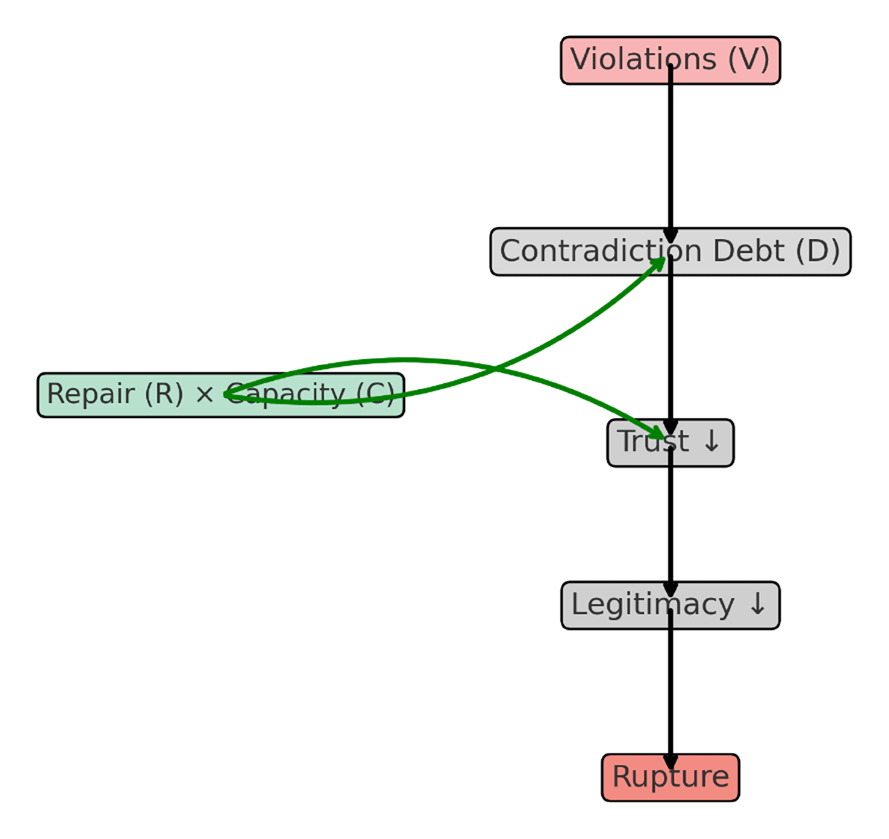
Figure 1
Conceptual Flow Model of the Contradiction Debt Mechanism.
Table 1
R/V thresholds and typical time to rupture.
| R/V RANGE | TYPICAL TIME TO RUPTURE | INTERPRETATION |
|---|---|---|
| < 0.30 | 1–2 quarters | Imminent breakdown |
| 0.30–0.45 | 2–3 quarters | High risk |
| 0.45–0.60 | 3–6 quarters | Moderate strain |
| ≥ 0.60 | ≥ 8 quarters | Stable/resilient |
Table 2
Violation domains (V), definitions, and indicative sources.
| DOMAIN | INDICATIVE SOURCES | EXAMPLES OF VIOLATIONS | CODING RULE (0–1) |
|---|---|---|---|
| Security/Rights | ACLED; HRW; UN SC reports | extrajudicial killings, repression, armed insurgency | 0 = none → 1 = systematic |
| Rule of Law/Elections | Amnesty; WJP; UNHRC | politicized courts, manipulated elections | 0 = credible → 1 = annulled |
| Center–Local Relations | ICG; constitutions | autonomy disputes, resource contests | 0 = cooperative → 1 = breakdown |
| Narrative Legitimacy | Freedom House; RSF; V-Dem | censorship, propaganda, disinformation | 0 = free media → 1 = systemic control |
| Humanitarian Obligations | UN OCHA; WHO; World Bank | service failures, famine, disaster neglect | 0 = adequate → 1 = collapse |
Table 3
Repair dimensions (R) and scoring criteria.
| MECHANISM | DEFINITION | INDICATORS/SOURCES |
|---|---|---|
| Acknowledgment | public recognition of grievances | speeches, official inquiries |
| Reform | structural policy change | legislative acts, judicial reform |
| Compensation | material or symbolic redress | reparations, truth commissions |
| Inclusivity | expanded participation | coalition building, minority representation |
| Implementation Fidelity | follow-through on reforms | enforcement rates, budget execution |
Table 4
R/V bands and forecast time windows.
| R/V BAND | FORECAST HORIZON | INTERPRETATION |
|---|---|---|
| < 0.30 | 1–2 quarters | imminent rupture |
| 0.30–0.45 | 2–3 quarters | high risk |
| 0.45–0.60 | 3–6 quarters | moderate strain |
| ≥ 0.60 | ≥ 8 quarters | stable |
Table 5
Comparative discrimination and calibration metrics.
| MODEL | AUROC | AUPRC | BRIER | MEAN LEAD-TIME ERROR (QUARTERS) |
|---|---|---|---|---|
| Contradiction Debt (CD) | 0.54 | 0.29 | 0.19 | ± 1.0 |
| ACLED Event Rate | 0.60 | 0.34 | 0.22 | ± 1.8 |
| Early Warning Project (EWP) | 0.56 | 0.31 | 0.24 | ± 2.0 |
| Fragile States Index (FSI) | 0.46 | 0.25 | 0.23 | ± 3.5 |
| V-Dem Autocratization Index | 0.49 | 0.27 | 0.22 | ± 2.5 |
Table 6
Logistic regression predicting rupture within two quarters.
| PREDICTOR | COEFFICIENT (β) | STD. ERROR | P-VALUE |
|---|---|---|---|
| R/V Ratio | –2.43 | 0.92 | 0.021 |
| ACLED Rate | 1.17 | 0.74 | 0.12 |
| FSI | 0.65 | 0.83 | 0.42 |
| V-Dem Autocratization | 0.52 | 0.79 | 0.49 |
| EWP Probability | 1.06 | 0.81 | 0.18 |
| Constant | –0.41 | 0.68 | — |
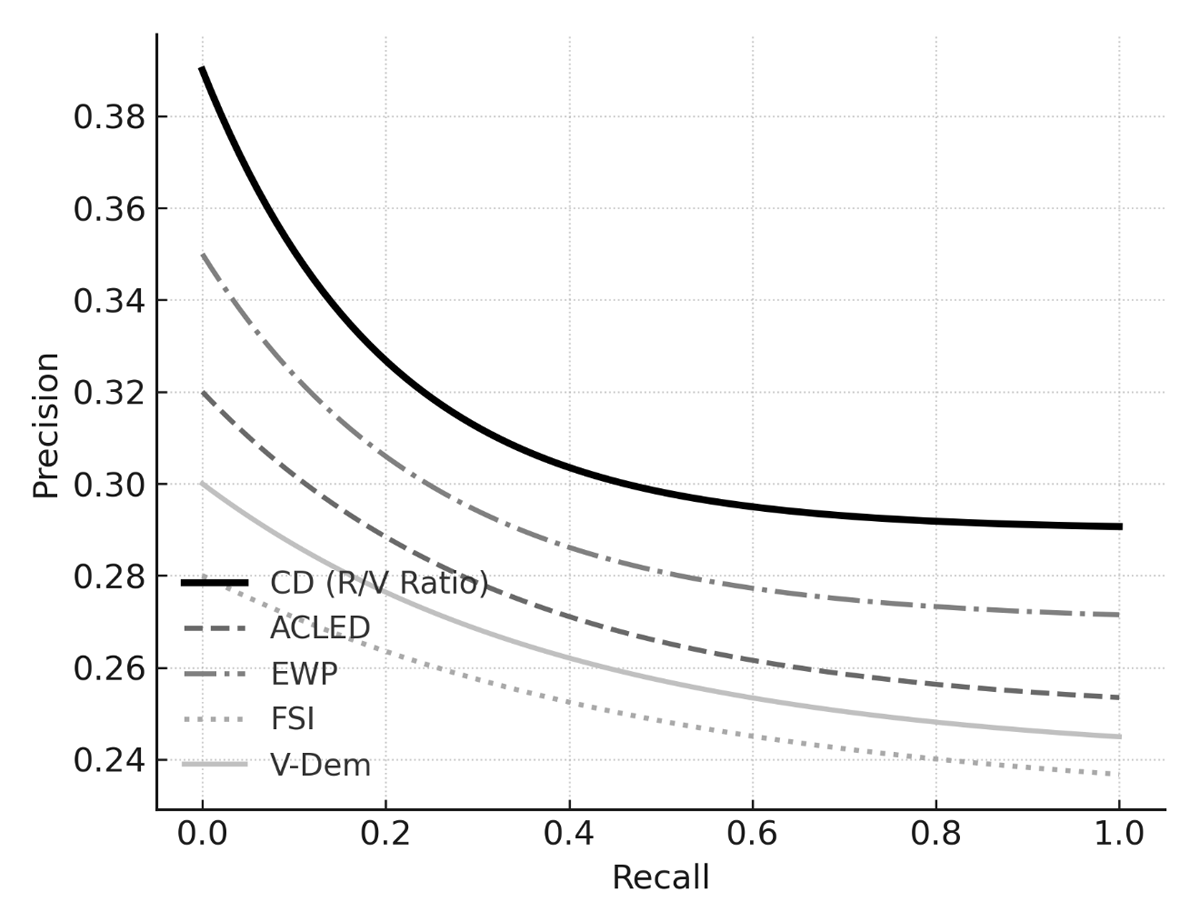
Figure 2
Precision–Recall Curves Across Models.
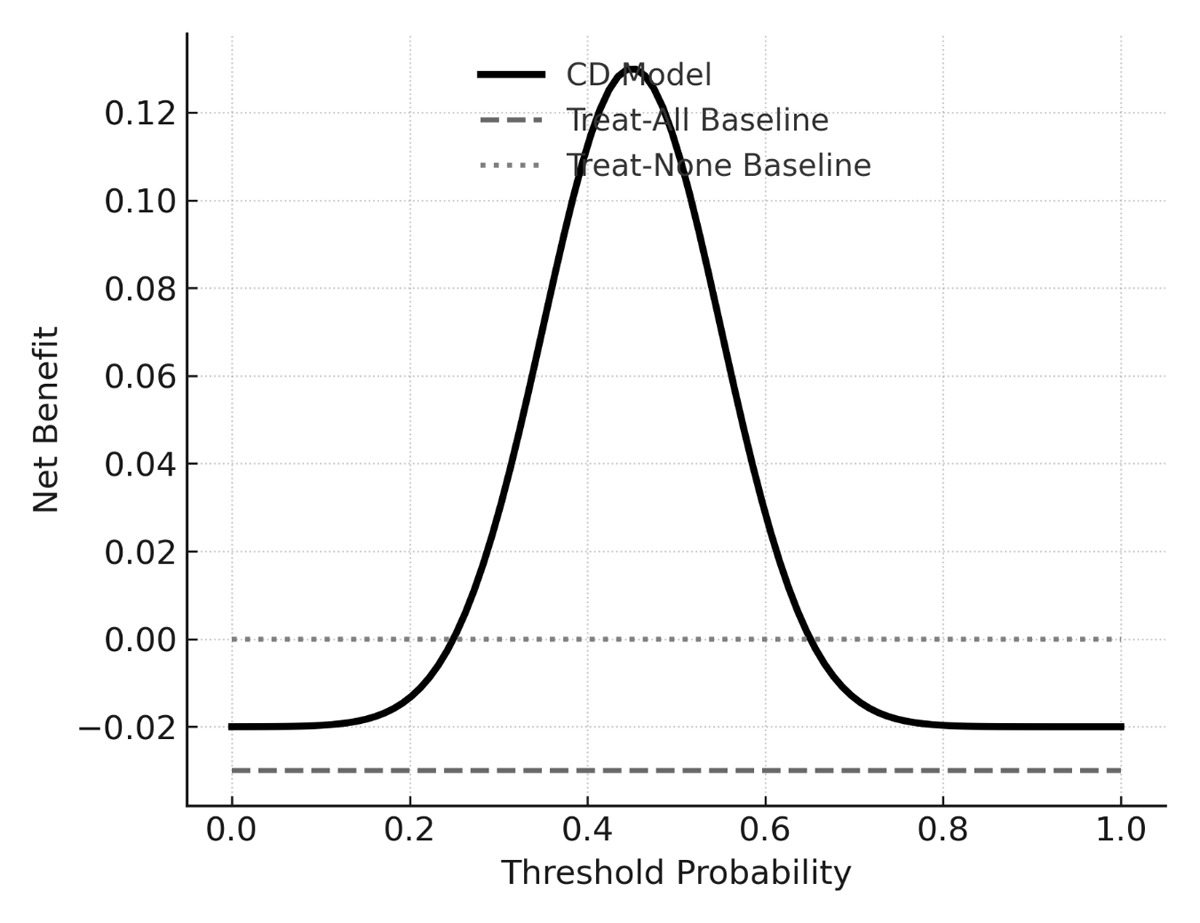
Figure 3
Decision-Curve Analysis.
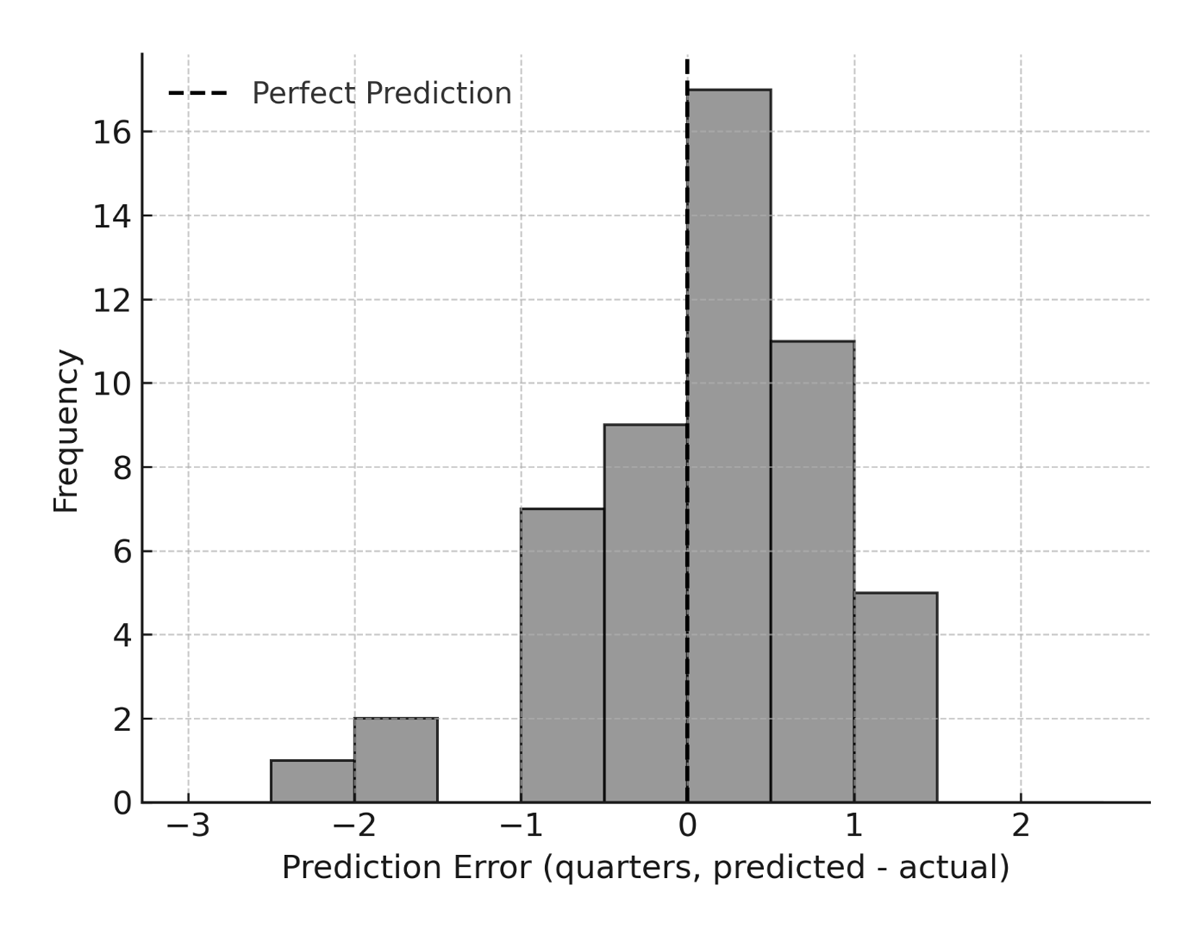
Figure 4
Lead-Time Error Distribution.
Table 7
Retrospective benchmark cases: predicted horizons and observed outcomes.
| CASE | R/V | PREDICTED HORIZON | OBSERVED OUTCOME |
|---|---|---|---|
| Tunisia (2011) | 0.22 | 1–2 quarters | Rupture occurred within one quarter. |
| Lebanon (2019) | 0.38 | 2–3 quarters | Government collapse followed in two quarters. |
| Myanmar (2021) | 0.26 | Imminent | Coup occurred within one quarter. |
| Sri Lanka (2022) | 0.28 | 1–2 quarters | Collapse occurred within one quarter. |
| Nepal (2025) | 0.24 | Imminent | Breakdown followed within weeks. |
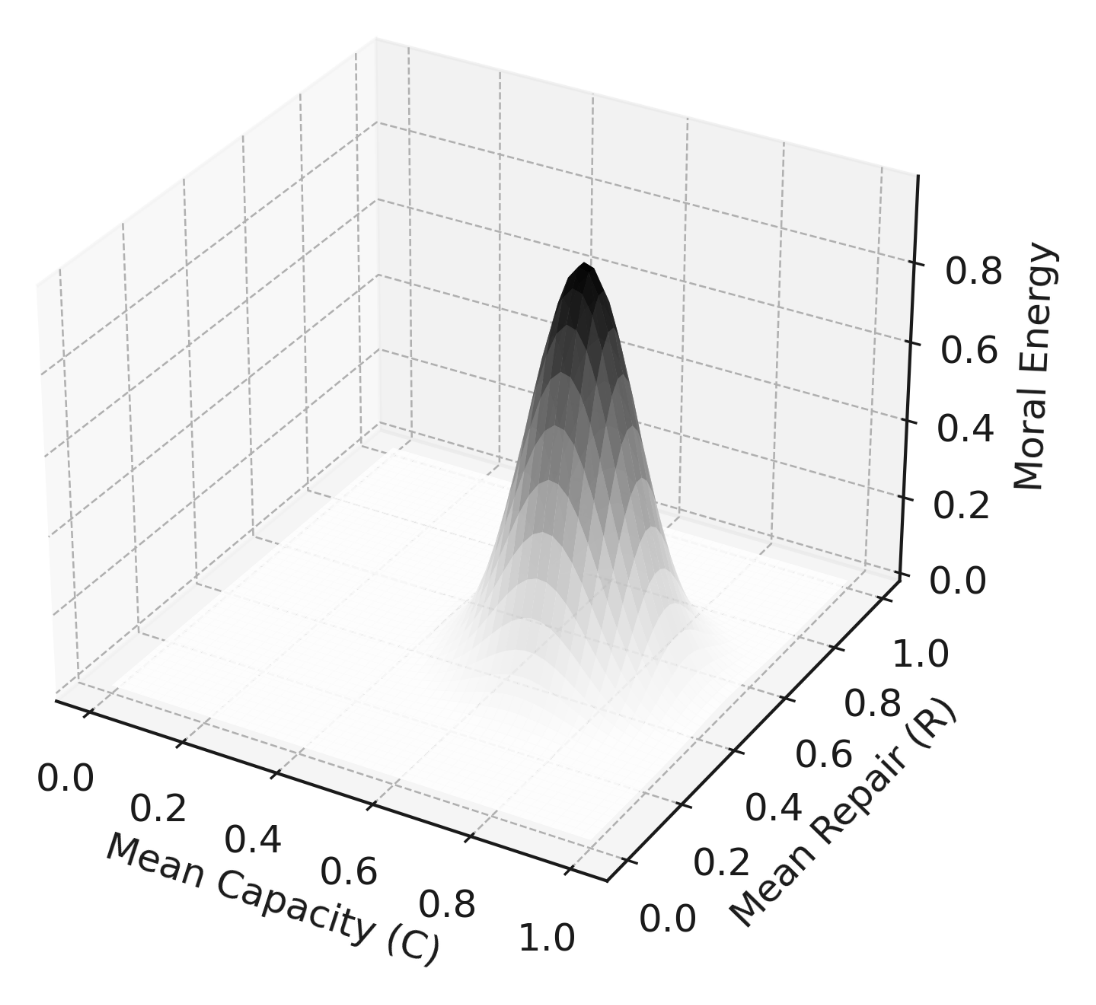
Figure 5
Critical Curvature Zone: Stability Surface.
Table A1
Violation domains, indicative sources, and anchor endpoints.
| DOMAIN | INDICATIVE SOURCES | EXAMPLE VIOLATIONS | CODING RULE (0–1) |
|---|---|---|---|
| Security/Rights | ACLED; HRW; UN Security Council reports | Extrajudicial killings, repression, armed insurgency | 0 = none → 1 = systematic |
| Rule of Law/Elections | Amnesty; WJP; UNHRC | Politicized courts, manipulated elections | 0 = credible → 1 = annulled |
| Center–Local Relations | ICG; constitutional texts | Autonomy disputes, resource contests | 0 = cooperative → 1 = breakdown |
| Narrative Legitimacy | Freedom House; RSF; V-Dem | Censorship, propaganda, disinformation | 0 = free media → 1 = systemic control |
| Humanitarian Obligations | UN OCHA; WHO; World Bank | Service failures, famine, disaster neglect | 0 = adequate → 1 = collapse |
Table A2
General intensity anchors for scope × severity (applied within each domain).
| SCORE | ANCHOR DESCRIPTION |
|---|---|
| 0.00 | No observable violation in the quarter; obligations substantially met. |
| 0.25 | Isolated or localized incidents; limited population affected; reversible. |
| 0.50 | Recurrent or regionally concentrated violations; moderate harm; contested but not systemic. |
| 0.75 | Widespread or escalating violations; severe harm; weak or absent accountability. |
| 1.00 | Systematic, nationwide violation; severe and sustained harm; institutional impunity. |
Table A3
Repair mechanisms, definitions, and indicators.
| MECHANISM | DEFINITION | INDICATORS/SOURCES |
|---|---|---|
| Acknowledgment | Public recognition of grievances | Speeches, official inquiries |
| Reform | Structural policy change | Legislative acts, judicial reform |
| Compensation | Material or symbolic redress | Reparations, truth commissions |
| Inclusivity | Expanded participation | Coalition building, minority representation |
| Implementation Fidelity | Follow-through on announced reforms | Enforcement rates, budget execution |
Table A4
General anchors for repair effectiveness (applied within each mechanism).
| SCORE | ANCHOR DESCRIPTION |
|---|---|
| 0.00 | No corrective action; grievance denied or ignored. |
| 0.25 | Rhetorical or symbolic gesture with no implementation. |
| 0.50 | Partial action; announced reforms with weak or uneven implementation. |
| 0.75 | Substantive action implemented across most of the affected domain. |
| 1.00 | Full, credible, and verifiably implemented repair restoring the obligation. |
Table A5
Capacity sub-factors and sources.
| FACTOR | CONSTRUCT | SOURCE |
|---|---|---|
| L — Legitimacy | Popular trust in government | V-Dem (“trust in government”) |
| E — Elite Cohesion | Unity/fragmentation of the governing elite | ICG reports; expert coding |
| K — Institutional Capacity | Administrative and judicial competence | World Bank Governance Indicators |