
Table 1
A summary of the meanings of vernacularization.
| VERNACULARIZATION SIGNIFIES… | COMPONENTS OR CONTEXTUAL FACTORS | CONTRASTING IDEOLOGIES OR DEVELOPMENTS | CENTRAL AUTHORS MENTIONED |
|---|---|---|---|
| The shift from Latin to vernacular literacy | Translation, transposition, transmission, standardization, spread of print culture | Latin learnedness, gatekeeping of knowledge | Cornish, Crossgrove, Millar |
| The creation of local (vernacular) literary culture | Literization, literarization, superposition | Cosmopolitanism | Pollock |
| The rise of national languages | Print culture, unification, language standardization | Multilingualism, regionalism | Anderson, Burke |
| An ideological preference for indigenous languages as official languages of state | Language planning and policy-making | Internationalism, globalization | Cobarrubias, Kamwangamalu, Riney |
| Destandardization | Relaxing norms of appropriateness in language use | Standardization | Bell, Coupland |
| The appropriation and domestication of foreign and/or colonial cultural properties | Decolonizing, indigenous empowerment | Imperialism, colonialism | Appadurai, Merry, Michelutti, Rafael |
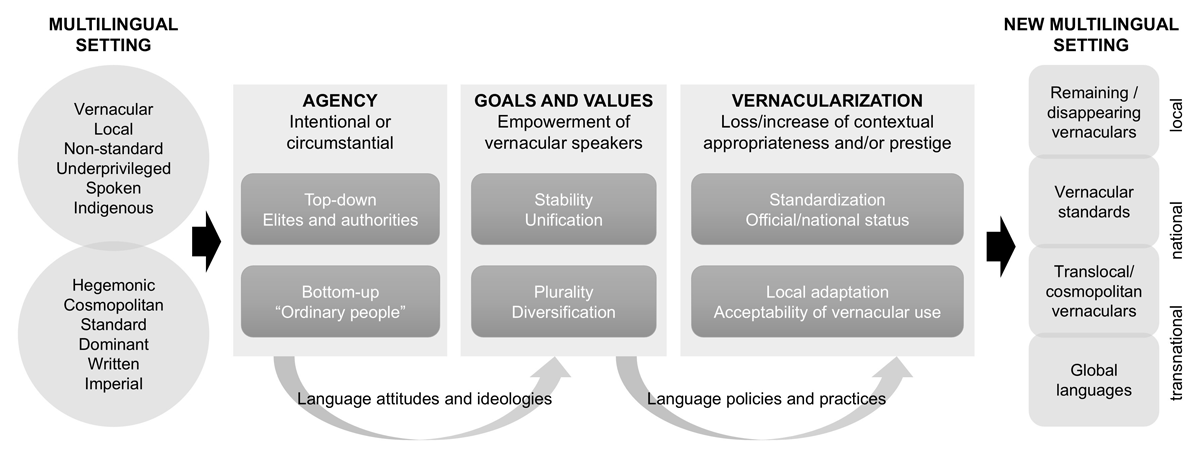
Figure 1
The common dynamics of vernacularization. Changes to the roles languages serve in a community are sought by individual and/or communal actors whose goals and actions are informed by their language attitudes and ideologies.