
Introduction
Virtually all societies display some form of multilingualism or, at the very least, variety within the language spoken by the community. Attitudes towards different languages or language variants and their perceived social value reflect power relations in society. Consequently, people have pursued changes to the statuses of languages to affect societal hierarchies (see Gramsci 2012, 164–94, 199–217). This relationship between language and power has, unsurprisingly, interested several academic disciplines from history and linguistics to anthropology and education, and many of those inquiries have employed the concept of vernacularization to describe the changing dynamics between different languages and language varieties. In this article, we review the meanings given to vernacularization in various academic contexts and argue that increased awareness of the different objects, trajectories, and projected outcomes scholars assign to vernacularization would improve its usefulness as an analytical concept across disciplines.
The concept of vernacularization has crossed disciplinary borders and gained specific uses that seem only partially related. Even within the linguistic–philological domain, the meanings of vernacularization vary so widely as to include near opposites: while the term is commonly used to refer to the creation and rising estimation of vernacular writing and the concomitant process of linguistic standardization (e.g. Binzel, Link & Ramachandran 2020; Burke 2013; Pollock 2006), it can also index the social elevation of particular non-standard varieties of vernacular speech and tolerance of a wider spectrum of linguistic variation in standard language societies – that is, a kind of destandardization (Coupland 2014). In most definitions, the object being vernacularized is the society or culture that begins to use a vernacular language in a new way, but the term is ambiguous enough to have inspired interpretations where the language itself is the object that is being made more vernacular: ‘To vernacularize a language is to reduce it to a vernacular’ (Chimhundu 1993, 35).
Herbert Chimhundu (1993) is decidedly in the minority when he argues that the reliance on former colonial languages at the expense of local vernaculars in many African countries is a form of vernacularization. Nkonko M. Kamwangamalu (2010, 1) is indicative of common usage when he defines vernacularization ‘as the use of indigenous African languages in higher domains such as education’ and exemplifies the inherent vagueness of the concept. Inasmuch as ‘vernacular’ refers to a language that the so-called ordinary people speak, vernacularization can be a fundamentally contradictory process that turns a mutable spoken language into a written, standard language that cannot change at the pace of speech. What was once a (spoken) vernacular becomes something else – a ‘vernacular standard’ (Joseph 1987, 48, 173) or a ‘literary vernacular’ (Pollock 2006, 24) – thus creating tension between the new standard language, its spoken variants, and previous written standards, and producing overlapping categories that call into question the definition of ‘vernacular’ (see also Helgesson et al. 2022).
It is important to note that we have limited our analysis to authors who use the term ‘vernacularization’ and that not all scholars interested in these dynamics use the same terminology. Many linguists who touch upon themes of differently valued (high and low) language variants and societal change (Ferguson 1959) opt for arguably more precise terminology such as ‘vernacular standardization’ (Millar 2010), ‘the emergence of vernacular standards’ (Joseph 1987, 48), ‘the rise of vernaculars of literacy’ (Fishman 2010), the ‘dissolution of diglossia’ (Gvozdanović 2014), or different types of ‘diglossia’ (Ferguson 1959; Fishman 1967; Hudson 2002). William Crossgrove (2000, 51) notes that vernacularization is not a particularly well-established term in historical linguistics; likewise, Nikolas Coupland (2014, 68) finds that it is a much less theorized concept in sociolinguistics compared with standardization. Some of its vagueness stems from the root term ‘vernacular’, whose etymological origins in the Latin ‘verna’, the house-born slave, reflect the subaltern position of the vernacular language, while its connection to the Latin ‘vernacularis’, meaning ‘local’, ‘native’ or ‘inborn’ as opposed to ‘foreign’, suggests a less pejorative connotation (Coupland 2014; Pollock 2006, 22). This intersection between the subaltern and the local runs through the history of talking about the vernacular.
William Labov (2006, 86) tried to establish vernacular as ‘a technical term to signify the language first acquired by the language learner, controlled perfectly, and used primarily among intimate friends and family members’, but even for him, these language variants carried any social stigma that may have been associated with their speakers. In most of the more recent scholarship, however, the connotations of vernacular are less derogatory and more locally bound: ‘vernacular’ has been used to denote local languages as opposed to cosmopolitan or global languages, dialects or sociolects as opposed to standardized languages, or a language that has not (yet) developed a standard variant as opposed to one that has.
The earliest occurrence of vernacularization we have found comes from Brian Houghton Hodgson (1841) and relates to language planning in a colonial setting (nineteenth-century South Asia) from the colonizers’ point of view. Philologists and historians have since used the term to refer to the variously timed shift from Latin to vernacular literacy in Europe (Literacy, knowledge, and prestige in medieval and early modern Europe and Decoupling standardization and nation-building), and more broadly to the birth of vernacular literary cultures (The creation of vernacular literary cultures). Scholars of language planning have framed vernacularization as an ideological pursuit in modern nation-states (Language planning as an ideological activity), while some sociolinguists have used the term to describe increasing tolerance of linguistic variation in post-standardization language communities (A post-standardization view of sociolinguistic change). In recent years, vernacularization has also been adopted by various fields such as architecture, music, education, and folkloristics to refer to the process of translating ideas and cultural practices into a common/popular, local/regional, or native/indigenous idiom. Perhaps most influentially, Sally Engle Merry (2006) has adopted the term into a human rights discourse within legal anthropology; we present her definition together with other anthropologically oriented accounts of vernacularization, which tend to frame vernacularization as empowering activities pursued by individuals in local communities, often in resistance to hegemonic or colonial culture (The decolonizing effect of domesticating the foreign).
Vernacularization in its widest sense can be viewed as an ongoing series of linguistic and cultural adaptations that respond to and affect attitudes towards the local, the indigenous, and the non-standard in relation to the powerful, prestigious, and global. Vernacularization highlights connections between asymmetric power relations and language functions and therefore also allows for divorcing the two. We argue that, when properly defined and taking into account the commonalities and the differences between the various uses of the term, vernacularization can help us interrogate language use and other cultural phenomena as they relate to such affectively charged topics as class, people, education, and different types of marginalization. However, vernacularization can only hold analytical power if the study explicitly acknowledges what is being vernacularized, by whom, and to what end.
Literacy, Knowledge, and Prestige in Medieval and Early Modern Europe
Vernacularization refers to the transposition of texts from a high status language, usually Latin, into a vernacular language that typically has lower prestige as a written language. (Crossgrove 2000, 47)
[V]ernacularization of Latin literature was not so much an importation of something foreign as a shift in register and social class—from the clergy to the court or, in Italy, to the semi-literate well-off citizens of the city-states for whom written and oral eloquence in the vernacular had practical political, commercial and ethical purposes. (Cornish 2011, 3)
Etymologically, local Romance languages were the original ‘vernaculars’, in contrast to Latin as the European lingua franca (Coupland 2016, 413), and the shift from Latin to vernacular writing in medieval and early modern Europe is probably the most common meaning of vernacularization among historians and philologists. They have been interested in the earliest vernacular translations and original vernacular texts (e.g. Cornish 2011) and the mixing of linguistic codes within texts (e.g. Pahta 2004; Peersman 2012); in the vernacularization of particular domains – especially religion (including but not limited to the protestant reformation; e.g. Millar 2010; Muessig 2010) but also the sciences (e.g. Cifuentes 1999; Crossgrove 2000; Taavitsainen & Pahta 2004); in the impact of print technology on the languages of book production (Febvre & Martin 1984) as well as the centuries-long transition from predominantly Latin to almost exclusively vernacular publishing in Europe (Binzel, Link & Ramachandran 2020), in the growth in vernacular literacy (e.g. Fishman 2010; Larsson 2009), and in linguistic standardization (e.g. Millar 2010).
While many of the writers mentioned above deal explicitly with language(s) and social hierarchies, most of them do not rely on vernacularization as a conceptual linchpin but use it pragmatically to describe the increasing proportion of vernacular to Latin writing in a given socio-historical setting. Robert McColl Millar (2010), for instance, only mentions vernacularization when describing particular instances of religious discontent in the fourteenth and fifteenth centuries. Millar’s actual conceptual focus is on the standardization of languages as a consequence of increasing literacy, but political implications are very much present in his depiction of the ‘first hegemonies’ of Greek and Latin, the ‘centrifugal and centripetal forces’ of late antiquity and the early medieval period, and the ‘competing hegemonies’ of the High Middle Ages. Importantly, Millar (2010) notes that pre-modernity is characterized by circumstantial (as opposed to planned) standardization: despite some writers exhibiting a desire to develop their language – Dante is the example mentioned by, for example, Peter Burke (2004), Sheldon Pollock (2006), and Millar (2010) – ‘no language committees and very few populist/popular movements existed’ (Millar 2010, 16). This and many other points Millar makes are as relevant to vernacularization as they are to language standardization.
A fundamental feature of vernacularization is the tension between cultural spheres in a society. As Crossgrove puts it (2000, 50), ‘[v]ernacularization presupposes the existence of vernacular culture in opposition to something more learned, more conscious, more prestigious’, but as he also notes, these oppositions are relative and exist and fluctuate between local varieties of language as well as between local and widely spread languages. Premodern vernacularization in Europe was not a movement by and for the (illiterate) vernacular majority. Rather, ‘vernacular standardizations’ produced written standards that were ‘rarely, if ever, intended for mass use’ (Millar 2010, 186), while Latin remained firmly in written use and coexisted with vernaculars even within individual manuscripts ‘for a considerable period of time’ (Crossgrove 2000, 54), as evidenced by multilingual phenomena such as macaronic texts (e.g. Muessig 2010), code-switching and borrowing (e.g. Pahta 2004), and glosses and quotations (e.g. Blom 2017; Peersman 2012). Contemporary writers often felt the need to justify the elevation of vernaculars to socially higher domains of writing. Burke (2004, 65) traces the origin of the ‘rise of the vernaculars’ in Europe back to Renaissance Italy and specifically Dante’s De vulgari eloquentia, which ‘offer[s] arguments for the ennoblement of vernacular language in its written form’ (Pollock 2006, 454, emphasis original). Pollock (2006, 452–3) interprets De vulgari eloquentia and the subsequent proliferation of treatises praising and/or defending various European vernaculars (for examples, see Burke 2004, 65) as signs of ‘vernacular anxiety’ which is ‘provoked by the act of seeking vernacular literariness within the power shadow of a cosmopolitan formation.’ Vernacularization can, then, be understood as a renegotiation of linguistic and, by extension, social prestige and hierarchy within and among societies.
The guarding of prestige is connected to monitoring who is allowed access to knowledge and the power that accompanies it. Millar (2010, 150) proposes that the Roman Church’s insistence on the Latin Vulgate in the High Middle Ages had more to do with gate-keeping and preventing individual, heretical interpretations of the Bible in an expanding Christendom than disapproving of vernacular Bible translations as such. This is a fundamental question with regard to vernacularization: who should be able to access the domain knowledge contained in texts. Vernacular readers require vernacular texts. Crossgrove (2000) defines vernacularization as the ‘transposition’ of texts from a high-prestige written language into a lower prestige one – a ‘shift in register and social class’ (Cornish 2011, 3) in terms of the domains of writing. Crossgrove and Alison Cornish foreground the process of remaking – translating, adapting, popularizing – a text into a vernacular one, reminding us that vernacular translations tend to precede original works written in the vernacular. Translations, along with imitations and adaptations, mediate the creation of vernacular cultural practices and eventually original works written in the vernacular.
In medieval and early modern Europe, vernacularization-as-translation had a decidedly religious slant, as ‘[i]t was translations, adaptations, and imitations from Latin religious literature that often signaled the beginning of the vernacular turn’ (Pollock 2006, 477). Judging by the number of manuscripts preserved, devotional literature had the largest vernacular readership in medieval Europe, but there are also more vernacular manuscripts in the domains of science, medicine, and technology than there are of fictional literature (Crossgrove 2000, 60–61). The impetus to vernacularize religious and scientific texts stemmed from the wide societal reach of these domains. According to Carolyn Muessig (2010, 267), ‘[…] the medieval sermon, and in particular the vernacular sermon, sat on the edge of learned and popular culture, embracing and reflecting both the Latinate clerical world that created it and the secular world that responded to it’. Similarly, applied sciences such as medicine are domains in which the learned meet the laypeople and the need to communicate academic knowledge to a vernacular audience emerges (see Crossgrove 2000). As for the rise of vernacular fiction, Sharon Michalove (2004, 62–3) attributes it in part to the increasing vernacular literacy of upper-class women (in her case in late medieval England and Burgundy), whose ‘patronage primarily produced works in the vernacular’ while male patrons more often favoured Latin.
The Creation of Vernacular Literary Cultures
Vernacularization is here understood—not a priori or stipulatively but from tendencies visible in the empirical record—as the historical process of choosing to create a written literature, along with its complement, a political discourse, in local languages according to models supplied by a superordinate, usually cosmopolitan, literary culture. (Pollock 2006, 23)
Sheldon Pollock’s The Language of the Gods in the World of Men: Sanskrit, Culture, and Power in Premodern India (2006) is the most extensive, and probably the most analytically robust, account of historical processes of vernacularization. It traces the connections between culture and power in South Asia from the beginnings of Sanskrit, before the Common Era, until the middle of the second millennium, just before the influence of the ‘European expansion’ (2006, 9–10) began to be felt in the area, and covers both the translocal, ‘cosmopolitan’ reach of Sanskrit literary culture and the local processes of vernacularization that led to its eventual demise and the creation of vernacular literatures.
Pollock’s conceptualization of vernacularization is remarkable in at least two ways. Firstly, few authors trace vernacularization as far back as Pollock does – in the case of Europe, to the birth of the first non-Latin (and non-Greek) literacies. Pollock’s long historical view stems from his exceptionally comprehensive definition of vernacularization which encompasses and differentiates between the introduction of writing to vernacular languages and the creation of vernacular, written literature. His vernacularization, the ‘process of people knowledgeably becoming vernacular’ (2006, 20), comprises three components: (1) ‘literization’ or the ‘invention of literacy’ in a given vernacular; (2) ‘literarization’ or the appearance of a literary kind of writing in the vernacular; and (3) ‘superposition’ or the emulation of a literary model ‘in a relation of unequal cultural power’ (Pollock 2006, 4–5, 26, 295). It is, in other words, a choice made by historical actors to start producing written literature and political discourse in a local language, in a situation in which writing, literature, and political discourse already exist in the local area but only in a translocal language such as Sanskrit or Latin. The introduction of writing changes what a (vernacular) language can do socially, textually, and historically, and produces a ‘literary vernacular’ that becomes subject to norms and standardization in ways that spoken language cannot be regulated (Pollock 2006, 24).
Secondly, Pollock draws attention to the particular connections between political and aesthetic practice in premodern South Asia, where Sanskrit had become the language used translocally to wield aesthetic power, to express ‘a kind of poetry of polity’ (Pollock 2006, 17). Despite its cosmopolitan status, Sanskrit was never the language of trade or administration, and unlike other cosmopolitan codes such as Latin, it was not spread through conquest (Pollock 2006, 14, 20). Pollock claims that this connection between political order and ‘workly’ literature (as opposed to documentary writing; Pollock 2006, 25) continued in South Asia throughout the period of vernacularization: ‘The creation of vernacular literature […] was intimately related to new conceptions of communities and places, which in turn correlated with a new kind of vernacular political order’ (2006, 6). He stresses that the appearance of writing in a vernacular language is not evidence enough of vernacularization – the new vernacular order needs to be elaborated through literary works (2006, 24). This emphasis on literature as opposed to other kinds of writing is not unique to Pollock’s concept of vernacularization, but it is atypical and stems from the ‘sharp distinction between literature and nonliterature […] in premodern South Asia’ (Pollock 2006, 5; see also Beecroft 2015).
Much of Pollock’s analysis is, however, transferable to other eras and cultures. For instance, he emphasizes the active agency of historical actors: the choice to vernacularize is made ‘in conscious opposition’ (2006, 21) to the larger intellectual sphere even though it is at the same time modelled on it. Such action is communal although not necessarily democratic: the choosing of a language for the community’s literary and political textual needs is a social act through which ‘social groups come to produce themselves and understand themselves as groups’. In South Asia as well as Europe, the decision to vernacularize was essentially taken by literary and courtly elites, despite the indisputably ‘popular’ origins of vernacular culture (2006, 28–9). The distinction between literization and literarization is also useful beyond South Asia even though the exact meaning of ‘literature’ may vary. Notably, since the literarization of a language may happen hundreds of years after its literization (Pollock 2006, 293–4), vernacularization according to Pollock’s definition takes place over generations.
Despite his secondary focus on Europe, Pollock’s work is rarely cited in studies of European vernacularizations (one exception is Cornish 2011), but it has enabled in-depth case studies of South Asian vernacularization (Novetzke 2016) as well as inspired various authors to adapt his conceptual framework to different time periods and geographical contexts (e.g. Kornicki 2014; Leezenberg 2020; Phan 2014; Rajani 2020; Snow 2013). Many of these authors produce further useful conceptualizations. Haruo Shirane (2014), for example, applies Pollock’s cosmopolitan–vernacular division to the relationship between the ‘transregional’ literary Chinese and the various Japanese writing systems that were developed from the Heian period (794–1185) onwards. He defines a vernacular as ‘a written language that reflects (to a limited extent) the spoken language, which remains in constant flux, in contrast to classical language (kobun), which attained a certain linguistic stability and canonicity’ (Shirane 2014, 129). This definition highlights the relativity that is embedded in vernacularity: the classical texts remain the same while the vernacular commentaries on and translations of them change along with normal language change.
The cosmopolitan–vernacular frame of reference has also influenced scholars of world literatures who take a long historical view (Beecroft 2015) or are interested in the more recent era of ‘accelerating vernacularization’ (Helgesson et al. 2022, xv, emphasis original). Beyond linguistic and literary studies, Pollock’s conceptualizations could prove helpful in creating a fuller overall analysis of culture–power relations in any era or area – they could even help us understand current forces of globalization. Pollock observes the relative and even circular nature of cultural shifts in which some local languages – for example, Latin or Chinese – become translocal while others remain local (2006, 20): while one cosmopolitan language dominates, people may start to use a local vernacular in its stead, and that vernacular may in turn spread to occupy a wider cultural space (see also Helgesson et al. 2022). The fates of local ways of speaking and widely spread codes can always be reversed. Some vernaculars become ‘cosmopolitan vernaculars’ with a hegemonic position vis-à-vis other local languages (Pollock 1998; 2006, 26–7) – French was such a language of prestige in medieval Europe (Putter & Busby 2010, 2) – while some vernaculars disappear altogether and previous cosmopolitan codes fall out of use.
Decoupling Standardization and Nation-Building
[T]he force of vernacularization, which, in alliance with print-capitalism, eventually destroyed the hegemony of Church Latin and was the midwife to the birth of nationalism, remains strong half a millennium later. (Anderson 2006, 208)
Language as a foundation of group identity has repeatedly been linked to nationalism. This connection is made in some philosophical works, perhaps most prominently by Johann Gottfried von Herder, who emphasized language as the basis for national cohesion, and in a range of humanities scholarship which presents the rise of vernacular literatures as a step towards the hegemony of the nation and its national language (Heilbron 1999) or discusses the role of vernacular language variants in efforts to bolster national identity (Hyvik, Millar & Newby 2016).
A general correlation between the rise of vernacular languages in print and their increasing significance as national emblems makes sense, as book printing in local languages gradually limited Latin printing in Europe to specific genres in the early modern period, but there are grounds for nuancing the story by taking into account geographical differences and the varying intentions of historical actors. Burke (2004), who studies the relationships between communities and their languages in the early modern period, consciously avoids anachronistically nationalistic interpretations of the development of vernacular standard languages, but pinning the role of locally spoken vernaculars within the gradual emergence of the nation-state is challenging. Burke remarks, on the one hand, that although there may have been linguistic pride and xenophobia in Renaissance Europe during the development of vernacular writing, there was no linguistic nationalism before the French Revolution (2004, 159). On the other hand, he underlines that whether or not ‘a written vernacular literature is necessary to the development of a nation, there can be little doubt that it stimulates national pride and helps form a national identity’ (Burke 2013). A similar tension is present in Benedict Anderson’s Imagined Communities (2006), which puts strong emphasis on the importance of the rise of vernacular printing in Europe to the emergence of nationalism by using the metaphor of vernacularization as ‘the midwife to the birth of nationalism’ (Anderson 2006, 208). However, Anderson also insists that there is no necessary link between vernacularization and nationalism as ‘nothing suggests that any deep-seated ideological, let alone proto-national, impulses underlay this vernacularization where it occurred’ (Anderson 2006, 41). Regardless of this caveat, Anderson’s somewhat undertheorized concept of vernacularization is often cited in studies that typically fail to disentangle vernacularization and nationalism.
Pollock (2000, 592) also emphasizes the necessity of disentangling vernacularization and nation-building by pointing at the different trajectories in South Asia and Western Europe: whereas vernacularization in Europe ‘accompanied and enabled the production of the nation-state’, in India it produced the ‘vernacular polity’. Pollock warns against purposefully looking for beginnings. He argues that no cosmopolitan – or local, or national – language was always such and criticizes the ‘delusion of autochthony and primevality [that] enables traditions (like nations) to constitute themselves’ (2006, 285). Here, the notion of vernacularization works as a corrective to the histories produced in the service of the nation:
To study the history of vernacularization is to study not the history of the emergence of primeval and natural communities of peoples and cultures but the historical inauguration of the naturalization of peoples and cultures through new conceptual and discursive practices. This naturalization took place by a double procedure of reduction and differentiation: as unmarked dialect was turned into unifying standard, heterogeneous practice into culture, and undifferentiated space into place, new regional worlds were created. What was inside these worlds would eventually be seen as the indigenous and natural; what was outside, as the exogenous and artificial. (Pollock 2006, 30)
European actors involved in the process of nation-building have been keen on charting and studying the early language standardization of so-called national languages (Millar 2005), but this does not mean that all standardization efforts were aimed at strengthening the nation, nor that all actors involved in language planning and standardization had a link to nationalism. Rather, language standardization has by some actors (and often much later) been co-opted into a vehicle of nationalism, especially in Europe but also elsewhere. Atsuko Ueda (2014) argues that the link between nationalism and language standardization was not all that strong in Japan even in the age of high nationalism. In an analysis of Japanese language standardization efforts in the late nineteenth century, Ueda posits that while recent scholarship has been very good at dismantling the teleology of inevitable progress in studying the vernacularization (and de-Sinification) in Japan, it is still entrenched in the idea ‘that all efforts at linguistic reform in the Meiji era contributed to the production of an ideologically charged “national language” (kokugo) in Japan’ (2014, 220). Ueda holds that to ‘posit nationalism as a driving force behind the many and diverse proposals for language reform […] runs the risk of inverting cause and effect’ and that it unnecessarily empowers ‘the nation as an entity that motivates the movement that created it’ (2014, 220, 249). Analyses of European contexts could benefit from a similar decoupling of vernacularization from the emergence of the nation-state.
The connection between language and nation remains a charged one, especially as popular European narratives of the nation often highlight the role of national language. Vernacularization is a process which can be made by political actors into a component in the nation-building process, but which may require drastic simplification to be fit for the purposes of national ideologists. In some cases, the writing of national history has distorted the richness embedded in historical vernacularization processes (see e.g. Ueda 2014). One reason for this has to do with the polysemy relating to the ‘people’ as a historical subject. Although the vernacular is related to some notion of the language of the people, it is not always the kind of people that nationalists want to emphasize in their project (see Gramsci 2012, 168–171, 187–8).
Language Planning as an Ideological Activity
Vernacularization involves the restoration and/or elaboration of an indigenous language and its adoption as an official language. There are also several processes of vernacularization which include the revival of a dead language (Hebrew in Israel), the restoration of a classical language (the Arabization process in Syria, Egypt, and Morocco), the promotion of an indigenous language to official status and its eventual standardization (Tagalog in the Philippines and Quechua in Peru). (Cobarrubias 1983, 66)
Language planning and language policy (LPLP) became a field of study at universities after the Second World War, in the wake of decolonization, and gradually developed to encompass postcolonial and feminist views on issues of inequality and marginalization (Wright 2004, 8). It is in this academic context that Juan Cobarrubias (1983) established vernacularization as the name of a particular language ideology – one possible stance among many that inform modern nation-states as they create their language policies and pursue changes to the functional and formal statuses of the languages spoken within their borders. If a language has a given function, it is deemed an appropriate means of communication in a particular sociolinguistic context such as religion, education, or government (Cobarrubias 1983, 49). Language status can refer to a language having a particular function or to its legal status within a state; Cobarrubias (1983, 48) favours a more restricted meaning where a language’s status consists of all the functions that have been allocated to it within a speech community. Any language status is relative to the statuses, or clusters of functions, of other languages in the community. The development of language planning and policy as a discipline enabled more linguistically informed and socially and politically conscious analyses of the various avenues of planned change or maintenance that state authorities have available to them with regard to the functions and resources of the languages spoken within their borders, as well as the attitudes and reasoning behind their actions.
Language planning is typically divided into corpus, status, and acquisition planning. Corpus planning refers to intentional changes to the linguistic resources of the language, status planning involves extralinguistic change that affects the appropriateness of using the language in a given situation, and acquisition planning tries to effect changes to who learns the language, when, how, and for what purposes (Taylor 2002; Wright 2004). Status planning in particular reflects the ‘ideologies the group in control wishes to endorse’ – for example, vernacularization – as it typically involves changes to which languages are considered official or national (see Riney 1998) and which languages are appropriate to use in government-regulated activities such as legal practice or education, that is, how languages, and by extension their speakers, are treated relative to one another by the powers that be (Cobarrubias 1983, 41–42). Cobarrubias argues for language-status planning that is ethically sound in its treatment of linguistic minorities and emphasizes that language policies are dependent on the attitudes and conceptions of those individuals and organizations – typically political authorities – that have the power to make policy decisions.
Cobarrubias’ definition of vernacularization above is rooted in the concept of a legally defined official language: the vernacularization of a state involves granting official status to one or possibly several local and/or Indigenous languages. The opposite ideology of favouring imported languages of wider communication as official languages or languages of instruction is termed internationalism, while linguistic assimilation and linguistic pluralism denote attitudes to multilingualism and linguistic diversity: assimilationists want everyone to speak the dominant language of the area/state, whereas pluralists advocate the equal right of different language groups to coexist and maintain their languages (Cobarrubias 1983, 63–66). As Cobarrubias (1983, 69, 74) points out, assimilationist policies, typically in conjunction with language nationalism, result in linguistic inequalities for all but the dominant language community, which has the power to afford itself linguistic rights and to deny them to what Cobarrubias calls ‘captive communities’.
As language ideologies involve value judgements about what rights different language groups within a society should have, they are closely related to other ideological and political forces, such as nationalism or modernization (Cobarrubias 1983, 69). They are also relative and shifting – for instance, a local language that has been made an official language in a process of vernacularization may in turn become the basis for an ideology of assimilationism in relation to other languages in the community (see Taylor 2002, on Estonian). Cobarrubias considers any form of pluralism to be more ethically sustainable than assimilationism. Ethically speaking, then, if vernacularization is understood as the creation of conventional rights of citizens to use local languages to accomplish societal functions, it should make itself redundant on the road to linguistic pluralism.
Generally, while a language could conceivably lose and then revive its literary uses, resulting in multiple vernacularizations of the same language, in the short term a language only needs to be made capable of serving written functions once, giving vernacularization a notion of permanence. As an analytical category, however, Cobarrubias’ vernacularization is malleable: it derives its specific meaning from its application to particular status changes in particular periods and locations. The indigenousness of any language, for instance, depends on the era and area investigated, as Timothy J. Riney (1998, 65) explains in his analysis of the dominant languages of publication in South and Southeast Asian and African countries after the period of European colonization. Riney (1998) finds that the existence or lack of pre-colonial writing systems in languages that are indigenous to the region may be one of the factors that explains why in some countries indigenous languages have become the main languages of publication (vernacularization) while others have retained colonial languages as primary publication languages (internationalization).
In the context of educational policy, vernacularization can also be understood as an ideological position regarding which language(s) the people living in a particular country should be able to read and write in. Kamwangamalu (2010) couples Cobarrubias’ vernacularization with the ideology of the decolonization of education, contrasted with the ideologies of development and internationalization. He argues that policies of vernacularization in African countries tend to remain symbolic and secondary to the prevailing ideology of internationalization espoused by the elites, and countries where the colonial language is not English face a further challenge to vernacularization in the form of globalization, which promotes English above all other languages. Since at least the 1960s, English has interested scholars of vernacularizations both as an example of vernacular varieties of English reclaiming space from standard English, and in relation to indigenous languages worldwide, as the current de facto cosmopolitan language with a deeply colonial past and, arguably, present.
A Post-Standardization View of Sociolinguistic Change
And if standardization is an ideological drive towards uniformity and […] to suppress variation, then vernacularization should be defined as resistance to these movements; vernacularization is an ideological drive towards plurality and difference as they exist outside of the normatizing influences of standardization […]. (Coupland 2014, 86)
There are obvious connections between LPLP and sociolinguistics as academic disciplines: both are interested in speakers’ attitudes towards language varieties and the language ideologies prevalent in society, and both concern themselves to varying degrees with language and power. The study of both fields can also be ideologically motivated. Above, we found Cobarrubias (1983) advocating ethically considered policies regarding linguistic diversity, while variationist sociolinguistics has, since Labov’s pioneering work on American dialects and African American Vernacular English (AAVE), included underprivileged language variants among its objects of interest, giving them a chance to ‘talk back against the cultural hegemony of the standard’ (Coupland 2016, 412). There are also, however, significant differences between the sometimes prescriptive LPLP, which typically focuses on political power and the language requirements of nation-states and is interconnected with literacy initiatives and the development of written standards, and sociolinguistics, which is primarily interested in describing speakers’ everyday usage of and attitudes towards the languages prevalent in their speech communities. Consequently, the two fields feature definitions of vernacularization that are almost diametrically opposed: where LPLP vernacularization is an ideology that is likely to lead to the creation of a written standard language, some sociolinguists use the term to refer to processes that undermine standard language ideology (Milroy & Milroy 1985) and challenge the assumption that written language is more highly valued by language users than spoken language.
The meaning of vernacularization depends, of course, largely on the definition given to ‘vernacular’ in a particular context. Often used as a ‘loose synonym’ for non-standard, the meaning of ‘vernacular’ in sociolinguistics continues to be influenced by Labov’s sense of it as ‘a particular, community-specific, bounded, baseline, class-linked, stigmatised, urban variety’ (Coupland 2016, 414). Distancing himself from Labov, Coupland (2016, 410) argues that ‘“vernacular language” should be understood as an idealisation of “ordinary language”, in ideological opposition to “standard language”, which is an idealisation of “elite language”’. Coupland (2014, 79) posits standardization and vernacularization as ‘opposing trajectories of sociolinguistic change’. According to his definition, vernacularization may result in new ways of thinking about and using language, but is less likely to cause formal or structural changes to a language (Coupland 2016, 421–2). Effectively, standardization has much the same meaning for Coupland as vernacularization does for historians and philologists, while vernacularization comes to mean the opposite of that: some domain of language use becoming less unified, less standardized, more accepting of the diversity of spoken vernaculars.
In practical terms, Coupland and Kristiansen (2011, 13) ask whether non-standard/vernacular varieties of language are beginning to appear in or take over language functions that have been dominated by standard language. Are language hierarchies flattening and are current standard varieties perhaps losing their privileged position in processes of re- or de-standardization? Coupland’s (2016, 423–4) examples of language behaviours that he interprets as demonstrating a vernacularizing ideological shift include BBC newsreaders employing a wider range of regional accents while RP speakers – the traditional voice of news broadcasting – can be found self-parodying their accent in light entertainment programmes. In addition to this expansion of regional varieties and dialects into new domains (see e.g. Bell 2011; Coupland 2014), vernacularization also has a crucial connection to social class. Coupland (2016, 425) relates the appearance of vernacular varieties of language in spaces previously reserved for standard language – ‘the cracking of a sociolinguistic order constructed around social class’ – to the phenomenon of social class becoming ‘less linear, less determinate and less determining’. This shift has impacted the connotations of vernacularity: if vernacular language use is no longer a definite sign of class membership, neither can it carry all the meanings of class stereotypes.
Coupland (2016) suggests, in reference to Britain, that evaluations of linguistic stigma and prestige have shifted alongside changing experiences and evaluations of social class from the prevalent standard language ideologies of the post-war era to the dialect levelling of late modernity. He argues that (sociolinguistic) vernacularization is characteristically a phenomenon of the era of late modernity and as such ‘involves a destabilising of the language-ideological conditions that led to linguistic standardisation’ (Coupland 2016, 410). This definition of vernacularization as destandardization is by no means stable within sociolinguistics – in fact, Tore Kristiansen (2021, 667) states that even the existence of destandardization, meaning ‘a progressive weakening of the norm in favour of variation’, is considered controversial, and that some sociolinguistic developments are better described as restandardization, demotization, or regionalization. Related concepts include localization (e.g. Johnstone 2016), and conversationalization and democratization (e.g. Fairclough 1995). Coupland (2014, 86) favours ‘vernacularization’ because of its ‘more positive valorization of vernacularity as well as a weakening or restriction of standard language ideology’.
The Decolonizing Effect of Domesticating the Foreign
The process of vernacularization is one of appropriation and translation. Human rights ideas and feminist ideas are appropriated by national elites and middle-level social activists and translated into local terms. Those who are most vulnerable, often the subjects of human rights, come to see the relevance of this framework for their lives only through the mediation of middle-level and elite activists who reframe their everyday problems in human rights terms. (Merry 2006, 219)
Many of the more metaphorical applications of ‘vernacularization’ are found in discourses that could be described as postcolonial, that deal with the Global South, and that seek to enfranchise or emancipate the powerless or to demonstrate their resistance against colonial power. Perhaps most influentially (see e.g. Atalay 2016; Cheng 2011; Levitt 2020), legal anthropologist Sally Engle Merry (2006) has adopted the term vernacularization to describe the process of taking the human rights ideas presented in international documents, and through a process of adaptation, making them understandable and acceptable in particular communities in order to reframe local problems and pursue solutions to them. This work, typically done by non-governmental organizations, is a purposeful process of ‘combining elements of the cultural repertoire already in place with specific pieces of what is circulating [in the organizational context, e.g. values such as women’s rights] so that they are comprehensible and useable in a particular context’ (Levitt et al. 2012, 130). Merry (2006) emphasizes that this process of appropriation is not one of transformation in terms of core values. Rather, vernacularization describes a goal-oriented application of more or less stable global concepts to serve a local purpose in a practical way.
For Merry, vernacularization has prescriptive undertones insofar as international agreements concerning human rights are binding in local or personal contexts. Scholars of postcolonial communities, such as Lucia Michelutti (2008), tend to use the term in a more descriptive and spontaneous sense to denote how partially or wholly imported ideas, values, or practices (in Michelutti’s case, democracy) are adopted through adaptation, internalized but also interpreted and transformed to make sense in and to serve particular communities (for Michelutti, a Yadav community in Mathura, India). Here, vernacularization is not practised by intermediaries but rather by the community members themselves. In Michelutti’s usage, ‘the process of vernacularisation of democratic politics’ means ‘the ways in which values and practices of democracy become embedded in particular cultural and social practices, and in the process become entrenched in the consciousness of ordinary people’ (2008, 1). ‘[V]ernacular politicians’ and a ‘folk understanding of democracy’ are created (Michelutti 2008, 11, 17) as the practices of democratic government become inextricably linked with other means of social organization such as caste and religion. Michelutti’s vernacularization is related to, if not directly derived from, Arjun Appadurai’s (1996) more straightforward case of the vernacularization of cricket in India. Appadurai describes a kind of domestication of English cricket terms: locally printed materials integrate English terminology and names transliterated into Indic scripts, thus introducing speakers of Hindi, Marathi or Tamil to the words they hear on the radio and indigenizing cricket culture. Appadurai’s vernacularization carries undertones of not only translation but also adaptation, and most significantly, decolonization.
Vicente L. Rafael describes vernacularization in a colonial environment as almost a form of covert noncompliance. In his study of Spanish colonial influence in the Philippines, Rafael (1988) remarks on the peculiar place of Christianity in the imperial project and notes that, crucially, evangelization required vernacular transmission. Rafael’s main interest lies in processes of translation as they relate to social order, and vernacularization in this context could be thought of as the localizing aspect of translation: the changes brought by colonizing Europeans could ‘be understood in terms of vernacularization, as it were, of foreign influences in local contexts’ (1988, 15). In a later article that examines the consequences of American (linguistic) colonialism in the Philippines, Rafael uses vernacularization in a rather similar sense to Appadurai and Michelutti, but with more focus on the relationship between the colonizer and the colonized:
Two decades of colonial education in English had thus produced not the hegemony of English but its transformation into a language foreign to the Americans themselves. Vernacularizing the foreign, Filipinos sustained the work of translation, disorienting their American interlocutors. (Rafael 2015, 294)
Teachers, who were themselves not native English-speakers, transmitted to their students a version of English that could only be easily understood if one recognized the phonetic patterns of the vernacular mother tongues. Vernacularization is seen as a way to adopt and adapt the foreign by mixing it with the local – an opposite approach to vernacularization understood as linguistic purism that tries to expel external influences (cf. Fishman 2004).
Notably, when Rafael talks about vernacularization in the Philippines, he is not describing efforts to increase the status of local languages, but rather ways to own the imported English language in locally relevant ways. Similarly, Rafael suggests that in the newly independent United States of America of the late 1700s, Noah Webster ‘sought to vernacularize English, turning it from an imperial into a national language’ by creating an American English ‘purified’ from ‘the corruptions of English wrought by an equally corrupt British society’ (2019, 144), essentially re-standardizing the existing standard language of some immigrants while suppressing all other immigrant as well as Indigenous languages. However, says Rafael, the languages repressed by the institution of English at the top of the linguistic hierarchy always re-emerge, either through creolization or in literature, both of which resist the ‘standardisation of communication’ (2019, 151). Creolization ‘re-vernacularizes English’ and thus ‘displaces the force of linguistic hierarchy and disrupts monolingual hegemony’ (Rafael 2019, 152). Creolization discards the rules of the standard language and mixes its elements with those of other languages in a process not unrelated to destandardization. Rafael warns against thinking that the creolization of English necessarily produces more equitable means of communication. Nevertheless, it challenges state-led language planning and demonstrates that like cosmopolitan languages before it, standard Englishes may eventually lose their current hegemonic position.
Conclusion
English, like other hegemonic world languages before it, contains the seeds of new vernacularizations within itself. The tension between what is considered standard and what is considered vernacular creates opportunities for a spiral of change that can move, depending on your definition of vernacularization, towards ever more languages being ‘lifted’ to a higher status while previous standards and hegemonic languages fade out of use, or towards standard languages gradually losing their preferential status in society. Shirane’s (2014, 144) analysis of the ‘intervernacular’ translations that were needed to make ‘linguistically distant’ classical texts accessible to pre- and early modern Japanese audiences highlights this perpetual nature of vernacularization: over time, any language variety, spoken or written, becomes a historical language variety, and new languages or varieties take its place as the locally (or globally) understood languages of the time. Still, in any particular spatio–temporal context, vernacularization could likely be defined as a finite process that is complete when a spoken vernacular has become a written standard language, or when attitudes about appropriateness have shifted to allow the language to be consistently used for a new function. Certainly most language planners and policy makers have a predetermined outcome in mind when they effect changes to the status, acquisition, or structural resources of a language, thus creating an illusion of finiteness.
Table 1 sums up the most common uses of ‘vernacularization’ in historical, linguistic, and anthropological literature. As we have shown, the meanings given to the term are diverse enough to warrant explicitly defining the objects, agents, and intended outcomes of ‘vernacularization’ in any particular context. Where philological/LPLP vernacularization (e.g. Cobarrubias 1983; Pollock 2006) acts upon languages and literatures to create vernacular written culture and vernacular standards, sociolinguistic vernacularization according to Coupland (2014, 2016) is a post-standardization development towards increasing tolerance of variability and/or informality of spoken or written language in functions previously reserved for standard language. Many historical vernacularizations have overtly or covertly depended on the agency of elites, whereas many anthropological interpretations in particular emphasize the initiative taken by the subaltern (Appadurai 1996; Michelutti 2008; Rafael 1988, 2015, 2019). The processes of vernacularization or standardization may be lengthy, up to hundreds of years, and circumstantial (Millar 2010; Pollock 2006), or they may have a much shorter timeline and be highly intentional and even interventionist (Cobarrubias 1983; Merry 2006). Philological vernacularization and standardization are unifying, centripetal forces, whereas sociolinguistic or anthropological vernacularization tends to be a centrifugal, diversifying process (see Bell 2011, 179). Acknowledging the coexistence of these different components and trajectories makes vernacularization a more sensitive analytical concept and emphasizes the need to define it on a case-by-case basis.
Table 1
A summary of the meanings of vernacularization.
| VERNACULARIZATION SIGNIFIES… | COMPONENTS OR CONTEXTUAL FACTORS | CONTRASTING IDEOLOGIES OR DEVELOPMENTS | CENTRAL AUTHORS MENTIONED |
|---|---|---|---|
| The shift from Latin to vernacular literacy | Translation, transposition, transmission, standardization, spread of print culture | Latin learnedness, gatekeeping of knowledge | Cornish, Crossgrove, Millar |
| The creation of local (vernacular) literary culture | Literization, literarization, superposition | Cosmopolitanism | Pollock |
| The rise of national languages | Print culture, unification, language standardization | Multilingualism, regionalism | Anderson, Burke |
| An ideological preference for indigenous languages as official languages of state | Language planning and policy-making | Internationalism, globalization | Cobarrubias, Kamwangamalu, Riney |
| Destandardization | Relaxing norms of appropriateness in language use | Standardization | Bell, Coupland |
| The appropriation and domestication of foreign and/or colonial cultural properties | Decolonizing, indigenous empowerment | Imperialism, colonialism | Appadurai, Merry, Michelutti, Rafael |
Still, we want to emphasize that despite all the variety there is more than a family resemblance between the different uses of ‘vernacularization’. Figure 1 describes the common properties of most, if not all, meanings of language-related vernacularization. Firstly, there is a multilingual (or in the case of nonlinguistic vernacularization, perhaps multicultural) setting with at least one ‘vernacular’, usually defined in opposition to another language that is perceived as more dominant. There are also people who have change-provoking attitudes towards the different languages in their community and who act on them intentionally or by happenstance. The pursued change, whether of unification or diversification of the linguistic situation, is usually considered to be an improvement for the speakers of the vernacular, and it affects the status of the vernacular in question and consequently the relative statuses of other languages in the community. The result is a changed multilingual setting that may, and most likely will, in turn undergo new processes of vernacularization. Even the more metaphorical uses of vernacularization, in which ‘vernacular’ does not refer to language, still feature elements of these dynamics with regard to agency and values.
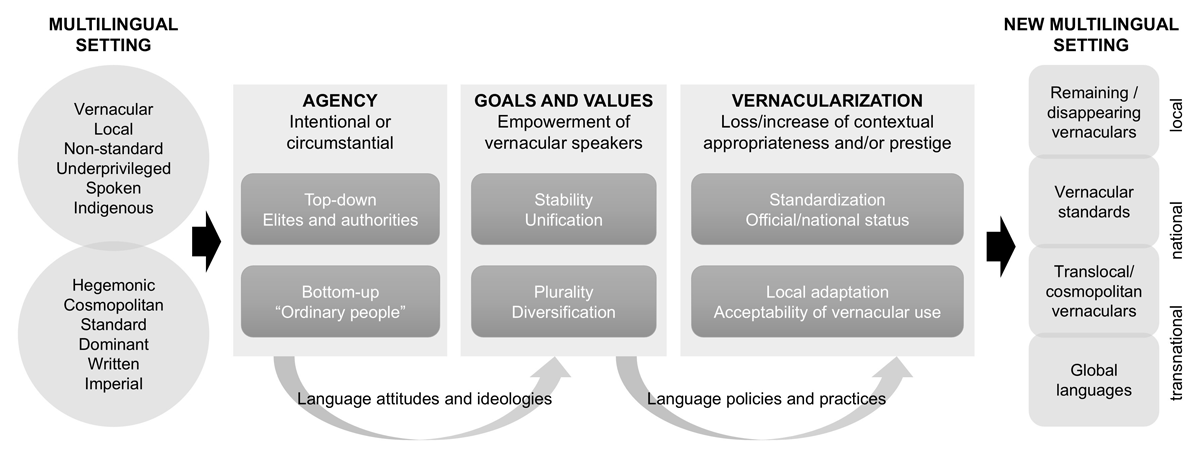
Figure 1
The common dynamics of vernacularization. Changes to the roles languages serve in a community are sought by individual and/or communal actors whose goals and actions are informed by their language attitudes and ideologies.
The concept of vernacularization nearly always carries an ideological dimension that can relate to nationalist thinking and linguistic purism, the superiority of certain languages over others and the elaboration of languages to elevate them to a certain status and functions in society, or to the primacy of speech and the desirability of maintaining a close connection between spoken and written variants of language. Value and meaning can be attached to the official status or stability of a language, or vernacularization can be understood as the domestication of a dominant, imported culture and the empowerment of oppressed, colonial/post-colonial subjects, languages, and cultures. From an ethical standpoint, researchers should pay attention to whose vernacular they refer to with ‘vernacularization’, since one speech community’s vernacularization often means another group’s language marginalization.
Competing Interests
The authors have no competing interests to declare.