
Introduction
The current study investigates whether highly educated daughters of Pakistani and Vietnamese immigrants return to work following childbirth. Labour market participation among female descendants1 of non-Western immigrants is a concern in several Western European countries (Kindt 2022; Koopmans 2016; Nadim 2014). One worry is whether highly educated descendants of immigrants will make use of their education after family formation or if they will follow a gender-based division of labour and childcare (Brekke & Rogstad 2011; Kindt 2022; Koopmans 2016; Nadim 2014). This concern is based on the idea that a daughter of immigrants’ opportunities and life choices are strongly influenced by the cultural norms she encounters in her family as well as in her ethnic community (Kindt 2022).
Studies have shown that highly educated women are likelier to return to work (and to do so sooner) following childbirth than women with lower educational qualifications (Dotti Sani & Scherer 2018; Kil et al. 2018; Rønsen & Kitterød 2012). Moreover, women with a long university education are more likely to be employed following childbirth compared with those with a short university education (Rønsen & Kitterød 2012). However, it has also been demonstrated that daughters of immigrants have lower labour market participation than majority women (Heath, Rothon & Kilpi 2008; Holland & de Valk 2017; Kil 2018; Olsen 2018). As such, highly educated female descendants of immigrants may be ‘stuck between a rock and a hard place’ when they become mothers; on the one hand, they are expected to make use of their education, while on the other, they are exposed to conflicting views about how to be a good mother. Highly educated daughters of immigrants therefore represent an interesting case for investigating return to work after childbirth.
However, the supposed conflict between fulfilling one’s career aspirations versus meeting familial expectations about maternal care has been questioned. Kitterød and Nadim (2020) concluded that descendants of immigrants support the dual-earner/dual-carer model and embrace gender-egalitarian Norwegian work–family attitudes and practices. While Kindt (2022) found that daughters of immigrants enrolled in prestigious education tracks saw no hindrance by their families or future husbands with regard to their careers, Nadim (2014) found that family–work preferences among highly educated descendants of Pakistani immigrants are similar to preferences among the typical middle class—that is, they see day care as beneficial for children’s development and work as a source of self-realisation. This indicates that the conflict between ‘modern individuality’ and ‘traditional family values’ may not be clear-cut—especially among highly educated descendants of immigrants.
However, these important qualitative studies on career plans (Kindt 2022) and work–care practices (Nadim 2014) conducted with highly educated daughters of immigrants have not been followed up by quantitative research in Norway. Moreover, studies specifically investigating return to work following childbirth (Olsen 2010; Rønsen & Kitterød 2012) have not differentiated between immigrant generation and/or different country background—thus hiding the group’s heterogeneity. Descendants of immigrants are not a monolithic unit but differ on important parameters such as education level and employment rate (Kirkeberg et al. 2019). It is therefore essential to differentiate between ethnic groups when investigating the return to work following childbirth among the daughters of immigrants.
Descendants of Vietnamese and Pakistani immigrants represent the largest groups of children of immigrants with higher educational qualifications in Norway (Kirkeberg et al. 2019). In relative numbers, 48.9% and 63.7% of the female descendants of Pakistani and Vietnamese immigrants, respectively, have higher education (Kirkeberg et al. 2019). In comparison, 59.3% of women without an immigrant background have a higher education (Kirkeberg et al. 2019). Employment rates among female descendants of Pakistani and Vietnamese immigrants and women without an immigrant background aged 25 to 39 years are just above 70%, 90% and 80%, respectively (Kirkeberg et al. 2019). Moreover, in a study by Kavli (2015), 60% of the Pakistani respondents report that mothers with children under the age of 4 years should not participate in the labour market, while the numbers among Vietnamese immigrants and the Norwegian majority are 18% and 11%, respectively. However, in their recent study, Kitterød and Nadim (2020) found that descendants of Pakistani and Vietnamese immigrants are similar to the majority population in their attitudes towards gender roles.
The rather large difference in employment rates between female descendants of Pakistani and Vietnamese immigrants, relative to the high numbers with higher educational qualifications and the apparent adaption to gender equality norms among both groups, makes it especially interesting to study return-to-work practices following childbirth among these groups.
Herein, the following research question is addressed: Does the chance of returning to work following childbirth among highly educated daughters of immigrants from Vietnam and Pakistan differ from that among highly educated women without an immigrant background? Work re-entry among these populations was investigated by exploiting unique, population-based data from Norwegian public registers using Cox proportional-hazards regression analysis.
Theoretical Perspectives
Human Capital Theory
Differences in maternal employment can be explained by human capital theory, which predicts that the more an individual has invested in their human capital, the stronger their connection to the labour market (Becker 1985). Investing in one’s own education and work experience is considered the most important means for increasing one’s human capital (Becker 1993). Following from this, highly educated women have invested in their education in the form of hard work and lost income during their years of education; therefore, they are a select group with strong incentives to participate in the labour market. Thus, the more years of education a woman has obtained, the more inclined she will be to return to work following childbirth. In line with this theory, it is expected that highly educated descendants of immigrants are more similar to their native peers with the same educational qualifications regarding decisions on returning to work following childbirth than they are to less educated women with the same ethnic background.
Norms and Attitudes Towards Female Employment
An important limitation of human capital theory is that it rests on the premise of rational choice and ignores socio-cultural factors and women’s non-economic preferences (Ingenfeld 2021). It disregards that real-life choices are influenced by norms, attitudes and values formed in a specific cultural environment (Greenman 2011). Norms on what is considered the ideal family–work balance may vary between and within ethnic groups. However, norms are not static but in a continuous process of change where they are negotiated and reinterpreted to make sense in people’s lives (Nadim 2014).
Nadim (2014) found that while Pakistani immigrant families support and expect their female family members to achieve higher education, they are somewhat less supportive of women entering the labour market. Thus, immigrant families’ ‘traditional’ values of gendered responsibilities are a barrier to female employment. Likewise, Read and Oselin (2008) argued that, among some ethnic groups, there is a weaker association between education and female labour market participation and that this can be attributed to female education being viewed as a family resource to be used in the home and not in the market.
However, Nadim (2014) reported that arguments and work–family preferences among highly educated children of Pakistani immigrants are similar to those among the typical middle class, indicating that the former have more in common with their native majority peers than with women of the same ethnic background without higher education. This may indicate a polarisation among descendants of immigrants, where some women are more work-oriented, have preferences that align with other middle-class women, and thus return to work more quickly, while others are more home-oriented with ‘traditional’ family values and consequently delay or decline work re-entry after becoming a mother.
Children of Vietnamese immigrants are even more supportive of the idea of shared breadwinning responsibility. The percentage of respondents agreeing with the statement that ‘Both the man and the woman should contribute to the household income’ was 93% among both the majority and Vietnamese descendants (Kitterød & Nadim 2020). This implies that descendants of Vietnamese immigrants embrace the idea of the dual-earner/dual-carer family model and have a faster return to work following childbirth.
Social Capital and the ‘Immigrant Drive’
Intergenerational mobility is quite high among the immigrant population, with smaller native–immigrant gaps in educational qualifications and earnings among children of immigrants compared to their parents (Hammarstedt & Palme 2012; Hermansen 2016). Descendants of immigrants have higher educational aspirations compared with their native peers, given the same academic performance and socio-economic background (Friberg 2019; Li 2018). Moreover, ethnic minorities are over-represented in higher education (Modood 2004; Shah, Dwyer & Modood 2010), especially when compared with their native majority counterparts with a comparable parental socio-economic status (Hermansen 2016). Higher educational aspirations and over-representation in higher education among the immigrant population have been labelled the ‘immigrant drive’ of achieving upward mobility (Portes 2012).
This drive can be explained by understanding ethnic capital as a form of social capital within ethnic communities, in which a member of a particular ethnic group has access to a network of material resources and information—even if their family lacks these resources (Friberg 2019). Solidarity, collective values and shared norms promoting the importance of education among members may enhance an individual’s ambitions and opportunities (Portes et al. 2005; Shah, Dwyer & Modood 2010). Shah, Dwyer and Modood (2010) showed that Pakistani fathers holding low-paying jobs in the United Kingdom (UK) may still be described as having a middle-class orientation. This was also found in Norway, where Kindt (2017) argued that the immigrant drive may as well be a middle-class drive because immigrants’ class positions tend to change with migration. Individuals who are relatively high-ranking in their home country can end up in poorly paid jobs in the host country. However, they still hold and pass on to their children, orientations and outlooks that are characteristic of the middle class (Kindt 2017; Shah, Dwyer & Modood 2010). For example, they are more likely to emphasise the importance of higher education. Moreover, descendants of non-Western immigrants are more polarised in their education choices compared with their native peers, either dropping out of high school or continuing on to higher education (Jonsson & Rudolphi 2011; Leirvik 2016; Modood 2004).
Research on the immigrant drive has been occupied mainly with educational aspirations and attainment. However, an interesting question is whether the mechanisms behind the immigrant drive also translate into aspirations for (or actual participation in) work for the daughters of immigrants. While the family often has been described as a barrier to female employment (Nadim 2014), it can also represent an opportunity for paid work following childbirth where the family can assist with economic and practical support, for example, with childcare (Nadim 2017). Thus, if highly educated female descendants of immigrants are more ‘driven’ and dedicated to their jobs compared with their majority peers, then this could imply a stronger association between educational qualifications and the chance of returning to work following childbirth among this group.
Previous Research on Ethnic Differences in Maternal Employment
Previous research suggests ethnic differences in female labour force participation (Bevelander & Groeneveld 2006; Dale, Lindley & Dex 2006; Khoudja & Platt 2018). These differences continue or increase following the transition to motherhood (Dale, Lindley & Dex 2006; Kil et al. 2018; Olsen 2010; Rønsen & Kitterød 2012). Although descendants of immigrants are only now coming of age and studies of their return to employment following childbirth are therefore scarce, several studies of maternal employment among immigrant women have been conducted.
Studies in the UK have shown that Pakistani and Bangladeshi mothers have the lowest likelihood of being economically active (Dale, Lindley & Dex 2006; Lindley, Dale & Dex 2006) and that women from Pakistan and Bangladesh are less likely to enter and more likely to exit the labour market (Khoudja & Platt 2018). In the Netherlands, Khoudja and Fleischmann (2015) concluded that Turks and Moroccans have the lowest maternal participation in the labour market. This is also the case in Belgium, where Kil et al. (2018) found that rates of employment following childbirth among women of Moroccan and Turkish origin tend to be the lowest. In Norway, immigrant women of Pakistani, Somali or Iraqi origin have among the lowest employment levels (Østby 2013).
Consistent with human capital theory, Lindley, Dale and Dex (2006) found that the importance of higher education for employment is significant among all ethnic groups in the UK. Moreover, by investigating possible interaction effects between higher education and ethnicity on the likelihood of a woman being economically active, they determined that this is particularly important for women from Pakistan and Bangladesh (Lindley, Dale & Dex 2006). However, that study did not specifically investigate the return to work following childbirth. In a study of career progress among highly educated minority women in Norway, Brekke and Mastekaasa (2008) found that differences in employment rates between native and immigrant women increased during their careers, with a steady decline in the probability of female immigrants being employed full-time.
Growing up in their residing country, mastering its official language and completing its education system further integrates children of immigrants within society compared with their immigrant parents (Heath, Rothon & Kilpi 2008; Hermansen 2012). Compared with female immigrants, female descendants of immigrants are more likely to have a university degree and to be employed (Østby 2013). Moreover, Pakistani descendants of immigrants are more supportive of working mothers than are Pakistani immigrants, though their average level of support is still lower than among native Norwegians (Kavli 2015). Consistent with this, support for ‘traditional’ gender roles among the Pakistani population in the UK decreases from immigrants to their children (Heath & Demireva 2014).
However, daughters of immigrants still have lower labour market participation than native women (Heath, Rothon & Kilpi 2008; Holland & de Valk 2017; Olsen 2018). Kil et al. (2018) concluded that socio-demographic and pre-birth employment largely explain post-birth labour force participation differences between majority women in Belgium and the daughters of immigrants from Turkey and Morocco. However, their study followed women’s employment paths only for 4 years and only after the birth of a first child.
Few studies have investigated return-to-work practices following childbirth among highly educated female descendants of immigrants; thus, this study adds new knowledge about family formation and career patterns among this population. Although the studies presented above addressed employment following childbirth, most used cross-sectional data rather than follow individuals over time. The unique, population-based Norwegian registries provide high-quality, longitudinal data, enabling intensive studies of relatively small groups—in this case, by following highly educated daughters of immigrants’ careers through family formation.
The Norwegian Setting
Immigrants and their children make up 18.5% of Norway’s total population, while children of immigrants alone—who are currently reaching an age when they are forming their own families—make up 3.7% of the population (Statistics Norway 2021).
Norway is characterised by high labour participation among women and among mothers (Ellingsæter & Gulbrandsen 2007). In 2019, 80% of mothers aged 30–39 years without an immigrant background and where the youngest child was under 6 years were employed (Statistics Norway 2020). Historically, maternal employment has been particularly high among mothers with higher educational qualifications (Ellingsæter & Gulbrandsen 2007).
Facilitating mothers’ opportunities to combine caregiving with labour market participation has been a political goal in Norway for decades (Rønsen & Kitterød 2015). National family–work arrangements include paid parental leave (currently 49 weeks of full income compensation or 59 weeks with 80% income compensation, where 15 or 19 of these weeks are reserved for the father, depending on the income compensation). Furthermore, children are entitled to a publicly subsidised day care placement from the age of 1 year.
Today, gender equality is the widespread norm in Norway (Nadim 2014). Decisions by highly educated descendants of immigrants regarding the division of labour following childbirth are thus made within a society that explicitly supports the dual-earner/dual-carer model (Kitterød & Nadim 2020). Therefore, Norway—with its high return-to-work rate following childbirth and a widespread maternal employment norm—is an interesting setting for investigating return-to-work practices among highly educated daughters of immigrants.
Data and Methods
Data
Data were obtained from administrative registers that include the entire Norwegian population and were combined by Statistics Norway using unique personal identification numbers. The dataset includes the first childbirth2 registered between 2003 and 2013 among native Norwegians (10% random sample, total N = 133,765) and descendants of immigrants from Vietnam or Pakistan. The descendant groups also include women who arrived before the age of compulsory education (i.e. the age of 7). The dataset was restricted to women aged 20–40 years with higher education and paid parental leave.3 In addition, a small number of self-employed women were dropped from the sample. The final sample included 13,884 women, among whom 13,377 had no immigrant background, 335 were daughters of immigrants from Pakistan and 172 were daughters of immigrants from Vietnam.
Outcome Variable
The dependent variable was based on two parts: (1) the time span of the observation period and (2) whether the time span ended with work entry (=1) or censoring (=0). Censoring occurred when an individual did not experience the event (work entry) during the observation period. It was expected that mothers’ entry into part-time work would occur sooner than entry into a full-time position (Rønsen & Kitterød 2015). Therefore, three models with different outcome variables were specified: (1) overall return to work (i.e. first registered employment following childbirth); (2) return to part-time work (i.e. first registered employment was less than 37 hours per week; and (3) return to full-time work (i.e. first registered employment was at least 37 hours per week). The outcomes for full- and part-time work are mutually exclusive and can thus be considered competing risks.
Explanatory Variable
The main explanatory variable was country of origin, referring to country of birth for women with no immigrant background (i.e. Norway) or, for daughters of immigrants, to their parents’ country of birth (i.e. Vietnam or Pakistan).
Covariates
Several variables known to correlate with the probability of employment following childbirth were included in the analyses.
Level of education
Level of education differentiates between those with a short (1–4 years) versus a long (minimum 5 years) university education. To investigate whether education level affects descendants of immigrants and the majority differently, interaction terms with country of origin and long university education were included.
Age
Age measures the woman’s age in the year she gave birth. Age can be used as a proxy for work experience and is thus an indicator of human capital (Rønsen & Kitterød 2012). Age was included in both linear and quadratic terms to control for non-linear associations.
Parity
Parity is a continuous variable referring to the current child’s number in the woman’s birth order.
Income
Log transformed annual income during the year before giving birth was included (inflation adjusted to 2011).
Union status
Union status was measured in the year of childbirth and indicates whether a woman was married or cohabiting (reference category: not married or cohabiting).
Region
Region is a set of dummy variables used to control for regional differences based on information about the individual’s municipality, which is merged into one of three larger regions: Oslo (capital city), the next five largest cities, and a broad category including the rest of the country.
Weekly working hours
This variable differentiates between whether the last position held before maternity leave was full-time (at least 37 hours per week) or part-time (less than 37 hours per week) work, with part-time work as the reference category.
Sector
To adjust for sector variation, a dummy variable indicating whether the last position held before maternity leave was in the private (reference category) or public sector was included.
Years
To adjust for temporal variation, dummy variables for (calendar) years were included. Because there were few individuals in the descendants of immigrant groups, years were combined into larger groups: 2003–2005 (reference category), 2006–2008, 2009–2011 and 2012–2013.
Partner’s employment status
This variable was measured in the year of childbirth to determine whether the partner was employed, self-employed or unemployed or outside the workforce (reference category).
Partner’s income
Measured in the year of childbirth in quartiles (inflation adjusted to 2011).
Endogamy
To measure whether a woman was married within her cultural group, that is, if her partner originated from the same country, a dummy variable was included (endogamy = 1).
Descriptive statistics for the variables used in the models are presented in the supplementary material (Table A1).
Statistical Models
The data were analysed using Cox regression, also known as the proportional hazards regression model, which is flexible because it does not require selecting a specific probability distribution in advance (Box-Steffensmeier & Jones 2004) and can handle both time-varying covariates and censoring (Allison 2014). However, the model also assumes that the effect of a variable is the same across time (Allison 2004). Violations of the proportional-hazard assumption are tested with Schoenfeld residuals, and violations are solved by allowing the non-proportional variables to interact with time and by stratification. When a covariate is used to stratify the sample, the covariate is controlled for, but no effect estimate for that covariate is estimated (Allison 2004).
The Cox model, including both fixed and time-dependent variables, is expressed as:
where the hazard for individual i at time t is a function of the baseline hazard function h0(t) and the regression parameter β for the covariates x1 and x2 at time t. In this equation, the first covariate is fixed and the second is time-varying. The observation period for each individual i starts at the date of giving birth (t = 0) and ends at the date of returning to work or censoring (t + Δt). In cases of another birth or the beginning of a course of education, the records will contribute survival times, but are then censored at the date of the mentioned event. The observation period ended on December 31, 2013. Individuals who had not returned to work by that date were censored.
In the last models, I differentiate between return to full-time and return to part-time work. I follow the recommendations by Allison (2010) on how to handle different kinds of events and have estimated two different Cox models:4 one where the event of interest is a return to full-time work and one where the event of interest is a return to part-time work. When estimating the hazard of returning to full-time work, individuals returning to part-time work are treated as censored at the time of returning to part-time work, and vice versa: when estimating the hazard of returning to part-time work, individuals returning to full-time work are treated as censored at the time of returning to full-time work.
Results
Before turning to the Cox regression results, an overview of the time from childbirth to re-entering the labour market among majority women and descendants of Vietnamese and Pakistani immigrants is given. Figure 1 shows Kaplan–Meier survival plots, where the survival rate is an expression of the probability that a woman remains out of work until time t + 1, given that she was still outside the workforce at time t. The Kaplan–Meier estimate of the survival function does not include any covariates. Figure 1a shows all work entries; Figure 1b shows entries into full-time work and Figure 1c shows entries into part-time work.
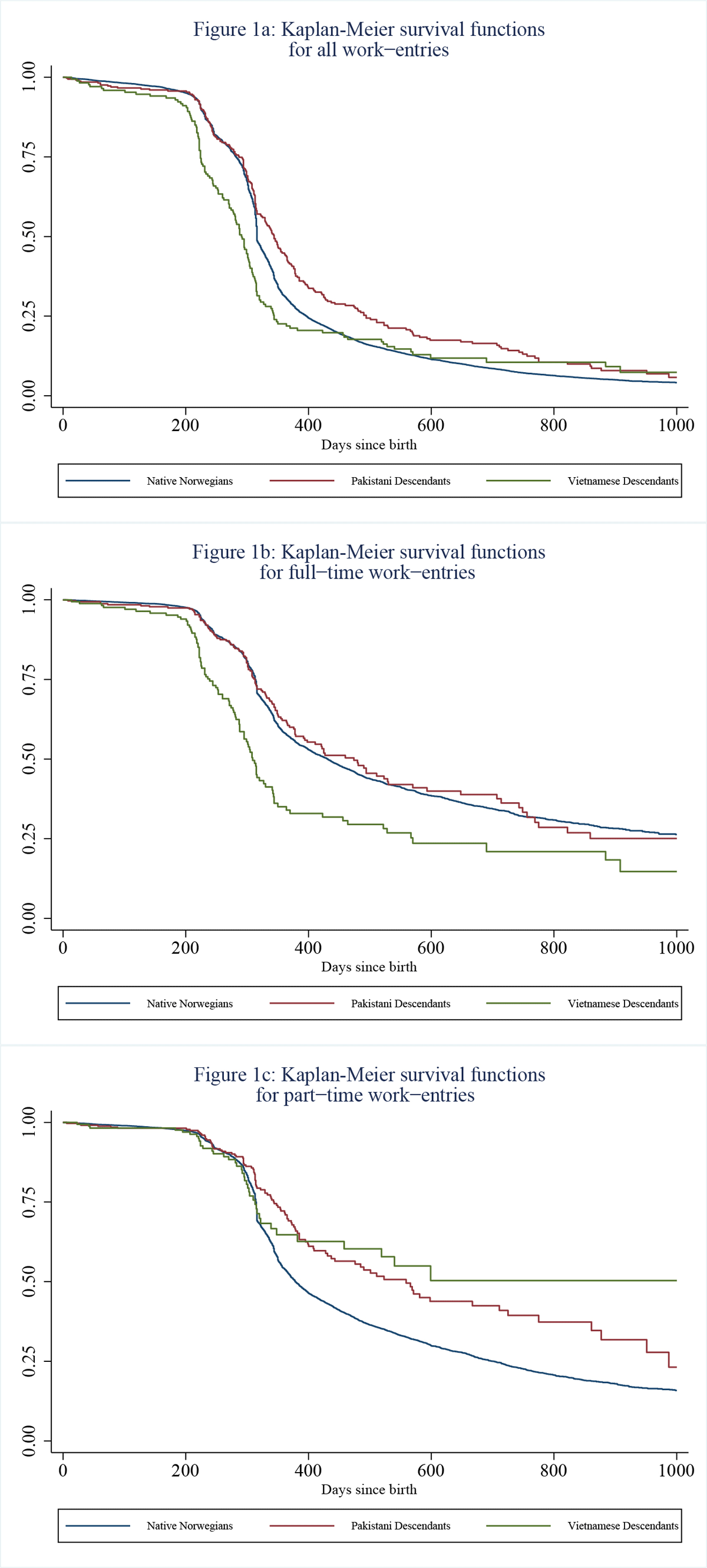
Figure 1
Kaplan–Meyer survival functions for work entries following childbirth.
To test whether the survival curves differed between ethnic groups, a log rank test was applied. For return to work overall, the p-value was less than 0.01 for all comparisons, indicating statistically significant between-group differences for overall return-to-work rates following childbirth. In Figure 1a, the plots for descendants of Pakistani immigrants and native Norwegians are quite similar during almost the first 300 days, after which the plot for daughters of Pakistani immigrants flattens. The plot for the descendants of Vietnamese immigrants crosses the other survival plots—indicating that the association between Vietnamese origin and return to work following childbirth changes over time.
The median return time was 316 days among native Norwegians, 291 days among Vietnamese descendants and 344 days among Pakistani descendants. When this was restricted to returning to full-time work (Figure 1b), the median for work entry increased among all three groups, indicating that return to full-time work occurred at a much slower rate. Moreover, the difference between native Norwegians and daughters of Vietnamese immigrants appears to be larger when examining the return to full-time work. The plots for native Norwegians and daughters of Pakistani immigrants overlapped and did not differ significantly.
Return to Work Following Childbirth
Table 1 includes three models. Model 1 included only the main explanatory variable (i.e. country of origin). The results here confirm the results from the Kaplan–Meier survival plots in Figure 1a where, compared to the native majority, daughters of Pakistani immigrants had a significantly lower chance of returning to work while daughters of Vietnamese immigrants had a higher chance of returning to work after childbirth. Model 2 included the main explanatory variable and all covariates (the model was stratified by year, region, and weekly working hours of last employment to allow for non-proportionality). For work entries regardless of working hours, descendants of Pakistani immigrants had a 19% lower hazard of work entry compared with women without an immigrant background. Descendants of Vietnamese immigrants had a 15% higher risk of returning to work following childbirth. However, because of the small size of this group, the estimate is less precise and is only statistically significant at the 10% level. Moreover, this estimate violated the proportional-hazards assumption, indicating that the association was not constant over time. To further investigate this, interaction with time was included in later analyses. However, when there is a violation of the proportional-hazards assumption and a variable is not independent of time, the estimate simply shows the average effect across time (Allison 2014).
Table 1
Work re-entry following childbirth among majority women and descendants of immigrants from Pakistan and Vietnam. Results of Cox regression. All work entries. Presented as hazard ratios (HR) and [95% CI].
| MODEL 1 | MODEL 2 | MODEL 3 | ||||
|---|---|---|---|---|---|---|
| VARIABLE | HR | CI | HR | CI | HR | CI |
| Country of origin (baseline: Native Norwegians) | ||||||
| Pakistan | 0.80** | [0.70, 0.91] | 0.81** | [0.71, 0.93] | 0.84* | [0.72, 0.98] |
| Vietnam | 1.27** | [1.07, 1.50] | 1.15 | [0.97, 1.36] | 1.09 | [0.89, 1.34] |
| Level of education (baseline: Short university education) | ||||||
| Long university education | 1.09* | [1.04, 1.15] | 1.09*** | [1.04, 1.15] | ||
| Interaction terms | ||||||
| Long university education# | 0.90 | [0.67, 1.20] | ||||
| Pakistani origin | ||||||
| Long university education# | 1.18 | [0.83, 1.68] | ||||
| Vietnamese origin | ||||||
| N (individuals) | 13,884 | 13,884 | 13,884 | |||
| N (person-days) | 4,852,398 | 4,852,398 | 4,852,398 | |||
| Number of events (work entries) | 11,664 | 11,664 | 11,664 | |||
[i] Notes: CI = confidence interval. *** p < 0.001, ** p < 0.01, * p < 0.05. Models 2 and 3 are stratified by year, region and weekly working hours at last employment and adjusted for age, age2, union status, parity, ln(income), sector of last employment, partner employment status, partner income and endogamy. Full table including all covariates is presented in the supplementary material (Table A2).
In Model 3, interaction terms between education level and country of origin were included. However, these were non-significant, indicating no different effect of education on return to work among descendants of immigrants compared with their native peers. Overall, women with a long university education had a significantly higher risk of returning to work compared with women with a short university education. The model was stratified by year, region, and weekly working hours of last employment to allow for non-proportionality.
The Effect of Time
To address whether the association between country of origin and return to work following childbirth differed over time, an interaction term between Vietnamese origin and time was added, using a dummy variable for before versus after 350 days following childbirth (Table 2).
Table 2
Work re-entry following childbirth among native Norwegians and descendants of immigrants from Pakistan and Vietnam. Results from Cox regression. All work entries. Presented as hazard ratios (HR) and [95% CI].
| MODEL 4 | ||
|---|---|---|
| VARIABLE | HR | CI |
| Country of origin (baseline: Native Norwegians) | ||
| Pakistan | 0.81** | [0.71, 0.93] |
| Vietnam | 1.39*** | [1.16, 1.66] |
| Interaction term | ||
| Vietnam# Time (baseline: time <= 350 days and Vietnamese origin = 1) | ||
| Time > 350 days and Vietnamese origin = 1 | 0.39*** | [0.24, 0.64] |
| N (individuals) | 13,884 | |
| N (person-days) | 4,852,398 | |
| Number of events (work entries) | 11,664 | |
[i] Notes: CI = confidence interval. *** p < 0.001, ** p < 0.01, * p < 0.05. Stratified by year, region and weekly working hours at last employment. Adjusted for age, age2, union status, parity, ln(income), level of education, sector of last employment, partner employment status, partner income and endogamy. Full table including all covariates is presented in the supplementary material (Table A3).
The risk of returning to work among Vietnamese descendants was 39% higher than among their native peers during the first 350 days following childbirth. However, after 350 days, the former group had a 46% lower hazard of returning to employment compared with those with no immigrant background (hazard ratio [HR] = 1.39 × 0.39 ≈ 0.54). In the Kaplan–Meier survival plots (Figure 1a), the plot for descendants of Vietnamese immigrants had a sharper drop and earlier flattening compared with that of majority women. This was further confirmed by the Cox regression in Model 4, in which the association between Vietnamese origin and return to work following childbirth was clearly time-dependent.
Return to Full-Time Versus Part-Time Work
To investigate differences in the associations between the independent variables and return to full-time versus part-time work, two models with different outcomes were specified (Table 3). While there were 11,664 events in the models investigating return to work overall, Model 5 shows that only 5,474 women returned to full-time work following childbirth.
Table 3
Work re-entry following childbirth among majority women and descendants of immigrants from Pakistan and Vietnam. Results from Cox regression. Return to full-time versus part-time work. Presented as hazard ratios (HR) and [95% CI].
| MODEL 5 RETURN TO FULL-TIME WORK | MODEL 6 RETURN TO PART-TIME WORK | |||
|---|---|---|---|---|
| VARIABLE | HR | CI | HR | CI |
| Country of origin (baseline: Native Norwegians) | ||||
| Pakistan | 0.87 | [0.73, 1.04] | 0.78* | [0.64, 0,95] |
| Vietnam | 1.48*** | [1.22, 1.81] | 0.74 | [0.54, 1.02] |
| N (individuals) | 13,884 | 13,884 | ||
| N (person-days) | 4,852,398 | 4,852,398 | ||
| Number of events (work entries) | 5,474 | 6,190 | ||
[i] Note: CI = confidence interval. *** p < 0.001, ** p < 0.01, * p < 0.05. Stratified by year and weekly working hours at last employment. Adjusted for age, age2, union status, parity, ln(income), level of education, sector of last employment, region, partner employment status, partner income and endogamy. Full table including all covariates is presented in the supplementary material (Table A4).
The estimated hazard of returning to full-time work among descendants of Pakistani immigrants did not differ significantly from that of native Norwegians. The former group’s estimated risk of returning to part-time work was 22% lower than among the majority group. Moreover, a z-test showed that the difference between the estimated coefficients for Pakistani origin was not statistically significant for return to full-time versus part-time work.
The estimated coefficients for the associations between Vietnamese origin and return to full-time versus part-time work differed significantly and substantially. While daughters of Vietnamese immigrants had a higher risk compared with the majority of Norwegians of returning to full-time work (HR = 1.48), their risk of returning to part-time work was lower (HR = 0.74). However, because of the small size of this group, the estimate for return to part-time work is less precise and is only statistically significant at the 10% level. When return to full-time work was specified, the estimated coefficient for Vietnamese origin no longer violated the proportional hazards assumption, which indicated that the association was constant over time.
Discussion
Low labour market participation among daughters of immigrants is a general concern in contemporary Western Europe, where a specific worry is whether highly educated daughters of immigrants will participate in the labour market following childbirth (Kindt 2022; Nadim 2014). This study investigated the return to work following childbirth among highly educated descendants of immigrants from Vietnam and Pakistan. Four key findings emerged from the analysis.
First, even with a dataset exclusively of women with higher education levels and controlling for covariates known to be associated with maternal employment, differences in work entry following childbirth between daughters of Pakistani immigrants and majority women persist. This indicates that decisions regarding family–work balance cannot be understood solely based on rational economic assessments, in which human capital theory is grounded, but are probably influenced by normative views on how to be a good mother, which are formed in specific cultural settings. This is in line with Nadim’s (2014) research showing that Pakistani immigrant families are somewhat less supportive of female employment than they are of women entering higher education.
Second, the difference between Pakistani women and their native peers is no longer statistically significant when looking at return to full-time work. This might indicate a polarisation among descendants of Pakistani immigrants, with women who work full-time being especially work-oriented and consequently exhibiting a less pronounced association between ethnic background and work re-entry. This is also consistent with Nadim’s (2014) finding that decisions made by highly educated daughters of immigrants regarding family and work are typically ‘middle class,’ and that these women are, in many ways, more similar to their native middle-class peers than to their ethnic peers.
Third, without considering possible variations over time, daughters of Vietnamese immigrants do not differ significantly from native majority women in their likelihood of re-entering the workforce following childbirth per se. However, they do have a greater chance of returning to full-time work following childbirth. This is consistent with the idea of ‘immigrant drive,’ where the children of immigrants achieve greater socio-economic success than their background would suggest (Friberg 2019). Moreover, it indicates that the mechanisms behind the immigrant drive also translate into actual participation in work for the daughters of Vietnamese immigrants.
Fourth, the association between Vietnamese background and the chance of returning to work per se is not constant over time. The chance of returning to work among daughters of Vietnamese immigrants is significantly and substantially higher than among their native peers for the first 350 days following childbirth, while after 350 days their hazard of returning to work is lower. This indicates a polarisation among descendants of Vietnamese immigrants. It is likely that a large proportion of daughters of Vietnamese immigrants return to work shortly after completing their paid parental leave (around 8–12 months postpartum, depending on their chosen income compensation and spousal parental leave duration). When the most work-oriented women have exited the risk set (i.e., returned to work), it then probably consists of more family oriented women whose likelihood of returning to work is far lower.
Given previous findings regarding support for traditional gender roles and attitudes towards working mothers, the return-to-work differences found herein between descendants of Vietnamese and Pakistani immigrants are as expected. Kavli (2015) found that while average support for maternal employment among Vietnamese immigrants is like that among native Norwegians, children of Pakistani immigrants’ average level of support is lower than among native Norwegians, but higher than among Pakistani immigrants. In the results herein, that is, compared with the native majority, descendants of Vietnamese immigrants mainly return at a similar rate, whereas descendants of Pakistani immigrants return at a somewhat slower rate, which demonstrates the same pattern. This may indicate different normative views on motherhood and gender roles between the daughters of Vietnamese and Pakistani immigrants. However, note that the difference in return-to-work rates between the daughters of Pakistani immigrants and their native peers is not large. Without considering any covariates, the difference in median return to work overall is only 28 days. This indicates that attitudes among highly educated daughters of Pakistani immigrants do indeed approach the gender equality norms in Norway, consistent with findings by Kitterød and Nadim (2020). Moreover, this is in line with the argument of ‘middle-class drive’ among descendants of immigrants made by Kindt (2017), for example, in which immigrants who have experienced a deterioration in class position after migration still hold and pass on to their children, orientations and outlooks that are characteristic of the middle class.
This article adds to the growing research on employment among female descendants of immigrants during the life course. Detailed Norwegian registry data combined with Cox regression enable a unique analysis of the timing of return to work following childbirth. Moreover, this study makes an important contribution towards understanding human capital. Consistent with the literature, the results presented here show that women with a long university education re-enter the workforce at a higher rate than women with a short university education. Although human capital theory has been criticised for not considering norms and values, it is crucial in explaining women’s labour market participation or lack thereof (Khattab, Johnston & Manley 2018). It is therefore important that future studies differentiate both between ethnic background and education level within ethnic groups.
Maternal employment differs across European countries (Eurostat 2022) and can be explained by different institutional and socio-normative contexts (Holland & de Valk 2017). Together with the other Scandinavian countries, Norway stands out with its generous family policies and gender equalitarian values and can be seen as a ‘best-case scenario’ for returning to work following childbirth. Furthermore, daughters of immigrants and their majority peers are exposed to the same institutional contexts during the life course (Holland & de Valk 2017). It is thus probable that differences in return-to-work rates are larger in other (non-Scandinavian) countries, and more research on how they differ across different country contexts is needed.
The present study has limitations. First, the study used employment as the outcome, as opposed to labour force participation, which includes those actively seeking employment. A lower employment rate among daughters of immigrants could thus result from both discrimination against ethnic minorities and from voluntary labour market absence. Field experiments have demonstrated discrimination against children of immigrants in the hiring process for lower-entry jobs (Carlsson 2010; Midtbøen 2016). However, there are reasons to assume that less discrimination occurs in occupations requiring higher education (Drange 2016). Nevertheless, previous studies have indicated mixed findings regarding whether there is less discrimination against or unequal return to education among highly educated immigrants and their descendants (Brekke 2007; Brekke & Mastekaasa 2008). In addition, perceived discrimination among immigrants tends to increase with their education level, which is referred to as ‘the paradox of integration’ (Steinmann 2019). Perceived discrimination does not necessarily entail actual discrimination, but it might influence the return-to-work decision following maternity leave. Though it was impossible to differentiate between discrimination against ethnic minorities and optional labour market absence in the current study, this study specifically investigated mothers’ return to work following childbirth, indicating a closer connection to the labour market.
Second, it is important to stress the limitations of registry data. Even if these data are unique by covering the entire population on a variety of parameters, they do not measure cultural values, norms or attitudes. Although some differences in work entry after childbirth between the native majority and descendants of immigrants persist after including variables known to correlate with maternal employment, it is not possible to determine that these differences are due to different values, norms or attitudes.
Conclusion
To conclude, highly educated descendants of Vietnamese and Pakistani immigrants do return to work following childbirth. However, the findings are nuanced: daughters of Pakistani immigrants return at a somewhat slower rate, and the difference between daughters of Vietnamese immigrants and majority women in the return-to-work rate changes over time. Previous studies have shown that children of immigrants are similar to their native peers in parameters such as education level, employment and attitudes about gender equality. This study underpins these findings by adding another dimension—namely return to work following childbirth, where the (highly educated) descendants of immigrants are embracing the typical middle-class approach to balancing working life and childcare.
As new cohorts of children of immigrants reach adulthood and begin families, more research will be both needed and possible. Further research investigating the careers and family formation practices of the descendants of immigrants should include those with different countries of origin, and it should follow them over a longer period, and include multiple childbirths.
Additional File
The additional file for this article can be found as follows:
Notes
[4] The terms ‘descendants of immigrants’ and children (daughters) of immigrants are used synonymously herein; this group also includes women who arrived before the age of 7.
[5] This does not automatically imply that it is the first birth per individual because women may have had children prior to the observation period. Higher-order births are thus included when an individual’s higher-order birth was their first birth during the observation period. The decision to include subsequent births was made to boost the sample size for daughters of immigrants.
[6] Eligibility for paid parental leave in Norway is conditional upon being employed for a minimum of 6 of the 10 months prior to giving birth and with a minimum income equivalent to half the National Insurance Scheme basic amount (G).
[7] I have also specified alternative competing risk models using the method introduced by Fine and Gray (1999). This models the sub-distribution hazard function (instead of the cause-specific hazard). The results from these regressions are available in the supplementary material (Table A5).
Acknowledgements
The author would like to thank Silje Fekjær, Are Skeie Hermansen and Nicolai Topstad Borgen for their valuable comments on earlier versions of this article. Also, the suggestions and comments from the editor and the two anonymous reviewers of the Nordic Journal of Migration Research have been greatly helpful.
Competing Interests
The author has no competing interests to declare.