
Table I
Primers used for reverse transcription-quantitative PCR.
| Target gene | Primers | Sequence (5′ to 3′) |
|---|---|---|
| mexB | mexB-F | CAACATCCAGGACCCACTCT |
| mexB-R | AGGAAATCTGCACGTTCTGC | |
| mexD | mexD-F | CTACCCTGGTGAAACAGC |
| mexD-R | AGCAGGTACATCACCATCA | |
| mexF | mexF-F | TGTACGCGAACGACTTCAAC |
| mexF-R | GAGGTGTCGCTGACCTTGAT | |
| mexY | mexY-F | TCAGGCCGACCTTGAAGTAG |
| mexY-R | TCTCGGTGTTGATCGTGTTC | |
| rpsL | rpsL-F | TACTTCGAACGACCCTGCTT |
| rpsL-R | TTTCCTCGTACATCGGTGGT |
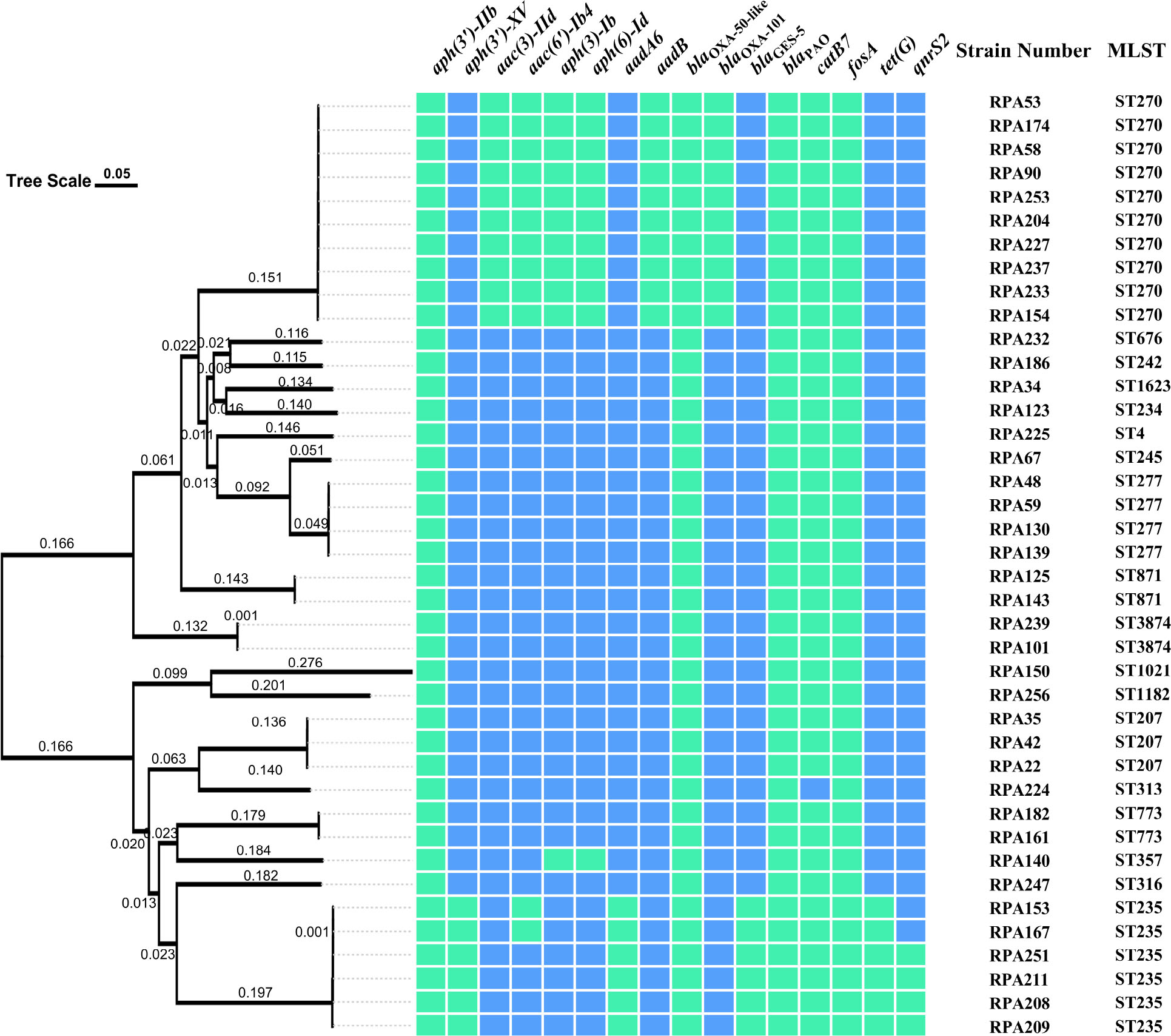
Fig. 1.
Distribution of sequence types and antimicrobial resistance genes. In the phylogenetic tree, each branch is labeled with numerical values representing its length, which directly reflects the genetic distance. The 40 CRPAs can be divided into two major evolutionary branches in the upper and lower parts. Heat map of the antimicrobial resistance genes of 40 CRPAs showed the prevalence of resistance genes in different isolates, green represent the presence of the resistance gene, and blue represent its absense.
Table II
Resistance rates of CRPA and C SPA isolates to commonly used antibiotics.
| Antibiotics | CRPA (n = 40) | CSPA (n = 222) | p | ||
|---|---|---|---|---|---|
| No. | Rate (%) | No. | Rate (%) | ||
| TCC | 29 | 72.50 | 37 | 16.67 | < 0.001* |
| TZP | 28 | 70.00 | 33 | 14.86 | < 0.001* |
| MEM | 29 | 72.50 | 0 | 0.00 | < 0.001* |
| IMP | 40 | 100.00 | 0 | 0.00 | < 0.001* |
| FEP | 10 | 25.00 | 4 | 1.80 | < 0.001* |
| CSL | 25 | 62.50 | 20 | 9.01 | < 0.001* |
| CAZ | 11 | 27.50 | 16 | 7.21 | < 0.001* |
| ATM | 11 | 27.5 | 24 | 10.81 | 0.004* |
| TOB | 14 | 35.00 | 5 | 2.25 | < 0.001* |
| AMK | 3 | 7.5 | 1 | 0.45 | 0.012* |
| CIP | 24 | 60 | 16 | 7.21 | < 0.001* |
| LVX | 29 | 72.50 | 37 | 16.67 | < 0.001* |
| COL | 5 | 12.50 | 1 | 0.45 | < 0.001* |
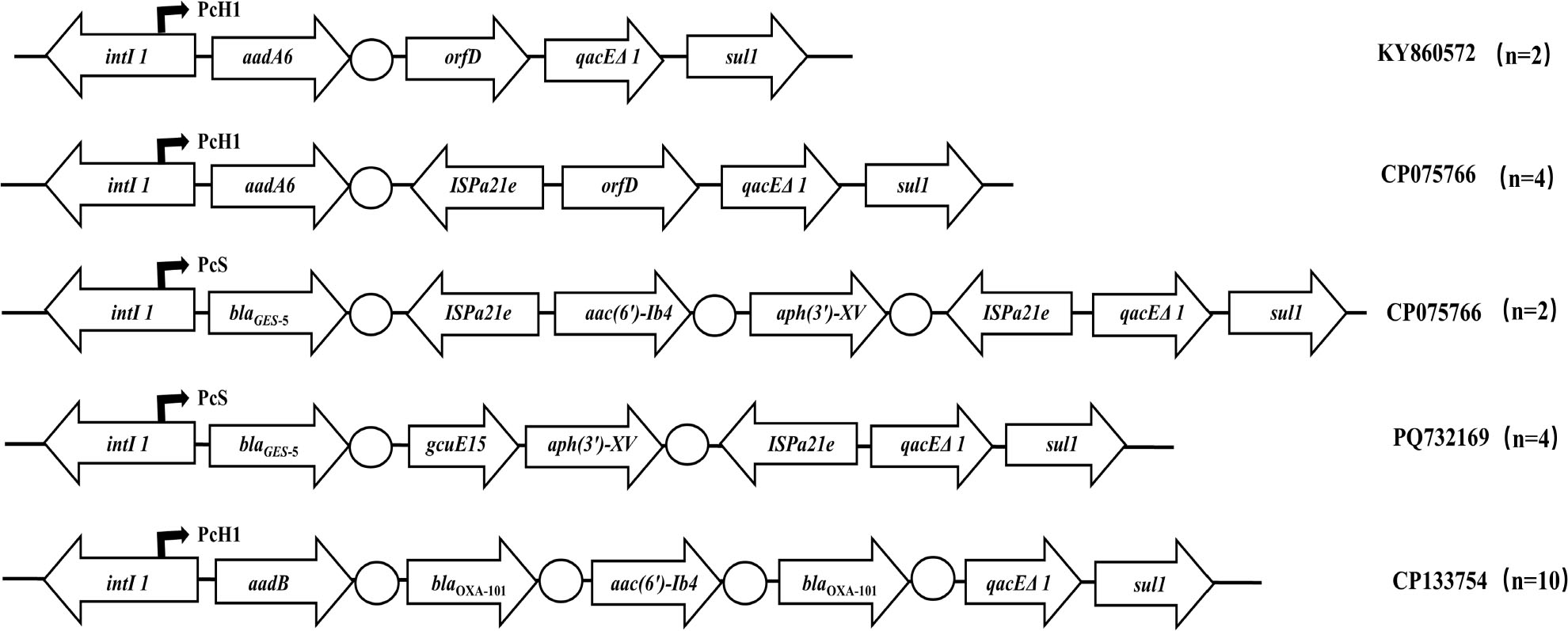
Fig. 2.
Schematic structures of the different class 1 integrons. Solid black arrows represent variable region promoters; ovals represent attC sites of gene cassettes; hollow arrows represent intI1 gene, insertion sequence and resistant genes.
Table III
Mutations of porin OprD in 40 carbapenem-resistant Pseudomonas aeruginosa isolates.
| Isolate | Amino acid changes in OprD sequencea | Indels/gain of stop codona | |
|---|---|---|---|
| RPA22 | ST207 | S57E, S59R, V127L, E185Q, P186G, V189T, E202Q, I210A, E230K, S240T, N262T, T276A, A281G, K296Q, Q301E, R310E, A315G, L347M | insertion of 30bp at nt1114 |
| RPA34 | ST1632 | D43N, S57E, S59R, E202Q | deletion of 1bp at nt630 |
| RPA35, RPA42 | ST207 | S57E, S59R, V127L, E185Q, P186G, V189T, E202Q, I210A, E230K, S240T, N262T, T276A | premature codon stops at AA277 |
| RPA48 | ST277 | T103S, K115T, F170L | insertion of 7bp at nt557 |
| RPA59, RPA130, RPA139 | ST277 | T103S, K115T | deletion of 1bp at nt354 |
| RPA53, RPA58, RPA90, RPA154, RPA174, RPA204, RPA227, RPA233, RPA237, RPA253 | ST270 | V127L, E185Q, P186G, V189T, E202Q, I210A, E230K, S240T | insertion of 2bp at nt729 |
| RPA67 | ST245 | T103S, K115T | deletion of 32bp at nt426 |
| RPA101, RPA239 | ST3874 | D43N, S57E, S59R | insertion of 1bp at nt174 |
| RPA123 | ST234 | V127L, E185R | deletion of 1bp at nt558 |
| RPA125 | ST871 | T103S, K115T, F170L, E185Q, P186G, V189T, R310E, A315G | insertion of 1bp at nt1206 |
| RPA140 | ST357 | S57E, S59R, V127L, E185Q, P186G, V189T, E202Q, I210A, E230K, S240T, N262T, 276A, A281G, K296Q, Q301E, R310E, A315G, L347M | insertion of 30bp at nt1114 |
| RPA143 | ST871 | None | premature codon stops at AA6 |
| RPA150 | ST1021 | T103S, K115T, F170L, E185Q, P186G, V189T, R310E, A315G | insertion of 55bp at 1089nt |
| RPA161 | ST773 | T103S, K115T, V129I | deletion of 1bp at nt460 |
| RPA153 | ST235 | None | deletion of 11bp at nt55 |
| RPA167, RPA208, RPA209, RPA211, RPA251 | ST235 | T103S, K115T, F170L, E185Q, P186G, V189T | premature codon stops at AA277 |
| RPA182 | ST773 | T103S, K115T, V129I | deletion of 10bp at nt463 |
| RPA186 | ST242 | D43N, S57E, S59R | insertion of 2bp at nt383 |
| RPA224 | ST313 | S57E, S59R, V127L, E185Q, P186G, V189T, E202Q, I210A, E230K, S240T, N262T, T276A, A281G, K296Q, Q301E, R310E, A315G, L347M | insertion of 30bp at nt1114 |
| RPA225 | ST4 | D43N, S57E, S59R, E202Q, I210A, E230K, S240T, N262T, A267S | insertion of 1bp at nt821 |
| RPA247 | ST316 | S57E, S59R, V127L, E185Q, P186G, V189T, E202Q, I210A, E230K, S240T, N262T, T276A, A281G, K296Q, Q301E, R310E, A315G, L347M | insertion of 30bp at nt1114 |
| RPA232 | ST676 | D43N, S57E, S59R, E202Q, I210A, E230K, S240T, N262T, A267S, A281G, K296Q, Q301E, R310G, V359L, | insertion of 30bp at nt1114 |
| RPA256 | T1182 | S57E, S59R, V127L, E185Q, P186G, V189T, E202Q, I210A, E230K, S240T, N262T, T276A, A281G, K296Q, Q301E, R310E, A315G, L347M | insertion of 30bp at nt1114 |
Table IV
Mutations of porin OprD in 15 carbapenem-sensitive Pseudomonas aeruginosa isolates.
| Isolate | MLST | Amino acid changes in OprD sequence | Indels/gain of stop codon |
|---|---|---|---|
| CSPA31 | ST244 | None | insertion of 1 bp at nt1206 |
| CSPA261 | ST244 | None | None |
| CSPA33, CSPA56, CSPA142, CSPA200, CSPA221, CSPA254, CSPA259 | ST491, ST2060, ST992, ST849, ST3360, ST796, ST16 | S57E, S59R, E202Q, I210A, E230K, S240T, N262T, A267S, A281G, K296Q, Q301E, R310G, V359L | Insertion of 30bp at nt1114 |
| CSPA84 | ST849 | S57E, S59R, E202Q, I210A, E230K, S240T, N262T, A267S, A281G, K296Q, Q301E, R310G | Insertion of 81bp at nt1019 |
| CSPA159 | ST871 | T103S, K115T, F170L, E185Q, P186G, V189T, R310E, A315G, G425A | None |
| CSPA170 | ST1337 | None | None |
| CSPA218, CSPA223 | ST277, ST261 | T103S, K115T, F170L | None |
| CSPA252 | ST4931 | S57E, S59R, E202Q, I210A, E230K, S240T, N262T, A267S, A281G, K296Q, Q301E, R310G, V359L | Insertion of 30bp at nt1114 |
Table V
Resistance rates of mexB overexpressed CRPAs and none-overexpressed mexB CRPAs.
| Antibiotics | Overexpression of mexB (n = 5) | None-overexpression of mexB (n = 35) | p | ||
|---|---|---|---|---|---|
| Number | Rate (%) | Number | Rate (%) | ||
| Penicillin/β-lactamase inhibitor combinations | 5 | 100 | 25 | 71.43 | 0.306 |
| Meropenem | 5 | 100 | 24 | 68.57 | 0.298 |
| Cephalosporins | 3 | 60.00 | 23 | 65.71 | 1.000 |
| Monocyclic β-lactams | 4 | 80.00 | 7 | 20.00 | 0.015* |
| Aminoglycosides | 0 | 0 | 15 | 42.86 | 0.137 |
| Fluoroquinolones | 5 | 100 | 25 | 71.43 | 0.306 |
Table VI
Resistance rates of mexY overexpressed CRPAs and none-overexpressed mexY CRPAs.
| Antibiotics | Overexpression of mexY (n = 23) | None-overexpression of mexY (n = 17) | p | ||
|---|---|---|---|---|---|
| Number | Rate (%) | Number | Rate (%) | ||
| Penicillin/β-lactamase inhibitor combinations | 21 | 91.30 | 10 | 58.82 | 0.006* |
| Meropenem | 21 | 91.30 | 8 | 47.06 | 0.001* |
| Cephalosporins | 21 | 91.30 | 5 | 29.41 | < 0.001* |
| Monocyclic β-lactams | 6 | 26.09 | 5 | 29.41 | 1.000 |
| Aminoglycosides | 13 | 56.52 | 2 | 11.76 | 0.002* |
| Fluoroquinolones | 21 | 91.30 | 8 | 47.06 | 0.001* |
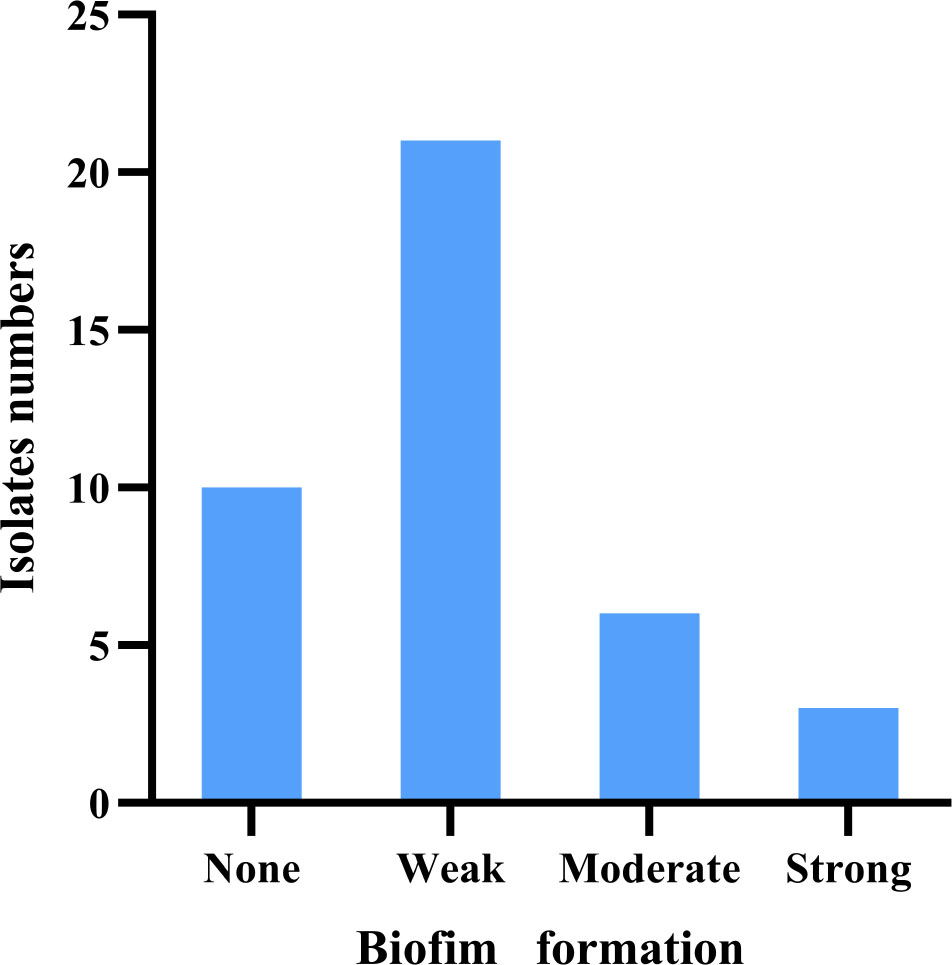
Fig. 3.
Diagram of biofilm production capacity of CRPAs. Cutoff value (ODc) was calculated based on the negative control. ODc = average OD of negative control + (3 × SD of negative control). None: OD < ODc; Weak: ODc < OD < 2 × ODc; Moderate: 2 × ODc < OD < 4 × ODc; Strong: OD ≥ 4 × ODc.