Have a personal or library account? Click to login
Molecular and metabolic characterization of petroleum hydrocarbons degrading Bacillus cereus Cover

Molecular and metabolic characterization of petroleum hydrocarbons degrading Bacillus cereus

Open Access
|Mar 2024

Figures & Tables

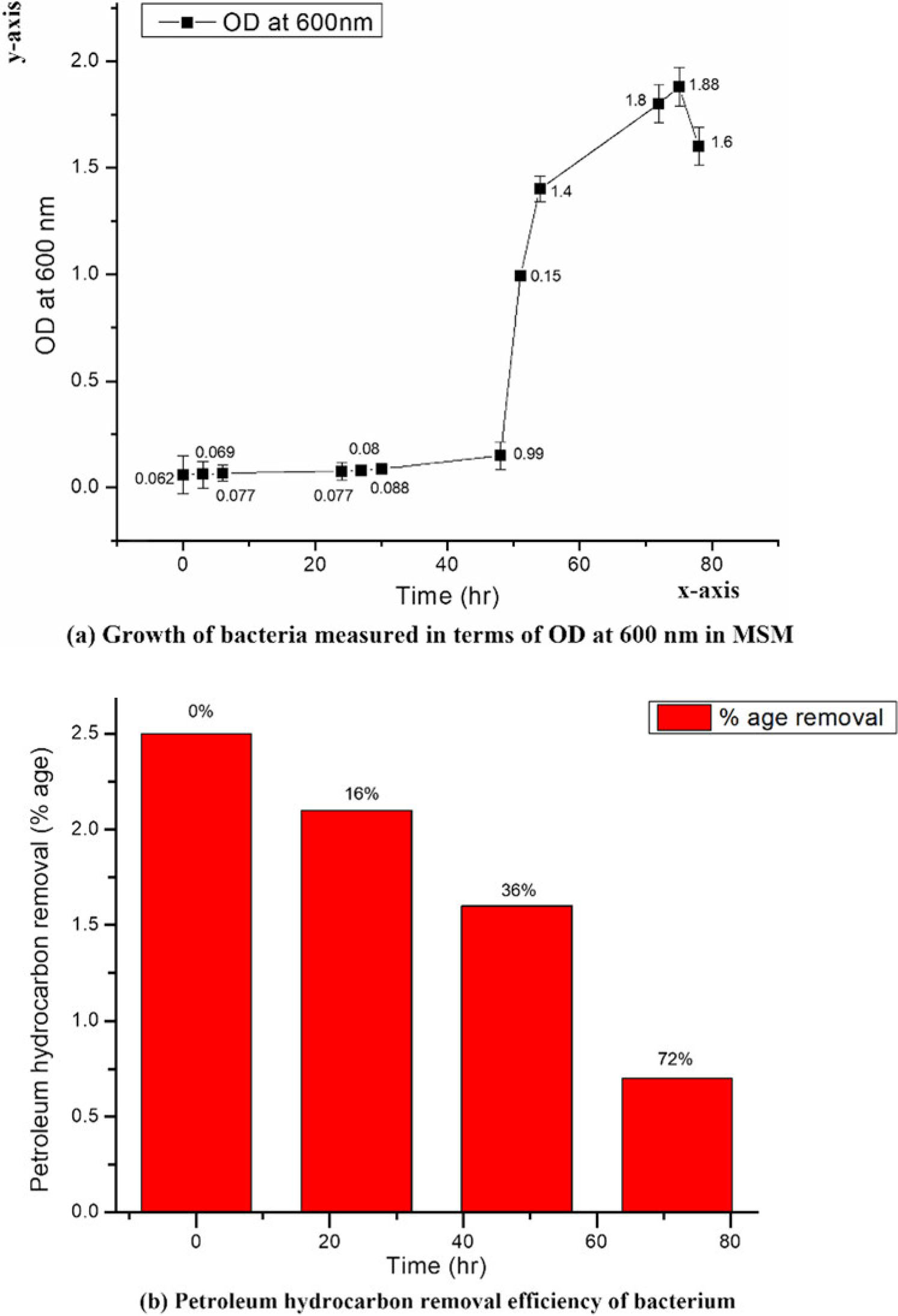
Fig. 1.

Growth phases and petroleum hydrocarbons degradation potential analysis of Bacillus cereus strain sab41in present study. a) Growth curve showing lag, log, static, and death phases; b) graph showing degradation efficiency of petroleum by B. cereus strain sab41 estimated by measuring OD600 of supernatant containing DCPIP.
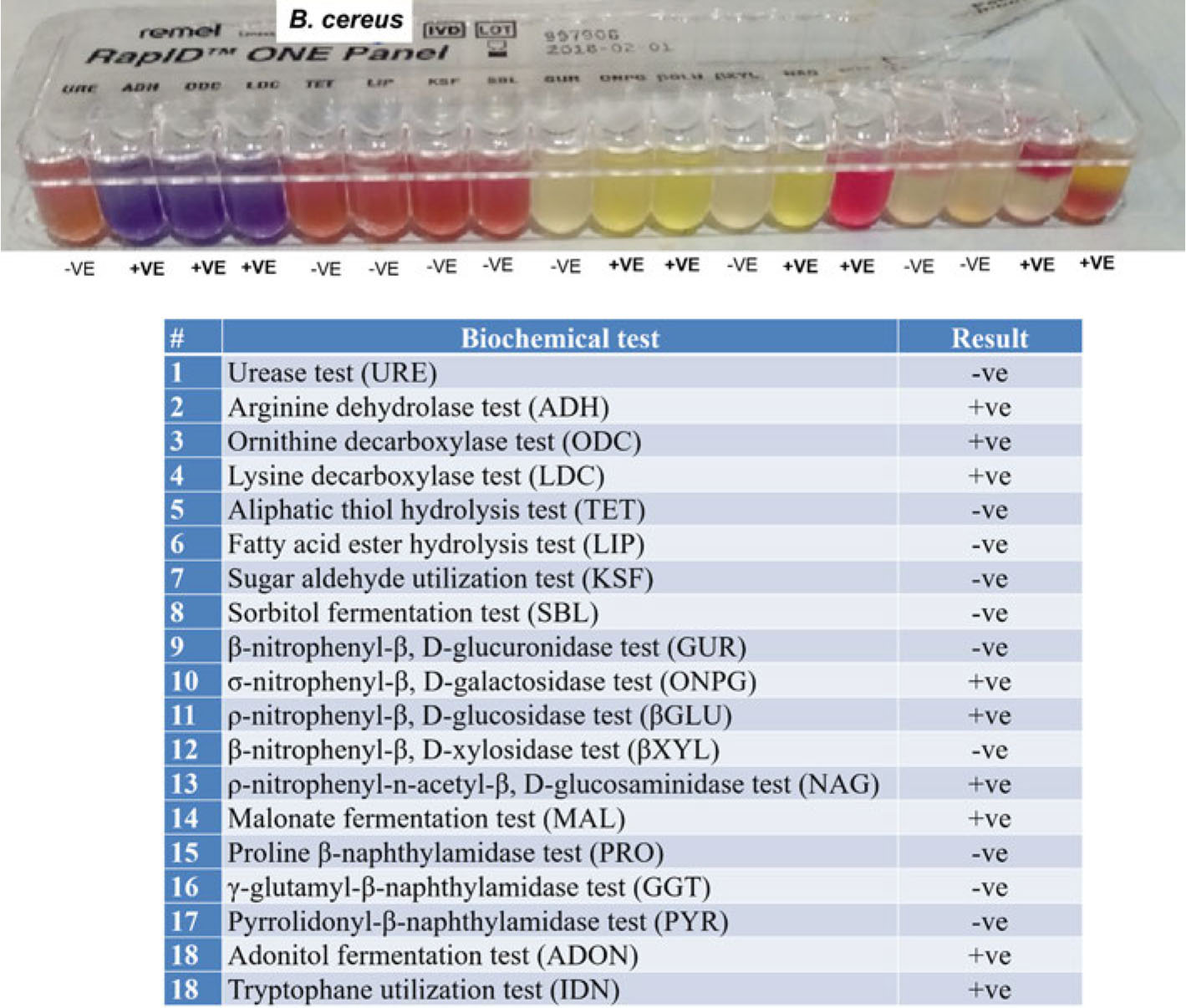

Fig. 2.

Biochemical characterization of Bacillus cereus strain sab41 using Remel RapID™ One panel.
a) Remel RapID™ One panel showing the results; b) table illustrating the biochemical tests being analyzed in the present study.
Biochemical characterization of Bacillus cereus strain sab41 using Remel RapID™ One panel. a) Remel RapID™ One panel showing the results; b) table illustrating the biochemical tests being analyzed in the present study.

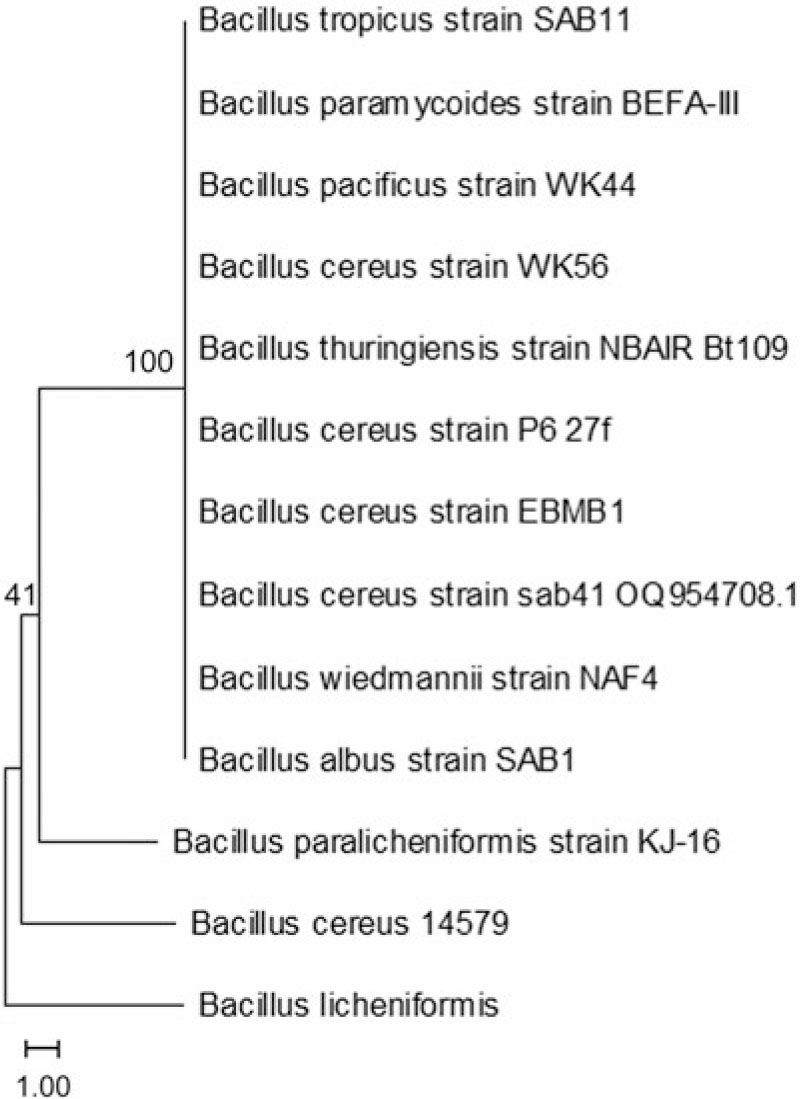
Fig. 3.

Phylogenetic tree of Bacillus cereus strain sab41 constructed using MEGA 11 software.
A maximum composite likelihood neighbor-joining tree using a bootstrap value 100 was constructed.
Phylogenetic tree of Bacillus cereus strain sab41 constructed using MEGA 11 software. A maximum composite likelihood neighbor-joining tree using a bootstrap value 100 was constructed.

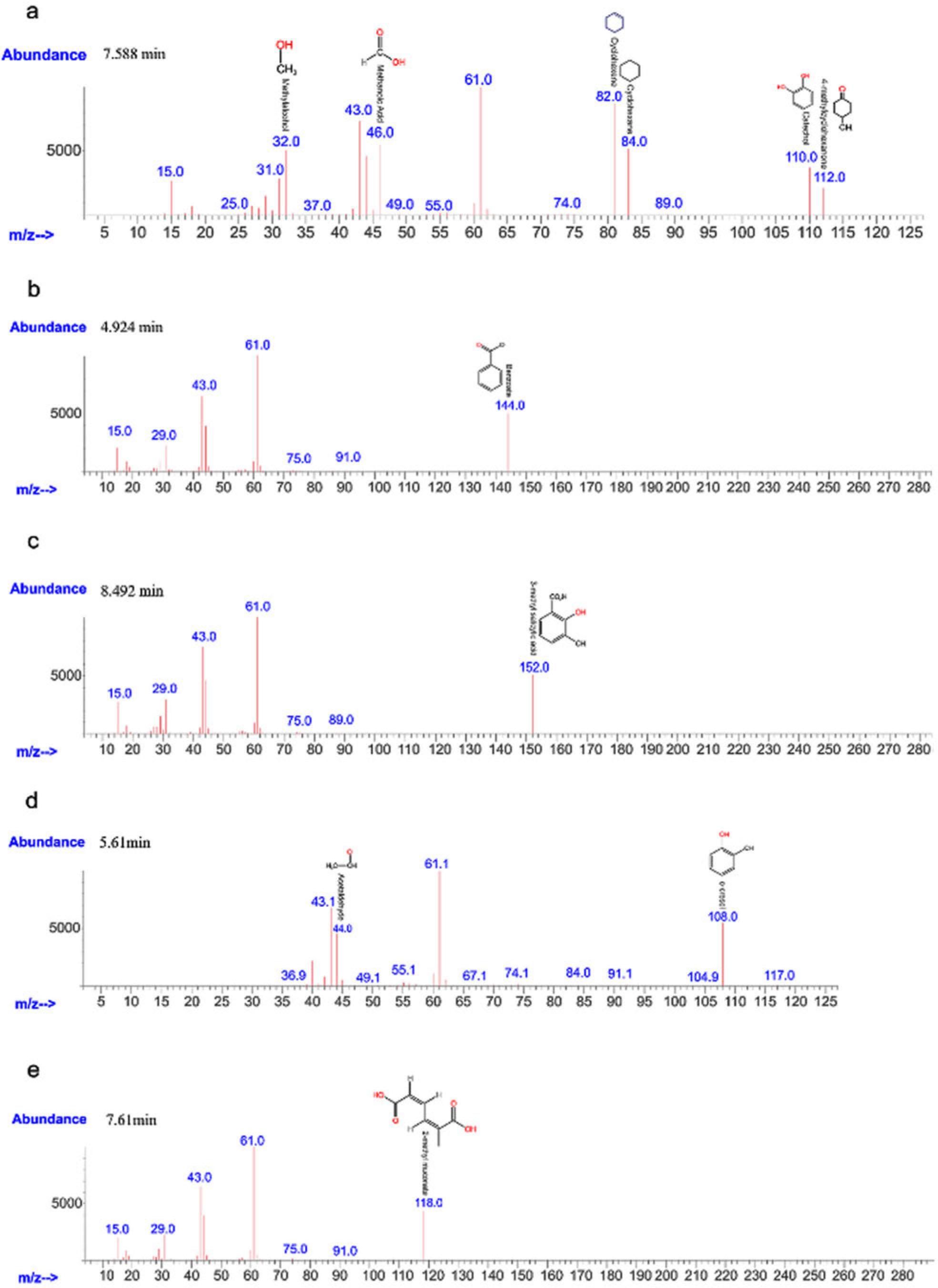
Fig. 4.

GC chromatograms of Bacillus cereus strain sab41 showing the identified metabolites formed by degradation of petroleum hydrocarbons in the present study.
a) Peaks showing methylalcohol, methanoic acid, cyclohexene, cyclohexane, catechol, 4-methylcyclohexanone; b) peak showing benzoate; c) peak showing 3-methyl salicylic acid; d) peak showing acetaldehyde and o-cresol; e) peak showing 2-methylmuconate.
GC chromatograms of Bacillus cereus strain sab41 showing the identified metabolites formed by degradation of petroleum hydrocarbons in the present study. a) Peaks showing methylalcohol, methanoic acid, cyclohexene, cyclohexane, catechol, 4-methylcyclohexanone; b) peak showing benzoate; c) peak showing 3-methyl salicylic acid; d) peak showing acetaldehyde and o-cresol; e) peak showing 2-methylmuconate.

Fig. 5.

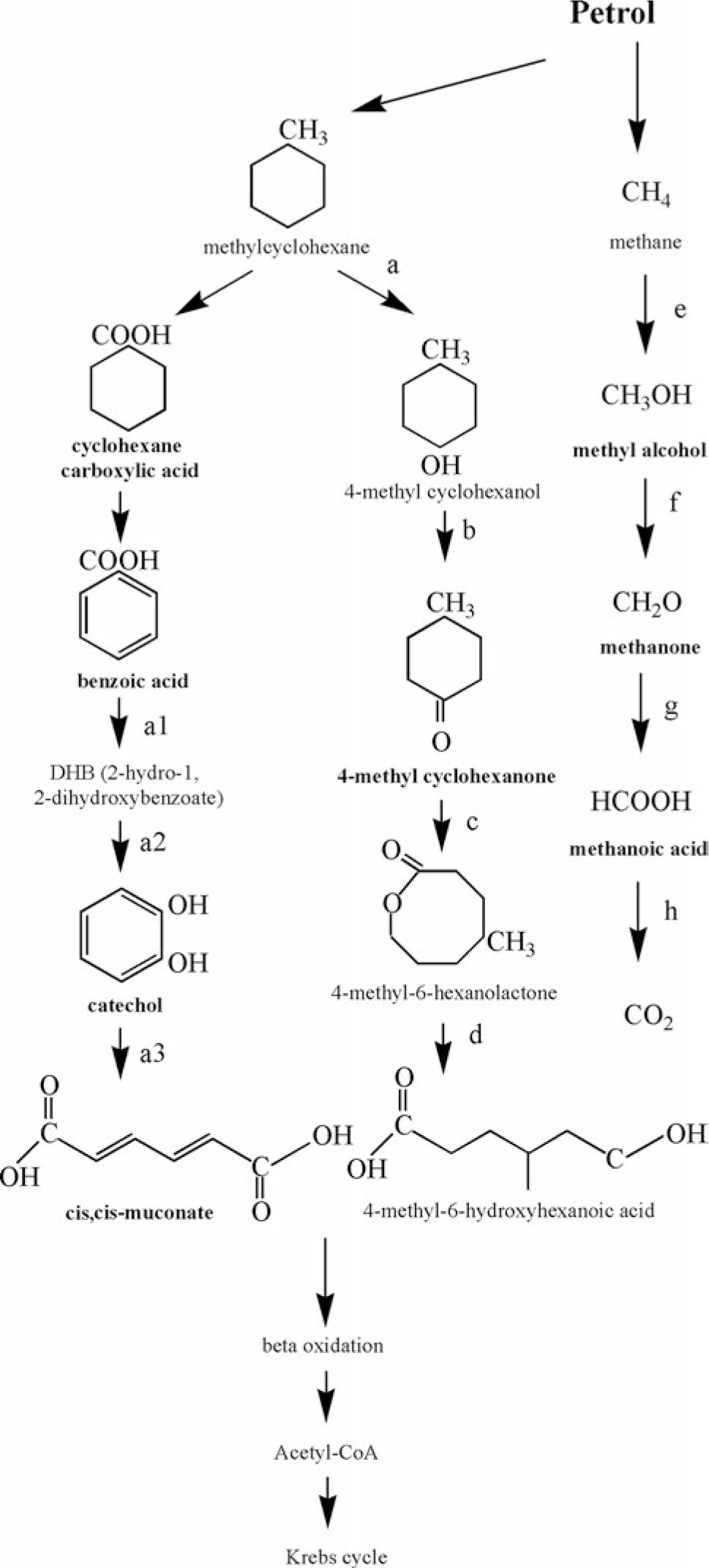
Pathways identified in Bacillus cereus strain sab41 associated with the degradation of alkanes and cycloalkanes.
a – alkane 1-monooxygenase; b – alcohol dehydrogenase; c – cyclohexanone monooxygenase; d – 6-hexanolactone hydrolase; a1 – benzoate 1,2-dioxygenase; a2 – dihydroxybenzoate dehydrogenase; a3 – catechol 1,2-dioxygenase; e – methane monooxygenase; f – methanol dehydrogenase; g – formaldehyde dehydrogenase; h – formate dehydrogenase
Pathways identified in Bacillus cereus strain sab41 associated with the degradation of alkanes and cycloalkanes. a – alkane 1-monooxygenase; b – alcohol dehydrogenase; c – cyclohexanone monooxygenase; d – 6-hexanolactone hydrolase; a1 – benzoate 1,2-dioxygenase; a2 – dihydroxybenzoate dehydrogenase; a3 – catechol 1,2-dioxygenase; e – methane monooxygenase; f – methanol dehydrogenase; g – formaldehyde dehydrogenase; h – formate dehydrogenase

Fig. 6.

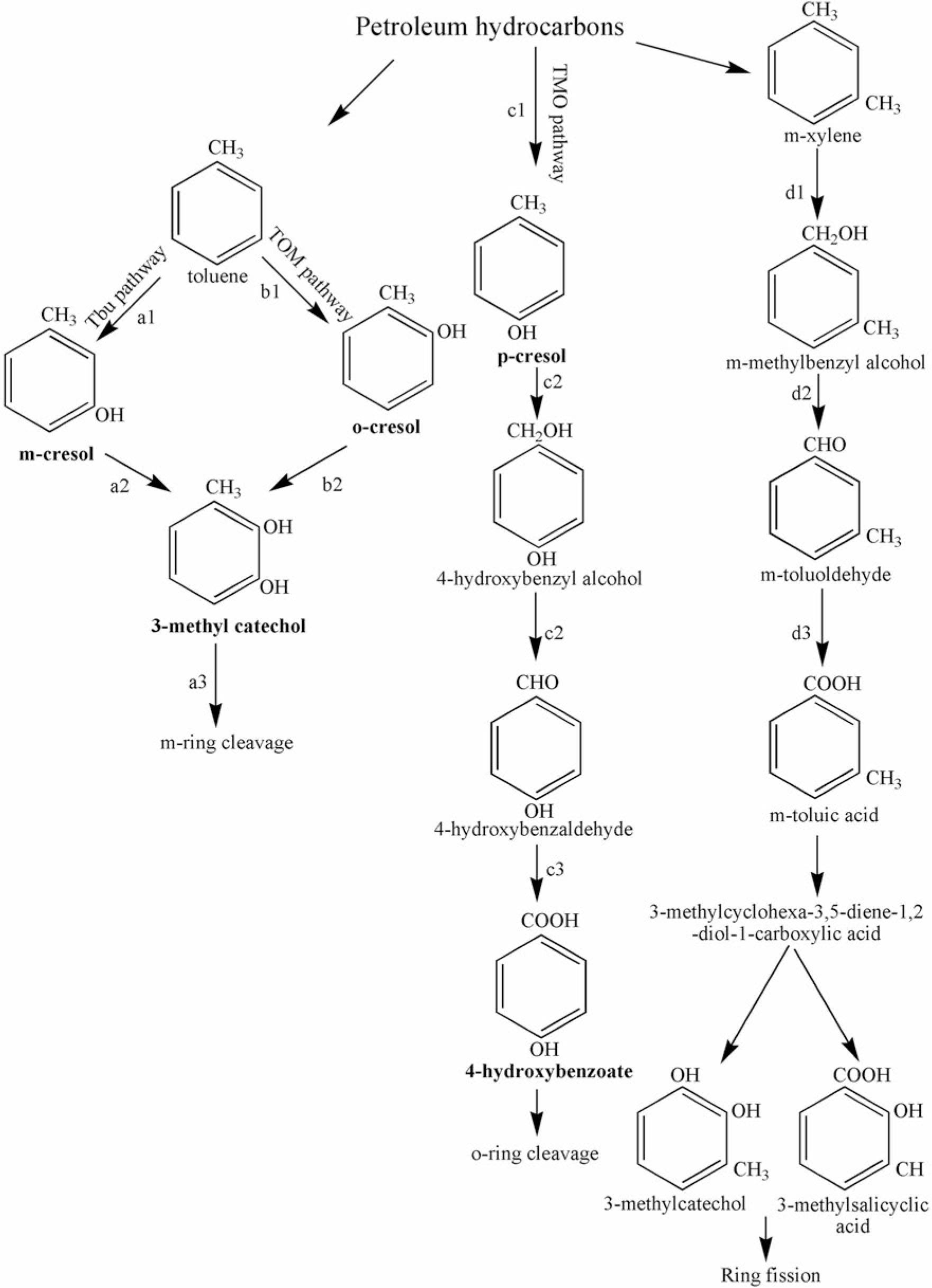
Pathways identified in Bacillus cereus strain sab41 involved in the degradation of aromatics.
a1, a2 – toluene 3-monooxygenase; b1, b2 – toluene 2-monooxygenase; c1 – toluene 4-monooxygenase; c2 – 4-hydroxymethyl hydroxylase; c3 – 4-hydroxybenzaldehyde dehydrogenase; d1 – xylene oxidase; d2 – alcohol dehydrogenase; d3 – aldehyde dehydrogenase
Pathways identified in Bacillus cereus strain sab41 involved in the degradation of aromatics. a1, a2 – toluene 3-monooxygenase; b1, b2 – toluene 2-monooxygenase; c1 – toluene 4-monooxygenase; c2 – 4-hydroxymethyl hydroxylase; c3 – 4-hydroxybenzaldehyde dehydrogenase; d1 – xylene oxidase; d2 – alcohol dehydrogenase; d3 – aldehyde dehydrogenase

Fig. 7.

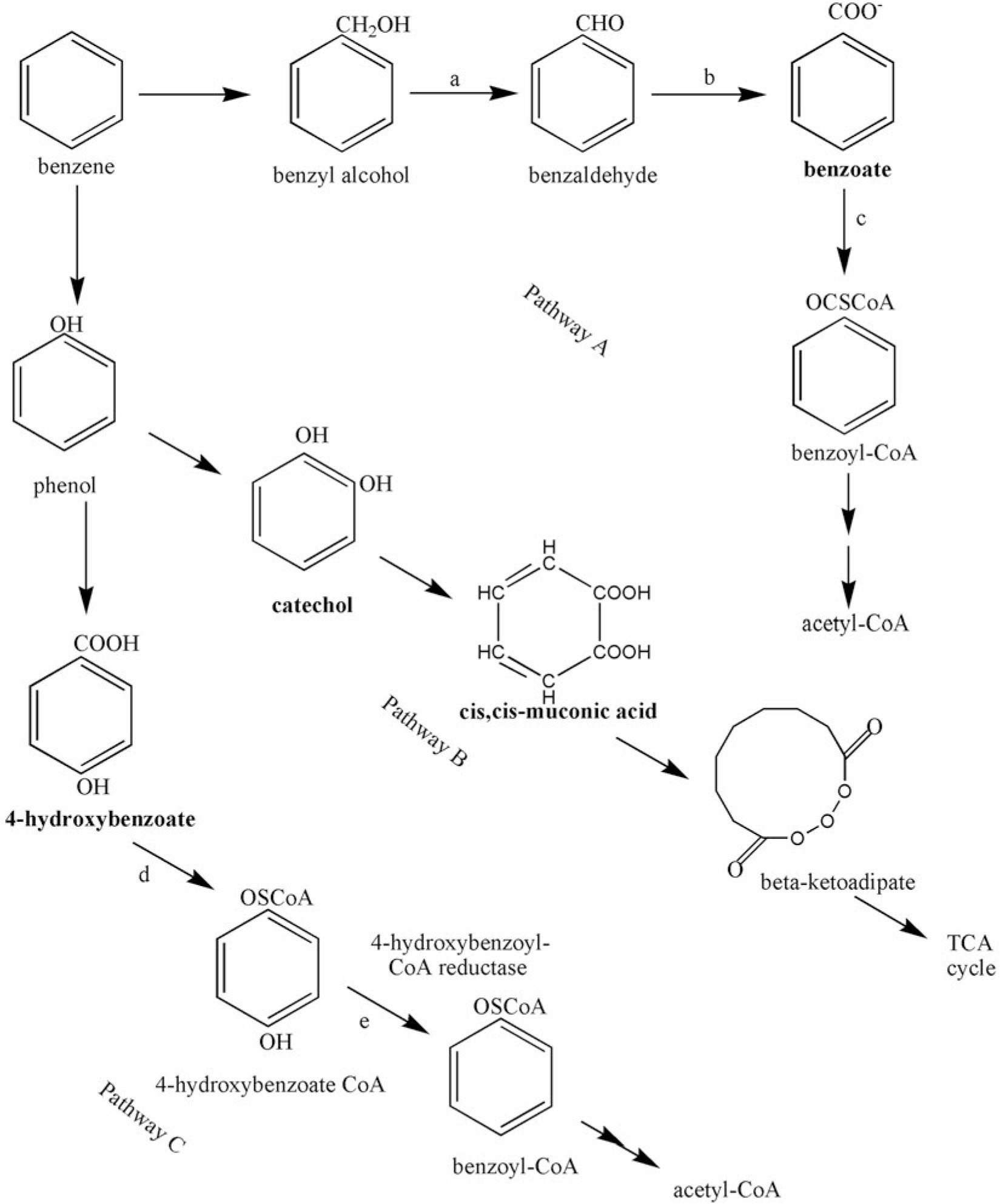
Benzene degradation pathways identified in Bacillus cereus strain sab41 in present study via GC-MS analysis.
a – benzylalcohol dehydrogenase; b – benzaldehyde dehydrogenase; c – benzoate CoA-ligase; d – 4-hydroxybenzoate CoA-ligase; e –4-hydroxybenoyl CoA reductase
Benzene degradation pathways identified in Bacillus cereus strain sab41 in present study via GC-MS analysis. a – benzylalcohol dehydrogenase; b – benzaldehyde dehydrogenase; c – benzoate CoA-ligase; d – 4-hydroxybenzoate CoA-ligase; e –4-hydroxybenoyl CoA reductase

Stoichiometric equations of reactions involved in formation of metabolic intermediates of petroleum hydrocarbons degradation identified in Bacillus cereus strain sab41

No. of reactionsStoichiometric equations
Methane
1 CH3OHCH2O+2H+methylalcoholmethanone \[\begin{align} & \\ & \begin{matrix} C{{H}_{3}}OH & \to & C{{H}_{2}}O & + & 2{{H}^{+}} \\ \text{methylalcohol} & {} & \text{methanone} & {} & {} \\ \end{matrix} \\ \end{align}\]
2 CH2O+12O2CH2O2methanonemethanoicacid \[\begin{matrix} C{{H}_{2}}O & + & \frac{1}{2}{{O}_{2}} & \to & C{{H}_{2}}{{O}_{2}} \\ \text{methanone} & {} & {} & {} & \text{methanoic}\,\text{acid} \\ \end{matrix}\]
Methylcycleohexane
1 C7H12O+12O2C7H12O2methylcyclohexanecyclohexanecarboxylicacid \[\begin{matrix} {{C}_{7}}{{H}_{12}}O & + & \frac{1}{2}{{O}_{2}} & \to & {{C}_{7}}{{H}_{12}}{{O}_{2}} \\ \text{methylcyclohexane} & {} & {} & {} & \text{cyclohexane}\,\text{carboxylic}\,\text{acid} \\ \end{matrix}\]
2 C7H12O2C6H5COOH+3H2cyclohexanecarboxylicacidbenzoicacid \[\begin{matrix} {{C}_{7}}{{H}_{12}}{{O}_{2}} & \to & {{C}_{6}}{{H}_{5}}COOH+3{{H}_{2}} \\ \text{cyclohexane}\,\text{carboxylic}\,\text{acid} & {} & \text{benzoic}\,\text{acid} \\ \end{matrix}\]
3 C7H6O5+2H2OC6H6O2+CO2+2H2O2-hydro-1,2-dihydroxybenzoatecatechol \[\begin{matrix} {{C}_{7}}{{H}_{6}}{{O}_{5}} & + & 2{{H}_{2}}O\to {{C}_{6}}{{H}_{6}}{{O}_{2}}+C{{O}_{2}}+2{{H}_{2}}O \\ \text{2-hydro-1,2-dihydroxybenzoate} & {} & \text{catechol} \\ \end{matrix}\]
4 C6H6O2+O2C6H4O4+2Hcis,cis-muconate \[\begin{matrix} {{C}_{6}}{{H}_{6}}{{O}_{2}} & + & {{O}_{2}} & \to & {{C}_{6}}{{H}_{4}}{{O}_{4}} & + & 2H \\ {} & {} & {} & {} & cis,cis\text{-muconate} & {} & {} \\ \end{matrix}\]
Toluene
1 (Tbu, TMO, TOM) C6H5CH3+O2C7H8Otolueneo-,m-,p-cresol \[\begin{matrix} {{C}_{6}}{{H}_{5}}C{{H}_{3}} & + & {{O}_{2}} & \to & {{C}_{7}}{{H}_{8}}O \\ \text{toluene} & {} & {} & {} & o\text{-,}m\text{-},p\text{-cresol} \\ \end{matrix}\]
2 (Tbu, TMO) C7H8OC7H8O23-methylcatechol \[\begin{matrix} {{C}_{7}}{{H}_{8}}O & \to & {{C}_{7}}{{H}_{8}}{{O}_{2}} \\ {} & {} & 3\text{-methylcatechol} \\ \end{matrix}\]
3 (TMO) C7H6O2+12O2C7H64-hydroxybenzaldehyde4-hydroxybenzoate \[\begin{matrix} {{C}_{7}}{{H}_{6}}{{O}_{2}} & + & \frac{1}{2}{{O}_{2}} & \to & {{C}_{7}}{{H}_{6}} \\ \text{4-hydroxybenzaldehyde} & {} & {} & {} & \text{4-hydroxybenzoate} \\ \end{matrix}\]
Benzene
1 (pathway A) C7H5O2_+C21H36N7O16P3SC28H36N7O17P3S4+12O2benzoateCoAbenzoyl-CoA \[\begin{matrix} {{C}_{7}}{{H}_{5}}O_{2}^{\_} & + & {{C}_{21}}{{H}_{36}}{{N}_{7}}{{O}_{16}}{{P}_{3}}S & \to & {{C}_{28}}{{H}_{36}}{{N}_{7}}{{O}_{17}}{{P}_{3}}{{S}^{-4}} & + & \frac{1}{2}{{O}_{2}} \\ \text{benzoate} & {} & \text{CoA} & {} & \text{benzoyl-CoA} & {} & {} \\ \end{matrix}\]
2 (pathway B) C6H5OH+12O2C6H6O2phenolcatechol \[\begin{matrix} {{C}_{6}}{{H}_{5}}OH & + & \frac{1}{2}{{O}_{2}} & \to & {{C}_{6}}{{H}_{6}}{{O}_{2}} \\ \text{phenol} & {} & {} & {} & \text{catechol} \\ \end{matrix}\]
3 C6H6O2+O2C6H6O4cis,cis-muconicacid \[\begin{matrix} {{C}_{6}}{{H}_{6}}{{O}_{2}} & + & {{O}_{2}} & \to & {{C}_{6}}{{H}_{6}}{{O}_{4}} \\ {} & {} & {} & {} & cis,cis\text{-muconic}\,\text{acid} \\ \end{matrix}\]
4 (pathway C) C6H5OH+CO2C7H6O3phenol4-hydroxybenzoate \[\begin{matrix} {{\text{C}}_{6}}{{\text{H}}_{5}}\text{OH} & + & C{{O}_{2}} & \to & {{C}_{7}}{{H}_{6}}{{O}_{3}} \\ \text{phenol} & {} & {} & {} & 4\text{-hydroxybenzoate} \\ \end{matrix}\]
Xylene
1 C8H10OC8H8O+2H+m-methylbenzylalcoholm-tolualdehyde \[\begin{matrix} {{C}_{8}}{{H}_{10}}O & \to & {{C}_{8}}{{H}_{8}}O & + & 2{{H}^{+}} \\ m\text{-methylbenzyl}\,\text{alcohol} & {} & m\text{-tolualdehyde} & {} & {} \\ \end{matrix}\]
2 C7H8O4C7H8O2+O23-methylcyclohexa-3,5-diene-1,2-diol-1-carboxylicacid3-methylcatechol \[\begin{matrix} {{C}_{7}}{{H}_{8}}{{O}_{4}} & \to & {{C}_{7}}{{H}_{8}}{{O}_{2}} & + & {{O}_{2}} \\ 3\text{-methylcyclohexa-3,5-diene-1,2-diol-1-carboxylic}\,\text{acid} & {} & 3\text{-methylcatechol} & {} & {} \\ \end{matrix}\]

Earlier reported pathways in petroleum degrading bacteria and the metabolites identified in Bacillus cereus strain sab41_

Petroleum hydrocarbon componentPathway/bacterium reported in literatureMetabolites identified in present studyReference
MethaneMethylomicrobium alcaliphilum 20Zmethylalcohol, methanone, methanoic acidKalyuzhnaya et al. 2013
MethylcyclohexanePseudophaeobacter, Gilvimarinus, Pseudomonas, Cycloclasticus, Roseovariuscyclohexane carboxylic acid, benzoic acid, catechol, cis,cis-muconateLi et al. 2023a
TolueneThauera sp. strain T1benzoate, acetaldehyde, cyclohexene, pyruvate, cresol, 3-methyl catechol, 4-hydroxybenzoateHeider et al. 1998; Muccee et al. 2019
Toluene 4-monoxygenase pathway in Pseudomonas mendocina KR1p-cresol, 4-hydroxybenzoateWhited and Gibson 1991
toluene 3-monooxygenase pathway in Pseudomonas pickettiim-cresol, 3-methylcatecholOlsen et al. 1994
BenzeneAcinetobacter calcoaceticus, Rhodopseudomonas palustris, Pseudomonas putida CSV86benzoate, catechol, cis,cis-muconic acid, 4-hydroxybenzoateMackintosh and Fewson 1988; Egland et al. 1997; Basu et al. 2003
Xylenem-xylene oxidation in Pseudomonas Pxym-tolualdehyde, 3-methylcatecholDavey and Gibson 1974

Petroleum hydrocarbons degrading bacteria reported in the literature_

BacteriaReferences
Acinetobacter XS-4Zou et al. 2023
Neorhizobium, Allorhizobium, Rhizobium, Pararhizobium, Pseudomonas, Nocardioides, SimplicispiraEziuzor and Vogt 2023
DehalococcoidiaZehnle et al. 2023
Pinisolibacter aquiterraeBedics et al. 2022
EnterobacterHossain et al. 2022
Talaromyces sp.Zhang et al. 2021
Pseudomonas pseudoalcaligenes, RhodococcusFeng et al. 2021; Chuah et al. 2022
AquabacteriumXu et al. 2019
Nesiotobacter exalbescensGanesh Kumar et al. 2019
Bradyrhizobium, Koribacter, AcidimicrobiumJeffries et al. 2018
SphingomonasZhou et al. 2016
Exiguobacterium aurantiacumMohanty and Mukherji 2008
Bacillus subtilis, Alcaligenes sp., Flavobacterium sp., Micrococcus roseus, Corynebacterium sp.Adebusoye et al. 2007
Marinobacter, Alcanivorax, Sphingomonas, Gordonia, Micrococcus, Cellulomonas, DietziaBrito et al. 2006
DOI: https://doi.org/10.33073/pjm-2024-012 | Journal eISSN: 2544-4646 | Journal ISSN: 1733-1331
Language: English
Page range: 107 - 120
Submitted on: Sep 11, 2023
Accepted on: Feb 12, 2024
Published on: Mar 4, 2024
Published by: Polish Society of Microbiologists
In partnership with: Paradigm Publishing Services
Publication frequency: 4 issues per year

© 2024 Nadia Hussain, Fatima Muccee, Muhammad Hammad, Farhan Mohiuddin, Saboor Muarij Bunny, Aansa Shahab, published by Polish Society of Microbiologists
This work is licensed under the Creative Commons Attribution-NonCommercial-NoDerivatives 4.0 License.